- Market Value (2025): USD 127.5 Mn
- Estimated Value (2026): USD 152.0 Mn
- Forecast Value (2036): USD 880.0 Mn
- CAGR (2026-2036): 19.2%
What is the Endometriosis Digital Care Market forecast to be worth by 2036?
USD 152.0 million in 2026 to USD 880.0 million by 2036 at 19.2% CAGR.
- The endometriosis digital care market crossed a valuation of USD 127.5 million in 2025.
- Demand is projected to increase from USD 152.0 million in 2026 to USD 880.0 million by 2036.
- The market is forecast to record 19.2% CAGR from 2026 to 2036 as symptom tracking and navigation move into more structured care pathways.
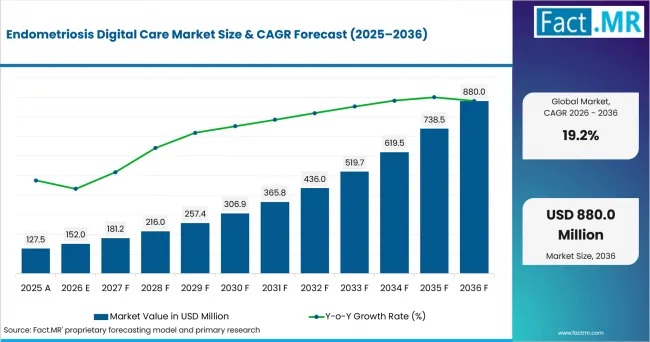
Endometriosis Digital Care Market Value Analysis | Source: Fact.MR
What are the defining numbers behind Endometriosis Digital Care Market growth?
USD 728.0 million absolute opportunity is expected between 2026 and 2036.
- Demand Drivers in the Market
- Diagnostic delay is expected to make navigation services valuable when symptom records need to move into specialist review.
- Symptom variability is anticipated to raise demand for recurring tracking and quality-of-life records.
- Multidisciplinary care needs are expected to support pelvic-floor care and mental-health resources beside referral support.
- Employer and health-plan channels are projected to favor programs that turn symptoms into guided service routes. That path separates this market from general telehealth therapy services.
- Key Segments Analyzed
- By Care Component: Pain & symptom tracking is expected to hold 35.4% share in 2026 because daily records capture symptom changes that short clinical visits may miss.
- By Platform Model: Self-management app is projected to account for 48.3% share in 2026 as immediate access supports repeat logging between appointments.
- By End User: Direct consumers are anticipated to capture 42.8% share in 2026 since people often begin seeking support before an employer, health plan or clinic provides a formal care route.
- Analyst Opinion at Fact.MR
- Shambhu Nath Jha, Sr. Consultant at Fact.MR, states, "The long-term value of endometriosis digital care will come from turning symptom records into safer clinical conversations and clearer referral decisions. Platforms are likely to gain stronger acceptance when consent, escalation pathways and qualified human oversight are built into the service, rather than treating user engagement as the main measure of performance."
- Strategic Implications
- Validated health measures belong inside routine care so symptom records can support clinical review and referral decisions.
- Program selection works better when sponsors assess diagnostic delays, referral completion and service quality instead of relying only on app activity.
- App-based diagnosis remains outside the service scope. Clear escalation pathways can direct users to qualified clinical care when symptoms require further assessment.
World Health Organization reported in October 2025 that endometriosis affects an estimated 190 million reproductive-age women worldwide. This figure explains why digital services need safe routing into qualified clinical care without presenting an app record as diagnosis.
The USA is expected to record an 18.8% CAGR from 2026 to 2036 with employer and health-plan routes giving platforms an early purchase channel. The UK is projected to record an 18.5% CAGR as NHS pathway design raises evidence expectations. Australia is anticipated to grow at 18.0% CAGR through remote-care access needs and national digital-health readiness. Canada is estimated to post a 17.7% CAGR where provincial delivery routes make localization important. Germany is forecast at 17.2% CAGR with evidence, security and interoperability requirements shaping entry.
How does the Endometriosis Digital Care Market break down by segment?
Pain & symptom tracking is expected to lead Care Component at 35.4% share in 2026. Self-management app is projected to lead Platform Model at 48.3% share in 2026. Direct consumers are anticipated to lead End User at 42.8% share in 2026.
Which care component dominates?
Pain & symptom tracking is projected to account for 35.4% share in 2026.
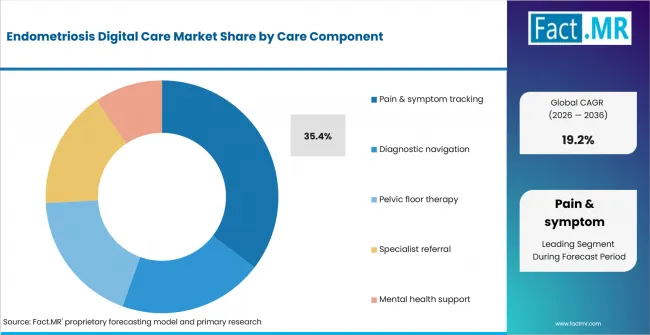
Endometriosis Digital Care Market Analysis By Care Component | Source: Fact.MR
Daily logging gives this component the lead because pain, fatigue and functional limits often change between clinical visits. A structured record can help users explain symptom patterns during medical review without presenting the app as a diagnostic tool. Diagnostic navigation and specialist referral remain important when symptoms require further assessment. Pelvic floor therapy supports physical function, while mental health resources address the emotional burden associated with long-term pain and delayed diagnosis.
What leads the Platform Model segment?
Self-management app is expected to hold 48.3% share in 2026.
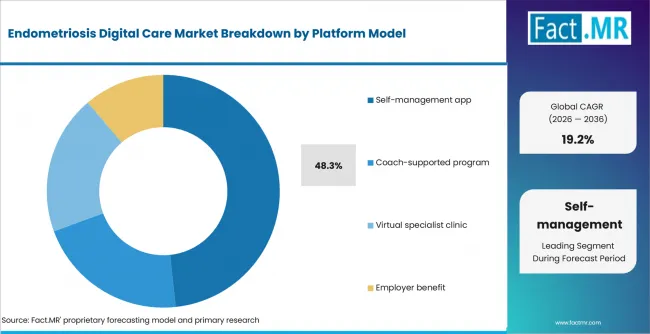
Endometriosis Digital Care Market Analysis By Platform Model | Source: Fact.MR
Immediate access gives self-management apps a strong position because users can record symptoms, review patterns and prepare for appointments without waiting for enrollment in a formal program. Coach-supported programs add personal guidance, while virtual specialist clinics connect users with more focused clinical expertise. Employer benefit platforms provide another access route through workplace health programs. Their overall value depends on whether the service offers clear referral options and escalation beyond routine symptom tracking.
Why do Direct consumers lead End User?
Direct consumers are forecast to account for 42.8% share in 2026.
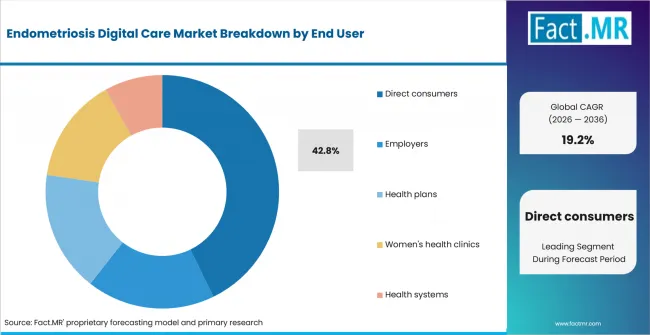
Endometriosis Digital Care Market Analysis By End User | Source: Fact.MR
Many users begin searching for endometriosis support independently when pain or fatigue starts affecting work, mobility or daily routines. Direct access removes delays linked with employer approval, insurance eligibility or clinic referral. Employers and health plans remain relevant where digital care is offered as a funded benefit. Women’s health clinics and health systems support more structured pathways, particularly when symptom records must connect with specialist review, pelvic-floor care or broader treatment planning.
What is accelerating Endometriosis Digital Care Market adoption, and what is holding it back?
Demand is expected to be driven by diagnostic delay and symptom variability. Adoption is expected to be held back by diagnosis boundaries, tracking burden and representation bias.
Drivers Impact Analysis
| DRIVER | QUALITATIVE IMPACT | GEOGRAPHIC RELEVANCE | IMPACT TIMELINE |
|---|---|---|---|
| Diagnostic delay | High | Global | Short term (<=2 years) |
| High symptom variability | High | Global | Short term (<=2 years) |
| Need for multidisciplinary care | Medium | Global | Medium term (2-4 years) |
| Employer focus on women's health | Medium | USA and enterprise markets | Medium term (2-4 years) |
Source: Fact.MR analysis. Updated Jul 27, 2026
- Diagnostic delay: People often pass through several encounters before diagnosis or specialist review is reached. Digital records can help organize symptom history and make referral discussions more focused.
- High symptom variability: Daily pain and fatigue records can help users show patterns between appointments. Longer tracking periods may also reveal how symptoms affect work, sleep and physical activity.
- Need for multidisciplinary care: Pelvic-floor therapy and mental-health support sit beside medical care when symptoms affect daily life. Coordinated services can reduce the need for users to manage several disconnected care routes.
- Employer focus on women’s health: Workplace benefits can address conditions that affect attendance and concentration. Employer-funded access may also help users reach support before symptoms result in repeated absence or lower productivity.
Opportunity Impact Analysis
| OPPORTUNITY | QUALITATIVE IMPACT | GEOGRAPHIC RELEVANCE | IMPACT TIMELINE |
|---|---|---|---|
| Validated electronic outcomes | High | Global | Short term (<=2 years) |
| Specialist navigation | Medium | USA and UK | Medium term (2-4 years) |
| Research-ready consented data | Medium | Global | Medium term (2-4 years) |
Source: Fact.MR analysis. Updated Jul 27, 2026
- Validated electronic outcomes: Real-time patient-reported measures can reduce recall bias and support treatment review. Standardized records also give providers a clearer way to compare symptom changes over time.
- Specialist navigation: Digital networks can route complex cases toward gynecology and pelvic-floor services. Clear referral steps may reduce confusion when users do not know which specialist or service to approach first.
- Research-ready consented data: Governed longitudinal records can support phenotype and treatment-response research. Consistent consent controls are important when symptom histories are used beyond routine care delivery.
Restraints Impact Analysis
| RESTRAINT | QUALITATIVE IMPACT | GEOGRAPHIC RELEVANCE | IMPACT TIMELINE |
|---|---|---|---|
| No app-based diagnosis | High | Global | Short term (<=2 years) |
| Tracking burden during pain flares | High | Regulated and payer-funded markets | Medium term (2-4 years) |
| Representation bias | Medium | Global | Medium term (2-4 years) |
Source: Fact.MR analysis. Updated Jul 27, 2026
- No app-based diagnosis: Endometriosis assessment and treatment decisions require qualified clinical care. Platforms must clearly separate symptom guidance from medical conclusions to avoid misleading users.
- Tracking burden during pain flares: High-frequency prompts can become intrusive when symptoms are severe. Flexible logging options may be necessary so users can pause or simplify data entry during difficult periods.
- Representation bias: Paid-app users do not consistently represent all ages or disease presentations. Limited access among lower-income or underserved groups can also reduce the reliability of platform-generated insights.
Which countries are scaling Endometriosis Digital Care Market fastest?
The country comparison is defined by a compact group of high-growth digital-care markets. The USA and UK form the upper pair. Australia follows with access-led demand. Canada and Germany create a measured second cluster. This pattern reflects reimbursement design and digital-health governance, not patient need alone.
- The USA shows the highest listed rate since employer and health-plan channels give digital endometriosis support a commercial entry route.
- The UK remains close to the USA as NHS pathway design rewards services that support symptom records and referral conversations.
- Australia holds a separate access-led position through remote care needs across a dispersed population.
- Canada records a slightly lower rate where provincial delivery variation increases the need for local referral practice.
- Germany trails the named set with evidence review and information-security expectations lengthening procurement cycles.
Comparable CAGRs can therefore produce different entry conditions across these countries. Deployment timing depends on reimbursement fit and professional responsibility. Commercial readiness reflects localization depth and safe data use. Clinical referral design separates this market from broader home healthcare deployment.
The full report provides country-level CAGR analysis across North America, Latin America, Europe, East Asia, South Asia and Pacific, and the Middle East and Africa.
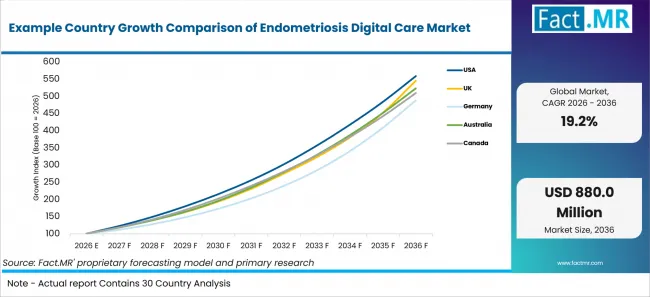
Example Country Growth Comparison Of Endometriosis Digital Care Market | Source: Fact.MR
| Country | CAGR (2026-2036) |
|---|---|
| USA | 18.8% |
| UK | 18.5% |
| Australia | 18.0% |
| Canada | 17.7% |
| Germany | 17.2% |
Source: Fact.MR analysis. Updated Jul 27, 2026
What supports USA adoption?
18.8% CAGR, supported by employer purchasing and digital-care investment.
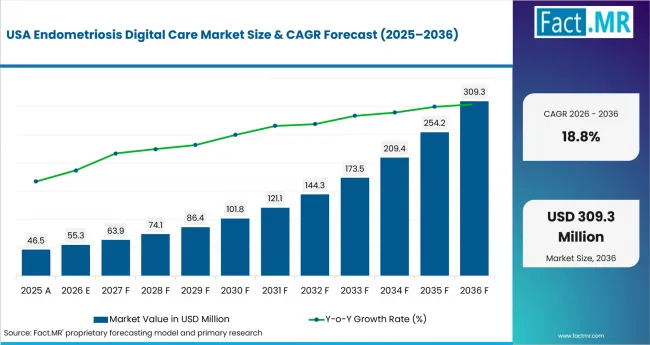
Endometriosis Digital Care Market Country Value Analysis | Source: Fact.MR
The USA's growth reflects a market where platforms must turn symptom records into safe care navigation. Employer and health-plan channels are expected to favor services that document burden and guide specialist referral. Provider selection is expected to resemble predictive telehealth platforms when evidence and escalation protocols decide approval.
How is UK scaling demand?
18.5% CAGR, driven by pathway fit and evidence expectations.
The UK growth route depends on alignment with structured clinical pathways and non-digital fallback options. Services are expected to gain attention when symptom diaries support general-practice conversations and specialist referral decisions. Adoption still depends on proving that digital support improves workflow without replacing clinical judgment.
What is driving Australia growth from 2026 to 2036?
18.0% CAGR, backed by digital-health infrastructure and access needs.
Australia's growth is supported by geography and the need for remote support between clinical visits. Digital services are expected to help users maintain records and prepare for specialist review when travel adds friction. Local uptake depends on privacy practice and clear clinical escalation routes.
How is Canada developing demand?
17.7% CAGR, supported by provincial delivery and benefit localization.
Canada's growth reflects a market where service design must adjust to provincial care pathways. Health plans and clinics are expected to compare referral practice and patient support depth before wider use. Localization is a commercial requirement for national service expansion.
How does Germany perform?
17.2% CAGR, led by evidence discipline and regulated digital-health procurement.
Germany's growth is shaped by formal evidence expectations and strict information-security review. Digital endometriosis services need to show clinical usefulness and responsible data handling before institutional adoption expands. This makes the market slower to enter than less regulated routes.
Who leads the Endometriosis Digital Care Market?
Matilda Health, Endo Black and Endo Health GmbH stand out through endometriosis-focused digital support, while Phendo and Syrona Health broaden the market through symptom tracking, research participation and women’s health services.
Matilda Health combines digital access with guided support for people managing endometriosis symptoms. Endo Black brings a strong community and advocacy dimension, particularly for underserved patients. Endo Health GmbH focuses on condition-specific care pathways and digital symptom management.
Competition through 2036 is likely to depend on more than app engagement. Providers will be compared on referral quality, clinical involvement, privacy controls and the ability to connect symptom records with useful care decisions. Services that combine easy access with dependable human support and clear escalation routes may gain stronger interest from consumers, employers, health plans and specialist clinics.
Which companies are the key providers?
Key companies include Matilda Health, Endo Black, Endo Health GmbH, Phendo (Citizen Endo), and Syrona Health.
- Matilda Health
- Endo Black
- Endo Health GmbH
- Phendo (Citizen Endo)
- Syrona Health
Bibliography
- World Health Organization. (2025, October 15). Endometriosis.
- Australian Government Department of Health, Disability and Ageing. (2025, May 22). Australian Living Evidence Guideline: Endometriosis.
- Australian Government Department of Health, Disability and Ageing. (2025, November 14). Government delivers 11 new endometriosis and pelvic pain clinics.
- NHS England. (2025, May 1). New endometriosis pill on the NHS could benefit more than 1,000 women a year.
This Report Answers
- The report provides strategic intelligence on the Endometriosis Digital Care Market across Care Component and Platform Model choices that shape symptom support and referral workflows.
- Segment analysis covers Pain & symptom tracking and Self-management app as the share leaders within the 2026 market.
- Country outlook evaluates the USA and UK alongside Australia and Canada. Germany completes the growth comparison across the profiled markets.
- Competitive analysis profiles Matilda Health alongside Endo Black and Endo Health GmbH. Phendo (Citizen Endo) and Syrona Health complete the provider set.
- Care-pathway assessment covers Diagnostic navigation and Specialist referral. Mental health support completes the view alongside pelvic-floor support.
What does the Endometriosis Digital Care Market cover?
Digital services are used to support endometriosis symptom tracking, navigation and care preparation where user records need to support safe clinical conversations.
The Endometriosis Digital Care Market covers software and service pathways used for pain and symptom tracking, diagnostic navigation, pelvic-floor support, specialist referral, and mental-health resources. Coverage extends to self-management apps and coach-supported programs. Virtual specialist clinics and employer benefits are included when the service is designed around endometriosis-specific care support.
The market differs from general wellness apps since commercial value comes from routing symptoms toward care review and support decisions. Surgical procedures such as laparoscopic gynecological procedures remain outside the revenue boundary unless a digital service supports navigation toward specialist review. General women's wellness content is excluded when it does not provide endometriosis-specific support.
What is included in the scope?
Endometriosis digital care services are used by direct consumers, employers, health plans, women's health clinics, and health systems.
The scope includes Care Component and Platform Model alongside End User and Region. Coverage spans pain and symptom tracking, diagnostic navigation, and pelvic-floor therapy. Specialist referral and mental-health support complete the care component scope. The platform scope includes self-management apps, coach-supported programs, virtual specialist clinics, and employer benefit routes.
What is excluded from the scope?
General wellness apps and unrelated women's health services remain outside the scope of this market.
The scope excludes services that do not address endometriosis symptoms, navigation or specialist support. General telehealth visits are excluded unless the service pathway is built around endometriosis care. Drug treatment revenue, surgical procedure revenue and standalone diagnostics remain outside the boundary. Company revenue without a clear connection to endometriosis digital support is excluded.
How Was the Analysis Built?
The analysis draws on 120+ sources, 35+ company portfolios, 25+ countries, and more than 20 industry interviews.
- Primary Research: Primary research includes discussions with manufacturers, service providers, technology developers, distributors, end users, procurement teams, and subject-matter experts. These conversations examine purchasing priorities, product adoption, operational challenges, approval requirements, competitive positioning, and the factors that influence wider market acceptance.
- Desk Research: Desk research covers government statistics, regulatory publications, company filings, trade data, technical studies, industry associations, standards, public policy, and other authoritative sources. Every source used in the analysis is documented in the bibliography.
- Market Sizing and Forecasting: Market estimates combine historical performance, demand indicators, pricing and volume trends, segment shares, company participation, country-level growth, adoption patterns, investment activity, and barriers to market expansion.
- Data Validation and Update Cycle: Findings are validated by comparing primary interviews with public data, company activity, regulatory changes, trade patterns, and industry developments. Regular updates review new product launches, capacity changes, partnerships, approvals, procurement trends, and shifts in commercial adoption.
Segmentation
What is the report's scope and coverage?
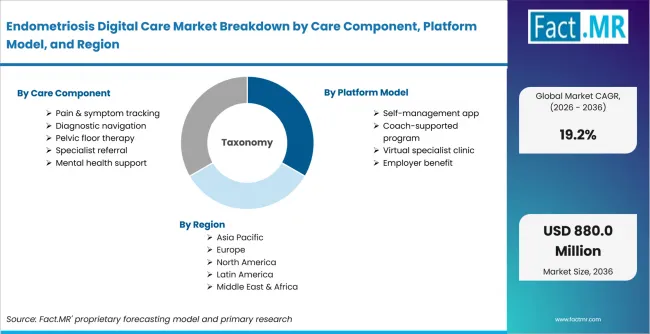
Endometriosis Digital Care Market Breakdown By Care Component, Platform Model, And Region | Source: Fact.MR
| Attribute | Details |
|---|---|
| Quantitative Units | USD 152.0 million in 2026 to USD 880.0 million by 2036 at 19.2% CAGR |
| Market Definition | Digital services designed to support people with endometriosis through pain and symptom tracking, diagnostic navigation, pelvic-floor support, specialist referral and mental-health resources |
| Care Component | Pain & symptom tracking, Diagnostic navigation, Pelvic floor therapy, Specialist referral, Mental health support |
| Platform Model | Self-management app, Coach-supported program, Virtual specialist clinic, Employer benefit |
| End User | Direct consumers, Employers, Health plans, Women's health clinics, Health systems |
| Regions Covered | North America, Latin America, Europe, East Asia, South Asia and Pacific, Middle East and Africa |
| Countries Covered | USA, UK, Germany, Australia, Canada |
| Key Companies Profiled | Matilda Health, Endo Black, Endo Health GmbH, Phendo (Citizen Endo), Syrona Health |
| Forecast Period | 2026 to 2036 |
| Approach | Hybrid top-down and bottom-up approach using care pathway demand, symptom-tracking use, referral navigation, digital-care delivery, end-user access, country adoption patterns and company portfolio review |
Source: Fact.MR analysis. Updated Jul 27, 2026
How is the market segmented?
-
By Care Component:
- Pain & symptom tracking
- Diagnostic navigation
- Pelvic floor therapy
- Specialist referral
- Mental health support
-
By Platform Model:
- Self-management app
- Coach-supported program
- Virtual specialist clinic
- Employer benefit
-
By End User:
- Direct consumers
- Employers
- Health plans
- Women's health clinics
- Health systems
-
By Region:
- North America
- Latin America
- Western Europe
- Eastern Europe
- East Asia
- South Asia and Pacific
- Middle East and Africa
Frequently Asked Questions
Which Care Component leads the market?
Which Platform Model leads the market?
Which End User leads the market?
Which country records the highest listed CAGR?
What is the primary driver in this market?
What is the main restraint?
Why do direct consumers lead demand?
Who worked on this report


Preview the report firsthand - request a free sample
Free SampleGet the brochure for pricing and purchase details
Download PDF