- Market Value (2025): USD 5.6 Bn
- Estimated Value (2026): USD 6.2 Bn
- Forecast Value (2036): USD 17.2 Bn
- CAGR (2026-2036): 10.8%
What is the Enzymatic Bio Platforms Market forecast to be worth by 2036?
USD 6.2 Billion in 2026 to USD 17.2 Billion by 2036 at a 10.8% CAGR.
- The Enzymatic Bio Platforms Market reached USD 5.6 Billion in 2025.
- Demand is projected to increase from USD 6.2 Billion in 2026 to USD 17.2 Billion by 2036.
- The market is forecast to record 10.8% CAGR from 2026 to 2036 as manufacturers use enzyme platforms to lower reaction severity and tighten process control.
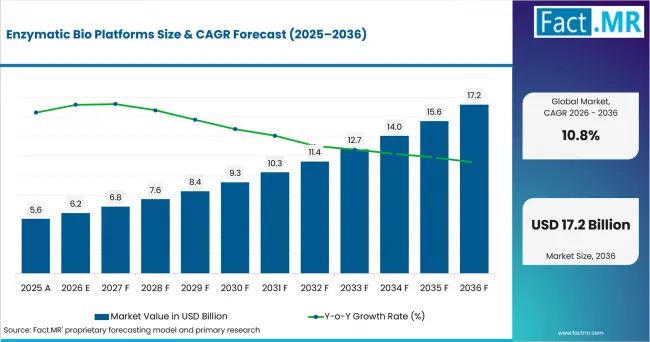
Enzymatic Bio Platforms Value Analysis | Source: Fact.MR
What are the defining numbers behind Enzymatic Bio Platforms Market growth?
USD 11.1 Billion absolute opportunity is expected between 2026 and 2036.
- Demand Drivers in the Market
- Food processors need enzyme systems that improve texture and protein function while keeping the full plant layout intact.
- Home-care formulators need stable hydrolase blends, supported by BASF’s July 2025 expansion of liquid lipase, cellulase and amylase formats.
- Biorefineries and renewable-chemical developers are receiving public R&D support; the U.S. Department of Energy announced up to USD 23 million in January 2025 for domestic chemicals and fuels from biomass and waste resources.
- Pharma process teams need reproducible enzyme development as RNA, peptide and small-molecule projects move from screening into qualified manufacturing.
- Key Segments Analyzed
- By Platform Type: Industrial enzyme production is expected to hold 27.0% share in 2026 supported by established fermentation and formulation routes.
- By Enzyme Class: Hydrolases are projected to account for 31.0% share in 2026 owing to use in protein, fat and carbohydrate conversion.
- By End-use: Food & beverage is anticipated to capture 24.0% share in 2026 due to enzyme use in texture, flavor development and yield.
- By Business Model: Direct enzyme sales are estimated to represent 44.0% share in 2026 because validated plants buy recurring enzyme supply.
- Analyst Opinion at Fact.MR
- Shambhu Nath Jha, Principal Consultant at Fact.MR, states, “The commercial test is moving beyond activity on a datasheet. Demand is expected to favor platforms that prove enzyme performance in a customer process. Suppliers need discovery tools, fermentation depth and application support that carry the same conversion from lab bench to plant floor.”
- Strategic Implications
- Enzyme producers should document activity by pH range, temperature window and substrate type so manufacturers reduce screening rounds.
- Food ingredient teams should connect enzyme claims to finished-product functions such as protein solubility, foam stability and cleaner texture.
- Bioprocess developers should build pilot evidence around yield and operating severity before customers approve plant trials.
- Platform licensors should define enzyme sale, custom development and full process transfer clearly before contract terms are negotiated.
Denmark is expected to post 13.6% CAGR through 2036, supported by biosolutions depth and manufacturing scale. The USA is projected to record 12.2% CAGR due to cell-free systems funding and renewable-chemical programs. Germany is anticipated to advance at 10.4% CAGR owing to industrial bioeconomy scale-up. The UK is estimated to reach 9.3% CAGR, while Japan is forecast to hold 8.0% CAGR through biomanufacturing policy work.
How does the Enzymatic Bio Platforms Market break down by segment?
Direct enzyme sales lead Business Model at 44.0%; Hydrolases lead Enzyme Class at 31.0%.
Which Platform Type dominates?
Industrial enzyme production is expected to hold 24.0% share in 2026.
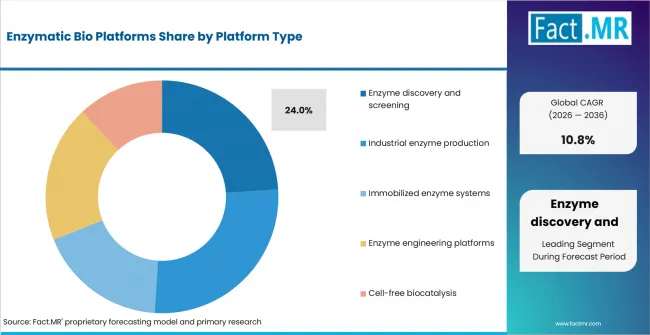
Enzymatic Bio Platforms Analysis By Platform Type | Source: Fact.MR
Industrial enzyme production leads the platform type segment because many manufacturers already use enzyme preparations inside validated production lines. Fermentation scale, formulation stability and repeat supply carry more weight than a single discovery claim. Process-linked enzyme production is therefore easier to qualify than early-stage discovery services.
What leads the Enzyme Class segment?
Hydrolases are projected to account for 31.0% share in 2026.
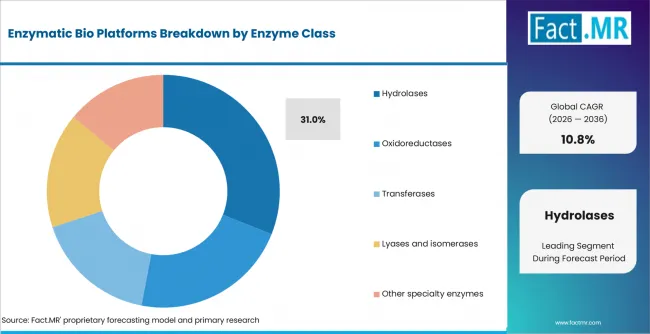
Enzymatic Bio Platforms Analysis By Enzyme Class | Source: Fact.MR
Hydrolases lead the enzyme class segment because proteases, lipases, amylases and cellulases work across common food and cleaning reactions. These enzymes split proteins, fats and carbohydrates under controlled conditions. Their appeal comes from direct application fit in production lines that already understand enzymatic conversion.
How does End-use shape demand?
Food & beverage is anticipated to capture 24.0% share in 2026.
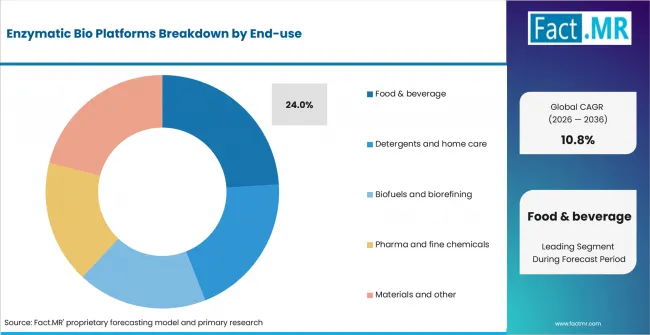
Enzymatic Bio Platforms Analysis By End Use | Source: Fact.MR
Food & beverage leads end-use demand because enzymes change protein function, texture and processing yield in familiar production settings. Amano Enzyme discussed PG-500 in August 2025 as a protein-glutaminase used to improve protein solubility and stability. Food manufacturers therefore evaluate enzyme platforms through finished-product behavior and process repeatability.
What supports Direct enzyme sales within Business Model?
Direct enzyme sales are estimated to represent 44.0% share in 2026.
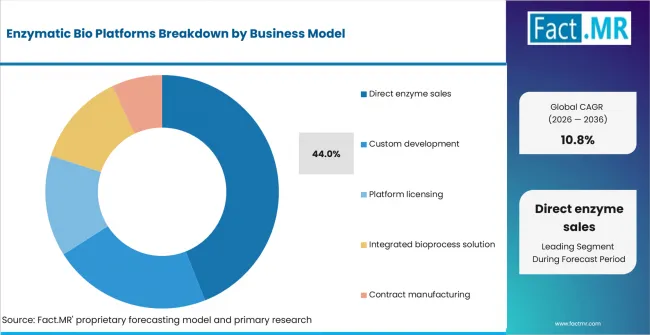
Enzymatic Bio Platforms Analysis By Business Model | Source: Fact.MR
Direct enzyme sales lead business model demand because validated processes need recurring enzyme supply after trials are complete. Custom development remains relevant for unusual substrates or stricter selectivity. Platform licensing and integrated process packages are used when the enzyme becomes part of the customer’s manufacturing route.
What is accelerating Enzymatic Bio Platforms Market adoption, and what is holding it back?
Process-yield improvement drives it; scale-up cost restrains it.
Drivers Impact Analysis
| DRIVER | (~) % IMPACT ON CAGR | GEOGRAPHIC RELEVANCE | IMPACT TIMELINE |
|---|---|---|---|
| Food and beverage process improvement | +2.0% | Global | Short term (<= 2 years) |
| Lower-temperature industrial biocatalysis | +1.7% | North America, Europe | Medium term (2-4 years) |
| Detergent and home-care enzyme upgrades | +1.3% | Europe, North America, Japan | Short term (<= 2 years) |
| Biorefineries and renewable chemicals | +1.0% | USA, Germany, Japan | Medium term (2-4 years) |
| Pharma and RNA manufacturing biocatalysis | +0.8% | USA, UK, Japan | Long term (>= 4 years) |
Source: Fact.MR analysis. Updated Sep 7, 2026
- Food and beverage process improvement: Enzyme platforms support food and beverage applications where specific functions improve texture, protein behavior, processing efficiency, or yield. Suppliers that connect enzyme selection with finished-product testing can help formulators qualify solutions more confidently across different food matrices.
- Lower-temperature industrial biocatalysis: Enzyme platforms can reduce reliance on harsher reaction conditions in oleochemicals and specialty chemicals. Clear operating windows, predictable reaction pathways, and practical process guidance make biocatalytic systems easier for industrial plants to evaluate and scale.
- Detergent and home-care enzyme upgrades: Home-care formulators use hydrolase blends to improve cleaning performance under milder washing conditions. Enzyme platforms are assessed for surfactant compatibility, storage stability, and formulation fit before adoption, making robust stability evidence important during supplier selection.
- Biorefineries and renewable chemicals: Biorefineries create opportunities for enzyme systems that selectively convert biomass and waste streams into higher-value products. Feedstock variability makes tolerance, conversion consistency, and yield protection important factors when operators compare enzyme platforms for renewable-chemical processes.
- Pharma and RNA manufacturing biocatalysis: Pharmaceutical manufacturers use enzyme platforms where selectivity and milder chemistry can improve process control. Suppliers gain relevance when biocatalytic systems are supported by manufacturing evidence, technology-transfer capability, and application data suitable for scale-up and regulated production environments.
Opportunity Impact Analysis
| OPPORTUNITY | (~) % IMPACT ON CAGR | GEOGRAPHIC RELEVANCE | IMPACT TIMELINE |
|---|---|---|---|
| Cell-free biocatalysis for faster testing | +1.2% | USA, Japan | Medium term (2-4 years) |
| Enzymatic biomaterials and polymer routes | +1.0% | Europe, North America | Medium term (2-4 years) |
| Custom enzyme engineering for specialty substrates | +0.8% | Global | Short term (<= 2 years) |
| Regional pilot and demonstration facilities | +0.6% | Denmark, Germany, UK | Long term (>= 4 years) |
Source: Fact.MR analysis. Updated Sep 7, 2026
- Cell-free biocatalysis for faster testing: Cell-free systems can accelerate enzyme screening and application development by allowing teams to test biochemical pathways without relying on whole-cell production. These platforms create opportunities for faster prototyping, process optimization, and use-inspired biocatalysis across industrial and specialty applications.
- Enzymatic biomaterials and polymer routes: Enzyme platforms can expand into biomaterials and polymer applications where biocatalysis changes material structure or performance. Suppliers can strengthen adoption by linking enzyme activity with measurable product properties and practical processing outcomes beyond conventional food-enzyme uses.
- Custom enzyme engineering for specialty substrates: Specialty reactions often require enzymes tailored to specific substrates and operating conditions. Custom engineering, screening capability, and scale-up support are particularly important in pharma, fine chemicals, and specialty materials, where successful early trials can lead to repeat commercial projects.
- Regional pilot and demonstration facilities: Pilot and demonstration facilities help enzyme projects move from laboratory validation toward industrial approval. Access to scale-up infrastructure, technical expertise, and regional bioeconomy clusters can reduce commercialization risk and support broader adoption of enzyme-based manufacturing processes.
Restraints Impact Analysis
| RESTRAINT | (~) % IMPACT ON CAGR | GEOGRAPHIC RELEVANCE | IMPACT TIMELINE |
|---|---|---|---|
| Scale-up from lab to industrial plant | -0.8% | Global | Medium term (2-4 years) |
| Enzyme stability across process conditions | -0.6% | Global | Short term (<= 2 years) |
| Food safety and intended-use validation | -0.5% | USA, Europe, Japan | Medium term (2-4 years) |
| Cost and energy pressure in manufacturing | -0.4% | Europe, Japan | Short term (<= 2 years) |
Source: Fact.MR analysis. Updated Sep 7, 2026
- Scale-up from lab to industrial plant: Promising enzymes can perform differently when moved from laboratory screening into continuous industrial operation. Feedstock variability, residence time, mixing, and process conditions can affect conversion, making pilot-scale evidence important for linking enzyme activity with realistic plant performance.
- Enzyme stability across process conditions: Temperature, pH, surfactants, and other process conditions can shorten enzyme working life. Home-care and industrial customers therefore need application data generated under realistic operating conditions, while weak stability evidence can increase reformulation work and delay approval.
- Food safety and intended-use validation: Food-enzyme applications require clear documentation covering safety, intended use, dosage guidance, and application conditions. Suppliers with well-prepared regulatory and technical files can help food manufacturers evaluate enzyme preparations more efficiently across dairy, plant-based, and related formulation systems.
- Cost and energy pressure in manufacturing: Manufacturing economics can influence enzyme scale-up decisions, particularly where labor and energy intensity remain high. Plants are more likely to prioritize enzyme projects that demonstrate clear improvements in yield, process severity, throughput, or operating efficiency.
Which countries are scaling the Enzymatic Bio Platforms Market through 2036?
- The country comparison spans 5.63 percentage points and forms three practical growth bands across the forecast period.
- Denmark remains 1.47 percentage points above the USA through biosolutions depth and manufacturing scale.
- The USA remains 1.76 percentage points above Germany as cell-free systems and renewable-chemical programs move enzyme platforms closer to use.
- Germany remains 1.16 percentage points above the UK through industrial bioeconomy scale-up and demonstration support.
- The UK remains 1.24 percentage points above Japan as life-sciences manufacturing funding supports enzyme-enabled process routes.
- Japan closes the displayed range through synthetic-biology policy work and biomanufacturing coordination.
Comparable CAGRs create different entry conditions because each country combines enzyme manufacturing, end-use processing and public scale-up support differently. Full report coverage includes North America, Latin America, Western Europe, Eastern Europe, East Asia, South Asia & Pacific, Middle East & Africa.
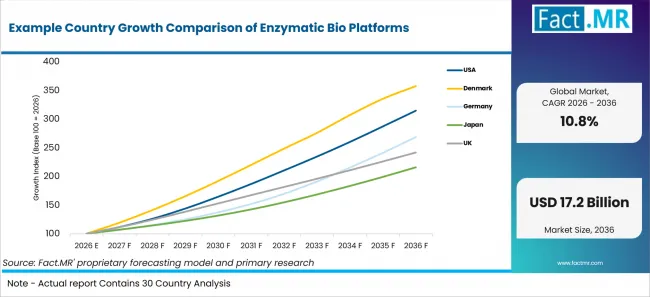
Example Country Growth Comparison Of Enzymatic Bio Platforms | Source: Fact.MR
| Country | CAGR |
|---|---|
| Denmark | 13.6% |
| USA | 12.2% |
| Germany | 10.4% |
| UK | 9.3% |
| Japan | 8.0% |
Source: Fact.MR analysis. Updated Sep 7, 2026
What is powering Denmark’s lead?
13.6% CAGR, supported by biosolutions depth and manufacturing scale.
Denmark has a deep biosolutions base anchored by enzyme production, food processing and pharma manufacturing. The market is expected to record 13.6% CAGR through 2036. Statistics Denmark reported manufacturing turnover of DKK 1.322 trillion in 2025, giving enzyme platform suppliers a wide industrial customer base for recurring application support.
How is the USA scaling Enzymatic Bio Platforms demand?
12.2% CAGR, driven by cell-free systems and renewable chemicals funding.
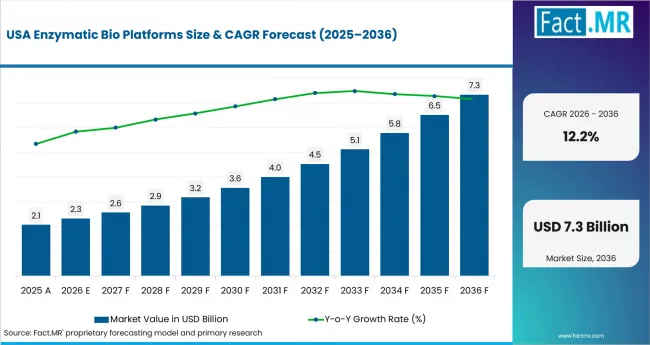
Enzymatic Bio Platforms Country Value Analysis | Source: Fact.MR
U.S. enzyme platform demand is shaped by public biotechnology funding and pharma process development. The market is projected to post 12.2% CAGR through 2036. NSF announced a USD 32.4 million investment in four CFIRE teams in August 2025 to accelerate adoption and expand the capabilities of cell-free systems, including applications involving engineered-enzyme production and advanced manufacturing.
What supports Germany’s outlook?
10.4% CAGR, supported by industrial bioeconomy scale-up.
Germany’s industrial base gives enzyme platforms a clear route into chemicals, materials and food production. The market is anticipated to advance at 10.4% CAGR through 2036. BMWE’s Industrial Bioeconomy funding program supports product and process development, demonstration-plant planning and construction, and regional innovation clusters, helping companies scale biobased processes from pilot-stage validation toward industrial implementation.
What supports the UK growth path?
9.3% CAGR, backed by life-sciences manufacturing support.
The UK combines food manufacturing, specialty bioprocessing and life-sciences manufacturing support. The market is estimated to reach 9.3% CAGR through 2036. The UK Life Sciences Sector Plan backs life-sciences manufacturing with up to GBP 520 million through the Life Sciences Innovative Manufacturing Fund.
How does Japan perform?
8.0% CAGR, led by synthetic-biology policy and manufacturing modernization.
Japan’s enzyme platform outlook is tied to manufacturing modernization and specialty food applications. The market is forecast to hold 8.0% CAGR through 2036. METI’s July 2026 materials state that synthetic biology and biotech is one of Japan’s 17 strategic fields and set out major products, technologies and a public-private investment roadmap for that field.
Who leads the Enzymatic Bio Platforms Market?
Novonesis and IFF are major direct enzymatic-platform providers, while BASF and Codexis contribute application-specific enzyme, biocatalysis and manufacturing technologies.
Novonesis is active across industrial enzymes and process-linked biosolutions, including dedicated enzymatic solutions for oleochemical applications such as fatty-acid splitting and ester production. IFF participates through broad bioscience capabilities and its Designed Enzymatic Biomaterials™ platform, which uses enzymatic polymerization to create tailored biobased materials. BASF adds home-care formulation capabilities through its Lavergy® enzyme portfolio.
Amano Enzyme contributes food-enzyme expertise through protein-modification technologies, including protein glutaminase and protease systems. AB Enzymes remains active as an integrated enzyme supplier after Roal Oy officially became AB Enzymes Finland Oy in September 2024. Codexis competes through its CodeEvolver® enzyme-engineering platform for applications including pharmaceutical biocatalysis, while its ECO Synthesis® Manufacturing Platform provides enzyme-enabled routes for scalable therapeutic RNA manufacturing.
Which companies are the key providers?
Key companies include Novonesis; IFF; Amano Enzyme; AB Enzymes; BASF; and Codexis.
- Novonesis
- IFF
- Amano Enzyme
- AB Enzymes
- BASF
- Codexis
Bibliography
- U.S. National Science Foundation. (2025, August 28). NSF invests more than $32M in biotechnology, accelerating the adoption of cell-free systems.
- AB Enzymes. (2025, March 19). AB Enzymes launches new corporate design, reflecting heritage, growth and innovation.
- U.S. Department of Energy. (2025, January 10). Department of Energy announces up to $23 million to propel renewable chemicals and fuels.
- Novonesis. (2025, November 18). Novonesis and thyssenkrupp Uhde launch enzymatic fat-splitting solution for scalable and more sustainable fatty acid production.
- BASF. (2025, July 10). BASF strengthens liquid enzyme portfolio for the laundry and cleaning industry.
- International Flavors & Fragrances Inc. (2025, October 21). IFF and BASF announce strategic collaboration to drive next-generation enzyme and polymer innovation.
- Amano Enzyme Inc. (2025, August 12). Protein Glutaminase “Amano” 500 and the new era of organic, non-GMO food solutions.
- Statistics Denmark. (2026, May 13). Sales of goods by manufacturing industries.
- Federal Statistical Office (Destatis). (2026, January 15). Gross domestic product up 0.2% in 2025.
- Codexis, Inc. (2026, August 11). Form 10-Q for the quarterly period ended June 30, 2026.
This Report Answers
- The report explains where enzymatic bio platforms are used across platform type and enzyme class.
- Segment analysis identifies the main 2026 share leaders and the operational reasons manufacturers choose them.
- Country analysis examines Denmark, USA, Germany, UK and Japan with market-specific growth mechanisms.
- Competitive analysis reviews Novonesis, IFF, Amano Enzyme, AB Enzymes, BASF and Codexis.
- Application analysis assesses how yield, selectivity and enzyme stability influence customer decisions.
What does the Enzymatic Bio Platforms Market cover?
The Enzymatic Bio Platforms Market covers systems used to discover, produce, engineer, immobilize and apply enzymes in industrial processes. It includes platform routes that make enzyme performance repeatable across food, detergent, biofuel, fine chemical and materials uses.
The assessment differs from the broader enzymes category because it focuses on platform capability, scale-up support and process integration. Standalone commodity enzymes enter the scope only when they are sold with production, engineering or application support that shapes the customer proposition.
What is included in the scope?
The scope includes enzyme production, discovery, immobilization, engineering and cell-free biocatalysis. It covers food & beverage, detergents and home care, biofuels and biorefining, pharma and fine chemicals, and materials applications. Industrial enzyme applications, bio-processing aids and molecular biology enzyme systems helps frame nearby categories while keeping the platform boundary clear.
What is excluded from the scope?
The scope excludes bulk sugars, amino acids, microbial cultures sold apart from enzyme functionality and conventional chemical catalysts. General fermentation equipment and broad biotechnology services are outside the assessment. Adjacent enzyme preparations are included only when platform capability shapes the commercial offer.
How Was the Analysis Built?
The analysis draws on 120+ sources, 35+ company portfolios, 25+ countries, and more than 20 industry interviews.
- Primary Research: Primary research includes discussions with manufacturers, service providers, technology developers, distributors, end users, and subject-matter experts. These conversations examine purchasing priorities, product adoption, operational challenges, approval requirements, competitive positioning, and the factors that influence wider market acceptance.
- Desk Research: Desk research covers government statistics, regulatory publications, company filings, trade data, technical studies, industry associations, standards, public policy, and other authoritative sources. Every source used in the analysis is documented in the bibliography.
- Market Sizing and Forecasting: Market estimates combine historical performance, demand indicators, pricing and volume trends, segment shares, company participation, country-level growth, adoption patterns, investment activity, and barriers to market expansion.
- Data Validation and Update Cycle: Findings are validated by comparing primary interviews with public data, company activity, regulatory changes, trade patterns, and industry developments. Regular updates review new product launches, capacity changes, partnerships, approvals, and shifts in commercial adoption.
Segmentation
What is the report’s scope and coverage?
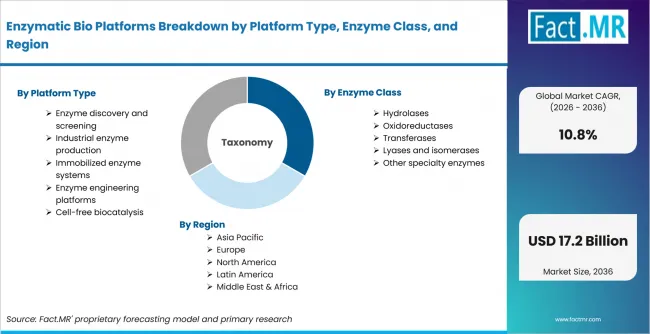
Enzymatic Bio Platforms Breakdown By Platform Type, Enzyme Class, And Region | Source: Fact.MR
| Attribute | Details |
|---|---|
| Quantitative Units | USD Billion |
| Market Definition | Enzymatic bio platforms cover enzyme production, discovery, immobilization, engineering and cell-free biocatalysis systems used to improve industrial conversion and product functionality. |
| Platform Type | Industrial enzyme production; Enzyme discovery and screening; Immobilized enzyme systems; Enzyme engineering platforms; Cell-free biocatalysis |
| Enzyme Class | Hydrolases; Oxidoreductases; Transferases; Lyases and isomerases; Other specialty enzymes |
| End-use | Food & beverage; Detergents and home care; Biofuels and biorefining; Pharma and fine chemicals; Materials and other |
| Business Model | Direct enzyme sales; Custom development; Platform licensing; Integrated bioprocess solution; Contract manufacturing |
| Regions Covered | North America; Latin America; Western Europe; Eastern Europe; East Asia; South Asia & Pacific; Middle East & Africa |
| Countries Covered | Denmark; USA; Germany; UK; Japan |
| Companies Profiled | Novonesis; IFF; Amano Enzyme; AB Enzymes; BASF; Codexis |
| Forecast Period | 2026 to 2036 |
| Approach | Hybrid top-down and bottom-up approach using enzyme application depth, end-use adoption, country growth, provider portfolios and verified official evidence. |
Source: Fact.MR analysis. Updated Sep 7, 2026
How is the market segmented?
-
By Platform Type
- Industrial enzyme production
- Enzyme discovery and screening
- Immobilized enzyme systems
- Enzyme engineering platforms
- Cell-free biocatalysis
-
By Enzyme Class
- Hydrolases
- Oxidoreductases
- Transferases
- Lyases and isomerases
- Other specialty enzymes
-
By End-use
- Food & beverage
- Detergents and home care
- Biofuels and biorefining
- Pharma and fine chemicals
- Materials and other
-
By Business Model
- Direct enzyme sales
- Custom development
- Platform licensing
- Integrated bioprocess solution
- Contract manufacturing
-
By Region
- North America
- Latin America
- Western Europe
- Eastern Europe
- East Asia
- South Asia & Pacific
- Middle East & Africa
Frequently Asked Questions
How big is the enzymatic bio platforms market in 2026?
What is the CAGR of the enzymatic bio platforms market from 2026 to 2036?
Which platform type leads the enzymatic bio platforms market?
Which business model leads the enzymatic bio platforms market?
Who are the leading companies in the enzymatic bio platforms market?
Who worked on this report


Preview the report firsthand - request a free sample
Free SampleGet the brochure for pricing and purchase details
Download PDF