- Forecast Value (2036): 3.4 Bn
- CAGR (2036): 14.6%
Variant-ID Packaging for Mixed SKU Kits Market Forecast and Outlook 2026 to 2036
Market growth of variant-ID packaging for mixed SKU kits market from USD 0.98 billion in 2026 to USD 3.4 billion by 2036 with CAGR 13.3%, reflects fundamental shifts in retail operations, manufacturing quality systems, and distribution infrastructure. As assortment complexity increases and order profiles become more customized, traditional manual verification methods are proving insufficient.
Key Takeaways from the Variant-ID Packaging for Mixed SKU Kits Market
- Variant-ID Packaging for Mixed SKU Kits Market Value (2026): USD 0.98 billion
- Variant-ID Packaging for Mixed SKU Kits Market Forecast Value (2036): USD 3.4 billion
- Variant-ID Packaging for Mixed SKU Kits Market Forecast CAGR (2026-2036): 13.3%
- Leading Kit Type: Electronics kits (46%)
- Key Market Participants: Avery Dennison, WestRock, Zebra Technologies, Domino Printing Sciences, Brady Corporation, Videojet Technologies, Cognex Corporation, Datalogic
- Key Growth Regions: Asia Pacific, North America, Europe, Latin America
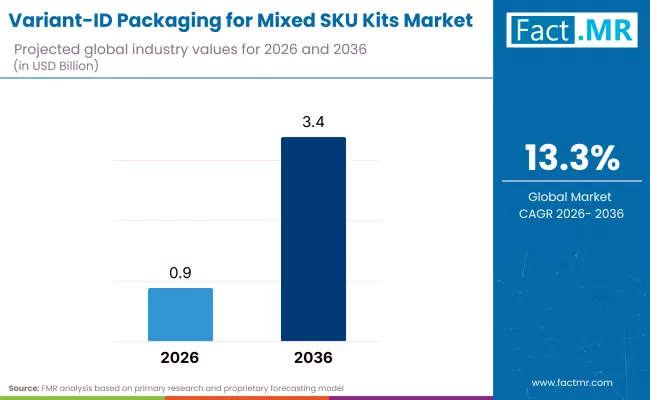
Variant Id Packaging For Mixed Sku Kits Market By Industry | Source: Fact.MR
Variant-ID packaging addresses these challenges by enabling unit-level identification, real-time verification, and automated error prevention across picking, kitting, and packing operations. The strategic importance of the category lies in its ability to reduce mis-shipments, improve compliance, and protect brand integrity in multi-SKU environments. Companies that integrate machine-readable identifiers, variable data printing, and system-level compatibility with warehouse automation platforms are positioned to capture outsized value as fulfillment networks continue to scale in speed, complexity, and regulatory oversight.
Variant-ID Packaging for Mixed SKU Kits Market
| Metric | Value |
|---|---|
| Estimated Value in (2026) | USD 0.98 billion |
| Forecast Value in (2036) | USD 3.4 billion |
| Forecast CAGR (2026 to 2036) | 13.3 % |
Source: Fact.MR analysis. Updated Feb 6, 2026
Category
| Category | Segments |
|---|---|
| Kit Type | Electronics kits, Industrial spare kits, Promotional kits, Medical kits |
| Identification Method | QR / Data Matrix labels, RFID tags, Color-coded cartons, Serialized labels |
| Substrate | Paperboard, Corrugated board, Coated paper, Specialty board |
| Region | North America; Europe; Asia Pacific; Latin America; Middle East & Africa |
Source: Fact.MR analysis. Updated Feb 6, 2026
Segmental Analysis
How are electronics kits establishing dominance in the variant-ID packaging market?
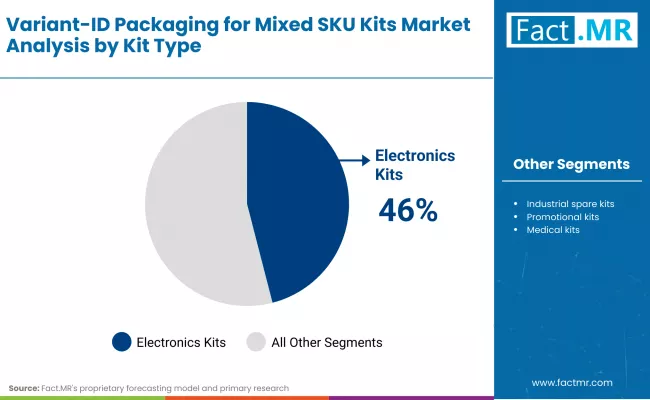
Variant Id Packaging For Mixed Sku Kits Market By Kit Type | Source: Fact.MR
Electronics kits account for 46 percent of the market because they deliver component-level traceability addressing semiconductor industry requirements and counterfeit prevention mandates. This segment encompasses circuit board assemblies, connector kits, passive component assortments, and consumer electronics accessory packages. The Electronic Components Industry Association recommends Data Matrix coding for electronic components, establishing industry-standard practices that drive identification technology adoption. Major electronics manufacturers implement multi-layer identification strategies, combining laser-etched Data Matrix codes on individual components with secondary packaging labels for shipment verification. Growth drivers include expanding semiconductor fabrication capacity, increasing complexity of electronic assemblies, and rising concerns regarding counterfeit component infiltration in supply chains.
Why do QR and Data Matrix labels maintain leadership position in identification method preferences?
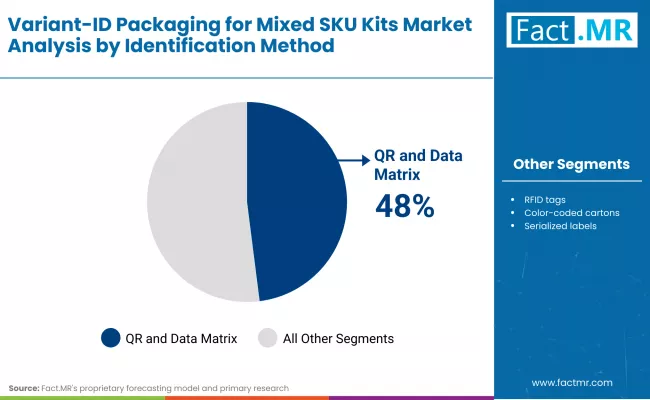
Variant Id Packaging For Mixed Sku Kits Market By Identification Method | Source: Fact.MR
QR and Data Matrix labels hold 48 percent share because their mechanism offers substantial data capacity within compact formats suitable for diverse packaging applications. Data Matrix codes find particular favor in industrial environments, capable of encoding up to 2,335 alphanumeric characters while maintaining readability even when 50 percent of the code is damaged. This error correction capability proves essential in manufacturing and logistics environments where labels face exposure to abrasion, contamination, and environmental stresses. QR codes serve broader consumer-facing applications, providing smartphone-readable links to product information, assembly instructions, and warranty registration portals. Technology providers continue advancing printing and marking methods, with laser etching, thermal transfer, and digital inkjet systems enabling permanent, high-resolution codes on substrates ranging from paper labels to metal components.
Variant-ID Packaging for Mixed SKU Kits Market-Drivers, Restraints & Trends
- Drivers: Demographic aging across developed economies creates expanding consumer bases actively seeking preventive skincare interventions, while rising middle-class populations in emerging markets discover premium skincare categories. Technological advancement in delivery systems enables enhanced bioavailability of active ingredients, improving product efficacy and justifying premium positioning. Digital commerce expansion provides brands direct consumer relationships supporting personalized product recommendations and subscription models that increase customer lifetime value. E-commerce Fulfillment Evolution The fundamental transformation of retail fulfillment operations drives sustained market expansion as e-commerce platforms transition from single-item shipments to consolidated multi-SKU orders. Amazon's March 2026 mandate eliminating commingled inventory practices and requiring complete FNSKU labeling responsibility represents a watershed moment, compelling third-party sellers to implement sophisticated identification infrastructure. Fulfillment center automation adoption accelerates globally, with major markets deploying robotic sortation systems requiring machine-readable identification on every package.
- Restraints: Formulation complexity and active ingredient instability present technical challenges requiring sophisticated preservation systems and climate-controlled storage throughout distribution. Regulatory fragmentation across markets creates compliance burdens, with ingredient restrictions varying significantly between jurisdictions and requiring market-specific formulations. Consumer sensitivity concerns and potential adverse reactions necessitate extensive safety testing and clear communication protocols to maintain brand trust. Implementation Cost Barriers Capital investment requirements for sophisticated identification infrastructure present significant adoption barriers, particularly for small and medium enterprises with constrained resources. Vision inspection systems, automated labeling equipment, and enterprise software integration projects require substantial upfront expenditures, with complete system implementations ranging from USD 100,000 to several million dollars depending on operational scale and complexity. RFID technology adoption faces incremental per-unit costs that remain challenging to justify in low-margin applications, despite operational efficiency benefits.
- Trend 1: Artificial Intelligence Integration Vision systems increasingly incorporate machine learning algorithms that enable adaptive code recognition across varied lighting conditions, substrate textures, and printing quality variations. These AI-enhanced systems reduce false rejection rates while improving throughput in automated verification applications.
- Trend 2: Sustainable Identification Solutions Environmental sustainability considerations drive innovation in identification substrate materials and printing methods that minimize ecological impact while maintaining performance. Recyclable RFID tags incorporating printable antennas on paper substrates address electronic waste concerns.
Variant-ID Packaging for Mixed SKU Kits Market Analysis by Key Country
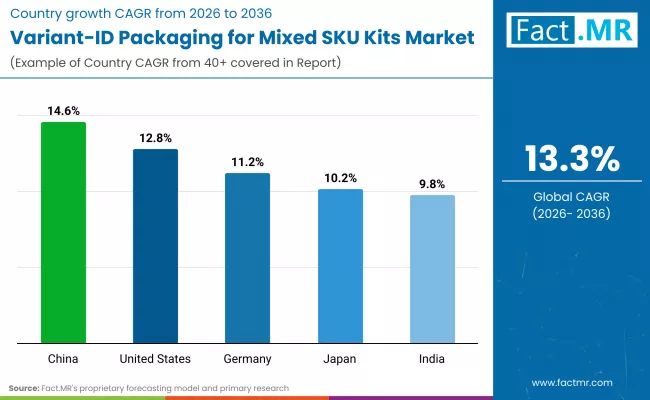
Variant Id Packaging For Mixed Sku Kits Market By Country | Source: Fact.MR
| Country | CAGR (2026-2036) |
|---|---|
| China | 14.6 |
| United States | 12.8 |
| Germany | 11.2 |
| Japan | 10.2 |
| India | 9.8 |
Source: Fact.MR analysis. Updated Feb 6, 2026
What factors position China to lead global growth in variant-ID packaging at 14.6% CAGR?
China leads global market expansion with CAGR of 14.6%, driven by government-mandated Smart Logistics 2026 Initiative promoting intelligent packaging integration across e-commerce hubs. This policy framework establishes systematic transition from traditional one-dimensional barcodes to item-level RFID and NFC technologies, enabling instantaneous mixed-kit verification capabilities. Major e-commerce platforms operating in China implement standardized RFID-variant kit systems supporting real-time inventory visibility and automated sortation. Sino-Pack 2026 exhibition showcased breakthrough variable data UV printing systems manufactured by Chinese equipment providers, demonstrating high-speed SKU-specific kit coding capabilities suitable for promotional and seasonal assembly operations. These systems achieve printing speeds exceeding 200 meters per minute while maintaining barcode quality standards.
How does the Amazon FBA 2026 mandate accelerate United States market growth at 12.8% CAGR?
The United States market experiences robust expansion at 12.8%, positioned as the second-fastest growing region globally. The market's momentum stems primarily from Amazon's transformative FBA 2026 mandate eliminating in-house labeling services, which fundamentally restructures identification responsibilities across the third-party seller ecosystem. Sellers now bear complete accountability for FNSKU and Shipment ID compliance, driving rapid adoption of vision-integrated pack stations capable of automated verification. Companies like AMZ Prep have launched automated pallet and carton labeling systems specifically engineered for 2026 FBA compliance standards, incorporating high-speed printing and vision verification in integrated workflows. The regulatory change particularly impacts resellers lacking Brand Registry status, who face mandatory FNSKU labeling on every unit regardless of existing manufacturer barcodes.
What role does EU PPWR enforcement play in Germany's 11.2% market expansion?
Germany demonstrates strong market growth at 11.2% compound annual rate, substantially influenced by EU Packaging and Packaging Waste Regulation enforcement beginning August 2026. These regulations mandate minimal air space in multi-SKU boxes to reduce transport waste, driving widespread adoption of fit-to-size automation technologies. Companies like Sparck Technologies deploy computer vision-powered carton forming systems that create custom-sized boxes precisely matched to mixed-SKU kit dimensions, eliminating void fill requirements while optimizing material consumption. German manufacturing sectors increasingly implement AI-driven simulated strength cartons, which use machine learning algorithms to determine optimal corrugate specifications based on contents weight, fragility, and distribution conditions. Extended Producer Responsibility programs established under EU frameworks tie packaging fees to actual recyclability performance.
How does Japan's logistics crisis drive 10.2% CAGR in shelf-ready packaging solutions?
Japan experiences a 10.2% compound annual growth rate amid severe labor shortage challenges designated the Logistics 2024-2026 Crisis, which mandates one-touch shelf-ready packaging solutions for retail distribution. This demographic-driven constraint compels development of retail-ready packaging systems requiring zero on-site assembly, with complex pre-sorted secondary packs incorporating integrated identification enabling direct shelf placement. Rengo Co., Japan's largest corrugated manufacturer, developed Yu-Packet automated robotic sorters specifically addressing the JPY 26.1 trillion e-commerce market's mixed-SKU verification requirements. These systems employ vision recognition and robotic handling to assemble customized product assortments without human intervention. Japan's logistics infrastructure emphasizes precision and reliability, with delivery time windows measured in hours rather than days, creating exacting performance requirements for identification systems supporting package routing and sortation.
What regulatory framework supports India's 9.8% growth in digital traceability systems?
India's market advances at a 9.8% compound annual growth rate, propelled by Extended Producer Responsibility mandates and QR code requirements taking effect under July 2025-2026 Plastic Waste Management Rules. These regulations require machine-readable QR codes on all kit components, establishing comprehensive digital twin requirements linking physical products to centralized traceability databases. Every item within mixed SKU bundles must now carry a unique identifier enabling individual component tracking through supply chains and into recycling systems. Hindustan Unilever implemented the Shikhar e-B2B App integrating digital kit traceability across its distribution network, establishing precedents for large-scale deployment of identification systems supporting regulatory compliance. The market benefits from India's position as a major manufacturing hub for pharmaceuticals, textiles, and consumer goods, each facing distinct regulatory requirements driving identification technology adoption.
Competitive Landscape for Variant-ID Packaging for Mixed SKU Kits Market
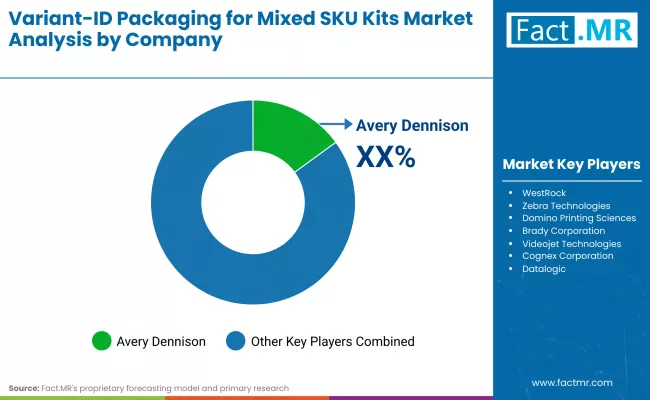
Variant Id Packaging For Mixed Sku Kits Market By Company | Source: Fact.MR
Competition in the variant-ID packaging for mixed SKU kits market has shifted from product differentiation toward comprehensive solution provision spanning substrates, identification technologies, printing equipment, and integration services. Leading companies pursue vertical integration strategies acquiring capability across the value chain to serve multi-national customers requiring standardized systems across global operations. Market consolidation accelerates through strategic acquisitions enabling technology portfolio expansion and geographic reach extension.
The competitive landscape features diverse participants including substrate manufacturers, identification technology providers, printing equipment suppliers, and integrated solution vendors. Avery Dennison Corporation maintains market leadership in pressure-sensitive label materials and RFID inlay technologies. WestRock Company operates as a major integrated packaging solutions provider following merger with Smurfit Kappa. Zebra Technologies Corporation specializes in automatic identification and data capture technologies. Additional significant participants include Domino Printing Sciences, Brady Corporation, Videojet Technologies, Cognex Corporation, and Datalogic.
Recent Development
- In January 2026, AMZ Prep, in collaboration with Zebra Technologies, launched automated pallet and carton labeling systems designed to meet Amazon FBA 2026 compliance requirements. The solutions integrate high-speed thermal transfer printing, vision-based barcode verification, and automated label application for corrugated containers.
- In February 2025, Packaging Innovations & Empack 2025 delivered a record-breaking event that showcased cutting-edge packaging technologies, including smart and data-driven solutions relevant to mixed-SKU kit assembly and identification workflows.
Key Players in Variant-ID Packaging for Mixed SKU Kits Market
- Avery Dennison
- WestRock
- Zebra Technologies
- Domino Printing Sciences
- Brady Corporation
- Videojet Technologies
- Cognex Corporation
- Datalogic
Bibliography
- European Commission. 2026. Packaging and Packaging Waste Regulation (EU PPWR): Digital labeling, recyclability, and extended producer responsibility requirements for transport and retail packaging. Brussels: European Union.
- GS1. 2025. Global standards for barcode, QR code, and serialization implementation in mixed SKU packaging and fulfillment operations. Brussels: GS1 AISBL.
- International Organization for Standardization (ISO). 2024. Packaging and distribution systems: Identification, traceability, and variable data printing requirements. ISO Technical Standards. Geneva: ISO.
- Association for Automatic Identification and Mobility (AIM). 2025. Best practices for variant identification in automated packaging and fulfillment environments. AIM Industry Guidelines.
- Journal of Packaging Technology and Research. 2025. Variable data printing and serialization for mixed SKU kit packaging: Accuracy, speed, and error reduction. Journal of Packaging Technology and Research 9(3): 211-228.
- Material Handling Industry (MHI). 2024. Automation-driven packaging requirements for mixed SKU kits in e-commerce and Omni channel fulfillment. Industry White Paper.
Segmentation
Scope of Report
| Items | Values |
|---|---|
| Quantitative Units (2026) | USD 0.98 Billion |
| Kit Type | Electronics kits, Industrial spare kits, Promotional kits, Medical kits |
| Identification Method | QR / Data Matrix labels, RFID tags, Color-coded cartons, Serialized labels |
| Substrate | Paperboard, Corrugated board, Coated paper, Specialty board |
| Regions Covered | North America, Europe, Asia Pacific, Latin America, Middle East & Africa |
| Countries Covered | U.S., Canada, Germany, Italy, UK, France, Japan, Australia, and other countries |
| Key Companies Profiled | Avery Dennison, WestRock, Zebra Technologies, Domino Printing Sciences, Brady Corporation, Videojet Technologies, Cognex Corporation, Datalogic |
| Additional Attributes | Dollar revenue in the Variant-ID Packaging for Mixed SKU Kits Market is segmented by packaging format (labels, inserts, printed cartons, smart tags), identification technology (barcodes, QR codes, RFID, variable data printing), material type (paper, films, corrugated board), end-use application, and region. |
Source: Fact.MR analysis. Updated Feb 6, 2026
Variant-ID Packaging for Mixed SKU Kits Market by Segments
-
Kit Type :
- Electronics kits
- Industrial spare kits
- Promotional kits
- Medical kits
-
Identification Method :
- QR / Data Matrix labels
- RFID tags
- Color-coded cartons
- Serialized labels
-
Substrate :
- Paperboard
- Corrugated board
- Coated paper
- Specialty board
-
Region :
- Asia Pacific
- China
- India
- Japan
- South Korea
- Australia
- Rest of Asia Pacific
- North America
- United States
- Canada
- Mexico
- Europe
- Germany
- France
- UK
- Italy
- Spain
- Rest of Europe
- Latin America
- Brazil
- Mexico
- Argentina
- Rest of Latin America
- Asia Pacific
Frequently Asked Questions
How big is the global Variant-ID Packaging for Mixed SKU Kits Market in 2026?
What will be the size of the Variant-ID Packaging for Mixed SKU Kits Market by 2036?
How fast will the Variant-ID Packaging for Mixed SKU Kits Market grow between 2026 and 2036?
Which identification technology holds the largest share in mixed SKU kit packaging?
Who worked on this report


Preview the report firsthand - request a free sample
Free SampleGet the brochure for pricing and purchase details
Download PDF