- Forecast Value (2036): 4.1 Bn
- CAGR (2036): 11.6%
Sleeve Packaging for Extrusions Market Forecast and Outlook 2026 to 2036
The global demand for sleeve packaging in extrusions is projected to rise from USD 1.2 billion in 2026 to approximately USD 4.1 billion by 2036, representing a CAGR of about 13.1% over the forecast period.
Key Takeaways from the Sleeve Packaging for Extrusions Market
- Sleeve Packaging for Extrusions Market Value (2026): USD 1.2 billion
- Sleeve Packaging for Extrusions Market Forecast Value (2036): USD 4.1 billion
- Sleeve Packaging for Extrusions Market Forecast CAGR (2026-2036): 13.1%
- Leading Extrusion Type: Aluminum Profiles (44%)
- Key market participants: Pregis LLC, Mondi Group, Amcor plc, Toppan Printing Co., Ltd.
- Key Growth Regions: North America, Europe, Asia Pacific, Latin America, Middle East
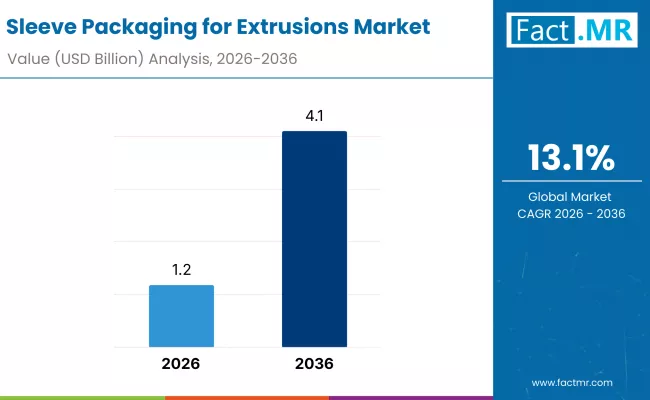
Sleeve Packaging For Extrusions Market By Industry | Source: Fact.MR
This growth reflects a fundamental transformation in industrial packaging, where the market focus has shifted from basic protective wrapping to engineered surface-critical logistics solutions. Rather than relying on traditional bulk wrapping or simple paper covers, the industry is increasingly centered on specialized sleeve technology that prevents surface damage, maintains product integrity during transit, and incorporates traceability features through serialization and QR coding.
Robert Hensley, VP of Industrial Packaging Solutions at Amcor, noted that "The transformation occurring in extrusion packaging is fundamentally about precision protection for high-value components. As aluminum, PVC, and composite profiles become more specialized for EV chassis, medical device manufacturing, and aerospace applications, packaging can no longer be an afterthought. We are witnessing 2026 as the year of serialized, VCI-enhanced sleeves that provide not just scratch protection but complete supply chain visibility and corrosion prevention across multi-modal transport networks."
Growth is further supported by evolving regulations and sustainability mandates. The European Union Packaging and Packaging Waste Regulation (PPWR), implemented in August 2026, requires all transport packaging to meet 100% recyclability standards, driving rapid adoption of mono-material sleeve designs. Similarly, state-driven mandates in China for lightweight aluminum in green energy infrastructure have created sustained demand for automated, recyclable sleeving solutions that can handle high-speed production lines while meeting environmental compliance requirements.
Sleeve Packaging for Extrusions Market
| Metric | Value |
|---|---|
| Estimated Value in (2026E) | USD 1.2 billion |
| Forecast Value in (2036F) | USD 4.1 billion |
| Forecast CAGR (2026 to 2036) | 13.1 % |
Source: Fact.MR analysis. Updated Feb 5, 2026
Category
| Category | Segments |
|---|---|
| Extrusion Type | Aluminum Profiles, Steel Channels, PVC Extrusions, Precision Profiles |
| Sleeve Format | Corrugated Sleeves, Film Sleeves, Foam-Lined Sleeves, Paperboard Sleeves |
| Material | Corrugated Board, LDPE Films, PE Foam, Coated Board |
| Region | North America; Europe; Asia Pacific; Latin America; Middle East & Africa |
Source: Fact.MR analysis. Updated Feb 5, 2026
Segmental Analysis
How are surface protection requirements positioning aluminum profiles as the leading extrusion type in the Sleeve Packaging for Extrusions Market?
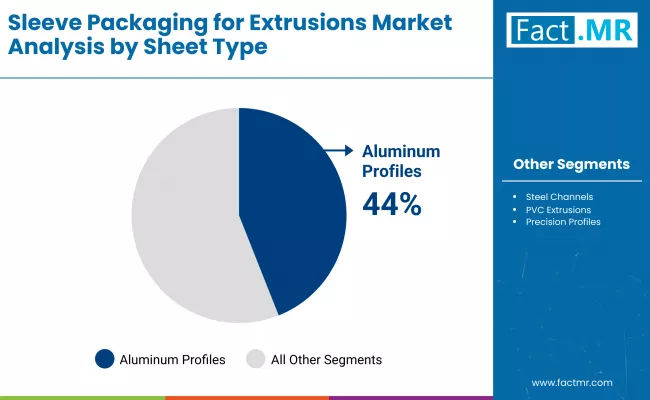
Sleeve Packaging For Extrusions Market By Sheet Type | Source: Fact.MR
Aluminum profiles lead the market with a 44% share, reflecting strong demand from construction, automotive, and renewable energy sectors that require scratch-free, corrosion-resistant delivery of architectural and structural components. These extrusions are particularly vulnerable to surface damage during handling and transportation, making specialized sleeve packaging essential rather than optional. The growing adoption of anodized and powder-coated aluminum finishes in modern construction has elevated surface quality expectations, driving demand for VCI-enhanced corrugated sleeves that provide both mechanical protection and vapor-phase corrosion inhibition. Electric vehicle manufacturing has created additional demand for lightweight aluminum chassis components that require serialized packaging for traceability throughout complex supply chains.
Why do corrugated sleeves remain the leading format in the Sleeve Packaging for Extrusions Market?
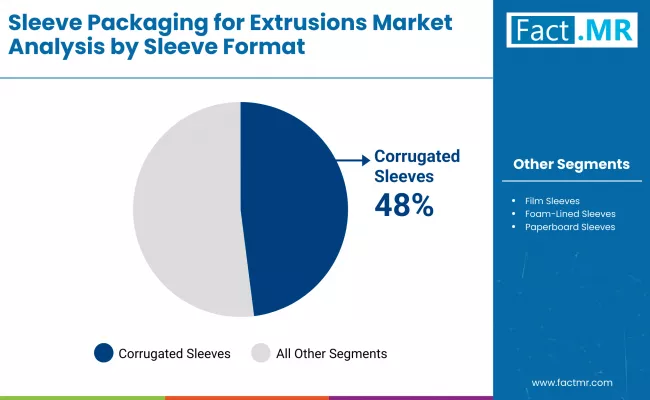
Sleeve Packaging For Extrusions Market By Sleeve Format | Source: Fact.MR
Corrugated sleeves account for 48% of total demand, making them the dominant format for extrusion packaging. This dominance reflects the optimal balance between cost efficiency, structural rigidity, and recyclability that corrugated materials provide for long-length industrial components. Unlike film sleeves that offer minimal impact protection or foam-lined options that create disposal challenges, corrugated sleeves deliver stackable protection while maintaining compatibility with existing material recovery infrastructure. The material naturally absorbs minor impacts during transit while its moisture resistance can be enhanced through coating technologies for humid shipping environments. Recent innovations in easy-tear designs and quick-release features have addressed labor efficiency concerns in construction site applications, where single-person handling requirements are becoming standard.
Market Dynamics
- Drivers: Rapid growth of electric vehicle manufacturing and renewable energy infrastructure. These sectors require specialized aluminum components with extremely tight surface quality standards. Battery housings and structural chassis extrusions used in EV platforms must be protected from even microscopic contamination, which can affect welding performance and coating adhesion. Similarly, solar panel frames and wind turbine structural elements require scratch-free delivery to installation sites. This has created steady demand for engineered protective sleeves. Labor shortages across logistics and construction are also accelerating adoption of easy-peel and tool-free sleeve designs. These solutions reduce handling time and simplify onsite installation. In addition, government-backed infrastructure programs, particularly in emerging Asian markets, are increasing production of architectural extrusions. Packaging specifications are increasingly included in procurement contracts to ensure damage-free delivery of anodized finishes and specialty coatings.
- Restraints: Market growth is constrained by the high capital cost of upgrading from manual wrapping to automated sleeve application systems. Small and mid-sized extrusion manufacturers using legacy equipment often face difficulty justifying this investment, especially in regional construction markets where damage claims are limited. Custom extrusion profiles also vary widely in size and geometry, creating inventory and tooling challenges for sleeve suppliers. Minimum order quantities and tooling costs can make small production runs uneconomical. In addition, extrusion end markets are highly fragmented. Packaging requirements differ significantly between architectural applications that allow minor cosmetic defects and aerospace or medical components that require validated, contamination-controlled packaging. This limits standardization and reduces economies of scale.
- Trend 1: Serialization for Supply Chain Visibility Sleeve packaging is increasingly incorporating QR codes and RFID tags to enable component-level tracking across complex supply chains. Medical-grade and clean-room extrusions now require full traceability from production through installation. Serialized sleeves help document handling conditions and environmental exposure.
- Trend 2: Mono-Material Sleeves for Circular Economy Compliance Regulatory pressure in Europe is accelerating the shift toward fully recyclable mono-material sleeve designs. Manufacturers are replacing mixed-material and foam-lined constructions with single-material solutions. Barrier and cushioning properties are being redesigned to remain compatible with existing recycling systems, particularly for construction waste management.
Sleeve Packaging for Extrusions Market Analysis by Key Country
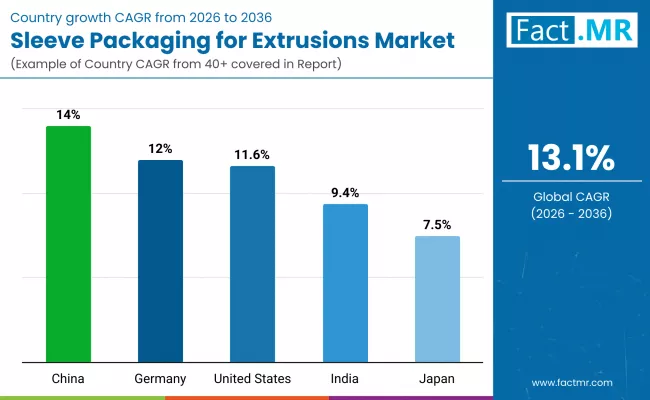
Sleeve Packaging For Extrusions Market By Country | Source: Fact.MR
| Country | CAGR (2026-2036) |
|---|---|
| United States | 11.6% |
| Germany | 12.0% |
| China | 14.0% |
| India | 9.4% |
| Japan | 7.5% |
Source: Fact.MR analysis. Updated Feb 5, 2026
How is advanced pharmaceutical and semiconductor manufacturing reshaping sleeve packaging demand in the United States?
The United States market is projected to grow at a CAGR of 11.6% through 2036. Growth is led by expanding pharmaceutical and medical device manufacturing infrastructure. New temperature-controlled facilities for GLP-1 drug production are increasing demand for medical-grade aluminum extrusions. These components require serialized sleeve packaging to ensure full traceability and contamination-free handling. Clean-room applications now routinely specify QR-coded sleeves. In parallel, domestic semiconductor fabrication projects supported by CHIPS Act funding are driving demand for precision packaging. In these environments, even minor surface contamination can disrupt production yields, elevating packaging from a support function to a critical process control element.
Why do renewable energy and EV production scale make China the fastest-growing sleeve packaging market?
China leads growth with a projected CAGR of 14.0% through 2036. Expansion is supported by government targets for renewable energy and electric vehicle deployment. Mandates promoting lightweight aluminum in solar and EV applications are accelerating adoption of automated sleeving lines, particularly in Guangdong manufacturing clusters. Producers are deploying intelligent packaging systems using recyclable paper sleeves to reduce labor dependence and meet export requirements. Large-scale production of solar frames and wind turbine components is driving strong demand for high-speed protective sleeves capable of maintaining surface integrity during long-distance and ocean freight transport.
How are recyclability regulations positioning Germany as a compliance-led sleeve packaging market?
Germany is expected to grow at a CAGR of 12.0% through 2036, driven primarily by regulatory mandates. The implementation of PPWR requirements in August 2026 requires all transport packaging to be fully recyclable. This has accelerated conversion to mono-material sleeve designs, particularly all-PE and all-PP formats. Automotive supply chains are leading adoption. Germany is emerging as a development hub for recyclable sleeves incorporating post-consumer recycled content while meeting strict performance and quality standards.
Why do climate conditions and infrastructure growth make India a protection-intensive sleeve packaging market?
India is forecast to grow at a CAGR of 9.4% through 2036, supported by Smart Cities development across Tier-2 urban centers. Demand is rising for scratch-free architectural extrusions used in residential and commercial construction. Humid and monsoon-prone logistics conditions are increasing the need for VCI-enhanced sleeve packaging. Domestic manufacturers are expanding regional packaging capacity to support local construction booms and reduce logistics costs. Anti-corrosive sleeves are increasingly specified for premium anodized profiles used in facades and curtain wall systems.
What are the prospects for the Sleeve Packaging for Extrusions Market in Japan?
Japan is projected to grow at 7.5% through 2036, with labor shortages shaping market demand. Reduced workforce availability in construction and logistics has increased demand for easy-peel and tool-free sleeve designs. One-person handling requirements have made quick-release packaging essential for long-length extrusions. Manufacturers are focusing on simplified opening mechanisms and ergonomic designs to reduce physical effort and installation time in labor-constrained environments.
Competitive Landscape for Sleeve Packaging for Extrusions Market
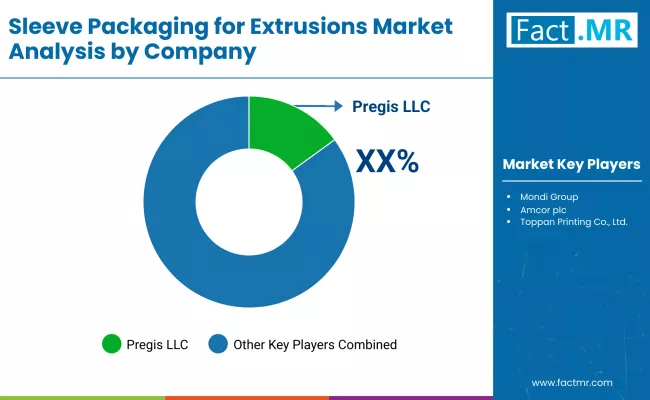
Sleeve Packaging For Extrusions Market By Company | Source: Fact.MR
The competitive landscape of the sleeve packaging for extrusions market is shaped by a gradual shift from basic protective solutions toward integrated, performance-driven systems. Competition is increasingly concentrated among global flexible packaging manufacturers with the scale and technical capability to support high-volume extrusion customers across automotive, construction, and industrial applications. Leading suppliers differentiate themselves through advanced material formulations, automated sleeve application compatibility, and the ability to meet evolving regulatory and sustainability requirements across regions.
Market leaders focus on engineered sleeve designs that combine surface protection, ease of removal, and recyclability. Investment in mono-material structures, VCI-enhanced coatings, and precision-fit sleeves allows suppliers to address strict surface quality standards demanded by electric vehicle, pharmaceutical, and architectural extrusion customers. In 2024, the sleeve packaging for extrusions market was largely characterized by price-led competition and standardized offerings. Most suppliers focused on basic polyethylene or paper sleeves designed to prevent visible scratches during transport. Packaging was often treated as a secondary input, with limited customization by extrusion profile, coating type, or downstream application. By 2026, the market moved away from simple product-based competition toward more engineering-focused and value-driven approaches. Sleeve packaging became a built-in part of how extrusions were produced, handled, and transported, rather than an add-on at the end of the process. Suppliers began offering sleeves designed for specific applications, including automated production lines, complex or curved profiles, and sensitive anodized or coated surfaces. Regulatory pressure, particularly from European recyclability requirements, pushed companies to adopt mono-material and fully recyclable designs. At the same time, labor shortages increased demand for easy-peel and tool-free sleeve formats that simplify handling. As a result, competition in 2026 is shaped more by technical expertise, sustainability performance, and long-term customer relationships than by unit price alone.
Key Players in Sleeve Packaging for Extrusions Market
- Pregis LLC
- Mondi Group
- Amcor plc
- Toppan Printing Co., Ltd.
Bibliography
- European Union. 2026. Packaging and Packaging Waste Regulation (PPWR). Official Journal of the European Union. Brussels, Belgium: European Commission.
- Guangdong Xingfa Aluminium. 2026. Intelligent Packaging Lines for Architectural Alloys. Corporate Sustainability Report. Guangdong, China: Xingfa Aluminium.
- Jindal Aluminium Ltd. 2026. Zero-Scratch Architectural Profiles for Smart Cities. Technical Documentation. Karnataka, India: Jindal Aluminium.
- Rengo Co., Ltd. 2026. Easy-Tear Industrial Sleeve Innovations. Product Development Report. Tokyo, Japan: Rengo.
Segmentation
Scope of Report
| Items | Values |
|---|---|
| Quantitative Units (2026) | USD 1.2 Billion |
| Extrusion Type | Aluminum Profiles, Steel Channels, PVC Extrusions, Precision Profiles |
| Sleeve Format | Corrugated Sleeves, Film Sleeves, Foam-Lined Sleeves, Paperboard Sleeves |
| Material | Corrugated Board, LDPE Films, PE Foam, Coated Board |
| Regions Covered | North America, Europe, Asia Pacific, Latin America, Middle East & Africa |
| Countries Covered | U.S., Canada, Germany, Italy, UK, France, Japan, Australia, and other countries |
| Key Companies Profiled | Pregis LLC, Mondi Group, Amcor plc, Toppan Printing Co., Ltd. |
| Additional Attributes | Dollar revenue in the sleeve packaging for extrusions market is segmented by extrusion type, sleeve format, material, and region. Regional demand patterns are shaped by electric vehicle manufacturing expansion, renewable energy infrastructure investment, construction sector modernization, regulatory pressure toward circular economy compliance, and labor shortage impacts driving automation and ease-of-use innovation. |
Source: Fact.MR analysis. Updated Feb 5, 2026
Sleeve Packaging for Extrusions Market by Segment
-
Extrusion Type :
- Aluminum Profiles
- Steel Channels
- PVC Extrusions
- Precision Profiles
-
Sleeve Format :
- Corrugated Sleeves
- Film Sleeves
- Foam-Lined Sleeves
- Paperboard Sleeves
-
Material :
- Corrugated Board
- LDPE Films
- PE Foam
- Coated Board
-
Region :
- North America
- United States
- Canada
- Mexico
- Europe
- Germany
- United Kingdom
- France
- Italy
- Spain
- Rest of Europe
- Asia Pacific
- China
- India
- Japan
- Australia
- South Korea
- Rest of Asia Pacific
- Latin America
- Brazil
- Argentina
- Rest of Latin America
- Middle East & Africa
- UAE
- Saudi Arabia
- South Africa
- Rest of Middle East & Africa
- North America
Frequently Asked Questions
How big is the global sleeve packaging for extrusions market in 2026?
What will be the size of the sleeve packaging for extrusions market in 2036?
How fast will the sleeve packaging for extrusions market grow between 2026 and 2036?
Which extrusion type dominates the sleeve packaging market?
Which sleeve format holds the largest share?
Who worked on this report


Preview the report firsthand - request a free sample
Free SampleGet the brochure for pricing and purchase details
Download PDF