Telematics and Connectivity Control Unit Systems Market
The Telematics and Connectivity Control Unit Systems Market is analyzed by system type, including embedded telematics control units and integrated connectivity and gateway units, and region, forecast 2026 to 2036.
By Fact.MR Automotive DeskLead analyst:
Shubham PatidarPublished :
15 min read
Fact-checked under the Fact.MR editorial process
Telematics and Connectivity Control Unit Systems Market Forecast and Outlook By Fact.MR
In 2025, the telematics and connectivity control unit systems market was valued at USD 17.2 billion.
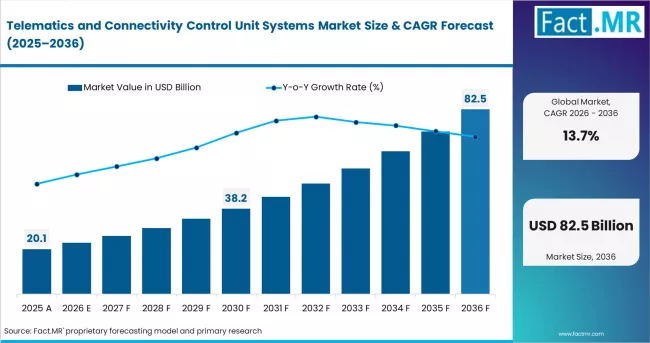
Based on Fact.MR analysis, demand for telematics and connectivity control unit systems is estimated to grow to USD 20.1billion in 2026 and USD 72.8 billion by 2036.
FACT.MR projects a CAGR of 13.7% during the forecast period.
Telematics And Connectivity Control Unit Systems Market Market Value Analysis | Source: Fact.MR
Metric
Value
Estimated Value in 2026
USD 20.1 billion
Forecast Value in 2036
USD 72.8 billion
Forecast CAGR (2026 to 2036)
13.7%
Source: Fact.MR analysis. Updated May 12, 2026
Summary of Telematics and Connectivity Control Unit Systems Market
Market Definition
The market covers telematics and connectivity control unit hardware embedded in vehicles to manage GPS, cellular, satellite, and V2X communications across OEM and fleet applications globally.
Demand Drivers
OEMs across China and Europe are mandating embedded 5G telematics units for software-defined vehicle programmes requiring over-the-air update capability.
AIS-140 fleet tracking regulations in India and eCall mandates in Europe are creating non-discretionary hardware procurement demand.
Insurance telematics and usage-based programmes in North America are driving aftermarket and embedded unit volumes across passenger and commercial vehicles.
Key Segments Analyzed
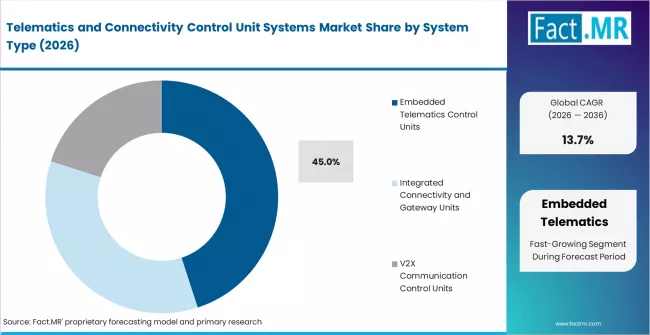
By System Type: Embedded telematics control units lead at 45% in 2026 due to OEM-standard integration in connected vehicle platforms.
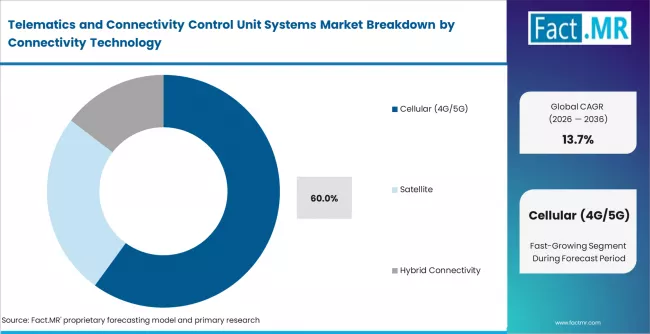
By Connectivity Technology: Cellular (4G/5G) leads at approximately 60% in 2026, driven by ubiquitous network coverage and OEM 5G upgrade cycles.
By Geography: China leads at 15.2% CAGR through 2036 due to largest connected vehicle production base and C-ITS infrastructure deployment.
Analyst Opinion at FACT.MR
Shambhu Nath Jha, Principal Consultant at Fact.MR opines, CXOs will find that 5G-embedded and V2X-capable telematics control units are moving from premium features to standard vehicle specifications. Suppliers without multi-protocol certification capabilities will face rapid exclusion from OEM preferred vendor lists by 2027.
Strategic Implications
Invest in 5G and C-V2X certified control unit platforms to meet OEM software-defined vehicle hardware specifications.
Build supply presence in India and Southeast Asia to serve AIS-140 fleet telematics mandates and emerging connected vehicle regulations.
Develop cybersecurity-certified telematics units compliant with UN Regulation No. 155 to access European OEM procurement programmes.
Methodology
Market sizing uses vehicle production volumes, telematics unit attachment rates, and ASP data by connectivity tier.
Analysis includes eCall regulation, AIS-140, C-ITS standards, IRA provisions, and OEM sourcing policy inputs.
Forecasts incorporate 5G rollout schedules, V2X infrastructure deployment, and OEM model cycle timing.
The market is projected to generate USD 52.7 billion in absolute opportunity between 2026 and 2036. Growth is strong and structurally driven by software-defined vehicle rollouts and V2X infrastructure mandates. Demand is expanding across Asia Pacific, North America, and Europe. 5G telematics integration and fleet digitization are primary drivers. Growth is moderated by semiconductor supply constraints, cybersecurity certification costs, and long OEM qualification timelines.
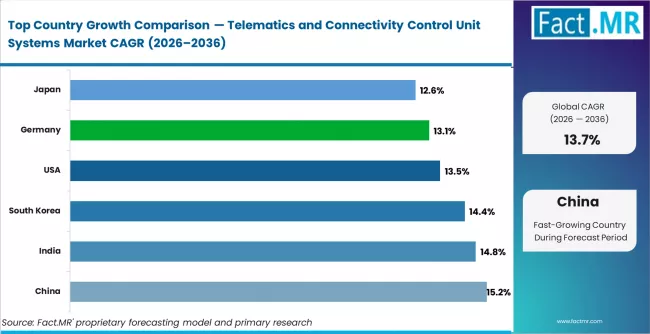
China leads at a projected CAGR of 15.2% through 2036. Growth is underpinned by the world's largest connected vehicle production base and 5G plus V2X infrastructure rollout under national C-ITS standards. India follows at 14.8%, driven by AIS-140 mandated vehicle tracking and rapid commercial fleet telematics expansion. South Korea records 14.4%, supported by Hyundai-Kia connected platform scaling and advanced 5G telecom infrastructure. The United States records 13.5%, anchored by mature fleet telematics ecosystems and strong insurance telematics demand. Germany records 13.1%, supported by eCall mandates and premium OEM integration requirements. Japan grows at 12.6%, reflecting early telematics adoption and stable but slower market maturation.
Segmental Analysis
Telematics and Connectivity Control Unit Systems Market Analysis by System Type
Telematics And Connectivity Control Unit Systems Market Analysis By System Type | Source: Fact.MR
Based on FACT.MR, embedded telematics control units hold 45% share in 2026. They lead due to OEM-standard integration in connected vehicle architectures. These units manage GPS, diagnostics, and cellular connectivity within a single certified module. OEM vehicle programmes across China, Europe, and North America are standardising embedded units at the platform level.
Robert Bosch Investment: Robert Bosch expanded its connected mobility hardware division in Q2 2024, committing EUR 400 million to embedded telematics unit production in Stuttgart and Suzhou. Focus targets 5G-enabled units for European and Chinese OEM platforms under software-defined vehicle programmes. [1]
Qualcomm Platform Development: Qualcomm launched the Snapdragon Auto 5G Modem-RF Gen 2 in early 2025, targeting embedded telematics control units with integrated 5G NR and C-V2X capability. It addresses OEM requirements for single-chip telematics and communication solutions in next-generation vehicle platforms. [2]
V2X Integration Trend: ETSI reported 34% growth in C-V2X equipment certifications in 2024, driven by European C-ITS corridor deployments and China National V2X Pilot Programme vehicle unit requirements. OEMs are integrating V2X modules with telematics control units to reduce hardware count and certification burden. [3]
Telematics and Connectivity Control Unit Systems Market Analysis by Connectivity Technology
Telematics And Connectivity Control Unit Systems Market Analysis By Connectivity Technology | Source: Fact.MR
Based on FACT.MR, cellular (4G/5G) connectivity holds approximately 60% share in 2026. It leads due to ubiquitous network infrastructure, OEM preference for low-latency data, and active 5G upgrade cycles. Cellular units support OTA updates, remote diagnostics, and emergency call services. 5G adoption is accelerating as OEMs launch software-defined vehicle platforms requiring higher bandwidth.
NXP Semiconductors Development: NXP Semiconductors launched the SAF5400 V2X-to-5G gateway chipset in Q3 2024, enabling automotive-grade cellular and V2X integration in a single module. It targets OEM telematics control unit programmes requiring both DSRC and C-V2X standards compliance for North American and European markets. [4]
Continental AG Platform: Continental AG announced a 5G telematics control unit programme with a major German OEM in January 2025, covering embedded 5G NR modem integration across passenger vehicle lines scheduled for 2026 production. The programme supports OTA software update and remote diagnostics requirements. [5]
Satellite Connectivity Growth: Iridium Communications reported 22% growth in automotive satellite connectivity module shipments in 2024, driven by commercial fleet operators expanding into remote and low-coverage regions. Hybrid cellular-satellite units are gaining specification in long-haul commercial trucks in North America and Australia. [6]
Drivers, Restraints, and Opportunities
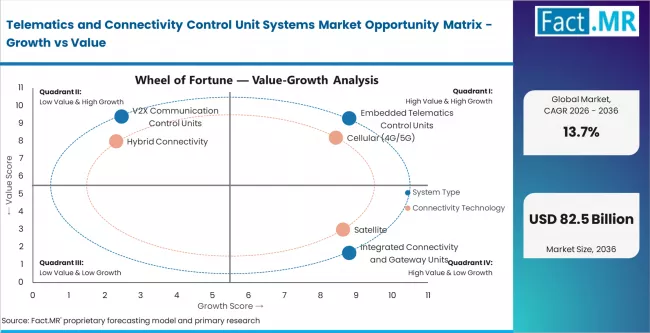
Telematics And Connectivity Control Unit Systems Market Opportunity Matrix Growth Vs Value | Source: Fact.MR
FACT.MR analysts observe growth is structurally linked to vehicle connectivity mandates and OEM platform upgrades. Telematics unit volumes are rising with connected vehicle production across all major markets. 5G and V2X capability are replacing 4G-only hardware. The market is in active technology transition with rising per-unit value.
Basic 4G telematic units are being displaced by integrated 5G gateway systems in OEM programmes. Embedded control units command 15-30% premiums over add-on modules. Fleet telematics aftermarket volumes remain stable but growth is concentrated in higher-specification embedded OEM hardware. V2X units represent the highest-margin growth tier.
Software-Defined Vehicle Mandates: Global OEM software-defined vehicle programmes are standardising embedded telematics control units. Volkswagen Group's E3 architecture and Hyundai's ccNC platform required telematics unit upgrades across model ranges in 2024-2025. This creates large, recurring procurement cycles for Tier 1 suppliers with certified hardware.
Regulatory Compliance Pressure: EU eCall Regulation (EU 2015/758) mandates emergency call hardware in all new passenger vehicles. UN Regulation No. 155 on cybersecurity management requires certified telematics security from July 2024. Suppliers without type approval face exclusion from European OEM contracts regardless of cost position.
Fleet Telematics Expansion: India's AIS-140 mandate for GPS tracking in public transport and commercial vehicles is expanding the addressable fleet telematics market. China's Ministry of Transport requires telematics in heavy commercial vehicles under national road transport regulations. These policies are accelerating mid-tier connectivity unit demand across emerging markets.
Regional Analysis
The telematics and connectivity control unit systems market is assessed across Asia Pacific, North America, Europe, Latin America, and Middle East and Africa, covering 40+ countries shaped by connected vehicle mandates, OEM platform investment cycles, fleet telematics regulations, and 5G and V2X infrastructure deployment timelines. The full report provides market attractiveness analysis by region and country.
Top Country Growth Comparison Telematics And Connectivity Control Unit Systems Market Cagr (2026 2036) | Source: Fact.MR
Country
CAGR (2026 to 2036)
China
15.2%
India
14.8%
South Korea
14.4%
United States
13.5%
Germany
13.1%
Japan
12.6%
Source: Fact.MR analysis. Updated May 12, 2026
Source: Fact.MR (FACT.MR) analysis, based on proprietary forecasting model and primary research
Telematics And Connectivity Control Unit Systems Market Cagr Analysis By Country | Source: Fact.MR
Asia Pacific Telematics and Connectivity Control Unit Systems Market Analysis
Asia Pacific is the largest production and demand hub for telematics control units. China leads through mandates and 5G-V2X investment. South Korea and India are scaling through OEM expansion and regulation. Robert Bosch, Denso Corporation, and Harman International Anchor Tier-1 supply.
China: Policy-led connectivity scale supports 15.2% CAGR through 2036. Ministry of Industry and Information Technology mandated V2X readiness from 2025. SAIC Motor and CATL integrated 5G telematics units across EV platforms. Huawei HiCar ecosystem expanded across OEM networks. C-ITS rollout across 60 cities is accelerating hardware deployment.
India: Regulation-driven fleet adoption supports 14.8% CAGR through 2036. Ministry of Road Transport and Highways AIS-140 mandates telematics in transport vehicles. Tata Motors and Mahindra & Mahindra expanded integration across fleets. LG Electronics entered AIS-140 hardware supply. Logistics expansion is sustaining long-term unit demand.
South Korea: Platform standardisation and 5G readiness support 14.4% CAGR through 2036. Hyundai Motor Group standardised telematics via ccOS platform. SK Telecom and KT Corporation enabled low-latency connectivity. Samsung SDI and LG Electronics supply module components. C-ITS pilots are scaling V2X demand.
Fact.MR’s analysis covers China, India, South Korea, Japan, ASEAN, and ANZ. It includes mandate timelines and OEM procurement trends.
North America Telematics and Connectivity Control Unit Systems Market Analysis
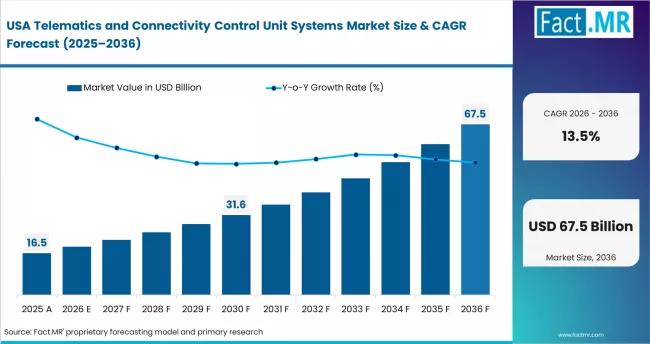
Telematics And Connectivity Control Unit Systems Market Country Value Analysis | Source: Fact.MR
North America is a mature, high-value telematics market. Growth is driven by insurance telematics and fleet digitisation. Qualcomm, Harman International, and NXP Semiconductors lead supply. OEM procurement cycles are long but stable.
United States: Platform-led expansion and insurance integration support 13.5% CAGR through 2036. General Motors OnStar and Ford Pro Intelligence expanded embedded telematics. Progressive Corporation and State Farm scaled usage-based insurance. National Highway Traffic Safety Administration is advancing data reporting mandates. Qualcomm secured long-term OEM contracts.
Fact.MR’s analysis covers United States, Canada, and Mexico. It includes fleet expansion and regulatory trends.
Europe Telematics and Connectivity Control Unit Systems Market Analysis
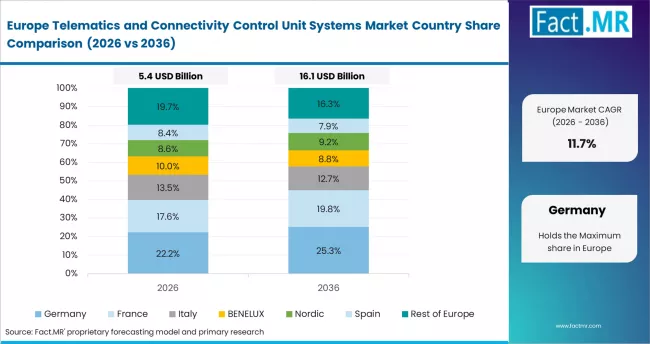
Telematics And Connectivity Control Unit Systems Market Europe Country Market Share Analysis, 2026 & 2036 | Source: Fact.MR
Europe is a compliance-led telematics market. eCall and GDPR shape procurement decisions. Continental AG, Robert Bosch, and Harman International lead supply. Certification complexity favours incumbents.
Germany: Regulation-driven integration supports 13.1% CAGR through 2036. EU eCall mandates baseline hardware across vehicles. Volkswagen Group expanded 5G telematics across SDV platforms. Continental AG and Robert Bosch secured OEM contracts. C-ITS corridors are accelerating V2X hardware demand.
Fact.MR’s analysis covers Germany, France, United Kingdom, Italy, Spain, and Rest of Europe. It includes compliance and deployment benchmarks.
Competitive Aligners for Market Players
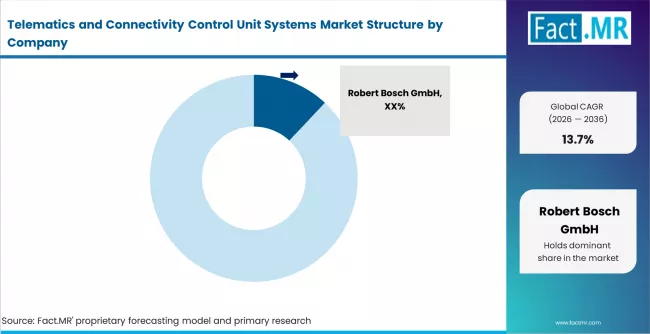
Telematics And Connectivity Control Unit Systems Market Analysis By Company | Source: Fact.MR
Competition in the telematics and connectivity control unit systems market is becoming more intense. OEMs are reducing supplier lists and tightening certification requirements. This is pushing the market toward a more controlled, performance-driven environment.
The space is moderately concentrated. Large Tier-1 suppliers and semiconductor companies set the pace. Differentiation is no longer about basic hardware. It now depends on multi-protocol certification, 5G capability, and V2X readiness.
Robert Bosch and Continental AG hold strong positions due to long-standing OEM relationships. They offer vertically integrated connectivity systems and already meet global certification standards. Their strength comes from multi-year platform contracts rather than pricing competition. Both are actively investing in 5G and V2X to stay aligned with evolving OEM requirements.
At the semiconductor level, Qualcomm and NXP Semiconductors bring a different advantage. Their chip platforms combine 5G modem, V2X, and security into single solutions. This gives them influence over how telematics systems are designed and specified. Harman International benefits from its ability to integrate software and hardware into unified systems. LG Electronics is expanding steadily, especially in fleet telematics across Asia. On the buyer side, large OEMs such as Volkswagen Group, Toyota, General Motors, and Hyundai Motor Group hold strong negotiating power. They rely on a few certified suppliers but maintain strict approval standards.
Key Players
Robert Bosch GmbH
Continental AG
Denso Corporation
Harman International Industries, Inc.
LG Electronics Inc.
Qualcomm Incorporated
NXP Semiconductors N.V.
Huawei Technologies Co., Ltd.
Bibliography
[1] Robert Bosch GmbH. (Q2 2024). Investor Relations: Connected Mobility Division EUR 400 Million Capital Allocation for 5G Embedded Telematics Control Unit Production Expansion at Stuttgart and Suzhou Facilities Targeting European and Chinese OEM Software-Defined Vehicle Programmes. Q2 2024. bosch.com/investor-relations
[2] Qualcomm Incorporated. (Early 2025). Product Launch: Snapdragon Auto 5G Modem-RF Gen 2 Platform for Automotive Embedded Telematics Control Units Integrating 5G NR Modem and C-V2X Capability for OEM Next-Generation Connected Vehicle Hardware Programmes. January 2025. qualcomm.com/products/automotive
[3] European Telecommunications Standards Institute. (2024). ETSI C-V2X Certification Activity Report 2024: 34% Growth in Automotive C-V2X Equipment Certifications Driven by European C-ITS Corridor Deployments and China National V2X Pilot Programme Vehicle Unit Requirements. 2024. etsi.org
[4] NXP Semiconductors N.V. (Q3 2024). Product Launch: SAF5400 Automotive-Grade V2X-to-5G Gateway Chipset for Telematics Control Unit Integration Supporting DSRC and C-V2X Standards Compliance for North American and European OEM Vehicle Platforms. Q3 2024. nxp.com/automotive
[5] Continental AG. (January 2025). Press Release: 5G Telematics Control Unit Supply Programme for Embedded Integration Across German OEM Passenger Vehicle Platform Scheduled for 2026 Production Supporting OTA Update and Remote Diagnostics Requirements. January 2025. continental.com/press
[6] Iridium Communications Inc. (2024). Annual Report 2024: Automotive Satellite Connectivity Module Shipment Growth of 22% Driven by Commercial Fleet Operators Expanding Operations into Low-Coverage Regions with Hybrid Cellular-Satellite Telematics Unit Deployments. 2024. iridium.com/investor-relations
This Report Addresses
Strategic intelligence on telematics and connectivity control unit demand across OEM embedded vehicle platforms, fleet telematics compliance, insurance usage-based programmes, and V2X infrastructure integration globally.
Market forecast from USD 20.1 billion in 2026 to USD 72.8 billion by 2036 at a CAGR of 13.7%.
Growth opportunity mapping across China C-ITS connected vehicle mandates, India AIS-140 fleet regulation demand, South Korea OEM platform scaling, Germany eCall compliance, and US insurance telematics expansion.
Segment analysis by system type (embedded, gateway, V2X), connectivity technology (cellular 4G/5G, satellite, hybrid), and end use (passenger, commercial, fleet).
Regional outlook covering Asia Pacific OEM platform-driven procurement, North America fleet and insurance telematics demand, and Europe eCall and C-ITS regulatory hardware investment.
Competitive analysis of Robert Bosch, Continental AG, Denso, Harman, LG Electronics, Qualcomm, NXP Semiconductors, and Huawei. Focus on 5G and V2X certification, OEM contract positioning, and chipset integration advantage.
Regulatory impact analysis covering EU eCall Regulation 2015/758, UN Regulation No. 155 cybersecurity requirements, India AIS-140 mandates, China ICV Technical Roadmap 2.0, and NHTSA connected vehicle rulemaking.
Report delivered in PDF, Excel datasets, and presentation formats. Supported by primary interviews, OEM sourcing disclosures, vehicle production data, regulatory compliance records, and telematics unit ASP benchmarks.
Telematics and Connectivity Control Unit Systems Market Definition
The market covers embedded and integrated hardware units managing vehicle telematics data acquisition, cellular and satellite connectivity, and V2X communication. Includes control units processing GPS location, vehicle diagnostics, and real-time connectivity across passenger cars, commercial trucks, and fleet vehicles. Used by OEMs, fleet operators, and insurance telematics providers globally.
Telematics and Connectivity Control Unit Systems Market Inclusions
Covers global and regional forecasts from 2026 to 2036. Includes system type, connectivity technology, and end use segments. Covers embedded, integrated gateway, and V2X control unit variants across 4G, 5G, satellite, and hybrid connectivity. Includes passenger, commercial, and fleet management applications through OEM and aftermarket channels.
Telematics and Connectivity Control Unit Systems Market Exclusions
Excludes standalone GPS navigation devices and discrete vehicle modems not integrated as control units. Omits finished telematics platform software and SaaS fleet management subscriptions. Excludes V2X roadside infrastructure hardware. Focus remains on vehicle-embedded connectivity control unit hardware and its immediate system-level integration.
Telematics and Connectivity Control Unit Systems Market Research Methodology
Primary Research:Interviews with OEM connectivity hardware teams, Tier 1 telematics suppliers, fleet procurement managers, and regulatory affairs specialists across key markets.
Desk Research:Uses NHTSA rulemaking disclosures, EU eCall Regulation data, ETSI C-ITS standards, and company data from Robert Bosch, Continental AG, Qualcomm, and NXP Semiconductors (2024-2025).
Market-Sizing and Forecasting:Hybrid model using OEM vehicle production volumes and telematics unit attachment rates. Includes average selling prices by unit type and connectivity tier across regions.
Data Validation and Update Cycle:Validated using OEM procurement volumes, shipment data, and connectivity unit ASP benchmarks. Cross-checked with industry specialists. Updated annually.
Market Breakdown
Segmentation
Scope of Report
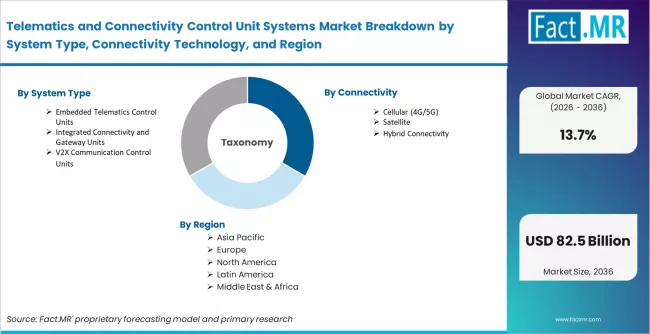
Telematics And Connectivity Control Unit Systems Market Breakdown By System Type, Connectivity Technology, And Region | Source: Fact.MR
Attribute
Details
Quantitative Units
USD 20.1 billion (2026) to USD 72.8 billion (2036), at a CAGR of 13.7%
Market Definition
Embedded and integrated telematics and connectivity control unit hardware managing GPS, cellular (4G/5G), satellite, and V2X communications in passenger vehicles, commercial trucks, and fleet vehicles for OEMs, fleet operators, and insurance telematics providers globally.
System Type Segmentation
Embedded Telematics Control Units, Integrated Connectivity and Gateway Units, V2X Communication Control Units
OEM embedded vehicle connectivity, fleet telematics compliance, insurance usage-based programmes, V2X infrastructure integration, software-defined vehicle OTA update hardware, and eCall emergency system mandates.
Regions Covered
North America, Europe, Asia Pacific, Latin America, Middle East and Africa
Countries Covered
USA, Canada, Mexico, Germany, UK, France, Italy, Spain, Nordic, BENELUX, China, Japan, South Korea, India, ASEAN, Australia and New Zealand, Brazil, Argentina, Chile, Saudi Arabia, GCC, Turkey, South Africa, Rest of MEA
Key Companies Profiled
Robert Bosch GmbH, Continental AG, Denso Corporation, Harman International Industries, LG Electronics Inc., Qualcomm Incorporated, NXP Semiconductors N.V., Huawei Technologies Co., Ltd.
Forecast Period
2026 to 2036
Approach
Hybrid top-down and bottom-up model using OEM vehicle production volumes by region, telematics unit attachment rates by vehicle class, average selling prices by connectivity tier, regulatory compliance mandates, and primary interviews with OEM connectivity hardware teams and fleet procurement specialists.
Source: Fact.MR analysis. Updated May 12, 2026
Telematics and Connectivity Control Unit Systems Market by Segments
By System Type:
Embedded Telematics Control Units
Integrated Connectivity and Gateway Units
V2X Communication Control Units
By Connectivity Technology:
Cellular (4G/5G)
Satellite
Hybrid Connectivity
By End Use:
Passenger Vehicles
Commercial Vehicles
Fleet Management
By Region:
North America
United States
Canada
Mexico
Latin America
Brazil
Mexico
Argentina
Chile
Rest of Latin America
Western Europe
Germany
United Kingdom
France
Italy
Spain
Nordic Countries
BENELUX
Rest of Western Europe
Eastern Europe
Russia
Poland
Hungary
Balkan and Baltic
Rest of Eastern Europe
East Asia
China
Japan
South Korea
South Asia and Pacific
India
ASEAN
Australia and New Zealand
Rest of South Asia and Pacific
Middle East and Africa
Kingdom of Saudi Arabia
Other GCC Countries
Turkey
South Africa
Rest of Middle East and Africa
Questions Answered
Frequently Asked Questions
How large is the global telematics and connectivity control unit systems market in 2025?
The global telematics and connectivity control unit systems market was valued at USD 17.2 billion in 2025.
What will the market size be in 2026?
Based on Fact.MR analysis, demand for telematics and connectivity control unit systems is estimated to grow to USD 20.1 billion in 2026.
What is the projected market size by 2036?
The market is projected to reach USD 72.8 billion by 2036, generating USD 52.7 billion in absolute dollar opportunity over the forecast period.
What is the expected CAGR from 2026 to 2036?
FACT.MR projects a CAGR of 13.7% for the global telematics and connectivity control unit systems market during the 2026 to 2036 forecast period.
Which system type segment is poised to lead the market?
Embedded Telematics Control Units lead with approximately 45% share in 2026, driven by OEM platform standardisation.
Which connectivity technology holds the largest share?
Cellular (4G/5G) leads with approximately 60% share in 2026, driven by OEM 5G upgrade cycles and network ubiquity.
Which country shows the fastest growth?
China leads at 15.2% CAGR through 2036, driven by the world's largest connected vehicle production base, C-ITS infrastructure rollout, and national V2X mandate requirements.
What is driving demand for telematics and connectivity control units?
Demand is driven by OEM software-defined vehicle mandates requiring embedded 5G hardware, fleet telematics regulations including AIS-140 and eCall, and usage-based insurance programme expansion.
What is the key challenge in this market?
Semiconductor supply constraints, long OEM cybersecurity certification cycles under UN Regulation No. 155, and high V2X hardware qualification costs constrain new entrant participation and slow supply diversification.
.webp "Top Country Growth Comparison Telematics And Connectivity Control Unit Systems Market Cagr (2026 2036)")