- Market Value (2025): USD 364.4 Mn
- Estimated Value (2026): USD 430.0 Mn
- Forecast Value (2036): USD 2251.0 Mn
- CAGR (2026-2036): 18.0%
What is the Flushable Packaging Substrates Market forecast to be worth by 2036?
USD 430.0 million in 2026 to USD 2,251.0 million by 2036 at an 18.0% CAGR.
- The Flushable Packaging Substrates Market reached USD 364.4 million in 2025.
- Demand is projected to increase from USD 430.0 million in 2026 to USD 2,251.0 million by 2036.
- The market is forecast to record 18.0% CAGR from 2026 to 2036 as food brands and personal care converters tighten proof requirements for post-use material behavior.
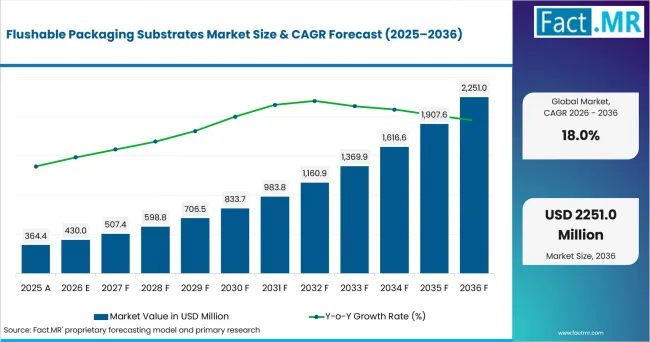
Flushable Packaging Substrates Market Value Analysis | Source: Fact.MR
What are the defining numbers behind Flushable Packaging Substrates Market growth?
USD 1,821.0 million absolute opportunity by 2036, led by bio-polymers, coating formats and food packaging.
- Demand Drivers in the Market
- Food brands need barrier substrates that protect moisture-sensitive packs while reducing dependence on difficult multi-material plastic films.
- USDA ERS reported in August 2026 that food-at-home prices in July 2026 were 2.7% higher than in July 2025. Cost pressure is making shelf-life protection and waste control part of substrate selection.
- The European Commission reported in August 2026 that new EU packaging rules require all packaging to be recyclable, with key recyclability requirements applying from 2030. Converters therefore need materials with clearer end-of-life evidence.
- Personal care converters need dispersible substrate structures that keep wet strength during use and break down under defined flushability tests.
- Foodservice operators need coated wraps and sachet webs that run on familiar equipment while improving post-use instructions for customers.
- Key Segments Analyzed
- By Material: Bio-polymers are expected to hold 38.0% share in 2026, supported by their role in water-soluble films and low-plastic barrier layers.
- By Format: Coating is projected to account for 41.0% share in 2026 because converters add barrier or dispersion control to paper and cellulose webs.
- By Function: Barrier protection is anticipated to capture 36.0% share in 2026 owing to demand for grease, oxygen and moisture control in food packaging.
- By Application: Food packaging is estimated to represent 40.0% share in 2026, led by packs that need short-use convenience and clearer disposal guidance.
- Analyst Opinion at Fact.MR
- Shambhu Nath Jha, Principal Consultant at Fact.MR, states, "Flushable packaging substrates are drawing attention because the buyer is asking for proof of both protection and post-use behavior. The category is expected to favor suppliers that provide barrier data, line fit and disposal performance in the same qualification file. Coating science, cellulose compatibility and verified test records are becoming more valuable than a material claim alone."
- Strategic Implications
- Converters should validate dispersion, seal strength and barrier data before moving flushable substrates onto high-speed packaging lines.
- Food brands should match substrate choice to product moisture and grease exposure so disposal language remains aligned with shelf-life needs.
- Personal care manufacturers should document flushability and wastewater behavior before using flushable language on retail packaging.
- Material suppliers should provide food-contact statements, fiber sourcing records and end-of-life test data in the first qualification package.
The USA is projected to record 19.8% CAGR through 2036, supported by food retail scale and short-use packaging trials. Germany is anticipated to post 18.9% CAGR as packaging rules push converters toward recyclable and documented formats. Japan is estimated to reach 17.6% CAGR through convenience-food use and waste-reduction pressure. France is forecast to advance at 16.9% CAGR, reflecting concentrated food retail channels and producer responsibility rules. Brazil is projected to hold 16.2% CAGR as packaged food demand and reverse-logistics requirements guide substrate decisions.
How does the Flushable Packaging Substrates Market break down by segment?
Bio-polymers lead Material at 38.0%; food packaging leads Application at 40.0%.
Which Material dominates?
Bio-polymers hold 38.0% share in 2026.
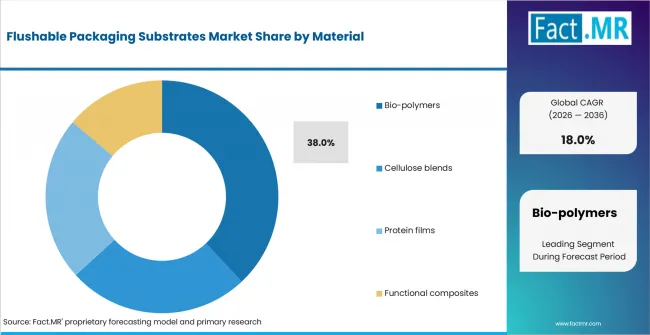
Flushable Packaging Substrates Market Analysis By Material | Source: Fact.MR
Bio-polymers lead Material because they give substrate suppliers a route to water-soluble, compostable or bio-based claims while retaining package strength. Packaging teams still require proof of sealability and food-contact compliance, so documentation depth shapes adoption alongside resin chemistry. Materials that combine predictable dispersion with heat-seal stability are expected to gain earlier use in wraps and small sachets than bulk rigid formats.
What leads the Format segment?
Coating accounts for 41.0% share in 2026.
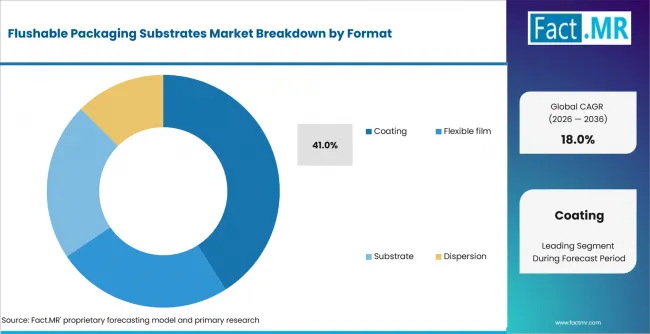
Flushable Packaging Substrates Market Analysis By Format | Source: Fact.MR
Coating leads Format segmentation because coatings can add barrier or dispersion control to familiar paper and cellulose webs. Mondi plc expanded FunctionalBarrier Paper Ultimate in August 2025, offering a high-barrier paper solution with OTR below 0.5 cm3/m2d; Mondi plc describes it as recyclable/high-barrier packaging rather than flushable packaging.
How does Function shape demand?
Barrier protection captures 36.0% share in 2026.
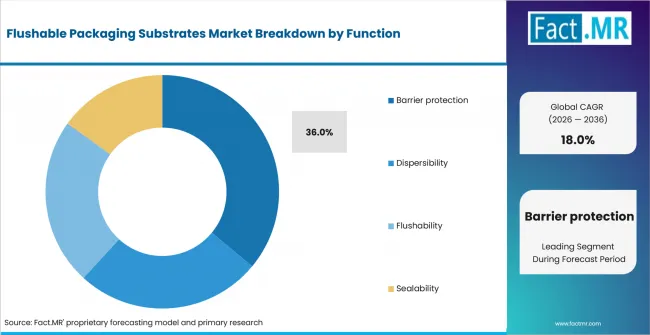
Flushable Packaging Substrates Market Analysis By Function | Source: Fact.MR
Barrier protection leads Function because flushable and dispersible substrates still need to protect food from grease, oxygen and moisture. Water-soluble or fiber-based formats gain value when a coating keeps the product safe during use and supports a cleaner disposal path after use.
What supports food packaging within Application?
Food packaging represents 40.0% share in 2026.
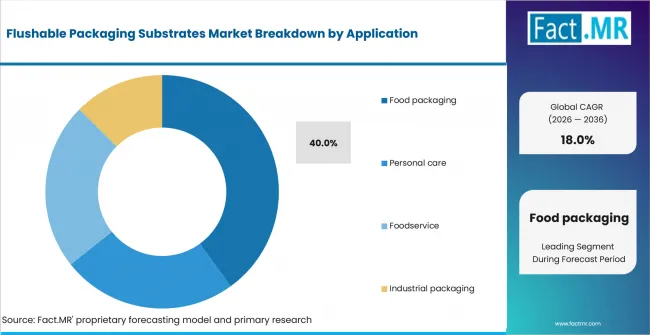
Flushable Packaging Substrates Market Analysis By Application | Source: Fact.MR
Food packaging leads Application because wraps, sachets and flexible packs create repeated routes for coated substrates. Eurostat reported in October 2025 that the EU generated 79.7 million tonnes of packaging waste in 2023, equivalent to 177.8 kg per inhabitant.
What is accelerating Flushable Packaging Substrates Market adoption, and what is holding it back?
Adoption rises through barrier-coated substrates and food packaging trials; growth is constrained by flushability proof and food-contact review.
Drivers Impact Analysis
| DRIVER | (~) % IMPACT ON CAGR | GEOGRAPHIC RELEVANCE | IMPACT TIMELINE |
| Barrier coatings replacing multilayer plastic in short-use packs | +2.1% | North America, Western Europe | Short term (<= 2 years) |
| Bio-polymer and cellulose substrate qualification | +1.7% | Global | Medium term (2-4 years) |
| Dispersible personal care trials | +1.2% | Japan, Western Europe | Medium term (2-4 years) |
| Foodservice wraps and sachets | +0.8% | North America, Latin America | Short term (<= 2 years) |
- Barrier coatings replacing multilayer plastic: Coated paper and cellulose formats are expected to reduce hard-to-separate layers while keeping grease and moisture protection.
- Bio-polymer and cellulose substrate qualification: Converters prefer materials that run on familiar equipment and arrive with food-contact records.
- Dispersible personal care trials: Hygiene packaging is anticipated to create a route when suppliers prove wet strength and dispersion behavior together.
- Foodservice wraps and sachets: Single-use formats add volume potential where disposal guidance is simple and package protection remains stable.
Opportunity Impact Analysis
| OPPORTUNITY | (~) % IMPACT ON CAGR | GEOGRAPHIC RELEVANCE | IMPACT TIMELINE |
| Water-soluble coatings for sachets and small packs | +1.3% | Global | Medium term (2-4 years) |
| Protein and cellulose blends for low-plastic flexible films | +1.0% | Europe, Japan | Long term (>= 4 years) |
| Certified flushable materials for personal care packaging | +0.7% | North America, Western Europe | Medium term (2-4 years) |
- Water-soluble coatings: Suppliers gain trials where small packs need sealability and controlled dispersion after use.
- Protein and cellulose blends: Hybrid materials reduce conventional plastic exposure while retaining texture and stiffness for flexible packs.
- Certified flushable materials: Personal care brands move faster when packages show dispersibility, biodegradation and wastewater compatibility evidence.
Restraints Impact Analysis
| RESTRAINT | (~) % IMPACT ON CAGR | GEOGRAPHIC RELEVANCE | IMPACT TIMELINE |
| Inconsistent flushability and wastewater acceptance criteria | -0.7% | Global | Short term (<= 2 years) |
| Food-contact and traceability documentation burden | -0.5% | North America, Europe | Medium term (2-4 years) |
| Higher qualification cost for bio-polymers and coated substrates | -0.4% | Global | Long term (>= 4 years) |
- Inconsistent flushability and wastewater acceptance criteria: Water utilities require test results before consumer-facing language reaches retail packaging.
- Food-contact and traceability documentation burden: Packaging teams must prove coatings and substrates fit the product and geography.
- Higher qualification cost: Bio-polymers and coated substrates require tests that slow conversion from low-cost plastic films.
Which countries are scaling the Flushable Packaging Substrates Market through 2036?
- The country comparison spans 3.6 percentage points between the USA and Brazil across the forecast period.
- The USA remains 0.9 percentage point above Germany as retail scale gives converters a broad trial base.
- Germany remains 1.3 percentage points above Japan with packaging waste rules and recycling evidence shaping substrate approval.
- Japan remains 0.7 percentage point above France through convenience-food formats and waste-reduction pressure.
- France remains 0.7 percentage point above Brazil as food retail concentration supports standard substrate testing.
- Brazil closes the displayed range as plastic packaging reverse logistics guides material review.
Comparable CAGRs create different entry conditions due to packaging scale, disposal rules, converter documentation and retail channel structure. Full report coverage includes North America, Latin America, Western Europe, Eastern Europe, East Asia, South Asia & Pacific, Middle East & Africa.
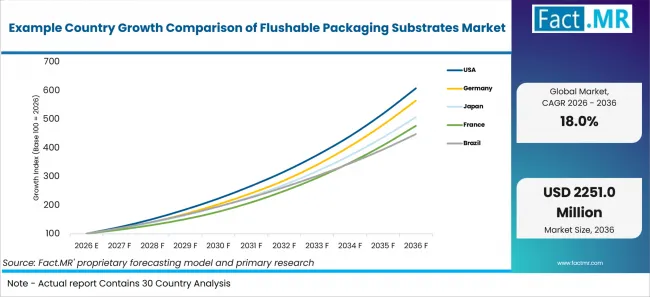
Example Country Growth Comparison Of Flushable Packaging Substrates Market | Source: Fact.MR
| Country | CAGR (2026-2036) |
|---|---|
| USA | 19.8% |
| Germany | 18.9% |
| Japan | 17.6% |
| France | 16.9% |
| Brazil | 16.2% |
What supports USA adoption?
19.8% CAGR, supported by retail scale and food packaging cost control.
The U.S. Census Bureau reported in August 2026 that July 2026 retail and food-service sales reached USD 763.6 billion. That sales base gives food brands and foodservice operators a broad route for testing coated paper, water-soluble films and bio-polymer substrates. USA adoption is expected to track above other profiled countries because packaging trials scale across large grocery and foodservice accounts once barrier and disposal evidence is accepted.
How is Germany scaling demand?
18.9% CAGR, shaped by packaging waste pressure and EU design rules.
The German Environment Agency reported in April 2026 that Germany’s packaging consumption totaled 17.92 million tonnes in 2023. That volume keeps packaging prevention and recovery performance high on converter qualification files. Germany is anticipated to scale flushable packaging substrates through coated cellulose and bio-polymer formats that support product protection while matching EU recycling and material-evidence expectations.
What supports Japan adoption?
17.6% CAGR, linked to convenience formats and waste reduction needs.
Japan’s Ministry of the Environment reported in June 2025 that FY2023 food loss and waste was 4.64 million tonnes. Shelf-life protection and clearer disposal guidance relevant for convenience food packs. Japan is estimated to use flushable substrates where compact formats need moisture control and consumer instructions that match local waste-handling expectations.
How is France developing demand?
16.9% CAGR, supported by food retail concentration and circular packaging rules.
INSEE reported in June 2026 that large general food stores represented 58.6% of French food-product retail trade in 2025. That channel concentration makes standardized substrate tests easier across wraps, sachets and coated food packs. France is forecast to develop through paper-adjacent materials that pair barrier protection with clear sorting or disposal instructions for retailers and brands.
How does Brazil perform?
16.2% CAGR, led by packaged food demand and plastic packaging reverse logistics.
Brazil’s Decree No. 12,688 of October 2025 set a 32% national recovery-index target for plastic packaging in 2026. That policy keeps packaging recovery evidence central for brand owners and converters. Brazil is projected to expand through selected foodservice and personal care uses where lower plastic exposure and documented post-use behavior support regional launch decisions.
Which companies are the key providers?
Key companies include Magnera Corporation, Suominen Corporation, Mondi plc, Aquapak Polymers Ltd., and Kuraray Co., Ltd. / MonoSol, LLC.
- Magnera Corporation
- Suominen Corporation
- Mondi plc
- Aquapak Polymers Ltd.
- Kuraray Co., Ltd. / MonoSol, LLC
Bibliography
- U.S. Census Bureau. (2026, August 14). Advance monthly sales for retail and food services.
- U.S. Department of Agriculture, Economic Research Service. (2026, August 25). Food Price Outlook: Summary Findings.
- Directorate-General for Communication. (2026, August 12). New packaging rules for less waste and easier recycling. European Commission.
- Mondi. (2025, August 14). Mondi ramps up FunctionalBarrier Paper Ultimate to meet growing demand for sustainable high-barrier paper-based packaging.
- Cayé, N., Größl, B., Müller, S., Nguyen, U., & Schüler, K. (2026, April). Aufkommen und Verwertung von Verpackungsabfällen in Deutschland im Jahr 2023 [Generation and recovery of packaging waste in Germany in 2023] (Texte 66/2026). Umweltbundesamt.
- Ministry of the Environment, Government of Japan. (2025, June 27). MOE Japan discloses the estimated amount of Japan's food loss and waste generated in FY2023.
- Institut national de la statistique et des études économiques. (2026, June 18). Parts de marché du commerce de détail selon la forme de vente: Données annuelles 2025.
- Presidência da República. (2025, October 21). Decreto nº 12.688, de 21 de outubro de 2025.
- Eurostat. (2025, November 5). Packaging waste statistics. Statistics Explained.
- Service des données et études statistiques. (2026, March 27). Gestion des déchets et économie circulaire en France – État des connaissances en 2025.
- Aquapak Polymers Ltd. (2025, March 12). Hydropol™ set to revolutionise disposable hygiene products, making them dissolvable, fully flushable, microplastic free and preventing them forming fatbergs.
- Kuraray. (2025, July 15). Kuraray pioneers sustainable packaging with innovative barrier materials.
- Magnera Corporation. (2025, December 3). Magnera introduces innovative solution for healthcare and beyond, focusing on safety and sustainability.
This Report Answers
- The report explains where flushable packaging substrates are used across material, format, function, application and region.
- Segment analysis identifies why converters prioritize coated bio-polymer and cellulose-based substrates.
- Country analysis examines retail, waste and packaging rules that influence substrate qualification.
- Competitive analysis reviews providers across fibers, nonwovens, soluble polymers and barrier papers.
- Application analysis assesses how barrier protection and flushability affect food packaging and personal care formats.
What does the Flushable Packaging Substrates Market cover?
The Flushable Packaging Substrates Market covers materials that protect products during use and disperse or dissolve more predictably after disposal. Adjacent coverage includes water-soluble packaging, biopolymer films, biodegradable packaging material and bioplastics for packaging where material choice affects pack protection and end-of-life claims.
The assessment covers substrates and coated webs used in food packaging, personal care, foodservice and industrial packaging. Related inputs include compostable heat-seal coatings, bio-based laminate packaging materials, compostable cartonboard coatings and water-soluble pouches where the material layer carries the protective function.
What is included in the scope?
The scope includes supplied substrates, coated webs, soluble films, dispersible nonwovens used as packaging layers and functional composites. Materials qualify when flushability, controlled dispersion or dissolution is part of the packaging value proposition.
The market sits next to sustainable plastic packaging and zero waste packaging, but the counted revenue centers on substrate materials sold for controlled post-use behavior and product protection.
What is excluded from the scope?
Finished hygiene products, ordinary plastic films and packaging machinery sold separately from a flushable substrate remain outside scope. Finished packs are counted only when substrate revenue is identifiable within the material sale.
General paperboard, commodity film and broad recycling services remain adjacent categories. The market boundary stays centered on substrate materials that combine barrier, dispersibility, flushability or sealability functions. Packaging services enter the analysis only when they influence substrate choice or qualification timing.
How Was the Analysis Built?
The analysis draws on 120+ sources, 35+ company portfolios, 25+ countries, and more than 20 industry interviews.
- Primary Research: Primary research includes discussions with manufacturers, service providers, technology developers, distributors, end users, and subject-matter experts. These conversations examine purchasing priorities, product adoption, operational challenges, approval requirements, competitive positioning, and the factors that influence wider market acceptance.
- Desk Research: Desk research covers government statistics, regulatory publications, company filings, trade data, technical studies, industry associations, standards, public policy, and other authoritative sources. Every source used in the analysis is documented in the bibliography.
- Market Sizing and Forecasting: Market estimates combine historical performance, demand indicators, pricing and volume trends, segment shares, company participation, country-level growth, adoption patterns, investment activity, and barriers to market expansion.
- Data Validation and Update Cycle: Findings are validated by comparing primary interviews with public data, company activity, regulatory changes, trade patterns, and industry developments. Regular updates review new product launches, capacity changes, partnerships, approvals, and shifts in commercial adoption.
What is the report’s scope and coverage?
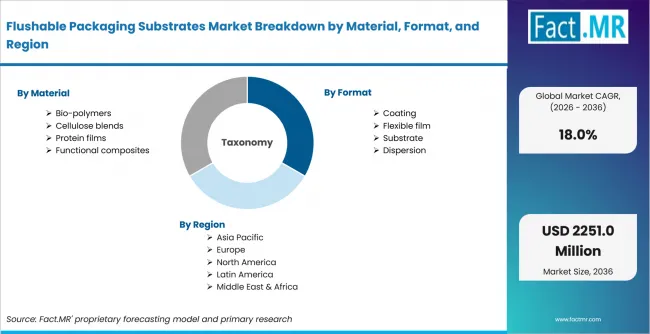
Flushable Packaging Substrates Market Breakdown By Material, Format, And Region | Source: Fact.MR
| Attribute | Details |
|---|---|
| Quantitative Units | USD million |
| Market Definition | Packaging substrates designed for controlled dispersion, dissolution or flushable disposal while maintaining product protection during use. The scope includes bio-polymers, cellulose blends, protein films, functional composites and coating formats. |
| Material | Bio-polymers; Cellulose blends; Protein films; Functional composites |
| Format | Coating; Flexible film; Substrate; Dispersion |
| Function | Barrier protection; Dispersibility; Flushability; Sealability |
| Application | Food packaging; Personal care; Foodservice; Industrial packaging |
| Regions Covered | North America; Latin America; Western Europe; Eastern Europe; East Asia; South Asia & Pacific; Middle East & Africa |
| Countries Covered | USA; Germany; Japan; France; Brazil |
| Key Companies Profiled | Magnera Corporation; Suominen Corporation; Mondi plc; Aquapak Polymers Ltd.; Kuraray Co., Ltd. / MonoSol, LLC |
| Forecast Period | 2026 to 2036 |
| Approach | Hybrid top-down and bottom-up approach using substrate adoption, format mix, function demand, application use, country growth and provider portfolio review. |
How is the market segmented?
-
By Material
- Bio-polymers
- Cellulose blends
- Protein films
- Functional composites
-
By Format
- Coating
- Flexible film
- Substrate
- Dispersion
-
By Function
- Barrier protection
- Dispersibility
- Flushability
- Sealability
-
By Application
- Food packaging
- Personal care
- Foodservice
- Industrial packaging
-
By Region
- North America
- Latin America
- Western Europe
- Eastern Europe
- East Asia
- South Asia & Pacific
- Middle East & Africa