- Market Value (2025): USD 135.7 Mn
- Estimated Value (2026): USD 138.2 Mn
- Forecast Value (2036): USD 166.2 Mn
- CAGR (2026-2036): 1.9%
What is the Fluvastatin Sodium Drug Market forecast to be worth by 2036?
USD 138.2 million in 2026 to USD 166.2 million by 2036 at a 1.9% CAGR.
- At USD 135.7 million in 2025, the fluvastatin sodium drug market rested on a stable base of patients who take the drug every day for years.
- Revenue will move from USD 138.2 million in 2026 to USD 166.2 million by 2036 as screening programs identify more adults who need lipid-lowering therapy.
- A 1.9% CAGR reflects a mature generic product whose prices are already low, with volume gains offset by patients moving to newer statins.
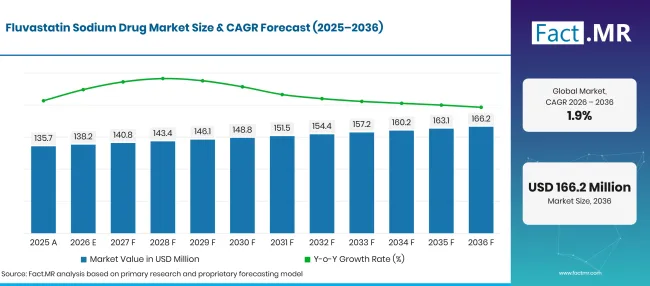
Fluvastatin Sodium Drug Market Forecast Global | Source: Fact.MR
| Year | Basis | Market Value (USD million) |
|---|---|---|
| 2025 | Actual | 135.7 |
| 2026 | Estimate | 138.2 |
| 2036 | Forecast | 166.2 |
| CAGR 2026 to 2036 | Forecast period | 1.9% |
Source: Fact.MR analysis. Updated Nov 2, 2026
What are the defining numbers behind Fluvastatin Sodium Drug Market growth?
The 2026 to 2036 period adds USD 28.0 million in new value, mostly from repeat tablet prescriptions dispensed through hospital and retail pharmacies.
- Demand Drivers in the Market
- The World Health Organization reports that cardiovascular disease caused about 19.8 million deaths in 2022. That equals roughly 32% of all global deaths and keeps lipid control a public health priority [1].
- The 2026 ACC/AHA dyslipidemia guideline uses the PREVENT-ASCVD equations for primary-prevention decisions and brings back LDL-C and non-HDL-C treatment goals, which gives doctors a clearer trigger to start and adjust statin therapy [2].
- The 2025 ESC/EAS focused update reviewed evidence on high-dose statin and ezetimibe combinations, as well as earlier intensification during hospital stays for acute coronary syndrome, keeping statins at the center of European lipid care [3].
- Diseases of the circulatory system caused 32.8% of all deaths in the European Union in 2023, which keeps cholesterol control a standing priority for national health systems [4].
- Key Segments Analyzed
- By Formulation: Tablets will hold 62.5% share in 2026, since once-daily extended-release dosing suits patients on lifelong therapy.
- By Application: Hypercholesterolemia will account for 64.6% of 2026 revenue, as lowering LDL cholesterol is the core labeled use of the drug.
- By Distribution Channel: Hospital Pharmacies will capture 42.3% in 2026, given that many patients start statins during or after a cardiac admission.
- By End-User: Hospitals will represent 62.2% of 2026 value, owing to their role in diagnosing lipid disorders and setting long-term treatment plans.
- Analyst Opinion at Fact.MR
- Shambhu Nath Jha, Principal Consultant at Fact.MR, states, “Fluvastatin sodium will keep a loyal base of patients who tolerate it well and have no reason to switch. Its growth will come from steady refills and wider cholesterol screening, not from new indications. Suppliers that secure consistent tablet quality and dependable hospital contracts will hold their position through 2036.”
- Strategic Implications
- Manufacturers should protect extended-release tablet supply and keep product registrations current in each market they serve, as small generic portfolios are easy to lose through lapsed licences.
- Distributors should tie hospital tenders to retail refill networks so that patients discharged on fluvastatin can continue treatment without a gap.
- Hospital buyers should weigh supply reliability and API sourcing records alongside unit price when awarding statin contracts.
- Investors should treat fluvastatin as a cash-generating niche asset whose value lies in stable volume and low promotional cost.
Germany will lead the five-country group at 2.5%, helped by a heavy cardiovascular burden and broad statutory insurance coverage of lipid care. The United Kingdom follows at 2.2%, where routine health checks find raised cholesterol in nearly half of adults. Growth in the United States will reach 1.9%, held back by deep generic price competition despite a large treated population. Brazil will advance at 1.6% as rising cardiometabolic risk meets tight household budgets, while Japan closes the range at 1.3% within a mature market that prefers newer agents. The full spread is 1.2 points, with each step between neighbors at 0.3 points.
How does the Fluvastatin Sodium Drug Market break down by segment?
Tablets will lead Formulation at 62.5%; Hypercholesterolemia will head Application at 64.6%; Hospital Pharmacies will top Distribution Channel at 42.3%; Hospitals will hold End-User at 62.2% in 2026.
Which Formulation leads?
Tablets take 62.5% of 2026 sales.
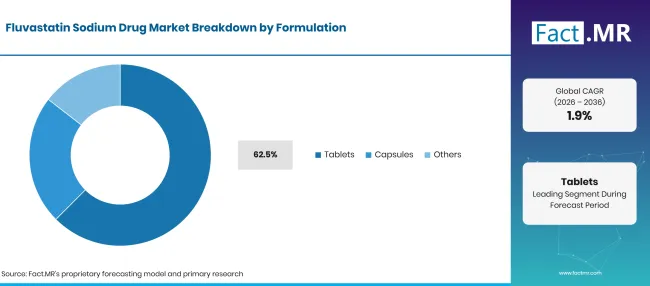
Fluvastatin Sodium Drug Market Breakdown Formulation 1 | Source: Fact.MR
| Formulation | Share (2026) |
|---|---|
| Tablets (Leading segment) | 62.5% |
| Other segments combined | 37.5%* |
| Total | 100.0% |
Source: Fact.MR analysis. Updated Nov 2, 2026
Patients on long-term lipid therapy value a single daily dose, and the 80 mg extended-release tablet delivers exactly that. The FDA label for fluvastatin sodium extended-release tablets, revised in March 2026, covers LDL-C reduction in adults with primary hyperlipidemia and in patients aged 10 years and older with heterozygous familial hypercholesterolemia [5]. Tablet production also fits the existing film-coating and bottling lines of generic manufacturers. Capsules in 20 mg and 40 mg strengths serve patients who start on a lower dose or need gradual titration. Other presentations fill narrow needs in specific national markets and hold a small part of revenue.
What supports Hypercholesterolemia within Application?
Hypercholesterolemia represents 64.6% of 2026 revenue.
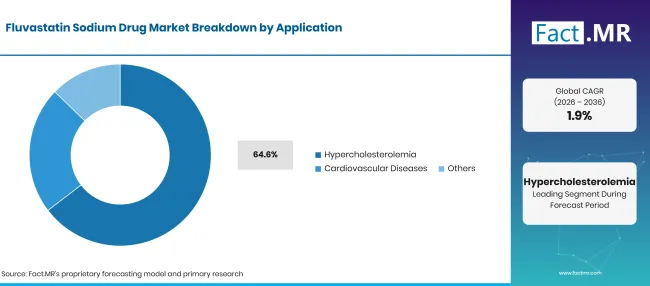
Fluvastatin Sodium Drug Market Breakdown Application | Source: Fact.MR
| Application | Share (2026) |
|---|---|
| Hypercholesterolemia (Leading segment) | 64.6% |
| Other segments combined | 35.4%* |
| Total | 100.0% |
Source: Fact.MR analysis. Updated Nov 2, 2026
Elevated LDL cholesterol is the condition most directly addressed by every fluvastatin label, so prescribing concentrates here. Patients needing deeper reductions may move to cholesterol-lowering biologic drugs later in care. Treatment usually continues for years once started, and the return of LDL-C goals in the 2026 ACC/AHA guideline gives doctors a measurable target to track [2]. Each follow-up test that confirms control tends to keep a patient on the same drug. Cardiovascular disease applications cover patients with established coronary heart disease, where the label supports reducing the risk of revascularization procedures [5]. Fluvastatin also competes with other atherosclerosis drugs in this group. These patients often receive more potent statins first, which limits the share fluvastatin can win in this group.
How does Distribution Channel shape demand?
Hospital Pharmacies account for 42.3% of 2026 market value.
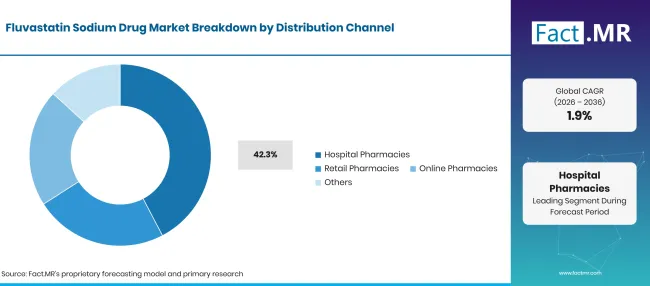
Fluvastatin Sodium Drug Market Breakdown Distribution Channel | Source: Fact.MR
| Distribution Channel | Share (2026) |
|---|---|
| Hospital Pharmacies (Leading segment) | 42.3% |
| Other segments combined | 57.7%* |
| Total | 100.0% |
Source: Fact.MR analysis. Updated Nov 2, 2026
Cardiac admissions are a common point where lipid-lowering therapy begins or changes, often alongside acute coronary syndrome therapeutics. Hospital pharmacies dispense the first supply at discharge and stock fluvastatin for inpatients who were already taking it. Their bulk purchasing through tenders also gives them a strong voice on price and supplier choice. Retail pharmacies handle most repeat prescriptions once a patient returns to community care. Online pharmacies serve patients with stable regimens in markets that permit remote dispensing, and other channels cover institutional and specialty buyers.
How does End-User shape demand?
Hospitals comprise 62.2% of 2026 market revenue.
| End-User | Share (2026) |
|---|---|
| Hospitals (Leading segment) | 62.2% |
| Other segments combined | 37.8%* |
| Total | 100.0% |
Source: Fact.MR analysis. Updated Nov 2, 2026
Diagnosis of severe or familial lipid disorders often happens in hospital clinics, where specialists set the first treatment plan. Hospital physicians also review response and tolerance, then decide whether to keep a patient on fluvastatin or switch to another agent. That decision point gives hospitals a strong influence over long-term volume. Clinics manage routine follow-up and repeat prescriptions for patients whose cholesterol is under control. Other care settings, such as nursing homes and outpatient centers, add steady but smaller volumes. Older residents often take fluvastatin alongside other geriatric medicines for chronic conditions.
What is accelerating Fluvastatin Sodium Drug Market adoption, and what is holding it back?
Wider cardiovascular risk screening and clear LDL-C goals in new guidelines keep a steady flow of patients into statin therapy. Generic supply keeps fluvastatin affordable for long-term use in hospital and retail settings. On the other side, atorvastatin and rosuvastatin achieve deeper LDL reductions and attract most new prescriptions. Low generic prices and a shrinking number of suppliers also limit how much revenue each new patient adds.
Drivers Impact Analysis
| DRIVER | (~) % IMPACT ON CAGR | GEOGRAPHIC RELEVANCE | IMPACT TIMELINE |
|---|---|---|---|
| Continued statin prescriptions for patients diagnosed with hypercholesterolemia | +0.7% | Global | Short term (<=2 years) |
| Wider cholesterol screening and cardiovascular risk assessment in primary care | +0.5% | North America, Europe | Medium term (2-4 years) |
| Availability of low-cost generic fluvastatin capsules and extended-release tablets | +0.4% | Global | Short term (<=2 years) |
| Hospital-based initiation and follow-up of patients with cardiovascular risk factors | +0.3% | Europe, Asia Pacific | Medium term (2-4 years) |
Source: Fact.MR analysis. Updated Nov 2, 2026
Opportunity Impact Analysis
| OPPORTUNITY | (~) % IMPACT ON CAGR | GEOGRAPHIC RELEVANCE | IMPACT TIMELINE |
|---|---|---|---|
| Expansion of generic API and finished-dose production for established statins | +0.4% | India, Europe | Medium term (2-4 years) |
| Wider access to prescription refills through retail and online pharmacies | +0.3% | Asia Pacific, Latin America | Medium term (2-4 years) |
| Stronger hospital pharmacy purchasing linked to cardiovascular care pathways | +0.2% | Global | Short term (<=2 years) |
| Use as a lower-dose option for patients who do not tolerate potent statins | +0.2% | Global | Long term (>=4 years) |
Source: Fact.MR analysis. Updated Nov 2, 2026
Restraints Impact Analysis
| RESTRAINT | (~) % IMPACT ON CAGR | GEOGRAPHIC RELEVANCE | IMPACT TIMELINE |
|---|---|---|---|
| Competition from other generic statins, including atorvastatin and rosuvastatin | -0.5% | Global | Short term (<=2 years) |
| Limited clinical differentiation of fluvastatin within the statin class | -0.4% | North America, Europe | Medium term (2-4 years) |
| Price erosion from generic competition and hospital tendering | -0.3% | Global | Short term (<=2 years) |
| Greater use of combination therapy and non-statin lipid-lowering medicines | -0.2% | Europe, North America, Japan | Long term (>=4 years) |
Source: Fact.MR analysis. Updated Nov 2, 2026
Which countries are scaling the Fluvastatin Sodium Drug Market through 2036?
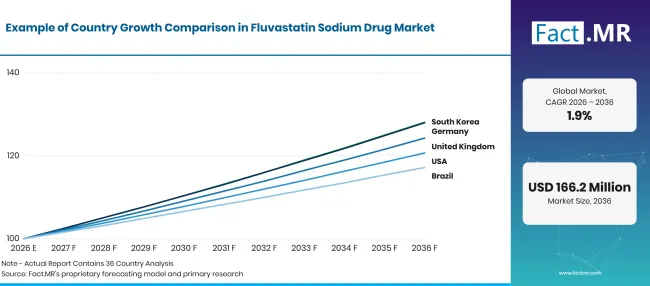
Fluvastatin Sodium Drug Market Growth Index | Source: Fact.MR
| Country | CAGR (2026 to 2036) |
|---|---|
| Germany | 2.5% |
| United Kingdom | 2.2% |
| United States | 1.9% |
| Brazil | 1.6% |
| Japan | 1.3% |
Source: Fact.MR analysis. Updated Nov 2, 2026
What supports fluvastatin sodium adoption in Germany?
2.5% CAGR, driven by a heavy cardiovascular disease burden and wide statutory insurance coverage.
Germany’s ageing population carries a large and lasting need for lipid-lowering care. The Federal Statistical Office recorded 68,098 deaths from chronic ischaemic heart disease in 2025, the most common single cause among circulatory deaths [6]. Statutory health insurance reimburses generic statins, so patients stable on fluvastatin face little cost pressure to switch. Prescribers in Germany also follow the ESC/EAS framework, which keeps statins as the base of most treatment plans [3].
How is the United Kingdom developing demand?
2.2% CAGR, backed by routine NHS health checks and a high prevalence of raised cholesterol.
The Health Survey for England, published in January 2026, found raised total cholesterol in 48% of adults in 2024. Women were more affected at 50%, against 45% of men [7]. This large pool gives primary care a constant flow of patients for risk assessment and statin review. Generic prescribing is standard in the NHS, which keeps fluvastatin in use for patients who respond well to it.
What is supporting United States adoption?
1.9% CAGR, reflecting a large treated population and updated national guidance.
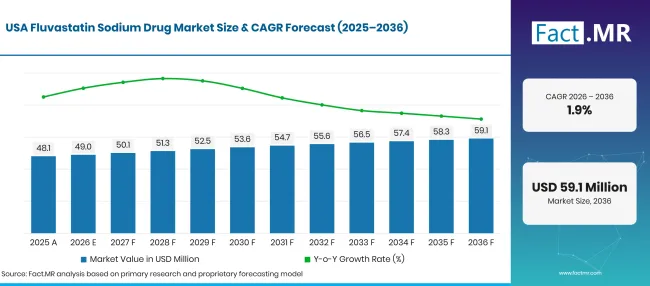
Fluvastatin Sodium Drug Market Forecast Usa | Source: Fact.MR
Heart disease remained the top cause of death in the United States in 2024, with 683,491 deaths recorded by the National Center for Health Statistics [8]. The March 2026 ACC/AHA guideline introduced PREVENT-ASCVD risk equations and restored LDL-C treatment goals [2]. Several generic labelers market fluvastatin capsules and extended-release tablets, which keeps prices low and access wide.
How is Brazil building demand?
1.6% CAGR, as chronic disease surveillance improves and a new national dyslipidemia guideline takes hold.
Brazil’s Ministry of Health reports that the share of adults with a medical diagnosis of hypertension rose from 22.6% in 2006 to 29.7% in 2024, a sign of growing cardiometabolic risk [9]. The Brazilian Society of Cardiology published its 2025 guideline on dyslipidemias and atherosclerosis prevention in October 2025, setting risk-based treatment targets [10]. Generic fluvastatin competes with cheaper statins in this price-sensitive market, which keeps growth below the European pace.
What supports Japan’s adoption?
1.3% CAGR, as an ageing population sustains lipid testing in a mature drug market.
The Ministry of Health, Labour and Welfare reported in December 2025 that 8.2% of adults aged 40 and above had LDL cholesterol of 160 mg/dL or more in the 2024 National Health and Nutrition Survey, or 8.5% after age adjustment [11]. Annual health checks catch many of these cases early. Japanese prescribers lean toward newer statins, which keeps growth for fluvastatin modest.
Who leads the Fluvastatin Sodium Drug Market?
Competition falls into two tiers with different strengths. Finished-dose generic companies such as Teva, Viatris, Sandoz and Lannett win on registered dossiers and reliable supply to hospital tenders and pharmacy wholesalers.
Lannett’s fluvastatin sodium extended-release tablet label was revised in March 2026, showing that the product is still maintained for the United States market [5]. API producers form the second tier, where TAPI, Biocon and Aurobindo Pharma compete on regulatory filings and process quality. TAPI lists fluvastatin sodium in its API catalog with a US DMF, a China DMF and a European CEP, in a page updated in May 2025 [12]. Few new entrants target a mature molecule with modest volume, so supply depends on a small group of experienced producers. Through 2036, the edge will go to firms that pair consistent API sourcing with low-cost tablet production and keep their licences active in every market they serve.
Which companies are the key providers?
Key companies in the Fluvastatin Sodium Drug Market include Teva Pharmaceutical Industries Ltd., Viatris Inc., Sandoz Group AG, Lannett Company, Inc., TAPI Technology & API Services, Biocon Limited and Aurobindo Pharma Limited.
- Teva Pharmaceutical Industries Ltd.
- Viatris Inc.
- Sandoz Group AG
- Lannett Company, Inc.
- TAPI Technology & API Services
- Biocon Limited
- Aurobindo Pharma Limited
Bibliography
- [1] World Health Organization. (2025, July 31). Cardiovascular diseases (CVDs).
- [2] American Heart Association. (2026, March 13). 2026 Guideline on the Management of Dyslipidemia.
- [3] European Society of Cardiology. (2025, August 29). 2025 Focused Update of the 2019 ESC/EAS Guidelines for the management of dyslipidaemias.
- [4] Eurostat. (2026, February). Causes of death statistics.
- [5] U.S. Food and Drug Administration. (2026, March 18). Fluvastatin Sodium Extended-Release Tablets: Prescribing Information.
- [6] Statistisches Bundesamt (Destatis). (2026, October 9). Häufigste Todesfälle durch Herz-Kreislauf-Erkrankungen 2025.
- [7] NHS England Digital. (2026, January 27). Health Survey for England, 2024: Adults’ health.
- [8] Centers for Disease Control and Prevention, National Center for Health Statistics. (2026, September 1). FastStats: Heart Disease.
- [9] Ministério da Saúde. (2026). Viva Mais Brasil: mais saúde na vida dos brasileiros (Resultados Vigitel 2025).
- [10] Sociedade Brasileira de Cardiologia. (2025, October 14). Diretriz Brasileira de Dislipidemias e Prevenção da Aterosclerose: 2025.
- [11] Ministry of Health, Labour and Welfare. (2025, December 2). Summary of results of the 2024 National Health and Nutrition Survey.
- [12] TAPI. (2025, May 19). Fluvastatin Sodium.
This Report Answers
- How much revenue fluvastatin sodium medicines will generate between 2026 and 2036, and at what pace.
- Which formulation, application, channel and end-user lead, with the 2026 share of each leader.
- Why generic competition and newer statins keep growth below the wider lipid-lowering field.
- Where API producers and finished-dose companies differ in what they compete on.
- What separates Germany, the United Kingdom, the United States, Brazil and Japan in growth.
- Which supply and pricing risks buyers and investors face through 2036.
What does the Fluvastatin Sodium Drug Market cover?
This study tracks revenue from finished medicines whose active ingredient is fluvastatin sodium, an HMG-CoA reductase inhibitor in the statin class. It covers capsules, extended-release tablets and other approved presentations, in both branded and generic form.
Values are measured at manufacturer selling prices in USD million. Revenue is split by formulation, application, distribution channel and end-user before being rolled up by region and country.
What is included in the scope?
Branded and generic fluvastatin sodium capsules and tablets sold through regulated prescription channels.
Sales dispensed through hospital pharmacies, retail pharmacies, online pharmacies and institutional buyers.
Use in hypercholesterolemia, mixed dyslipidemia and secondary prevention of coronary heart disease.
API production reviewed as part of the competitive landscape where it supports finished-dose supply.
What is excluded from the scope?
Other statins such as atorvastatin, rosuvastatin, simvastatin and pravastatin, which are treated as competing therapies.
Non-statin lipid-lowering drugs, including ezetimibe, bempedoic acid and PCSK9 inhibitors.
Wider lipid metabolism modulators that do not contain fluvastatin sodium.
Standalone API and intermediate sales, which are not counted as finished-dose revenue.
Diagnostic services, cholesterol testing equipment and non-drug treatment programs.
Dietary supplements such as red yeast rice products sold without a prescription.
How Was the Analysis Built?
The analysis draws on 120+ sources, 35+ company portfolios, 25+ countries, and more than 20 industry interviews.
- Primary Research: Primary research includes discussions with manufacturers, service providers, technology developers, distributors, end users, and subject-matter experts. These conversations examine purchasing priorities, product adoption, operational challenges, approval requirements, competitive positioning, and the factors that influence wider market acceptance.
- Desk Research: Desk research covers government statistics, regulatory publications, company filings, trade data, technical studies, industry associations, standards, public policy, and other authoritative sources. Every source used in the analysis is documented in the bibliography.
- Market Sizing and Forecasting: Market estimates combine historical performance, demand indicators, pricing and volume trends, segment shares, company participation, country-level growth, adoption patterns, investment activity, and barriers to market expansion.
- Data Validation and Update Cycle: Findings are validated by comparing primary interviews with public data, company activity, regulatory changes, trade patterns, and industry developments. Regular updates review new product launches, capacity changes, partnerships, approvals, and shifts in commercial adoption.
Segmentation
What is the report’s scope and coverage?
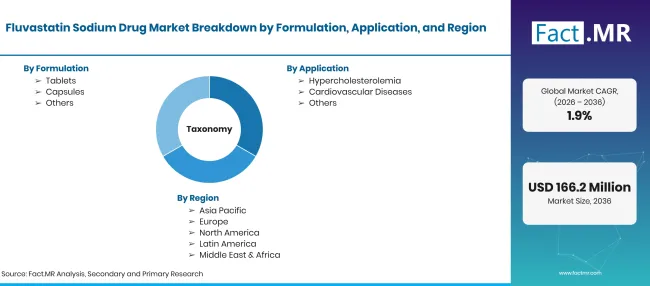
Fluvastatin Sodium Drug Market Taxonomy | Source: Fact.MR
| Attribute | Details |
|---|---|
| Quantitative Units | USD million |
| Market Definition | Finished-dose medicines containing fluvastatin sodium as the active ingredient, used to lower elevated cholesterol and reduce cardiovascular risk. |
| Formulation | Tablets; Capsules; Others |
| Application | Hypercholesterolemia; Cardiovascular Diseases; Others |
| Distribution Channel | Hospital Pharmacies; Retail Pharmacies; Online Pharmacies; Others |
| End-User | Hospitals; Clinics; Others |
| Regions Covered | North America; Latin America; Western Europe; Eastern Europe; East Asia; South Asia & Pacific; Middle East & Africa |
| Countries Covered | Germany; United Kingdom; United States; Brazil; Japan |
| Companies Profiled | Teva Pharmaceutical Industries Ltd.; Viatris Inc.; Sandoz Group AG; Lannett Company, Inc.; TAPI Technology & API Services; Biocon Limited; Aurobindo Pharma Limited |
| Forecast Period | 2026 to 2036 |
| Approach | Hybrid top-down and bottom-up model built on prescription trends, generic availability, formulation mix, pharmacy dispensing and country growth indicators. |
Source: Fact.MR analysis. Updated Nov 2, 2026
How is the market segmented?
-
By Formulation
- Tablets
- Capsules
- Others
-
By Application
- Hypercholesterolemia
- Cardiovascular Diseases
- Others
-
By Distribution Channel
- Hospital Pharmacies
- Retail Pharmacies
- Online Pharmacies
- Others
-
By End-User
- Hospitals
- Clinics
- Others
-
By Region
- North America
- Latin America
- Western Europe
- Eastern Europe
- East Asia
- South Asia & Pacific
- Middle East & Africa
Frequently Asked Questions
How large is the fluvastatin sodium drug market in 2026?
What growth rate will the fluvastatin sodium drug market record?
Which formulation leads?
Which application leads?
Which distribution channel leads?
Which end-user leads?
Which country will grow quickest?
Who are the main companies?
What holds the market back?
Who worked on this report


Preview the report firsthand - request a free sample
Free SampleGet the brochure for pricing and purchase details
Download PDF