- Market Value (2025): USD 1.5 Bn
- Estimated Value (2026): USD 1.7 Bn
- Forecast Value (2036): USD 5.3 Bn
- CAGR (2026-2036): 12.0%
What is the Food-Safe PCR Cups Market forecast to be worth by 2036?
USD 1.7 billion in 2026 to USD 5.3 billion by 2036 at a 12.0% CAGR.
- The Food-Safe PCR Cups Market reached USD 1.5 billion in 2025.
- Demand is projected to increase from USD 1.7 billion in 2026 to USD 5.3 billion by 2036.
- The market is forecast to record a 12.0% CAGR from 2026 to 2036 as stadiums, event venues and foodservice operators formalize reusable and recycled-content cup programs.
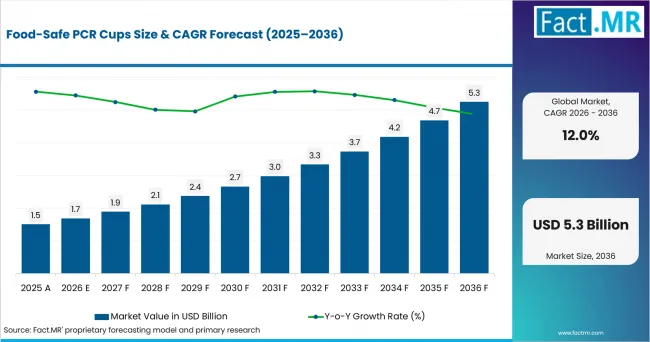
Food Safe Pcr Cups Value Analysis | Source: Fact.MR
What are the defining numbers behind Food-Safe PCR Cups Market growth?
An absolute opportunity of USD 3.1 billion is expected between 2026 and 2036.
- Demand Drivers in the Market
- Venue operators need cups that combine food-contact suitability with dependable collection and return workflows. PCR content becomes commercially useful when material identity remains traceable from recycled resin through cup conversion.
- Stadium and event teams need standardized cup sizes that move efficiently through concessions and return points. Deposit-return programs support higher recovery when cup dimensions and graphics remain consistent across a venue.
- Foodservice operators need recycled-content formats that retain stiffness and clarity without disrupting filling or stacking. PCR polypropylene and rPET blends address this requirement when qualified feedstock and process controls are available.
- Packaging converters need predictable recycled resin quality for repeat production. On June 26, 2025, the U.S. Food and Drug Administration listed Recycle No. 398 for WIS Kunststoffe GmbH, a polypropylene recycling process for articles contacting all food types under Conditions of Use E through G, provided the feedstock is sourced from PP cups and complies with all applicable authorizations.
- Key Segments Analyzed
- By Cup Material: PCR polypropylene is expected to hold 34.0% share in 2026 because its toughness and wash resistance fit venue cups that must survive handling and return cycles.
- By Use Model: Venue deposit-return is projected to account for 37.0% share in 2026 as a refundable charge creates a direct mechanism for cup recovery after consumption.
- By Capacity: <300 mL is anticipated to capture 33.0% share in 2026 owing to portion control across soft drinks, tasting formats and smaller beverage servings.
- By End-use: Stadiums are estimated to represent 36.0% share in 2026 because concentrated attendance supports standardized cup distribution and organized post-use collection.
- Analyst Opinion at Fact.MR
- Shambhu Nath Jha, Principal Consultant at Fact.MR, states, “Food-safe PCR cups are a systems market as much as a resin market. Venues are expected to favor formats that connect approved recycled feedstock with simple return logistics and repeatable cleaning or recycling routes. Suppliers should combine documented food-contact suitability with cup designs that stack, survive service and return reliably.”
- Strategic Implications
- Cup converters should document recycled feedstock origin and food-contact qualification for each resin family used in commercial programs, especially when evaluating food-grade recycled polymers for repeated beverage service.
- Venue operators should align cup capacity with return-point placement so concession speed and recovery performance remain balanced.
- Reuse-system providers should track cup loss and return frequency because asset replacement changes deposit-return economics. In February 2026, ADEME’s National Observatory for Reuse and Reutilization stated that, for 2025, producers placing at least 10,000 packaged-product units on the French market and with annual turnover above EUR 50 million were subject to a 7% minimum proportion of reused packaging.
- Foodservice brands should test printing, odor control and stacking behavior on PCR cups before moving a format into high-volume service.
France is forecast to record 12.9% CAGR through 2036 as reuse obligations strengthen demand for durable cup systems. China is projected to post 12.2% as catering activity and tourism support large venue volumes. The USA and Japan are each anticipated at 11.7%, while Germany is estimated at 11.5% as packaging recovery rules and foodservice economics shape adoption.
How does the Food-Safe PCR Cups Market break down by segment?
Venue deposit-return is projected to lead Use Model at 37.0% share in 2026; Stadiums lead End-use at 36.0% share.
Which Cup Material dominates?
PCR polypropylene is expected to hold 34.0% share in 2026.
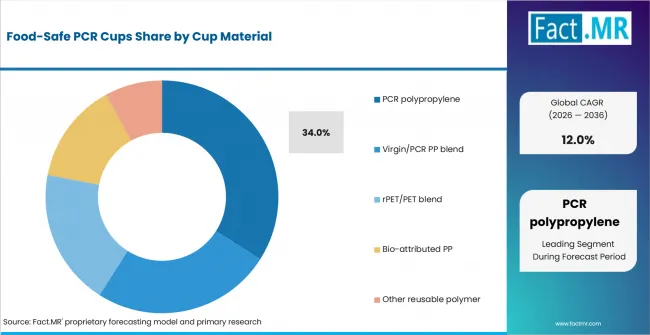
Food Safe Pcr Cups Analysis By Cup Material | Source: Fact.MR
PCR polypropylene is projected to lead because venue cups need impact resistance and wash tolerance alongside traceable food-contact feedstock. Virgin/PCR PP blends provide a transition route where converters need tighter appearance or mechanical consistency. Japan’s Ministry of the Environment reported on March 31, 2026 that 767,595 tonnes of plastic containers and packaging were separately collected in fiscal 2024.
What leads the Use Model segment?
Venue deposit-return is projected to account for 37.0% share in 2026.
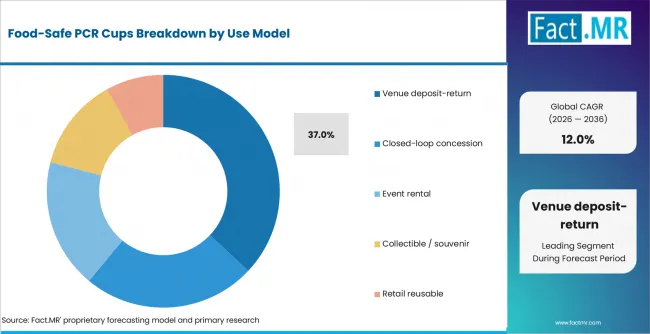
Food Safe Pcr Cups Analysis By Use Model | Source: Fact.MR
Venue deposit-return is expected to lead because the return incentive is built into the transaction at the point of sale. Closed-loop concession programs keep cups within a controlled venue network, while event rental suits temporary festivals and corporate functions. Collectible formats trade some return volume for souvenir value, while retail reusable programs extend circulation outside venues. These models align with foodservice reusable cup systems built around standardized returns.
How does Capacity shape demand?
<300 mL is anticipated to lead with 33.0% share in 2026.
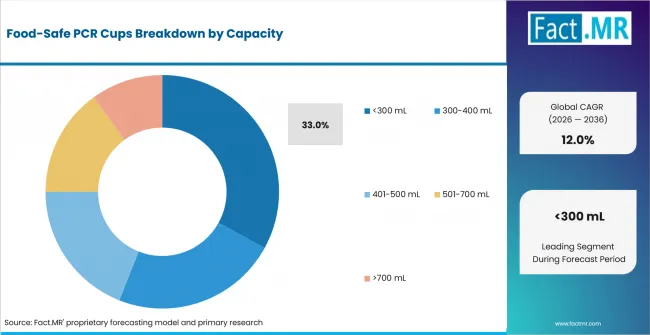
Food Safe Pcr Cups Analysis By Capacity | Source: Fact.MR
The <300 mL format is anticipated to hold the largest share because smaller servings fit tasting and portion-controlled beverage occasions. The 300-400 mL range suits standard concession drinks, while 401-500 mL supports longer events and larger cold beverages. Larger sizes serve souvenir or fewer-refill formats. Capacity selection also affects stack height and return-bin density, linking cup design with adjacent PET containers used in beverage and food packaging.
What supports Stadiums within End-use?
Stadiums are estimated to represent 36.0% share in 2026.
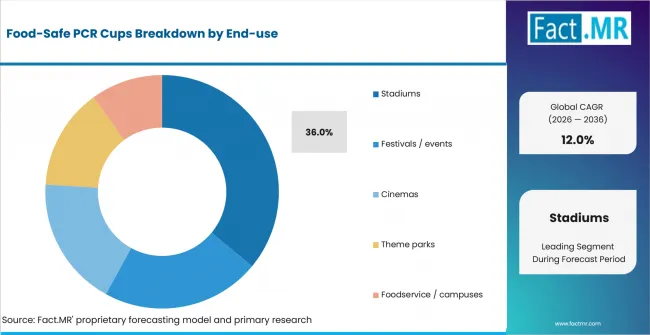
Food Safe Pcr Cups Analysis By End Use | Source: Fact.MR
Stadiums are estimated to lead because thousands of beverage transactions occur within a defined perimeter and short service window. Festivals and events provide similar concentration, while cinemas and theme parks benefit from controlled entry and exit points. Foodservice and campuses extend the model into recurring daily use. These settings overlap with wider foodservice packaging formats where stackability and service speed influence format choice.
What is accelerating Food-Safe PCR Cups Market adoption, and what is holding it back?
Venue return systems and food-contact PCR qualification support adoption; feedstock consistency and return losses restrain it.
Drivers Impact Analysis
| DRIVER | (~) % IMPACT ON CAGR | GEOGRAPHIC RELEVANCE | IMPACT TIMELINE |
|---|---|---|---|
| Venue deposit-return expansion | +1.8% | Europe, North America | Short term (<= 2 years) |
| Food-contact PCR qualification | +1.5% | Global | Medium term (2-4 years) |
| Stadium and event beverage volumes | +1.2% | Global | Short term (<= 2 years) |
| Recycled-content and reuse rules | +1.0% | Europe, East Asia | Medium term (2-4 years) |
Opportunity Impact Analysis
| OPPORTUNITY | (~) % IMPACT ON CAGR | GEOGRAPHIC RELEVANCE | IMPACT TIMELINE |
|---|---|---|---|
| Closed-loop concession cup fleets | +1.3% | North America, Europe | Medium term (2-4 years) |
| Food-grade rPET and PCR PP cup conversion | +1.0% | Global | Medium term (2-4 years) |
| Rental systems for festivals and campuses | +0.8% | Europe, East Asia | Long term (>= 4 years) |
Restraints Impact Analysis
| RESTRAINT | (~) % IMPACT ON CAGR | GEOGRAPHIC RELEVANCE | IMPACT TIMELINE |
|---|---|---|---|
| Food-contact feedstock variability | -0.7% | Global | Short term (<= 2 years) |
| Cup loss and reverse-logistics cost | -0.6% | Global | Medium term (2-4 years) |
| Cleaning and traceability requirements | -0.4% | Europe, North America | Long term (>= 4 years) |
Which countries are scaling the Food-Safe PCR Cups Market through 2036?
- The country comparison spans 1.4 percentage points across the five profiled markets.
- France remains 0.7 percentage point above China as reuse obligations move more packaging toward returnable formats.
- China remains 0.5 percentage point above the USA as catering and tourism volumes create large event-service demand.
- The USA and Japan share an 11.7% CAGR, although foodservice scale and recycling infrastructure shape different adoption routes.
- Germany closes the displayed range at 11.5% as high recycling performance is balanced by softer restaurant activity.
Comparable growth rates create different operating requirements. Food-contact authorization and recycled-resin availability shape how quickly PCR cups move from pilots into repeat programs. Venue density and collection economics influence the operating model. Full report coverage includes North America, Latin America, Western Europe, Eastern Europe, East Asia, South Asia & Pacific, Middle East & Africa.
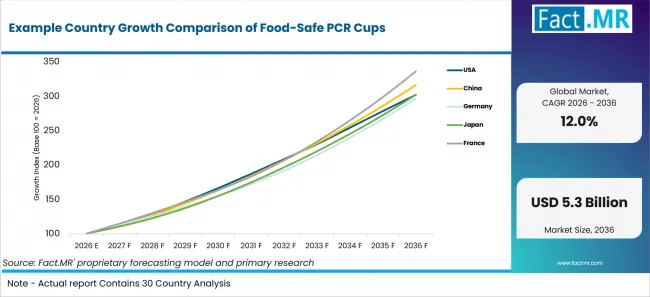
Example Country Growth Comparison Of Food Safe Pcr Cups | Source: Fact.MR
| Country | CAGR (2026-2036) |
|---|---|
| France | 12.9% |
| China | 12.2% |
| USA | 11.7% |
| Japan | 11.7% |
| Germany | 11.5% |
What supports France adoption?
12.9% CAGR, supported by reuse obligations and foodservice recovery systems.
France’s 12.9% CAGR is expected to be supported by reuse obligations and high out-of-home service demand. Insee reported on June 16, 2026 that spending on restaurants and accommodation in 2025 was more than 20% above 2019. This larger out-of-home consumption base provides demand context for foodservice packaging and return-based cup systems within broader sustainable plastic packaging.
What supports China adoption?
12.2% CAGR, supported by catering scale and high venue traffic.
China’s 12.2% CAGR is projected to reflect the scale of catering and visitor-facing beverage service. The National Bureau of Statistics reported on January 20, 2026 that catering-industry income reached RMB 5,798.2 billion in 2025, up 3.2% year on year. This scale provides demand context for high-throughput foodservice packaging and venue beverage service linked with wider circular plastics.
What supports USA adoption?
11.7% CAGR, supported by food-away-from-home activity and qualified PCR feedstock.
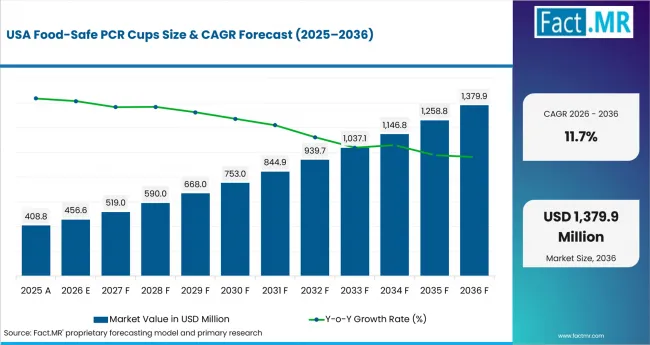
Food Safe Pcr Cups Country Value Analysis | Source: Fact.MR
The USA is anticipated to record an 11.7% CAGR as high-volume foodservice creates repeat cup demand across concessions and campuses. The U.S. Census Bureau reported on May 14, 2026, that sales at food services and drinking places were up 2.7% (±1.8%) in April 2026 from April 2025. FDA Recycle No. 398 provides a favorable opinion on a specified recycling process for cup-derived recycled polypropylene used in food-contact articles under defined Conditions of Use E through G.
What supports Japan adoption?
11.7% CAGR, supported by visitor traffic and established packaging collection.
Japan is forecast to post an 11.7% CAGR as visitor traffic supports high-throughput foodservice and beverage occasions. The Japan National Tourism Organization reported on January 21, 2026 that Japan received 42,683,600 international visitors in 2025, up 15.8% year on year and the highest annual total on record. This visitor volume provides demand context for beverage service at attractions, transport hubs and event venues.
What supports Germany adoption?
11.5% CAGR, supported by packaging recovery and foodservice cost discipline.
Germany is estimated to record an 11.5% CAGR as packaging recovery infrastructure supports recycled-material circulation. Destatis reported on January 16, 2026 that prices for catering services in restaurants, cafés and similar establishments increased 4.0% on average in 2025. This cost context is relevant when operators compare standardized service formats and repeat-use efficiency.
Who leads the Food-Safe PCR Cups Market?
Amcor is relevant through the former Berry Global business following completion of the companies’ combination on April 30, 2025. Amcor currently lists a PET drinking cup manufactured with up to 65% recycled content using a blend of post-consumer and post-industrial recycled materials. The company states that the plastic material used meets applicable South African food-grade approvals.
Greiner Packaging reported in April 2026 that 100,000 reusable cups made from 100% recycled material would be used at the Eurovision Song Contest 2026 in Vienna. The recycled feedstock originates from Austria’s Yellow Bag and Yellow Bin collection system and is processed into food-contact-approved plastic material before Greiner Packaging manufactures the reusable cups.
Faerch reported in May 2026 that it delivered 22,000 tonnes of CIRPET+™ material from its Cirrec recycling facility during 2025. Its portfolio also includes a PET hot-cup lid containing up to 85% post-consumer recycled content and designed for recycling into new food packaging.
Amcor’s current packaging platform continues to list Superfos among its packaging brands. RPC Group Plc was acquired by Berry Global on July 1, 2019, and its former operations subsequently formed part of Berry’s packaging business before the 2025 combination with Amcor. Supplier differentiation in recycled food-contact packaging includes recycled-content levels, food-contact suitability, packaging performance, and compatibility with collection and recycling systems, which also shape circular plastic packaging ecosystems.
Which companies are the key providers?
Key companies include Amcor (including the former Berry Global business and Superfos brand); Greiner Packaging; and Faerch.
- Amcor (including the former Berry Global business and Superfos brand)
- Greiner Packaging
- Faerch
Bibliography
- ADEME, Observatoire national du Réemploi et de la Réutilisation. (2026, February 3). Réemploi des emballages industriels et commerciaux : Déclaration 2026 pour les données de mise en marché 2025 [Webinar slides].
- Beretti, P.-A., & Pereira, É. (2026, June 16). Household consumption in 2025: Household consumption slowed despite a sharp deceleration in prices. Insee Première, (2110).
- National Bureau of Statistics of China. (2026, January 20). Total retail sales of consumer goods in December 2025.
- U.S. Census Bureau. (2026, May 14). Advance monthly sales for retail and food services, April 2026 (Release No. CB26-78).
- Federal Statistical Office (Destatis). (2026, January 16). CORRECTION: Inflation rate at +2.2% in 2025.
- Faerch. (2026, May 13). Faerch’s 2025 sustainability report showcases strong progress on decarbonisation, circularity and innovation.
- Amcor plc. (2025, April 30). Amcor completes combination with Berry Global; positioned to significantly enhance value for customers and shareholders.
- Greiner Packaging. (2026, April 28). ESC 2026: Reusable cups made from 100% recycled material show Austrian circular economy in action.
This Report Answers
- The report explains how cup material, use model, capacity and end-use influence demand for food-safe PCR cups.
- Segment analysis identifies the leading subsegments and the operating reasons venues prioritize them.
- Country analysis examines France, China, USA, Japan and Germany through country-specific demand conditions and one official evidence point per market.
- Competitive analysis reviews current providers and clarifies the post-2025 corporate status of the former Berry Global business and Superfos brand.
- Application analysis assesses return logistics, recycled-resin qualification and food-contact requirements across venue programs.
What does the Food-Safe PCR Cups Market cover?
The Food-Safe PCR Cups Market covers beverage and foodservice cups made with qualified post-consumer recycled polymer where the finished cup is intended for food contact. It includes PCR polypropylene, PP blends, rPET/PET blends and other reusable polymers when recycled content and food-contact controls form part of the product specification.
The assessment covers deposit-return, closed-loop concession, event rental, souvenir and retail reusable models. It focuses on cups used at stadiums, festivals, cinemas, theme parks, campuses and related foodservice environments where collection and material traceability affect the commercial proposition. The market boundary follows the cup itself from qualified recycled resin into venue use and organized recovery. This keeps material choice connected with service conditions and return-system design without extending the scope to unrelated rigid packaging.
What is included in the scope?
The scope includes food-grade PCR polypropylene, food-grade recycled polymers and cup systems connected with venue return programs. It also covers refillable and reusable food packaging systems when beverage cups use qualified PCR content and operate within a return model.
Adjacent material context includes PET containers, rigid plastic packaging and recycled polyolefin materials. End-use context covers foodservice packaging formats, while material-circulation context includes circular plastics and sustainable plastic packaging.
What is excluded from the scope?
The scope excludes virgin-only disposable cups, paper-only cups and compostable cups without post-consumer recycled polymer. It also excludes bottles, trays, bowls and lids sold independently unless they are part of a food-safe PCR cup system. General recycling technology and recycled resin are excluded when no cup or food-contact application is involved.
How Was the Analysis Built?
The analysis draws on 120+ sources, 35+ company portfolios, 25+ countries, and more than 20 industry interviews.
- Primary Research: Primary research includes discussions with manufacturers, service providers, technology developers, distributors, end users, and subject-matter experts. These conversations examine purchasing priorities, product adoption, operational challenges, approval requirements, competitive positioning, and the factors that influence wider market acceptance.
- Desk Research: Desk research covers government statistics, regulatory publications, company filings, trade data, technical studies, industry associations, standards, public policy, and other authoritative sources. Every source used in the analysis is documented in the bibliography.
- Market Sizing and Forecasting: Market estimates combine historical performance, demand indicators, pricing and volume trends, segment shares, company participation, country-level growth, adoption patterns, investment activity, and barriers to market expansion.
- Data Validation and Update Cycle: Findings are validated by comparing primary interviews with public data, company activity, regulatory changes, trade patterns, and industry developments. Regular updates review new product launches, capacity changes, partnerships, approvals, and shifts in commercial adoption.
What is the report’s scope and coverage?
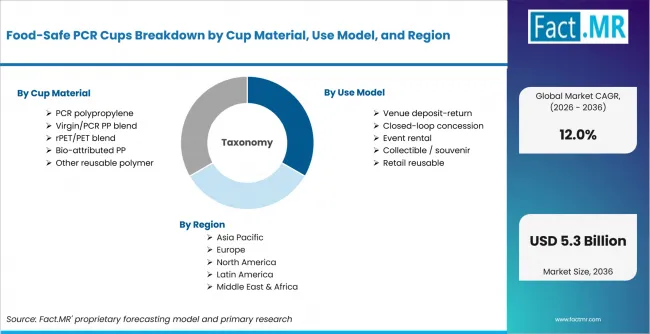
Food Safe Pcr Cups Breakdown By Cup Material, Use Model, And Region | Source: Fact.MR
| Attribute | Details |
|---|---|
| Quantitative Units | USD billion |
| Market Definition | Food-safe cups made wholly or partly from qualified post-consumer recycled polymer for beverage and foodservice use, including reusable and recyclable venue formats. |
| Cup Material | PCR polypropylene; Virgin/PCR PP blend; rPET/PET blend; Bio-attributed PP; Other reusable polymer |
| Use Model | Venue deposit-return; Closed-loop concession; Event rental; Collectible / souvenir; Retail reusable |
| Capacity | <300 mL; 300-400 mL; 401-500 mL; 501-700 mL; >700 mL |
| End-use | Stadiums; Festivals / events; Cinemas; Theme parks; Foodservice / campuses |
| Regions Covered | North America; Latin America; Western Europe; Eastern Europe; East Asia; South Asia & Pacific; Middle East & Africa |
| Countries Covered | USA; China; Germany; Japan; France |
| Key Companies Profiled | Amcor (including former Berry Global business and Superfos brand); Greiner Packaging; Faerch |
| Forecast Period | 2026 to 2036 |
| Approach | Hybrid top-down and bottom-up approach using foodservice activity, venue use models, qualified PCR availability, packaging regulation, country adoption and provider portfolio review. |
How is the market segmented?
-
By Cup Material
- PCR polypropylene
- Virgin/PCR PP blend
- rPET/PET blend
- Bio-attributed PP
- Other reusable polymer
-
By Use Model
- Venue deposit-return
- Closed-loop concession
- Event rental
- Collectible / souvenir
- Retail reusable
-
By Capacity
- <300 mL
- 300-400 mL
- 401-500 mL
- 501-700 mL
- >700 mL
-
By End-use
- Stadiums
- Festivals / events
- Cinemas
- Theme parks
- Foodservice / campuses
-
By Region
- North America
- Latin America
- Western Europe
- Eastern Europe
- East Asia
- South Asia & Pacific
- Middle East & Africa