- Market Value (2025): USD 2.8 Bn
- Estimated Value (2026): USD 3.1 Bn
- Forecast Value (2036): USD 8.4 Bn
- CAGR (2026-2036): 10.6%
What is the Food-Waste Derived Diols Market forecast to be worth by 2036?
USD 3.1 billion in 2026 to USD 8.4 billion by 2036 at a 10.6% CAGR.
- The Food-Waste Derived Diols Market crossed a valuation of USD 2.8 billion in 2025.
- Demand is projected to increase from USD 3.1 billion in 2026 to USD 8.4 billion by 2036.
- The market is forecast to record a 10.6% CAGR from 2026 to 2036 as polyester recyclers and resin producers expand waste-derived feedstock use.
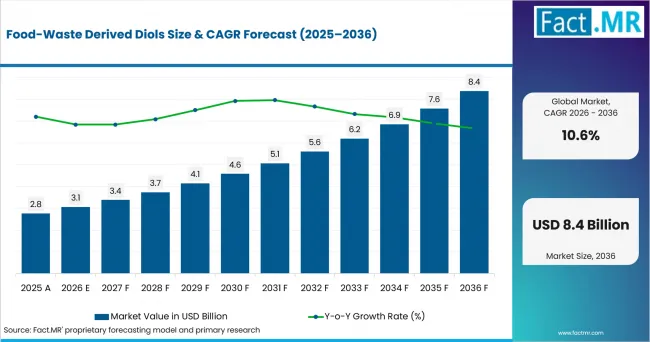
Food Waste Derived Diols Value Analysis | Source: Fact.MR
What are the defining numbers behind Food-Waste Derived Diols Market growth?
USD 5.3 billion absolute opportunity by 2036, led by chemically recycled PET, food-waste-derived diols and packaging applications.
- Demand Drivers in the Market
- Polyester recyclers need dependable monomer recovery.
- Resin producers need traceable circular feedstocks to support consistent quality and verifiable recycled-content pathways in polyester production.
- Engineering teams need recovered intermediates that preserve viscosity and mechanical performance so recycled polyester can meet demanding processing and end-use requirements.
- Key Segments Analyzed
- By Polyester Route: Chemically recycled PET is expected to hold 39.0% share in 2026 due to established PET collection and depolymerization pathways.
- By Waste-Derived Feedstock: Food-waste-derived diols are projected to account for 31.0% share in 2026 as valorization routes target carbon-rich residual streams.
- By Application: Packaging is anticipated to capture 35.0% share in 2026 because recovered polyester building blocks fit bottle, tray and other food-contact resin systems.
- By Performance: High IV / strength is estimated to represent 29.0% share in 2026 owing to the need for recycled polymers that retain processing stability and load-bearing performance.
- Analyst Opinion at Fact.MR
- Shambhu Nath Jha, Principal Consultant at Fact.MR, states, “The commercial test for waste-derived diols depends on more than feedstock availability; recovered molecules must enter polyester systems with repeatable purity and performance. Demand is expected to favor routes that connect collection, depolymerization and polymer qualification. Suppliers that pair feedstock traceability with stable viscosity and application-specific validation are positioned to address packaging and engineering uses.”
- Strategic Implications
- Recyclers should separate feedstock streams tightly enough to protect monomer purity and reduce variability before polymerization.
- Polyester producers should document recycled-feedstock allocation and resin performance.
- Automotive and electronics processors should focus on heat resistance and strength retention when replacing conventional polyester inputs with circular alternatives.
South Korea is expected to record 10.7% CAGR through 2036 as policy and chemical-sector investment support recycled feedstocks. The USA is projected to post 10.4% as large chemical and plastics manufacturing bases provide downstream demand. Japan is anticipated to advance at 9.1% as food-loss and PET-circulation programs expand recoverable inputs. Germany is estimated to reach 8.8% due to high packaging collection and recycling volumes. Sweden is forecast to record 7.8% as food-waste measurement and packaging collection rules reinforce circular-material supply.
How does the Food-Waste Derived Diols Market break down by segment?
Chemically recycled PET leads Polyester Route at 39.0%; Packaging leads Application at 35.0%.
Which Polyester Route dominates?
Chemically recycled PET is expected to hold 39.0% share in 2026.
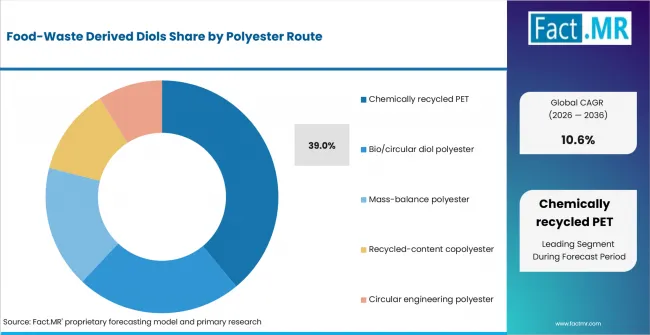
Food Waste Derived Diols Analysis By Polyester Route | Source: Fact.MR
Chemically recycled PET leads because depolymerization returns polyester waste to molecular building blocks that can be purified and repolymerized. Bio/circular diol polyester broadens the route toward lower-fossil feedstocks. Mass-balance polyester gives producers a chain-of-custody option where circular inputs are mixed within existing systems. Recycled-content copolyester and circular engineering polyester serve applications that need tailored clarity, toughness or heat performance. The route aligns with chemical recycling systems that recover polyester building blocks for new polymer production.
What leads the Waste-Derived Feedstock segment?
Food-waste-derived diols are projected to account for 31.0% share in 2026.
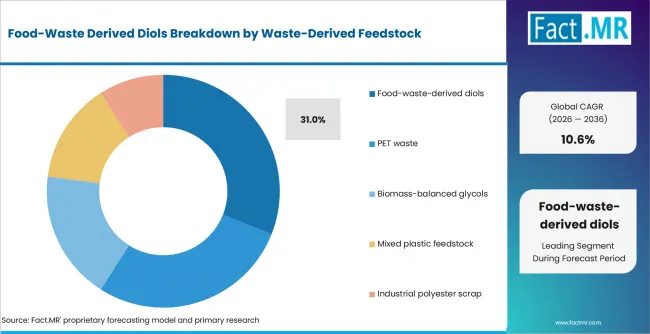
Food Waste Derived Diols Analysis By Waste Derived Feedstock | Source: Fact.MR
Food-waste-derived diols lead the feedstock view because organic residues contain carbon that can be converted into chemical intermediates when separation and conversion economics are workable. PET waste provides a more established polyester-specific stream. Biomass-balanced glycols use certified allocation systems to substitute part of the fossil feedstock base. Mixed plastic feedstock and industrial polyester scrap widen the available waste pool where purification routes can control contaminants. Feedstock selection therefore depends on residue concentration and conversion yield.
How does Application shape demand?
Packaging is anticipated to capture 35.0% share in 2026.
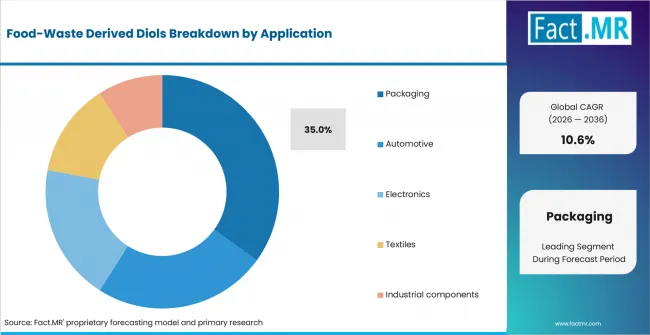
Food Waste Derived Diols Analysis By Application | Source: Fact.MR
Packaging leads because PET and related polyesters already have large bottle, tray and film applications with established collection systems. Automotive uses focus more heavily on heat and mechanical stability. Electronics applications require tighter purity and electrical-performance controls, while textiles can absorb recycled polyester at higher volumes when color and fiber quality are consistent. Industrial components add demand where circular engineering polyesters meet dimensional and chemical-resistance requirements. U.S. Census Bureau data released in September 2026 placed 2024 food-manufacturing shipments at USD 1,054.3 billion.
What supports High IV / strength within Performance?
High IV / strength is estimated to represent 29.0% share in 2026.
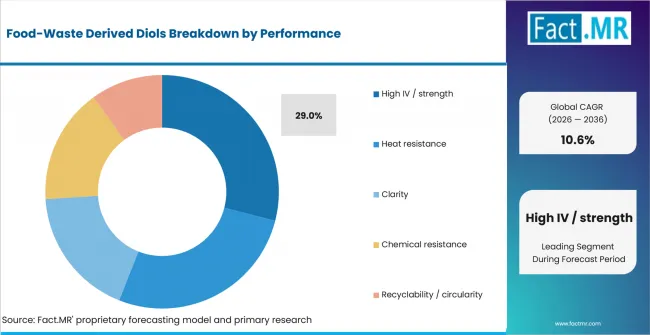
Food Waste Derived Diols Analysis By Performance | Source: Fact.MR
High IV / strength is the largest performance category because recycled polyester must survive conversion and retain mechanical properties in demanding formats. Heat resistance is more relevant in automotive and electronics uses. Clarity remains central to transparent packaging, while chemical resistance affects industrial parts and containers exposed to aggressive contents. Recyclability / circularity influences material selection where customers seek another recovery cycle after use. BASF announced in March 2025 that its Loop polyurethane portfolio incorporated recycled content for footwear, automotive and synthetic leather applications.
What is accelerating Food-Waste Derived Diols Market adoption, and what is holding it back?
Waste valorization and recycled-content demand accelerate adoption; feedstock variability and qualification requirements restrain it.
Drivers Impact Analysis
| DRIVER | (~) % IMPACT ON CAGR | GEOGRAPHIC RELEVANCE | IMPACT TIMELINE |
|---|---|---|---|
| PET depolymerization and monomer recovery | +1.7% | North America, Europe, East Asia | Medium term (2-4 years) |
| Food-waste and organic-residue valorization | +1.3% | Global | Long term (>= 4 years) |
| Recycled-content packaging requirements | +1.1% | Europe, North America, East Asia | Medium term (2-4 years) |
| Circular polyester investment | +0.8% | East Asia, North America | Short term (<= 2 years) |
| Performance-qualified recycled resins | +0.6% | Global | Long term (>= 4 years) |
Source: Fact.MR analysis. Updated Sep 21, 2026
Opportunity Impact Analysis
| OPPORTUNITY | (~) % IMPACT ON CAGR | GEOGRAPHIC RELEVANCE | IMPACT TIMELINE |
|---|---|---|---|
| Food-processing residue conversion | +1.0% | North America, Europe, East Asia | Long term (>= 4 years) |
| Food-contact circular polyester | +0.9% | North America, Europe, Japan | Medium term (2-4 years) |
| Automotive and electronics copolyesters | +0.7% | Germany, Japan, South Korea | Medium term (2-4 years) |
| Mass-balance glycol substitution | +0.5% | Europe, Global | Short term (<= 2 years) |
Source: Fact.MR analysis. Updated Sep 21, 2026
Restraints Impact Analysis
| RESTRAINT | (~) % IMPACT ON CAGR | GEOGRAPHIC RELEVANCE | IMPACT TIMELINE |
|---|---|---|---|
| Feedstock contamination and variability | -0.8% | Global | Short term (<= 2 years) |
| Food-contact purity requirements | -0.6% | North America, Europe, Japan | Medium term (2-4 years) |
| Depolymerization energy and process cost | -0.5% | Global | Medium term (2-4 years) |
| Limited collection consistency | -0.4% | Global | Long term (>= 4 years) |
Source: Fact.MR analysis. Updated Sep 21, 2026
Which countries are scaling the Food-Waste Derived Diols Market through 2036?
- The displayed country range spans 2.9 percentage points across the 2026 to 2036 forecast period.
- South Korea remains 0.3 percentage point above the USA through recycled-plastic policy and chemical-material investment.
- The USA remains 1.3 percentage points above Japan as its chemical and food-manufacturing bases create broad downstream demand.
- Japan remains 0.3 percentage point above Germany as food-loss reduction and polyester circulation programs shape feedstock recovery.
- Germany remains 1.0 percentage point above Sweden through established packaging collection and recycling systems.
Comparable CAGRs can produce different entry conditions because feedstock collection, chemical conversion capacity and application qualification vary by country. Full report coverage includes North America, Latin America, Western Europe, Eastern Europe, East Asia, South Asia & Pacific, Middle East & Africa.
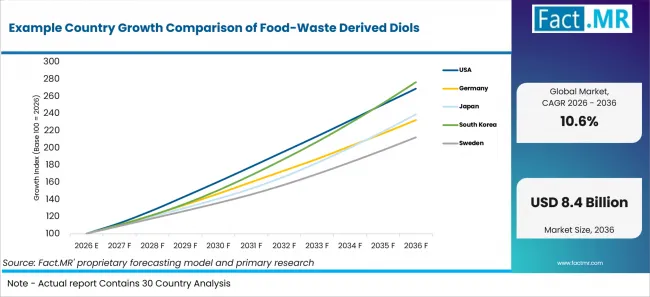
Example Country Growth Comparison Of Food Waste Derived Diols | Source: Fact.MR
| Country | CAGR (2026-2036) |
|---|---|
| South Korea | 10.7% |
| USA | 10.4% |
| Japan | 9.1% |
| Germany | 8.8% |
| Sweden | 7.8% |
Source: Fact.MR analysis. Updated Sep 21, 2026
What supports USA adoption?
10.4% CAGR, supported by chemical manufacturing scale and downstream polymer demand.
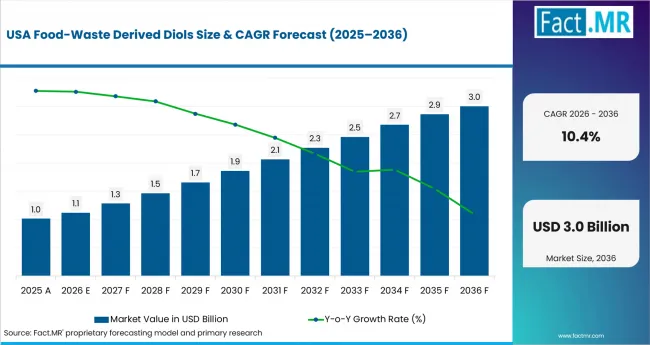
Food Waste Derived Diols Country Value Analysis | Source: Fact.MR
U.S. chemical manufacturing provides a large conversion base for recycled monomers and circular polyester feedstocks. The U.S. Census Bureau reported in September 2026 that 2024 Chemical Manufacturing shipments reached USD 918.2 billion. That industrial scale is expected to support qualification of recovered diols across packaging and engineered polymer applications.
What underpins Germany’s growth?
8.8% CAGR, shaped by packaging recovery and polyester recycling infrastructure.
Germany combines organized packaging collection with a large chemical-conversion base. The German Environment Agency reported in January 2026 that around 5.5 million tonnes of packaging waste collected by dual systems were recycled in 2024. That recovered-material flow is expected to support feedstock availability for depolymerization and circular polyester production.
How is Japan scaling demand?
9.1% CAGR, supported by food-loss reduction and polyester circulation programs.
Japan links food-loss management with established polyester manufacturing and recycling expertise. The Ministry of Agriculture, Forestry and Fisheries reported in June 2026 that food loss reached 4.61 million tonnes in FY2024.
What is powering South Korea’s outlook?
10.7% CAGR, supported by recycled-material policy and chemical-sector investment.
South Korea is expanding policy support for recycled materials while chemical producers scale circular feedstock technology. In December 2025, South Korea’s Ministry of Climate, Energy and Environment disclosed a draft Comprehensive Plastic Reduction Plan for public discussion. The draft targeted reducing virgin-plastic-based waste to 7 million tonnes by 2030 through 1 million tonnes of source reduction and 2 million tonnes of recycled-material use.
How does Sweden perform?
7.8% CAGR, led by food-waste measurement and packaging collection systems.
Sweden combines detailed waste measurement with producer-responsibility systems for packaging. The Swedish Environmental Protection Agency reported in December 2025 that 880,000 tonnes of food waste arose in 2024 across retail, foodservice, public meals, wholesale and households.
Who leads the Food Waste Derived Diols Market?
Polylabs, Hairma (Nantong) Technology, Wanhua Chemical provide documented polyester-recycling or recycled-material capabilities. Covestro and BASF provide adjacent polyurethane-recycling examples.
Covestro and BASF provide adjacent polyurethane-recycling evidence rather than direct food-waste-derived-diol supplier evidence. In July 2025, Covestro India signed an agreement with CSIR-NCL to develop polyurethane upcycling approaches aimed at transforming polyurethane waste into valuable feedstock chemicals. BASF announced its Loop portfolio in March 2025, comprising polyurethane solutions incorporating recycled content for footwear, automotive and synthetic-leather applications in China.
Across these recycling approaches, relevant supplier-comparison factors include feedstock quality, conversion performance, product qualification and the ability to incorporate recovered intermediates into established polymer-production systems.
Which companies are the key providers?
Key companies include Polylabs; Hairma (Nantong) Technology; Wanhua Chemical; Covestro; and BASF.
- Polylabs
- Hairma (Nantong) Technology
- Wanhua Chemical
- Covestro
- BASF
Bibliography
- U.S. Census Bureau. (2026, September 3). Census Bureau releases new Annual Integrated Economic Survey data.
- BASF. (2025, March 25). BASF’s Performance Materials expands its sustainable portfolio with innovative polyurethanes recycling solutions.
- German Environment Agency, & Central Agency Packaging Register. (2026, January 27). Facts against myths: Packaging waste recycling in Germany is working.
- Ministry of Climate, Energy and Environment, Republic of Korea. (2025, December 23). Public forum for the formulation of a comprehensive plastic reduction plan.
- Swedish Environmental Protection Agency. (2025, December 18). Oförändrad mängd matsvinn i Sverige – en samhällsutmaning [Unchanged amount of food waste in Sweden – a societal challenge].
- Covestro. (2025, July 15). Covestro India and CSIR-NCL tie-up to transform polyurethane waste.
- Statistisches Bundesamt (Destatis). (2026, February 23). Abfallentsorgung 2024: Art, Menge und Verbleib der im Berichtsjahr 2024 entsorgten Verpackungen.
- Ministry of Trade, Industry and Resources. (2025, December 23). Korea launches “K-Chemistry Roadmap 2030” to drive a new leap forward for Korea’s chemical industry.
This Report Addresses
- The report evaluates Polyester Route and Waste-Derived Feedstock as core dimensions.
- Country analysis covers the USA, Germany, Japan, South Korea and Sweden using the supplied 2026–2036 country CAGRs.
- Competitive analysis reviews circular-polyester or recycled-PET capabilities from Polylabs, Hairma (Nantong) Technology, Wanhua Chemical, with Covestro and BASF treated as adjacent polyurethane-recycling examples. No company market shares are assigned.
- Technology coverage includes depolymerization, mass-balance inputs and recycled-content polyester routes.
- Application coverage follows packaging, automotive, electronics and industrial components.
- The evidence base uses official statistics and first-party company material.
What does the Food-Waste Derived Diols Market cover?
Waste-derived diols, glycols and related polyester intermediates used in circular polymer production.
The market covers chemical intermediates recovered or produced from food-waste-linked streams, PET waste, biomass-balanced inputs, mixed plastic feedstock and industrial polyester scrap. Coverage follows their use in polyester routes that return waste carbon or recovered monomers to packaging, automotive, electronics, textiles and industrial components.
The boundary is narrower than the broad recycled-plastics field because it focuses on diol, glycol or polyester-intermediate chemistry and the polymers built from those inputs. Adjacent categories are considered only where they explain feedstock supply, circular polyester conversion or end-use qualification.
What is included in the scope?
Circular polyester routes and waste-derived feedstocks used across packaging and engineering applications.
Included coverage spans chemically recycled PET and bio/circular diol polyester, together with mass-balance polyester and recycled-content copolyesters. It also covers food-waste-derived diols, PET waste and biomass-balanced glycols when these inputs feed polymer production. Adjacent intelligence on plastic chemical recycling catalysts helps frame depolymerization routes, while recycled plastic materials provide downstream context for textiles and engineered products.
Packaging demand is considered alongside sustainable packaging systems and PET container applications. Polymer-performance comparisons also use adjacent coverage of engineering thermoplastics and polyester polyol systems where waste-derived intermediates compete for higher-specification uses.
What is excluded from the scope?
Virgin fossil-only diols, unrelated organic-waste treatment and recycled polymers without a diol or polyester-intermediate link are outside the scope.
The scope excludes virgin glycol production when no waste-derived or circular allocation is involved. It also excludes stand-alone composting, anaerobic digestion and food-loss prevention services, although food waste reduction programs are relevant to feedstock availability. General bioplastics are outside the boundary unless their chemistry overlaps the defined diol and polyester routes; related context is available through bio-based polyester materials.
Unsaturated polyester and flame-retardant polyester systems are excluded unless waste-derived diols form part of the material input. These adjacent chemistries are covered separately under circular packaging systems and bio-succinic polyester polyols.
How Was the Analysis Built?
The analysis draws on 120+ sources, 35+ company portfolios, 25+ countries, and more than 20 industry interviews.
- Primary Research: Primary research includes discussions with manufacturers, service providers, technology developers, distributors, end users, and subject-matter experts. These conversations examine purchasing priorities, product adoption, operational challenges, approval requirements, competitive positioning, and the factors that influence wider market acceptance.
- Desk Research: Desk research covers government statistics, regulatory publications, company filings, trade data, technical studies, industry associations, standards, public policy, and other authoritative sources. Every source used in the analysis is documented in the bibliography.
- Market Sizing and Forecasting: Market estimates combine historical performance, demand indicators, pricing and volume trends, segment shares, company participation, country-level growth, adoption patterns, investment activity, and barriers to market expansion.
- Data Validation and Update Cycle: Findings are validated by comparing primary interviews with public data, company activity, regulatory changes, trade patterns, and industry developments. Regular updates review new product launches, capacity changes, partnerships, approvals, and shifts in commercial adoption.
Segmentation
What is the report’s scope and coverage?
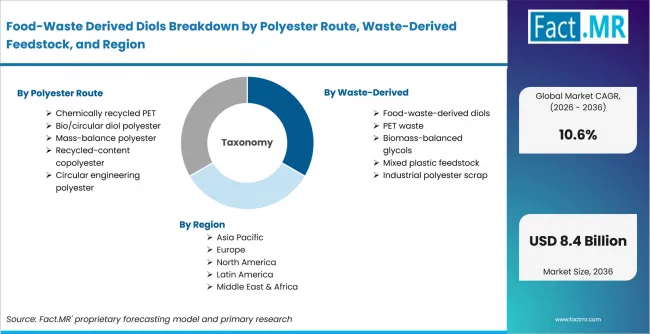
Food Waste Derived Diols Breakdown By Polyester Route, Waste Derived Feedstock, And Region | Source: Fact.MR
| Attribute | Details |
|---|---|
| Quantitative Units | USD billion |
| Market Definition | Diol and glycol intermediates derived from food-waste or waste-linked feedstocks and used in circular polyester or related polymer systems. |
| Polyester Route | Chemically recycled PET; Bio/circular diol polyester; Mass-balance polyester; Recycled-content copolyester; Circular engineering polyester |
| Waste-Derived Feedstock | Food-waste-derived diols; PET waste; Biomass-balanced glycols; Mixed plastic feedstock; Industrial polyester scrap |
| Application | Packaging; Automotive; Electronics; Textiles; Industrial components |
| Performance | High IV / strength; Heat resistance; Clarity; Chemical resistance; Recyclability / circularity |
| Regions Covered | North America; Latin America; Western Europe; Eastern Europe; East Asia; South Asia & Pacific; Middle East & Africa |
| Countries Profiled | USA; Germany; Japan; South Korea; Sweden |
| Companies Profiled | Polylabs; Hairma (Nantong) Technology; Wanhua Chemical; Covestro; BASF |
| Forecast Period | 2026 to 2036 |
| Approach | Hybrid review of supplied market values, official waste and manufacturing statistics, company recycling capabilities, segment structure and country-level adoption conditions. |
Source: Fact.MR analysis. Updated Sep 21, 2026
How is the market segmented?
-
By Polyester Route
- Chemically recycled PET
- Bio/circular diol polyester
- Mass-balance polyester
- Recycled-content copolyester
- Circular engineering polyester
-
By Waste-Derived Feedstock
- Food-waste-derived diols
- PET waste
- Biomass-balanced glycols
- Mixed plastic feedstock
- Industrial polyester scrap
-
By Application
- Packaging
- Automotive
- Electronics
- Textiles
- Industrial components
-
By Performance
- High IV / strength
- Heat resistance
- Clarity
- Chemical resistance
- Recyclability / circularity
-
By Region
- North America
- Latin America
- Western Europe
- Eastern Europe
- East Asia
- South Asia & Pacific
- Middle East & Africa
Frequently Asked Questions
How big is the Food-Waste Derived Diols Market in 2026?
What is the CAGR of the Food-Waste Derived Diols Market from 2026 to 2036?
Which Polyester Route leads the Food-Waste Derived Diols Market?
Which Waste-Derived Feedstock leads the market?
Which Application leads the Food-Waste Derived Diols Market?
Who worked on this report


Preview the report firsthand - request a free sample
Free SampleGet the brochure for pricing and purchase details
Download PDF