- Base Value(2025): 3.4 Bn
- Estimated Value(2026): 3.8 Bn
- Forecast Value (2036): 12.2 Bn
- CAGR (2026 - 2036): 12.3%
Rear-Seat Entertainment Display Platforms for SUVs Market Forecast and Outlook by Fact.MR
In 2025, the rear-seat entertainment display platforms for SUVs market was valued at USD 3.4 billion. Based on Fact.MR analysis, demand for rear-seat entertainment display platforms for SUVs is estimated to grow to USD 3.8 billion in 2026 and USD 12.2 billion by 2036. FACT.MR projects a CAGR of 12.3% during the forecast period.
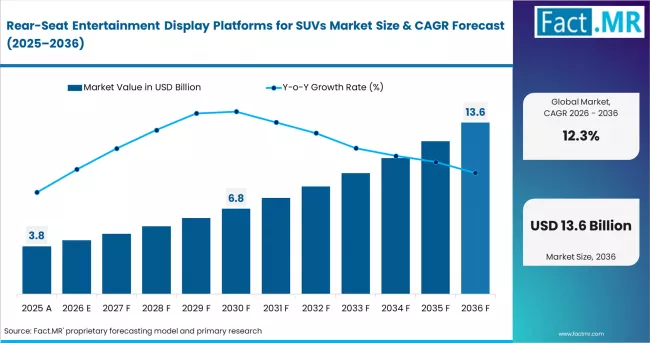
Rear Seat Entertainment Display Platforms For Suvs Market Value Analysis | Source: Fact.MR
Summary of Rear-Seat Entertainment Display Platforms for SUVs Market
- Market Definition
- Market includes LCD and OLED rear-seat entertainment display platforms in headrest, seatback, and overhead configurations supporting video, streaming, and connectivity for SUV rear cabin passengers globally.
- Demand Drivers
- China NEV RSE Mandates: Chinese NEV OEMs are standardising rear-seat entertainment platforms across new energy SUV models as a differentiation feature in a highly competitive domestic electric vehicle market.
- Premium SUV Feature Integration: U.S. and German premium OEMs are specifying seatback-integrated OLED RSE platforms in luxury SUV programmes to meet rising passenger experience expectations.
- Streaming Connectivity Demand: OEM integration of 5G-connected RSE platforms with Netflix, YouTube, and OEM app stores is increasing platform average selling prices and driving Tier 1 software investment.
- Key Segments Analyzed
- By Installation Type: Headrest-mounted displays lead with 48% share in 2026. Growth is supported by easy integration and lower cost across SUV platforms.
- By Display Technology: LCD displays hold 56% share in 2026. They benefit from mature supply chains and cost efficiency. OLED is the fastest-growing segment in premium SUVs.
- By Screen Size: 10–15 inch displays lead with 44% share in 2026. They offer a balance between viewing comfort and integration constraints.
- By Geography: China leads with 13.5% CAGR through 2036. Growth is driven by SUV production scale and NEV integration mandates.
- Analyst Opinion at FACT.MR
- Shambhu Nath Jha, Principal Consultant at Fact.MR, opines, “CXOs will find that 5G-enabled streaming integration and OLED qualification are key differentiators. Suppliers without strong software ecosystems risk losing premium SUV OEM contracts through 2036.”
- Strategic Implications
- Invest in 5G-enabled RSE software platforms to meet OEM requirements in China, Germany, and the United States. Connectivity is becoming a core design specification.
- Expand OLED display capacity for luxury SUV programmes. Premium cabin experience is outweighing cost considerations.
- Develop seatback-integrated RSE systems with built-in streaming partnerships. Demand is shifting toward fully embedded solutions over standalone units.
- Methodology
- Market sizing is based on SUV production volumes and RSE attach rates. Data is validated using OEM disclosures and Tier-1 revenue data from 2024–2025.
- Analysis incorporates NHTSA guidelines, EU regulations, and China MIIT NEV policies. OEM connectivity specifications are also considered.
- Forecasts factor in OLED cost trends, 5G adoption timelines, and SUV electrification schedules across regions.
| Metric | Value |
|---|---|
| Estimated Value in 2026 | USD 3.8 billion |
| Forecast Value in 2036 | USD 12.2 billion |
| Forecast CAGR (2026 to 2036) | 12.3% |
Source: Fact.MR analysis. Updated Apr 29, 2026
The market is anticipated to generate an additional USD 8.4 billion in value over the 2026 to 2036 period. Growth is driven by rising SUV platforms and higher passenger experience expectations. OEMs are increasingly integrating in-cabin entertainment systems. Adoption is faster in premium SUV markets. Cost-sensitive regions in Asia and Latin America are slower to shift from basic screens to integrated platforms.
OEM procurement is moving toward connected ecosystem contracts. Long-term agreements now include streaming and software integration. This trend is strong in North America and Europe. Panasonic Automotive Systems and Harman International maintain strong positions through multi-OEM partnerships.
China leads growth with a CAGR of 13.5% through 2036. This is supported by large SUV and EV production and OEM integration mandates. India follows at 12.9%, driven by rapid SUV demand and rising premium feature adoption. The United States grows at 11.2%, supported by premium SUV penetration and upgrade cycles. Germany records 10.8%, led by luxury OEM innovation. Japan grows at 9.7%, supported by steady premium SUV integration.
Segmental Analysis
Rear-Seat Entertainment Display Platforms for SUVs Market Analysis by Installation Type
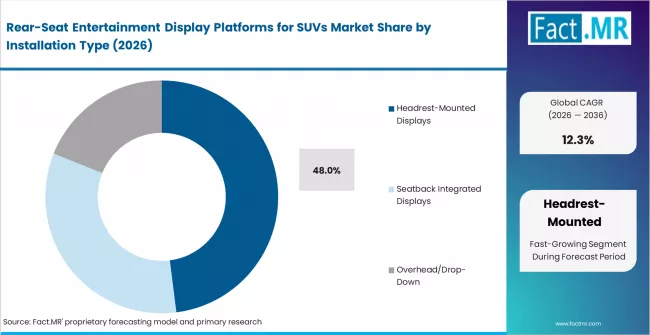
Rear Seat Entertainment Display Platforms For Suvs Market Analysis By Installation Type | Source: Fact.MR
Based on FACT.MR, headrest-mounted displays hold 48% share in 2026. They lead due to compatibility across SUV platforms. Lower integration cost supports adoption. They also allow easier retrofit compared to seatback systems.
- Panasonic Investment: Panasonic expanded RSE production in Osaka in Q3 2024. The focus is on headrest and seatback systems for global SUV programmes from 2025 [4].
- Harman Technology Launch: Harman launched RSE Platform 3.0 in Q1 2025. It includes 5G, OTA updates, and streaming integration. The system targets premium SUVs in North America and Europe [5].
- RSE Attach Rate Trend: DSCC 2024 data shows SUV RSE attach rates rose from 22% in 2022 to 31% in 2024. China NEV SUVs exceeded 45%. Headrest units held 49% shipment share [6].
Rear-Seat Entertainment Display Platforms for SUVs Market Analysis by Display Technology
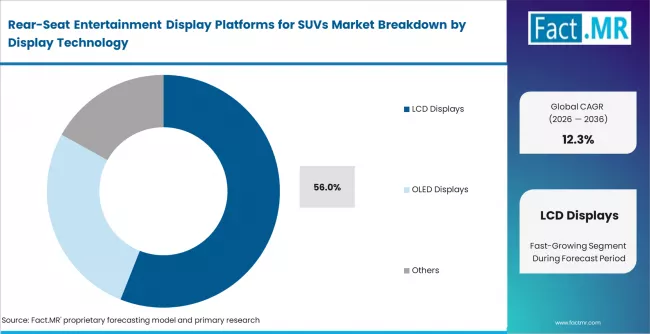
Rear Seat Entertainment Display Platforms For Suvs Market Analysis By Display Technology | Source: Fact.MR
Based on FACT.MR, LCD holds 56% share in 2026. It leads due to cost efficiency and strong supply chains. LCD panels are widely used in 10–15 inch configurations. Most mid-range SUV programmes rely on LCD.
- LG Display Investment: LG Display expanded OLED production in Guangzhou in Q4 2024. The focus is on 10–15 inch RSE panels for premium SUVs [7].
- Alpine Electronics Development: Alpine launched OLED RSE displays in Q2 2024. These include 12.8-inch panels for BMW and Mercedes SUV platforms [8].
- OLED RSE Cost Trend: DSCC 2024 data shows OLED panel prices are expected to decline 16% by 2027. This is supporting adoption in mid-premium SUV segments.
Drivers, Restraints, and Opportunities
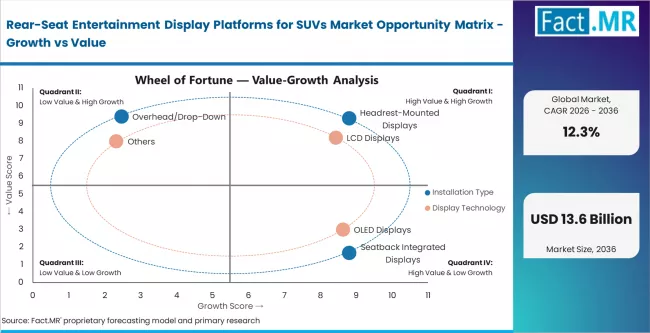
Rear Seat Entertainment Display Platforms For Suvs Market Opportunity Matrix Growth Vs Value | Source: Fact.MR
FACT.MR analysis indicates that the rear-seat entertainment display platforms for SUVs market is undergoing a structural shift. Growth is driven by rising SUV volumes and connected passenger experience demand.
Basic headrest LCD units are losing share in premium SUVs. Seatback-integrated and connected systems are gaining traction. These platforms offer higher average selling prices. OLED RSE systems command 35–55% premiums over LCD. OEMs absorb this in luxury SUVs where experience differentiation matters. LCD with connectivity remains dominant in mass-market segments.
- China NEV RSE Policy: China’s MIIT updated smart vehicle requirements in 2024 to promote multi-screen rear entertainment integration. BYD Yangwang U8 and NIO ET9 launched with integrated RSE in 2024. Panasonic Automotive Systems and Harman International benefited from increased procurement [1].
- NHTSA Passenger Screen Policy: NHTSA updated display guidelines in Q3 2024. Rear-seat displays were exempted from driver distraction rules. This removed regulatory uncertainty. OEMs such as GM, Ford, and Stellantis accelerated RSE adoption [2].
- EU Vehicle Type Approval: The EU updated UN ECE Regulation 48 in 2024. New rules cover luminance and reflectance for rear displays. BMW and Mercedes-Benz accelerated OLED RSE qualification. Tier-1 procurement increased for Harman and Alpine Electronics [3].
Regional Analysis
The rear-seat entertainment display platforms for SUVs market is assessed across Asia Pacific, North America, Europe, Latin America, and Middle East and Africa, covering 40+ countries with distinct OEM procurement structures, SUV segment growth profiles, and display technology qualification frameworks. The full report offers market attractiveness analysis by region and country.
.webp "Top Country Growth Comparison Rear Seat Entertainment Display Platforms For Suvs Market Cagr (2026 2036)")
Top Country Growth Comparison Rear Seat Entertainment Display Platforms For Suvs Market Cagr (2026 2036) | Source: Fact.MR
| Country | CAGR (2026 to 2036) |
|---|---|
| China | 13.5% |
| India | 12.9% |
| United States | 11.2% |
| Germany | 10.8% |
| Japan | 9.7% |
Source: Fact.MR analysis. Updated Apr 29, 2026
Source: Fact.MR (FACT.MR) analysis, based on proprietary forecasting model and primary research
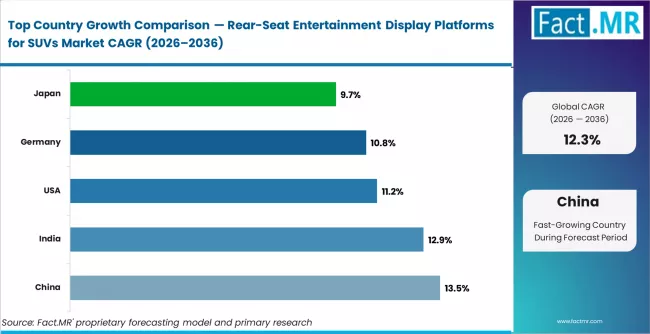
Rear Seat Entertainment Display Platforms For Suvs Market Cagr Analysis By Country | Source: Fact.MR
Asia Pacific Rear-Seat Entertainment Display Platforms for SUVs Market Analysis
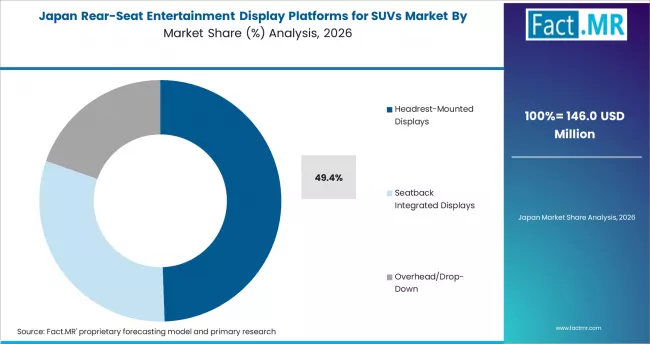
Rear Seat Entertainment Display Platforms For Suvs Market Japan Market Share Analysis By Installation Type | Source: Fact.MR
Asia Pacific stands out as the largest and fastest-growing region for SUV RSE platforms. Growth is anchored in China’s NEV scale and India’s SUV expansion. Japan adds strength through mature OEM-supplier integration. Panasonic Automotive Systems, Harman International, and LG Display dominate supply networks.
- China: Strong policy backing is accelerating China’s RSE adoption at 13.5% CAGR through 2036. The 2024 MIIT update pushed multi-screen rear entertainment into NEV cockpit standards. OEMs like BYD, NIO, and Li Auto embedded RSE in new SUV launches. Harman reported major programme wins tied to NEV platforms. Subsidy support in key provinces is boosting uptake of fully digital cabins.
- India: A fast-evolving SUV market is driving India’s 12.9% CAGR through 2036. Over half of passenger vehicle sales now come from SUVs. OEMs such as Tata Motors and Mahindra are introducing factory-fitted RSE systems. Panasonic strengthened partnerships to support local programmes. Demand is rising sharply in mid-premium SUVs.
- Japan: Japan’s growth remains measured at 9.7% CAGR through 2036. OEMs focus on quality and integration rather than rapid expansion. Toyota deployed RSE in Land Cruiser and Alphard platforms. Denso supports system integration, while Japan Display supplies panels. Adoption is steady and specification-driven.
Fact.MR covers China, India, Japan, South Korea, ASEAN, and Australia and New Zealand. It includes NEV mandates, SUV attach rates, and OEM pipeline insights.
North America Rear-Seat Entertainment Display Platforms for SUVs Market Analysis
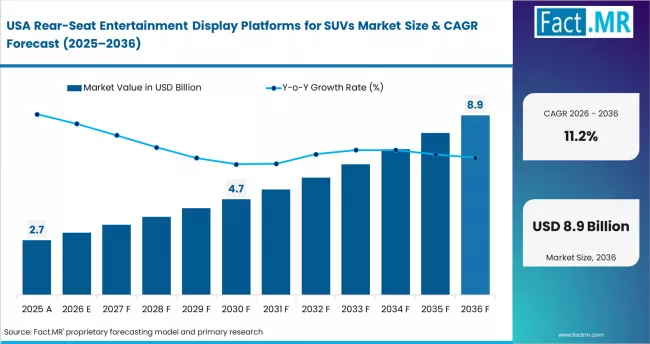
Rear Seat Entertainment Display Platforms For Suvs Market Country Value Analysis | Source: Fact.MR
North America reflects a premium-driven and connectivity-focused landscape. OEM upgrades and regulatory clarity are shaping demand. GM, Ford, and Stellantis lead adoption. Harman and Panasonic hold strong Tier-1 positions.
- United States: Regulatory clarity unlocked growth in the U.S., which is set to expand at 11.2% CAGR through 2036. NHTSA’s 2024 update removed uncertainty around rear displays. OEMs accelerated RSE integration across flagship SUVs. GM standardised systems in multiple 2025 models. Harman remains a key supplier across programmes.
Fact.MR covers the United States, Canada, and Mexico. It includes regulatory trends, attach rates, and procurement data.
Europe Rear-Seat Entertainment Display Platforms for SUVs Market Analysis
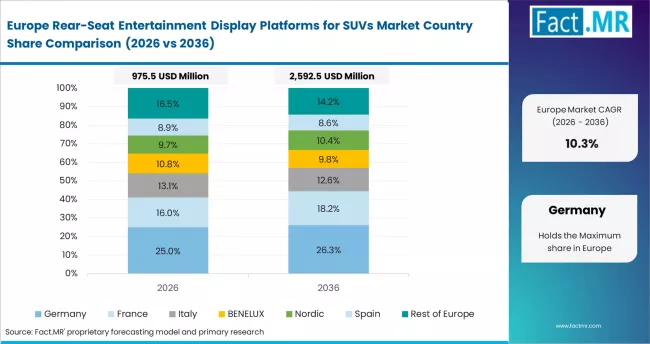
Rear Seat Entertainment Display Platforms For Suvs Market Europe Country Market Share Analysis, 2026 & 2036 | Source: Fact.MR
Europe is defined by premium innovation and strict compliance frameworks. Luxury OEMs continue to push advanced RSE specifications. BMW, Mercedes-Benz, and Volkswagen anchor demand. Harman and Alpine Electronics lead supply.
- Germany: Premium innovation continues to drive Germany’s 10.8% CAGR through 2036. Updated EU rules in 2024 added stricter display standards. BMW introduced Theatre Screen OLED systems in flagship models. Alpine supports key supply programmes. Demand is centred on high-end SUV experience differentiation.
Fact.MR covers Germany, the UK, France, Italy, Spain, Nordic countries, and BENELUX. It includes compliance timelines, OLED trends, and OEM programme insights.
Competitive Aligners for Market Players
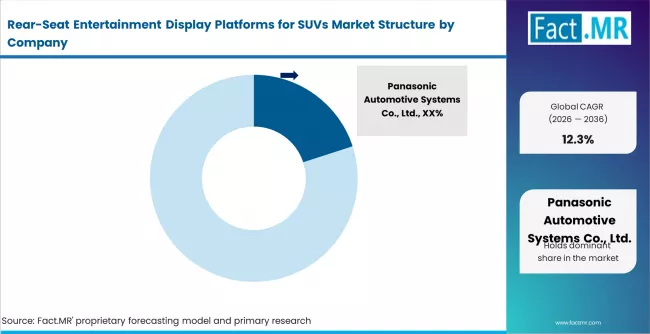
Rear Seat Entertainment Display Platforms For Suvs Market Analysis By Company | Source: Fact.MR
Key Players
- Panasonic Automotive Systems Co., Ltd.
- Harman International Industries, Inc.
- Visteon Corporation
- Denso Corporation
- Robert Bosch GmbH
- Alpine Electronics, Inc.
- LG Display Co., Ltd.
- Samsung Display Co., Ltd.
- Japan Display Inc.
- Continental AG
Bibliography
- [1] Ministry of Industry and Information Technology, China. (2024). Smart Connected Vehicle Technical Requirements Update 2024: Multi-Screen Rear Cabin Entertainment Integration Guidance for NEV Intelligent Cockpit Specifications Including BYD and NIO Platform Requirements. 2024. miit.gov.cn/english
- [2] National Highway Traffic Safety Administration. (Q3 2024). In-Vehicle Visual Display Guidelines Update: Rear-Seat Passenger Display Exemption from Driver Distraction Standards Clarification for OEM RSE Platform Design-In Programmes. Q3 2024. nhtsa.gov
- [3] United Nations Economic Commission for Europe. (2024). ECE Regulation 48 Amendment: Luminance and Reflectance Standards for Passenger-Facing Rear Cabin Display Systems in EU Vehicle Type Approval Applications. 2024. unece.org/transport/vehicle-regulations
- [4] Panasonic Automotive Systems Co., Ltd. (Q3 2024). Operations Update: RSE Display Platform Manufacturing Capacity Expansion at Osaka Automotive Electronics Facility Targeting Headrest-Mounted and Seatback-Integrated Systems for Toyota, Honda, and Stellantis SUV Programmes. Q3 2024. panasonic.com/global/automotive
- [5] Harman International Industries, Inc. (Q1 2025). Product Launch: Ready Access RSE Platform 3.0 Integrating 5G Connectivity, OTA Software Updates, and Netflix-Certified Streaming into Unified Headrest and Seatback RSE System for Luxury SUV OEM Programmes. January 2025. harman.com/news
- [6] Display Supply Chain Consultants. (2024). Automotive Display Market Report 2024: RSE Display Attach Rate Growth from 22% in 2022 to 31% in 2024 Globally, China NEV SUV Exceeding 45%, and OLED RSE Panel ASP Decline of 16% Projected 2024 to 2027. 2024. displaysupplychain.com
- [7] LG Display Co., Ltd. (Q4 2024). Operations Update: Automotive-Grade OLED Panel Production Expansion at Guangzhou Facility Adding Rear-Seat Entertainment Display Capacity in 10–15 Inch Configurations for Korean and European Premium SUV OEM Programmes. Q4 2024. lgdisplay.com/eng/media
- [8] Alpine Electronics, Inc. (Q2 2024). Product Launch: RSE OLED Display Platform Series with 12. 8-Inch Automotive-Grade Panels for BMW X-Series and Mercedes-Benz GLE-Class Rear Cabin Entertainment Programmes in European and North American Markets. Q2 2024. alpine.com/news
This Report Addresses
- Strategic intelligence on rear-seat entertainment display platform demand across headrest-mounted, seatback integrated, and overhead installation types for SUV OEM and aftermarket channels globally.
- Market forecast from USD 3.8 billion in 2026 to USD 12.2 billion by 2036 at a CAGR of 12.3%.
- Opportunity mapping across China NEV SUV RSE mandates, India rapid SUV segment expansion, U.S. NHTSA passenger display policy clarification, Germany luxury SUV OLED RSE innovation, and Japan premium platform integration.
- Segment analysis by installation type (headrest, seatback, overhead), display technology (LCD, OLED), and screen size (10–15 inch, >15 inch, <10 inch) across global and regional markets.
- Regional outlook covering Asia Pacific NEV-driven RSE procurement, North America NHTSA-enabled design-in acceleration, and Europe EU type approval and luxury OEM rear cabin digitalisation.
- Competitive analysis of Panasonic Automotive Systems, Harman International, Visteon Corporation, Denso Corporation, Alpine Electronics, and LG Display covering 5G integration depth, OLED qualification status, and OEM programme tenure.
- Regulatory impact analysis covering NHTSA in-vehicle passenger display guidelines, EU UN ECE Regulation 48 rear cabin luminance standards, China MIIT smart connected vehicle requirements, and OEM streaming certification mandates.
- Report delivered in PDF, Excel datasets, and presentation formats. Supported by primary interviews, OEM programme disclosures, DSCC automotive display shipment data, and Tier 1 RSE supplier revenue filings.
Rear-Seat Entertainment Display Platforms for SUVs Market Definition
The rear-seat entertainment display platforms for SUVs market includes headrest-mounted, seatback integrated, and overhead display systems using LCD and OLED panels, deployed to deliver video, gaming, and connectivity services to rear cabin passengers in sport utility vehicles globally.
Rear-Seat Entertainment Display Platforms for SUVs Market Inclusions
Covers global and regional forecasts from 2026 to 2036. Segmentation includes installation type, display technology, and screen size. Includes LCD, OLED, and other display grades. Installation types include headrest-mounted, seatback integrated, and overhead systems across OEM and aftermarket SUV channels.
Rear-Seat Entertainment Display Platforms for SUVs Market Exclusions
Excludes front-seat infotainment screens and instrument cluster displays unless integrated into rear-seat entertainment platform architectures. Omits standalone portable tablets and consumer electronics. Excludes display driver ICs and audio components as standalone units not forming part of integrated RSE platform systems.
Rear-Seat Entertainment Display Platforms for SUVs Market Research Methodology
- Primary Research
- Includes interviews with OEM interior procurement managers, Tier 1 RSE platform suppliers, display panel manufacturers, and automotive software integration engineers across China, Germany, United States, India, and Japan.
- Desk Research
- Includes analysis of company filings from Panasonic Automotive Systems, Harman International, and Visteon Corporation. Incorporates NHTSA passenger display guidelines, EU vehicle type approval updates, and automotive display shipment data from DSCC (2024–2025).
- Market-Sizing and Forecasting
- Uses a hybrid approach. Combines OEM SUV production volumes, RSE attach rates by vehicle segment, and average selling prices by installation type and display technology.
- Data Validation and Update Cycle
- Validated using OEM programme disclosures, Tier 1 supplier revenue filings, and global SUV production statistics. Updated regularly through display technology cost curve and OEM platform inputs.
Segmentation
Scope of Report
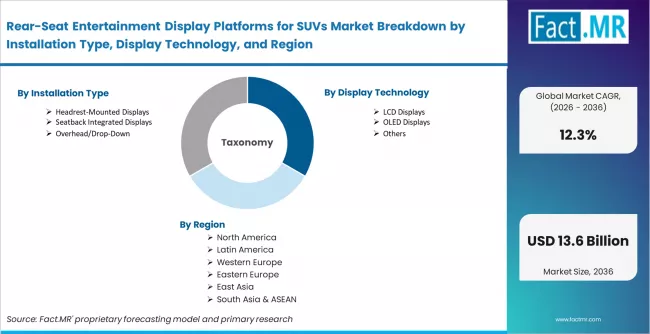
Rear Seat Entertainment Display Platforms For Suvs Market Breakdown By Installation Type Display Technology And Region | Source: Fact.MR
| Attribute | Details |
|---|---|
| Quantitative Units | USD 3.8 billion (2026) to USD 12.2 billion (2036), at a CAGR of 12.3% |
| Market Definition | Headrest-mounted, seatback integrated, and overhead LCD and OLED display systems for SUV rear cabin passenger entertainment, streaming, gaming, and connectivity applications across OEM and aftermarket channels globally. |
| Installation Type Segmentation | Headrest-Mounted Displays, Seatback Integrated Displays, Overhead/Drop-Down |
| Display Technology Segmentation | LCD Displays, OLED Displays, Others |
| Screen Size Segmentation | 10–15 Inch, >15 Inch, <10 Inch |
| Application Coverage | SUV rear cabin streaming and video entertainment, OEM seatback RSE platform supply, headrest display OEM and aftermarket fitment, 5G-connected rear cabin entertainment systems, and OLED premium RSE programme qualification. |
| Regions Covered | North America, Europe, Asia Pacific, Latin America, Middle East and Africa |
| Countries Covered | USA, Canada, Mexico, Germany, UK, France, Italy, Spain, Nordic, BENELUX, China, Japan, South Korea, India, ASEAN, Australia and New Zealand, Brazil, Argentina, Chile, Saudi Arabia, GCC, Turkey, South Africa, Rest of MEA |
| Key Companies Profiled | Panasonic Automotive Systems, Harman International, Visteon Corporation, Denso Corporation, Robert Bosch GmbH, Alpine Electronics, LG Display, Samsung Display, Japan Display Inc., Continental AG |
| Forecast Period | 2026 to 2036 |
| Approach | Hybrid top-down and bottom-up model using OEM SUV production volumes, RSE platform attach rates by installation type and screen size, average selling prices by display technology, and primary interviews with OEM interior procurement managers and Tier 1 RSE suppliers. |
Source: Fact.MR analysis. Updated Apr 29, 2026
Rear-Seat Entertainment Display Platforms for SUVs Market by Segments
-
By Installation Type:
- Headrest-Mounted Displays
- Seatback Integrated Displays
- Overhead/Drop-Down
-
By Display Technology:
- LCD Displays
- OLED Displays
- Others
-
By Screen Size:
- 10–15 Inch
- >15 Inch
- <10 Inch
-
By Region:
- North America
- United States
- Canada
- Mexico
- Latin America
- Brazil
- Argentina
- Chile
- Mexico
- Rest of Latin America
- Western Europe
- Germany
- United Kingdom
- France
- Italy
- Spain
- Nordic Countries
- BENELUX
- Rest of Western Europe
- Eastern Europe
- Russia
- Poland
- Hungary
- Balkan and Baltic
- Rest of Eastern Europe
- East Asia
- China
- Japan
- South Korea
- South Asia and Pacific
- India
- ASEAN
- Australia and New Zealand
- Rest of South Asia and Pacific
- Middle East and Africa
- Kingdom of Saudi Arabia
- Other GCC Countries
- Turkey
- South Africa
- Rest of Middle East and Africa
- North America
Frequently Asked Questions
How large is the global rear-seat entertainment display platforms for SUVs market in 2025?
What will the market size be in 2026?
What is the projected market size by 2036?
What is the expected CAGR from 2026 to 2036?
Which installation type segment is poised to lead the market?
Which display technology holds the largest share?
Which screen size segment dominates the market?
Which country shows the fastest growth in the market?
What drives demand in this market?
Who are the key players in the market?
Who worked on this report


Preview the report firsthand - request a free sample
Free SampleGet the brochure for pricing and purchase details
Download PDF