- Market Value (2025): USD 8.8 Bn
- Estimated Value (2026): USD 9.6 Bn
- Forecast Value (2036): USD 21.9 Bn
- CAGR (2026-2036): 8.6%
What is the Government Enterprise Content Management ECM Market forecast to be worth by 2036?
USD 9.6 billion in 2026 to USD 21.9 billion by 2036 at 8.6% CAGR.
- The government enterprise content management ECM market crossed a valuation of USD 8.8 billion in 2025 as agencies replaced file shares and paper-heavy records processes.
- Demand is projected to increase from USD 9.6 billion in 2026 to USD 21.9 billion by 2036.
- The market is forecast to record 8.6% CAGR from 2026 to 2036.
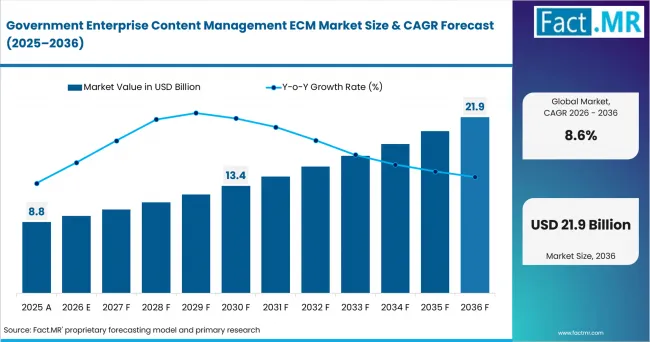
Government Enterprise Content Management Ecm Market Value Analysis | Source: Fact.MR
What are the defining numbers behind Government Enterprise Content Management ECM Market growth?
USD 12.2 billion absolute opportunity by 2036 led by document management systems and records management.
- Demand Drivers in the Market
- Government agencies need document repositories that preserve official records and make retrieval easier during audits and public disclosure work.
- Cloud migration is expected to raise demand for ECM platforms that combine repositories with identity controls and secure sharing.
- AI-enabled classification is anticipated to reduce manual tagging when agencies manage scanned files and case records.
- Integration with data catalog software is expected to matter where agencies need stronger metadata control across unstructured information assets.
- Key Segments Analyzed
- By ECM Solution: Document Management Systems is expected to hold 38.0% share in 2026 because it forms the core repository layer for official files.
- By Government Function: Records Management is projected to account for 36.0% share in 2026 as retention schedules remain central to public administration.
- By Public Sector Entity: Central Government Agencies is anticipated to capture 41.0% share in 2026 since national bodies manage the broadest record volumes.
- By Deployment Environment: Cloud-based ECM is estimated to represent 58.0% share in 2026 due to easier scaling and lower infrastructure burden.
- By Content Technology: Artificial Intelligence-enabled Content Management is forecast to hold 35.0% share in 2026 as classification and search improve daily records work.
- Analyst Opinion at Fact.MR
- Shambhu Nath Jha, Principal Consultant at Fact.MR, states, “Government ECM programs are moving from basic storage toward governed content operations. Agencies are expected to favor platforms that connect records policy with secure access. Workflow evidence and AI-assisted search must fit the same content environment.”
- Strategic Implications
- Vendors should make records retention and access controls easy to configure before promoting advanced automation features.
- Implementation partners can gain trust by mapping each workflow to audit evidence and case ownership.
- Product teams should connect ECM repositories with cloud data security controls so agencies can protect files during sharing.
The USA leads at 9.4% CAGR through federal cloud maturity and public-records modernization. Canada follows at 9.0% as digital service programs support secure records workflows. Germany reaches 8.7% through administrative digitization. The UK records 8.3% through information governance needs. Japan posts 8.0% through agency modernization. Australia reaches 7.6% through public-sector cloud adoption. Singapore records 7.2% through compact digital-government execution.
How does the Government Enterprise Content Management ECM Market break down by segment?
Document Management Systems are expected to lead ECM Solution at 38.0% share in 2026. Records Management is projected to lead Government Function at 36.0% share in 2026.
Why do Document Management Systems lead ECM Solution?
Document Management Systems are projected to account for 38.0% share in 2026.
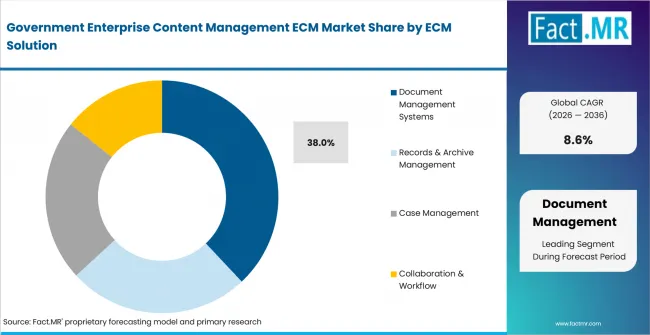
Government Enterprise Content Management Ecm Market Analysis By Ecm Solution | Source: Fact.MR
This category leads because agencies usually build ECM programs around a controlled repository before adding automation. Buyers need version control and permissions alongside content analytics discovery features that make official files easier to find.
Why does Records Management lead Government Function?
Records Management is expected to hold 36.0% share in 2026.
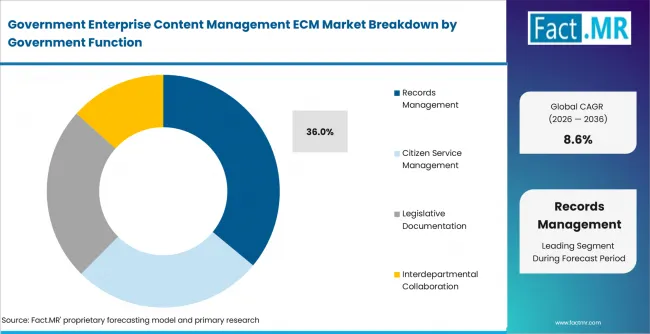
Government Enterprise Content Management Ecm Market Analysis By Government Function | Source: Fact.MR
Retention schedules give this function a clear place in government ECM budgets. Legal holds and audit trails make the system useful beyond storage when content moves through a governed data marketplace platform environment.
What supports Central Government Agencies within Public Sector Entity?
Central Government Agencies are anticipated to represent 41.0% share in 2026.
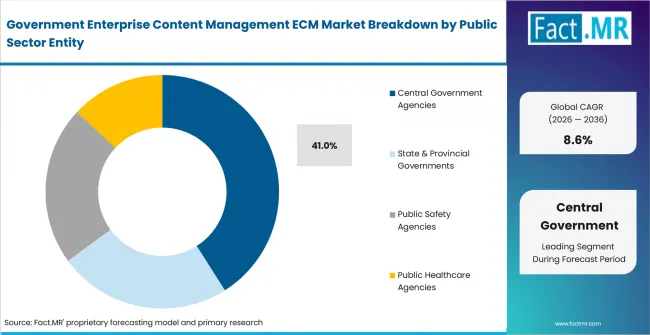
Government Enterprise Content Management Ecm Market Analysis By Public Sector Entity | Source: Fact.MR
National bodies manage policy files and program records across many departments. Their content volumes are larger than most local bodies. This creates a practical need for centralized platforms with clear ownership rules.
How does Cloud-based ECM lead Deployment Environment?
Cloud-based ECM is estimated to capture 58.0% share in 2026.
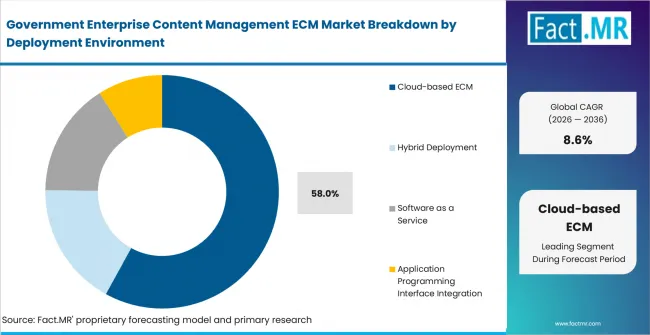
Government Enterprise Content Management Ecm Market Analysis By Deployment Environment | Source: Fact.MR
Agencies are expected to prefer cloud-based ECM when internal infrastructure limits scaling. The deployment model supports remote access and disaster recovery. Migration still needs careful planning because records history and permissions must remain intact.
Why does Artificial Intelligence-enabled Content Management lead Content Technology?
Artificial Intelligence-enabled Content Management is forecast to hold 35.0% share in 2026.
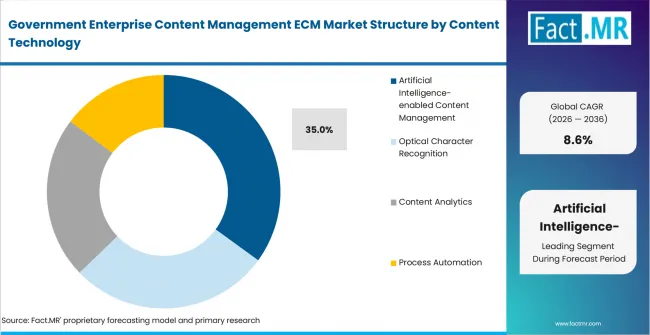
Government Enterprise Content Management Ecm Market Analysis By Content Technology | Source: Fact.MR
AI-enabled content management gains share when agencies need faster classification of scanned records. The value is highest when automation stays inside governed workflows with clear ModelOps controls.
What is accelerating Government Enterprise Content Management ECM Market adoption, and what is holding it back?
Demand is expected to rise through digital records modernization and cloud migration. Growth is likely to be limited by migration cost and legacy-system dependence. Records-management skill gaps add pressure.
Drivers Impact Analysis
| DRIVER | (~) % IMPACT ON CAGR | GEOGRAPHIC RELEVANCE | IMPACT TIMELINE |
|---|---|---|---|
| Digital records modernization | +2.4% | USA, Canada, UK | Short term (<= 2 years) |
| Cloud-based repository migration | +2.0% | North America, Europe, Singapore | Short term (<= 2 years) |
| Records compliance and audit trails | +1.7% | Government-heavy markets | Medium term (2-4 years) |
| AI-assisted classification and search | +1.4% | USA, Japan, Australia | Medium term (2-4 years) |
| Workflow integration across agencies | +1.1% | Global | Long term (>= 4 years) |
Source: Fact.MR analysis. Updated Aug 7, 2026
- Digital records modernization: Agency buyers are expected to prioritize ECM systems that reduce paper handoffs and make official records easier to locate.
- Cloud-based repository migration: Cloud ECM is expected to appeal where agencies want secure access without separate infrastructure for each department.
- Records compliance and audit trails: Records policy is expected to keep ECM spending tied to retention schedules and legal review.
Opportunity Impact Analysis
| OPPORTUNITY | (~) % IMPACT ON CAGR | GEOGRAPHIC RELEVANCE | IMPACT TIMELINE |
|---|---|---|---|
| AI-led metadata enrichment | +1.2% | USA, Japan, Singapore | Medium term (2-4 years) |
| Cloud records migration services | +1.0% | Canada, UK, Australia | Medium term (2-4 years) |
| Public-service workflow automation | +0.8% | North America and Europe | Long term (>= 4 years) |
| Integrated disclosure and case records | +0.6% | USA and UK | Long term (>= 4 years) |
Source: Fact.MR analysis. Updated Aug 7, 2026
- AI-led metadata enrichment: Vendors that reduce manual indexing are expected to improve ECM value for agencies with mixed document types.
- Cloud records migration services: Service providers can capture demand where agencies need to move legacy repositories without losing retention history.
- Public-service workflow automation: ECM platforms that route content through approvals are expected to gain relevance beyond storage.
Restraints Impact Analysis
| RESTRAINT | (~) % IMPACT ON CAGR | GEOGRAPHIC RELEVANCE | IMPACT TIMELINE |
|---|---|---|---|
| Legacy repository migration cost | -1.1% | Global | Short term (<= 2 years) |
| Records policy complexity | -0.9% | USA, Canada, Europe | Short term (<= 2 years) |
| Integration with old case systems | -0.7% | Mature public sectors | Medium term (2-4 years) |
| Workforce capability gaps | -0.5% | Developing markets | Long term (>= 4 years) |
Source: Fact.MR analysis. Updated Aug 7, 2026
- Legacy repository migration cost: Large agencies often need staged migration because files and retention rules must remain intact.
- Records policy complexity: ECM projects can slow when legal and security teams interpret requirements differently.
- Integration with old case systems: Older public-sector applications often lack clean APIs. This raises configuration work before ECM workflows operate smoothly.
Which countries are scaling Government Enterprise Content Management ECM Market fastest?
- The displayed country comparison spans 2.2 percentage points across the forecast period.
- The USA remains 0.4 percentage point above Canada through federal cloud maturity and large public-sector software procurement.
- Canada stays 0.3 percentage point above Germany as digital service programs support secure records workflow demand.
- Germany holds a 0.4 percentage point lead over the UK through administrative digitization and compliance-heavy public operations.
- The UK is 0.3 percentage point ahead of Japan as public services require stronger information governance.
- Japan remains 0.4 percentage point above Australia through agency modernization and structured records programs.
- Australia keeps a 0.4 percentage point gap over Singapore. Singapore closes the range through compact digital-government execution.
Comparable CAGRs can create different entry conditions because procurement scale and security review differ by country. Full report coverage includes North America; Latin America; Europe; East Asia; South Asia and Pacific; Middle East and Africa.
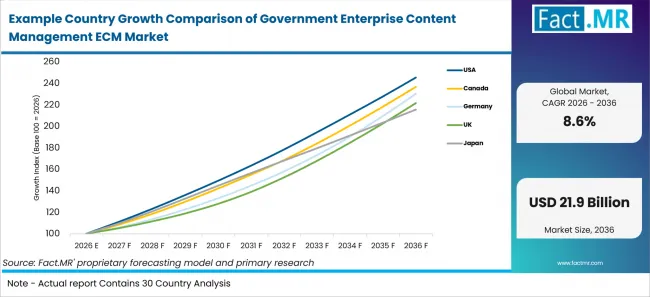
Example Country Growth Comparison Of Government Enterprise Content Management Ecm Market | Source: Fact.MR
| Country | CAGR (2026-2036) |
|---|---|
| USA | 9.4% |
| Canada | 9.0% |
| Germany | 8.7% |
| UK | 8.3% |
| Japan | 8.0% |
| Australia | 7.6% |
| Singapore | 7.2% |
Source: Fact.MR analysis. Updated Aug 7, 2026
What supports USA adoption?
9.4% CAGR, supported by federal cloud maturity and public-sector records modernization.
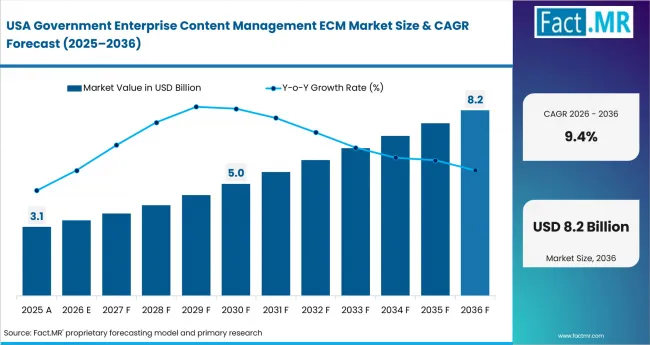
Government Enterprise Content Management Ecm Market Country Value Analysis | Source: Fact.MR
Federal buyers in the USA evaluate ECM systems through security evidence before content migration begins. Demand is expected to focus on repositories that protect official records and support service delivery.
How is Canada scaling demand?
9.0% CAGR, backed by digital service programs and secure public records workflows.
Canada’s public agencies need ECM platforms that handle bilingual content and privacy controls. This favors systems that make collaboration easier without weakening records governance.
What is driving Germany’s growth from 2026 to 2036?
8.7% CAGR, supported by administrative digitization and compliance-heavy public operations.
Germany’s demand is shaped by structured administration and strict data protection expectations. ECM buyers are expected to focus on metadata quality and secure document exchange.
How is the UK developing demand?
8.3% CAGR, led by public-service modernization and information governance requirements.
UK agencies need searchable records for service delivery and disclosure requests. ECM adoption is expected to favor platforms that connect case records with audit trails.
How does Japan perform?
8.0% CAGR, driven by agency modernization and structured records management.
Japan’s agencies continue to manage mixed paper and digital processes. Buyers are expected to value stable repositories with predictable integration and Japanese-language metadata handling.
What supports Australia’s growth?
7.6% CAGR, backed by cloud adoption and public-sector digital service delivery.
Australia’s market reflects a practical need to manage records across national and local agencies. ECM platforms are expected to support remote access and clear retention controls.
What supports Singapore’s growth?
7.2% CAGR, supported by compact digital-government execution and regional technology depth.
Singapore’s smaller market benefits from advanced public-sector technology use. Agencies are expected to prefer ECM systems that integrate with portals and identity tools.
Who leads the Government Enterprise Content Management ECM Market?
OpenText and Hyland hold the strongest fit in government ECM, while Microsoft, Oracle and IBM add scale through cloud, records and enterprise software depth.
SER Group Doxis, Laserfiche and M-Files widen the field through document control and workflow tools. Box and Newgen strengthen secure content collaboration and process automation. Competition is likely to depend on audit trails, retention controls and agency-ready migration support.
Which companies are the key providers?
Key companies include OpenText Corporation; Hyland Software, Inc.; Microsoft Corporation; Oracle Corporation; IBM Corporation; SER Group – Doxis; Laserfiche, Inc.; M-Files Corporation; Box, Inc.; and Newgen Software Technologies Limited
- OpenText Corporation
- Hyland Software, Inc.
- Microsoft Corporation
- Oracle Corporation
- IBM Corporation
- SER Group – Doxis
- Laserfiche, Inc.
- M-Files Corporation
- Box, Inc.
- Newgen Software Technologies Limited
Bibliography
- Federal Risk and Authorization Management Program. (2025, May 29). FedRAMP 20x—Two months in and taking off.
- National Archives and Records Administration. (2026, February 23). 2025 federal agency records management reporting period and questionnaires [Memorandum].
- Department for Science, Innovation and Technology. (2025, January). State of digital government review: A review of technology and data in the public sector: Successes, challenges and root causes (CP 1251).
- Box, Inc. (2025, March 4). Box reports fourth quarter and fiscal 2025 financial results.
This Report Answers
- The report explains how ECM Solution and Government Function choices shape public-sector records programs.
- Segment analysis covers Document Management Systems and Records Management as 2026 share leaders.
- Country outlook evaluates the USA; Canada; Germany; the UK; Japan; Australia; and Singapore.
- Competitive analysis profiles OpenText Corporation and Hyland Software, Inc. alongside Microsoft Corporation and Oracle Corporation.
- Adoption assessment connects ECM with software distribution; cloud-native technologies; and public cloud services as agencies move content workloads into secure platforms.
What does the Government Enterprise Content Management ECM Market cover?
Government ECM systems manage official records and route documents through approved workflows.
The market covers software and services for repositories and retention policy. It includes capture and workflow routing across government content environments. The scope applies when the system manages the lifecycle of official records.
What is included in the scope?
Government ECM is used across central agencies and local authorities.
Public-service bodies and regulated public institutions are included. The scope covers ECM Solution and Government Function alongside Public Sector Entity. Deployment Environment and Content Technology are included when they support content management.
What is excluded from the scope?
General office productivity software remains outside the scope unless it is deployed as part of a government ECM workflow.
Consumer file sharing and basic cloud storage are excluded. Standalone website publishing is outside the scope when it lacks records lifecycle functionality. Cybersecurity tools are excluded unless they control content governance inside ECM workflows.
How Was the Analysis Built?
The analysis draws on 120+ sources, 35+ company portfolios, 25+ countries, and more than 20 interviews.
- Primary Research: Interviews with manufacturers, retailers, salon operators, and experts examine purchase priorities, adoption, approval requirements, and competitive positioning.
- Desk Research: Desk research covers government statistics, regulatory publications, company filings, trade data, technical studies, industry associations, standards, and public policy.
- Market Sizing and Forecasting: Estimates combine historical performance, demand indicators, pricing, segment shares, company participation, country growth, adoption patterns, and barriers to expansion.
- Data Validation and Update Cycle: Findings are validated against public data, company activity, regulatory changes, product launches, recalls, and adoption shifts.
Segmentation
What is the report’s scope and coverage?
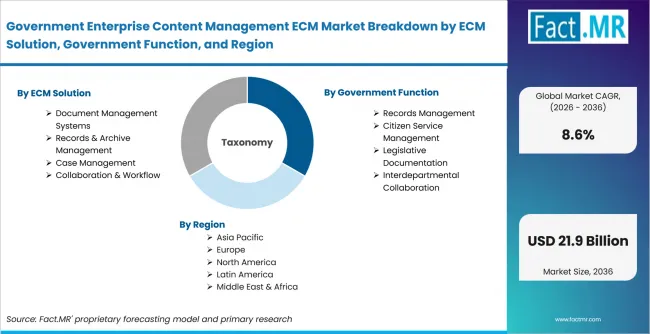
Government Enterprise Content Management Ecm Market Breakdown By Ecm Solution, Government Function, And Region | Source: Fact.MR
| Attribute | Details |
|---|---|
| Quantitative Units | USD billion in 2026 to USD billion by 2036 at CAGR |
| Market Definition | Content software and related services used by public agencies to capture, store, retrieve, secure, preserve and dispose of official records where searchable access, audit trails, retention control and secure workflow management determine agency adoption and records-governance approval |
| ECM Solution | Document Management Systems; Records Management Systems; Workflow Management; Web Content Management; Digital Asset Management |
| Government Function | Records Management; Citizen Services; Compliance and Audit; FOIA and Public Disclosure; Procurement and Finance; Human Resources |
| Public Sector Entity | Central Government Agencies; State and Provincial Government; Local Government; Public Safety and Justice Agencies; Public Institutions |
| Deployment Environment | Cloud-based ECM; On-premise ECM; Hybrid ECM; FedRAMP-compliant Cloud; Sovereign Cloud |
| Content Technology | Artificial Intelligence-enabled Content Management; Metadata and Taxonomy Automation; Search and Discovery; OCR and Capture; Records Retention Automation |
| Regions Covered | North America; Latin America; Europe; East Asia; South Asia and Pacific; Middle East and Africa |
| Countries Covered | USA; Canada; Germany; UK; Japan; Australia; Singapore |
| Key Companies Profiled | OpenText Corporation; Hyland Software, Inc.; Microsoft Corporation; Oracle Corporation; IBM Corporation; SER Group – Doxis; Laserfiche, Inc.; M-Files Corporation; Box, Inc.; Newgen Software Technologies Limited |
| Forecast Period | 2026 to 2036 |
| Approach | Hybrid top-down and bottom-up approach using software demand; records modernization; cloud deployment; ECM mix; compliance needs; country growth; and company portfolio review |
Source: Fact.MR analysis. Updated Aug 7, 2026
How is the market segmented?
-
By ECM Solution
- Document Management Systems
- Records Management Systems
- Workflow and Business Process Management
- Web Content Management
- Digital Asset Management
-
By Government Function
- Records Management
- Citizen Services
- Compliance and Audit
- FOIA and Public Disclosure
- Procurement and Finance
- Human Resources
-
By Public Sector Entity
- Central Government Agencies
- State and Provincial Government
- Local Government
- Public Safety and Justice Agencies
- Education and Public Institutions
-
By Deployment Environment
- Cloud-based ECM
- On-premise ECM
- Hybrid ECM
- FedRAMP-compliant Cloud
- Sovereign Cloud
-
By Content Technology
- Artificial Intelligence-enabled Content Management
- Metadata and Taxonomy Automation
- Search and Discovery
- OCR and Capture
- Records Retention Automation
-
By Region
- North America
- Latin America
- Europe
- East Asia
- South Asia and Oceania
- Middle East and Africa
Frequently Asked Questions
How big is the government enterprise content management ECM market in 2026?
What is the CAGR of the government enterprise content management ECM market from 2026 to 2036?
Which ECM solution leads the government enterprise content management ECM market?
Which government function leads the government enterprise content management ECM market?
Who are the leading companies in the government enterprise content management ECM market?
Who worked on this report


Preview the report firsthand - request a free sample
Free SampleGet the brochure for pricing and purchase details
Download PDF