- Market Value (2025): USD 7.4 Bn
- Estimated Value (2026): USD 8.2 Bn
- Forecast Value (2036): USD 21.7 Bn
- CAGR (2026-2036): 10.2%
What is the HCM Software in the Government and Public Sector Market forecast to be worth by 2036?
USD 8.2 billion in 2026 to USD 21.7 billion by 2036 at 10.2% CAGR.
- The HCM software in the government and public sector market reached USD 7.4 billion in 2025.
- Demand is forecast to increase from USD 8.2 billion in 2026 to USD 21.7 billion by 2036.
- The market is projected to record 10.2% CAGR from 2026 to 2036.
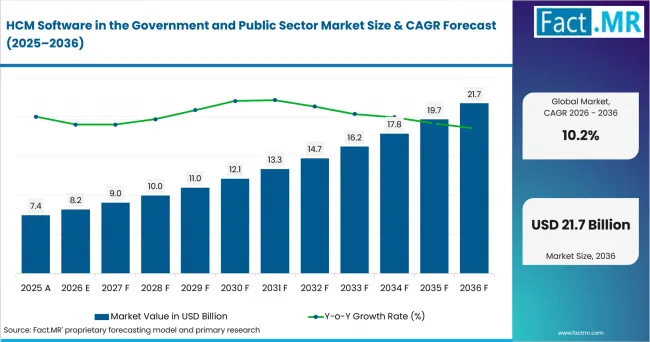
Hcm Software In The Government And Public Sector Market Value Analysis | Source: Fact.MR
What are the defining numbers behind HCM Software in the Government and Public Sector Market growth?
USD 13.5 billion absolute opportunity is expected by 2036.
- Demand Drivers in the Market
- Government HR teams are expected to replace fragmented personnel records with core systems that keep employee data and position data in one auditable environment. In June 2026, the U.S. Office of Personnel Management said the federal government had more than 100 separate Core HCM systems across agencies and that the new Core HCM platform would support approximately two million U.S. Executive Branch civilian employees.
- Public agencies are anticipated to favor cloud-based HCM platforms where compliance review and security controls must operate inside the same workflow.
- Central government agencies are expected to prioritize common data standards because workforce planning becomes harder when HR systems remain separated.
- Key Segments Analyzed
- By Software Module: Core Human Resource Management is expected to hold 46.0% share in 2026 because agencies need a trusted employee record before wider process automation can scale.
- By Application: Workforce Administration is projected to account for 42.0% share in 2026 as public-sector HR teams manage staffing and service requests through shared workflows.
- By End User: Central Government Agencies are anticipated to capture 39.0% share in 2026 since national departments need standardized data and secure employee access.
- By Deployment Model: Cloud-based Deployment is estimated to represent 58.0% share in 2026 due to lower infrastructure burden and easier upgrades across multi-agency programs.
- By Technology Platform: Artificial Intelligence-enabled HCM is forecast to hold 45.0% share in 2026 as agencies seek better service routing and workforce insight.
- Analyst Opinion at Fact.MR
- Shambhu Nath Jha, Principal Consultant at Fact.MR, states, "Government HCM modernization is moving from record replacement toward workforce intelligence. Agencies that combine secure cloud deployment with auditable data models are expected to gain higher adoption because public-sector buyers need reliability before advanced automation."
- Strategic Implications
- Software providers should make compliance and audit trails central to product design because public agencies cannot separate HR modernization from governance requirements.
- Implementation teams should prepare migration plans before configuration begins since legacy position records can slow payroll and employee-service transitions.
- Vendors can strengthen bids by showing how HCM data connects with business process as a service and finance workflows. Identity controls should remain part of the same operating plan.
- Agencies should test AI-enabled functions through explainability and access checks before using them for workforce decisions.
The USA leads at 11.1% CAGR through enterprise software depth and government cloud modernization. The UK follows at 10.7%. Germany reaches 10.3% and Canada records 9.9%. Australia reaches 9.5%. Japan posts 9.1% and Singapore closes the listed range at 8.7%.
How does the HCM Software in the Government and Public Sector Market break down by segment?
Core Human Resource Management is expected to lead Software Module with 46.0% share in 2026. Workforce Administration leads Application with 42.0%.
Which software module dominates?
Core Human Resource Management is projected to account for 46.0% share in 2026.
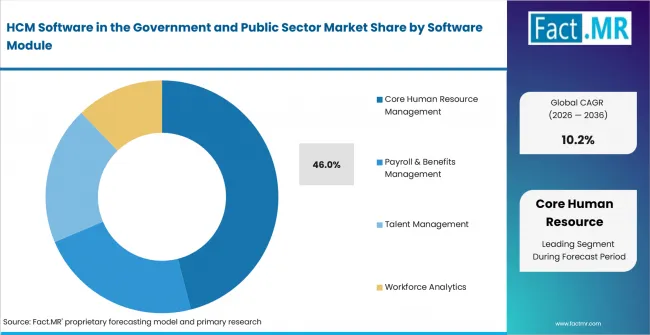
Hcm Software In The Government And Public Sector Market Analysis By Software Module | Source: Fact.MR
Core HR leads because agencies need one controlled employee record before adding talent tools or analytics. The segment reduces errors when personnel data must move across payroll and finance systems. Identity controls depend on the same record quality. What leads the Application segment?
Which software module dominates?Which software module dominates?
By Application, Workforce Administration is expected to hold 42.0% share in 2026.
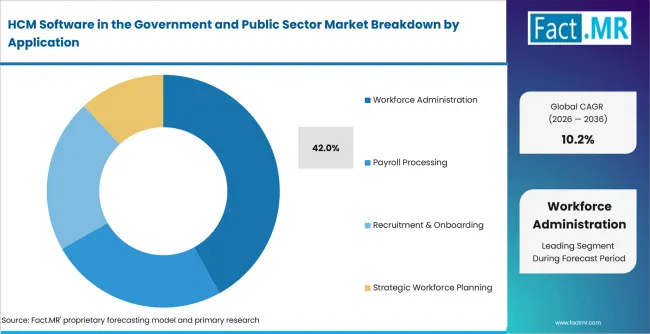
Hcm Software In The Government And Public Sector Market Analysis By Application | Source: Fact.MR
Routine HR actions make this segment the practical center of public-sector HCM. Hiring support and transfers need clear workflows with auditable documentation. Leave and records changes follow the same operating need. UKG launched an AI-guided UKG Pro experience in October 2025 across HR, pay, and workforce management, helping users complete actions such as time-off requests, timesheet approvals, pay views, and personal-information updates in a few clicks.
How do Central Government Agencies shape demand?
National departments are anticipated to represent 39.0% share in 2026 across End User demand.
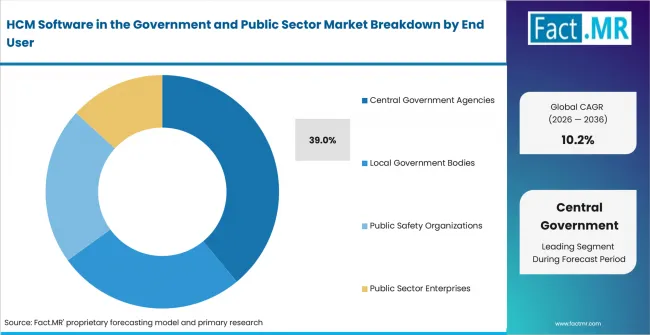
Hcm Software In The Government And Public Sector Market Analysis By End User | Source: Fact.MR
Central agencies set policy and coordinate reporting across departments. Their purchases favor platforms that standardize processes without weakening agency-level operating needs.
Why does Cloud-based Deployment lead?
A 58.0% share is estimated for Cloud-based Deployment in 2026.
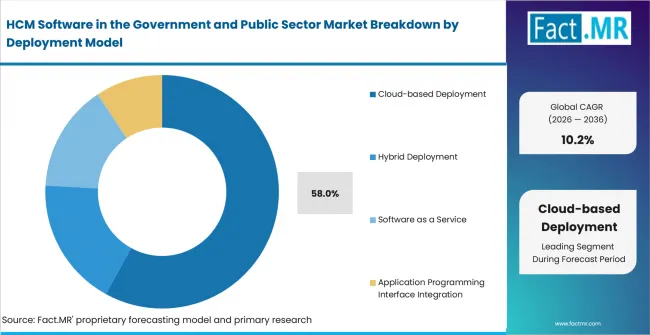
Hcm Software In The Government And Public Sector Market Analysis By Deployment Model | Source: Fact.MR
Cloud deployment leads because agencies want faster updates and lower infrastructure burden. Buyers still need secure hosting and clear integration plans as cloud managed services become part of the wider operating model.
What supports Artificial Intelligence-enabled HCM?
Artificial Intelligence-enabled HCM is forecast to hold 45.0% share in 2026.
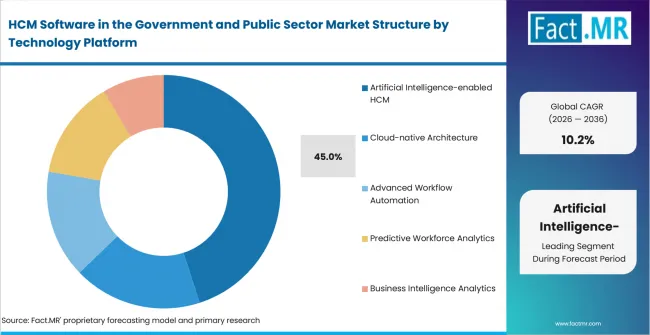
Hcm Software In The Government And Public Sector Market Analysis By Technology Platform | Source: Fact.MR
AI-enabled HCM gains share where automation improves search and case routing. Adoption is expected to depend on transparent rules and governance checks before decision support is used in workforce planning.
What is accelerating HCM Software in the Government and Public Sector Market adoption, and what is holding it back?
Demand is expected to rise as agencies modernize HR records and move workflows to cloud platforms. Adoption may be held back by legacy data and procurement delays. Drivers Impact Analysis
| DRIVER | (~) % IMPACT ON CAGR | GEOGRAPHIC RELEVANCE | IMPACT TIMELINE |
|---|---|---|---|
| Core HR record modernization | +2.8% | North America and Europe | Short term (<= 2 years) |
| Cloud-based deployment shift | +2.4% | USA, UK, Canada, Australia | Short term (<= 2 years) |
| AI-enabled employee service | +2.0% | USA, Japan, Singapore | Medium term (2-4 years) |
| Integrated workforce administration | +1.6% | Global public sector | Medium term (2-4 years) |
| Compliance and reporting needs | +1.4% | Central government agencies | Long term (>= 4 years) |
Source: Fact.MR analysis. Updated Aug 11, 2026
- Core HR record modernization: Public agencies are expected to prioritize accurate personnel data because every later workflow depends on a trusted employee record.
- Cloud-based deployment shift: Cloud HCM is anticipated to lower upgrade pressure as agencies move closer to cloud native technologies and shared update cycles.
- AI-enabled employee service: Automation is projected to improve routing and case handling when agencies pair it with clear knowledge-management practices.
Opportunity Impact Analysis
| OPPORTUNITY | (~) % IMPACT ON CAGR | GEOGRAPHIC RELEVANCE | IMPACT TIMELINE |
|---|---|---|---|
| Unified workforce data models | +1.5% | USA and UK | Medium term (2-4 years) |
| Employee self-service portals | +1.2% | Canada and Australia | Medium term (2-4 years) |
| AI-assisted workforce planning | +1.0% | Japan and Singapore | Long term (>= 4 years) |
| System-integration services | +0.8% | Germany and Europe | Long term (>= 4 years) |
Source: Fact.MR analysis. Updated Aug 11, 2026
- Unified workforce data models: Agencies that combine role data and service data are expected to create better reporting for HR leaders.
- Employee self-service portals: Digital access to records and tickets is expected to reduce routine HR workload. The same buyer need supports wider digital workplace investment.
- AI-assisted workforce planning: HCM vendors can create opportunity where planning tools connect skills data with self-service analytics for decision-makers.
Restraints Impact Analysis
| RESTRAINT | (~) % IMPACT ON CAGR | GEOGRAPHIC RELEVANCE | IMPACT TIMELINE |
|---|---|---|---|
| Legacy data migration burden | -1.3% | Mature public systems | Short term (<= 2 years) |
| Procurement and approval cycles | -1.0% | North America and Europe | Short term (<= 2 years) |
| Integration with payroll and finance | -0.8% | Global public sector | Medium term (2-4 years) |
| Cybersecurity and access controls | -0.6% | Cloud-led deployments | Long term (>= 4 years) |
Source: Fact.MR analysis. Updated Aug 11, 2026
- Legacy data migration burden: Older records often use inconsistent job and department structures. This raises cleanup work before deployment.
- Procurement and approval cycles: Public buyers may delay replacement programs when budgets and security reviews move at different speeds. This makes planning discipline as useful as office of the CFO software integration.
- Cybersecurity and access controls: Agencies are expected to examine HCM platforms through zero-trust principles before expanding employee self-service across mobile device management environments.
Which countries are scaling the HCM Software in the Government and Public Sector Market fastest?
- The displayed country range spans 2.4 percentage points and forms three practical growth bands across the forecast period.
- The USA remains 0.4 percentage points above the UK through enterprise software scale and government cloud activity.
- The UK remains 0.4 percentage points above Germany as public services keep modernizing workforce and employee-service systems.
- Germany remains 0.4 percentage points above Canada through structured administration and enterprise software integration needs.
- Canada remains 0.4 percentage points above Australia because public agencies continue digital-service and workforce-system upgrades.
- Australia remains 0.4 percentage points above Japan through cloud adoption and digital government programs.
- Japan remains 0.4 percentage points above Singapore since enterprise technology modernization supports HCM replacement activity.
Comparable CAGRs can still create different supplier conditions because agency size and procurement rules vary by country. Full report coverage includes North America and Latin America. Europe and East Asia complete the next part of the regional view. South Asia and Pacific plus Middle East and Africa complete the scope.
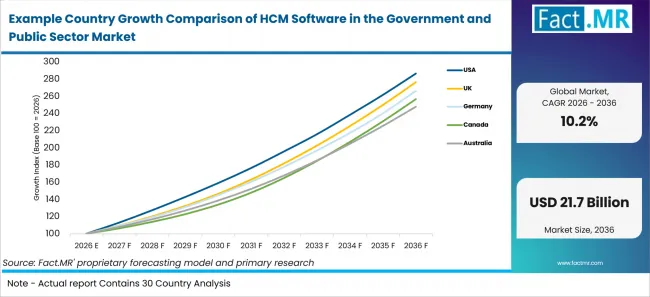
Example Country Growth Comparison Of Hcm Software In The Government And Public Sector Market | Source: Fact.MR
| Country | CAGR (2026-2036) |
|---|---|
| USA | 11.1% |
| UK | 10.7% |
| Germany | 10.3% |
| Canada | 9.9% |
| Australia | 9.5% |
| Japan | 9.1% |
| Singapore | 8.7% |
Source: Fact.MR analysis. Updated Aug 11, 2026
What supports USA adoption?
11.1% CAGR, supported by leadership in enterprise software and cloud computing.
Federal and state agencies in the USA evaluate HCM platforms through scale and auditability. Large employee populations make reliable records and service workflows necessary. Buyers are expected to prefer systems that can connect HR data with managed infrastructure services without adding manual control work.
How is the UK scaling demand?
10.7% CAGR, supported by financial services depth and professional services capability.
The UK market is shaped by public bodies that need cleaner employee service and workforce planning. Procurement teams are expected to favor HCM platforms that support shared processes and keep reporting usable across departments. The UK Cabinet Office reported Civil Service employment of 549,660 headcount and 516,150 FTE as of March 31, 2025, showing the scale of employee records and service cases that digital HCM systems must support.
What is driving Germany’s growth from 2026 to 2036?
10.3% CAGR, backed by industrial digitalization and manufacturing software demand.
Germany’s public-sector demand is expected to move through structured implementation cycles. Agencies need stable system integration because employee records must remain consistent across payroll and personnel administration. Reporting workflows depend on the same data discipline.
How is Canada developing demand?
9.9% CAGR, driven by technology sector growth and digital transformation.
Canada’s growth reflects agency interest in simpler employee-facing services and better HR reporting. Bilingual service needs and cloud readiness are expected to shape vendor selection across public-sector programs. The Public Service Commission of Canada reported 279,707 employees under the Public Service Employment Act as of March 31, 2025, after a 1% decline during fiscal 2024 to 2025.
How does Australia perform?
9.5% CAGR, led by cloud adoption and digital government programs.
Australia’s market is expected to develop as agencies replace manual workflows with shared digital platforms. Cloud deployment supports wider employee access and gives HR teams a clearer route for updates. The Australian Public Service Commission reported 198,529 APS employees across 102 agencies and 586 locations at June 30, 2025, supporting demand for shared records across dispersed agencies.
What supports Japan’s growth?
9.1% CAGR, supported by enterprise technology modernization initiatives.
Japan’s buyers are expected to value controlled implementation and careful process alignment. Stable support becomes necessary when agencies modernize HR systems without disrupting payroll and personnel administration.
What supports Singapore’s growth?
8.7% CAGR, backed by regional headquarters and financial technology.
Singapore’s compact administration environment is expected to support selective HCM upgrades. Buyers are likely to focus on secure employee self-service and workforce analytics that fit wider public digital systems. Singapore's Public Service Division said that in 2025 only 35 late salary-payment cases occurred because of appointment-record delays, equal to about 0.02% of over 158,000 officers.
Who leads the HCM Software in the Government and Public Sector Market?
Workday and Oracle form part of the core global provider group. SAP and UKG add broader HCM coverage. Dayforce expands the group. Cornerstone OnDemand and Infor broaden the competitive set. Deloitte and NEC add implementation services. IBM adds public-sector technology services.
Competition is expected to depend on public-sector fit more than broad enterprise software scale alone. Buyers compare security controls and audit trails. Workflow configuration and service support remain part of the decision. Integration with payroll or finance systems is another purchase check. Vendors that reduce migration risk are expected to have an advantage in long approval cycles. Workday said in November 2025 that the U.S. Department of Energy went live on Workday Government as the first cabinet-level agency to move core HR systems into a FedRAMP-authorized cloud.
Which companies are the key providers?
Companies include Workday, Inc., Oracle Corporation, SAP SE, UKG Inc., Dayforce, Inc., Cornerstone OnDemand, Inc., Infor, Inc.
- Workday, Inc.
- Oracle Corporation
- SAP SE
- UKG Inc.
- Dayforce, Inc.
- Cornerstone OnDemand, Inc.
- Infor, Inc.
Bibliography
- U.S. Office of Personnel Management. (2025, July 1). New data shows Trump Administration’s progress in right-sizing the federal bureaucracy.
- U.S. Office of Personnel Management. (2026, June 10). OPM awards contract for first ever governmentwide HR platform.
- Woelke, B. (2025, April 15). SAP SuccessFactors first half 2025 release: New AI-enabled innovations boost efficiency, flexibility, and success for employees and organizations. SAP.
- UKG. (2025, October 30). UKG debuts AI-guided user experience. The date and headline exactly match UKG's newsroom release.
- Cabinet Office. (2025, October 29). Statistical bulletin - Civil Service Statistics: 2025. GOV.UK shows the page as updated October 29, 2025 and identifies Cabinet Office as the issuing department.
- Public Service Commission of Canada. (2025, December 16). Release of the Public Service Commission of Canada's 2024 to 2025 annual report. The official Canada.ca release confirms both the author and date.
- Australian Public Service Commission. (2025, November 26). APS workforce size and location.
- Public Service Division. (2026, March 6). Question on cases where salaries of public sector employees are not paid on time. The PSD page explicitly gives March 6, 2026.
- Workday, Inc. (2025, November 25). Workday announces fiscal 2026 third quarter financial results. Workday's official release confirms November 25, 2025 and the exact headline.
This Report Answers
- The report provides strategic intelligence on Software Module and Application choices that shape public-sector HR modernization.
- Segment analysis covers Core Human Resource Management and Workforce Administration as the leading 2026 areas.
- Country outlook evaluates the USA and the UK alongside Germany and Canada. Australia and Japan complete the growth comparison. Singapore closes it.
- Competitive analysis profiles Workday and Oracle. SAP and UKG add wider HCM coverage. Dayforce extends the provider set. Cornerstone OnDemand and Infor complete the provider set. Deloitte and NEC add service depth. IBM adds technology exposure.
- Technology assessment covers Cloud-based Deployment and Artificial Intelligence-enabled HCM. Compliance and integration shape the technology view. Employee service needs remain central.
What does the HCM Software in the Government and Public Sector Market cover?
HCM software covers employee records and workforce administration. Employee-facing HR services are included when they rely on the same platform.
The market covers core HR systems used by central government agencies and related public bodies. It includes cloud deployment and AI-enabled HCM functions. Employee self-service and reporting workflows are included. Finance and payroll integration is covered when it supports HCM deployment. Identity and service-management integration follows the same rule.
What is included in the scope?
The scope includes HCM software used across public-sector HR operations and workforce administration.
Coverage spans Core Human Resource Management and Workforce Administration. Central Government Agencies and Cloud-based Deployment complete the scope. Artificial Intelligence-enabled HCM follows the same rule. Records and workflows shape buying decisions.
What is excluded from the scope?
Standalone services and unrelated enterprise software remain outside the scope unless directly tied to public-sector HCM deployment.
Excluded areas include payroll outsourcing without HCM software and staffing agency services. Private-sector-only HR applications and separately sold finance or procurement software are outside the scope.
How Was the Analysis Built?
The analysis draws on 120+ sources and 35+ company portfolios. It reflects 25+ countries and more than 20 industry interviews.
- Primary Research: Interviews with software vendors and implementation partners examine buying priorities. Public-sector buyers and procurement teams add approval context.
- Desk Research: Review covers government publications and company filings. Product releases and technology documentation support the source base. Standards are reviewed separately. Every retained source appears in the bibliography.
- Market Sizing and Forecasting: Estimates combine historical performance and demand indicators. Pricing and segment shares support the model. Company participation and country growth are reviewed separately. Cloud adoption and procurement barriers complete the model.
- Data Validation and Update Cycle: Findings are checked against public data and company activity. Updates review regulatory changes and procurement trends. Product development and partnerships are checked before publication. Commercial adoption shifts receive final review.
Segmentation
What is the report’s scope and coverage?
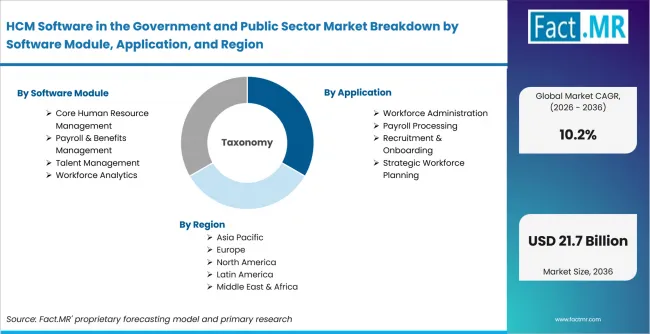
Hcm Software In The Government And Public Sector Market Breakdown By Software Module, Application, And Region | Source: Fact.MR
| Attribute | Details |
|---|---|
| Quantitative Units | USD billion |
| Market Definition | Software platforms used by government and public-sector organizations to manage employee records, workforce administration, service workflows, compliance processes, cloud HCM deployment, and AI-enabled workforce intelligence |
| Software Module | Core Human Resource Management; Payroll & Benefits Management; Talent Management; Workforce Analytics; |
| Application | Workforce Administration; Payroll Processing; Recruitment & Onboarding; Strategic Workforce Planning |
| End User | Central Government Agencies; Local Government Bodies; Public Safety Organizations; Public Sector Enterprises |
| Deployment Model | Cloud-based Deployment; Hybrid Deployment; Software as a Service; Application Programming Interface Integration |
| Technology Platform | Artificial Intelligence-enabled HCM; Cloud-native Architecture; Predictive Workforce Analytics; Business Intelligence Analytics |
| Regions Covered | North America; Latin America; Europe; East Asia; South Asia and Pacific; Middle East and Africa |
| Countries Covered | USA; UK; Germany; Canada; Australia; Japan; Singapore |
| Key Companies Profiled | Workday, Inc.; Oracle Corporation; SAP SE; UKG Inc.; Dayforce, Inc.; Cornerstone OnDemand, Inc.; Infor, Inc. |
| Forecast Period | 2026 to 2036 |
| Base Year | 2025 |
| Approach | Hybrid top-down and bottom-up approach using HCM software demand; public-sector cloud adoption; core HR modernization; workforce administration needs; AI-enabled employee service; country-level growth; portfolio review and source verification |
Source: Fact.MR analysis. Updated Aug 11, 2026
How is the market segmented?
-
By Software Module:
- Core Human Resource Management
- Employee Records Management
- Organization Management
- Payroll & Benefits Management
- Payroll Administration
- Compensation Management
- Talent Management
- Recruitment Management
- Learning & Development
- Workforce Analytics
- Workforce Planning
- Performance Analytics
- Core Human Resource Management
-
By Application:
- Workforce Administration
- Personnel Administration
- Employee Lifecycle Management
- Payroll Processing
- Benefits Administration
- Pension & Retirement Management
- Recruitment & Onboarding
- Candidate Selection
- Employee Training
- Strategic Workforce Planning
- Succession Planning
- Productivity Monitoring
- Workforce Administration
-
By End User:
- Central Government Agencies
- Federal Government Departments
- State Government Agencies
- Local Government Bodies
- Public Healthcare Organizations
- Public Education Institutions
- Public Safety Organizations
- Defense Organizations
- Judicial Institutions
- Public Sector Enterprises
- Public Utility Organizations
- Government-owned Enterprises
- Central Government Agencies
-
By Deployment Model:
- Cloud-based Deployment
- Public Cloud
- Private Cloud
- Hybrid Deployment
- On-premises Deployment
- Government Community Cloud
- Software as a Service
- Managed Services
- Multi-tenant Platform
- Application Programming Interface Integration
- Low-code Integration
- Enterprise System Integration
- Cloud-based Deployment
-
By Technology Platform:
- Artificial Intelligence-enabled HCM
- Machine Learning Analytics
- Natural Language Processing
- Cloud-native Architecture
- Advanced Workflow Automation
- Robotic Process Automation
- Predictive Workforce Analytics
- Skills Intelligence Platform
- Digital Learning Analytics
- Business Intelligence Analytics
- Predictive Workforce Intelligence
- Data-driven Decision Support
- Artificial Intelligence-enabled HCM
-
By Region:
- North America
- Latin America
- Europe
- East Asia
- South Asia and Pacific
- Middle East and Africa
Frequently Asked Questions
How big is the HCM software in the government and public sector market in 2026?
What is the CAGR of the HCM software in the government and public sector market from 2026 to 2036?
Which software module leads the HCM software in the government and public sector market?
Which application leads the HCM software in the government and public sector market?
Who are the leading companies in the HCM software in the government and public sector market?
Who worked on this report


Preview the report firsthand - request a free sample
Free SampleGet the brochure for pricing and purchase details
Download PDF