- Market Value (2025): USD 131.1 Mn
- Estimated Value (2026): USD 160 Mn
- Forecast Value (2036): USD 1169 Mn
- CAGR (2026-2036): 22.0%
What is the Graphene Recycled Masterbatches Market forecast to be worth by 2036?
USD 160 million in 2026 to USD 1,169 million by 2036 at 22.0% CAGR.
- The graphene recycled masterbatches market was valued at USD 131.1 million in 2025.
- Demand is projected to increase from USD 160 million in 2026 to USD 1,169 million by 2036.
- The market is forecast to record 22.0% CAGR from 2026 to 2036 as compounders and converters qualify recycled polymers for higher-value applications.
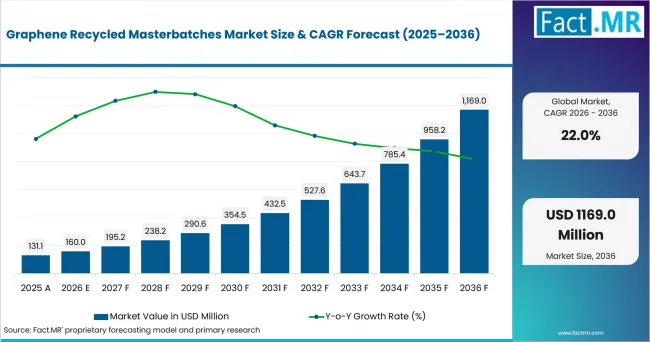
Graphene Recycled Masterbatches Market Value Analysis | Source: Fact.MR
What are the defining numbers behind Graphene Recycled Masterbatches Market growth?
USD 1,009 million absolute opportunity by 2036, led by recycled PP, nanoplatelets and mechanical recovery.
- Demand Drivers in the Market
- Packaging converters need PCR-compatible masterbatches that restore color and strength when post-consumer resin batches vary.
- EPA's material-specific plastics data report that 3.09 million tons of plastics were recycled in 2018, an 8.7% recycling rate.
- Automotive material teams need recycled PP and polyamide compounds that retain stiffness and impact behavior during repeat molding trials.
- Graphene additives are expected to gain attention in sustainable plastic packaging where recycled-content claims require better barrier and UV performance.
- Key Segments Analyzed
- By Carrier Resin: Recycled PP is expected to hold 45.0% share in 2026 due to its use in automotive, durable goods and rigid packaging compounds.
- By Additive: Nanoplatelets are projected to account for 52.0% share in 2026 owing to practical loading and dispersion in recycled polymers.
- By Target Property: Mechanical recovery is anticipated to capture 49.0% share in 2026 as converters prioritize impact and stiffness restoration.
- By End Use: Automotive is estimated to represent 31.0% share in 2026 because molded housings and trim require repeatable compound behavior.
- Analyst Opinion at Fact.MR
- Shambhu Nath Jha, Principal Consultant at Fact.MR, states, "The purchase test is shifting from graphene novelty to recycled-compound proof. Compounders are expected to pay for additives that make recycled resin easier to approve in real parts. Suppliers need dispersion control, carrier-resin choice and application data in the same technical file."
- Strategic Implications
- Masterbatch producers should publish loading windows for recycled PP, PE, PET and polyamide so converters shorten trial cycles.
- Compounders should compare graphene concentrates against other additive masterbatches before changing established extrusion or molding conditions.
- Packaging suppliers should pair property data with UV resistant masterbatches benchmarks where outdoor durability is part of the buyer claim.
- Automotive teams should test recycled carrier grades before tooling freeze so late material changes do not delay part approval.
Japan is forecast to post 26.3% CAGR through 2036 due to plastic-resource projects and electronics-grade recycled compounds. The USA is projected to record 25.0% CAGR as polyolefin R&D supports higher-value recycled materials. The UK is anticipated to advance at 22.5% CAGR owing to recycled-content tax reporting. South Korea is estimated to hold 22.0% CAGR due to PET recycled-content rules. Germany is forecast to reach 21.1% CAGR as packaging recycling discipline raises proof requirements.
How does the Graphene Recycled Masterbatches Market break down by segment?
Recycled PP leads Carrier Resin at 45.0%; nanoplatelets lead Additive at 52.0%.
Which Carrier Resin dominates?
Recycled PP holds 45.0% share in 2026.
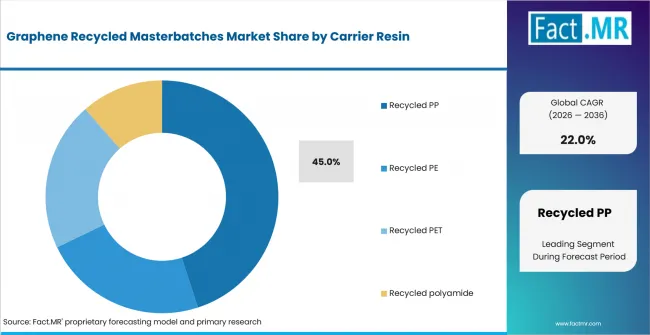
Graphene Recycled Masterbatches Market Analysis By Carrier Resin | Source: Fact.MR
Recycled PP leads because automotive and rigid packaging parts already use polypropylene blends at scale. Masterbatch concentrates provides an adjacent benchmark for how carrier choice shapes formulation purchases.
The carrier also supports injection molding and extrusion routes without forcing a complete process redesign. That makes it a practical starting point for graphene-enhanced recycled compounds.
What leads the Additive segment?
Nanoplatelets account for 52.0% share in 2026.
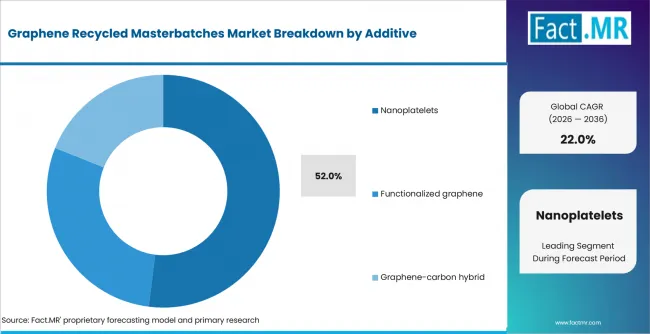
Graphene Recycled Masterbatches Market Analysis By Additive | Source: Fact.MR
Nanoplatelets lead because they provide a practical balance of surface area, loading efficiency and dispersion across thermoplastic compounds. Their structure supports reinforcement without requiring excessive additive content.
How does Target Property shape demand?
Mechanical recovery captures 49.0% share in 2026.
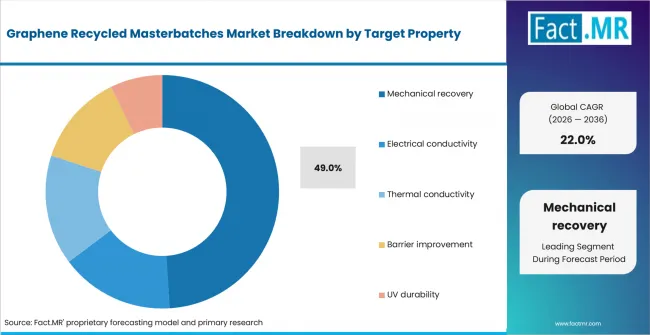
Graphene Recycled Masterbatches Market Analysis By Target Property | Source: Fact.MR
Mechanical recovery leads because recycled resins often lose stiffness, strength or impact performance during sorting and repeated processing. Additives that restore these properties help manufacturers maintain usable part performance without relying entirely on virgin resin. Demand for recycled plastic resins therefore supports solutions that improve consistency and mechanical reliability.
What supports Automotive within End Use?
Automotive represents 31.0% share in 2026.
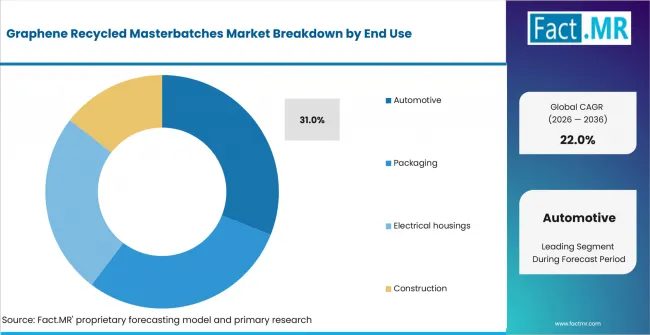
Graphene Recycled Masterbatches Market Analysis By End Use | Source: Fact.MR
Automotive leads because interior trim, housings, covers and other molded components must meet strict repeatability and performance requirements before recycled compounds enter approved part lists. Manufacturers therefore prioritize additives that stabilize mechanical properties, processing behavior and dimensional consistency while supporting broader recycled-content targets across vehicle platforms.
What is accelerating Graphene Recycled Masterbatches Market adoption, and what is holding it back?
Growth is shaped by recycled-content proof, property recovery and qualification risk.
| Driver | (~) % Impact on CAGR | Geographic Relevance | Impact Timeline |
|---|---|---|---|
| Recycled-content compliance in packaging | +2.1% | North America, Europe, East Asia | Short term |
| Mechanical recovery in recycled PP and PET | +1.8% | Global | Medium term |
| Conductive housings for automotive and electronics | +1.3% | East Asia, Europe | Medium term |
| Graphene dispersion improvements | +0.9% | Global | Long term |
Source: Fact.MR analysis. Updated Aug 22, 2026
- Recycled-content compliance in packaging: HMRC reported that 38% of total plastic packaging tonnage manufactured in and imported into the UK in financial year 2024–2025 was declared taxable under the Plastic Packaging Tax, while 51% of total tonnage met the threshold of 30% or more recycled plastic.
- Mechanical recovery in recycled PP and PET: The U.S. Department of Energy listed a September 2025 University of Delaware project on recycling polyolefins via novel electrothermochemical processing.
- Conductive housings for automotive and electronics: Electrical housings need antistatic behavior where recycled resin use does not weaken processing consistency.
| Opportunity | (~) % Impact on CAGR | Geographic Relevance | Impact Timeline |
|---|---|---|---|
| PCR-compatible graphene masterbatches | +1.4% | North America, Europe | Medium term |
| Recycled polyolefin functionalization | +1.0% | Global | Short term |
| Automotive recycled-compound approvals | +0.8% | Europe, East Asia | Long term |
Source: Fact.MR analysis. Updated Aug 22, 2026
- PCR-compatible graphene masterbatches: Packaging converters need concentrates that support recycled color correction without weakening sorting or wash behavior.
- Recycled polyolefin functionalization: The U.S. Department of Energy supported a September 2025 project to convert plastic waste into monomers through electrothermochemical processing.
- Automotive recycled-compound approvals: Material teams are expected to approve grades faster when conductivity, impact and recycled-content files are delivered together.
| Restraint | (~) % Impact on CAGR | Geographic Relevance | Impact Timeline |
|---|---|---|---|
| Inconsistent recycled feedstock quality | -0.8% | Global | Short term |
| Higher graphene additive cost | -0.6% | Global | Medium term |
| Qualification time for safety-sensitive uses | -0.5% | North America, Europe, East Asia | Long term |
Source: Fact.MR analysis. Updated Aug 22, 2026
- Inconsistent recycled feedstock quality: Mixed resin streams reduce melt repeatability and often make graphene dispersion harder to control.
- Higher graphene additive cost: Converters need clear evidence that lower loading or better properties offset the masterbatch premium.
- Qualification time for safety-sensitive uses: Automotive and electrical housing applications require repeat testing before wider purchasing.
Which countries are scaling the Graphene Recycled Masterbatches Market through 2036?
- The country comparison spans 5.2 percentage points across the five profiled markets.
- Japan remains 1.3 percentage points above the USA as plastic-resource projects meet precision automotive and electronics demand.
- The USA remains 2.5 percentage points above the UK because polyolefin recycling R&D and resin-output tracking support recycled-compound trials.
- The UK remains 0.5 percentage point above South Korea as recycled-content tax reporting keeps packaging compound demand visible.
- South Korea remains 0.9 percentage point above Germany due to PET recycled-content rules and export-oriented vehicle manufacturing.
- Germany closes the displayed range while strict recycling systems raise proof expectations for functional recycled compounds.
Comparable CAGRs create different entry conditions because recycled-resin access, graphene dispersion quality and application testing vary by country.
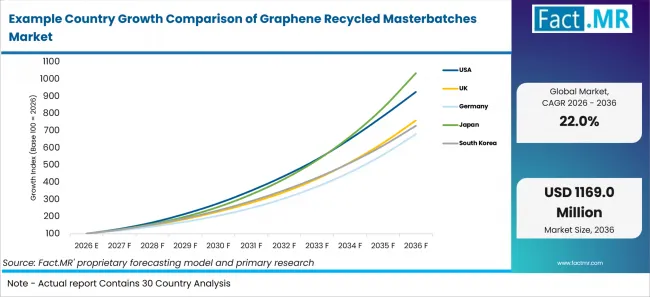
Example Country Growth Comparison Of Graphene Recycled Masterbatches Market | Source: Fact.MR
| Country | CAGR (2026-2036) |
|---|---|
| Japan | 26.3% |
| USA | 25.0% |
| United Kingdom | 22.5% |
| South Korea | 22.0% |
| Germany | 21.1% |
Source: Fact.MR analysis. Updated Aug 22, 2026
What is powering Japan adoption?
26.3% CAGR through 2036, supported by plastic-resource projects and electronics-grade recycled compounds.
Japan’s growth is supported by resource-circulation policy and precision automotive and electronics manufacturing. The Ministry of the Environment selected eight FY2025 plastic-resource-circulation advanced social-implementation model projects in August 2025, while JAMA reported production of 8.235 million four-wheel vehicles in 2024. Graphene masterbatches are expected to support recycled PET and PP applications requiring improved mechanical, electrical and barrier performance.
What supports USA adoption?
25.0% CAGR through 2036, backed by polyolefin recycling R&D and resin-output visibility.
The USA’s growth reflects its large polymer-processing base and increasing research into recycled polyolefins. FRED listed the not-seasonally-adjusted industrial production index for plastics material and resin manufacturing at 107.9815 in April 2026 (2017=100), while the U.S. Department of Energy posted a March 2026 project focused on kilogram-scale, solvent-free upcycling of pure and mixed polyolefin waste. Graphene masterbatches can support recycled PP and PE in packaging, automotive and electrical applications.
How is the United Kingdom scaling demand?
22.5% CAGR through 2036, driven by recycled-content tax reporting and zero-emission vehicle materials.
The UK’s growth is shaped by recycled-content requirements and expanding zero-emission vehicle activity. HMRC reported that 38% of total plastic packaging tonnage manufactured in and imported into the UK in financial year 2024–2025 was declared taxable, while 51% of total tonnage met the threshold of 30% or more recycled plastic. The Department for Transport reported that 473,000 zero-emission cars were registered for the first time in 2025, up 24% from 2024.
How is South Korea developing participation?
22.0% CAGR through 2036, reinforced by recycled PET rules and vehicle export activity.
South Korea’s growth is supported by recycled-content policy and its export-oriented automotive and electronics industries. From January 1, 2026, South Korean bottled-water and non-alcoholic beverage manufacturers using at least 5,000 tonnes of PET bottles annually are required to use recycled material equivalent to 10% of applicable shipment volume, beginning with colorless PET bottles. MOTIR also reported that automobile exports reached USD 72.0 billion in 2025. Graphene masterbatches are expected to support conductive recycled housings and PET and PP compounds.
What supports Germany adoption?
21.1% CAGR through 2036, supported by packaging recycling discipline and electric vehicle production.
Germany’s growth reflects mature packaging recycling and a large automotive manufacturing base. UBA and the Central Agency Packaging Register reported that around 5.5 million tonnes of packaging waste collected through Germany’s dual systems were recovered in 2024, while VDA reported production of 1.67 million electric passenger cars in 2025, up 23% from 2024. Graphene masterbatches can support mechanical recovery, durability and functional performance in recycled polymers.
Who leads the Graphene Recycled Masterbatches Market?
NanoXplore has direct first-party evidence for GrapheneBlack Masterbatch Pellets produced largely from recycled plastic.
Competition centers on graphene dispersion, carrier-resin choice and evidence that the recycled compound reaches the target property. Graphene composites helps frame where masterbatches sit within the wider materials chain.
NanoXplore reported that Canuck Compounders supports recycled-resin pellets for GrapheneBlack Masterbatch Pellets.
Which companies are the key providers?
Key companies include Black Swan Graphene Inc., Energeia-Graphenemex, Broadway Colours Ltd., Techmer PM, and NanoXplore.
- NanoXplore
- Black Swan Graphene Inc.
- Energeia-Graphenemex
- Broadway Colours Ltd.
- Techmer PM
Bibliography
- Department for Environment, Food & Rural Affairs. (2025, July 23). UK statistics on waste.
- Department for Transport. (2026, April 29). Vehicle licensing statistics, United Kingdom: 2025.
- Federal Statistical Office (Destatis). (2026, February 6). Production in December 2025: -1.9% on the previous month.
- German Environment Agency, & Central Agency Packaging Register. (2026, January 27). Facts against myths: Packaging waste recycling in Germany is working.
- Japan Automobile Manufacturers Association, Inc. (2025, September). The Motor Industry of Japan 2025.
- Ministry of Trade, Industry and Resources. (2026, January 15). Automobile exports hit record high of $72 billion in 2025.
- NanoXplore Inc. (2026). 2025 sustainability report.
- U.S. Department of Energy, Office of NEPA Policy and Compliance. (2025, September 12). CX-270831: University of Delaware - Recycling of polyolefins via novel electrothermochemical processing.
- U.S. Department of Energy, Office of NEPA Policy and Compliance. (2026, March 11). CX-270942: Washington University in St. Louis - Kg-scale, solvent-free upcycling of pure and mixed polyolefin waste.
- U.S. Environmental Protection Agency. (2026, March 13). Plastics: Material-specific data.
This Report Answers
- The report explains where graphene recycled masterbatches are used across carrier resin and additive types.
- Segment analysis identifies the leading subsegments and the practical reasons compounders prioritize them.
- Country analysis examines the listed markets and the policy or manufacturing mechanisms supporting adoption.
- Competitive analysis reviews providers across graphene powders, dispersion systems and thermoplastic masterbatches.
- Application analysis assesses how mechanical recovery, conductivity and barrier improvement influence purchase decisions.
What does the Graphene Recycled Masterbatches Market cover?
The Graphene Recycled Masterbatches Market covers concentrates where graphene additives are dispersed in recycled polymer carrier resins. Adjacent coverage of recycled plastic provides context for the recovery streams that feed these compounds.
The assessment covers recycled PP, PE, PET and polyamide across automotive, packaging, electrical housings and construction applications. Demand is assessed by carrier resin, additive form, target property and region.
What is included in the scope?
The scope includes graphene masterbatches sold for recycled PP, PE, PET and polyamide compounds. It also includes concentrates used where commercial graphene is sold through a polymer carrier instead of as loose powder.
Property-specific concentrates for mechanical recovery, electrical conductivity, thermal conductivity, barrier improvement and UV durability are included when they are sold as masterbatch inputs to compounders or converters.
What is excluded from the scope?
The scope excludes neat graphene powders sold without a masterbatch carrier, virgin-only masterbatches and finished plastic goods sold without a separate concentrate.
Broader packaging categories are excluded unless graphene recycled masterbatch is the purchased product. Finished sustainable plastic packaging is therefore outside scope when the concentrate is not sold separately.
How Was the Analysis Built?
The analysis draws on 120+ sources, 35+ company portfolios, 25+ countries, and more than 20 industry interviews.
- Primary Research: Primary research includes discussions with compounders, additive suppliers, recyclers, converters, procurement teams and end-use material engineers.
- Desk Research: Desk research covers government statistics, policy releases, company sustainability reports, product pages, standards and recycling data.
- Market Sizing and Forecasting: Market estimates combine recycled resin demand, carrier resin mix, additive loading, end-use adoption, country policy and provider portfolios.
- Data Validation and Update Cycle: Findings are checked against public data, company activity, regulatory changes, product launches and shifts in commercial qualification.
Segmentation
What is the report's scope and coverage?
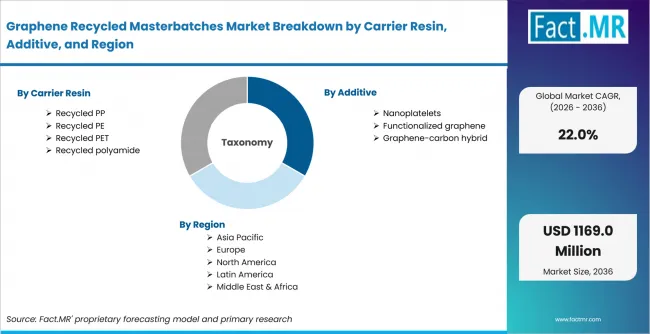
Graphene Recycled Masterbatches Market Breakdown By Carrier Resin, Additive, And Region | Source: Fact.MR
| Attribute | Details |
|---|---|
| Quantitative Units | USD million |
| Market Definition | Graphene masterbatch concentrates made with recycled carrier resins and used to improve mechanical, electrical, thermal, barrier or UV properties in recycled polymer compounds. |
| Carrier Resin | Recycled PP; Recycled PE; Recycled PET; Recycled polyamide |
| Additive | Nanoplatelets; Functionalized graphene; Graphene-carbon hybrid |
| Target Property | Mechanical recovery; Electrical conductivity; Thermal conductivity; Barrier improvement; UV durability |
| End Use | Automotive; Packaging; Electrical housings; Construction |
| Regions Covered | North America; Latin America; Western Europe; Eastern Europe; East Asia; South Asia & Pacific; Middle East & Africa |
| Countries Covered | USA; United Kingdom; Germany; Japan; South Korea |
| Key Companies Profiled | NanoXplore, Black Swan Graphene Inc., Energeia-Graphenemex, Broadway Colours Ltd., Techmer PM |
| Forecast Period | 2026 to 2036 |
| Approach | Hybrid top-down and bottom-up approach using recycled resin availability, masterbatch pricing, end-use qualification, country policy signals and provider portfolio review. |
Source: Fact.MR analysis. Updated Aug 22, 2026
How is the market segmented?
-
By Carrier Resin
- Recycled PP
- Recycled PE
- Recycled PET
- Recycled polyamide
-
By Additive
- Nanoplatelets
- Functionalized graphene
- Graphene-carbon hybrid
-
By Target Property
- Mechanical recovery
- Electrical conductivity
- Thermal conductivity
- Barrier improvement
- UV durability
-
By End Use
- Automotive
- Packaging
- Electrical housings
- Construction
-
By Region
- North America
- Latin America
- Western Europe
- Eastern Europe
- East Asia
- South Asia & Pacific
- Middle East & Africa
Frequently Asked Questions
How big is the graphene recycled masterbatches market in 2026?
What is the CAGR of the graphene recycled masterbatches market from 2026 to 2036?
Which carrier resin leads the graphene recycled masterbatches market?
Which additive leads the graphene recycled masterbatches market?
Who are the leading companies in the graphene recycled masterbatches market?
Who worked on this report


Preview the report firsthand - request a free sample
Free SampleGet the brochure for pricing and purchase details
Download PDF