- Market Value (2025): USD 6.4 Bn
- Estimated Value (2026): USD 7.4 Bn
- Forecast Value (2036): USD 32.6 Bn
- CAGR (2026-2036): 16.0%
What is the HBM CoWoS Packaging Capacity and Supply Demand Market forecast to be worth by 2036?
USD 7.4 billion in 2026 to USD 32.6 billion by 2036 at 16.0% CAGR.
- The HBM CoWoS packaging capacity and supply demand market reached USD 6.4 billion in 2025 as AI package planning moved from isolated accelerator programs into larger supply commitments.
- Demand is projected to increase from USD 7.4 billion in 2026 to USD 32.6 billion by 2036.
- The market is forecast to record 16.0% CAGR from 2026 to 2036.
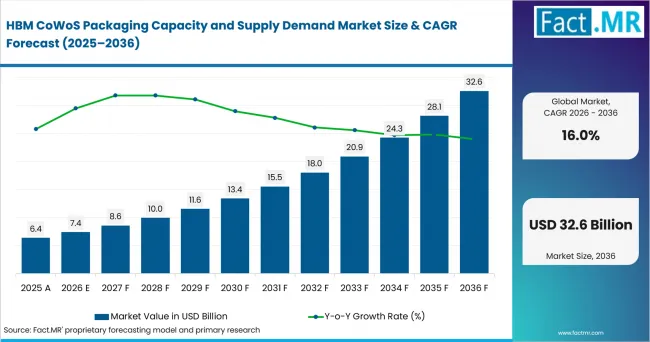
Hbm Cowos Packaging Capacity And Supply Demand Market Value Analysis | Source: Fact.MR
What are the defining numbers behind HBM CoWoS Packaging Capacity and Supply Demand Market growth?
USD 25.4 billion absolute opportunity by 2036.
- Demand Drivers in the Market
- AI accelerator roadmaps are expected to raise reliance on 3D semiconductor packaging because memory bandwidth now shapes training and inference throughput.
- Chiplet-based processor designs are anticipated to lift demand for interposers and TSV formation. Fine-pitch assembly is needed because several dies must work as one package.
- Hyperscale data center buildouts are projected to tighten GPU package slots and HBM stack availability. Buyers need qualified supply before platform launch dates are fixed. The U.S. Energy Information Administration estimated in May 2026 that data center servers accounted for 7.0% of U.S. commercial-sector electricity consumption in 2025.
- Thermal design pressure is expected to make package qualification harder. High-power accelerators need tighter control of warpage and heat flow before final approval.
- Key Segments Analyzed
- By Packaging Platform: CoWoS Packaging is expected to hold 61.0% share in 2026 because large AI packages need proven interposer capacity.
- By Application: Artificial Intelligence Accelerators are projected to account for 49.0% share in 2026 as GPU and ASIC programs carry the highest HBM content.
- By End-use Industry: Hyperscale Data Centers are anticipated to capture 45.0% share in 2026 due to dense accelerator clusters and platform refresh cycles.
- By Customer Type: GPU Designers are estimated to represent 41.0% share in 2026 because they reserve package capacity early in product planning.
- By Packaging Process: Chip-on-Wafer-on-Substrate is forecast to hold 72.0% share in 2026 because it remains the main route for interposer-based packages.
- Analyst Opinion at Fact.MR
- Shambhu Nath Jha, Principal Consultant at Fact.MR, states, "HBM and CoWoS capacity now remain close to the center of AI hardware planning. Buyers are expected to judge suppliers by package yield and interposer availability. Substrate readiness and on-time accelerator qualification are equally important."
- Strategic Implications
- Packaging suppliers should align capacity reservations with accelerator launch windows before substrate and interposer limits affect customer commitments.
- Memory vendors and GPU designers can lower supply risk when HBM stack qualification is coordinated with package-level thermal and electrical tests.
- OSAT providers are expected to gain more value when assembly capacity is paired with test support and customer-specific process work.
Taiwan leads at 17.3% CAGR through foundry scale and CoWoS capacity pull. South Korea follows at 16.8% through HBM production. The USA reaches 16.2% through accelerator design and packaging partnerships. Japan records 15.6%. China posts 14.9%. Germany reaches 14.3%. Singapore records 13.6%.
How does the HBM CoWoS Packaging Capacity and Supply Demand Market break down by segment?
CoWoS Packaging leads Packaging Platform with 61.0% share in 2026. Artificial Intelligence Accelerators lead Application with 49.0% share in 2026.
Why does CoWoS Packaging lead Packaging Platform?
CoWoS Packaging is projected to account for 61.0% share in 2026.
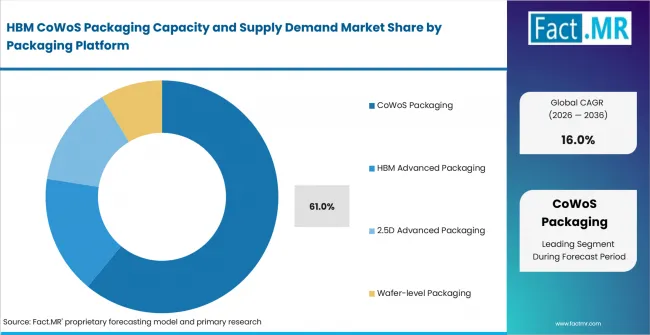
Hbm Cowos Packaging Capacity And Supply Demand Market Analysis By Packaging Platform | Source: Fact.MR
Large AI accelerators need proven interposer routing and HBM placement before volume packaging begins. CoWoS has the clearest production path for high-end GPU and ASIC programs. TGV interposers is expected to expand as customers compare future package routes. TSMC's 2025 annual report states that it certified a CoWoS advanced packaging solution for 5.5x mask/reticle-size interposers in 2025, with volume production planned for 2026.
Why do Artificial Intelligence Accelerators lead Application?
Artificial Intelligence Accelerators are expected to account for 49.0% share in 2026.
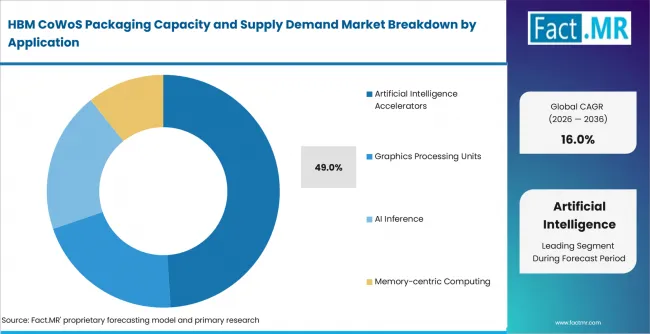
Hbm Cowos Packaging Capacity And Supply Demand Market Analysis By Application | Source: Fact.MR
Training and inference systems depend on fast memory access, so AI accelerators carry the most direct need for HBM stacks. Buyers are expected to prioritize interposer area and HBM stack inspection before volume ramps.
Why do Hyperscale Data Centers lead End-use Industry?
Hyperscale Data Centers are anticipated to capture 45.0% share in 2026.
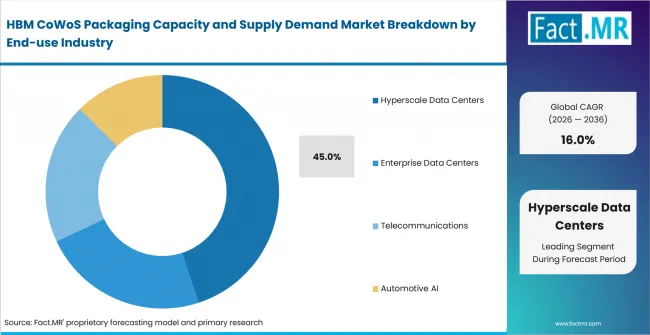
Hbm Cowos Packaging Capacity And Supply Demand Market Analysis By End Use Industry | Source: Fact.MR
Hyperscale operators refresh accelerator platforms often and buy systems in large clusters. Their demand is expected to favor suppliers that can support data center accelerators with stable package availability.
Why do GPU Designers lead Customer Type?
GPU Designers are estimated to represent 41.0% share in 2026.
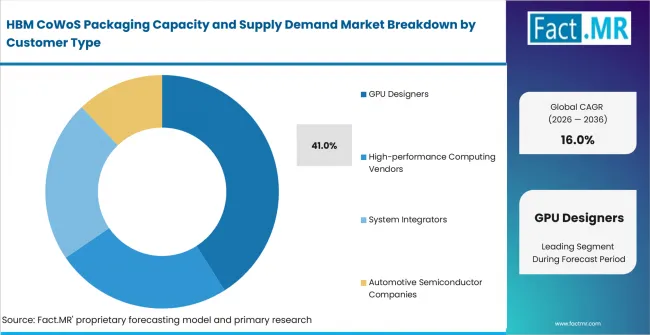
Hbm Cowos Packaging Capacity And Supply Demand Market Analysis By Customer Type | Source: Fact.MR
GPU designers lock packaging choices early because package area and HBM stack count affect accelerator architecture. They remain the main customer group for CoWoS slots and high-speed memory signal integrity test support.
Why does Chip-on-Wafer-on-Substrate lead Packaging Process?
Chip-on-Wafer-on-Substrate is forecast to hold 72.0% share in 2026.
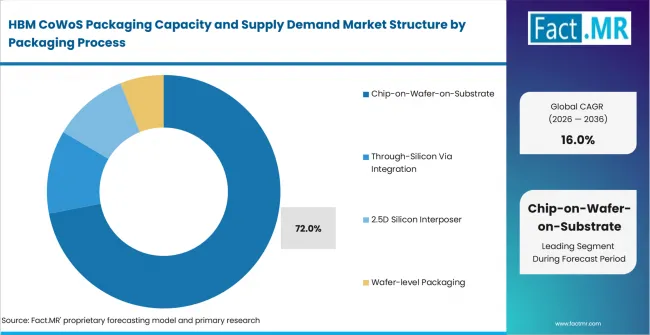
Hbm Cowos Packaging Capacity And Supply Demand Market Analysis By Packaging Process | Source: Fact.MR
Chip-on-Wafer-on-Substrate remains the main route because it supports large interposers and complex accelerator dies. Demand for 3D TSV packages is expected to rise where stacked memory must pass electrical and thermal checks.
What is accelerating HBM CoWoS Packaging Capacity and Supply Demand Market adoption, and what is holding it back?
Demand is expected to rise as AI packages become larger and memory content per accelerator increases. Growth may be limited by concentrated capacity and long package qualification cycles.
Drivers Impact Analysis
| DRIVER | (~) % IMPACT ON CAGR | GEOGRAPHIC RELEVANCE | IMPACT TIMELINE |
|---|---|---|---|
| AI accelerator package density | +3.8% | Taiwan, South Korea, USA | Short term (<= 2 years) |
| HBM stack integration | +3.3% | East Asia and North America | Short term (<= 2 years) |
| CoWoS substrate allocation | +2.7% | Taiwan, Singapore, USA | Medium term (2-4 years) |
| Thermal design pressure | +2.2% | Global | Medium term (2-4 years) |
| Package-level test readiness | +1.5% | GPU and memory supply chains | Long term (>= 4 years) |
Source: Fact.MR analysis. Updated Aug 10, 2026
- AI accelerator package density: Larger die areas and more HBM stacks are expected to increase the value of qualified CoWoS capacity.
- HBM stack integration: Memory and logic suppliers must coordinate interface design before high-volume shipments can move smoothly. Demand for advanced IC substrates is expected to rise with this package complexity.
- CoWoS substrate allocation: Large package formats need stable material supply. A delay in substrate readiness can slow accelerator launch schedules.
Opportunity Impact Analysis
| OPPORTUNITY | (~) % IMPACT ON CAGR | GEOGRAPHIC RELEVANCE | IMPACT TIMELINE |
|---|---|---|---|
| OSAT capacity partnerships | +1.8% | Taiwan, USA, Singapore | Medium term (2-4 years) |
| HBM4 package migration | +1.5% | South Korea, Taiwan, USA | Medium term (2-4 years) |
| Automotive AI compute packages | +1.0% | Japan, Germany, China | Long term (>= 4 years) |
| Co-packaged optics adjacency | +0.7% | USA, Taiwan, Singapore | Long term (>= 4 years) |
Source: Fact.MR analysis. Updated Aug 10, 2026
- OSAT capacity partnerships: Foundry and OSAT coordination is expected to improve access to qualified assembly and test support for AI packages.
- HBM4 package migration: New memory generations are anticipated to create openings for suppliers that can manage stack height and power integrity. Tools such as queue-time hybrid bonders may support tighter bonding flows.
- Automotive AI compute packages: Vehicle compute platforms are expected to create selective demand for reliable high-bandwidth packages beyond data center use.
Restraints Impact Analysis
| RESTRAINT | (~) % IMPACT ON CAGR | GEOGRAPHIC RELEVANCE | IMPACT TIMELINE |
|---|---|---|---|
| Advanced packaging capacity concentration | -1.5% | Taiwan and leading OSAT clusters | Short term (<= 2 years) |
| Substrate and interposer bottlenecks | -1.2% | Global | Short term (<= 2 years) |
| Thermal and yield qualification burden | -0.9% | GPU and memory supply chains | Medium term (2-4 years) |
| Export and regional access controls | -0.6% | China, USA, Europe | Long term (>= 4 years) |
Source: Fact.MR analysis. Updated Aug 10, 2026
- Advanced packaging capacity concentration: Buyers may face longer allocation cycles when few qualified sites handle the most complex CoWoS programs. This makes high-density AI racks vulnerable to package availability.
- Substrate and interposer bottlenecks: Large package formats need stable material supply. Shortages can delay launch schedules even when chips are ready.
- Thermal and yield qualification burden: High-power packages must pass strict test windows before customers approve them for dense accelerator clusters.
Which countries are scaling HBM CoWoS Packaging Capacity and Supply Demand Market fastest?
- The country comparison spans 3.7 percentage points and forms a clear growth ladder across the forecast period.
- Taiwan remains 0.5 percentage point above South Korea through foundry scale and CoWoS capacity pull.
- South Korea stays 0.6 percentage point above the USA through HBM production and package qualification.
- The USA remains 0.6 percentage point above Japan because accelerator designers shape early package requirements.
- Japan stays 0.7 percentage point above China through materials depth and process-control expertise.
- China remains 0.6 percentage point above Germany as local packaging activity supports domestic semiconductor programs.
- Germany stays 0.7 percentage point above Singapore through automotive compute and industrial electronics demand.
- Singapore closes the displayed range through OSAT activity and regional shipment support.
Comparable CAGRs can create different entry conditions. Supplier concentration and qualification burden change the route to adoption. Full report coverage includes North America; Latin America; Europe; East Asia; South Asia and Pacific; Middle East and Africa.
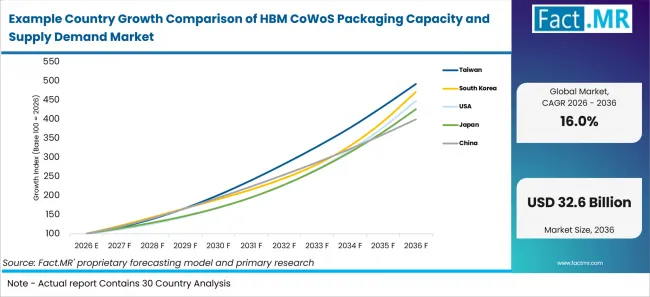
Example Country Growth Comparison Of Hbm Cowos Packaging Capacity And Supply Demand Market | Source: Fact.MR
| Country | CAGR (2026-2036) |
|---|---|
| Taiwan | 17.3% |
| South Korea | 16.8% |
| USA | 16.2% |
| Japan | 15.6% |
| China | 14.9% |
| Germany | 14.3% |
| Singapore | 13.6% |
Source: Fact.MR analysis. Updated Aug 10, 2026
What supports Taiwan adoption?
17.3% CAGR, supported by foundry scale and CoWoS capacity pull.
Taiwan begins from a supply position where wafer fabrication and package integration are planned close together. That structure is expected to help suppliers reserve interposer and assembly capacity before AI accelerator ramps become urgent. Taiwan's Ministry of Economic Affairs reported in November 2025 that ASE's K18B expansion involves NT$17.6 billion in investment and is expected to create nearly 2,000 jobs while expanding packaging and testing capacity.
How is South Korea developing demand?
16.8% CAGR, driven by HBM memory production and package qualification.
South Korea’s demand case starts with memory manufacturing. HBM stack readiness is expected to guide package qualification because GPU and ASIC customers need memory supply to match accelerator launch timing. South Korea's Ministry of Science and ICT reported that the national critical-technology plan included KRW 17.8 billion for an advanced semiconductor packaging flagship project.
What supports USA growth?
16.2% CAGR, backed by AI accelerator design and domestic advanced packaging partnerships.
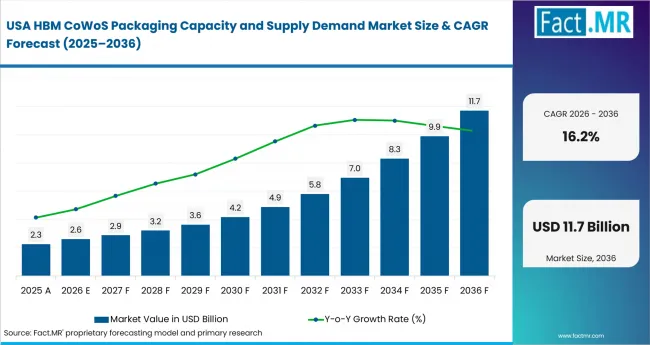
Hbm Cowos Packaging Capacity And Supply Demand Market Country Value Analysis | Source: Fact.MR
The USA market is shaped by accelerator designers and cloud infrastructure buyers. Package demand is expected to move toward domestic and allied supply options when customers seek shorter qualification paths. The U.S. Department of Commerce finalized USD 1.4 billion in CHIPS advanced-packaging awards in January 2025, including USD 300.0 million for substrates and materials research and USD 1.1 billion for an advanced-packaging piloting facility.
How does Japan perform?
15.6% CAGR through materials and equipment depth.
Japan’s growth is supported by strong materials expertise and semiconductor process equipment capabilities. As advanced packages become more complex, suppliers benefit from process-control experience that helps manage tighter tolerances, thermal behavior, and qualification requirements.
How is China scaling demand?
14.9% CAGR, supported by domestic semiconductor supply-chain goals and local packaging activity.
China is expanding through local assembly, packaging engineering, and broader semiconductor localization efforts. Growth depends on access to suitable equipment and materials that can support consistent package qualification and repeatable production across advanced semiconductor programs.
What supports Germany adoption?
14.3% CAGR, supported by automotive compute and industrial electronics demand.
Germany’s demand is tied to reliable advanced packages for automotive and industrial systems. High-performance vehicle processors create selective opportunities where customers require strong thermal control, dependable operation, and proven package quality before broader deployment.
What supports Singapore growth?
13.6% CAGR through OSAT activity and specialty fabs.
Singapore benefits from a compact cluster of assembly and test providers. Specialty manufacturing and logistics support are expected to help regional package qualification. Singapore's Economic Development Board reported in March 2025 that a new S$500.0 million national semiconductor R&D fabrication facility would initially focus on advanced packaging.
Who leads the HBM CoWoS Packaging Capacity and Supply Demand Market?
Taiwan Semiconductor Manufacturing Company has the strongest direct position in CoWoS capacity, while Samsung Electronics and SK hynix reinforce the HBM supply side. TSMC anchors interposer-based packaging for large AI accelerators.
Samsung and SK hynix support memory-stack availability and qualification. ASE and Amkor expand assembly and testing capacity. Intel adds alternative advanced-packaging expertise, while NVIDIA, AMD, Broadcom, and Micron strengthen demand through accelerator, XPU, and HBM platform development.
Which companies are the key providers?
Key companies include Taiwan Semiconductor Manufacturing Company Limited, Samsung Electronics Co., Ltd., SK hynix Inc., Advanced Semiconductor Engineering, Inc., Amkor Technology, Inc., Intel Corporation, NVIDIA Corporation, Advanced Micro Devices, Inc., Broadcom Inc., and Micron Technology, Inc.
- Taiwan Semiconductor Manufacturing Company Limited
- Samsung Electronics Co., Ltd.
- SK hynix Inc.
- Advanced Semiconductor Engineering, Inc.
- Amkor Technology, Inc.
- Intel Corporation
- NVIDIA Corporation
- Advanced Micro Devices, Inc.
- Broadcom Inc.
- Micron Technology, Inc.
Bibliography
- Advanced Semiconductor Engineering, Inc. (2025, May 28). ASE announces FOCoS-Bridge with TSV; latest package technology reduces power loss by 3x for next-generation AI and HPC applications.
- Amkor Technology, Inc. (2026, July 23). Amkor Technology announces strategic partnership with NVIDIA to expand advanced packaging and test for next-generation AI infrastructure.
- Broadcom Inc. (2024, December 5). Broadcom delivers industry’s first 3.5D F2F technology for AI XPUs.
- Intel Corporation. (2026, July 24). Intel and Lens Technology collaborate to enable advanced semiconductor packaging for the AI era.
- Micron Technology, Inc. (2026, March 16). Micron in High-Volume Production of HBM4 Designed for NVIDIA Vera Rubin, PCIe Gen6 SSD and SOCAMM2.
- U.S. Department of Energy. (2025, November 13). Smart transmission tools modernize America’s power grid.
- U.S. Energy Information Administration. (2026, May 19). Data center server energy use grows across the commercial building stock.
- Taiwan Semiconductor Manufacturing Company Limited. (2026). TSMC 2025 annual report.
- NVIDIA Corporation. (2026, February 25). NVIDIA announces financial results for fourth quarter and fiscal 2026.
- Micron Technology, Inc. (2025, September 23). Fiscal Q4 2025 earnings call prepared remarks.
- Advanced Micro Devices, Inc. (2026, February 3). AMD reports fourth quarter and full year 2025 financial results.
- Ministry of Science and ICT, Republic of Korea. (2025, March 12). KRW 6.8 trillion investment in 2025 to advance critical and emerging technologies and secure leadership in global tech race.
- U.S. Department of Commerce. (2025, January 16). U.S. Department of Commerce announces $1.4 billion in final awards to support the next generation of U.S. semiconductor advanced packaging.
- Samsung Electronics Co., Ltd. (2026, February 12). Samsung ships industry-first commercial HBM4 with ultimate performance for AI computing.
This Report Answers
- The report provides strategic intelligence on the HBM CoWoS Packaging Capacity and Supply Demand Market across Packaging Platform and Application choices that shape AI package planning.
- Segment analysis covers CoWoS Packaging and Artificial Intelligence Accelerators as the share leaders within the 2026 market structure.
- Country outlook evaluates Taiwan and South Korea alongside the USA and Japan. China and Germany complete the growth comparison with Singapore.
- Competitive analysis profiles TSMC with Samsung Electronics and SK hynix. ASE and Amkor add OSAT depth. Intel; NVIDIA; AMD; Broadcom; and Micron complete the provider set.
- Process assessment covers Chip-on-Wafer-on-Substrate and TSV integration. Interposer fabrication and substrate assembly complete the process view with final test and burn-in.
What does the HBM CoWoS Packaging Capacity and Supply Demand Market cover?
HBM CoWoS packaging capacity covers the production and qualification routes used to place high-bandwidth memory near AI accelerator and GPU logic.
The market covers advanced package capacity used for HBM-integrated accelerators and high-performance processors. Coverage extends to CoWoS Packaging and InFO Packaging. EMIB Packaging and FOCoS Packaging complete the platform scope. Hybrid Bonding Platforms are included where they support package qualification.
What is included in the scope?
The scope includes packaging capacity used by GPU designers and cloud service providers. Foundries and OSATs are included. Memory vendors and ASIC developers are also covered.
The scope includes Packaging Platform and Application. End-use Industry and Customer Type complete the scope. Packaging Process is included for qualification and shipment readiness. Coverage spans Artificial Intelligence Accelerators and HPC Processors. Data Center GPUs and Automotive AI Processors complete the application view.
What is excluded from the scope?
Commodity memory modules and standard server assembly remain outside the scope of this market.
The scope excludes conventional PCB assembly and software-only AI infrastructure spending. General semiconductor equipment revenue is excluded unless it supports HBM package capacity or supply-demand planning. Standard memory packaging is excluded when it does not require CoWoS-class integration. Company revenue without a clear connection to HBM packaging or package qualification is also excluded.
How Was the Analysis Built?
The analysis draws on 120+ sources, 35+ company portfolios, 25+ countries, and more than 20 industry interviews.
- Primary Research: Primary research includes discussions with manufacturers, service providers, technology developers, distributors, end users, procurement teams, and subject-matter experts. These conversations examine purchasing priorities, product adoption, operational challenges, approval requirements, competitive positioning, and the factors that influence wider market acceptance.
- Desk Research: Desk research covers government statistics, regulatory publications, company filings, trade data, technical studies, industry associations, standards, public policy, and other authoritative sources. Every source used in the analysis is documented in the bibliography.
- Market Sizing and Forecasting: Market estimates combine historical performance, demand indicators, pricing and volume trends, segment shares, company participation, country-level growth, adoption patterns, investment activity, and barriers to market expansion.
- Data Validation and Update Cycle: Findings are validated by comparing primary interviews with public data, company activity, regulatory changes, trade patterns, and industry developments. Regular updates review new product launches, capacity changes, partnerships, approvals, procurement trends, and shifts in commercial adoption.
Segmentation
What is the report’s scope and coverage?
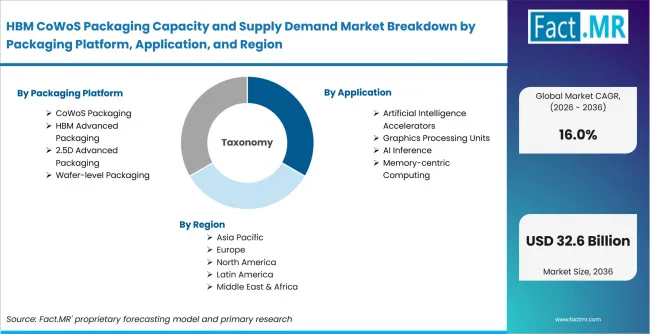
Hbm Cowos Packaging Capacity And Supply Demand Market Breakdown By Packaging Platform, Application, And Region | Source: Fact.MR
| Attribute | Details |
|---|---|
| Quantitative Units | USD billion in 2026 to USD billion by 2036 at CAGR |
| Market Definition | Advanced packaging capacity and supply-demand planning used to connect HBM stacks with AI accelerators, GPU packages, networking ASICs, and chiplet-based processors where interposer area, TSV quality, substrate capacity, thermal behavior, and back-end test determine shipment readiness |
| Packaging Platform | CoWoS Packaging; InFO Packaging; EMIB Packaging; FOCoS Packaging; Hybrid Bonding Platforms |
| Application | Artificial Intelligence Accelerators; HPC Processors; Data Center GPUs; Automotive AI Processors; Networking ASICs |
| End-use Industry | Hyperscale Data Centers; Semiconductor Foundries; Memory Manufacturers; Automotive Electronics; Defense and Aerospace |
| Customer Type | GPU Designers; Cloud Service Providers; Foundries and OSATs; Memory Vendors; ASIC Developers |
| Packaging Process | Chip-on-Wafer-on-Substrate; Through-Silicon Via Integration; Interposer Fabrication; Substrate Assembly; Final Test and Burn-in |
| Regions Covered | North America; Latin America; Europe; East Asia; South Asia and Pacific; Middle East and Africa |
| Countries Covered | Taiwan; South Korea; USA; Japan; China; Germany; Singapore |
| Key Companies Profiled | Taiwan Semiconductor Manufacturing Company Limited; Samsung Electronics Co., Ltd.; SK hynix Inc.; Advanced Semiconductor Engineering, Inc.; Amkor Technology, Inc.; Intel Corporation; NVIDIA Corporation; Advanced Micro Devices, Inc.; Broadcom Inc.; Micron Technology, Inc. |
| Forecast Period | 2026 to 2036 |
| Approach | Hybrid top-down and bottom-up approach using packaging platform demand; HBM supply coordination; accelerator qualification activity; memory and foundry capacity; substrate readiness; TSV integration; package-level test requirements; country adoption patterns and company portfolio review |
Source: Fact.MR analysis. Updated Aug 10, 2026
How is the market segmented?
-
By Packaging Platform
- CoWoS Packaging
- CoWoS-S
- CoWoS-L
- HBM Advanced Packaging
- HBM3E Packaging
- HBM4-ready Packaging
- 2.5D Advanced Packaging
- High-density Interposer
- Multi-chip Packaging
- Wafer-level Packaging
- Fan-out Wafer-level Packaging
- Panel-level Packaging
- CoWoS Packaging
-
By Application
- Artificial Intelligence Accelerators
- AI Training Clusters
- Large Language Models
- Graphics Processing Units
- High-performance Computing
- Networking Accelerators
- AI Inference
- Edge AI Computing
- Data Processing Units
- Memory-centric Computing
- Autonomous Driving
- Next-generation AI Systems
- Artificial Intelligence Accelerators
-
By End-use Industry
- Hyperscale Data Centers
- Cloud Service Providers
- High-performance Computing
- Enterprise Data Centers
- Research Computing
- 5G Infrastructure
- Telecommunications
- Edge Computing
- Enterprise IT
- Automotive AI
- Automotive Electronics
- Defense Computing
- Hyperscale Data Centers
-
By Customer Type
- GPU Designers
- Fabless Semiconductor Companies
- Accelerator Manufacturers
- High-performance Computing Vendors
- OSAT Providers
- Network Equipment Manufacturers
- System Integrators
- Server Manufacturers
- Cloud Infrastructure Providers
- Automotive Semiconductor Companies
- Automotive Tier 1 Suppliers
- Defense Technology Organizations
- GPU Designers
-
By Packaging Process
- Chip-on-Wafer-on-Substrate
- Advanced CoWoS Integration
- High-density Interposer Packaging
- Through-Silicon Via Integration
- Micro-bump Bonding
- Hybrid Bonding Technology
- 2.5D Silicon Interposer
- Fine-pitch Redistribution Layer
- Multi-die Integration
- Wafer-level Packaging
- Fan-out Integration
- Advanced Panel-level Packaging
- Chip-on-Wafer-on-Substrate
-
By Region
- North America
- Latin America
- Western Europe
- Eastern Europe
- East Asia
- South Asia and Pacific
- Middle East & Africa
Frequently Asked Questions
How big is the HBM CoWoS packaging capacity and supply demand market in 2026?
What is the CAGR of the HBM CoWoS packaging capacity and supply demand market from 2026 to 2036?
Which packaging platform leads the HBM CoWoS packaging capacity and supply demand market?
Which application leads the HBM CoWoS packaging capacity and supply demand market?
Who are the leading companies in the HBM CoWoS packaging capacity and supply demand market?
Who worked on this report


Preview the report firsthand - request a free sample
Free SampleGet the brochure for pricing and purchase details
Download PDF