- Market Value (2025): USD 87.4 Bn
- Estimated Value (2026): USD 92.8 Bn
- Forecast Value (2036):USD 169.4 Bn
- CAGR (2026-2036): 6.2%
What is the Health Check Up Market forecast to be worth by 2036?
USD 92.8 billion in 2026 to USD 169.4 billion by 2036 at 6.2% CAGR.
- The health check up market reached USD 87.4 billion in 2025 as hospitals and diagnostic networks continued funding general health check-up packages.
- Demand is projected to increase from USD 92.8 billion in 2026 to USD 169.4 billion by 2036.
- The market is forecast to record 6.2% CAGR from 2026 to 2036 because preventive screening and chronic-risk review move into routine care planning.
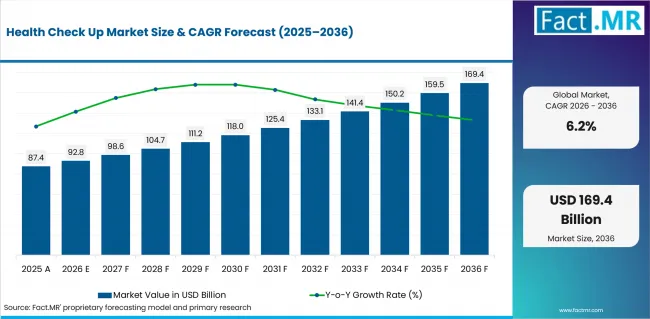
Health Check Up Market Value Analysis | Source: Fact.MR
What are the defining numbers behind Health Check Up Market growth?
USD 76.6 billion absolute opportunity by 2036 led by General Health Check-Up Packages and Preventive Healthcare alongside Hospitals, Direct Hospital Booking and Blood Tests.
- Demand Drivers in the Market
- General health check-up packages give hospitals and diagnostic networks a clear service bundle for routine screening. Customers understand the offer more easily once test coverage and follow-up steps are stated upfront.
- Preventive healthcare demand is expected to rise when chronic-risk review moves into scheduled care. Pathology services help providers classify risk through repeatable laboratory evidence.
- Direct hospital booking is expected to reduce conversion friction when patients receive one accountable route for appointments and consultation. This makes the service easier to compare than scattered test purchases.
- Blood tests remain central to health check-up packages. Routine panels help clinicians review glucose, cholesterol and organ function before deeper testing is recommended.
- Key Segments Analyzed
- By Product Type: General Health Check-Up Packages are expected to hold 37.0% share in 2026. The bundled offer gives hospitals and diagnostic centers the clearest commercial entry point.
- By Application: Preventive Healthcare is projected to account for 32.7% share in 2026. Scheduled screening supports earlier risk review before acute care demand emerges.
- By End User: Hospitals are anticipated to capture 31.9% share in 2026. They combine test access and physician referral inside one trusted care setting.
- By Distribution Channel: Direct Hospital Booking is estimated to represent 30.5% share in 2026. The route gives providers better control over appointments and post-test consultation.
- By Test Type: Blood Tests are forecast to hold 38.1% share in 2026. Routine metabolic and hematology panels remain the starting point for most check-up packages.
- Analyst Opinion at Fact.MR
- Shambhu Nath Jha, Senior Analyst at Fact.MR, states, “Health check-up demand is expected to depend on how clearly providers match packages with preventive screening and follow-up action. Customers are expected to value offers that reduce confusion around test selection and next-step consultation.”
- Strategic Implications
- Hospitals can define package tiers around clinical intent instead of long test menus. Diagnostic imaging centers become more useful when imaging is matched with age, risk profile and physician follow-up.
- Diagnostic networks need to explain how blood testing and consultation work after booking. Point of care diagnostics add more value when rapid tests support a structured review instead of a one-off urgent result.
- Investors may compare providers on repeat booking strength and referral discipline. Value-based healthcare service exposure becomes more relevant when check-up packages help reduce avoidable downstream care costs.
The USA is expected to record a 8.0% CAGR from 2026 to 2036 through direct booking depth and established preventive screening behavior. Japan is projected to record a 7.5% CAGR as aging populations support routine check-up habits. Germany is anticipated to grow at 6.8% through organized healthcare access and diagnostic service quality. The UK is estimated to post a 6.2% CAGR through institutional screening and private check-up uptake. Canada is forecast at 5.6% through service coverage across large geographies. Australia is projected to reach 4.9% through dependable diagnostic networks. Brazil is anticipated to record a 4.3% CAGR as affordability and regional access shape package uptake.
How does the Health Check Up Market break down by segment?
General Health Check-Up Packages are expected to lead Product Type at 37.0% share in 2026. Preventive Healthcare is projected to lead Application at 32.7% share in 2026.
Why do General Health Check-Up Packages lead Product Type?
General Health Check-Up Packages are projected to account for 37.0% share in 2026.
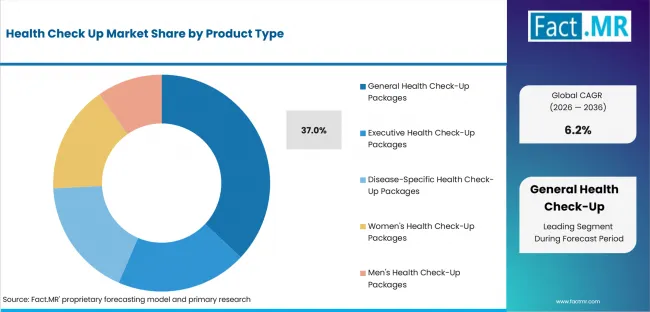
Health Check Up Market Analysis By Product Type | Source: Fact.MR
Their lead position reflects the ease of selling a bundled service that combines routine blood work with consultation and follow-up guidance. Basic Health Screening and Comprehensive Health Screening remain useful where customers need narrower or deeper test menus. Executive packages add value when employers require a defined risk profile.
Why does Preventive Healthcare lead Application?
Preventive Healthcare is expected to hold 32.7% share in 2026.
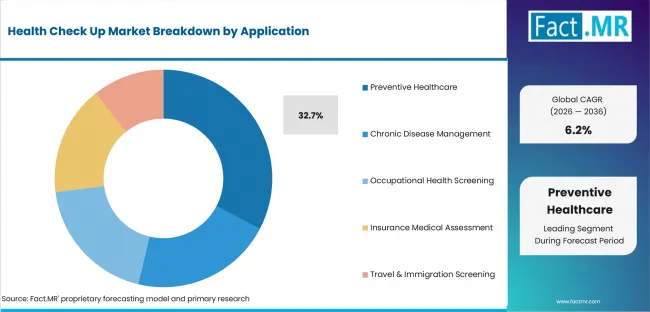
Health Check Up Market Analysis By Application | Source: Fact.MR
Preventive use leads when health check-ups are purchased before symptoms create acute care demand. Early Disease Detection and Routine Wellness Monitoring still shape demand where customers need testing at set intervals. The segment gains value when reports lead to clear medical advice.
What supports Hospitals within End User?
Hospitals are anticipated to represent 31.9% share in 2026.
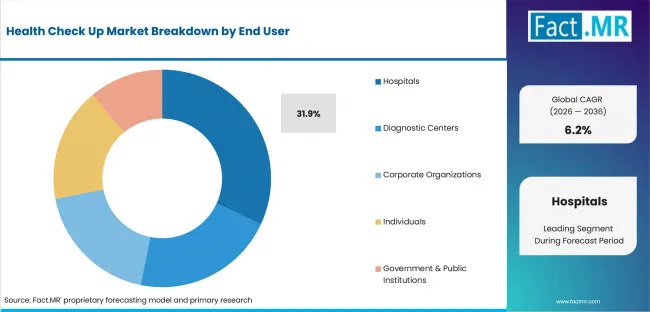
Health Check Up Market Analysis By End User | Source: Fact.MR
Hospitals lead when they combine test access and physician consultation under one care brand. This position connects with value-based healthcare service planning when providers use check-ups to support earlier intervention. Diagnostic centers compete through convenience and price visibility.
What supports Direct Hospital Booking within Distribution Channel?
Direct Hospital Booking is estimated to hold 30.5% share in 2026.
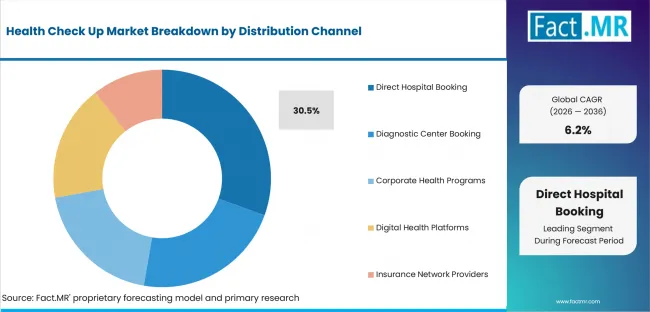
Health Check Up Market Analysis By Distribution Channel | Source: Fact.MR
Direct booking leads when hospitals control appointment timing and follow-up scheduling. Digital health platforms and mHealth services remain useful when customers expect reminders, report access and online payment support. Insurance network routes gain weight when reimbursement terms are clear.
Why do Blood Tests lead Test Type?
Blood Tests are forecast to account for 38.1% share in 2026.
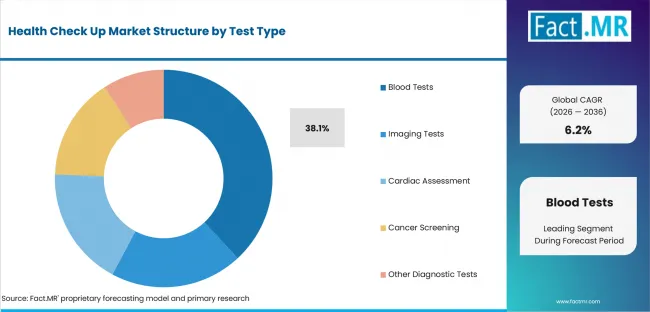
Health Check Up Market Analysis By Test Type | Source: Fact.MR
Blood tests lead as most general check-ups begin with metabolic and hematology panels. Molecular diagnostic testing and imaging tests matter when risk-specific packages require deeper confirmation. Cardiac assessment and cancer screening add value when age or physician advice creates a clearer testing reason.
What is accelerating Health Check Up Market adoption, and what is holding it back?
Demand is likely to grow through preventive care packages and hospital bookings. Limited reimbursement and weak follow-up after test results may slow adoption.
Drivers Impact Analysis
| DRIVER | QUALITATIVE RELEVANCE | GEOGRAPHIC RELEVANCE | IMPACT TIMELINE |
|---|---|---|---|
| Preventive package standardization | High | USA, Japan, Germany | Short term (<= 2 years) |
| Hospital-led booking control | Moderate | USA, UK, Canada | Short term (<= 2 years) |
| Blood testing volume | Moderate | All listed markets | Medium term (2-4 years) |
| Employer and insurance screening | Moderate | USA, Germany, Australia | Medium term (2-4 years) |
| Follow-up referral value | Selective | Hospital and diagnostic networks | Long term (>= 4 years) |
Source: Fact.MR analysis. Updated Jul 29, 2026
- Preventive package standardization: Providers are expected to gain repeat demand when customers understand what each package includes. Clear tiers reduce confusion between basic screening and disease-specific checks.
- Hospital-led booking control: Direct hospital booking is expected to improve conversion as appointments and consultation remain in one accountable channel. This helps providers protect service consistency across repeated viis concentrated.
- Blood testing volume: Blood tests are expected to anchor most package designs where routine panels are easy to schedule. They create a simple first step before imaging or specialist referral.
- Employer and insurance screening: Corporate and insurance-led programs are expected to support recurring demand when eligibility and report delivery are standardized. Annual employee screening remains useful where organizations need predictable appointment planning.
- Follow-up referral value: Check-up packages are expected to gain value when reports are built around physician advice. Providers that guide the next care step reduce the risk of ignored results.
Opportunity Impact Analysis
| OPPORTUNITY | QUALITATIVE RELEVANCE | GEOGRAPHIC RELEVANCE | IMPACT TIMELINE |
|---|---|---|---|
| Bundled annual health plans | Moderate | USA and Japan | Medium term (2-4 years) |
| Digital booking and report access | Selective | UK, Canada, Australia | Medium term (2-4 years) |
| Corporate health program expansion | Selective | USA, Germany, Brazil | Medium term (2-4 years) |
| Risk-specific screening bundles | Selective | Hospitals and diagnostic centers | Long term (>= 4 years) |
Source: Fact.MR analysis. Updated Jul 29, 2026
- Bundled annual health plans: Providers are expected to expand packages that combine routine tests and physician review. These plans make preventive care easier to purchase than separate test orders.
- Digital booking and report access: Online appointment tools are expected to improve retention when reports and reminders are handled in one workflow. mHealth services support this route when providers already operate broad branch networks.
- Corporate health program expansion: Corporate wellness programs are expected to create stable volume when check-up packages are scheduled across large workforces. Providers need reliable service slots and consistent reporting to retain these contracts.
- Risk-specific screening bundles: Women’s health and cardiac packages are expected to appeal to customers with defined risk profiles. Wearable readings can guide timing only when a provider converts them into a clinical visit.
Restraints Impact Analysis
| RESTRAINT | QUALITATIVE RELEVANCE | GEOGRAPHIC RELEVANCE | IMPACT TIMELINE |
|---|---|---|---|
| Reimbursement uncertainty | Moderate | USA, UK, Canada | Short term (<= 2 years) |
| Price sensitivity | Selective | Brazil and self-pay customers | Short term (<= 2 years) |
| Follow-up capacity gaps | Selective | Hospitals and diagnostic networks | Medium term (2-4 years) |
| Report quality variation | Selective | Fragmented service channels | Long term (>= 4 years) |
Source: Fact.MR analysis. Updated Jul 29, 2026
- Reimbursement uncertainty: Demand slows when customers cannot tell whether a package is covered by insurance. Providers need clear payment rules before customers commit to repeat check-ups.
- Price sensitivity: Conversion is expected to weaken when package pricing is not measured against clinical value. Self-pay customers compare test count and consultation access before choosing a provider.
- Follow-up capacity gaps: Test packages lose value when reports are delivered without medical explanation. Hospitals and diagnostic centers need enough consultation capacity to turn results into next steps.
- Report quality variation: Inconsistent formats and delayed report delivery create customer friction. Providers with standardized reporting are expected to retain better trust across repeat visits.
Which countries are scaling Health Check Up Market fastest?
The country comparison is more clustered than wide. The spread between the USA and Brazil is 3.7 percentage points. Service access and channel depth therefore matter more than a sharp difference in growth speed. The USA, Japan and Germany are positioned above the global 6.2% rate. The UK aligns with the global line. Canada, Australia and Brazil show steadier growth built around service coverage and affordability.
- The USA shows the highest listed CAGR where hospital-led screening and direct laboratory booking are familiar to customers. General Health Check-Up Packages are expected to benefit when clinical follow-up is clear.
- Japan and Germany remain close to the USA since aging populations and organized healthcare access support scheduled preventive testing. Provider selection is expected to depend on service reliability and referral discipline.
- Canada, Australia and Brazil trail the upper group yet remain useful where large service areas place value on dependable diagnostic networks. Price clarity is expected to decide package uptake outside major cities.
The full report provides country-level CAGR analysis across North America; Latin America; Europe; East Asia; South Asia and Pacific; and the Middle East and Africa.
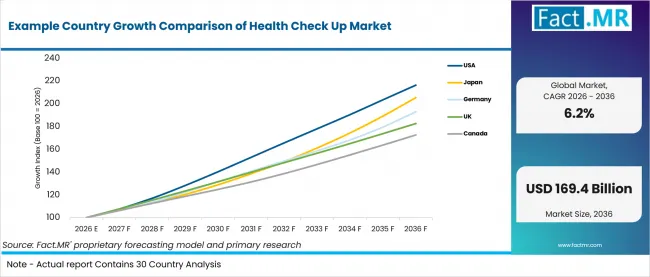
Example Country Growth Comparison Of Health Check Up Market | Source: Fact.MR
| Country | CAGR (2026-2036) |
|---|---|
| USA | 8.0% |
| Japan | 7.5% |
| Germany | 6.8% |
| UK | 6.2% |
| Canada | 5.6% |
| Australia | 4.9% |
| Brazil | 4.3% |
Source: Fact.MR analysis. Updated Jul 29, 2026
What supports USA adoption?
8.0% CAGR, supported by direct booking depth and established preventive screening behavior.
The USA outlook reflects a market where hospitals and self-pay testing channels already understand routine screening packages. Providers are expected to win repeat demand when they explain package value and simplify report follow-up. Direct hospital booking remains useful as it gives customers one route for scheduling and consultation.
How is Japan scaling demand?
7.5% CAGR, led by aging-driven screening demand and routine health review habits.
Japan’s outlook is shaped by demand for scheduled check-ups that support chronic-risk review and early referral. Providers are expected to emphasize reliability and compact appointment flows. Preventive Healthcare remains the main application lens because customers value structured screening before symptoms disrupt daily care.
What is driving Germany’s growth from 2026 to 2036?
6.8% CAGR, backed by organized healthcare access and diagnostic service quality.
Germany’s growth reflects a setting where clinical documentation and service dependability matter in provider selection. Hospitals and diagnostic centers are expected to compete on report clarity and referral discipline. Corporate packages remain useful when customers need defined scheduling and repeat testing terms.
How does the UK perform?
6.2% CAGR, matching the global market rate.
The UK outlook reflects balanced demand between institutional screening and private check-ups. Providers are expected to strengthen package uptake by giving customers a clear reason for each test. Direct Hospital Booking remains useful when patients want appointment certainty and guided follow-up after results.
What supports Canada’s growth?
5.6% CAGR, supported by service coverage across large geographies.
Canada’s growth is shaped by access needs across wide service areas and customer preference for dependable diagnostic networks. Providers are expected to compete on appointment availability and report turnaround. Blood Tests remain useful because routine panels give customers a practical starting point before extra screening.
How does Australia perform?
4.9% CAGR, backed by diagnostic network reliability and organized patient pathways.
Australia’s outlook support demand for check-up packages that work across metro and regional service settings. Providers are expected to emphasize dependable scheduling and consistent report delivery. General Health Check-Up Packages remain useful when customers want a simple package that still connects to physician advice.
What is shaping Brazil’s outlook through 2036?
4.3% CAGR, supported by regional access and affordability-sensitive package demand.
Brazil’s outlook is shaped by the need for accessible packages that match household budgets and regional service availability. Diagnostic networks are expected to gain demand when they make pricing and follow-up terms clear. Preventive Healthcare adoption is expected to move faster where providers reduce friction between testing and referral.
Who leads the Health Check Up Market?
Quest Diagnostics and Labcorp show direct relevance by combining patient-facing test access with laboratory scale. Sonic Healthcare and SYNLAB International support the broader pathology-services base. Unilabs; Eurofins Scientific; and Cerba HealthCare extend the provider set through laboratory and specialist testing coverage.
Competitive positioning is expected to depend on package clarity and branch coverage. Report quality and follow-up coordination are expected to decide repeat use. AI in diagnostics becomes useful where providers use automated support to improve triage or workflow control without replacing clinical review.
From 2026 to 2036 providers are expected to compete around general health-check packages and wider service coverage in the USA. The best offers are expected to combine clear package tiers with appointment access and post-report guidance.
Which companies are the key providers?
Key companies include Quest Diagnostics; Labcorp; Sonic Healthcare; SYNLAB International; Unilabs; Eurofins Scientific; and Cerba HealthCare.
- Quest Diagnostics
- Labcorp
- Sonic Healthcare
- SYNLAB International
- Unilabs
- Eurofins Scientific
- Cerba HealthCare
Bibliography
- Centers for Disease Control and Prevention. (2025, December 11). Prevention: PLACES measure definitions.
- Office for Health Improvement and Disparities. (2026, July 7). NHS Health Check quarterly statistics: January to March 2026 offers and uptake. Government of the United Kingdom.
- Australian Government Department of Health, Disability and Ageing. (2025, May 29). Protecting Australians from heart disease.
- Quest Diagnostics. (2025, June 10). Quest Diagnostics to develop multi-cancer stratification blood test based on MD Anderson technology.
This Report Answers
- The report provides strategic intelligence on the Health Check Up Market across Product Type and Application choices that shape preventive screening packages.
- Segment analysis covers General Health Check-Up Packages and Preventive Healthcare as the share leaders within the 2026 market structure.
- Country outlook evaluates the USA and Japan alongside Germany and the UK. Canada, Australia and Brazil complete the growth comparison across the profiled markets.
- Competitive analysis profiles Quest Diagnostics and Labcorp alongside Sonic Healthcare and SYNLAB International. Unilabs; Eurofins Scientific; and Cerba HealthCare complete the provider set.
- Test-type assessment covers Blood Tests and Imaging Tests. Cardiac Assessment, Cancer Screening and Other Diagnostic Tests complete the service view.
What does the Health Check Up Market cover?
Health check-up packages are used to organize routine screening and clinical review. They also guide follow-up for individuals; employers; hospitals; insurers; and public institutions.
The Health Check Up Market covers general check-up packages, basic screening and comprehensive screening. Executive packages and disease-specific packages are included when they are sold as structured check-up services. Coverage extends to preventive healthcare and early disease detection. Routine wellness monitoring and chronic disease management remain inside the same package boundary. Blood tests, imaging tests and cardiac assessment are included when they are sold inside check-up packages. Molecular diagnostic testing and human papillomavirus testing are included only when they support a defined screening package or medical referral pathway.
The market differs from one-off diagnostic testing because commercial value comes from package design and post-test guidance. Standalone wellness content remains outside the boundary. General fitness subscriptions are excluded. Unrelated hospital infrastructure spending is excluded unless it directly serves health check-up delivery.
What is included in the scope?
Health-check packages are used across hospitals and diagnostic centers. Corporate organizations and individuals are included when the service is package-based. Government institutions and insurance networks follow the same rule.
The scope includes Product Type and Application alongside End User, Distribution Channel and Test Type. Coverage spans general health check-up packages and preventive healthcare. It includes hospitals, direct hospital booking and blood tests. Digital Health Platforms are included when they support booking or report access for a check-up package. Imaging services are included when they form part of a package.
What is excluded from the scope?
Unrelated wellness services and diagnostic activity outside structured health-check packages remain outside the scope of this market.
The scope excludes services that do not address preventive screening or package-based diagnostic delivery. General teleconsultation without a check-up package is excluded. Fitness coaching and consumer wellness memberships are excluded unless they are bundled with a medical check-up service. Company revenue without a clear connection to package-based testing or follow-up guidance is excluded as well.
How Was the Analysis Built?
The analysis draws on 120+ sources, 35+ company portfolios, 25+ countries, and more than 20 industry interviews.
- Primary Research: Primary research includes discussions with manufacturers, service providers, technology developers, distributors, end users, procurement teams, and subject-matter experts. These conversations examine purchasing priorities, product adoption, operational challenges, approval requirements, competitive positioning, and the factors that influence wider market acceptance.
- Desk Research: Desk research covers government statistics, regulatory publications, company filings, trade data, technical studies, industry associations, standards, public policy, and other authoritative sources. Every source used in the analysis is documented in the bibliography.
- Market Sizing and Forecasting: Market estimates combine historical performance, demand indicators, pricing and volume trends, segment shares, company participation, country-level growth, adoption patterns, investment activity, and barriers to market expansion.
- Data Validation and Update Cycle: Findings are validated by comparing primary interviews with public data, company activity, regulatory changes, trade patterns, and industry developments. Regular updates review new product launches, capacity changes, partnerships, approvals, procurement trends, and shifts in commercial adoption.
Segmentation
What is the report’s scope and coverage?
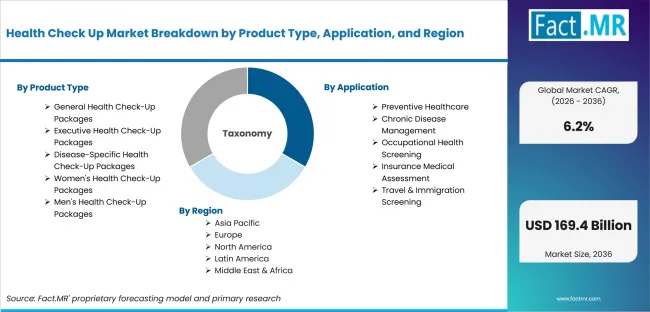
Health Check Up Market Breakdown By Product Type, Application, And Region | Source: Fact.MR
| Attribute | Details |
|---|---|
| Quantitative Units | USD billion in 2026 to USD billion by 2036 at a CAGR |
| Market Definition | Structured preventive screening packages, routine diagnostics and booking routes used to review health risk before acute care demand emerges |
| Product Type | General Health Check-Up Packages; Basic Health Screening; Comprehensive Health Screening; Executive Health Check-Up Packages; Standard Executive Check-Up; Premium Executive Check-Up; Disease-Specific Health Check-Up Packages; Cardiac Health Check-Up; Diabetes Health Check-Up; Women’s Health Check-Up Packages; Gynecological Screening; Prenatal Health Screening; Men’s Health Check-Up Packages; Prostate Health Screening; Hormonal Health Assessment |
| Application | Preventive Healthcare; Early Disease Detection; Routine Wellness Monitoring; Chronic Disease Management; Diabetes Monitoring; Cardiovascular Monitoring; Occupational Health Screening; Pre-Employment Check-Up; Annual Employee Screening; Insurance Medical Assessment; Life Insurance Examination; Health Insurance Assessment; Travel & Immigration Screening; Visa Medical Examination; International Travel Health Screening |
| End User | Hospitals; Public Hospitals; Private Hospitals; Diagnostic Centers; Independent Diagnostic Centers; Multi-Specialty Diagnostic Chains; Corporate Organizations; Large Enterprises; Small & Medium Enterprises; Individuals; Self-Paying Patients; Family Health Packages; Government & Public Institutions; Public Health Departments; Defense & Public Sector Organizations |
| Distribution Channel | Direct Hospital Booking; In-Person Appointment; Hospital Website Booking; Diagnostic Center Booking; Walk-In Registration; Online Appointment; Corporate Health Programs; Employer Wellness Programs; Annual Employee Contracts; Digital Health Platforms; Healthcare Apps; Telehealth Portals; Insurance Network Providers; Cashless Health Check-Up; Panel Hospital Booking |
| Test Type | Blood Tests; Complete Blood Count; Blood Glucose Test; Imaging Tests; X-Ray; Ultrasound; Cardiac Assessment; ECG; Stress Test; Cancer Screening; Mammography; Colon Cancer Screening; Other Diagnostic Tests; Urine Analysis; Pulmonary Function Test |
| Regions Covered | North America; Latin America; Europe; East Asia; South Asia and Pacific; Middle East and Africa |
| Countries Covered | USA; Japan; Germany; UK; Canada; Australia; Brazil |
| Key Companies Profiled | Quest Diagnostics; Labcorp; Sonic Healthcare; SYNLAB International; Unilabs; Eurofins Scientific; Cerba HealthCare |
| Forecast Period | 2026 to 2036 |
| Approach | Hybrid top-down and bottom-up assessment using preventive screening demand; package uptake; hospital and diagnostic-center capacity; booking channels; test-type mix; country growth; company participation; pricing and reimbursement signals; follow-up pathways; and public evidence relevant to the category |
Source: Fact.MR analysis. Updated Jul 29, 2026
How is the market segmented?
-
By Product Type:
- General Health Check-Up Packages
- Basic Health Screening
- Comprehensive Health Screening
- Executive Health Check-Up Packages
- Standard Executive Check-Up
- Premium Executive Check-Up
- Disease-Specific Health Check-Up Packages
- Cardiac Health Check-Up
- Diabetes Health Check-Up
- Women’s Health Check-Up Packages
- Gynecological Screening
- Prenatal Health Screening
- Men’s Health Check-Up Packages
- Prostate Health Screening
- Hormonal Health Assessment
-
By Application:
- Preventive Healthcare
- Early Disease Detection
- Routine Wellness Monitoring
- Chronic Disease Management
- Diabetes Monitoring
- Cardiovascular Monitoring
- Occupational Health Screening
- Pre-Employment Check-Up
- Annual Employee Screening
- Insurance Medical Assessment
- Life Insurance Examination
- Health Insurance Assessment
- Travel & Immigration Screening
- Visa Medical Examination
- International Travel Health Screening
-
By End User:
- Hospitals
- Public Hospitals
- Private Hospitals
- Diagnostic Centers
- Independent Diagnostic Centers
- Multi-Specialty Diagnostic Chains
- Corporate Organizations
- Large Enterprises
- Small & Medium Enterprises
- Individuals
- Self-Paying Patients
- Family Health Packages
- Government & Public Institutions
- Public Health Departments
- Defense & Public Sector Organizations
-
By Distribution Channel:
- Direct Hospital Booking
- In-Person Appointment
- Hospital Website Booking
- Diagnostic Center Booking
- Walk-In Registration
- Online Appointment
- Corporate Health Programs
- Employer Wellness Programs
- Annual Employee Contracts
- Digital Health Platforms
- Healthcare Apps
- Telehealth Portals
- Insurance Network Providers
- Cashless Health Check-Up
- Panel Hospital Booking
-
By Test Type:
- Blood Tests
- Complete Blood Count
- Blood Glucose Test
- Imaging Tests
- X-Ray
- Ultrasound
- Cardiac Assessment
- ECG
- Stress Test
- Cancer Screening
- Mammography
- Colon Cancer Screening
- Other Diagnostic Tests
- Urine Analysis
- Pulmonary Function Test
-
By Region:
- North America
- Latin America
- Europe
- East Asia
- South Asia and Pacific
- Middle East and Africa
Frequently Asked Questions
Which Product Type leads the market?
Which Application leads the market?
Which End User leads the market?
Which Distribution Channel leads the market?
Which Test Type leads the market?
Which country records the highest listed CAGR?
What is the primary driver in this market?
What is the main restraint?
Why do hospitals lead demand?
Who worked on this report


Preview the report firsthand - request a free sample
Free SampleGet the brochure for pricing and purchase details
Download PDF