- Market Value (2025): USD 2.6 Bn
- Estimated Value (2026): USD 2.9 Bn
- Forecast Value (2036): USD 8.1 Bn
- CAGR (2026-2036): 10.8%
What is the Heart Failure POC and LOC Devices Market forecast to be worth by 2036?
USD 2.9 billion in 2026 to USD 8.1 billion by 2036 at 10.8% CAGR.
- The Heart Failure POC and LOC Devices market reached USD 2.6 billion in 2025 as hospitals and urgent care units expanded cardiac testing capacity near the patient.
- Demand is projected to increase from USD 2.9 billion in 2026 to USD 8.1 billion by 2036.
- The market is forecast to record 10.8% CAGR from 2026 to 2036 owing to acute triage needs and wider use of biomarker-based testing.
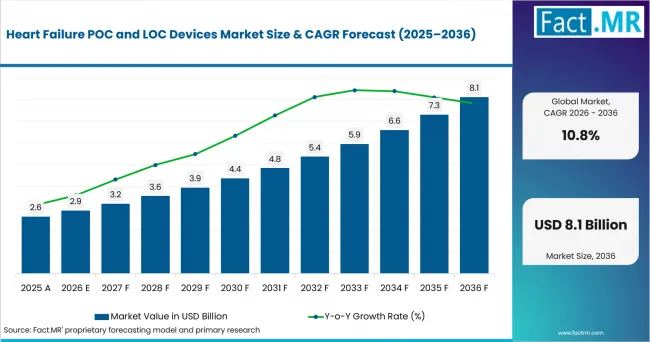
Heart Failure Poc And Loc Devices Market Value Analysis | Source: Fact.MR
What are the defining numbers behind Heart Failure POC and LOC Devices Market growth?
USD 5.2 billion absolute opportunity by 2036.
- Demand Drivers in the Market
- Emergency teams need point of care diagnostics that separate cardiac causes of breathlessness from other urgent conditions before bed decisions are made. The Australian Institute of Health and Welfare reported in 2026 that Australia recorded around 188,000 hospitalisations where heart failure or cardiomyopathy was a principal or additional diagnosis in 2023–24, reinforcing the need for faster cardiac evidence in hospital settings.
- Cardiac biomarkers such as BNP and NT-proBNP are expected to remain central because they connect symptoms with measurable strain on the heart.
- Hospitals are likely to prioritize compact analyzers that fit emergency and observation workflows without complex sample handling.
- Critical care diagnostics are expected to benefit when results can move into clinical records without manual transcription or delayed review.
- Key Segments Analyzed
- By Device Category: Point-of-Care Diagnostic Devices are expected to hold 48.0% share in 2026 because near-patient BNP and NT-proBNP testing remains central to triage.
- By Application: Acute Heart Failure Diagnosis is projected to account for 42.0% share in 2026 as urgent dyspnea assessment remains the main clinical use case.
- By End User: Hospitals are anticipated to capture 45.0% share in 2026 since emergency departments and cardiology units handle most acute testing volume.
- By Distribution Channel: Direct Sales are estimated to represent 54.0% share in 2026 because hospitals require service support and analyzer validation before purchase.
- By Technology Platform: Biomarker-based Testing is forecast to hold 46.0% share in 2026 as blood based biomarkers support faster clinical decisions.
- Analyst Opinion at Fact.MR
- Shambhu Nath Jha, Principal Consultant at Fact.MR, states, “Heart failure testing is moving closer to the patient because emergency teams need faster evidence before admission or referral decisions. Reliable biomarker performance and simple training are expected to shape hospital acceptance.”
- Strategic Implications
- Hospital purchasing teams should align POC cardiac testing with triage protocols before expanding device fleets.
- Diagnostic suppliers can strengthen tender positioning by proving workflow fit and sample stability. Operator training and connectivity should be shown before scale-up.
- Investors should separate true heart failure POC and LOC exposure from broad cardiovascular monitoring businesses.
The USA leads at 11.7% CAGR through hospital testing density and cardiology network depth. Germany follows at 11.3% as hospital procurement discipline supports adoption. The UK reaches 10.9% through national care pathways. Japan records 10.5% because older-patient care needs keep cardiac diagnostics relevant. Canada posts 10.0%. France reaches 9.6%. Australia records 9.2%.
How does the Heart Failure POC and LOC Devices Market break down by segment?
Point-of-Care Diagnostic Devices are expected to lead Device Category at 48.0% share in 2026. Acute Heart Failure Diagnosis is projected to lead Application at 42.0% share in 2026.
Which device category dominates?
Point-of-Care Diagnostic Devices are forecast to account for 48.0% share in 2026.
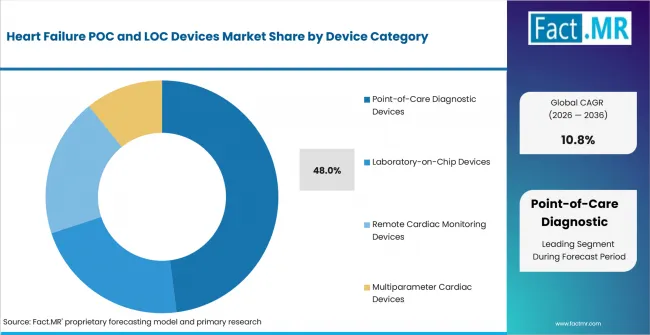
Heart Failure Poc And Loc Devices Market Analysis By Device Category | Source: Fact.MR
Near-patient analyzers lead because they fit emergency and cardiology workflows where time affects admission and referral decisions. A cardiac POC testing setup is valuable when clinicians need a result before central-lab turnaround slows the care pathway. FDA’s K253539 record shows Alere NT-proBNP for Alinity i received a substantially equivalent decision on February 18, 2026 after a November 13, 2025 submission, supporting continued regulatory activity around natriuretic peptide testing for emergency heart failure assessment.
Why does Acute Heart Failure Diagnosis lead Application?
Acute Heart Failure Diagnosis hold 42.0% share in 2026.
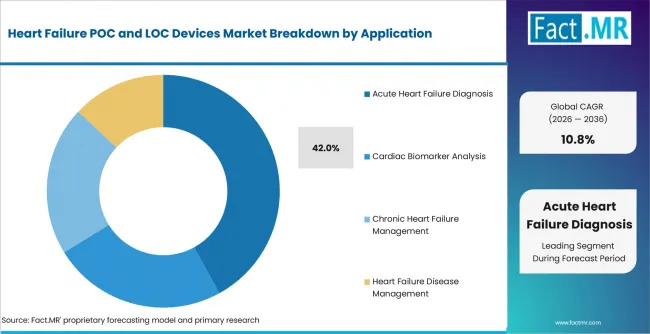
Heart Failure Poc And Loc Devices Market Analysis By Application | Source: Fact.MR
This application leads when clinicians must judge whether breathlessness reflects heart failure or another urgent condition. Fast biomarker testing supports earlier treatment routing and reduces uncertainty during emergency intake. FDA’s March 24, 2026 K252169 letter for Beckman Coulter’s Access BNP II lists emergency-department use for suspected new-onset, acutely decompensated, or exacerbated heart failure and risk stratification in heart failure, matching the application’s reliance on BNP evidence.
How do Hospitals shape End User demand?
Hospitals are anticipated to capture 45.0% share in 2026.
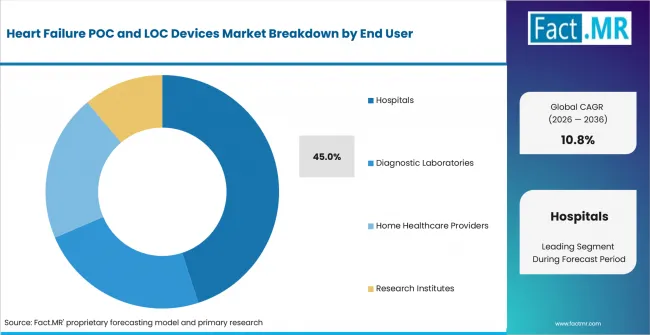
Heart Failure Poc And Loc Devices Market Analysis By End User | Source: Fact.MR
Hospitals carry the largest demand because emergency and cardiology teams use cardiac testing across several decision points. Their purchasing process also favors platforms with training and service coverage.
What supports Direct Sales within Distribution Channel?
Direct Sales are estimated to represent 54.0% share in 2026.
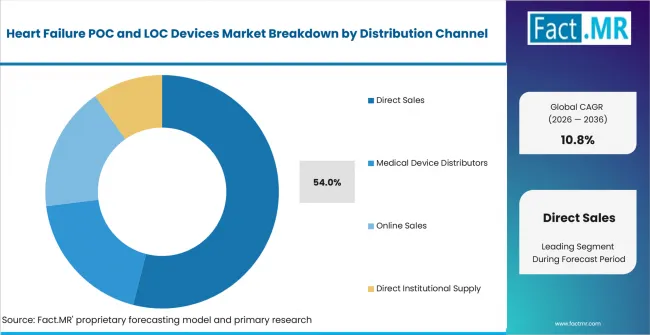
Heart Failure Poc And Loc Devices Market Analysis By Distribution Channel | Source: Fact.MR
Direct procurement is preferred when hospitals need installation support and analyzer validation. Suppliers are expected to use direct sales teams where tenders require technical review and service commitments.
Why does Biomarker-based Testing lead Technology Platform?
Biomarker-based Testing is forecast to hold 46.0% share in 2026.
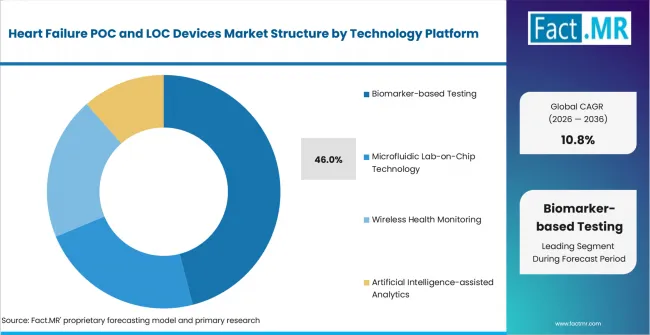
Heart Failure Poc And Loc Devices Market Analysis By Technology Platform | Source: Fact.MR
BNP and NT-proBNP testing keeps biomarker platforms central to triage and monitoring. These tests give clinicians a measurable signal that can be interpreted with symptoms and patient history.
What is accelerating Heart Failure POC and LOC Devices Market adoption, and what is holding it back?
Demand is expected to rise through faster cardiac triage and better decentralized testing. Growth may be limited by assay validation work and hospital IT integration.
Drivers Impact Analysis
| DRIVER | (~) % IMPACT ON CAGR | GEOGRAPHIC RELEVANCE | IMPACT TIMELINE |
|---|---|---|---|
| Acute dyspnea triage | +2.8% | North America, Europe | Short term (<= 2 years) |
| Biomarker workflow adoption | +2.4% | Global hospital clusters | Medium term (2-4 years) |
| Bedside connectivity and data capture | +1.9% | USA, UK, Japan | Medium term (2-4 years) |
| Lab-on-chip workflow miniaturization | +1.5% | Advanced care networks | Long term (>= 4 years) |
| Hospital protocol standardization | +1.2% | Mature healthcare systems | Long term (>= 4 years) |
Source: Fact.MR analysis. Updated Aug 10, 2026
- Acute dyspnea triage: Suspected heart failure cases need faster testing near emergency intake. This is expected to increase the value of reliable bedside cardiac biomarker results.
- Biomarker workflow adoption: BNP and NT-proBNP assays help clinicians interpret symptoms before a full diagnostic sequence is complete. This supports adoption where physicians need earlier evidence.
- Bedside connectivity and data capture: Hospitals are expected to prefer devices that send results into clinical systems without manual transcription or delayed review.
Opportunity Impact Analysis
| OPPORTUNITY | (~) % IMPACT ON CAGR | GEOGRAPHIC RELEVANCE | IMPACT TIMELINE |
|---|---|---|---|
| Cartridge-based menu expansion | +1.4% | USA and Germany | Medium term (2-4 years) |
| Lab-on-chip sample simplification | +1.1% | UK and Japan | Medium term (2-4 years) |
| Connected emergency workflows | +0.8% | Canada and Australia | Long term (>= 4 years) |
| Chronic-care monitoring adjacency | +0.6% | France and mature cardiology networks | Long term (>= 4 years) |
Source: Fact.MR analysis. Updated Aug 10, 2026
- Cartridge-based menu expansion: Suppliers that add cardiac and renal markers to the same platform can increase testing value without adding analyzer complexity.
- Lab-on-chip sample simplification: Compact workflows can reduce sample-handling friction and support smaller care settings. This favors lab informatics only when results still move cleanly into records.
- Connected emergency workflows: Devices that connect results with order entry and electronic records are expected to reduce manual steps during acute-care decisions.
Restraints Impact Analysis
| RESTRAINT | (~) % IMPACT ON CAGR | GEOGRAPHIC RELEVANCE | IMPACT TIMELINE |
|---|---|---|---|
| Assay validation and operator training | -1.3% | Global | Short term (<= 2 years) |
| Procurement price sensitivity | -1.0% | Hospitals and urgent care networks | Medium term (2-4 years) |
| Integration with hospital IT | -0.7% | Mature markets | Medium term (2-4 years) |
| Sample-quality and workflow errors | -0.5% | Decentralized testing sites | Long term (>= 4 years) |
Source: Fact.MR analysis. Updated Aug 10, 2026
- Assay validation and operator training: POC testing requires repeatable handling across shifts and care sites. Weak training can reduce confidence in decentralized results.
- Procurement price sensitivity: Hospitals may delay upgrades when analyzer costs and cartridge budgets do not show clear workflow savings.
- Integration with hospital IT: Devices must connect with records and laboratory governance systems. Poor integration can slow routine deployment even when assay performance is acceptable.
Which countries are scaling the Heart Failure POC and LOC Devices Market fastest?
- The country comparison spans 2.5 percentage points and forms three practical growth bands across the forecast period.
- The USA remains 0.4 percentage point above Germany through hospital testing density and cardiology network depth.
- Germany remains 0.4 percentage point above the UK as structured procurement and medical device capability support advanced diagnostics.
- The UK remains 0.4 percentage point above Japan through national care pathways and specialist referral networks.
- Japan remains 0.5 percentage point above Canada because older-patient care needs support advanced diagnostic practice.
- Canada remains 0.4 percentage point above France through universal healthcare access and regional cardiac-care networks.
- France remains 0.4 percentage point above Australia through hospital modernization and cardiology service development.
Comparable CAGRs can create different entry conditions due to reimbursement and hospital purchasing pathways. Full report coverage includes North America, Latin America, Europe, East Asia, South Asia and Pacific, Middle East and Africa.
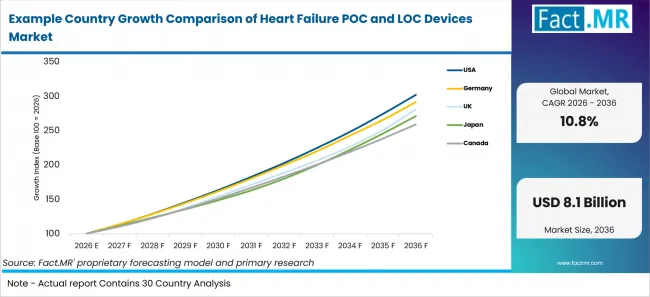
Example Country Growth Comparison Of Heart Failure Poc And Loc Devices Market | Source: Fact.MR
| Country | CAGR (2026-2036) |
|---|---|
| USA | 11.7% |
| Germany | 11.3% |
| UK | 10.9% |
| Japan | 10.5% |
| Canada | 10.0% |
| France | 9.6% |
| Australia | 9.2% |
Source: Fact.MR analysis. Updated Aug 10, 2026
What supports USA adoption?
11.7% CAGR, supported by hospital testing density and advanced cardiac care pathways.
Emergency and cardiology teams in the USA evaluate turnaround time before approving new cardiac testing platforms. Adoption is expected to depend on reliable biomarker performance and clean transfer of results into hospital systems.
What is driving Germany’s growth?
11.3% CAGR, backed by structured hospital procurement and a strong medical device base.
Germany is expected to benefit from hospital buyers that value analyzer quality control. Vendors must show service reliability before large systems standardize decentralized cardiac testing.
How is the UK scaling demand?
10.9% CAGR, driven by national care pathways and specialist cardiac referral networks.
The UK’s pathway-led care model favors devices that reduce uncertainty during suspected heart failure assessment. Procurement remains disciplined and favors clear workflow evidence. NHS England statistics show that emergency departments recorded 27.4 million A&E attendances in the 2024-25 financial year, representing a significant 4.0% increase compared to the previous year. This rising trajectory, which has pushed recent 12-month rolling totals above 28 million attendances, strongly underscores the clinical demand for pathway-led triage tools to manage patient flow in increasingly crowded emergency settings.
How does Japan perform?
10.5% CAGR, supported by older-patient care needs and advanced diagnostic practice.
Japan’s growth reflects a care setting where older patients often need careful cardiac assessment. Compact testing systems are expected to separate cardiac and non-cardiac symptoms earlier. Japan’s Statistics Bureau reported in September 2025 that 36.19 million people were aged 65 or older and that this group represented 29.4% of the population, strengthening the case for compact cardiac testing in older-patient care.
What supports Canada adoption?
10.0% CAGR, backed by universal healthcare access and regional cardiac-care networks.
Canada’s regional hospital networks must balance centralized testing with local access needs. Suppliers are expected to compete on service coverage and oversight fit.
How does France develop demand?
9.6% CAGR, led by hospital modernization and cardiology service development.
France is expected to register steady adoption as hospitals improve movement between emergency and cardiology services. Budget review processes may keep demand selective.
What supports Australia’s growth?
9.2% CAGR, supported by specialist cardiac care and remote-care requirements.
Australia’s adoption case is shaped by advanced hospitals and care delivery across large distances. Device reliability is expected to guide purchasing decisions.
Who leads the Heart Failure POC and LOC Devices Market?
Abbott Laboratories, F. Hoffmann-La Roche Ltd., and Siemens Healthineers AG have the broadest diagnostic relevance. QuidelOrtho Corporation adds near-patient testing exposure.
FDA records show Access NT-proBNP received a substantially equivalent decision under K232164 on April 12, 2024. This record supports the direct relevance of natriuretic peptide testing in heart failure diagnostics.
Koninklijke Philips N.V. strengthen the monitoring and connected-care field. Boditech Med Inc. extends competition through immunoassay and biomarker platform exposure. Cardiac marker analyzer selection is expected to depend on workflow fit and integration with hospital data systems.
Which companies are the key providers?
Key companies include Abbott Laboratories; F. Hoffmann-La Roche Ltd.; Siemens Healthineers AG; QuidelOrtho Corporation; Koninklijke Philips N.V.; Boditech Med Inc.
- Abbott Laboratories
- F. Hoffmann-La Roche Ltd.
- Siemens Healthineers AG
- QuidelOrtho Corporation
- Koninklijke Philips N.V.
- Boditech Med Inc.
Bibliography
- American Heart Association. (2025, January 27). 2025 heart disease and stroke statistics.
- American Heart Association. (2025, May 30). Diagnosing heart failure.
- U.S. Food and Drug Administration. (2024, April 12). 510(k) premarket notification: Access NT-proBNP (K232164) [Database record].
- Australian Institute of Health and Welfare. (2026, May 27). Heart, stroke and vascular disease: Australian facts—Heart failure and cardiomyopathy.
- U.S. Food and Drug Administration. (2026, February 18). 510(k) premarket notification: Alere NT-proBNP for Alinity i (K253539) [Database record].
- U.S. Food and Drug Administration. (2026, March 24). 510(k) premarket notification: Access BNP II (K252169) [Database record].
- Wang, X., & Black, L. I. (2026, April). Prevalence of selected chronic conditions among adults age 45 and older, by age and urbanization level: United States, 2024 (NCHS Data Brief No. 557). National Center for Health Statistics.
- Statistisches Bundesamt (Destatis). (2025, August 29). Bevölkerung: Ältere Menschen.
- NHS England. (2026, January 15). Second biggest drop in NHS waiting list in 15 years amid record number of patients.
- QuidelOrtho Corporation. (2025, November 3). QuidelOrtho receives FDA 510(k) clearance for VITROS™ Immunodiagnostic Products hs Troponin I Assay.
This Report Answers
- The report provides strategic intelligence on the Heart Failure POC and LOC Devices Market across Device Category and Application choices that shape near-patient cardiac testing.
- Segment analysis covers Point-of-Care Diagnostic Devices and Acute Heart Failure Diagnosis as the share leaders within the 2026 market.
- Country outlook evaluates the USA and Germany alongside the UK and Japan. Canada, France, and Australia complete the growth comparison across the profiled markets.
- Competitive analysis profiles Abbott Laboratories and F. Hoffmann-La Roche Ltd. alongside Siemens Healthineers. bioMérieux, QuidelOrtho, Philips, iRhythm Technologies, Boditech Med, and Fujirebio complete the provider set.
- Technology assessment covers Biomarker-based Testing and Microfluidics. Immunoassay Platforms, Electrochemical Detection, and Connected Digital Platforms complete the wider technology view.
What does the Heart Failure POC and LOC Devices Market cover?
Heart Failure POC and LOC Devices support diagnosis and triage. They also support monitoring and therapy response assessment when heart failure is suspected or confirmed.
The market covers near-patient devices and lab-on-chip systems. Wearable monitoring and multiplex biomarker devices are included when testing output supports heart failure decisions. Critical care biomarker use is covered when heart failure assessment is part of acute-care testing.
What is included in the scope?
The scope includes devices and platforms used for diagnosis and triage. Monitoring and therapy response assessment are included where heart failure is the clinical focus.
Coverage includes Device Category and Application alongside End User and Distribution Channel. The market includes BNP and NT-proBNP testing workflows. Immunoassay and connected digital platforms are included when they support heart failure testing. Molecular diagnostics are considered only where they support a defined heart failure testing route.
What is excluded from the scope?
General cardiovascular devices that do not support heart failure testing or monitoring remain outside the scope of this market.
The scope excludes pure wellness wearables and unrelated ECG products. Broad hospital IT systems and assays without heart failure relevance are also excluded.
How Was the Analysis Built?
The analysis draws on 120+ sources, 35+ company portfolios, 25+ countries, and more than 20 interviews.
- Primary Research: Interviews with manufacturers, retailers, salon operators, and experts examine purchase priorities, adoption, approval requirements, and competitive positioning.
- Desk Research: Desk research covers government statistics, regulatory publications, company filings, trade data, technical studies, industry associations, standards, and public policy.
- Market Sizing and Forecasting: Estimates combine historical performance, demand indicators, pricing, segment shares, company participation, country growth, adoption patterns, and barriers to expansion.
- Data Validation and Update Cycle: Findings are validated against public data, company activity, regulatory changes, product launches, recalls, and adoption shifts.
Segmentation
What is the report’s scope and coverage?
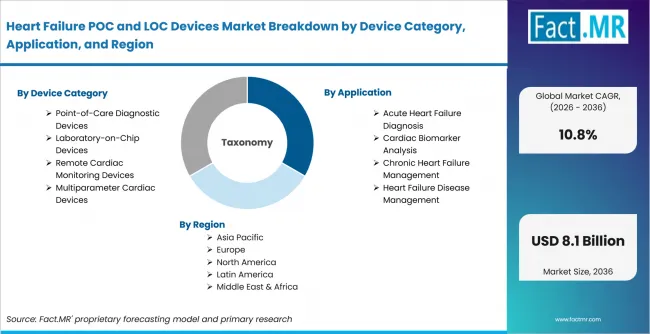
Heart Failure Poc And Loc Devices Market Breakdown By Device Category, Application, And Region | Source: Fact.MR
| Attribute | Details |
|---|---|
| Quantitative Units | USD billion |
| Market Definition | Portable, bedside, and lab-on-chip systems used for heart failure diagnosis, triage, monitoring, and therapy response assessment. |
| Device Category | Point-of-Care Diagnostic Devices; Lab-on-Chip Devices; Wearable/Portable Monitoring Devices; Microfluidic Testing Systems; Multiplex Biomarker Devices |
| Application | Acute Heart Failure Diagnosis; Chronic Heart Failure Monitoring; Risk Stratification; Emergency Department Triage; Therapy Response Monitoring |
| End User | Hospitals; Diagnostic Laboratories; Ambulatory Care Centers; Homecare Settings; Research and Academic Institutes |
| Distribution Channel | Direct Sales; Distributor Sales; Online Procurement; Group Purchasing Organizations; Service Contracts |
| Technology Platform | Biomarker-based Testing; Microfluidics; Immunoassay Platforms; Electrochemical Detection; Connected Digital Platforms |
| Regions Covered | North America; Latin America; Europe; East Asia; South Asia and Pacific; Middle East and Africa |
| Countries Covered | USA; Germany; UK; Japan; Canada; France; Australia |
| Key Companies Profiled | Abbott Laboratories; F. Hoffmann-La Roche Ltd.; Siemens Healthineers AG; QuidelOrtho Corporation; Koninklijke Philips N.V.; Boditech Med Inc. |
| Forecast Period | 2026 to 2036 |
| Approach | Hybrid top-down and bottom-up approach using heart failure testing workflows; hospital procurement patterns; segment shares; country adoption patterns and company portfolio review |
Source: Fact.MR analysis. Updated Aug 10, 2026
How is the market segmented?
-
By Device Category
- Point-of-Care Diagnostic Devices
- BNP Testing Devices
- NT-proBNP Testing Devices
- Laboratory-on-Chip Devices
- Microfluidic Diagnostic Chips
- Portable Lab-on-Chip Systems
- Remote Cardiac Monitoring Devices
- Wearable Cardiac Monitors
- Handheld Cardiac Monitors
- Multiparameter Cardiac Devices
- Portable Multiparameter Analyzers
- Integrated Cardiac Diagnostic Systems
- Point-of-Care Diagnostic Devices
-
By Application
- Acute Heart Failure Diagnosis
- Emergency Department Testing
- Rapid Heart Failure Screening
- Cardiac Biomarker Analysis
- Cardiovascular Risk Assessment
- Outpatient Monitoring
- Chronic Heart Failure Management
- Remote Patient Monitoring
- Post-discharge Monitoring
- Heart Failure Disease Management
- High-risk Patient Monitoring
- Preventive Cardiac Assessment
- Acute Heart Failure Diagnosis
-
By End User
- Hospitals
- Cardiac Care Centers
- Specialty Cardiology Clinics
- Diagnostic Laboratories
- Academic Medical Centers
- Ambulatory Care Centers
- Home Healthcare Providers
- Cardiology Practices
- Community Healthcare Centers
- Research Institutes
- Clinical Research Organizations
- Public Health Organizations
- Hospitals
-
By Distribution Channel
- Direct Sales
- Hospital Procurement
- Authorized Distributors
- Medical Device Distributors
- Clinical Supply Partners
- Group Purchasing Organizations
- Online Sales
- E-commerce Platforms
- Retail Medical Suppliers
- Direct Institutional Supply
- Research Procurement Programs
- Long-term Supply Agreements
- Direct Sales
-
By Technology Platform
- Biomarker-based Testing
- BNP Immunoassay Technology
- NT-proBNP Immunoassay Technology
- Microfluidic Lab-on-Chip Technology
- Miniaturized Biosensor Platform
- Integrated Microfluidic Assays
- Wireless Health Monitoring
- Bluetooth-enabled Connectivity
- Cloud-connected Diagnostics
- Artificial Intelligence-assisted Analytics
- Predictive Diagnostic Algorithms
- Digital Clinical Decision Support
- Biomarker-based Testing
-
By Region
- North America
- Latin America
- Europe
- East Asia
- South Asia and Oceania
- Middle East and Africa
Frequently Asked Questions
How big is the heart failure POC and LOC devices market in 2026?
The heart failure POC and LOC devices market is valued at USD 2.9 billion in 2026 and is forecast to reach USD 8.1 billion by 2036.
Which device category leads the heart failure POC and LOC devices market?
Which application leads the heart failure POC and LOC devices market?
Who are the leading companies in the heart failure POC and LOC devices market?
Who worked on this report


Preview the report firsthand - request a free sample
Free SampleGet the brochure for pricing and purchase details
Download PDF