- Market Value (2025): USD 2.2 Bn
- Estimated Value (2026): USD 2.4 Bn
- Forecast Value (2036): USD 4.1 Bn
- CAGR (2026-2036): 5.8%
What is the Heart Lung Machine Market forecast to be worth by 2036?
USD 2.4 billion in 2026 to USD 4.1 billion by 2036 at 5.8% CAGR.
- The heart lung machine market reached USD 2.2 billion in 2025 as hospitals kept funding perfusion equipment replacement and service planning.
- Demand is projected to increase from USD 2.4 billion in 2026 to USD 4.1 billion by 2036.
- The market is forecast to record 5.8% CAGR from 2026 to 2036 owing to cardiac surgery volumes and stricter perfusion workflow checks.
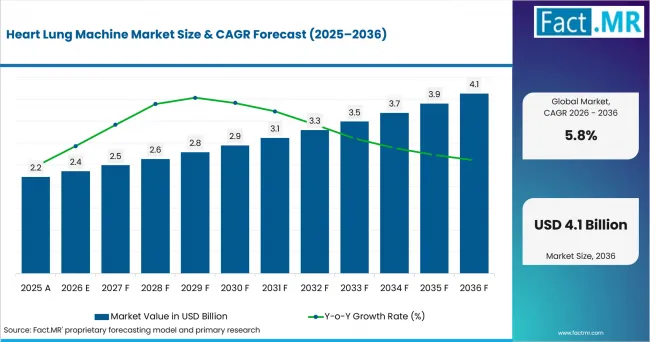
Heart Lung Machine Market Value Analysis | Source: Fact.MR
What are the defining numbers behind Heart Lung Machine Market growth?
USD 1.8 billion absolute opportunity by 2036.
- Demand Drivers in the Market
- Conventional heart lung machines remain central to bypass procedures since hospitals can validate their use through established perfusion protocols.
- Cardiac surgery teams require steady pump control and oxygenation support when procedure complexity rises inside the operating room.
- Hospital procurement favors platforms that provide service access and staff training before repeated surgical use.
- Key Segments Analyzed
- By Product Type: Conventional Heart Lung Machines are expected to hold 38.1% share in 2026 because many perfusion teams already use established bypass workflows.
- By Application: Cardiac Surgery is projected to account for 31.5% share in 2026 as bypass support remains tied to open-heart procedures.
- By End User: Hospitals are anticipated to capture 32.1% share in 2026 since most purchases require surgical infrastructure and perfusion staff.
- By Distribution Channel: Direct Sales are estimated to represent 31.7% share in 2026 due to the need for technical review before capital purchase approval.
- By Technology: Roller Pump Technology is forecast to hold 42.9% share in 2026 as it remains familiar to many perfusion teams.
- Analyst Opinion at Fact.MR
- Shambhu Nath Jha states as Principal Consultant at Fact.MR: “Heart lung machine providers need to prove reliability inside the operating room and not only list console features. Procurement is expected to depend on service support, perfusion training and disposable compatibility.”
- Strategic Implications
- Manufacturers should explain how pump stability works with cardiovascular monitoring devices before hospital tenders reach final review.
- Sales teams should show how installation and training fit the wider operating room equipment environment.
- Investors should separate bypass equipment from heart pump devices. Heart lung machines are used during planned procedures so their purchase case depends on operating-room readiness.
Germany is expected to record a 7.5% CAGR through service depth. Brazil is projected at 7.0% CAGR as distributor service coverage improves. Australia is anticipated to grow at 4.1% CAGR through renewal planning. The USA is estimated at 6.4% CAGR as cardiac centers review reliability. Canada is forecast at 4.6% CAGR through centralized procurement. The UK is projected at 4.1% CAGR under budget-controlled buying. Japan is expected to record 4.6% CAGR as mature centers prioritize service continuity.
How does the Heart Lung Machine Market break down by segment?
Conventional Heart Lung Machines are expected to lead Product Type at 38.1% share in 2026. Cardiac Surgery is projected to lead Application at 31.5% share in 2026.
Which Product Type dominates?
Conventional Heart Lung Machines are projected to account for 38.1% share in 2026.
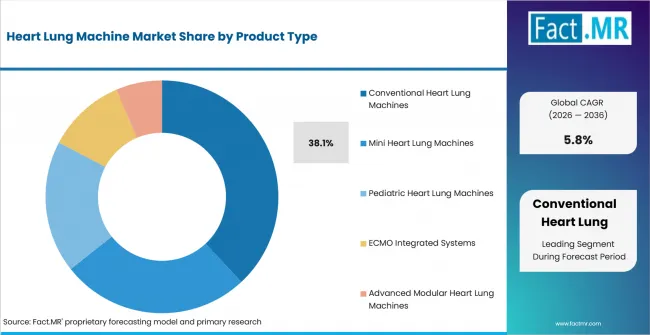
Heart Lung Machine Market Analysis By Product Type | Source: Fact.MR
Conventional systems lead through trained perfusion teams and familiar service routines. Roller Pump Systems and Centrifugal Pump Systems remain relevant where teams need different flow-control profiles.
Why does Cardiac Surgery lead Application?
Cardiac Surgery is expected to hold 31.5% share in 2026.
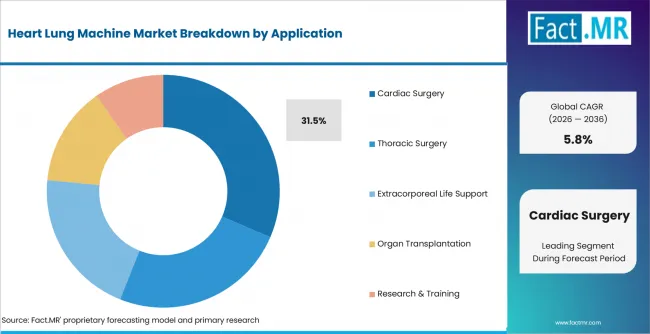
Heart Lung Machine Market Analysis By Application | Source: Fact.MR
Open-heart procedures create the main use case when circulation needs extracorporeal support. structural heart devices and cardiovascular repair devices remain adjacent when hospitals review cardiac procedure capability.
What supports Hospitals within End User?
Hospitals are anticipated to account for 32.1% share in 2026.
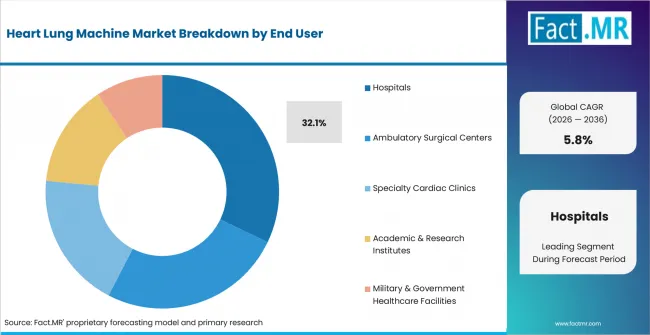
Heart Lung Machine Market Analysis By End User | Source: Fact.MR
Hospitals lead because purchases require operating rooms and trained perfusion staff. Multispecialty Hospitals and Cardiac Specialty Hospitals remain relevant where cardiac programs handle regular bypass cases.
How does Direct Sales shape channel demand?
Direct Sales are estimated to represent 31.7% share in 2026.
Direct Sales lead when hospitals need demonstrations and service terms before capital approval. Hospital Procurement and Group Purchasing Organizations influence pricing discipline.
What supports Roller Pump Technology?
Roller Pump Technology is forecast to hold 42.9% share in 2026.
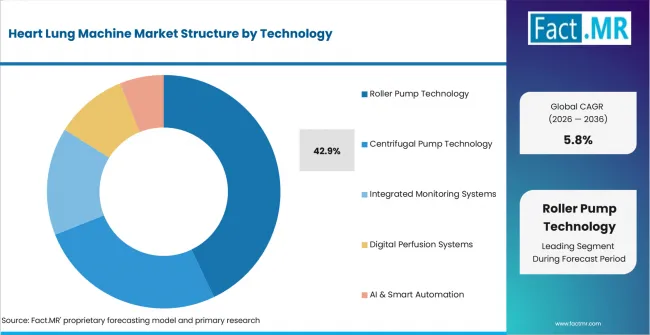
Heart Lung Machine Market Analysis By Technology | Source: Fact.MR
Roller pump systems benefit from familiar flow control and maintenance routines. blood flow measurement devices and hemodynamic monitoring systems show why flow visibility matters during bypass support.
What is accelerating Heart Lung Machine Market adoption, and what is holding it back?
Demand is expected to rise as hospitals replace bypass equipment and improve workflows. Limited budgets and lengthy approval processes may slow adoption.
Drivers Impact Analysis
| DRIVER | (~) % IMPACT ON CAGR | GEOGRAPHIC RELEVANCE | IMPACT TIMELINE |
|---|---|---|---|
| Conventional CPB equipment replacement | +1.4% | Europe and North America | Short term (<= 2 years) |
| Cardiac surgery workflow readiness | +1.2% | Germany, Brazil, USA | Short term (<= 2 years) |
| Hospital perfusion service coverage | +1.0% | Germany and Australia | Medium term (2-4 years) |
| Disposable and oxygenator compatibility | +0.8% | Global cardiac centers | Medium term (2-4 years) |
| Digital perfusion monitoring | +0.6% | USA, UK and Japan | Long term (>= 4 years) |
Source: Fact.MR analysis. Updated Jul 31, 2026
- Conventional CPB equipment replacement: Older consoles are expected to enter review when hospitals compare service risk with operating-room downtime.
- Cardiac surgery workflow readiness: Procedure teams are expected to favor systems that support pump control and oxygenation during bypass.
- Hospital perfusion service coverage: Local service depth is expected to reduce approval friction after installation.
Opportunity Impact Analysis
| OPPORTUNITY | (~) % IMPACT ON CAGR | GEOGRAPHIC RELEVANCE | IMPACT TIMELINE |
|---|---|---|---|
| Integrated perfusion records | +1.1% | USA and UK | Medium term (2-4 years) |
| Service-led replacement programs | +0.9% | Germany and Canada | Medium term (2-4 years) |
| Training packages for perfusion teams | +0.7% | Brazil and Australia | Medium term (2-4 years) |
| Compact systems for selected procedures | +0.5% | Japan and specialist centers | Long term (>= 4 years) |
Source: Fact.MR analysis. Updated Jul 31, 2026
- Integrated perfusion records: Providers that pair pump readings with patient monitoring are expected to build a stronger clinical review file.
- Service-led replacement programs: Vendors that package installation and preventive maintenance are expected to improve tender confidence.
- Training packages for perfusion teams: Product demonstrations are expected to clarify circuit set-up and safety checks before approval.
Restraints Impact Analysis
| RESTRAINT | (~) % IMPACT ON CAGR | GEOGRAPHIC RELEVANCE | IMPACT TIMELINE |
|---|---|---|---|
| Capital budget pressure | -1.1% | Hospitals with delayed procurement | Short term (<= 2 years) |
| Long validation and training cycles | -0.8% | Germany, USA, UK | Short term (<= 2 years) |
| Service access gaps | -0.6% | Brazil and remote hospital networks | Medium term (2-4 years) |
| Disposable compatibility review | -0.5% | Global cardiac centers | Medium term (2-4 years) |
Source: Fact.MR analysis. Updated Jul 31, 2026
- Capital budget pressure: High purchase value is expected to delay orders when hospitals prioritize urgent infrastructure or staffing needs.
- Long validation and training cycles: Teams must test alarms and pump response before approving a new platform.
- Service access gaps: Hospitals outside major cardiac clusters are expected to delay purchases when emergency service response remains uncertain.
Which countries are scaling Heart Lung Machine Market fastest?
- Germany and Brazil lead through strong service networks and hospital access. Australia and the USA stay near the global pace as hospitals review replacement needs and system reliability.
- Canada grows through centralized purchasing and clear service requirements. The UK advances more slowly because budget checks and tender timing delay approvals.
- Japan records the lowest growth as mature cardiac centers focus mainly on equipment replacement and continuity.
- Comparable CAGRs can produce different entry conditions. Deployment timing depends on clinical approval evidence and service coverage. Training comfort also affects order conversion.
The full report provides country-level CAGR analysis across North America; Latin America; Europe; East Asia; South Asia and Oceania; and the Middle East and Africa.
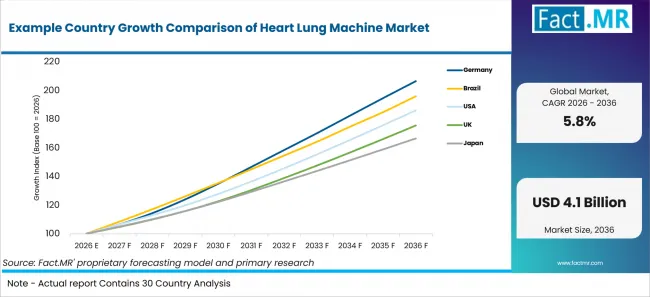
Example Country Growth Comparison Of Heart Lung Machine Market | Source: Fact.MR
| Country | CAGR (2026-2036) |
|---|---|
| Germany | 7.5% |
| Brazil | 7.0% |
| Australia | 4.1% |
| USA | 6.4% |
| Canada | 4.6% |
| UK | 5.8% |
| Japan | 5.2% |
Source: Fact.MR analysis. Updated Jul 31, 2026
What supports Germany adoption?
6.7% CAGR, supported by hospital replacement cycles and perfusion-service depth.
Germany’s cardiac centers evaluate service response before approving replacement platforms. Conventional systems benefit where teams prefer familiar routines.
How is Brazil scaling demand?
6.1% CAGR, driven by cardiac surgery access and distributor service coverage.
Brazil depends on vendor and distributor support beyond major cardiac centers. Financing comfort and local service response are expected to decide purchase timing.
What shapes Australia’s growth from 2026 to 2036?
5.8% CAGR, backed by public and private hospital renewal planning.
Across Australia, replacement demand is expected to move through planned procurement cycles. Direct Sales remain useful where vendors explain service coverage clearly.
How is the USA developing demand?
5.5% CAGR, supported by cardiac-center equipment review and staff training needs.
In the USA, cardiac programs are expected to review systems through reliability evidence and training readiness. Technology selection remains tied to perfusion-team familiarity.
What supports Canada’s position?
5.2% CAGR, driven by centralized procurement and replacement demand.
Canadian procurement favors systems that fit existing clinical protocols. Hospitals are expected to prefer platforms with a clear maintenance case.
Why does the UK grow at a measured pace?
4.9% CAGR, supported by budget-controlled procurement and service-led replacement.
UK demand reflects steady replacement and not fast fleet expansion. Budget review and tender timing are expected to extend the buying cycle.
How does Japan compare with other listed countries?
4.3% CAGR, connected to mature cardiac centers and service continuity.
Japan records the lowest listed CAGR since many cardiac centers use established perfusion infrastructure. Purchases focus on reliability and replacement fit.
Who leads the Heart Lung Machine Market?
The profiled provider set covers perfusion equipment companies and cardiac surgery technology providers. Competition is expected to focus on reliability, compatibility and service depth.
LivaNova PLC; Getinge AB; Terumo Corporation; Medtronic plc; Xenios AG; and Braile Biomedica have relevant cardiopulmonary or extracorporeal exposure.
Competition is expected to depend on operating-room reliability and service response. Hospitals are expected to review adjacent procedure needs through surgical procedures volume and patient monitoring systems.
Which companies are the key providers?
The profiled company set includes LivaNova PLC; Getinge AB; Terumo Corporation; Medtronic plc; Xenios AG; and Braile Biomedica.
- LivaNova PLC
- Getinge AB
- Terumo Corporation
- Medtronic plc
- Xenios AG
- Braile Biomedica
Bibliography
- Therapeutic Goods Administration. (2024, March 25). Abbott Medical Australia Pty Ltd—Heart-lung bypass system module, console: ARTG 444353. Australian Government.
- Medicines and Healthcare products Regulatory Agency. (2025, January 29). Field Safety Notices: 20 to 24 January 2025. GOV.UK.
- Terumo Corporation. (2024, May 28). Terumo Cardiovascular announces 510(k) clearance for the CDI OneView Monitoring System.
- Getinge AB. (2025, March 27). Getinge publishes annual report for 2024.
This Report Answers
- The report provides strategic intelligence on the Heart Lung Machine Market across Product Type and Application choices.
- Segment analysis covers Conventional Heart Lung Machines and Cardiac Surgery as the 2026 share leaders.
- Country outlook evaluates Germany and Brazil alongside Australia and the USA. Canada, the UK and Japan complete the comparison.
- Competitive analysis profiles LivaNova PLC and Getinge AB alongside Terumo Corporation and Medtronic plc. Xenios AG and Braile Biomedica complete the set.
- Technology assessment covers Roller Pump Technology and Centrifugal Pump Technology alongside Single Roller Pumps, Dual Roller Pumps and AI & Smart Automation.
What does the Heart Lung Machine Market cover?
Heart lung machines support cardiopulmonary bypass during cardiac procedures where circulation and oxygenation need extracorporeal support.
The market covers equipment used by hospitals and cardiac centers during bypass-supported procedures. Coverage extends to conventional systems and roller pump systems. Centrifugal pump systems and mini heart lung machines are included where they support cardiac surgery workflows.
What is included in the scope?
Conventional Heart Lung Machines; Roller Pump Systems; Centrifugal Pump Systems; and Mini Heart Lung Machines are included in the scope.
The scope includes Product Type; Application; End User; Distribution Channel; Technology; and Region. Coverage spans Cardiac Surgery and Coronary Artery Bypass Grafting. Heart Valve Surgery and Thoracic Surgery complete the application view.
What is excluded from the scope?
General patient monitors, standalone oxygenators and unrelated cardiac devices remain outside the scope of this market.
The scope excludes devices that do not provide machine-level cardiopulmonary bypass support. Standalone monitoring equipment is excluded unless it is sold as part of a heart lung machine platform. reprocessed medical devices remain outside the scope unless compatibility affects equipment review.
How Was the Analysis Built?
The analysis draws on 120+ sources, 35+ company portfolios, 25+ countries, and more than 20 interviews.
- Primary Research: Interviews with manufacturers, retailers, salon operators, and experts examine purchase priorities, adoption, approval requirements, and competitive positioning.
- Desk Research: Desk research covers government statistics, regulatory publications, company filings, trade data, technical studies, industry associations, standards, and public policy.
- Market Sizing and Forecasting: Estimates combine historical performance, demand indicators, pricing, segment shares, company participation, country growth, adoption patterns, and barriers to expansion.
- Data Validation and Update Cycle: Findings are validated against public data, company activity, regulatory changes, product launches, recalls, and adoption shifts.
Segmentation
What is the report’s scope and coverage?
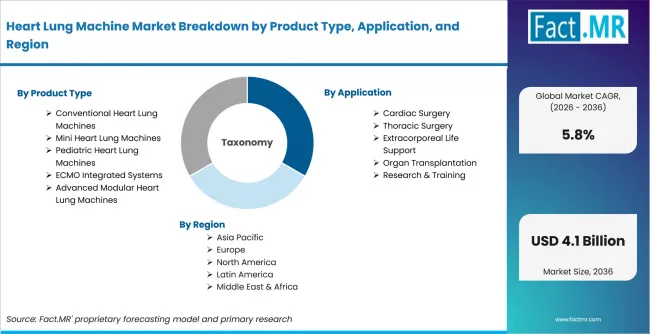
Heart Lung Machine Market Breakdown By Product Type, Application, And Region | Source: Fact.MR
| Attribute | Details |
|---|---|
| Quantitative Units | USD billion in 2026 to USD million by 2036 at CAGR |
| Market Definition | Heart lung machines and related perfusion systems used to support cardiopulmonary bypass during cardiac procedures |
| Product Type | Conventional Heart Lung Machines; Roller Pump Systems; Centrifugal Pump Systems; Mini Heart Lung Machines |
| Application | Cardiac Surgery; Coronary Artery Bypass Grafting; Heart Valve Surgery; Thoracic Surgery |
| End User | Hospitals; Multispecialty Hospitals; Cardiac Specialty Hospitals; Ambulatory Surgical Centers |
| Distribution Channel | Direct Sales; Hospital Procurement; Group Purchasing Organizations; Medical Device Distributors |
| Technology | Roller Pump Technology; Single Roller Pumps; Dual Roller Pumps; Centrifugal Pump Technology; AI & Smart Automation |
| Regions Covered | North America; Latin America; Europe; East Asia; South Asia and Pacific; Middle East and Africa |
| Countries Covered | Germany; Brazil; Australia; USA; Canada; UK; Japan |
| Key Companies Profiled | LivaNova PLC; Getinge AB; Terumo Corporation; Medtronic plc; Xenios AG; Braile Biomedica |
| Forecast Period | 2026 to 2036 |
| Approach | Hybrid top-down and bottom-up approach using perfusion equipment demand; cardiac surgery workflow review; hospital procurement behavior; service coverage; disposable compatibility; technology preference; country adoption patterns |
Source: Fact.MR analysis. Updated Jul 31, 2026
How is the market segmented?
-
By Product Type
- Conventional Heart Lung Machines
- Roller Pump Systems
- Centrifugal Pump Systems
- Mini Heart Lung Machines
- Portable CPB Systems
- Compact Perfusion Systems
- Pediatric Heart Lung Machines
- Neonatal CPB Systems
- Infant Perfusion Systems
- ECMO Integrated Systems
- Veno-Arterial ECMO Systems
- Veno-Venous ECMO Systems
- Advanced Modular Heart Lung Machines
- Modular Perfusion Consoles
- Digital Perfusion Systems
- Conventional Heart Lung Machines
-
By Application
- Cardiac Surgery
- Coronary Artery Bypass Grafting
- Heart Valve Surgery
- Thoracic Surgery
- Lung Transplantation
- Aortic Surgery
- Extracorporeal Life Support
- Cardiogenic Shock
- Respiratory Failure
- Organ Transplantation
- Heart Transplant
- Lung Transplant
- Research & Training
- Clinical Research
- Medical Education
- Cardiac Surgery
-
By End User
- Hospitals
- Multispecialty Hospitals
- Cardiac Specialty Hospitals
- Ambulatory Surgical Centers
- Cardiac Surgery Centers
- Day Care Surgical Centers
- Specialty Cardiac Clinics
- Heart Institutes
- Cardiovascular Centers
- Academic & Research Institutes
- Medical Universities
- Clinical Research Centers
- Military & Government Healthcare Facilities
- Defense Hospitals
- Public Healthcare Centers
- Hospitals
-
By Distribution Channel
- Direct Sales
- Hospital Procurement
- Group Purchasing Organizations
- Medical Device Distributors
- National Distributors
- Regional Distributors
- Government Tenders
- Public Hospital Contracts
- Defense Procurement
- Online B2B Procurement
- Digital Procurement Platforms
- E-Hospital Marketplaces
- Third-Party Suppliers
- Independent Suppliers
- Medical Equipment Integrators
- Direct Sales
-
By Technology
- Roller Pump Technology
- Single Roller Pumps
- Dual Roller Pumps
- Centrifugal Pump Technology
- Magnetic Levitation Pumps
- Mechanical Bearing Pumps
- Integrated Monitoring Systems
- Real-Time Hemodynamic Monitoring
- Automated Perfusion Monitoring
- Digital Perfusion Systems
- Touchscreen Interfaces
- Data Management Software
- AI & Smart Automation
- Predictive Perfusion Analytics
- Automated Flow Control
- Roller Pump Technology
-
By Region
- North America
- Latin America
- Europe
- East Asia
- South Asia & Pacific
- Middle East & Africa
Frequently Asked Questions
Which Product Type leads the market?
Which Application leads the market?
Which End User leads the market?
Which Distribution Channel leads the market?
Which Technology leads the market?
Which country records the highest listed CAGR?
What is the primary driver in this market?
What is the main restraint?
Why do hospitals lead demand?
Who worked on this report


Preview the report firsthand - request a free sample
Free SampleGet the brochure for pricing and purchase details
Download PDF