- Market Value (2025): USD 672.7 Mn
- Estimated Value (2026): USD 740.0 Mn
- Forecast Value (2036): USD 1919.0 Mn
- CAGR (2026-2036): 10.0%
What is the Heat-Stable Coating Fats Market forecast to be worth by 2036?
USD 740.0 million in 2026 to USD 1919.0 million by 2036 at a 10.0% CAGR.
- The Heat-Stable Coating Fats Market reached USD 672.7 million in 2025.
- Demand is projected to increase from USD 740.0 million in 2026 to USD 1919.0 million by 2036.
- The market is forecast to record 10.0% CAGR from 2026 to 2036 as confectionery, bakery and prepared-food manufacturers specify fats that retain coating quality under heat stress.
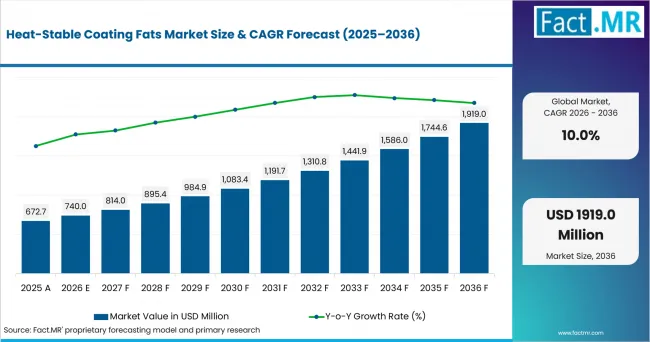
Heat Stable Coating Fats Market Value Analysis | Source: Fact.MR
What are the defining numbers behind Heat-Stable Coating Fats Market growth?
An absolute opportunity of USD 1179.0 million is expected between 2026 and 2036.
- Demand Drivers in the Market
- Confectionery brands need coating fats that reduce bloom risk during retail display. Lauric and blended systems help compound coatings set quickly.
- Bakery manufacturers need stable glazes and fillings for products that move from production lines into ambient retail channels. Blocks and flakes support controlled dosing without large heated tanks.
- Prepared-food producers need release performance where coatings protect surface quality during freezing, reheating and tray separation.
- Application technologists need supplier trials that connect fat chemistry with coating weight, gloss and shelf exposure. Trial data helps plants approve new coating systems without changing installed line routines.
- Key Segments Analyzed
- By Fat System: Lauric is expected to hold 38.0% share in 2026 because palm-kernel and coconut fractions support quick crystallization in compound coatings.
- By Function: Heat stability is projected to account for 41.0% share in 2026 as coated products move through warmer storage and distribution routes.
- By Application: Confectionery is anticipated to capture 37.0% share in 2026 since molded, enrobed and filled products need stable surface appearance.
- By Form: Blocks are estimated to represent 36.0% share in 2026 owing to simple storage, controlled dosing and compatibility with smaller coating rooms.
- Analyst Opinion at Fact.MR
- Shambhu Nath Jha, Principal Consultant at Fact.MR, states, "Coating fat selection is becoming a test-led decision. Brands no longer judge the ingredient only by melt point or cost. Demand is expected to favor suppliers that document bloom behavior, heat tolerance and handling performance in the same application file."
- Strategic Implications
- Fat processors should publish application data for gloss retention, cooling behavior and coating set by product format.
- Confectionery brands should separate heat-stability targets from cocoa-butter-equivalent targets before approving a replacement system.
- Bakery producers should test block and flake formats on installed coaters before shifting to new fat systems.
The USA is expected to record 11.0% CAGR through 2036, driven by food retail throughput and confectionery coating needs. Germany is projected to post 10.5% CAGR as processed-food and confectionery production sustain ingredient trials. Japan is anticipated to advance at 9.8% CAGR due to premium food exports and compact retail formats. France is estimated to hold 9.4% CAGR supported by food manufacturing and branded chocolate investment. Brazil is forecast to record 9.0% CAGR as food processing scale and tropical-oil access support regional formulation work.
How does the Heat-Stable Coating Fats Market break down by segment?
Heat stability leads Function at 41.0% share in 2026; Lauric leads Fat System at 38.0% share.
Which Fat System dominates?
Lauric is expected to hold 38.0% share in 2026.
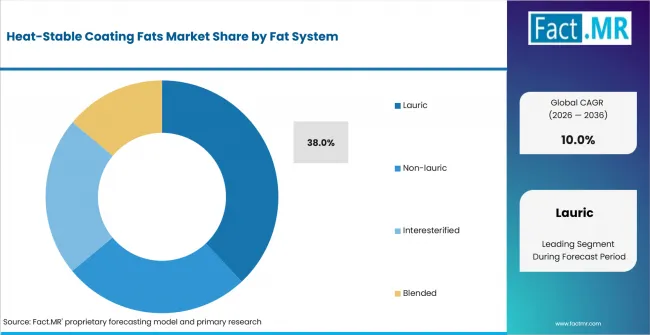
Heat Stable Coating Fats Market Analysis By Fat System | Source: Fact.MR
Lauric systems lead the fat system segment because they set quickly and give compound coatings a clean snap. Non-lauric systems serve cocoa-butter-compatible recipes. Interesterified fats support controlled texture when simple blends fall short of the required melt curve.
What leads the Function segment?
Heat stability is projected to account for 41.0% share in 2026.
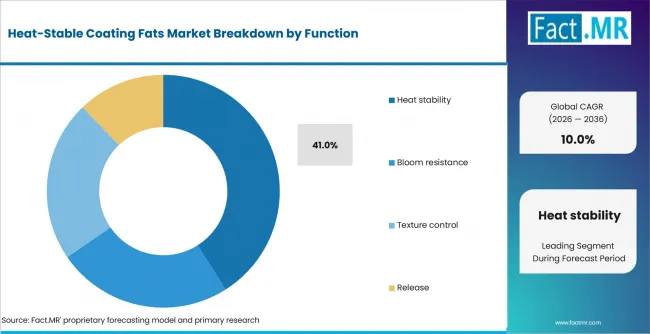
Heat Stable Coating Fats Market Analysis By Function | Source: Fact.MR
Heat stability leads the function segment because coated products face warm warehouses, transport exposure and open retail shelves. Bloom resistance follows closely in chocolate-style coatings where surface quality affects repeat purchase. Texture control supports filled bakery and wafer products. AAK AB launched ILLEXAO EN 10 in May 2026 for enrobed applications, supporting cleaner curtains and uniform coating weight in long production runs.
How does Application shape demand?
Confectionery is anticipated to capture 37.0% share in 2026.
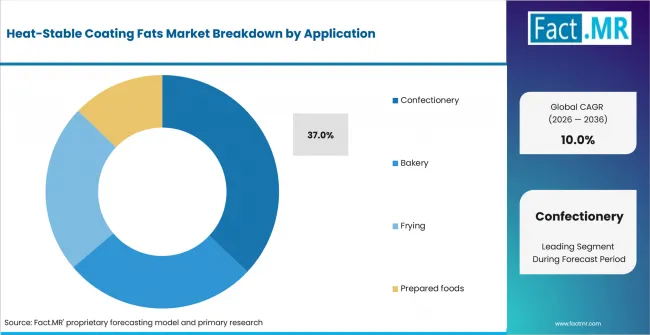
Heat Stable Coating Fats Market Analysis By Application | Source: Fact.MR
Confectionery holds the leading application position because molded pieces, enrobed snacks and filled bars make coating quality visible to consumers. Bakery applications use heat-stable fats for glazes and filled biscuits. Frying uses stable fat systems when repeated heating stresses oil quality.
What supports Blocks within Form?
Blocks are estimated to represent 36.0% share in 2026.
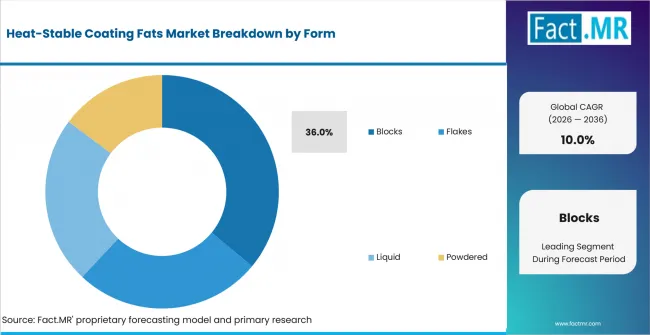
Heat Stable Coating Fats Market Analysis By Form | Source: Fact.MR
Blocks hold the main form position because they are easy to store and portion in smaller production rooms. Flakes support faster melting and shorter changeovers. Liquid formats fit plants with heated tanks and automated dosing. Powdered fats work in dry mixes before coating.
What is accelerating Heat-Stable Coating Fats Market adoption, and what is holding it back?
Temperature-resilient coatings drive it; input volatility and reformulation trials restrain it.
Drivers Impact Analysis
| Driver | (~) % Impact on CAGR | Geographic Relevance | Impact Timeline |
|---|---|---|---|
| Heat-stable confectionery coatings | +1.7% | North America, Western Europe, East Asia | Short term (<= 2 years) |
| Bakery and snack coating throughput | +1.2% | USA, Germany, France | Medium term (2-4 years) |
| Cocoa-butter substitution pressure | +1.0% | Global | Medium term (2-4 years) |
| Prepared-food release performance | +0.8% | Brazil, USA, Japan | Long term (>= 4 years) |
| Clean handling formats | +0.6% | Global | Short term (<= 2 years) |
Source: Fact.MR analysis. Updated Aug 28, 2026
- Heat-stable confectionery coatings: Confectionery producers use coating fats to control gloss, snap and bloom in products that face warm storage and distribution conditions.
- Bakery and snack coating throughput: Bakery teams need fats that melt and reset predictably across short production runs. Blocks and flakes are expected to reduce handling waste where plants change products frequently.
- Cocoa-butter substitution pressure: Compound coatings help brands manage cocoa-linked cost exposure while preserving texture and flavor release. Stable fat systems give formulators greater flexibility when adjusting recipes while maintaining finished-product quality.
- Prepared-food release performance: Prepared-food producers need release and texture behavior that protects surface appearance through freezing and reheating. Blended systems are expected to gain attention where release, bite and cost need to be balanced.
- Clean handling formats: Blocks, flakes and powders simplify dosing for plants that lack bulk heated tanks. These formats are expected to support mid-sized confectionery and bakery sites where recipe flexibility and cleaner handling are important.
Opportunity Impact Analysis
| Opportunity | (~) % Impact on CAGR | Geographic Relevance | Impact Timeline |
|---|---|---|---|
| Bloom-resistant coatings for warm retail | +1.1% | USA, Brazil, Japan | Medium term (2-4 years) |
| Interesterified texture systems | +0.9% | Germany, France, USA | Long term (>= 4 years) |
| Regional specialty fats capacity | +0.8% | Asia-Pacific, Latin America | Medium term (2-4 years) |
| Bakery glaze and filling reformulation | +0.6% | Europe, North America | Short term (<= 2 years) |
Source: Fact.MR analysis. Updated Aug 28, 2026
- Bloom-resistant coatings for warm retail: Retail exposure creates demand for fats that maintain surface quality after products leave controlled storage. Suppliers can support adoption by demonstrating gloss retention, coating consistency and storage tolerance.
- Interesterified texture systems: Interesterified fats are expected to gain attention where melt profile and plasticity require tighter control. These systems support fillings and coatings that need stable texture and predictable performance.
- Regional specialty fats capacity: Regional processing capacity is expected to shorten customer trials and strengthen supply reliability for coating-fat users. Local application support can also improve qualification and conversion near confectionery and bakery manufacturing hubs.
- Bakery glaze and filling reformulation: Bakery glazes and fillings provide opportunities for heat-stable fats beyond traditional chocolate coatings. Reformulation is expected to focus on clean melt, stable surfaces and reliable handling on existing production lines.
Restraints Impact Analysis
| Restraint | (~) % Impact on CAGR | Geographic Relevance | Impact Timeline |
|---|---|---|---|
| Input-price swings in cocoa and tropical oils | -0.8% | Global | Short term (<= 2 years) |
| Compatibility limits between fat systems | -0.6% | Europe, Japan | Medium term (2-4 years) |
| Palm sourcing documentation burden | -0.5% | Europe, North America | Medium term (2-4 years) |
| Application trial cost for smaller plants | -0.4% | Global | Long term (>= 4 years) |
Source: Fact.MR analysis. Updated Aug 28, 2026
- Input-price swings in cocoa and tropical oils: Cocoa, palm kernel and coconut inputs create pricing pressure for coating-fat contracts. Diverging input costs can require fresh formulation and performance checks before switching between lauric and non-lauric systems.
- Compatibility limits between fat systems: Lauric and non-lauric systems behave differently when combined with cocoa butter. Compatibility testing and storage trials remain important before commercial approval.
- Palm sourcing documentation burden: Palm-linked fat systems require clear sourcing and traceability records for food brands and retailers. Export-oriented suppliers are expected to prioritize stronger feedstock documentation during qualification.
- Application trial cost for smaller plants: Smaller plants often depend on supplier laboratories for melt, bloom and storage testing. Trial requirements can extend reformulation cycles, particularly in seasonal confectionery and bakery applications.
Which countries are scaling the Heat-Stable Coating Fats Market through 2036?
- The country comparison spans 2.0 percentage points and forms a narrow growth band across food-processing and confectionery manufacturing hubs.
- The USA remains 0.5 percentage point above Germany as food retail throughput keeps coating-fat performance under review.
- Germany remains 0.7 percentage point above Japan through processed-food manufacturing and chocolate-product output.
- Japan remains 0.4 percentage point above France as premium food exports keep packaging and coating quality in focus.
- France remains 0.4 percentage point above Brazil through branded food manufacturing and chocolate investment.
- Brazil closes the displayed range as domestic processing scale and tropical-oil access support formulation work.
Comparable CAGRs create different entry conditions because each country weighs processing scale, climate exposure, retail format and sourcing documentation differently. Coverage includes North America, Latin America, Western Europe, Eastern Europe, East Asia, South Asia and Pacific, Middle East and Africa.
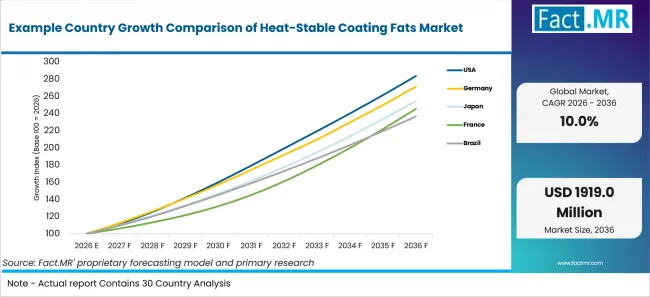
Example Country Growth Comparison Of Heat Stable Coating Fats Market | Source: Fact.MR
| Country | CAGR |
|---|---|
| USA | 11.0% |
| Germany | 10.5% |
| Japan | 9.8% |
| France | 9.4% |
| Brazil | 9.0% |
Source: Fact.MR analysis. Updated Aug 28, 2026
What supports USA adoption?
11.0% CAGR, supported by food retail throughput and confectionery coating needs.
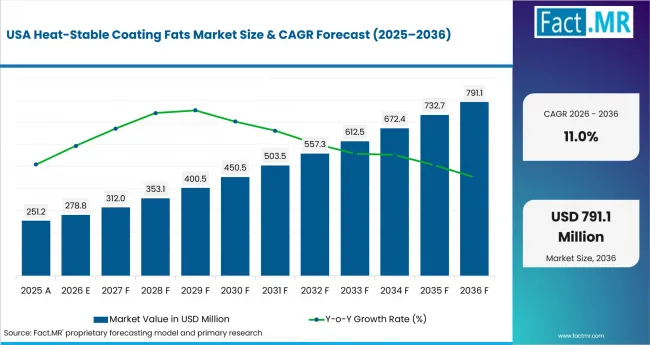
Heat Stable Coating Fats Market Country Value Analysis | Source: Fact.MR
U.S. retail replenishment keeps coated snacks and bakery products moving through high-volume channels. The USA to record 11.0% CAGR through 2036. The U.S. Census Bureau estimated July 2026 retail and food services sales at USD 763.6 billion, up 5.0% from July 2025.
How is Germany scaling demand?
10.5% CAGR, driven by confectionery depth and processed-food manufacturing.
Germany has a large manufacturing base for confectionery, bakery and prepared foods. USDA FAS reported in March 2026 that Germany produced an estimated USD 270.1 billion of processed food and beverages in 2024. Germany will hold a 10.5% CAGR through 2036 and interprets the manufacturing base as supportive of coating-fat trials focused on texture and retail appearance.
What supports Japan demand?
9.8% CAGR, led by premium food exports and compact processing lines.
Japan links coating-fat demand with small pack formats and export-facing food quality. MAFF reported in February 2026 that agricultural, forestry, fishery and food exports reached JPY 1,700.5 billion in 2025, up 12.8%. Japan will advance at 9.8% CAGR through 2036 and interprets export-facing premium confectionery and bakery activity as supportive of demand for stable surface quality during shipping.
How does France perform?
9.4% CAGR, supported by food manufacturing and branded chocolate investment.
French food manufacturing gives coating-fat suppliers a steady application base. Agreste reported in December 2025 that food and beverage manufacturers in France commercialized EUR 162 billion of products in 2024. France will hold a 9.4% CAGR through 2036 and interprets the country's food-manufacturing scale as supportive of trials focused on gloss, melt and sourcing documentation.
What underpins Brazil growth?
9.0% CAGR, driven by food processing scale and tropical-oil supply access.
Brazil combines large food processing revenue with access to oilseed and tropical-oil supply chains. USDA FAS reported in March 2026 that Brazil food processing revenue reached USD 248 billion in 2025, up 8.0% from 2024. Brazil to record 9.0% CAGR through 2036 and interprets the country's processing scale and distribution conditions as supportive of coating fats designed for warm distribution.
Who leads the Heat-Stable Coating Fats Market?
AAK AB and Cargill, Incorporated as leading providers in the assessed company set, while Bunge Global SA and Fuji Oil Co., Ltd. strengthen adjacent specialty oil capability.
AAK AB is active in chocolate and confectionery fats, including cocoa butter alternatives and filling fats for coatings and shelf-life performance. Cargill, Incorporated is active through specialty fats used in chocolate, bakery, dairy, frying and fillings. Both companies compete where formulators need application files that compare bloom behavior, melt profile and coating weight.
Bunge Global SA participates through plant-based specialty oils and fats for food manufacturers. Fuji Oil Co., Ltd. supports the market through vegetable fats for chocolate, compound chocolate and hard butters. Wilmar International Limited brings edible oil refining, palm kernel crushing and specialty fats scale. Musim Mas adds palm and specialty oil supply depth, with competition shaped by application testing, sourcing documentation and the ability to match fat systems to local processing lines.
Which companies are the key providers?
Key companies include AAK AB, Cargill, Incorporated, Bunge Global SA, Fuji Oil Co., Ltd., Wilmar International Limited, and Musim Mas.
- AAK AB
- Cargill, Incorporated
- Bunge Global SA
- Fuji Oil Co., Ltd.
- Wilmar International Limited
- Musim Mas
Bibliography
- Cargill. (2026, March 31). Cargill strengthens global specialty fats portfolio with expansion of Port Klang, Malaysia facility.
- Zeballos, E., & Sinclair, W. (2026, June 11). Total U.S. food spending reached $2.51 trillion in 2025. U.S. Department of Agriculture, Economic Research Service.
- U.S. Census Bureau. (2026, August 14). Advance monthly sales for retail and food services.
- U.S. Department of Agriculture, Foreign Agricultural Service. (2026, March 30). Food processing ingredients annual: Germany (GAIN Report No. GM2026-0007).
- Federal Statistical Office (Destatis). (2025, December 2). 12,8 Kilo Schokolade pro Kopf wurden 2024 produziert [12.8 kilograms of chocolate per capita were produced in 2024].
- Renaud, A. (2025, December 17). Productions commercialisées des industries agroalimentaires 2024 : léger recul des ventes mais un niveau toujours élevé. Agreste.
- U.S. Department of Agriculture, Foreign Agricultural Service. (2026, March 31). Food processing ingredients annual: Brazil (GAIN Report No. BR2026-0011).
- AAK. (2026, May 28). AAK’s new cocoa butter equivalent overcomes enrobing challenges – even when used at high levels.
This Report Answers
- The report explains where heat-stable coating fats are used across fat system and function. It also covers application and form.
- Segment analysis identifies Lauric systems and Heat stability as the main 2026 share positions.
- Country analysis examines the USA, Germany, Japan, France and Brazil with country-specific manufacturing and retail mechanisms.
- Competitive analysis reviews AAK AB, Cargill, Incorporated, Bunge Global SA, Fuji Oil Co., Ltd., Wilmar International Limited and Musim Mas across coating-fat capability.
- Application analysis assesses how confectionery, bakery, frying and prepared foods use coating fats to manage heat exposure and texture.
What does the Heat-Stable Coating Fats Market cover?
The Heat-Stable Coating Fats Market covers specialty fats used to control melt behavior, bloom risk, texture and release in coated foods. It includes lauric, non-lauric, interesterified and blended systems where the fat is specified for heat-resilient coating performance.
The scope is narrower than fats and oils because commodity edible oils are excluded unless sold for coating performance. It connects with compound chocolate, cocoa butter and chocolate ingredients when formulators compare melt behavior and cost.
What is included in the scope?
The scope includes coating fat systems used in confectionery, bakery, frying and prepared foods. Coverage spans block, flake, liquid and powdered formats where fat performance determines gloss, release, set time or texture. Vegetable oils, food coating ingredients, baking ingredients and food processing ingredients where the link is ingredient functionality in food manufacturing.
What is excluded from the scope?
The scope excludes finished chocolate, bakery and prepared-food products when the coating fat is absent as a separate ingredient. It also excludes commodity palm oil, soybean oil, coconut oil and specialty triglycerides sold without a defined coating-fat performance claim.
How Was the Analysis Built?
The analysis draws on 120+ sources, 35+ company portfolios, 25+ countries, and more than 20 industry interviews.
- Primary Research: Primary research includes discussions with fat processors, confectionery brands, bakery manufacturers, prepared-food producers, distributors, application technologists. They examine approval routines, coating defects and sourcing needs.
- Desk Research: Desk research covers government statistics, food-processing reports, company product pages, official announcements, regulatory material, technical documents and industry references. The bibliography documents the sources used.
- Market Sizing and Forecasting: Market estimates combine historical values, application demand, fat-system shares, country growth, provider portfolios, input exposure and barriers to reformulation.
- Data Validation and Update Cycle: Findings are validated by comparing public data, company activity, application evidence, sourcing documents and portfolio changes. Regular updates review launches, capacity changes and commercial adoption.
Segmentation
What is the report’s scope and coverage?
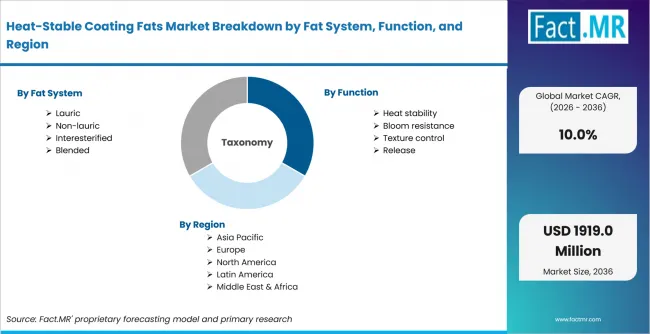
Heat Stable Coating Fats Market Breakdown By Fat System, Function, And Region | Source: Fact.MR
| Attribute | Details |
|---|---|
| Quantitative Units | USD million |
| Market Definition | Heat-stable coating fats are specialty fat systems used to control melting, bloom resistance, texture and release in coated food applications. |
| Fat System | Lauric; Non-lauric; Interesterified; Blended |
| Function | Heat stability; Bloom resistance; Texture control; Release |
| Application | Confectionery; Bakery; Frying; Prepared foods |
| Form | Blocks; Flakes; Liquid; Powdered |
| Regions Covered | North America; Latin America; Western Europe; Eastern Europe; East Asia; South Asia and Pacific; Middle East and Africa |
| Countries Covered | USA; Germany; Japan; France; Brazil |
| Key Companies Profiled | AAK AB; Cargill, Incorporated; Bunge Global SA; Fuji Oil Co., Ltd.; Wilmar International Limited; Musim Mas |
| Forecast Period | 2026 to 2036 |
| Approach | Hybrid top-down and bottom-up approach using fat-system mapping, application demand, country food-processing indicators and provider portfolio review. |
Source: Fact.MR analysis. Updated Aug 28, 2026
How is the market segmented?
-
By Fat System:
- Lauric
- Non-lauric
- Interesterified
- Blended
-
By Function:
- Heat stability
- Bloom resistance
- Texture control
- Release
-
By Application:
- Confectionery
- Bakery
- Frying
- Prepared foods
-
By Form:
- Blocks
- Flakes
- Liquid
- Powdered
-
By Region:
- North America
- Latin America
- Western Europe
- Eastern Europe
- East Asia
- South Asia and Pacific
- Middle East and Africa
Frequently Asked Questions
How big is the Heat-Stable Coating Fats Market in 2026?
What is the CAGR of the Heat-Stable Coating Fats Market from 2026 to 2036?
Which Fat System leads the Heat-Stable Coating Fats Market?
Which Function leads the Heat-Stable Coating Fats Market?
Who are the leading companies in the Heat-Stable Coating Fats Market?
Who worked on this report


Preview the report firsthand - request a free sample
Free SampleGet the brochure for pricing and purchase details
Download PDF