- Market Value (2025): USD 2.5 Bn
- Estimated Value (2026): USD 2.8 Bn
- Forecast Value (2036): USD 8.4 Bn
- CAGR (2026-2036): 11.6%
What is the High-Durability Conductive Additives Market forecast to be worth by 2036?
USD 2.8 billion in 2026 to USD 8.4 billion by 2036 and CAGR is 11.6%.
- The High-Durability Conductive Additives Market reached USD 2.5 billion in 2025.
- Demand is projected to rise from USD 2.8 billion in 2026 to USD 8.4 billion by 2036.
- The market is forecast to record an 11.6% CAGR from 2026 to 2036.
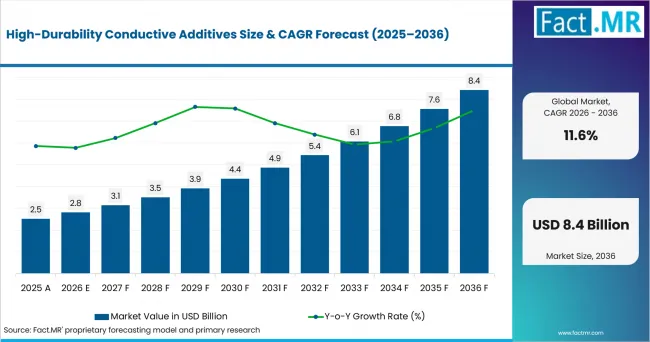
High Durability Conductive Additives Value Analysis | Source: Fact.MR
What are the defining numbers behind High-Durability Conductive Additives Market growth?
An absolute opportunity of USD 5.6 billion is expected between 2026 and 2036.
- Demand Drivers in the Market
- Fab teams need floors and coated surfaces with stable resistance. The resistance must remain steady after wear and cleaning. In June 2025, the U.S. Department of Commerce said Micron planned to invest USD 200 billion in U.S. semiconductor manufacturing and R&D.
- Battery plant teams need ESD or dissipative surfaces near cell assembly and power equipment. In February 2026, the U.S. Energy Information Administration said a record 15 GW of utility-scale battery storage was added in 2025.
- Device assembly managers need coatings with static control and a durable finish. Automated handling raises the value of stable resistance. The coating must work through repeated cycles. Additive systems also need even dispersion and easy application.
- Key Segments Analyzed
- By Conductive Additive: Carbon black is forecast to hold 34.0% share in 2026. It offers a familiar route to charge control.
- By Conductivity Target: Antistatic is projected to account for 31.0% share in 2026. Many sites need steady charge decay.
- By End-use Facility: Semiconductor fabs are expected to capture 36.0% share in 2026. Cleanrooms apply strict ESD controls.
- By Coating System: Epoxy is forecast to represent 29.0% share in 2026. It gives site floors a hard base.
- Analyst Opinion at Fact.MR
- Shambhu Nath Jha, Principal Consultant at Fact.MR states: “The commercial issue is how long charge control lasts. Site teams are expected to compare resistance after wear and cleaning. Firms that combine steady dispersion with clear test data are positioned to support demanding ESD uses.”
- Strategic Implications
- Additive teams should report resistance after wear and cleaning cycles. Clear test data helps site teams compare carbon black with nanocarbon systems. Coating teams should add simple dispersion guidance. This helps formulators select filler levels.
- Coating producers should qualify conductive fillers across epoxy and polyurethane systems. Wider resin compatibility gives crews more choices. Teams can then balance wear life with surface resistance. Firms should explain effects on cure and flow.
- Site crews should document grounding and substrate preparation. Consistent installation helps the coating reach its specified resistance. Test points should cover traffic zones.
- Electronics and battery plant owners should include stable resistance in coating specifications. Repair planning should be reviewed at the same stage. Busy work areas need predictable maintenance.
The USA is projected to record an 11.9% CAGR through 2036. Semiconductor and digital buildout support growth. France is expected to match 11.9%. Data-center and electronics spending support its outlook. China is forecast at 11.7% on the back of device output. Germany is anticipated at 11.7% due to factory electronics activity. Japan is estimated at 10.6% as semiconductor capacity develops.
How does the High-Durability Conductive Additives Market break down by segment?
Carbon black is expected to lead Conductive Additive at 34.0%. Semiconductor fabs are anticipated to lead End-use Facility at 36.0%.
Which Conductive Additive leads?
Carbon black is expected to hold 34.0% share in 2026.
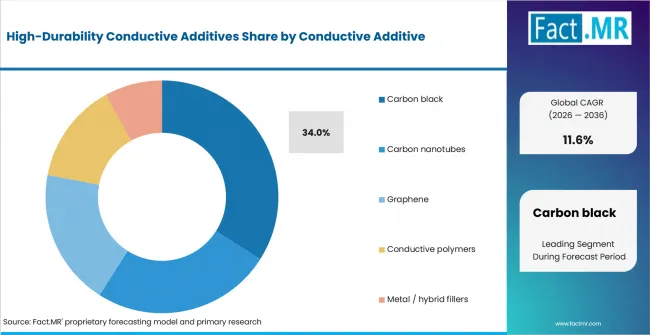
High Durability Conductive Additives Analysis By Conductive Additive | Source: Fact.MR
Carbon black is expected to lead the Conductive Additive segment at 34.0% in 2026. Its known dispersion behavior supports steady resistance control. It works in common coating systems. Conductive carbon black serves antistatic uses. It also serves static-dissipative uses. Carbon nanotubes and graphene can serve lower-loading formulas. They can also serve higher-conductivity formulas. Conductive polymers and metal or hybrid fillers serve more specialized needs.
What leads the Conductivity Target segment?
Antistatic is projected to account for 31.0% share in 2026.
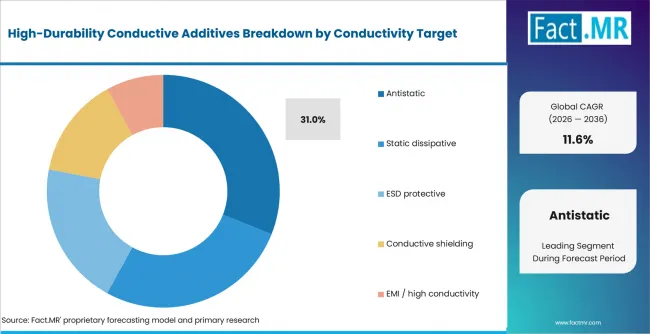
High Durability Conductive Additives Analysis By Conductivity Target | Source: Fact.MR
Antistatic is projected to lead the Conductivity Target segment at 31.0% in 2026. Many production areas need controlled charge decay. Full shielding conductivity is not always required. Anti-static polymer compounds offer one route for material-level charge control. EMI shielding materials serve other uses. These uses need electrical continuity or interference control.
How does End-use Facility shape demand?
Semiconductor fabs are anticipated to hold 36.0% share in 2026.
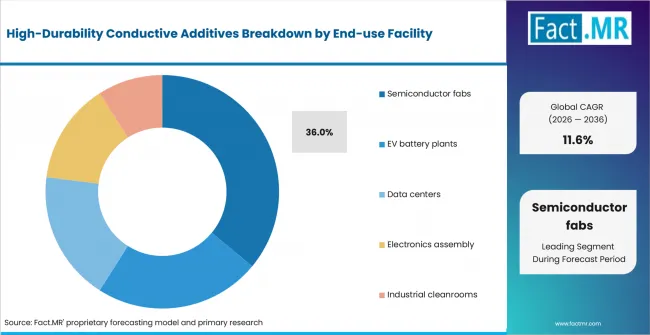
High Durability Conductive Additives Analysis By End Use Facility | Source: Fact.MR
Semiconductor fabs are anticipated to hold 36.0% share of End-use Facility demand in 2026. Fabs use ESD controls across cleanrooms. They also use them in equipment areas. Sensitive devices move through repeated handling. Graphene ESD additives offer one lower-loading route for static-control systems.
What supports Epoxy within Coating System?
Epoxy is estimated to represent 29.0% share in 2026.
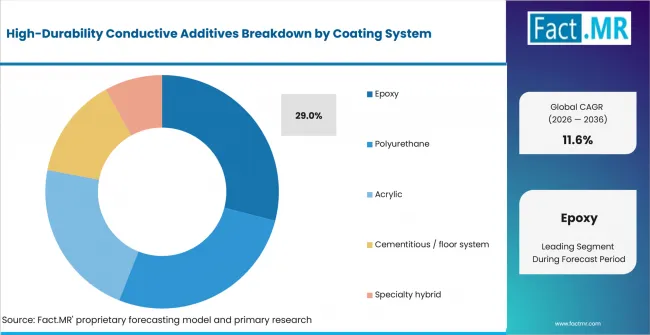
High Durability Conductive Additives Analysis By Coating System | Source: Fact.MR
Epoxy is estimated to lead the Coating System segment at 29.0% in 2026. The resin gives conductive floors a hard surface, and it suits demanding facilities. The finish can handle traffic. It can also handle routine cleaning. Graphene-based additives broaden options for specialty conductive coatings.
What is accelerating High-Durability Conductive Additives Market adoption, and what is holding it back?
Site electrification and ESD-control needs support adoption and approval time and mix cost restrain faster uptake.
Drivers Impact Analysis
| DRIVER | (~) % IMPACT ON CAGR | GEOGRAPHIC RELEVANCE | IMPACT TIMELINE |
|---|---|---|---|
| Semiconductor-fab expansion | +2.1% | North America, East Asia, Europe | Medium term (2-4 years) |
| Data-center construction | +1.6% | North America, Europe, East Asia | Medium term (2-4 years) |
| EV battery-plant buildout | +1.4% | North America, Europe, East Asia | Medium term (2-4 years) |
| Tighter ESD-control specifications | +1.1% | Global | Short term (<= 2 years) |
| Longer coating service-life targets | +0.8% | Global | Long term (>= 4 years) |
Source: Fact.MR analysis. Updated Sep 23, 2026
Opportunity Impact Analysis
| OPPORTUNITY | (~) % IMPACT ON CAGR | GEOGRAPHIC RELEVANCE | IMPACT TIMELINE |
|---|---|---|---|
| Low-loading nanotube and graphene systems | +1.3% | Global | Medium term (2-4 years) |
| Waterborne conductive coatings | +0.9% | Europe, North America, East Asia | Medium term (2-4 years) |
| Retrofit ESD flooring | +0.8% | Mature electronics markets | Short term (<= 2 years) |
| Hybrid conductive filler packages | +0.7% | Global | Long term (>= 4 years) |
Source: Fact.MR analysis. Updated Sep 23, 2026
Restraints Impact Analysis
| RESTRAINT | (~) % IMPACT ON CAGR | GEOGRAPHIC RELEVANCE | IMPACT TIMELINE |
|---|---|---|---|
| Qualification and testing burden | -0.8% | Global | Short term (<= 2 years) |
| Nanofiller dispersion difficulty | -0.6% | Global | Medium term (2-4 years) |
| Conductive filler cost volatility | -0.5% | Global | Medium term (2-4 years) |
| Application sensitivity | -0.4% | Global | Long term (>= 4 years) |
Source: Fact.MR analysis. Updated Sep 23, 2026
Which countries are scaling the High-Durability Conductive Additives Market through 2036?
- France is projected at 11.9% CAGR through 2036. The USA is also projected at 11.9%.
- China is forecast at 11.7% CAGR through 2036. Germany is also forecast at 11.7%.
- Japan is estimated at 10.6% CAGR. Semiconductor spending supports controlled work environments.
- The displayed range spans 1.3 percentage points. It covers the five profiled countries.
Comparable CAGRs can create different entry conditions. Site mix affects demand. Approval practice also matters. Together, they shape which additive chemistry and coating system receives attention in each country.
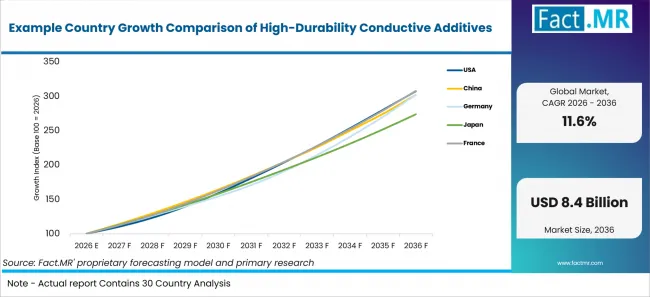
Example Country Growth Comparison Of High Durability Conductive Additives | Source: Fact.MR
| Country | CAGR (2026-2036) |
|---|---|
| USA | 11.9% |
| France | 11.9% |
| China | 11.7% |
| Germany | 11.7% |
| Japan | 10.6% |
Source: Fact.MR analysis. Updated Sep 23, 2026
What supports USA adoption?
11.9% CAGR, supported by semiconductor manufacturing and battery-storage buildout.
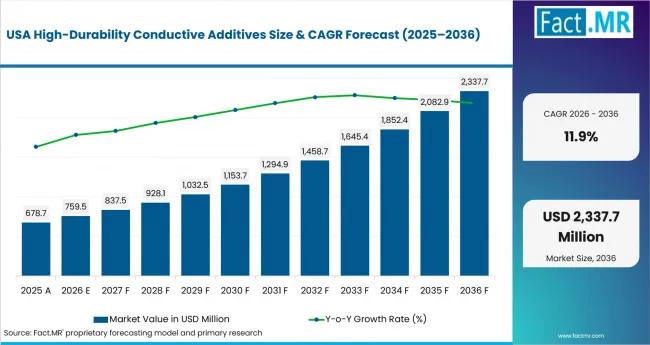
High Durability Conductive Additives Country Value Analysis | Source: Fact.MR
U.S. site teams compare stable electrical resistance with wear performance when approving ESD floors. In August 2026, the U.S. Energy Information Administration said operational utility-scale battery storage capacity reached 43.6 GW at the end of 2025. Chip fabs and battery facilities create a broad application base for epoxy and hybrid systems that must maintain charge control under regular traffic.
How is China scaling demand?
11.7% CAGR, driven by electronics manufacturing scale and factory automation.
China has a large electronics manufacturing base that supports static-control coatings across assembly, testing and automated production areas. In April 2026, the Ministry of Industry and Information Technology said revenue from computer, communications and other electronic equipment manufacturing reached 17.4 trillion yuan in 2025. Carbon black supports broad antistatic applications, while nanocarbon systems can address tighter resistance requirements.
What supports Germany’s growth?
11.7% CAGR, supported by industrial electronics and electrification.
German production facilities use ESD control across electronics manufacturing and automated work areas. Destatis said in February 2026 that new orders for computer, electronic and optical products rose 5.7% month on month in December 2025. This industrial base supports epoxy and polyurethane systems that combine resistance control with chemical and wear performance.
How is France developing demand?
11.9% CAGR, driven by data-center activity and electronics production.
French data-center and electronics projects are widening the application base for ESD flooring systems. INSEE reported in July 2026 that output in the manufacture of computer, electronic and optical products was 6.1% higher during March–May 2026 than in the same three-month period a year earlier. Static-safe testing, server and production areas require durable coatings that can maintain charge control under regular service traffic.
How does Japan perform?
10.6% CAGR, supported by semiconductor investment and controlled production space.
Japan’s semiconductor buildout is increasing the need for clean production areas with stable ESD control. METI said in February 2026 that the Government of Japan and private companies had invested a total of 267.6 billion yen in Rapidus. New fab capacity supports durable ESD coatings that must maintain resistance after cleaning, equipment movement and routine plant use.
Who leads the High-Durability Conductive Additives Market?
Cabot Corporation supplies conductive specialty carbons for static-control applications, including conductive and electrostatic coatings. Birla Carbon offers conductive carbon black grades for coatings and polymer systems, with products designed to provide antistatic, static-dissipative and conductive performance. Orion S.A. supplies specialty carbon blacks for conductive coatings, including PRINTEX® grades developed to increase coating conductivity. OCSiAl provides TUBALL™ graphene nanotube solutions for ESD flooring, powder coatings and other electrically conductive coating systems.
Avient supplies Stat-Tech™ static-dissipative and electrically conductive polymer formulations for electronics and semiconductor-packaging applications. This participation is adjacent to the conductive-coatings market because Stat-Tech products are engineered polymer formulations rather than coating additives. NanoXplore supplies graphene-based conductive additives, including xGnP™ D500-HP for highly conductive composites, advanced electronics and other applications requiring electrical conductivity and ESD performance. Competition is expected to span carbon black, graphene nanotube and graphene-based conductive technologies. Supplier selection is expected to depend on dispersion performance, required electrical resistance, formulation compatibility and processing requirements.
Which companies are the key providers?
Key companies include Cabot Corporation, Birla Carbon, and Orion S.A. OCSiAl, NanoXplore Inc., and Avient Corporation.
- Cabot Corporation
- Birla Carbon
- Orion S.A.
- OCSiAl
- NanoXplore Inc.
- Avient Corporation
Bibliography
- U.S. Department of Commerce. (2025, June 12). President Trump secures $200B investment from Micron Technology for memory chip manufacturing in the United States.
- U.S. Energy Information Administration. (2026, February 20). New U.S. electric generating capacity expected to reach a record high in 2026.
- U.S. Energy Information Administration. (2026, August 7). Battery storage capacity averaged 70% growth over the last three years.
- Federal Statistical Office (Destatis). (2026, February 5). New orders in manufacturing in December 2025: +7.8% on the previous month.
- Institut national de la statistique et des études économiques. (2026, July 3). In May 2026, manufacturing output fell back by 1.0%.
- Ministry of Economy, Trade and Industry. (2026, February 27). Press conference by Minister Akazawa (excerpt).
- Avient Corporation. (2025, February 28). Navigating the challenges of semiconductor packaging with specialty polymer solutions.
- NanoXplore Inc. (2026, May 5). NanoXplore launches xGnP™ D500-HP, high-purity graphene to replace conventional conductive additives.
This Report Answers
- The report explains where high-durability conductive additives are used across Conductive Additive, Conductivity Target, End-use Facility, and Coating System. It also covers regional demand across industrial ESD and conductive-coating applications.
- Segment analysis identifies the leading subsegments and explains why coating formulators and facility teams prioritize particular conductive fillers, resistance targets, end-use environments, and resin systems.
- Country analysis examines the USA, China, Germany, Japan, and France together with the semiconductor, electronics, battery-storage, and data-center factors supporting demand for durable static-control coatings.
- Competitive analysis reviews current providers across conductive carbon black, graphene nanotubes, graphene additives, conductive polymers, and related ESD material technologies used in coating and static-control applications.
- Application analysis assesses how electrical resistance, dispersion, resin compatibility, wear durability, cleaning stability, grounding, and processing requirements influence additive and coating-system selection across demanding industrial facilities.
What does the High-Durability Conductive Additives Market cover?
The market covers conductive fillers and conductive polymers used in durable coatings. These materials support static control or higher current flow. The scope includes floor and protective coating systems in semiconductor fabs and battery plants. Data centers and electronics assembly areas add more uses. Adjacent categories include conductive plastic compounds and graphene polymer masterbatches. In those materials, conductivity is built into the host polymer.
What is included in the scope?
The scope includes carbon black and carbon nanotubes used in coating mixes. It also includes graphene and conductive polymers.
Metal or hybrid fillers are covered. Resin platforms include epoxy and polyurethane systems. Acrylic and cementitious floor systems are included when they provide antistatic or ESD-protective performance. Related application paths include graphene auto additives in conductive vehicle materials.
What is excluded from the scope?
The scope excludes battery-electrode additives and bulk conductive plastics sold outside coating uses.
Standalone thermal conductive adhesives are outside the boundary. Metal shielding is also outside the boundary. Standard protective coatings are covered only when a conductive additive is part of the mix.
How Was the Analysis Built?
The analysis draws on 120+ sources, 35+ company portfolios, 25+ countries, and more than 20 industry interviews.
- Primary Research: Primary research includes discussions with manufacturers, service providers, technology developers, distributors, end users, and subject-matter experts. These conversations examine purchasing priorities, product adoption, operational challenges, approval requirements, competitive positioning, and the factors that influence wider market acceptance.
- Desk Research: Desk research covers government statistics, regulatory publications, company filings, trade data, technical studies, industry associations, standards, public policy, and other authoritative sources. Every source used in the analysis is documented in the bibliography.
- Market Sizing and Forecasting: Market estimates combine historical performance, demand indicators, pricing and volume trends, segment shares, company participation, country-level growth, adoption patterns, investment activity, and barriers to market expansion.
- Data Validation and Update Cycle: Findings are validated by comparing primary interviews with public data, company activity, regulatory changes, trade patterns, and industry developments. Regular updates review new product launches, capacity changes, partnerships, approvals, and shifts in commercial adoption.
Segmentation
What is the report’s scope and coverage?
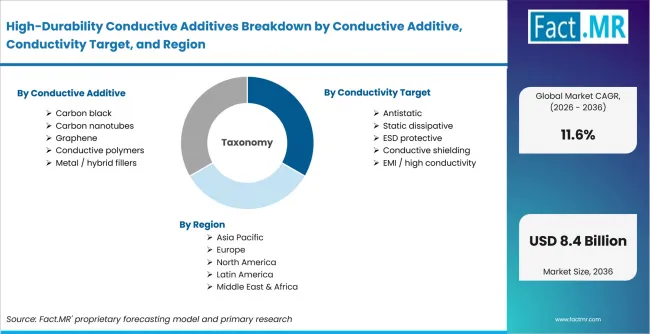
High Durability Conductive Additives Breakdown By Conductive Additive, Conductivity Target, And Region | Source: Fact.MR
| Attribute | Details |
|---|---|
| Quantitative Units | USD billion |
| Market Definition | Conductive additive materials used in durable coating systems to provide antistatic, static-dissipative, ESD-protective, conductive-shielding or high-conductivity performance in industrial facilities. |
| Conductive Additive | Carbon black; Carbon nanotubes; Graphene; Conductive polymers; Metal / hybrid fillers |
| Conductivity Target | Antistatic; Static dissipative; ESD protective; Conductive shielding; EMI / high conductivity |
| End-use Facility | Semiconductor fabs; EV battery plants; Data centers; Electronics assembly; Industrial cleanrooms |
| Coating System | Epoxy; Polyurethane; Acrylic; Cementitious / floor system; Specialty hybrid |
| Regions Covered | North America; Latin America; Western Europe; Eastern Europe; East Asia; South Asia & Pacific; Middle East & Africa |
| Countries Covered | USA; China; Germany; Japan; France |
| Key Companies Profiled | Cabot Corporation; Birla Carbon; Orion S.A.; OCSiAl; NanoXplore Inc.; Avient Corporation |
| Forecast Period | 2026 to 2036 |
| Approach | Hybrid top-down and bottom-up approach using facility construction; electronics manufacturing; coating-system adoption; conductive-additive qualification; and country-level end-use indicators. |
Source: Fact.MR analysis. Updated Sep 23, 2026
How is the market segmented?
-
By Conductive Additive:
- Carbon black
- Carbon nanotubes
- Graphene
- Conductive polymers
- Metal / hybrid fillers
-
By Conductivity Target:
- Antistatic
- Static dissipative
- ESD protective
- Conductive shielding
- EMI / high conductivity
-
By End-use Facility:
- Semiconductor fabs
- EV battery plants
- Data centers
- Electronics assembly
- Industrial cleanrooms
-
By Coating System:
- Epoxy
- Polyurethane
- Acrylic
- Cementitious / floor system
- Specialty hybrid
-
By Region:
- North America
- Latin America
- Western Europe
- Eastern Europe
- East Asia
- South Asia & Pacific
- Middle East & Africa
Frequently Asked Questions
How big is the high-durability conductive additives market in 2026?
What is the CAGR of the high-durability conductive additives market from 2026 to 2036?
Which conductive additive leads the market?
Which end-use facility leads the market?
Who are the leading companies in the high-durability conductive additives market?
Who worked on this report


Preview the report firsthand - request a free sample
Free SampleGet the brochure for pricing and purchase details
Download PDF