- Base Value(2026): 6.2 Bn
- Estimated Value(2026): 6.2 Bn
- Forecast Value (2036): 8.1 Bn
- CAGR (2026 - 2036): 2.7%
High Temperature Grease Market Forecast and Outlook 2026 to 2036
In 2025, the high temperature grease market surpassed a valuation of USD 6.1 billion. Based on Fact.MR analysis, demand for high temperature grease is estimated to grow to USD 6.2 billion in 2026 and USD 8.1 billion by 2036. Fact.MR projects a CAGR of 2.7% during the forecast period.
Between 2026 and 2036, the high temperature grease market is projected to generate an absolute dollar opportunity of USD 1.9 billion. This incremental rather than transformational expansion reflects the market's embedded position in industrial maintenance cycles and automotive drivetrain servicing, where specification inertia and long relubrication intervals moderate volume growth. Structural constraints include REACH and EPA chemical regulation compliance costs that increase formulation investment requirements, raw material price volatility in lithium carbonate and polyalphaolefin base stocks, and accelerating electrification of passenger vehicles that gradually reduces automotive high-temperature grease consumption per new vehicle.
Harsh Vardhan Jain, CEO of Vinni Chemicals said. "The automotive, construction, mining, and other industries are expected to grow significantly. While there is competition from EVs, fuel additives, lubricants, greases, coolants, and other components will remain essential. We were also one of the first to develop coolants for EVs and hydrogen fuel cells. Though 2024 was relatively slower... we are anticipating a stronger growth in 2025."
Country growth reflects industrial activity and regulatory compliance. China leads at 3.8% CAGR driven by large steel, cement, and heavy machinery output. India follows at 3.6% supported by power, mining, and infrastructure demand. Germany grows 3.4% on premium synthetic grease adoption under REACH rules. Brazil posts 2.8% from mining and agro processing. The United States grows 2.4% on aftermarket demand. The United Kingdom records 2.2% on non PFAS upgrades. Japan advances 2.0% with steady replacement demand.
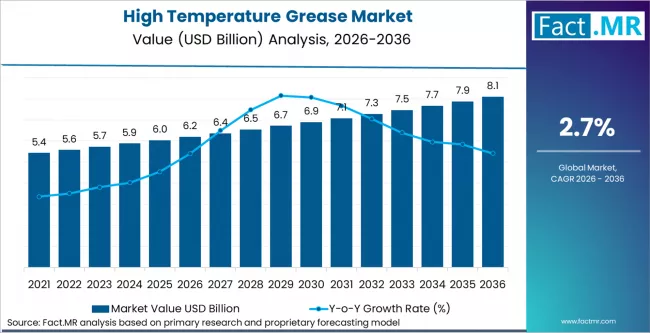
High Temperature Grease Market Market Value Analysis | Source: Fact.MR
| Metric | Value |
|---|---|
| Estimated Value in 2026 | USD 6.2 billion |
| Forecast Value in 2036 | USD 8.1 billion |
| Forecast CAGR (2026 to 2036) | 2.7% |
Source: Fact.MR analysis. Updated Mar 3, 2026
Market Definition
Covers high temperature grease products formulated to maintain lubrication performance at sustained operating temperatures above 150°C. Includes soap-thickened greases (lithium complex, calcium sulfonate, and polyurea) and non-soap-thickened synthetic greases deployed in industrial machinery, steel mills, cement plants, automotive drivetrain components, and food-grade processing equipment. Encompasses both conventional mineral oil-based and synthetic polyalphaolefin and ester-based formulations.
Market Inclusions
Includes global and regional revenue forecasts (2026-2036) by thickener type and application. Covers industrial and automotive end-use segment analysis, pricing dynamics by formulation tier, regulatory compliance cost analysis, and bio-based and PFAS-free product adoption trends by region.
Market Exclusions
Excludes standard general-purpose greases operating below 150°C, cutting fluids, metalworking lubricants, hydraulic fluids, and greases used exclusively in non-thermal industrial applications. Also excludes downstream maintenance service contracts and equipment covered by OEM lubrication supply agreements where grease is not separately purchased. Fully synthetic greases used outside high-temperature operating environments are excluded from this scope.
Research Methodology
- Primary Research: Interviews were conducted with industrial lubrication engineers, automotive OEM procurement specialists, grease formulation chemists, and industrial distribution managers across North America, Europe, and Asia Pacific.
- Desk Research: Sources included NLGI grease classification standards, REACH substance restriction registers, EPA PFAS regulatory documentation, national industrial output statistics, company investor presentations, and OEM technical service bulletins.
- Market Sizing and Forecasting: A hybrid model combined top-down industrial equipment fleet estimates and automotive production volumes with bottom-up average unit pricing by formulation type and application, incorporating regulatory compliance migration timelines from primary interviews.
- Data Validation and Update Cycle: Outputs were validated against manufacturer revenue disclosures, raw material pricing indices, regulatory implementation records, and regional industrial production data. Forecasts are reviewed annually to reflect regulatory calendar updates and base stock cost movements.
Summary
- Market Definition
- High temperature greases are specialised lubricant formulations engineered to maintain consistent film strength, oxidation resistance, and structural stability at sustained operating temperatures above 150°C across industrial and automotive applications.
- Demand Drivers
- Expanding heavy industrial production in China and India, particularly in steel, cement, mining, and power generation sectors, is sustaining high-volume consumption of high-temperature greases required for continuous operation of kilns, conveyors, and rotating equipment.
- Tightening global chemical regulations including REACH SVHC restrictions on PFAS-based thickeners and EPA regulatory updates in the United States are driving mandatory formulation upgrades toward bio-based and synthetic alternatives that carry higher per-unit value.
- Automotive OEM relubrication specification upgrades for wheel bearings, constant velocity joints, and brake caliper pins in hybrid and electrified platform models are generating incremental demand for premium high-temperature grease formulations compatible with reduced maintenance interval schedules.
- Key Segments Analyzed
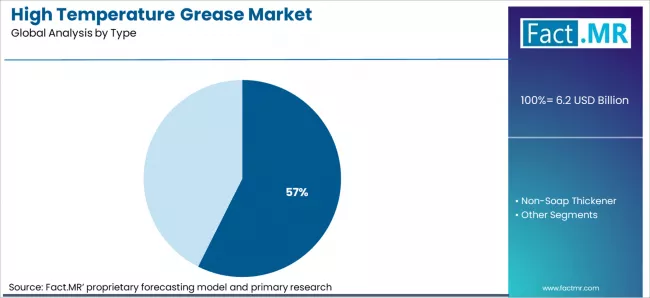
- By Type: Soap Thickener dominates with 57.4% share, reflecting the cost-effectiveness, wide availability, and established industrial specification acceptance of lithium complex and calcium sulfonate grease families across the broadest range of high-temperature operating environments.
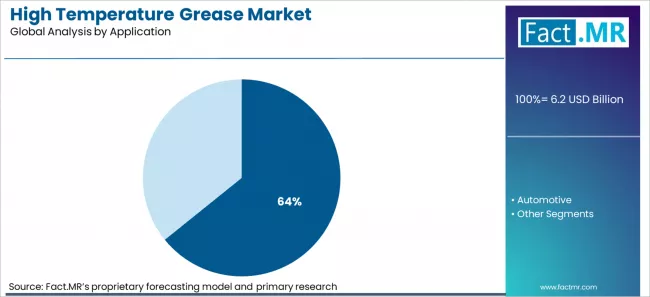
- By Application: Industrial leads with 64.2% share as steel mills, cement plants, mining operations, and food processing facilities require continuous high-temperature lubrication across kilns, conveyors, bearings, and rotating equipment operating at sustained elevated temperatures.
- By Geography: Asia Pacific leads volume growth, with China contributing the highest CAGR at 3.8%, supported by the region's concentration of heavy industrial output, steel production, and expanding infrastructure construction activity.
- Analyst Opinion at FACT.MR
- Shambhu Nath Jha, Principal Consultant at Fact.MR, opines, 'CXOs will find this report essential for navigating the regulatory-driven bifurcation between commodity lithium complex greases facing margin compression and premium PFAS-free synthetic and bio-based high-temperature formulations generating specification lock-in and durable pricing power across heavy industrial and automotive OEM channels.'
- Strategic Implications
- Manufacturers should accelerate investment in PFAS-free synthetic and bio-based thickener systems. REACH SVHC restriction timelines are making regulatory compliance a non-negotiable specification criterion in European industrial procurement, and suppliers with certified formulations will capture premium share as legacy products face restriction.
- Distributors should deepen coverage in India and China's industrial maintenance markets. Heavy infrastructure construction, power sector expansion, and growing food processing industries are generating structured demand pipelines for high-temperature greases that outpace mature market replacement dynamics.
- Industrial suppliers should develop food-grade high-temperature grease extension lines. NSF H1 and H2 registered formulations command significant price premiums over standard industrial greases and benefit from mandatory food safety compliance requirements that insulate margins from commodity price competition.
- Methodology
- Market sizing combined industrial equipment fleet estimates and automotive production volumes with average high-temperature grease unit pricing across type and application tiers, validated through distributor sales data and manufacturer earnings disclosures.
- Regulatory compliance migration timelines and formulation upgrade trends were benchmarked against REACH SVHC restriction records, EPA PFAS regulatory documentation, and OEM technical service bulletin updates from 2024 and 2025.
- Regional forecasts incorporated industrial output growth projections, national automotive production statistics, chemical regulation enforcement timelines, and primary interviews with Tier 1 lubricant manufacturers and industrial maintenance distributors.
Segmental Analysis
High Temperature Grease Market Analysis by Type
High Temperature Grease Market Analysis By Type | Source: Fact.MR
Soap thickener greases hold about 57.4% share in 2026, led by lithium complex, calcium sulfonate, and polyurea types. They dominate due to wide temperature performance, cost competitiveness, and strong OEM and maintenance specification lock in that limits switching to alternative systems.
- FUCHS PETROLUB SE Bio Based Grease Launch: In April 2025, FUCHS launched RENOLIT DURAPLEX BIO, a PFAS free lithium complex grease using renewable esters for REACH compliant customers in Europe. [2]
- Shell Cassida Food Grade Extension: In 2025, Shell expanded Cassida H1 calcium sulfonate greases for food lines above 180°C, supporting FSMA and EU food safety compliance. [3]
- SKF Polyurea Adoption Trend: In 2024, SKF highlighted rising use of polyurea greases in high speed bearings above 160°C for better shear and oxidation stability. [4]
High Temperature Grease Market Analysis by Application
High Temperature Grease Market Analysis By Application | Source: Fact.MR
Industrial applications hold about 64.2% share in 2026 due to mandatory high temperature lubrication in steel, cement, and mining equipment. Continuous kiln, conveyor, and rotating machinery operations require scheduled relubrication, with buyers specifying greases by NLGI grade, temperature range, and bearing compatibility, creating stable long term supplier relationships.
- ExxonMobil Mobilith SHC Expansion: In 2024, ExxonMobil added new synthetic grades for kiln and steel bearings up to 200°C. [5]
- TotalEnergies OEM Win: In 2025, TotalEnergies secured EV wheel bearing qualification for CERAN AP synthetic grease. [6]
- NLGI Food Grade Guidance: In 2024, NLGI noted rising NSF H1 grease adoption above 150°C in food plants. [7]
Drivers, Restraints, and Opportunities
Growth is driven mainly by relubrication cycles and formulation upgrades rather than new equipment sales. Stable industrial maintenance demand provides resilient baseline revenue.
Regulatory pressure and vehicle electrification are reshaping demand. REACH and EPA PFAS actions are forcing reformulation, while BEVs reduce some grease points but increase demand for premium electric motor and hybrid drivetrain formulations.
- REACH PFAS Restriction Driving Mandatory Reformulation: The proposed EU PFAS restriction affects PTFE and fluorinated additives, pushing suppliers like FUCHS and Shell toward PFAS free synthetic and bio based alternatives. [8]
- India Infrastructure Expansion Sustaining Industrial Volume: Cement, mining, and power projects under India’s infrastructure plan support steady high temperature grease demand aligned with updated ISO standards. [9]
- Automotive EV Transition Creating Premium Reformulation Demand: BEVs reduce exhaust and transmission greasing, but hybrids require broader thermal range synthetic greases, supporting higher value OEM demand. [10]
Regional Analysis
The high temperature grease market is analysed across Asia Pacific, Europe, North America, Latin America, and Middle East and Africa, covering over 40 countries with individual industrial output profiles, automotive production volumes, and regulatory compliance timelines. The full report also offers market attractiveness analysis based on regional industrial growth rates, regulatory pressure intensity, and synthetic grease adoption trajectories.
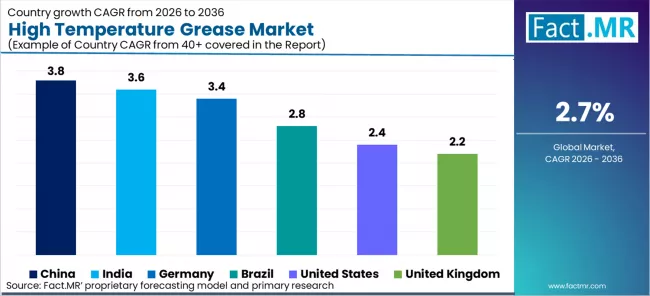
High Temperature Grease Market Cagr Analysis By Country | Source: Fact.MR
| Country | CAGR (2026-2036) |
|---|---|
| China | 3.8% |
| India | 3.6% |
| Germany | 3.4% |
| Brazil | 2.8% |
| United States | 2.4% |
| United Kingdom | 2.2% |
Source: Fact.MR analysis. Updated Mar 3, 2026
Source: Fact.MR (FACT.MR) analysis, based on proprietary forecasting model and primary research
Asia Pacific High Temperature Grease Market Analysis
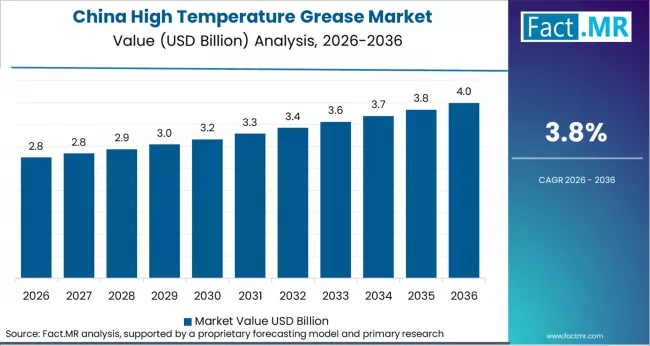
High Temperature Grease Market Country Value Analysis | Source: Fact.MR
Asia Pacific is the largest volume market driven by steel, cement, mining, and heavy industry, with China leading demand and India delivering faster growth.
- China: China’s high temperature grease market is set to expand at a compound annual growth rate of 3.8% through 2036. Steel production above 1 billion tonnes and dominant cement output sustain continuous kiln and bearing lubrication demand. Sinopec expanded lithium high temperature grease production in 2025 to serve steel and cement customers.
- India: Indian market for high temperature grease market is anticipated to increase at an average annual rate of 3.6% through 2036. Steel capacity expansion, power generation growth, and infrastructure projects support demand, while Indian Oil launched SERVOSYN synthetic grease in 2025 targeting cement and power sectors. Food processing expansion is increasing NSF H1 grease use.
FACT.MR's Asia Pacific analysis of the high temperature grease market covers China, Japan, South Korea, India, Australia and New Zealand, ASEAN, and Rest of Asia Pacific. Readers can find country-level CAGR projections, industrial sector demand profiles, regulatory compliance timelines, and synthetic grease adoption benchmarks by application.
Europe High Temperature Grease Market Analysis
Europe is driven by REACH compliance and OEM upgrades, accelerating synthetic and PFAS free reformulation.
- Germany: Germany’s high temperature grease market is expected to advance at a steady 3.4% annual growth rate through 2036. Hybrid drivetrain grease upgrades and FUCHS capacity expansion support automotive and industrial demand.
- United Kingdom: The UK high temperature grease market is forecast to grow at an average pace of 2.2% per year through 2036. Updated chemical safety guidance and aerospace and food sector specialty grease demand sustain growth.
FACT.MR's European analysis of the high temperature grease market covers Germany, France, the United Kingdom, Italy, Spain, the Netherlands, the Nordics, and Rest of Europe. Readers can find REACH compliance migration timelines, automotive OEM specification upgrade trends, PFAS-free product adoption rates, and country-level CAGR projections by application segment.
North America High Temperature Grease Market Analysis
North America is a large, mature high temperature grease market anchored by sustained industrial equipment maintenance cycles, a large food and beverage processing industry with mandatory food-grade lubrication requirements, and aftermarket automotive servicing demand.
- United States: Demand for high temperature grease in the U.S. is projected to rise at a 2.4% CAGR through 2036. EPA PFAS compliance pressure, mining and steel maintenance demand, and steady NSF H1 grease use in food processing support growth.
Latin America High Temperature Grease Market Analysis
Latin America is a steady growth region for high temperature greases, led by Brazil’s mining, agri industrial, and sugar ethanol sectors. Operations at mines, refineries, and processing plants require continuous high temperature lubrication in harsh tropical conditions, sustaining stable industrial demand.
- Brazil: Brazil market is projected to rise at a 2.8% CAGR through 2036. Mining operations, synthetic lubricant imports growth, and continuous lubrication in sugar ethanol processing sustain structured demand.
FACT.MR's Latin American analysis of the high temperature grease market covers Brazil, Chile, Ecuador, and Rest of Latin America. Readers can find mining sector demand profiles, agri-industrial maintenance cycle analyses, synthetic grease adoption trends, and country-level growth projections by end-use segment.
Competitive Aligners for Market Players
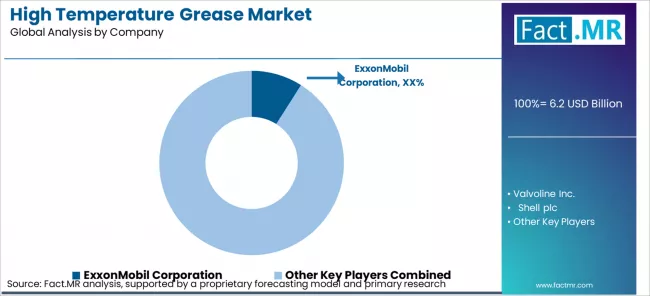
High Temperature Grease Market Analysis By Company | Source: Fact.MR
The global high temperature grease market is moderately concentrated among large integrated lubricant companies, while regional blenders compete in mid-tier grades. ExxonMobil, Shell, TotalEnergies, Chevron, and FUCHS PETROLUB SE dominate premium revenue through integrated base oil supply, additive development, and global distribution strength. Competitive differentiation in premium segments depends on certification depth including NLGI grades, NSF H1 food grade approval, REACH compliance, and OEM specific validation, creating strong specification lock in and limiting price competition.
Structural advantages rest with suppliers that control synthetic base oils, proprietary additive chemistry, and OEM technical relationships. ExxonMobil leverages PAO integration in Mobil SHC and Mobilith lines to sustain premium positioning. FUCHS benefits from deep European OEM ties and early PFAS free reformulation investment. Castrol maintains strength in automotive and aerospace through extensive OEM approvals that function as procurement gatekeepers and support pricing resilience.
Industrial buyers prioritize reliability over price due to high equipment failure costs, using preferred vendor lists and multiyear contracts. In contrast, the automotive aftermarket faces stronger price pressure from private label imports, reinforcing focus on industrial and OEM channels.
Recent Developments
- In April 2025, FUCHS PETROLUB SE launched its RENOLIT DURAPLEX BIO bio-based high-temperature grease range at Hannover Messe 2025, targeting European industrial customers requiring PFAS-free and sustainably sourced lubrication solutions compliant with evolving REACH restrictions.
- In February 2025, Shell plc announced expansion of its Cassida food-grade high-temperature grease manufacturing capacity at its Hamburg blending plant, citing growing demand from European food and beverage processing customers subject to updated EU food safety contact material regulations.
Key Players
- ExxonMobil Corporation
- Valvoline Inc.
- Shell plc
- Chevron Corporation
- TotalEnergies SE
- BP p.l.c. (Castrol)
- FUCHS PETROLUB SE
- Petro-Canada Lubricants Inc.
- MOL Group
Bibliography
- [1] FUCHS PETROLUB SE. (2025). Annual Report 2024: Innovation and Sustainability in Lubricant Formulation. FUCHS PETROLUB SE Investor Relations. March 2025.
- [2] FUCHS PETROLUB SE. (2025). Press Release: RENOLIT DURAPLEX BIO Bio-Based High-Temperature Grease Launch, Hannover Messe 2025. April 2025.
- [3] Shell plc. (2025). Shell Cassida Food-Grade Lubricants Portfolio Update: High-Temperature NSF H1 Calcium Sulfonate Complex Extension. Shell Industrial Lubricants. February 2025.
- [4] SKF Group. (2024). Lubrication Solutions Technical Bulletin: Polyurea Grease Selection for High-Speed Electric Motor and Robot Drivetrain Bearings. SKF Industrial Lubrication. September 2024.
- [5] ExxonMobil Corporation. (2024). Mobilith SHC Series Product Extension: High-Viscosity Synthetic Grease Grades for Cement and Steel Applications. ExxonMobil Lubricants Technical Bulletin. August 2024.
- [6] TotalEnergies SE. (2025). Press Release: CERAN AP Synthetic Grease OEM Qualification for European Electric Vehicle Wheel Bearing Applications. TotalEnergies Lubricants. March 2025.
- [7] National Lubricating Grease Institute (NLGI). (2024). High-Temperature Grease Application Guidelines: Food-Grade Synthetic Grease Adoption Trends in Regulated Processing Industries. NLGI Annual Publication. October 2024.
- [8] European Chemicals Agency (ECHA). (2024). Universal PFAS Restriction Proposal: Progress Update and Industry Preparation Status. ECHA Regulatory Affairs. November 2024.
- [9] Bureau of Indian Standards / Ministry of Steel, Government of India. (2024). ISO Grease Classification Adoption Update and Steel Sector Capacity Expansion Report. BIS Technical Circular. June 2024.
- [10] Volkswagen Group / Toyota Motor Corporation. (2024). Hybrid Platform Relubrication Specification Disclosures: High-Temperature Synthetic Grease Requirements for MEB+ and THS Hybrid Drivetrains. Annual Reports FY2024.
This Report Addresses
- Strategic market intelligence covering PFAS-free formulation investment, synthetic grease adoption in heavy industry, food-grade high-temperature certification requirements, and automotive OEM specification upgrade cycles for hybrid and BEV platforms.
- Market size and forecast: valued at USD 6.2 billion in 2026, projected to reach USD 8.1 billion by 2036 at a 2.7% CAGR, segmented by thickener type, application, and region.
- Growth opportunity mapping across REACH-compliant bio-based and PFAS-free reformulation segments, India and China industrial maintenance volume expansion, and food-grade NSF H1 high-temperature grease adoption in regulated processing industries.
- Segment and regional outlook with country-level CAGR for China (3.8%), India (3.6%), Germany (3.4%), Brazil (2.8%), United States (2.4%), United Kingdom (2.2%), and Japan (2.0%).
- Competitive strategy analysis of ExxonMobil, Shell, FUCHS, TotalEnergies, Chevron, and Castrol covering OEM specification positioning, PFAS-free product development investment, industrial channel depth, and food-grade certification differentiation.
- Product and technology tracking including calcium sulfonate complex greases, polyurea non-soap formulations, bio-based ester base stock greases, PTFE-free high-temperature additives, and NSF H1-registered synthetic food-grade formulations.
- Regulatory impact analysis covering REACH PFAS universal restriction proposals, EPA TSCA PFAS reporting rules, BIS ISO grease classification adoption in India, EU food safety contact material regulations, and FSMA food-safe lubricant compliance requirements.
- Report delivered in Excel datasets, PowerPoint summary, and detailed PDF supported by verified regulatory records, manufacturer disclosures, and primary research sources.
Segmentation
Scope of Report
| Items | Values |
|---|---|
| Quantitative Units | USD 6.2 billion (2026) to USD 8.1 billion (2036), at a CAGR of 2.7% |
| Market Definition | High temperature greases are specialised lubricants designed to maintain film strength and stability above 150°C in industrial equipment, automotive components, and food processing machinery, using soap and non-soap thickeners with mineral or synthetic base oils. |
| Type Segmentation | Soap Thickener, Non-Soap Thickener |
| Application Segmentation | Industrial, Automotive |
| Application Coverage | Steel and cement kiln lubrication, mining equipment servicing, food grade processing lubrication, automotive wheel bearing and CV joint greasing, hybrid and BEV motor bearings, industrial robot drivetrains, and power generation turbine and generator lubrication. |
| Regions Covered | Asia Pacific, Europe, North America, Latin America, Middle East and Africa |
| Countries Covered | China, Japan, South Korea, Australia and New Zealand, India, ASEAN, Rest of Asia Pacific, Germany, United Kingdom, France, Italy, Spain, Netherlands, Nordics, Rest of Europe, United States, Canada, Mexico, Brazil, Chile, Ecuador, Rest of Latin America, Kingdom of Saudi Arabia, United Arab Emirates, South Africa, Turkey, Rest of Middle East and Africa |
| Key Companies Profiled | ExxonMobil Corporation, Valvoline Inc., Shell plc, Chevron Corporation, TotalEnergies SE, BP p.l.c. (Castrol), FUCHS PETROLUB SE, Petro-Canada Lubricants Inc., MOL Group |
| Forecast Period | 2026 to 2036 |
| Approach | A hybrid top down and bottom up model was used. Top down inputs covered industrial equipment fleets, automotive production forecasts, and regulatory timelines. Bottom up inputs included unit prices by thickener type, relubrication cycles, OEM upgrade rates, and food grade adoption based on interviews with manufacturers, distributors, and maintenance engineers. |
Source: Fact.MR analysis. Updated Mar 3, 2026
High Temperature Grease Market by Segment
-
By Type
- Soap Thickener
- Non-Soap Thickener
-
By Application
- Industrial
- Automotive
-
By Region
- North America
- United States
- Canada
- Mexico
- Europe
- Germany
- United Kingdom
- France
- Italy
- Spain
- Netherlands
- Nordics
- Rest of Europe
- Asia Pacific
- China
- Japan
- South Korea
- India
- Australia and New Zealand
- ASEAN
- Rest of Asia Pacific
- Latin America
- Brazil
- Chile
- Ecuador
- Rest of Latin America
- Middle East and Africa
- Kingdom of Saudi Arabia
- United Arab Emirates
- South Africa
- Turkey
- Rest of Middle East and Africa
- North America
Frequently Asked Questions
How large is the high temperature grease market in 2025?
What will the market size be in 2026?
What is the projected market size by 2036?
What is the expected CAGR from 2026 to 2036?
Which type segment is poised to lead the market?
Which application segment holds the largest share?
Which country shows the fastest growth rate?
How fast is the market expected to expand in India?
What is the forecast CAGR for Germany?
What growth rate is expected for the United States?
What are the main growth drivers of the market?
What role does regulation play in market expansion?
Which base oil type is gaining traction?
How does EV adoption impact demand?
Which distribution channel dominates the market?
Who worked on this report


Preview the report firsthand - request a free sample
Free SampleGet the brochure for pricing and purchase details
Download PDF