- Market Value (2025): USD 0.7 Bn
- Estimated Value (2026): USD 0.9 Bn
- Forecast Value (2036): USD 7.2 Bn
- CAGR (2026-2036): 23.1%
What is the Hollow Core Fiber Backbone Network Market forecast to be worth by 2036?
The market is projected to grow from USD 0.9 billion in 2026 to USD 7.2 billion by 2036, registering a CAGR of 23.1%.
- The Hollow Core Fiber Backbone Network market reached USD 0.7 billion in 2025.
- Demand is forecast to increase from USD 0.9 billion in 2026 to USD 7.2 billion by 2036.
- The market is forecast to record 23.1% CAGR from 2026 to 2036.
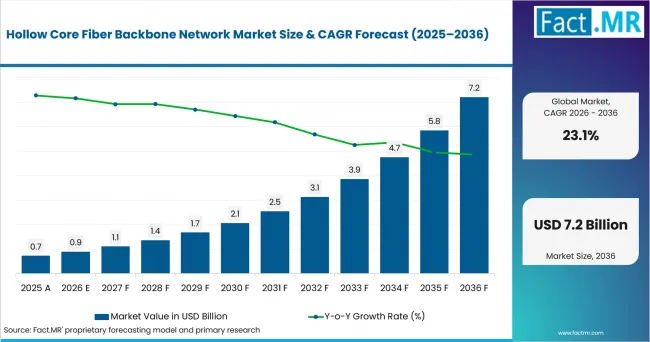
Hollow Core Fiber Backbone Network Market Value Analysis | Source: Fact.MR
What are the defining numbers behind Hollow Core Fiber Backbone Network Market growth?
An absolute dollar opportunity of USD 6.3 billion is expected between 2026 and 2036.
- Demand Drivers in the Market
- Lower optical loss is moving hollow-core fiber closer to backbone-network use. A 2025 Nature Photonics study reported attenuation below 0.1 dB per km across an 18 THz bandwidth in double-nested anti-resonant nodeless fiber. Lower loss can extend unamplified spans and reduce the number of optical amplification sites required on selected routes.
- Latency reduction is becoming commercially relevant for cloud and AI infrastructure. Microsoft reports that light travels through its hollow-core fiber substantially faster than through conventional silica fiber, reducing transmission latency by about one-third. The company has begun deploying the technology within Azure networks and is expanding manufacturing through Corning and Heraeus.
- AI data centers are increasing the value of low-latency links between computing clusters. Distributed training and storage traffic move across regional data-center networks, where propagation delay becomes more important as route length increases. Hollow-core fiber provides an infrastructure option for routes where latency carries direct operational value.
- Hollow-core designs also reduce nonlinear effects that limit conventional fiber at higher optical power. Lower nonlinearity allows network designers to use broader optical bandwidth and higher launch power without the same degree of signal distortion, supporting future high-capacity transport systems.
- Operator trials and initial commercial links are reducing deployment uncertainty. Comcast installed a 40 km hybrid hollow-core and conventional-fiber route in Philadelphia, while BT tested hollow-core fiber for mobile-network and quantum-secure communication use cases. These deployments provide evidence on handling, splicing and compatibility under real network conditions.
- Manufacturing scale is improving across multiple regions. YOFC reports long-length hollow-core fiber production and commercial pilot links, while Microsoft is outsourcing production to established glass and fiber manufacturers. Greater supply capacity is required before operators can specify the technology for broader backbone programmes.
- Key Segments Analyzed
- Hollow Core Fiber Cables account for 61.0% of Product Type in 2026, supported by operator demand for deployable cable assemblies rather than uncabled research fiber.
- Long-haul Backbone Networks represent 39.0% of Application in 2026 because lower latency and optical loss become more valuable as route length increases.
- Telecommunications Operators account for 44.0% of End User in 2026 as they own backbone routes and control fiber qualification, installation and network integration.
- New Network Deployment holds 68.0% of Deployment Type in 2026 because new routes can be engineered around hollow-core cable dimensions, splicing and termination requirements from the outset.
- Anti-resonant Hollow Core Fiber represents 54.0% of Fiber Technology in 2026, reflecting the low-loss performance achieved by nested anti-resonant designs.
- Analyst Opinion at Fact.MR
- “Commercial adoption will depend on whether hollow-core fiber can move from isolated trials to repeatable network construction. Lower latency and record optical loss create a clear performance case, but operators will also assess cable length, bend performance, splicing loss and field repair. Suppliers that combine scalable fiber drawing with qualified cable assemblies and installation support are positioned more strongly as the market expands from USD 0.9 billion in 2026 to USD 7.2 billion by 2036.”, says Shambhu Nath Jha, Sr. Consultant, Fact.MR
- Strategic Implications
- Fiber suppliers should prioritize long continuous draw lengths and repeatable cable production because route economics depend on reducing the number of joints and field splices.
- Commercialization plans should include adapters, connectors and splicing procedures that allow hollow-core sections to interface with established single-mode fiber networks.
- Suppliers should target latency-sensitive data-center and financial-network routes before broader backbone replacement, where the economic value of lower propagation delay is easier to demonstrate.
- Network operators should use new-build routes and controlled pilot corridors to validate bend performance, environmental stability and maintenance procedures before large-scale deployment.
- Manufacturers should develop regional production and backup capacity because backbone customers require continuity across multi-year construction programmes.
- Equipment vendors should verify transceiver and amplification performance across the broader spectrum and lower-nonlinearity characteristics offered by hollow-core fiber.
How does the Hollow Core Fiber Backbone Network Market break down by segment?
The market is segmented by Product Type, Application, End User, Deployment Type and Fiber Technology.
Why do Hollow Core Fiber Cables lead Product Type?
Hollow Core Fiber Cables are projected to account for a 61.0% share in 2026.
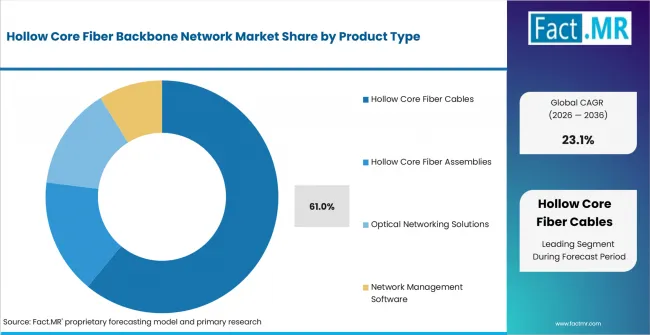
Hollow Core Fiber Backbone Network Market Analysis By Product Type | Source: Fact.MR
Commercial networks purchase cable systems that protect the fiber during pulling, bending and long-term operation. Bare hollow-core fiber cannot be deployed across backbone routes without jacketing and mechanical reinforcement suited to ducts or data-center pathways.
Cable suppliers also need to provide termination and splicing methods. YOFC offers adapters that connect hollow-core and conventional single-mode fiber, together with hollow-core splicing services. These supporting components make finished cables the practical purchasing unit for network operators.
Why do Long-haul Backbone Networks lead Application?
Long-haul Backbone Networks are projected to account for a 39.0% share in 2026.
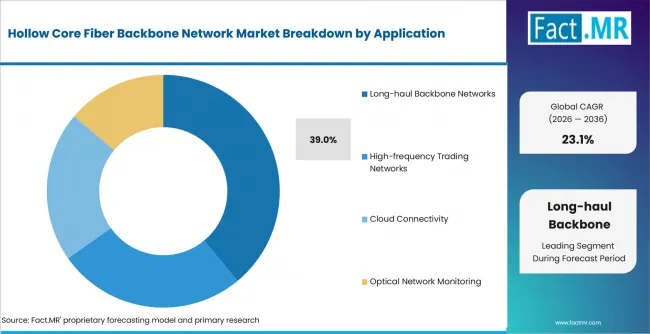
Hollow Core Fiber Backbone Network Market Analysis By Application | Source: Fact.MR
Propagation delay accumulates with distance, so the latency benefit of guiding light mainly through air becomes more valuable on longer routes. Backbone networks connecting data centers and metropolitan regions can therefore obtain a larger absolute delay reduction than short in-building links.
Long-haul routes also benefit from lower optical loss and nonlinearity. The 2025 Nature Photonics result below 0.1 dB per km across a broad transmission band indicates the potential for longer spans and higher-capacity wavelength systems, although commercial network design still requires field qualification.
Why do Telecommunications Operators lead End User?
Telecommunications Operators are projected to account for a 44.0% share in 2026.
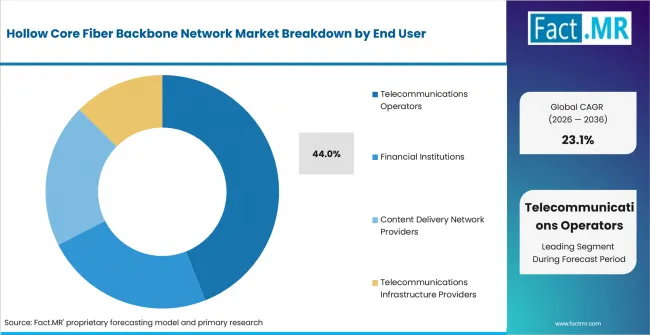
Hollow Core Fiber Backbone Network Market Analysis By End User | Source: Fact.MR
Telecommunications operators own or lease the routes where hollow-core fiber can be installed at scale. They also control optical transport equipment, maintenance procedures and service-level requirements, making them responsible for approving a new fiber type.
Comcast and BT have already conducted field trials to evaluate latency and compatibility. These programmes show that operator participation begins with route testing and engineering validation before wider network procurement.
Why does New Network Deployment lead Deployment Type?
New Network Deployment is projected to account for a 68.0% share in 2026.
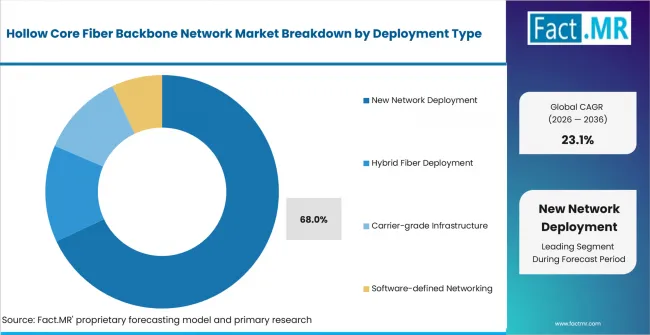
Hollow Core Fiber Backbone Network Market Analysis By Deployment Type | Source: Fact.MR
New routes allow operators to specify duct space, cable handling and splice locations around the characteristics of hollow-core fiber. This reduces the need to adapt existing closures and repair procedures after a network has already been commissioned.
Hollow-core fiber is also being introduced first in controlled data-center and backbone corridors. Microsoft’s Azure deployments follow this approach, using selected links where installation and performance can be monitored before wider regional rollout.
Why does Anti-resonant Hollow Core Fiber lead Fiber Technology?
Anti-resonant Hollow Core Fiber is projected to account for a 54.0% share in 2026.
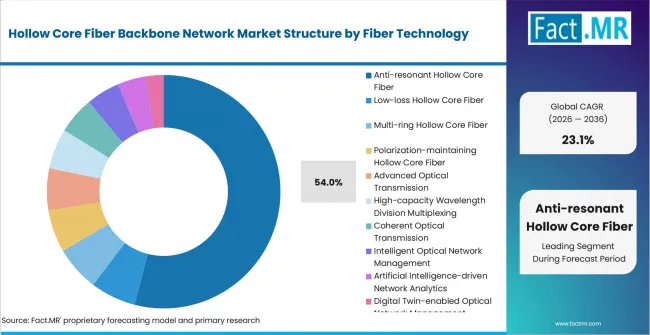
Hollow Core Fiber Backbone Network Market Analysis By Fiber Technology | Source: Fact.MR
Anti-resonant designs guide light through an air-filled core using thin glass membranes that prevent energy from coupling into the surrounding structure. Nested arrangements reduce leakage while maintaining a broad transmission window.
Double-nested anti-resonant nodeless fiber has produced the lowest reported broadband loss among hollow-core designs. Its combination of low attenuation and low nonlinearity supports research and commercial interest in backbone and data-center networks.
What is accelerating Hollow Core Fiber Backbone Network Market adoption, and what is holding it back?
Drivers Impact Analysis
| Factor | (~) % Impact on CAGR | Geographic Relevance | Impact Timeline |
|---|---|---|---|
| Lower-loss HCF and cable commercialization | +1.6% | Global | 2026-2036 |
| Advanced optical-network programmes | +1.4% | North America, Europe | 2026-2032 |
| AI data-center and telecom backbone expansion | +1.1% | Asia Pacific, MEA | 2026-2036 |
| Latency and repeater reduction | +0.9% | Global | 2026-2036 |
Source: Fact.MR analysis. Updated Aug 11, 2026
Restraints Impact Analysis
| Factor | (~) % Impact on CAGR | Geographic Relevance | Impact Timeline |
|---|---|---|---|
| Fiber drawing, cabling and splicing investment | -1.1% | Developing Markets | 2026-2030 |
| Limited long-length fiber and connector availability | -0.9% | Global | 2026-2028 |
| HCF installation and test capability gaps | -0.7% | Africa, Latin America | 2026-2036 |
Source: Fact.MR analysis. Updated Aug 11, 2026
Which countries are scaling the Hollow Core Fiber Backbone Network Market fastest?
- USA: Microsoft is deploying hollow-core fiber within Azure and expanding production through Corning and Heraeus. Comcast has also operated a 40 km hybrid field route in Philadelphia, giving the country direct experience with real-network installation and monitoring.
- Japan: NICT launched a 2025 hollow-core fiber ecosystem programme, while Furukawa Electric is validating performance with data-center operators.
- UK: The technology emerged from University of Southampton research and the Lumenisity spinout. BT conducted trials at Adastral Park, while Microsoft continues engineering and production activity after acquiring Lumenisity.
- Germany: Heraeus is helping Microsoft scale hollow-core fiber production, while Fraunhofer institutes develop hollow-core preforms and manufacturing methods.
- China: YOFC offers cable and adapter products and has reported long continuous fiber production with commercial or pilot telecom links.
- South Korea: Government 6G research covers high-speed optical transport for fronthaul, backhaul and core networks, supporting future low-latency fiber trials.
- France: Orange has identified hollow-core fiber as a route for reducing propagation limits and included the technology in its 6G research outlook.
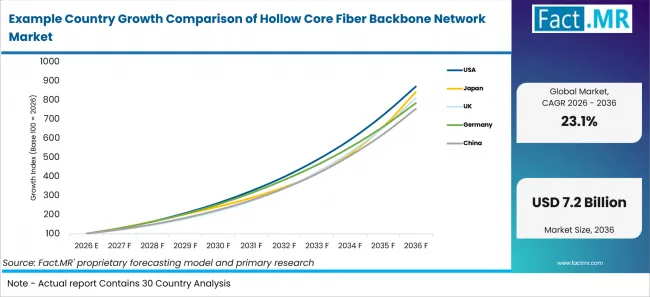
Example Country Growth Comparison Of Hollow Core Fiber Backbone Network Market | Source: Fact.MR
| Country | CAGR, 2026-2036 |
|---|---|
| USA | 24.2% |
| Japan | 23.8% |
| UK | 23.3% |
| Germany | 22.9% |
| China | 22.4% |
| South Korea | 21.9% |
| France | 21.5% |
Source: Fact.MR analysis. Updated Aug 11, 2026
What is driving the Hollow Core Fiber Backbone Network market in USA?
USA is projected to register a CAGR of 24.2% from 2026 to 2036.
The USA combines early operator trials with cloud-network deployment. Comcast connected two Philadelphia locations using a 40 km hybrid route to assess hollow-core fiber under field conditions. The trial allowed engineers to observe latency and compatibility without replacing the complete route.
Microsoft is now using hollow-core fiber in selected Azure regions and has arranged production with Corning and Heraeus. This shifts demand from research fiber toward repeatable cable supply for data-center and regional backbone links.
What is driving the Hollow Core Fiber Backbone Network market in Japan?
Japan is projected to register a CAGR of 23.8% from 2026 to 2036.
Japan is establishing a domestic research base for hollow-core fiber and connection technology. NICT's 2025 programme focuses on the fiber and interface technologies required for a wider ecosystem, recognizing that low-loss fiber alone is insufficient for network deployment.
Furukawa Electric is developing hollow-core fiber and evaluating performance with data-center operators. Its existing optical-cable manufacturing base can support the transition from research samples to qualified cable products.
What is driving the Hollow Core Fiber Backbone Network market in UK?
UK is projected to register a CAGR of 23.3% from 2026 to 2036.
The UK has a strong technology-development base because hollow-core fiber research was advanced at the University of Southampton and commercialized through Lumenisity. Microsoft acquired Lumenisity in 2022 and continues to operate the technology as part of its cloud-network programme.
BT has tested hollow-core fiber for mobile-network and quantum-secure communication applications. Government analysis also includes hollow-core fiber within the country's advanced connectivity technology sector, supporting continued research and supplier development.
What is driving the Hollow Core Fiber Backbone Network market in Germany?
Germany is projected to register a CAGR of 22.9% from 2026 to 2036.
Germany's role is linked to precision glass and photonic manufacturing. Heraeus is supporting Microsoft’s effort to scale hollow-core fiber production through facilities in Europe and the USA, strengthening access to specialized glass components and manufacturing processes.
Fraunhofer research includes hollow-core preform fabrication and fiber manufacturing methods. These capabilities can support European production as operators move from pilot links toward longer cable requirements.
What is driving the Hollow Core Fiber Backbone Network market in China?
China is projected to register a CAGR of 22.4% from 2026 to 2036.
China is progressing rapidly through YOFC's integrated fiber and cable manufacturing chain. The company offers anti-resonant hollow-core fiber, adapters and splicing services, allowing customers to purchase a more complete interconnection solution.
YOFC reported a 0.04 dB per km attenuation result and a continuous fiber length of 91.2 km in 2026. It also cited more than ten commercial and pilot projects, including links with Chinese telecom operators, indicating movement toward backbone-scale deployment.
What is driving the Hollow Core Fiber Backbone Network market in South Korea?
South Korea is projected to register a CAGR of 21.9% from 2026 to 2036.
South Korea's 6G programme includes research on high-speed and high-capacity optical transport for fronthaul, backhaul and core networks. These requirements create a long-term application case for fiber that can reduce propagation delay and support broader optical bandwidth.
ETRI has also demonstrated low-latency optical access and nationwide precision-network technologies. Hollow-core fiber remains an emerging option, but the country's telecom research base can support future trials as cable supply matures.
What is driving the Hollow Core Fiber Backbone Network market in France?
France is projected to register a CAGR of 21.5% from 2026 to 2036.
France has an established optical-network research base through Orange and public photonics laboratories. Orange has examined hollow-core fiber as a means of guiding light mainly through air and reducing limits associated with conventional silica transmission.
The technology also appears in Orange's 6G research outlook. Adoption is likely to begin through experimental transport links and specialist low-latency routes before broader backbone use.
Who leads the Hollow Core Fiber Backbone Network Market?
Lumenisity Limited is a central technology provider within the company list, but it is no longer independent. Microsoft acquired Lumenisity in December 2022 and now uses the technology within its Azure network programme. Microsoft has also expanded manufacturing through Corning and Heraeus.
NKT Photonics A/S contributes specialty-fiber manufacturing capability and has operated as a Hamamatsu Photonics subsidiary since June 2024. Furukawa Electric Co., Ltd. is developing hollow-core fiber and confirming performance with data-center operators.
YOFC has established a more complete hollow-core product chain covering fiber, cable, adapters and splicing. Corning Incorporated and OFS Fitel, LLC bring large-scale conventional optical-fiber and cabling expertise, although participation in this emerging segment must be assessed at the product level.
Nokia Corporation, Ciena Corporation, Huawei Technologies Co., Ltd. and Cisco Systems, Inc. primarily compete through optical transport and network equipment rather than hollow-core fiber manufacturing. Their role becomes relevant when transmission systems are qualified to use the wider spectrum, lower latency and lower nonlinearity of hollow-core links.
Competition depends on attenuation and usable bandwidth. Long continuous draw length, bend performance and splice loss also influence customer qualification. Suppliers able to deliver field-ready cables with adapters and installation support have an advantage over research-focused fiber developers.
Which companies are the key providers?
Key companies profiled include Lumenisity Limited, a Microsoft company; NKT Photonics A/S, a Hamamatsu Photonics subsidiary; Furukawa Electric Co., Ltd.; Yangtze Optical Fibre and Cable Joint Stock Limited Company; Corning Incorporated; OFS Fitel, LLC; Nokia Corporation; Ciena Corporation; Huawei Technologies Co., Ltd.; and Cisco Systems, Inc.
- Lumenisity Limited, a Microsoft company
- NKT Photonics A/S, a Hamamatsu Photonics subsidiary
- Furukawa Electric Co., Ltd.
- Yangtze Optical Fibre and Cable Joint Stock Limited Company
- Corning Incorporated
- OFS Fitel, LLC
- Nokia Corporation
- Ciena Corporation
- Huawei Technologies Co., Ltd.
- Cisco Systems, Inc.
Bibliography
- BT Group. (2021). BT Kicks Off Trials of Revolutionary New Optical Fibre.
- BT Group. (2021). BT Conducts World's First Trial of Quantum-secure Communications over Hollow Core Fibre Cable.
- Comcast Corporation. (2022). Comcast Becomes First ISP in the United States to Deploy Hollow Core Fiber.
- Fraunhofer Institute for Laser Technology. (2024). Collaborative Project LAR3S: Hollow-core Fiber Preform Manufacturing.
- Furukawa Electric Co., Ltd. (2025). Practical Applications of Hollow Core Fiber.
- Hamamatsu Photonics K.K. (2024). Acquisition Completion of NKT Photonics.
- Microsoft. (2022). Microsoft Acquires Lumenisity, an Innovator in Hollow Core Fiber Cable.
- Microsoft Azure. (2025). The Deployment of Hollow Core Fiber in Azure's Network.
- Microsoft Azure. (2025). Microsoft Azure Scales Hollow Core Fiber Production through Outsourced Manufacturing.
- Ministry of Science and ICT, Republic of Korea. (2023). Securing Global Leadership in 6G with 6G Global.
- National Institute of Information and Communications Technology, Japan. (2025). Research and Development for a Hollow-structure Optical Fiber Ecosystem.
- Orange. (2021). Air at the Centre of Optical Fibres to Guide Light.
- Orange. (2022). Orange's Vision for 6G.
- Petrovich, M. N., et al. (2025). Broadband Optical Fibre with an Attenuation Lower than 0.1 Decibel per Kilometer. Nature Photonics.
- UK Department for Science, Innovation and Technology. (2026). Advanced Connectivity Technologies Sector Study 2026.
- Yangtze Optical Fibre and Cable Joint Stock Limited Company. (2026). YOFC Unveils HollowBand Hollow-core Fibre at MWC Barcelona 2026.
This Report Answers
- How hollow-core fiber demand develops across backbone-network applications and deployment types.
- Which categories account for the largest shares of the 2026 market.
- Why latency-sensitive cloud and telecom routes are early commercial targets.
- How commercialization differs across the USA, Japan, the UK, Germany, China, South Korea and France.
- Which companies participate through fiber manufacturing, cabling or optical transport equipment.
- How the market is separated from conventional solid-core fiber and adjacent network hardware.
What does the Hollow Core Fiber Backbone Network Market cover?
The market covers hollow-core optical fiber and cable deployed as part of telecommunications and data-network backbones. Light is guided mainly through an air-filled core rather than solid silica, providing lower propagation delay and reduced optical nonlinearity.
The assessment includes hollow-core cable used in long-haul and regional backbone routes. It also covers deployment within data-center interconnection and other network corridors where low latency or broad optical bandwidth justifies the use of a new fiber type.
What is included in the scope?
The scope includes deployable hollow-core fiber cable and associated connection products supplied for backbone-network construction. Anti-resonant hollow-core designs are included when intended for communication transmission.
Demand from telecommunications operators and other network owners is assessed. New-build routes and controlled network upgrades are included where hollow-core cable forms part of the installed optical path.
Adapters and splice solutions are included when sold as an integral part of the hollow-core cable deployment. Commercial trials and pilot routes are considered where they represent paid network construction or qualified supply.
What is excluded from the scope?
Conventional solid-core single-mode and multimode optical fiber are excluded. Fiber-to-the-home access cable is outside the market unless hollow-core fiber is installed as part of a backbone route.
Hollow-core fiber used only for laser delivery, sensing, spectroscopy or gyroscopes is excluded because these applications do not form part of a communications backbone.
Optical transceivers and routers are outside the market when sold independently. Submarine cable systems are excluded unless hollow-core fiber forms part of the transmission cable.
Research samples that are not supplied as deployable cable are excluded from market revenue.
How Was the Analysis Built?
- Primary Research: Interviews with hollow-core fiber developers, cable manufacturers, telecommunications operators, data-center network engineers and optical-equipment suppliers examine qualification requirements and deployment economics.
- Desk Research: The review covers peer-reviewed optical-fiber research, operator trials, government connectivity programmes and company manufacturing developments. Every external source used in the article is listed in the bibliography.
- Market Sizing and Forecasting: Estimates combine deployed route length, cable pricing, pilot-to-commercial conversion, backbone construction and the mix of new network deployment versus upgrades.
- Data Validation and Update Cycle: Findings are cross-checked against public field trials, manufacturing announcements and company product portfolios. Updates account for attenuation improvements, long-length production, splicing performance and commercial link deployment.
Segmentation
What is the report's scope and coverage?
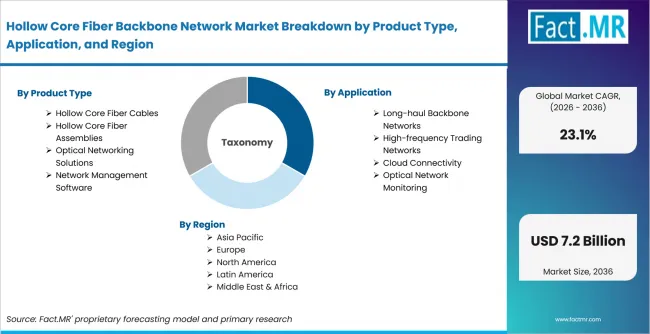
Hollow Core Fiber Backbone Network Market Breakdown By Product Type, Application, And Region | Source: Fact.MR
| Attribute | Details |
|---|---|
| Quantitative Units | USD billion |
| Market Definition | Hollow-core optical fiber and cable deployed across telecommunications and data-network backbones, where light travels mainly through an air-filled core to reduce propagation delay and optical nonlinearity across latency-sensitive network routes |
| Product Type | Hollow Core Fiber Cables; Hollow Core Fiber Assemblies; Optical Networking Solutions; Network Management Software |
| Application | Long-haul Backbone Networks; High-frequency Trading Networks; Cloud Connectivity; Optical Network Monitoring |
| End User | Telecommunications Operators; Financial Institutions; Content Delivery Network Providers; Telecommunications Infrastructure Providers |
| Deployment Type | New Network Deployment; Hybrid Fiber Deployment; Carrier-grade Infrastructure; Software-defined Networking |
| Fiber Technology | Anti-resonant Hollow Core Fiber; Low-loss Hollow Core Fiber; Multi-ring Hollow Core Fiber; Polarization-maintaining Hollow Core Fiber; Advanced Optical Transmission; High-capacity Wavelength Division Multiplexing; Coherent Optical Transmission; Intelligent Optical Network Management; Artificial Intelligence-driven Network Analytics; Digital Twin-enabled Optical Network Management |
| Regions Covered | North America; Europe; Asia Pacific; Latin America; Middle East and Africa |
| Countries Covered | USA; Japan; UK; Germany; China; South Korea; France |
| Key Companies Profiled | Lumenisity Limited; NKT Photonics A/S; Furukawa Electric Co., Ltd.; Yangtze Optical Fibre and Cable Joint Stock Limited Company (YOFC); Corning Incorporated; OFS Fitel, LLC; Nokia Corporation; Ciena Corporation; Huawei Technologies Co., Ltd.; Cisco Systems, Inc. |
| Forecast Period | 2026 to 2036 |
| Approach | Hybrid assessment using deployed route length, cable pricing, pilot-to-commercial conversion, backbone construction, new network deployment versus upgrades, attenuation improvements, long-length production, splicing performance and commercial link deployment |
Source: Fact.MR analysis. Updated Aug 11, 2026
How is the market segmented?
-
By Product Type
- Hollow Core Fiber Cables
- Long-distance Transmission Fiber
- Ultra-low Latency Fiber
- Hollow Core Fiber Assemblies
- Pre-terminated Fiber Assemblies
- High-performance Optical Interconnects
- Optical Networking Solutions
- Low-latency Optical Links
- Wavelength Division Multiplexing Solutions
- Network Management Software
- Optical Performance Analytics
- Predictive Network Optimization
- Hollow Core Fiber Cables
-
By Application
- Long-haul Backbone Networks
- Hyperscale Data Center Interconnects
- Metro Backbone Networks
- High-frequency Trading Networks
- 5G Transport Networks
- Research & Education Networks
- Cloud Connectivity
- Artificial Intelligence Cluster Networking
- Supercomputing Networks
- Optical Network Monitoring
- Fault Detection & Diagnostics
- Capacity Planning
- Long-haul Backbone Networks
-
By End User
- Telecommunications Operators
- Hyperscale Cloud Service Providers
- Internet Service Providers
- Financial Institutions
- Mobile Network Operators
- Research Institutions
- Content Delivery Network Providers
- Artificial Intelligence Infrastructure Providers
- High-performance Computing Centers
- Telecommunications Infrastructure Providers
- Network Operations Centers
- Government Communication Networks
- Telecommunications Operators
-
By Deployment Type
- New Network Deployment
- Greenfield Fiber Infrastructure
- Backbone Network Expansion
- Hybrid Fiber Deployment
- Data Center Interconnection
- Optical Backbone Modernization
- Carrier-grade Infrastructure
- Managed Optical Network Services
- System Integrator Deployment
- Software-defined Networking
- Cloud-managed Networks
- Hybrid Network Management
- New Network Deployment
-
By Fiber Technology
- Anti-resonant Hollow Core Fiber
- Nested Anti-resonant Nodeless Fiber
- Hollow Core Photonic Crystal Fiber
- Low-loss Hollow Core Fiber
- Multi-ring Hollow Core Fiber
- Polarization-maintaining Hollow Core Fiber
- Advanced Optical Transmission
- High-capacity Wavelength Division Multiplexing
- Coherent Optical Transmission
- Intelligent Optical Network Management
- Artificial Intelligence-driven Network Analytics
- Digital Twin-enabled Optical Network Management
- Anti-resonant Hollow Core Fiber
-
By Region
- North America
- Latin America
- Western Europe
- Eastern Europe
- East Asia
- South Asia and Pacific
- Middle East & Africa
Frequently Asked Questions
What is the Hollow Core Fiber Backbone Network market size in 2026?
At what CAGR is the Hollow Core Fiber Backbone Network market expected to grow?
What is the projected Hollow Core Fiber Backbone Network market size by 2036?
Which country records the highest listed CAGR?
Which Product Type accounts for the largest share?
Which Application accounts for the largest share?
Which End User accounts for the largest share?
Which Deployment Type accounts for the largest share?
Which Fiber Technology accounts for the largest share?
What is the primary driver in this market?
What is the main restraint?
Which companies are included in the market assessment?
Who worked on this report


Preview the report firsthand - request a free sample
Free SampleGet the brochure for pricing and purchase details
Download PDF