- Market Value (2025):USD 129.9 Mn
- Estimated Value (2026): USD 140 Mn
- Forecast Value (2036): USD 296.7 Mn
- CAGR (2026-2036): 7.8%
What is the hybrid marine capstans market forecast to be worth by 2036?
USD 140 million in 2026 to USD 296.7 million by 2036, at 7.8% CAGR.
- The hybrid marine capstans market crossed a valuation of USD 129.9 million in 2025.
- Demand is expected to increase from USD 140 million in 2026 to USD 296.7 million by 2036.
- The market is forecast to record a 7.8% CAGR from 2026 to 2036 as workboats, tugboats, ferries and offshore support vessels upgrade deck machinery for safer and more controllable line handling.
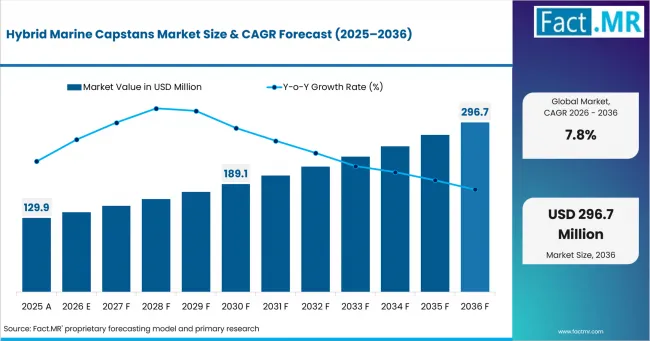
Hybrid Marine Capstans Market Market Value Analysis | Source: Fact.MR
What are the defining numbers behind hybrid marine capstans market growth?
USD 156.7 million absolute opportunity by 2036, led by hybrid electric-hydraulic systems, mooring applications and workboat upgrades.
- Demand Drivers in the Market
- Harbor fleets need capstans that improve rope handling without adding hydraulic complexity.
- Shipyards need compact deck machinery that fits hybrid and electric vessel architectures.
- Vessel owners need remote and load-limited controls for safer line handling.
- Marine distributors need retrofit-ready capstans for workboats, tugs and ferries.
- Key Segments Analyzed
- By Drive System: Hybrid electric-hydraulic systems are expected to hold 36.0% share in 2026 because they support transition from hydraulic fleets.
- By Application: Mooring leads because capstans are widely used in docking and harbor operations. The segment is projected to capture 33.0% share in 2026.
- By Vessel Type: Workboats are likely to account for 30.0% share in 2026 because utility vessels need compact rope-handling systems.
- By Control: Remote control is expected to hold 32.0% share in 2026 because operators need safer deck positioning.
- By Buyer Type: Shipyards are projected to record 34.0% share in 2026 because hybrid capstans are easiest to integrate during vessel build.
- Analyst Opinion at Fact.MR
- Shambhu Nath Jha, Senior Analyst at Fact.MR, states, “Hybrid marine capstans are gaining attention because vessel operators want cleaner line-handling systems without losing familiar deck behavior. Adoption will grow where suppliers prove torque response and control safety. The best-positioned products will combine compact design, remote operation and strong service support.”
- Strategic Implications
- Capstan suppliers should position hybrid systems around safer line handling and lower hydraulic exposure.
- Shipyards should assess capstan power and control needs early in vessel design.
- Harbor fleets should target high-use mooring and line-handling tasks for early upgrades.
- Marine distributors should train customers on remote control, load limits and retrofit requirements.
Kongsberg Maritime launched a new electric towing winch for the tug market in 2025, using a frequency converter-driven electric motor and reducing hydraulic systems onboard. This supports the market boundary because hybrid marine capstans are part of the wider shift toward cleaner and more controllable deck machinery.
Norway is projected to record 8.8% CAGR through 2036 as tug and offshore fleets adopt electric and hybrid deck systems. Germany is expected to post 8.4% CAGR through 2036 as deck machinery suppliers and shipyards support electric-hydraulic transition. The United States is likely to record 8.0% CAGR as workboat and harbor fleet retrofit demand expands. Spain is forecast to advance at 7.6% CAGR as marine equipment suppliers support hybrid deck machinery. Japan is set to record 7.2% CAGR as shipyards and fishing vessel operators adopt compact line-handling upgrades.
How does the hybrid marine capstans market break down by segment?
Hybrid electric-hydraulic systems lead at 36.0%; mooring leads at 33.0%.
Which drive system dominates?
Hybrid electric-hydraulic systems hold 36.0% share in 2026.
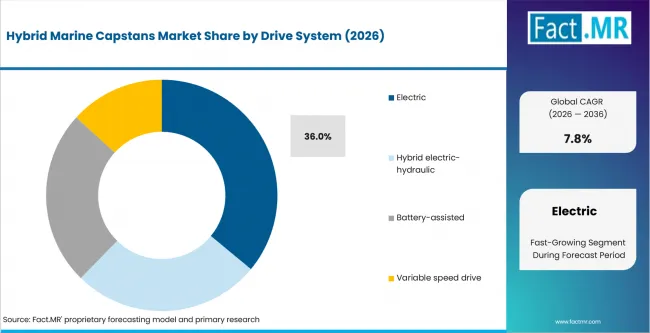
Hybrid Marine Capstans Market Analysis By Drive System | Source: Fact.MR
Hybrid electric-hydraulic systems are expected to hold 36.0% share in 2026 because vessel owners want a transition route between familiar hydraulic deck machinery and cleaner electric control. Electric capstans follow where shipyards can design power supply and controls from the start. Battery-assisted systems are growing in low-emission harbor craft. Variable speed drive systems support smoother line handling and better rope control.
Which application dominates?
Mooring accounts for 33.0% share, hybrid marine capstan demand.
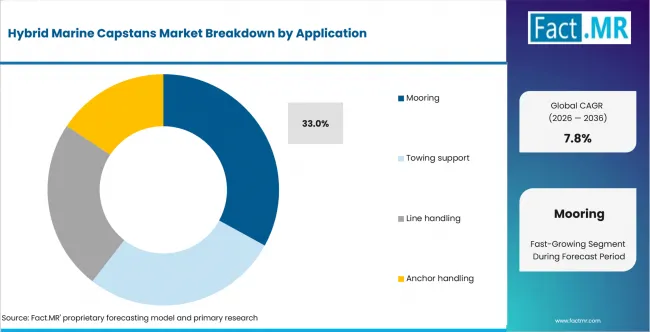
Hybrid Marine Capstans Market Analysis By Application | Source: Fact.MR
Mooring leads because capstans are frequently used during docking, berth work and routine harbor operations. The segment is projected to capture 33.0% share in 2026 as workboats, ferries and tugboats seek smoother line handling and safer deck routines. Towing support follows where capstans assist line management around tug and harbor work. Line handling is broad and steady across workboats. Anchor handling is smaller but important for offshore support vessels. Harbor operations support repeated short-cycle use. DMT Marine Equipment states that its capstans are engineered to handle high loads and provide consistent controlled pulling power.
Which vessel type dominates?
Workboats hold 30.0% share in 2026.
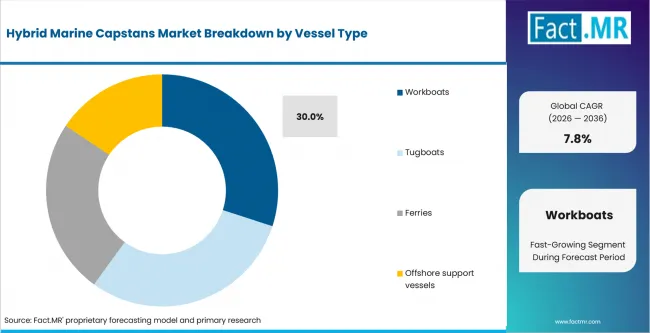
Hybrid Marine Capstans Market Analysis By Vessel Type | Source: Fact.MR
Workboats lead because they need compact, durable and easy-to-operate capstans for daily utility tasks. The vessel type segment is likely to account for 30.0% share in 2026 as harbor service vessels, maintenance craft and small commercial boats adopt electric or hybrid line-handling systems. Tugboats follow because towing support and mooring routines are frequent. Ferries adopt hybrid capstans where clean port operations matter. Offshore support vessels need stronger systems for anchor and line handling. Patrol craft need compact and reliable deck equipment. Markey Machine states that its capstan winches are offered in electric, hydraulic and pneumatic models for maritime and industrial applications.
Which control type dominates?
Remote control leads with 32.0% share in 2026.
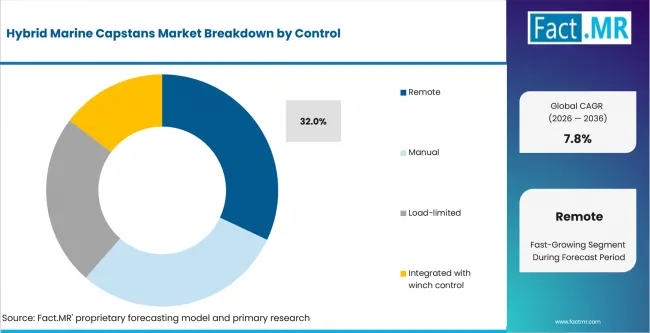
Hybrid Marine Capstans Market Analysis By Control | Source: Fact.MR
Remote control leads because rope handling can expose crew to snap-back risk, moving lines and poor weather. The control segment is expected to hold 32.0% share in 2026 as vessel owners seek safer operator positioning and bridge-deck coordination. Manual control remains relevant for small vessels and simple deck tasks. Load-limited control grows where operators need protection against overload. Integration with winch control is important on tugboats and offshore support vessels. DMT Marine Equipment describes electrical control systems and automation services tailored for the deck machinery industry.
Which buyer type dominates?
Shipyards hold 34.0% share in 2026.
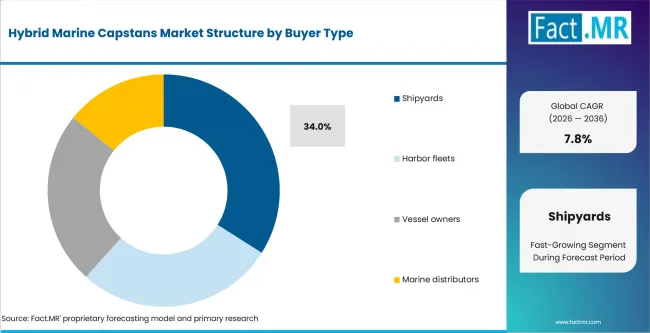
Hybrid Marine Capstans Market Analysis By Buyer Type | Source: Fact.MR
Shipyards lead because hybrid capstans are easiest to integrate when vessel power architecture, deck layout and control panels are designed together. The buyer type segment is projected to record 34.0% share in 2026 as newbuild workboats, ferries and tugboats adopt electric or hybrid deck machinery. Harbor fleets drive replacement demand where rope-handling intensity is high. Vessel owners invest when hydraulic maintenance or safety concerns rise. Marine distributors support replacement and small-vessel channels. The IMO’s 2025 net-zero framework update keeps pressure on shipping stakeholders to modernize vessel systems and improve operating efficiency.
What is accelerating Hybrid Marine Capstans Market adoption, and what is holding it back?
Deck machinery electrification drives it; Higher upfront cost restrains it.
Drivers Impact Analysis
| DRIVER | (~) % IMPACT ON CAGR | GEOGRAPHIC RELEVANCE | IMPACT TIMELINE |
|---|---|---|---|
| Deck machinery electrification moving capstans toward hybrid drive systems | +0.9% | Europe, North America, Japan | Medium term (2–4 years) |
| Harbor fleets needing safer and cleaner line-handling equipment | +0.7% | Norway, Germany, United States, Netherlands | Short term (≤ 2 years) |
| Remote control improving operator positioning during mooring work | +0.6% | Global, strongest in workboats and tugs | Short term (≤ 2 years) |
| Retrofit demand rising as hydraulic systems age | +0.5% | United States, Europe, Asia-Pacific | Medium term (2–4 years) |
| Variable speed drives improving rope control and deck workflow | +0.4% | Europe, Japan, South Korea | Long term (≥ 4 years) |
Source: Fact.MR analysis. Updated Jul 4, 2026
- Deck machinery electrification
- Deck machinery electrification is the strongest driver because vessel operators are moving more onboard functions toward electric and hybrid power systems. Hybrid capstans fit this shift without forcing every vessel to abandon existing hydraulic architecture at once. This makes adoption practical for workboats and ferries. The driver is strongest where shipyards already design cleaner deck systems.
- Harbor fleet line handling
- Harbor fleets need safer and cleaner line-handling equipment because capstans are used repeatedly during docking, towing support and berth work. Hybrid systems can reduce hydraulic oil exposure while keeping strong pulling performance. This driver is strongest in ports with high vessel movement. It also supports capstan upgrades in small commercial craft.
- Remote control
- Remote control improves operator safety by allowing crew to manage capstan movement from better positions. This matters during mooring and line handling when ropes can move suddenly. Remote control also improves coordination between bridge and deck teams. The driver will gain strength as more capstans are integrated with winch control and monitoring systems.
- Hydraulic retrofit pressure
- Hydraulic retrofit pressure supports demand because older vessels can face leak risk, hose maintenance and service downtime. Hybrid capstans offer a middle path for owners that want cleaner control without full vessel redesign. Retrofit demand will be selective because power capacity and deck space must be checked. Marine distributors and retrofit contractors will be important in this driver.
- Variable speed drive control
- Variable speed drives improve rope handling by allowing smoother speed changes and better load response. This helps during mooring, towing support and anchor handling. VSD systems also connect capstans with modern control panels and alarms. Adoption will grow as vessel owners ask for more precise deck equipment.
Opportunity Impact Analysis
| OPPORTUNITY | (~) % IMPACT ON CAGR | GEOGRAPHIC RELEVANCE | IMPACT TIMELINE |
|---|---|---|---|
| Battery-assisted capstans for low-emission harbor craft | +0.6% | Norway, Netherlands, Japan, United States | Medium term (2–4 years) |
| Load-limited capstans for safer mooring and towing support | +0.5% | Global, strongest in tug and workboat fleets | Short term (≤ 2 years) |
| Retrofit-ready hybrid kits for aging hydraulic capstans | +0.5% | United States, Germany, Spain, India | Medium term (2–4 years) |
| Integrated winch-control packages for tugboats and offshore vessels | +0.4% | Norway, United Kingdom, Japan, South Korea | Long term (≥ 4 years) |
Source: Fact.MR analysis. Updated Jul 4, 2026
- Battery-assisted capstans
- Battery-assisted capstans create opportunity as harbor craft and ferries adopt hybrid power systems. Battery support can help handle peak pulling loads without oversizing generators. It can also reduce noise and local emissions during berth work. The opportunity is strongest in port cities with active harbor decarbonization programs.
- Load-limited capstans
- Load-limited capstans create opportunity because crew safety is a central deck-operation concern. Load-limited controls can reduce overload events and support safer rope handling. The feature is useful for mooring, towing support and anchor handling. Suppliers that combine load limits with alarms and remote control can build stronger value.
- Retrofit-ready hybrid kits
- Retrofit-ready hybrid kits can help vessel owners modernize older capstans without rebuilding the full deck system. A kit can include drive, controls, sensors and service support. This route suits vessels with frequent line-handling use and aging hydraulic components. The opportunity will grow through marine distributors and service yards.
- Integrated winch-control packages
- Integrated winch-control packages create opportunity for tugboats and offshore support vessels. Capstans often work near towing winches, anchor winches and other deck machinery. Shared control logic can improve safety and workflow. This opportunity will expand as more deck equipment becomes connected and software-managed.
Restraints Impact Analysis
| RESTRAINT | (~) % IMPACT ON CAGR | GEOGRAPHIC RELEVANCE | IMPACT TIMELINE |
|---|---|---|---|
| Higher upfront cost compared with conventional hydraulic capstans | -0.7% | Global | Short term (≤ 2 years) |
| Retrofit power integration challenges on older vessels | -0.6% | Global, strongest in small fleets | Medium term (2–4 years) |
| Marine environment durability requirements for electric components | -0.5% | Offshore, fishing and workboat fleets | Medium term (2–4 years) |
| Crew familiarity with hydraulic and manual systems | -0.4% | Global | Long term (≥ 4 years) |
Source: Fact.MR analysis. Updated Jul 4, 2026
- Upfront cost
- Higher upfront cost is the main restraint because hybrid capstans can cost more than familiar hydraulic or manual systems. Smaller vessel owners often focus on first purchase price. Shipyards may also avoid late design changes if the capstan choice is made after power layout planning. Lifecycle cost evidence is needed to reduce this restraint.
- Power integration
- Power integration challenges slow retrofit adoption. Older vessels may not have enough electrical capacity or control wiring for hybrid capstans. Battery-assisted systems need additional review of charging and power management. Retrofit contractors must check vessel load profiles before recommending conversion. This makes project planning critical.
- Marine durability
- Marine durability requirements are strict because capstans operate in salt, spray, shock and vibration. Electric motors, controls and connectors must withstand deck exposure. Poor sealing or weak components can reduce user confidence. Suppliers need rugged designs and simple service access.
- Crew familiarity
- Crew familiarity with hydraulic and manual systems can slow adoption. Operators may prefer equipment they already know how to maintain and troubleshoot. Hybrid systems require different diagnostic skills. Training, clear controls and strong service support will help reduce resistance over time.
Which countries are scaling hybrid marine capstans fastest?
Norway 8.8%; Germany 8.4%; United States 8.0%; Spain 7.6%; Japan 7.2%.
Based on regional analysis, the hybrid marine capstans market is segmented into North America, Western Europe, East Asia, South Asia, Latin America, and the Middle East & Africa.
| Country | CAGR |
|---|---|
| Norway | 8.8% |
| Germany | 8.4% |
| United States | 8.0% |
| Spain | 7.6% |
| Japan | 7.2% |
Source: Fact.MR analysis. Updated Jul 4, 2026
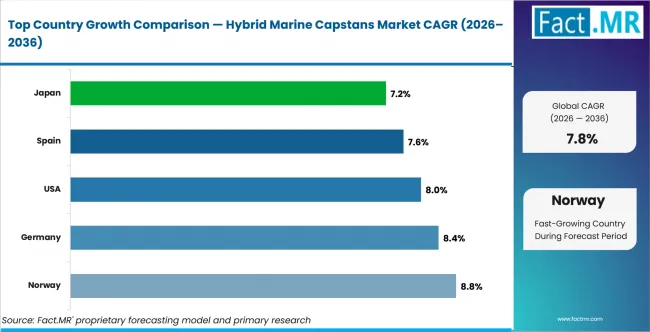
Hybrid Marine Capstans Market Cagr Analysis By Country | Source: Fact.MR
What is powering Norway’s lead?
8.8% CAGR, driven by Kongsberg Maritime and tug-focused electric deck systems.
Norway is projected to record 8.8% CAGR from 2026 to 2036 as tugboats, workboats and offshore support vessels adopt cleaner deck machinery. Hybrid capstans will benefit from the country’s marine electrification base and service ecosystem. Growth will favor remote control, load monitoring and integrated winch-control packages.
How is Germany scaling hybrid marine capstan demand?
8.4% CAGR, backed by MacGregor, including TTS heritage/assets and deck machinery electrification.
Germany is expected to post 8.4% CAGR through 2036 as shipyards and marine equipment suppliers support electric and hybrid deck systems. Demand will focus on mooring and line-handling capstans for workboats and harbor craft. Growth will favor compact systems with strong service support.
What supports the United States outlook?
8.0% CAGR, driven by Markey Machinery and workboat retrofit demand.
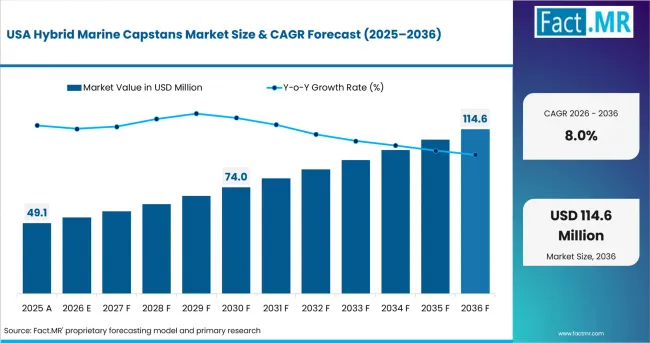
Hybrid Marine Capstans Market Country Value Analysis | Source: Fact.MR
The United States is likely to record 8.0% CAGR by 2036 as workboat, tugboat and harbor fleet operators modernize line-handling equipment. Retrofit contractors will support demand where hydraulic maintenance cost and deck safety concerns are rising. Remote and load-limited controls will shape equipment selection.
What underpins Spain’s growth?
Spain is scaling through Industrias Ferri and marine deck equipment supply.
Spain is forecast to advance at 7.6% CAGR through 2036 as shipyards and marine distributors support deck machinery upgrades across harbor and offshore craft. Hybrid electric-hydraulic capstans will gain attention where owners want transition flexibility. Growth will favor mooring, towing support and anchor-handling applications.
How is Japan scaling hybrid marine capstan adoption?
7.2% CAGR, supported by compact vessel automation and fishing fleet upgrades.
Japan is set to record 7.2% CAGR through 2036 as shipyards and vessel owners adopt compact, reliable and easy-to-control capstan systems. Fishing vessels, patrol craft and workboats will support electric and hybrid capstan demand. Growth will favor simple controls, rugged construction and service reliability.
Who leads the hybrid marine capstans market?
DMT Marine Equipment and Markey Machinery lead direct capstan coverage, while MacGregor, including TTS heritage/assets and Kongsberg Maritime strengthen electric deck machinery transition.
Hybrid marine capstans are supplied by capstan specialists, deck machinery suppliers and marine technology companies. DMT Marine Equipment is directly relevant through capstans and electrical control systems for deck machinery. Markey Machinery is directly relevant through capstan winches offered in electric, hydraulic and pneumatic models. MacGregor, including TTS heritage/assets support the category through electric deck systems and broader deck machinery expertise. Kongsberg Maritime supports the transition through electric towing and integrated marine control systems.
Industrias Ferri supports the supplier set through marine deck equipment and handling systems. Competition through 2036 will be shaped by drive reliability, compact design, remote control, load-limited operation, marine durability and retrofit support.
Which companies are the key providers?
DMT Marine Equipment and Markey Machinery are key providers. MacGregor, including TTS heritage/assets and Kongsberg Maritime are also profiled. Industrias Ferri completes the company set.
- DMT Marine Equipment
- Markey Machinery
- MacGregor, including TTS heritage/assets
- Kongsberg Maritime
- Industrias Ferri
Bibliography
- Kongsberg Maritime. (2025, May 20). Kongsberg Maritime launches new electric towing winch for tug market. Kongsberg Maritime.
- DMT Marine Equipment. (2026). Capstans. DMT Marine Equipment.
- Markey Machine. (2026). Your top marine capstan winch destination. Markey Machine.
- DMT Marine Equipment. (2026). Control systems: Complete electrical solutions for deck machinery. DMT Marine Equipment.
- International Maritime Organization. (2025, April 11). IMO approves net-zero regulations for global shipping. International Maritime Organization.
This Report Addresses
- Strategic intelligence on hybrid marine capstans across drive system and application.
- Segment analysis covering Hybrid Electric-hydraulic Systems and Mooring.
- Regional outlook covering Norway, Germany, the United States, Spain and Japan.
- Competitive analysis of DMT Marine Equipment, Markey Machinery, MacGregor, including TTS heritage/assets, Kongsberg Maritime and Industrias Ferri.
- Technology assessment covering electric drive, hybrid electric-hydraulic drive, battery-assisted systems, variable speed drive and remote control.
- Use case assessment covering mooring, towing support, line handling, anchor handling and harbor operations.
- Primary interviews, provider checks and official source review support the forecast.
What does the hybrid marine capstans market cover?
Electric, hybrid electric-hydraulic, battery-assisted, and variable-speed-drive capstans used for marine line handling.
The hybrid marine capstans market covers electric and variable speed drive systems. These capstans are used for mooring and harbor operations.
The market differs from broad deck machinery because it focuses on capstan equipment and its control features. It excludes conventional hydraulic-only capstans unless they are part of an electric-hydraulic transition package or retrofit program.
What is included in the scope?
Hybrid marine capstan systems used on working vessels and harbor craft.
The scope includes electric capstans and variable speed drive capstans. Application coverage includes mooring and harbor operations.
Vessel type coverage includes industrial workboats and patrol craft. Control coverage includes manual control and integration with winch control. Buyer-type coverage includes shipyards and marine distributors.
Hybrid capstan adoption also aligns with electric ship programs where cleaner auxiliary equipment is specified during newbuild planning. Battery-assisted designs can support electric boat platforms that need compact line-handling systems with lower onboard emissions. Offshore use cases overlap with offshore support vessels, where controlled deck handling is important during demanding marine operations. Power integration can also connect capstan selection with marine gensets when vessels balance auxiliary loads, redundancy and retrofit constraints.
What is excluded from the scope?
Hydraulic-only capstans and land-based pulling systems are outside the scope.
The scope excludes hydraulic-only capstans without electric transition logic and ordinary rope-handling accessories. It also excludes full winch systems unless the capstan component is separately specified or sold as part of a deck machinery package.
How was the analysis built?
100+ sources, 40+ company portfolios, 25+ countries, 20+ interviews.
- Primary Research:
- Primary research includes interviews with shipyards, harbor fleet operators and vessel owners. It includes input from marine distributors, retrofit contractors, deck machinery suppliers and service engineers.
- Desk Research:
- Desk research reviews official capstan product pages, electric deck machinery articles, control-system portfolios, marine electrification updates and supplier product catalogs.
- Market-Sizing and Forecasting:
- Forecasting uses vessel fleet upgrade cycles, deck machinery replacement behavior, capstan attachment rates, retrofit pricing and drive-system mix.
- Data Validation and Update Cycle:
- Forecasts are validated through provider checks and technical interviews. Product portfolio mapping, vessel type demand and marine distributor feedback help confirm market direction.
Segmentation
What is the report’s scope and coverage?
| Attribute | Details |
|---|---|
| Quantitative Units | USD Million in 2026 to USD Million by 2036 at CAGR |
| Market Definition | Electric, hybrid electric-hydraulic and battery-assisted capstans used for marine line handling |
| Drive System | Electric; hybrid electric-hydraulic; battery-assisted; variable speed drive |
| Application | Mooring; towing support; line handling; anchor handling; harbor operations |
| Vessel Type | Workboats; tugboats; ferries; offshore support vessels; patrol craft |
| Control | Manual; remote; load-limited; integrated with winch control |
| Buyer Type | Shipyards; harbor fleets; vessel owners; marine distributors |
| Regions Covered | North America; Western Europe; East Asia; South Asia; Latin America; Middle East and Africa |
| Countries Covered | Norway; Germany; United States; Spain; Japan |
| Key Companies Profiled | DMT Marine Equipment; Markey Machinery; MacGregor, including TTS heritage/assets; Kongsberg Maritime; Industrias Ferri |
| Forecast Period | 2026 to 2036 |
| Approach | Hybrid top-down and bottom-up approach using vessel upgrade cycles, capstan replacement demand, hybrid drive adoption and provider validation |
Source: Fact.MR analysis. Updated Jul 4, 2026
How is the market segmented?
-
By Drive System:
- Electric
- Hybrid electric-hydraulic
- Battery-assisted
- Variable speed drive
-
By Application:
- Mooring
- Towing support
- Line handling
- Anchor handling
- Harbor operations
-
By Vessel Type:
- Workboats
- Tugboats
- Ferries
- Offshore support vessels
- Patrol craft
-
By Control:
- Manual
- Remote
- Load-limited
- Integrated with winch control
-
By Buyer Type:
- Shipyards
- Harbor fleets
- Vessel owners
- Marine distributors
-
Region:
- North America
- United States
- Canada
- Mexico
- Western Europe
- Norway
- Germany
- Spain
- Netherlands
- United Kingdom
- East Asia
- Japan
- China
- South Korea
- South Asia
- India
- Singapore
- Thailand
- Latin America
- Brazil
- Chile
- Middle East & Africa
- UAE
- Saudi Arabia
- South Africa
- North America
Frequently Asked Questions
Which drive system leads the Hybrid Marine Capstans Market?
Which application leads the Hybrid Marine Capstans Market?
Which vessel type leads the Hybrid Marine Capstans Market?
Which control type leads the Hybrid Marine Capstans Market?
Which buyer type leads the Hybrid Marine Capstans Market?
Which country expands fastest in the Hybrid Marine Capstans Market?
How does Germany perform in the Hybrid Marine Capstans Market?
How does the United States perform in the Hybrid Marine Capstans Market?
How does Spain perform in the Hybrid Marine Capstans Market?
How does Japan perform in the Hybrid Marine Capstans Market?
What is the primary driver in the Hybrid Marine Capstans Market?
What is the main restraint in the Hybrid Marine Capstans Market?
Why are hybrid electric-hydraulic systems important?
Why do shipyards dominate demand?
Who worked on this report


Preview the report firsthand - request a free sample
Free SampleGet the brochure for pricing and purchase details
Download PDF