- Market Value (2025): USD 26.7 Mn
- Estimated Value (2026): USD 35 Mn
- Forecast Value (2036): USD 520.9 Mn
- CAGR (2026-2036): 31.0%
What is the hydrogen ground power units market forecast to be worth by 2036?
USD 35 million in 2026 to USD 520.9 million by 2036, at 31.0% CAGR.
- The hydrogen ground power units market crossed a valuation of USD 26.7 million in 2025.
- Demand is expected to increase from USD 35 million in 2026 to USD 520.9 million by 2036.
- The market is forecast to record 31.0% CAGR from 2026 to 2036 as hydrogen GPUs move from demonstrator units into early fleet conversion programs.
- These deployments also support airport operation workflows when aircraft ground power is tied to cleaner turnaround operations.
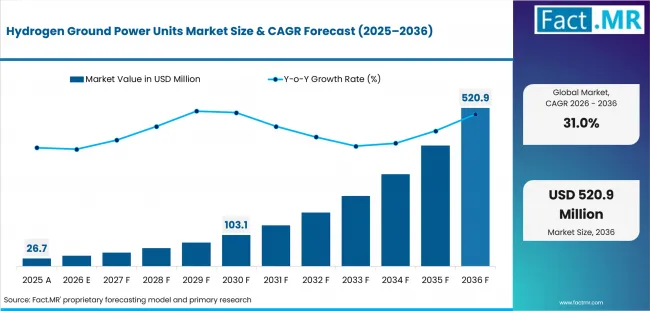
Hydrogen Ground Power Units Market Market Value Analysis | Source: Fact.MR
What are the defining numbers behind hydrogen ground power units market growth?
USD 485.9 million absolute opportunity by 2036, led by mobile units and airport hydrogen hubs.
- Demand Drivers in the Market
- Airports need zero-emission ground power where diesel GPUs still serve remote stands.
- Airlines need reliable gate power that reduces APU use during turnaround.
- Ground handlers need faster refueling options where battery charging creates downtime.
- Hydrogen hubs need early equipment uses that build daily airport hydrogen demand.
- Key Segments Analyzed
- By Power Rating: Narrowbody GPUs are expected to hold 39.0% share in 2026 because early trials fit regional and single-aisle aircraft needs.
- By Fuel System: Fuel-cell modules lead because they are the core conversion pathway. The segment is projected to capture 42.0% share in 2026.
- By Application: Gate power is likely to account for 36.0% share in 2026 because parked aircraft need stable electrical supply.
- By Customer Type: Airports are expected to hold 35.0% share in 2026 because they shape infrastructure and safety approvals.
- By Deployment: Pilot projects are projected to record 48.0% share in 2026 because the category is still moving through operational validation.
- Analyst Opinion at Fact.MR
- Shambhu Nath Jha, Senior Analyst at Fact.MR, states, “Hydrogen ground power units are still early, but the use case is clear. Airports need clean power for aircraft without creating long charging queues or remote-stand downtime. The market will grow where hydrogen GPUs prove reliability and competitive operating cost against battery and diesel alternatives.”
- Strategic Implications
- GPU manufacturers should prove runtime, refueling speed and aircraft power compatibility in live airport pilots.
- Airports should test hydrogen GPUs first at remote stands and high-use gate clusters.
- Ground handlers should compare TCO against diesel and battery GPUs under real shift patterns.
- Hydrogen infrastructure partners should link GPU pilots with wider airport hydrogen hub planning.
Schiphol tested the world’s first hydrogen-powered GPU connected to an aircraft in 2024 through the TULIPS partnership. This supports the market boundary because hydrogen GPUs are now being tested in live airport conditions. Hydrogen GPU pilots also connect with air start unit planning where airports modernize aircraft support equipment around lower-emission ramp operations.
The Netherlands is projected to record 34.2% CAGR through 2036 as Schiphol-led hydrogen GPU testing shapes early adoption. Germany is expected to post 32.6% CAGR through 2036 as Dynell and EKPO-linked fuel-cell equipment pathways support airport prototypes. The United Kingdom is likely to record 31.8% CAGR as hydrogen airport trials and ground support equipment pilots expand. The United States is forecast to advance at 30.5% CAGR as airport hydrogen hub studies mature. Japan is set to record 29.4% CAGR as Toyota fuel-cell expertise support hydrogen ground operations.
How does the hydrogen ground power units market break down by segment?
Narrowbody GPUs lead at 39.0%; pilot projects lead at 48.0%.
Which power rating dominates?
Narrowbody GPUs hold 39.0% share in 2026.
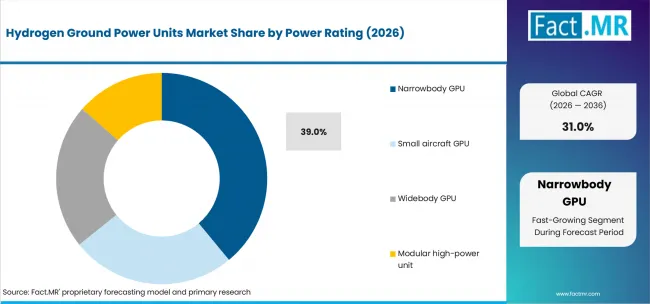
Hydrogen Ground Power Units Market Analysis By Power Rating | Source: Fact.MR
Narrowbody GPUs are expected to hold 39.0% share in 2026 because early airport trials are focused on practical aircraft power supply rather than very high-capacity widebody operations. Small aircraft GPUs follow where regional aircraft and maintenance areas need lower power. Widebody GPUs will grow as fuel-cell stacks scale. Modular high-power units are relevant for future fleet conversion and fixed gate use. Dynell stated in 2024 that its DHM 090 hydrogen GPU delivers 400 Hz and 28 VDC power for aircraft ground operations.
Which fuel system dominates?
Fuel-cell modules hold 42.0% share in 2026.
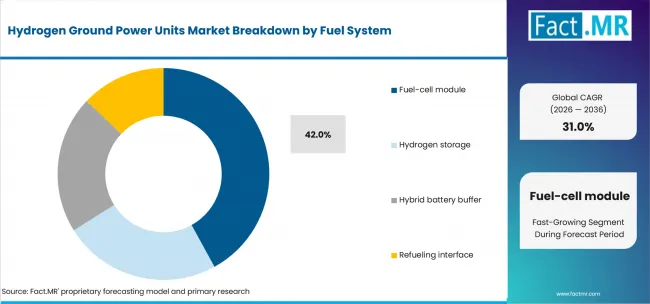
Hydrogen Ground Power Units Market Analysis By Fuel System | Source: Fact.MR
Fuel-cell modules lead because they convert hydrogen into aircraft ground power while keeping the system emission-free at the point of use. The fuel-system segment is projected to capture 42.0% share in 2026 as developers test compact power modules and power electronics. Hydrogen storage follows because runtime and refueling safety depend on tank design. Hybrid battery buffers help manage peak load. Refueling interfaces become critical as airports move from demonstration to repeated use. EKPO supplied an NM5-evo fuel cell stack for an aircraft power supply unit at Amsterdam Airport Schiphol in 2024.
Which application dominates?
Gate power at 36.0%, dominates by hydrogen GPU demand.
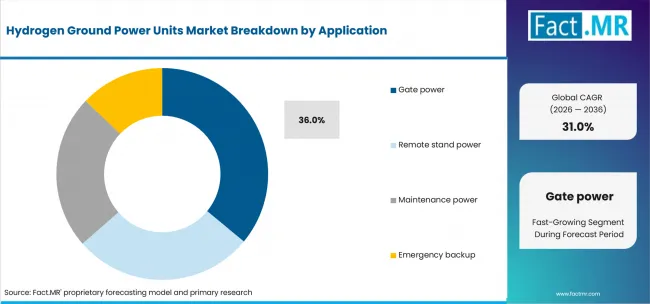
Hydrogen Ground Power Units Market Analysis By Application | Source: Fact.MR
Gate power leads because stationary aircraft need stable electrical power for cabin and cockpit systems. The application segment is likely to account for 36.0% share in 2026 as airports test hydrogen GPUs at stands where diesel equipment remains in use. Remote stand power follows because mobile hydrogen units can avoid long battery charging cycles. Maintenance power supports hangar and apron operations. Emergency backup remains smaller but useful where airports need resilience during grid limits. Cleaner ground power also supports sequencing with belt loaders when aircraft servicing begins after power connection.
Which customer type dominates?
Airports hold 35.0% share in 2026.
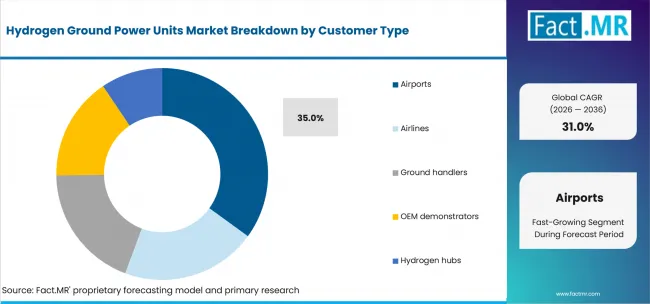
Hydrogen Ground Power Units Market Analysis By Customer Type | Source: Fact.MR
Airports lead because hydrogen GPUs require safety approval, refueling access and infrastructure coordination. The customer type segment is expected to hold 35.0% share in 2026 as airports coordinate hydrogen pilots with airlines and ground handlers. Airlines follow because aircraft turnaround and APU reduction are operational priorities. Ground handlers operate the equipment and influence fleet conversion. OEM demonstrators are important at the pilot stage. Hydrogen hubs support broader infrastructure planning. Airbus stated in 2024 that hydrogen airport ecosystems must address supply, storage and distribution before hydrogen operations can scale.
Which deployment dominates?
Pilot projects hold 48.0% share in 2026.
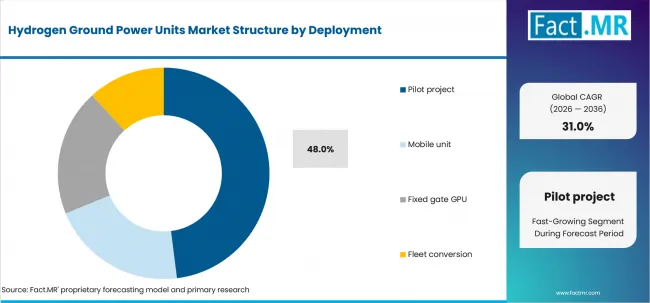
Hydrogen Ground Power Units Market Analysis By Deployment | Source: Fact.MR
Pilot projects lead because hydrogen GPUs are still in operational validation. The deployment segment is projected to record 48.0% share in 2026 as airports test runtime, refueling, safety procedures and aircraft compatibility. Mobile units follow because they can serve remote stands and reduce infrastructure lock-in. Fixed gate GPUs will grow after hydrogen supply becomes reliable. Fleet conversion remains longer-term because airports must compare total cost against battery eGPUs and diesel units. ITW GSE reported in 2024 that dnata added electric GPUs in Dubai as part of a wider shift away from fossil-fuel engines.
What is accelerating Hydrogen Ground Power Units Market adoption, and what is holding it back?
Airport decarbonization and remote-stand uptime drive it; hydrogen supply and TCO uncertainty restrain it.
Drivers Impact Analysis
| DRIVER | (~) % IMPACT ON CAGR | GEOGRAPHIC RELEVANCE | IMPACT TIMELINE |
|---|---|---|---|
| Airport decarbonization pushing diesel GPUs toward zero-emission options | +3.1% | Netherlands, Germany, United States, Japan | Short term (≤ 2 years) |
| Hydrogen refueling reducing downtime versus some battery-only workflows | +2.6% | Large hubs and remote stand airports | Medium term (2–4 years) |
| Fuel-cell modules improving mobile high-power ground supply | +2.2% | Europe, North America, East Asia | Medium term (2–4 years) |
| Airport hydrogen hubs creating shared refueling infrastructure | +1.9% | Europe, United States, Japan, UAE | Long term (≥ 4 years) |
| Ground handling sustainability programs increasing pilot funding | +1.5% | Global, strongest in large hub airports | Short term (≤ 2 years) |
Source: Fact.MR analysis. Updated Jul 6, 2026
- Airport decarbonization
- Airport decarbonization is the strongest driver because diesel GPUs still create local emissions and noise around aircraft stands. Hydrogen units can provide clean point-of-use power where fixed electricity or battery charging is difficult. This driver is strongest where airports already run hydrogen or electric GSE pilots. It also supports cleaner workflows around aircraft tugs when airports modernize ramp fleets together.
- Hydrogen refueling
- Hydrogen refueling supports demand because battery GPUs may need dedicated charging time and charger access. A hydrogen GPU can be refueled more like conventional mobile equipment if safe infrastructure is available. This matters at remote stands and high-use apron zones. The driver depends on tanker access, refueling procedures and staff training.
- Fuel-cell module progress
- Fuel-cell module progress supports adoption because aircraft GPUs need reliable power output under varying load. Compact fuel-cell stacks and hybrid battery buffers can improve performance. This helps developers serve narrowbody aircraft and maintenance power first. Fuel-cell design will need strong uptime evidence before fleet conversion.
- Airport hydrogen hubs
- Airport hydrogen hubs create long-term support because GPUs can become one of several daily hydrogen uses. Ground power can share infrastructure with airport vehicles and future aircraft applications. This improves the business case for hydrogen storage and refueling. Hub planning also supports aircraft tow tractors when towing fleets move toward hydrogen or other zero-emission options.
- Ground handling sustainability
- Ground handling sustainability programs increase pilot funding because airports and airlines need measurable decarbonization steps before hydrogen aircraft arrive. Hydrogen GPUs are practical because they serve existing aircraft. Ground handlers can test operating procedures without changing the aircraft fleet. The driver will grow as safety rules and refueling standards become clearer.
Opportunity Impact Analysis
| OPPORTUNITY | (~) % IMPACT ON CAGR | GEOGRAPHIC RELEVANCE | IMPACT TIMELINE |
|---|---|---|---|
| Mobile hydrogen GPUs for remote stands | +2.4% | Netherlands, United States, India, UAE | Short term (≤ 2 years) |
| Hybrid battery buffers for peak aircraft power demand | +2.0% | Europe, Japan, North America | Medium term (2–4 years) |
| Fixed gate GPUs tied to airport hydrogen hubs | +1.7% | Europe, United States, Japan | Long term (≥ 4 years) |
| Fleet conversion bundles combining GPU, refueling and service support | +1.4% | Large hub airports globally | Long term (≥ 4 years) |
Source: Fact.MR analysis. Updated Jul 6, 2026
- Mobile hydrogen GPUs
- Mobile hydrogen GPUs create opportunity because they can serve gates and remote stands without major fixed electrical work. Airports can test them on selected routes or aircraft types before wider deployment. This reduces infrastructure risk. Mobile units also fit airports with seasonal peaks or dispersed apron layouts.
- Hybrid battery buffers
- Hybrid battery buffers create opportunity because fuel cells can be paired with batteries for peak load and transient response. This can improve power stability during aircraft servicing. Buffers also help the fuel-cell module run more efficiently. The opportunity is strongest for narrowbody and future widebody units.
- Fixed gate GPUs
- Fixed gate hydrogen GPUs create opportunity when airports build hydrogen supply and storage networks. Fixed systems can support predictable stands with high utilization. They may also reduce the movement of mobile units around busy aprons. This use case will scale after hydrogen logistics mature.
- Fleet conversion bundles
- Fleet conversion bundles can combine hydrogen GPUs and operator training. This helps airports move beyond one-off pilots. It also gives ground handlers clearer service support. The bundle approach can include safety documentation and TCO tracking.
Restraints Impact Analysis
| RESTRAINT | (~) % IMPACT ON CAGR | GEOGRAPHIC RELEVANCE | IMPACT TIMELINE |
|---|---|---|---|
| Limited hydrogen supply and refueling access at airports | -2.6% | Global | Short term (≤ 2 years) |
| TCO uncertainty versus battery eGPUs and fixed electrical power | -2.2% | Global, strongest in budget-constrained airports | Medium term (2–4 years) |
| Safety approval and operating procedures for apron hydrogen use | -1.9% | Europe, North America, Japan | Medium term (2–4 years) |
| Small commercial supplier base beyond demonstrator units | -1.5% | Global | Long term (≥ 4 years) |
Source: Fact.MR analysis. Updated Jul 6, 2026
- Hydrogen supply limits
- Hydrogen supply limits are the main restraint because most airports do not yet have regular airside hydrogen refueling. Mobile supply can work for pilots, but fleet conversion needs dependable delivery and storage. Airports must manage safety zones and refueling access. This slows adoption outside major demonstration hubs.
- TCO uncertainty
- TCO uncertainty slows purchasing because airports already compare diesel, fixed electrical power and battery eGPUs. Hydrogen units need proof on fuel cost, stack life and utilization. Remote stands may justify the premium sooner than easy-to-electrify gates. Clear operating data will be needed before larger orders.
- Safety approval
- Safety approval is critical because hydrogen must be handled near aircraft and ramp teams. Airports need refueling rules and staff training. Permitting can take time. Demonstrations will help define safe operating models.
- Supplier base
- The supplier base is still small because hydrogen GPUs are not yet a mature catalog product. Many offerings are prototypes or pilot units built through partnerships. This can raise cost and service risk. Larger GSE manufacturers may enter after early demonstrations prove the use case.
Which countries are scaling hydrogen ground power units fastest?
Netherlands 34.2%; Germany 32.6%; United Kingdom 31.8%; United States 30.5%; Japan 29.4%.
Based on regional analysis, the hydrogen ground power units market is segmented into North America, Western Europe, East Asia, South Asia, Latin America, and Middle East and Africa.
Country CAGR
| Country | CAGR |
|---|---|
| Netherlands | 34.2% |
| Germany | 32.6% |
| United Kingdom | 31.8% |
| United States | 30.5% |
| Japan | 29.4% |
Source: Fact.MR analysis. Updated Jul 6, 2026
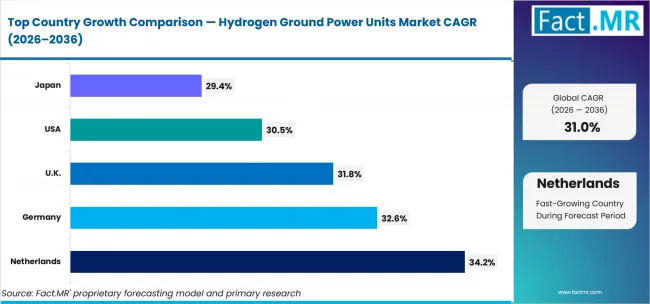
Hydrogen Ground Power Units Market Cagr Analysis By Country | Source: Fact.MR
What is powering the Netherlands lead?
34.2% CAGR, driven by Schiphol and live hydrogen GPU testing.
The Netherlands is projected to record 34.2% CAGR from 2026 to 2036 as Schiphol and TULIPS partners build early evidence for hydrogen GPU use. Growth will favor pilot projects, mobile units and refueling-interface validation. Airport hydrogen logistics will remain central to adoption.
How is Germany scaling hydrogen GPU demand?
Germany is at 32.6%, scaling through Dynell and EKPO fuel-cell equipment pathways.
Germany is expected to post 32.6% CAGR through 2036 as fuel-cell stack suppliers and GPU developers support hydrogen ground power prototypes. Demand will focus on modular power systems, hybrid battery buffers and aircraft power compatibility. Growth will favor suppliers that can prove field durability and serviceability.
What supports the United Kingdom outlook?
31.8% CAGR, driven by hydrogen airport trials and low-emission GSE programs.
The United Kingdom is likely to record 31.8% CAGR over the study period as airport trials and hydrogen ground support equipment projects expand. Early demand will focus on mobile GPUs and remote stand applications. TCO versus battery eGPUs will shape adoption at regional airports and larger hubs.
What underpins the United States growth?
The United States is at 30.5%, scaling through airport hydrogen hub studies.
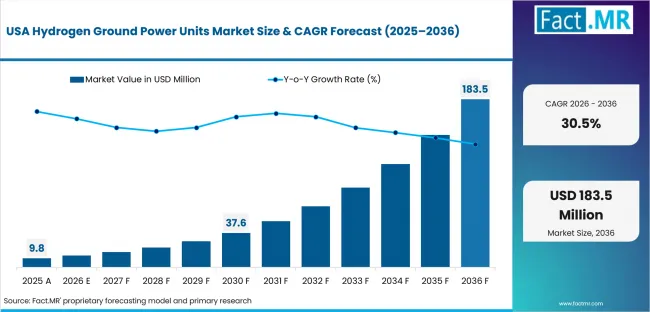
Hydrogen Ground Power Units Market Country Value Analysis | Source: Fact.MR
The United States is forecast to advance at 30.5% CAGR through 2036 as hydrogen infrastructure studies connect airports, airlines and fuel-cell suppliers. Plug Power’s ground support fuel-cell ecosystem supports wider airport fleet use cases. Ramp equipment planning can also connect hydrogen GPUs with aircraft refueler workflows where apron fuel movement and safety procedures already require strict controls.
How is Japan scaling hydrogen GPU adoption?
29.4% CAGR, driven by Toyota fuel-cell expertise.
Japan is set to record 29.4% CAGR through 2036 as hydrogen airport infrastructure studies and fuel-cell expertise support low-emission ground operations. Growth will favor pilot projects, modular high-power units and hydrogen hub planning. Hydrogen GPU deployment may scale alongside hydrant dispensers modernization where airports coordinate safer fuel and energy servicing at stands.
Who leads the hydrogen ground power units market?
Dynell and zepp.solutions lead the most direct hydrogen GPU evidence, while ITW GSE and Powervamp are stronger electric GPU benchmarks.
Hydrogen ground power units are supplied by early H2-GPU developers, fuel-cell providers and airport hydrogen ecosystem partners. Dynell and zepp.solutions are directly relevant through the DHM 090 hydrogen GPU tested at Schiphol. EKPO supports the category through fuel-cell stack supply for aircraft ground power. Plug Power is relevant through fuel-cell ground support equipment and hydrogen refueling infrastructure. Plug Power states that fuel-cell-powered GSE supports zero-emission operation and faster refueling compared with some battery workflows.
ITW GSE and Powervamp are important adjacent suppliers because they shape the electric GPU benchmark against which hydrogen GPUs are compared. Hydrogen GPU adoption will also interact with proton exchange membrane hydrogen fuel cell development because compact stacks are central to mobile airport power units.
Competition through 2036 will be shaped by runtime and TCO versus battery eGPUs. Ground handler fleet planning can also connect with ground support equipment tires replacement cycles when airports convert older diesel GSE fleets toward zero-emission platforms.
Which companies are the key providers?
Dynell and zepp.solutions are direct hydrogen GPU developers. ITW GSE and Powervamp are adjacent electric GPU benchmarks.
- ITW GSE
- Powervamp
- Dynell
- zepp.solutions
Bibliography
- Schiphol. (2024, August 5). World first at Schiphol: Airport tests the first hydrogen GPU. Schiphol.
- zepp.solutions. (2024, August 6). Hydrogen GPU tests kicked off at Schiphol. zepp.solutions.
- Dynell. (2024, August 27). Dynell presents the DHM 090. Dynell.
- EKPO Fuel Cell Technologies. (2024, June 4). EKPO fuel cell stack for power supply unit at Amsterdam Airport. EKPO Fuel Cell Technologies.
- Plug Power. (2026). Ground support equipment (GSE) powered by fuel cells. Plug Power.
- Airbus. (2024, September 2). Developing a global ecosystem to support hydrogen-powered flight. Airbus.
This Report Addresses
- Strategic intelligence on hydrogen ground power units across power rating and fuel system.
- Segment analysis covering Narrowbody GPUs and Fuel-cell Modules.
- Regional outlook covering the Netherlands, Germany, United Kingdom, United States and Japan.
- Competitive analysis of ITW GSE, Powervamp, Dynell, zepp.solutions.
- Technology assessment covering fuel-cell modules, hydrogen storage, hybrid battery buffers and refueling interfaces.
- Use case assessment covering gate power, remote stand power, maintenance power and emergency backup.
- Pilot-readiness screening separates hydrogen GPU demonstrators from mature battery eGPU fleets.
- Primary interviews, provider checks and official source review support the forecast.
What does the hydrogen ground power units market cover?
Hydrogen-powered GPUs that provide electrical power to parked aircraft at gates, stands and maintenance areas.
The hydrogen ground power units market covers small aircraft GPUs, narrowbody GPUs, widebody GPUs and modular high-power units. Fuel-system coverage includes fuel-cell modules, hydrogen storage, hybrid battery buffers and refueling interfaces.
The market differs from broad electric GPU coverage because the hydrogen fuel system is central to the product. It excludes diesel GPUs and conventional fixed electrical ground power systems unless hydrogen is part of the power architecture.
What is included in the scope?
Fuel-cell GPUs and mobile or fixed aircraft ground power systems.
The scope includes small aircraft GPUs, narrowbody GPUs, widebody GPUs and modular high-power units. Application coverage includes gate power, remote stand power, maintenance power and emergency backup.
Customer coverage includes airports and hydrogen hubs. Deployment coverage includes pilot projects, mobile units, fixed gate GPUs and fleet conversion. Hydrogen GPUs can also work near passenger boarding bridge systems when fixed gate power and aircraft docking workflows are coordinated.
What is excluded from the scope?
Diesel GPUs, battery-only GPUs and non-airport hydrogen generators are outside the scope.
The scope excludes conventional diesel ground power units, battery-only electric GPUs, fixed grid power systems without hydrogen backup and general fuel-cell generators used outside airports. It also excludes hydrogen aircraft propulsion unless the same infrastructure directly supports airport ground power units.
How was the analysis built?
100+ sources, 40+ company portfolios, 25+ countries, 20+ interviews.
- Primary Research:
- Primary research includes interviews with airport sustainability teams, GSE fleet managers and ground handlers. It includes input from fuel-cell developers, GPU manufacturers, hydrogen infrastructure providers and airline engineering teams.
- Desk Research:
- Desk research reviews official hydrogen GPU trials, fuel-cell stack announcements, airport hydrogen hub programs, eGPU fleet deployments and ground handling sustainability priorities.
- Market-Sizing and Forecasting:
- Forecasting uses airport pilot activity, GSE electrification plans, fuel-cell module cost, hydrogen refueling readiness and remote-stand power demand.
- Data Validation and Update Cycle:
- Forecasts are validated through provider checks and technical interviews. Pilot performance and TCO versus battery GPUs help confirm market direction.
Segmentation
What is the report’s scope and coverage?
| Attribute | Details |
|---|---|
| Quantitative Units | USD Million in 2026 to USD Million by 2036 at CAGR |
| Market Definition | Hydrogen-powered GPUs that provide electrical power to parked aircraft at gates, stands and maintenance areas |
| Power Rating | Small aircraft GPU; narrowbody GPU; widebody GPU; modular high-power unit |
| Fuel System | Fuel-cell module; hydrogen storage; hybrid battery buffer; refueling interface |
| Application | Gate power; remote stand power; maintenance power; emergency backup |
| Customer Type | Airports; airlines; ground handlers; OEM demonstrators; hydrogen hubs |
| Deployment | Pilot project; mobile unit; fixed gate GPU; fleet conversion |
| Regions Covered | North America; Western Europe; East Asia; South Asia; Latin America; Middle East and Africa |
| Countries Covered | Netherlands; Germany; United Kingdom; United States; Japan |
| Key Companies Profiled | ITW GSE; Powervamp; Dynell; zepp.solutions |
| Forecast Period | 2026 to 2036 |
| Approach | Hybrid top-down and bottom-up approach using pilot deployments, GPU fleet conversion, airport hydrogen readiness, TCO versus battery GPUs and provider validation |
Source: Fact.MR analysis. Updated Jul 6, 2026
How is the market segmented?
-
By Power Rating:
- Small aircraft GPU
- Narrowbody GPU
- Widebody GPU
- Modular high-power unit
-
By Fuel System:
- Fuel-cell module
- Hydrogen storage
- Hybrid battery buffer
- Refueling interface
-
By Application:
- Gate power
- Remote stand power
- Maintenance power
- Emergency backup
-
By Customer Type:
- Airports
- Airlines
- Ground handlers
- OEM demonstrators
- Hydrogen hubs
-
By Deployment:
- Pilot project
- Mobile unit
- Fixed gate GPU
- Fleet conversion
-
Region:
- North America
- United States
- Canada
- Western Europe
- Netherlands
- Germany
- United Kingdom
- France
- Spain
- East Asia
- Japan
- China
- South Korea
- South Asia
- India
- Singapore
- Thailand
- Latin America
- Brazil
- Mexico
- Chile
- Middle East & Africa
- UAE
- Saudi Arabia
- South Africa
- North America
Frequently Asked Questions
Which power rating leads the Hydrogen Ground Power Units Market?
Which fuel system leads the Hydrogen Ground Power Units Market?
Which application leads the Hydrogen Ground Power Units Market?
Which customer type leads the Hydrogen Ground Power Units Market?
Which deployment leads the Hydrogen Ground Power Units Market?
Which country expands fastest in the Hydrogen Ground Power Units Market?
How does Germany perform in the Hydrogen Ground Power Units Market?
How does the United Kingdom perform in the Hydrogen Ground Power Units Market?
How does the United States perform in the Hydrogen Ground Power Units Market?
How does Japan perform in the Hydrogen Ground Power Units Market?
What is the primary driver in the Hydrogen Ground Power Units Market?
What is the main restraint in the Hydrogen Ground Power Units Market?
Why are fuel-cell modules important?
Why do airports dominate demand?
Who worked on this report


Preview the report firsthand - request a free sample
Free SampleGet the brochure for pricing and purchase details
Download PDF