- Market Value (2025): USD 768.7 Mn
- Estimated Value (2026): USD 832.0 Mn
- Forecast Value (2036): USD 1836.5 Mn
- CAGR (2026-2036): 8.2%
What is the Hydrophilic Nonwoven Additives Market forecast to be worth by 2036?
USD 832.0 million in 2026 to USD 1836.5 million by 2036 at an 8.2% CAGR.
- The wetting web agents Market was valued at USD 768.7 million in 2025.
- Demand is expected to increase from USD 832.0 million in 2026 to USD 1836.5 million by 2036.
- The market is forecast to record an 8.2% CAGR from 2026 to 2036. Hygiene. health and test webs require set moisture flow.
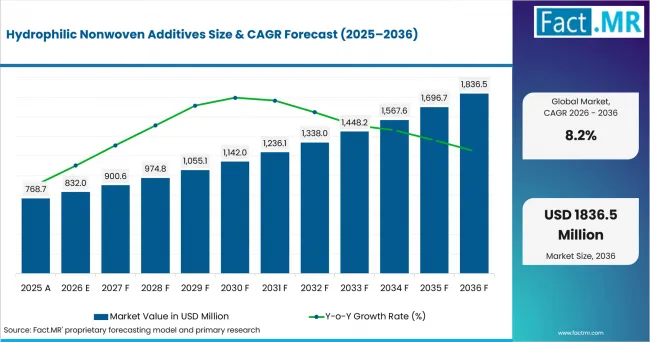
Hydrophilic Nonwoven Additives Value Analysis | Source: Fact.MR
What are the defining numbers behind Hydrophilic Nonwoven Additives Market growth?
USD 1004.5 million of absolute opportunity is expected between 2026 and 2036.
- Demand Drivers in the Market
- Hygiene converters need fast strike-through in topsheets so liquid reaches the absorbent structure and leaves a drier contact surface. Adjacent tissue and hygiene products rely on the same fluid-transfer function. Melt-integrated hydrophilic chemistry is expected to help converters control wetting at production speed while limiting dependence on a separate surface-treatment stage.
- Health-material teams need wettable webs that retain softness. Process stability while meeting composition and extract levels needs.
- Spunbond and meltblown producers are expected to value melt-integrated agents. surface role can be introduced during resin line work. Carried into the finished web. The approach can simplify line design. The agent performs consistently across resin lots. vendors are expected to support adoption with dosing guidance. Ageing data tied to the intended web construction.
- Test-cloth producers are expected to use controlled wicking where filtration. Cleaning fabrics require predictable moisture flow across the treated structure. plant webs can need a different balance of wetting speed. Lasting use than hygiene products. agent selection is therefore expected to depend on fiber chemistry plus the contact conditions faced by the finished material.
- Key Segments Analyzed
- By Additive Platform: Migratory surfactant masterbatch is expected to hold 30.0% share in 2026 owing to direct incorporation during polymer processing. The platform connects with broader additive masterbatch use in functional polymer modification.
- By Host Polymer: PP is projected to account for 40.0% share in 2026 because polypropylene is widely used in spunbond and meltblown structures. Its wetting response is closely linked to the chemistry of surfactants used for surface-energy control.
- By Application: Nonwovens are anticipated to capture 45.0% share in 2026 as wetting additives are used in hygiene, medical and technical webs.
- By Performance: Wicking speed is estimated to represent 35.0% share in 2026 due to its direct role in fluid movement through treated structures.
- Analyst Opinion at Fact.MR
- Fact.MR Principal Consultant Shambhu Nath Jha states, “Hydrophilic additives connect polymer processing with fluid-management performance. Demand is expected to favour formulations that keep wetting behaviour consistent after converting and storage. Suppliers should combine polymer compatibility data with practical wicking and extractables testing.”
- Strategic Implications
- Blend vendors should document how loading changes strike-through. Rewet in PP webs. results data should cover the intended basis weight and line range. Converters can compare mixes under realistic output conditions. Clear dose-response information is expected to reduce trial iterations. A line moves from laboratory test to market output.
- Converters should qualify agents on the intended line. Migration behaviour can change with resin grade and thermal history. Trials should examine wetting after conversion. After storage instead of relying on an immediate wetting check alone. The testing plan is expected to connect agent loading with line speed. The fluid-handling target of the finished web.
- Health-material teams should review composition. Extract levels data before they approve mix changes.
- Hygiene producers should test aged samples. Immediate wetting gives only the first view of lasting use after storage. Rewet and strike-through should be checked after the converted web has experienced normal packaging and handling conditions. Formulators are expected to gain an advantage. They can explain how migration develops over time. How that behaviour changes fluid transfer.
South Korea is expected to record 10.3% CAGR through 2036. Czech Republic is expected at 9.1%. While the United States is forecast at 8.3%. Japan is expected at 7.7% and Germany at 6.6%. Country conditions differ through healthcare use. Web conversion and resin-line work activity.
How does the Hydrophilic Nonwoven Additives Market break down by segment?
Webs are expected to lead use at 45.0% share in 2026. PP is expected to lead Host resin at 40.0% share.
Which Additive Platform dominates?
Migratory surfactant blend is expected to hold 30.0% share in 2026.
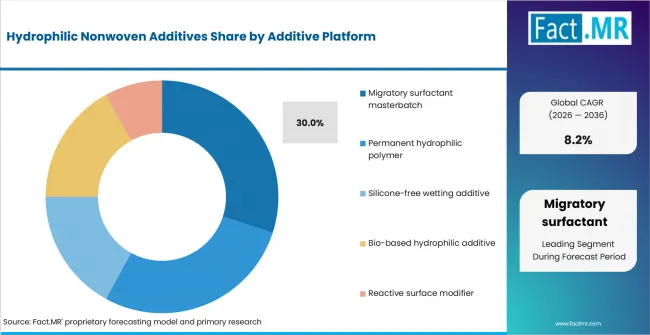
Hydrophilic Nonwoven Additives Analysis By Additive Platform | Source: Fact.MR
Migratory surfactant blends give converters a direct route to reduce surface resistance to water during resin line work. Permanent wetting polymers address longer-duration functionality. Ageing stability has greater weight. Silicone-free wetting agents serve specifications centered on alternative surface mix. Bio-based and reactive options address feedstock choice or lasting use needs. Formulators are expected to compare these platforms on dosing efficiency. Retained wettability after storage.
What leads the Host Polymer segment?
PP is expected to account for 40.0% share in 2026.
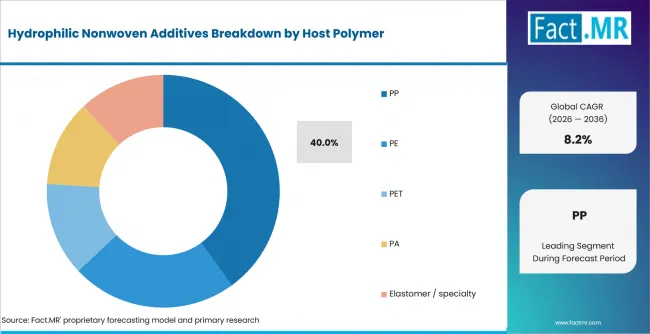
Hydrophilic Nonwoven Additives Analysis By Host Polymer | Source: Fact.MR
Polypropylene is central to spunbond and meltblown nonwovens used in hygiene and medical products. Hydrophilic additives raise surface affinity when fluid intake is required. Broader synthetic and bio-based polypropylene applications show the importance of fiber-grade PP in textile structures. PE and PET serve structures where softness or dimensional stability changes the formulation choice. PA and specialty polymers remain relevant where thermal or mechanical requirements justify a different additive system.
How does Application shape demand?
webs are expected to capture 45.0% share in 2026.
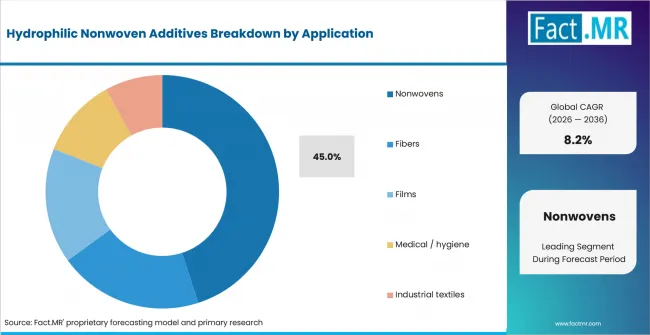
Hydrophilic Nonwoven Additives Analysis By Application | Source: Fact.MR
Nonwovens are anticipated to capture 45.0% share in 2026 because fluid-handling layers are common in hygiene and medical nonwoven disposables. In April 2026 EDANA reported that nonwovens production in Greater Europe reached 2,919,000 tonnes in 2025. The production base gives additive suppliers a broad set of spunmelt and converted-web applications where wetting performance can be specified. Suppliers are expected to focus on repeatable strike-through and rewet behaviour across high-speed converting conditions.
What supports Wicking Speed within Performance?
Wicking speed is expected to represent 35.0% share in 2026.
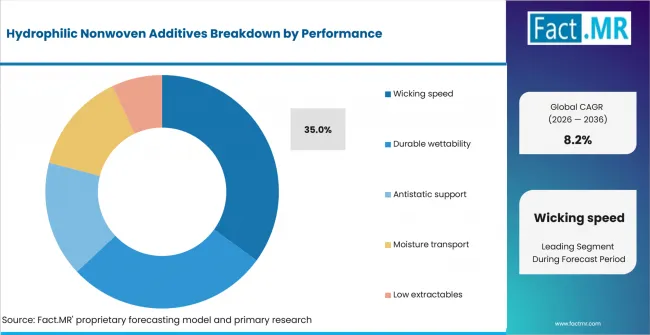
Hydrophilic Nonwoven Additives Analysis By Performance | Source: Fact.MR
Wicking speed gives converters a direct measure of how rapidly liquid moves through or across a treated structure. Durable wettability becomes relevant when results must persist after storage. Antistatic support serves uses where charge control accompanies moisture management. Low extract levels gain weight in health. Hygiene uses with tighter composition needs. results claims are expected to be backed by test conditions. Match the intended fiber and fluid system.
What is accelerating Hydrophilic Nonwoven Additives Market adoption, and what is holding it back?
Hygiene and health fluid control needs support demand. testing and lasting use needs can slow mix changes.
Drivers Impact Analysis
| DRIVER | (~) % IMPACT ON CAGR | GEOGRAPHIC RELEVANCE | IMPACT TIMELINE |
|---|---|---|---|
| Hygiene fluid management | +1.6% | Global | Short term (<= 2 years) |
| Medical nonwoven demand | +1.2% | North America, Europe, East Asia | Medium term (2-4 years) |
| Melt-integrated modification | +0.9% | Global | Medium term (2-4 years) |
| Wicking specifications | +0.6% | Global | Long term (>= 4 years) |
Source: Fact.MR analysis. Updated Sep 22, 2026
Opportunity Impact Analysis
| OPPORTUNITY | (~) % IMPACT ON CAGR | GEOGRAPHIC RELEVANCE | IMPACT TIMELINE |
|---|---|---|---|
| Durable hydrophilic systems | +1.0% | Global | Medium term (2-4 years) |
| Low-extractables formulations | +0.8% | North America, Europe, East Asia | Medium term (2-4 years) |
| Bio-based platforms | +0.5% | Europe, North America | Long term (>= 4 years) |
Source: Fact.MR analysis. Updated Sep 22, 2026
Restraints Impact Analysis
| RESTRAINT | (~) % IMPACT ON CAGR | GEOGRAPHIC RELEVANCE | IMPACT TIMELINE |
|---|---|---|---|
| Qualification burden | -0.6% | Medical and hygiene markets | Short term (<= 2 years) |
| Wettability loss | -0.5% | Global | Medium term (2-4 years) |
| Input-cost variability | -0.3% | Global | Short term (<= 2 years) |
Source: Fact.MR analysis. Updated Sep 22, 2026
Which countries are scaling the Hydrophilic Nonwoven Additives Market through 2036?
- The country comparison spans 3.7 percentage points from South Korea at 10.3% to Germany at 6.6%.
- South Korea remains 1.2 percentage points above Czech Republic. Hygiene conversion and health-material needs support agent use.
- Czech Republic remains 0.8 percentage point above the United States. Plastics and cloth output provide a local converting base.
- The United States remains 0.6 percentage point above Japan through domestic cloth making and healthcare use. Japan remains 1.1 percentage points above Germany. High-specification hygiene uses support agent testing.
- Germany closes the displayed range at 6.6%. Health-material use and resin-conversion capability support wetting agent testing.
Comparable CAGRs can create different entry conditions. Healthcare use and conversion capability vary by country. Full report coverage spans North America. Latin America, Western Europe, Eastern Europe. East Asia, South Asia & Pacific, and Middle East & Africa.
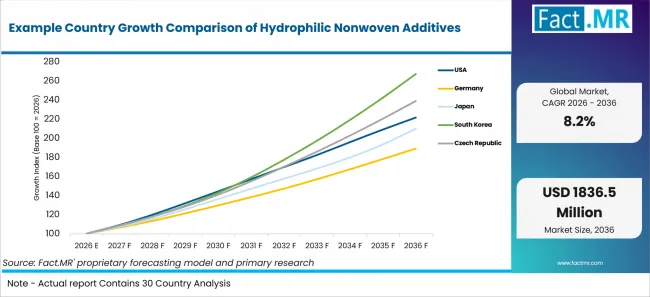
Example Country Growth Comparison Of Hydrophilic Nonwoven Additives | Source: Fact.MR
| Country | CAGR (2026-2036) |
|---|---|
| South Korea | 10.3% |
| Czech Republic | 9.1% |
| United States | 8.3% |
| Japan | 7.7% |
| Germany | 6.6% |
Source: Fact.MR analysis. Updated Sep 22, 2026
What supports South Korea adoption?
10.3% CAGR, supported by hygiene demand and a growing infant-care cohort.
South Korea combines a developed resin-line work base with recurring demand from hygiene and health uses. Statistics Korea reported in February 2026. The preliminary number of live births in the country reached 254,457 in 2025. Up 6.8% from 2024. The larger annual birth cohort supports diaper and baby-care volumes. Wetting topsheets and acquisition layers need controlled liquid transfer. PP remains a practical host resin for these structures. Converters can combine low basis weight with softness and output speed. agent vendors are expected to gain. They can document stable wetting after storage. Provide mix guidance for spunbond or meltblown lines. Local formulators are expected to benefit. Agents combine controlled strike-through with stable results after warehousing and high-speed conversion.
How is Czech Republic scaling demand?
9.1% CAGR, led by plastics output and web conversion.
Czech Republic has a plant base. Links resin line work with test-cloth and web conversion. The Czech Statistical Office reported in February 2026. Plant output increased 1.5% in 2025. With rubber and plastic products contributing positively to the annual result. That activity gives agent vendors a relevant customer base for PP-compatible wetting systems used in hygiene. Health and plant webs. Durable or reactive surface modifiers can fit uses. Converted materials move through export supply chains. Require consistent results after storage. test support is expected to carry weight. Converters test agent loading against line speed and fiber properties. Regional converters are expected to value agent systems. Transfer across export-oriented output. Keeping dosing and wetting behaviour consistent.
What supports United States adoption?
8.3% CAGR, shaped by domestic cloth making and healthcare uses.
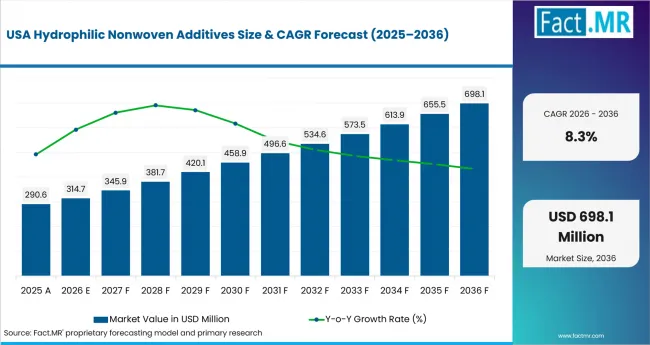
Hydrophilic Nonwoven Additives Country Value Analysis | Source: Fact.MR
The United States combines domestic fiber. Fabric output with large health and personal-care end uses. The U.S. Bureau of Labor Statistics reported in September 2026. Seasonally adjusted employment in U.S. cloth mills stood at a preliminary 78,300 workers in August 2026. The plant base supports local trials of agent blends in fibers. Web webs before scale-up. health and hygiene converters are expected to focus on strike-through. Rewet and extract levels when qualifying wetting systems. vendors with responsive test service can shorten mix work by matching agent chemistry to PP grades. Thermal history and required wetting lasting use. The market advantage is expected to come from test support. Connects laboratory wetting results with repeatable results on output-scale web gear.
How does Japan perform?
7.7% CAGR, backed by resin-line work capability and high-specification hygiene uses.
Japan combines established resin line work with demanding quality expectations for hygiene. Health and specialty cloth uses. Japan's Ministry of Economy, Trade and Industry reported in February 2026. The 2025 output index for plastic products was 98.0. Was up 0.1% from 2024. That activity provides a domestic base for functional agents across PP and other host polymers. wetting systems are expected to find value. Converters need controlled wicking or durable wetting after ageing. mix vendors can differentiate through consistent dosing guidance. Results data that fits precise output settings. mix partners are expected to gain. They can support precise dosing and ageing checks. Fit Japan's quality-focused converting environment.
What is supporting Germany adoption?
6.6% CAGR, driven by health use and established resin-conversion capability.
Germany combines established chemical supply with a large healthcare system and experienced web conversion. Destatis reported in November 2025. German hospitals recorded about 17.5 million inpatient treatments in 2024. Up 2.0% from 2023. Hospital activity supports recurring demand for disposable health materials. Wettability can influence fluid handling and comfort. The country’s resin and cloth engineering base gives formulators access to testing. Output expertise across PP and specialty fibers. agent vendors are expected to compete on repeatable wicking results. Ageing stability and records. Supports health or hygiene testing. Local test teams are expected to favour vendors. Can link surface-energy modification with reproducible web results during testing and scale-up.
Who leads the Hydrophilic Nonwoven Additives Market?
Competition depends on how well surface-modifying agents work with host polymers and fiber-line conditions. vendors must also meet the required end-use results. Techmer PM unveiled its CoLab at the Dalton Fiber Center in May 2025. The facility houses an use lab, color lab. And design center and provides pilot-plant capability for real-time material. Product testing and work. Techmer PM also documents expertise across webs. A range of plastics and fiber-line work tech.
Avient and Croda provide resin-agent tech for fiber. Web, health, hygiene, and related uses. Croda offers wetting finishes for polyolefin webs. Avient provides functional agents for spunbond and meltblown webs. vendors compete on wetting results, lasting use. Records, process fit, and test support.
Which companies are the key providers?
Companies profiled include Avient. Americhem. Fine Organic Industries. Croda. and Techmer PM.
- Avient
- Americhem
- Fine Organic Industries
- Croda
- Techmer PM
How is the market segmented?
-
By Additive Platform
- Migratory surfactant masterbatch
- Permanent hydrophilic polymer
- Silicone-free wetting additive
- Bio-based hydrophilic additive
- Reactive surface modifier
-
By Host Polymer
- PP
- PE
- PET
- PA
- Elastomer / specialty
-
By Application
- Nonwovens
- Fibers
- Films
- Medical / hygiene
- Industrial textiles
-
By Performance
- Wicking speed
- Durable wettability
- Antistatic support
- Moisture transport
- Low extractables
-
By Region
- North America
- Latin America
- Western Europe
- Eastern Europe
- East Asia
- South Asia & Pacific
- Middle East & Africa
Bibliography
- Techmer PM. (2025, May 14). Techmer PM unveils CoLab and Fibertech Connect at Dalton Fiber Center.
- Centers for Medicare & Medicaid Services. (2026, January 14). Historical. National Health Expenditure Data.
- Czech Statistical Office. (2026, February 6). Industrial production increased by 1.5% in 2025 [Supplementary information to the news release on industry – December 2025].
- EDANA. (2026, April 7). 2025 nonwoven production in Greater Europe: European nonwovens industry remains strong amid challenging market conditions.
- Statistisches Bundesamt (Destatis). (2025, November 6). 2,0 % mehr stationäre Krankenhausbehandlungen im Jahr 2024 [2.0% more inpatient hospital treatments in 2024].
- Ministry of Economy, Trade and Industry. (2026, February 27). Indices of industrial production.
- Statistics Korea. (2026, February 25). Vital statistics in December 2025.
This Report Answers
- The report explains where hydrophilic additive platforms are used across fibers and nonwovens. It also covers related surface-modification applications where liquid transfer is a defined material requirement.
- Segment analysis identifies the leading 2026 subsegments across additive platform and host polymer. Application and performance dimensions show where formulation choices connect with fluid-handling requirements.
- Country analysis examines the listed markets and the healthcare or manufacturing conditions supporting adoption. Each country block uses one official post-2024 statistic to anchor the local market context.
- Competitive analysis reviews the profiled providers and the factors that shape product qualification across biomedical textiles and related functional nonwoven uses. The analysis focuses on product fit and technical support. Company-share estimates are outside the report scope.
- Application analysis assesses how wicking speed and durable wettability influence formulation choices. It also considers low extractables and moisture transport in qualified nonwoven uses.
What does the Hydrophilic Nonwoven Additives Market cover?
The Hydrophilic Nonwoven Additives Market covers additives and fiber-finish systems used to increase water affinity, strike-through or wicking in synthetic fibers and nonwoven webs. The scope includes PP, PE, PET, PA and specialty structures. Adjacent demand includes baby disposable diapers and consumer wet wipes as well as medical disposables.
What is included in the scope?
The scope includes melt-blendable hydrophilic masterbatches and permanent hydrophilic polymer systems. It also covers silicone-free wetting additives, bio-based additives, and reactive surface modifiers used in fibers, films, and nonwovens. Related technical textiles are included when surface modification controls liquid movement.
What is excluded from the scope?
Finished adult diapers, wipes, gowns and absorbent cores fall outside the scope when the functional additive is sold as part of the finished article. Commodity resin and primarily hydrophobic barrier additives fall outside the defined market boundary.
How Was the Analysis Built?
The analysis draws on 120+ sources, 35+ company portfolios, 25+ countries, and more than 20 industry interviews.
- Primary Research: Primary research includes discussions with manufacturers, service providers, technology developers, distributors, end users, and subject-matter experts. These conversations examine purchasing priorities, product adoption, operational challenges, approval requirements, competitive positioning, and the factors that influence wider market acceptance.
- Desk Research: Desk research covers government statistics, regulatory publications, company filings, trade data, technical studies, industry associations, standards, public policy, and other authoritative sources. Every source used in the analysis is documented in the bibliography.
- Market Sizing and Forecasting: Market estimates combine historical performance, demand indicators, pricing and volume trends, segment shares, company participation, country-level growth, adoption patterns, investment activity, and barriers to market expansion.
- Data Validation and Update Cycle: Findings are validated by comparing primary interviews with public data, company activity, regulatory changes, trade patterns, and industry developments. Regular updates review new product launches, capacity changes, partnerships, approvals, and shifts in commercial adoption.
Segmentation
What is the report’s scope and coverage?
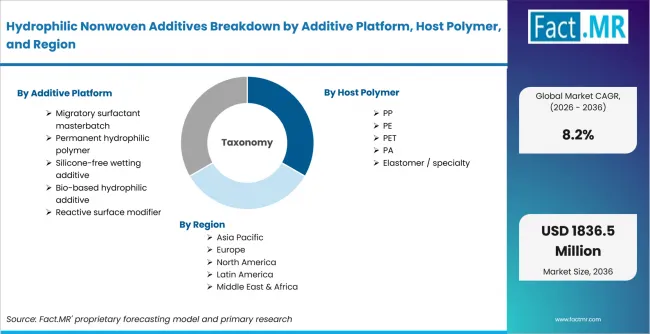
Hydrophilic Nonwoven Additives Breakdown By Additive Platform, Host Polymer, And Region | Source: Fact.MR
| Attribute | Details |
|---|---|
| Quantitative Units | USD million |
| Market Definition | Additives used in polymer fibers or nonwoven webs to improve wettability, wicking or moisture transport. |
| Additive Platform | Migratory surfactant masterbatch; Permanent hydrophilic polymer; Silicone-free wetting additive; Bio-based hydrophilic additive; Reactive surface modifier |
| Host Polymer | PP; PE; PET; PA; Elastomer / specialty |
| Application | Nonwovens; Fibers; Films; Medical / hygiene; Industrial textiles |
| Performance | Wicking speed; Durable wettability; Antistatic support; Moisture transport; Low extractables |
| Regions Covered | North America; Latin America; Western Europe; Eastern Europe; East Asia; South Asia & Pacific; Middle East & Africa |
| Countries Covered | United States; Germany; Japan; South Korea; Czech Republic |
| Key Companies Profiled | Avient; Americhem; Fine Organic Industries; Croda; Techmer PM |
| Forecast Period | 2026 to 2036 |
| Approach | Government evidence, company portfolios, application demand and provider validation. |
Source: Fact.MR analysis. Updated Sep 22, 2026
Frequently Asked Questions
How big is the hydrophilic nonwoven additives market in 2026?
What is the CAGR of the hydrophilic nonwoven additives market from 2026 to 2036?
Which host polymer leads the hydrophilic nonwoven additives market?
Which application leads the hydrophilic nonwoven additives market?
Who are the leading companies in the hydrophilic nonwoven additives market?
Who worked on this report


Preview the report firsthand - request a free sample
Free SampleGet the brochure for pricing and purchase details
Download PDF