Point of Care Drug of Abuse Testing Market

Point of Care Drug of Abuse Testing Market Size and Share Forecast Outlook 2025 to 2035

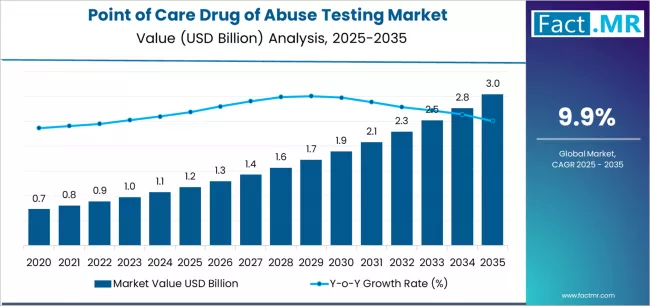
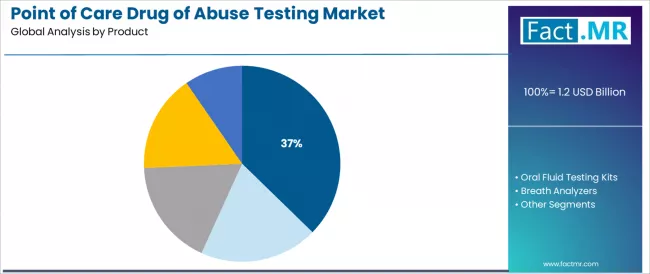
Point of care drug of abuse testing market is projected to grow from USD 1.2 billion in 2025 to USD 3.0 billion by 2035, at a CAGR of 9.9%. Immunoassay Test Strips and Cassettes will dominate with a 37.3% market share, while urine will lead the sample type segment with a 42.7% share.

Point of Care Drug of Abuse Testing Market Forecast and Outlook 2025 to 2035

The global point of care drug of abuse testing market is projected to reach USD 3.04 billion by 2035, recording an absolute increase of USD 1.86 billion over the forecast period. The market is valued at USD 1.18 billion in 2025 and is set to rise at a CAGR of 9.8% during the assessment period.

The overall market size is expected to grow by approximately 2.6 times during the same period, supported by increasing workplace drug screening mandates and expanding roadside testing programs across law enforcement agencies worldwide, driving demand for rapid diagnostic solutions and increasing investments in portable testing technologies with clinical accuracy across occupational health and emergency department applications globally.

Quick Stats for Point of Care Drug of Abuse Testing Market

  • Point of Care Drug of Abuse Testing Market Value (2025): USD 1.18 billion
  • Point of Care Drug of Abuse Testing Market Forecast Value (2035): USD 3.04 billion
  • Point of Care Drug of Abuse Testing Market Forecast CAGR: 9.8%
  • Leading Product Type in Point of Care Drug of Abuse Testing Market: Immunoassay Test Strips and Cassettes (37.3%)
  • Key Growth Regions in Point of Care Drug of Abuse Testing Market: North America, Asia Pacific, and Europe
  • Top Players in Point of Care Drug of Abuse Testing Market: Abbott, Quest Diagnostics, Thermo Fisher Scientific, OraSure Technologies, Siemens Healthineers, F. Hoffmann-La Roche Ltd., Drägerwerk AG & Co. KGaA, Premier Biotech, Inc., LabCorp, Greenlane Holdings

Point Of Care Drug Of Abuse Testing Market Market Value Analysis

Healthcare providers and employers face mounting pressure to implement immediate drug detection protocols while addressing public safety concerns and regulatory compliance requirements, with modern point of care testing devices providing documented therapeutic benefits including instant results, reduced laboratory turnaround times, and improved clinical decision-making compared to conventional laboratory-based testing methods alone.

Rising awareness about substance abuse prevention and expanding telehealth platforms enabling remote testing supervision create substantial opportunities for manufacturers and healthcare partners. However, limited standardization across testing protocols and regulatory variations across markets may pose obstacles to widespread adoption.

The immunoassay test strips and cassettes segment dominates market activity, driven by extensive clinical validation supporting rapid screening capabilities and cost-effective deployment across diverse testing environments worldwide. Healthcare providers and employers increasingly recognize the operational benefits of immunoassay platforms, with typical product offerings providing effective drug detection and reliable results at accessible price points through established diagnostic distribution networks.

The urine sample type segment demonstrates robust presence, supported by established collection protocols and comprehensive drug detection panels addressing multiple substance categories in modern screening approaches. Lateral flow assay technology emerges as the dominant platform, reflecting industry preference for simple visual interpretation and minimal training requirements in point of care testing applications. Hospitals and emergency departments represent the leading end use category, driven by immediate clinical decision-making needs and acute intoxication management protocols enabling rapid patient assessment.

Regional dynamics show North America maintaining market leadership, supported by comprehensive workplace drug testing regulations and established screening programs across occupational health categories. Asia Pacific demonstrates the fastest growth trajectory driven by increasing road safety initiatives and expanding awareness about substance abuse prevention, while Europe emphasizes standardized testing protocols and quality assurance for diagnostic reliability.

USA leads country-level growth through extensive federal workplace regulations and law enforcement adoption, followed by China supported by expanding transportation safety programs and government anti-drug initiatives. The competitive landscape features moderate concentration with Abbott maintaining market leadership position, while specialized players including Quest Diagnostics, Thermo Fisher Scientific, OraSure Technologies, and Siemens Healthineers compete through comprehensive product portfolios and integrated laboratory service offerings across diverse testing applications.

Point of Care Drug of Abuse Testing Market Year-over-Year Forecast 2025 to 2035

Between 2025 and 2029, the point of care drug of abuse testing market is projected to expand from USD 1.18 billion to USD 1.67 billion, resulting in a value increase of USD 0.49 billion, which represents 26.3% of the total forecast growth for the period. This phase of development will be shaped by rising demand for workplace screening programs and roadside testing enforcement, product innovation in digital connectivity and cloud-based result management systems, as well as expanding integration with occupational health platforms and law enforcement protocols. Companies are establishing competitive positions through investment in biosensor technologies, smartphone integration capabilities, and strategic market expansion across hospital emergency departments, workplace testing facilities, and law enforcement distribution models.

From 2029 to 2035, the market is forecast to grow from USD 1.67 billion to USD 3.04 billion, adding another USD 1.37 billion, which constitutes 73.7% of the overall expansion. This period is expected to be characterized by the expansion of specialized product applications, including multi-panel testing devices and saliva-based screening solutions tailored for specific enforcement scenarios, strategic collaborations between diagnostic manufacturers and occupational health service providers, and an enhanced focus on regulatory harmonization and quality control standards. The growing emphasis on connected diagnostics and rising preference for non-invasive sample collection methods will drive demand for comprehensive screening solutions across diverse user populations.

Point of Care Drug of Abuse Testing Market Key Takeaways

Metric Value
Market Value (2025) USD 1.18 billion
Market Forecast Value (2035) USD 3.04 billion
Forecast CAGR (2025-2035) 9.8%

Why is the Point of Care Drug of Abuse Testing Market Growing?

The point of care drug of abuse testing market grows by enabling healthcare providers, employers, and law enforcement agencies to implement immediate drug screening protocols while addressing public safety requirements and regulatory compliance mandates without exclusive reliance on centralized laboratory infrastructure.

Organizations face mounting pressure to detect substance abuse and implement prevention programs while managing workplace safety risks, transportation security concerns, and clinical emergency situations, with modern point of care testing devices typically providing rapid results including instant drug detection, comprehensive panel coverage, and documented chain of custody compared to traditional laboratory methods alone, making immediate screening essential for comprehensive substance abuse management.

The occupational health industry's need for accessible and reliable diagnostic solutions creates demand for specialized point of care testing products that can provide immediate results, reduce operational downtime, and support regulatory documentation without compromising accuracy standards or causing excessive testing delays. Healthcare provider adoption and regulatory enforcement supporting point of care testing drive implementation in emergency departments, workplace health clinics, and law enforcement environments, where immediate results have direct impact on patient care decisions and safety interventions.

The increasing substance abuse prevalence globally, affecting diverse populations across workplace and community settings, creates expanding testing requirements seeking rapid screening approaches. Rising awareness about the operational and clinical benefits of immediate drug detection enables informed technology adoption and adherence to standardized protocols. Variability in cutoff thresholds among different testing platforms and limited confirmation capabilities at point of care may restrict complete laboratory replacement and optimal diagnostic workflows among diverse testing scenarios with different accuracy requirements.

Segmental Analysis

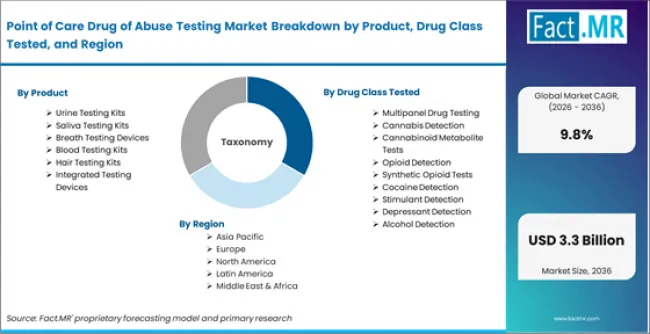
The market is segmented by product, sample type, technology, end use, and region. By product, the market is divided into immunoassay test strips and cassettes, oral fluid testing kits, breath analyzers, urine collection cups, and digital/portable analyzers. Based on sample type, the market is categorized into urine, saliva (oral fluid), breath, blood, and sweat/hair. By technology, the market includes lateral flow assay (LFA), chromatographic immunoassays, enzyme-linked immunosorbent assay (ELISA), and mass spectrometry (portable or hybrid POC units).

Based on end use, the market is divided into hospitals & emergency departments, workplace & occupational health centers, home care & remote users, and others. Regionally, the market is divided into Asia Pacific, Europe, North America, Latin America, and Middle East & Africa.

By Product, Which Segment Accounts for the Dominant Market Share?

Point Of Care Drug Of Abuse Testing Market Analysis By Product

The immunoassay test strips and cassettes segment represents the dominant force in the point of care drug of abuse testing market, capturing 37.3% of the total market share in 2025. This category encompasses solutions featuring clinically validated screening capabilities and multi-drug detection technologies, including advanced lateral flow platforms combining visual interpretation systems and digital readers that enable superior operational efficiency and user compliance across workplace testing and emergency department applications worldwide.

The immunoassay segment's market leadership stems from its superior cost-effectiveness profile, with solutions capable of addressing comprehensive drug screening requirements including common substances of abuse while maintaining excellent ease of use standards and rapid turnaround characteristics across diverse testing populations.

The oral fluid testing kits segment maintains a substantial market share in the 20.9% range, serving organizations and agencies that require non-invasive collection methods addressing privacy concerns and supervised collection protocols for roadside testing, workplace screening, and home monitoring applications. These solutions offer practical advantages for environments where urine collection proves challenging or inappropriate while providing sufficient detection windows to support effective screening programs.

The oral fluid segment demonstrates strong growth potential, driven by expanding law enforcement adoption and increasing preference for observed collection procedures. Within the product category, breath analyzers demonstrate established presence in alcohol detection applications, driven by widespread adoption in law enforcement and workplace safety programs requiring immediate impairment assessment. This sub-segment benefits from portable design advantages and real-time measurement capabilities.

Key operational advantages driving the immunoassay segment include:

  • Advanced multi-panel configurations with clinically demonstrated detection of diverse substance classes including opioids, cannabinoids, amphetamines, and benzodiazepines across testing scenarios
  • Established ease of use characteristics allowing minimal training requirements and straightforward visual interpretation without extensive technical expertise
  • Enhanced affordability features enabling cost-effective screening programs while maintaining test integrity and regulatory compliance
  • Superior workflow integration providing optimal operational efficiency for high-volume testing environments across various organizational settings

By Sample Type, Which Segment Accounts for the Largest Market Share?

Point Of Care Drug Of Abuse Testing Market Analysis By Sample Type

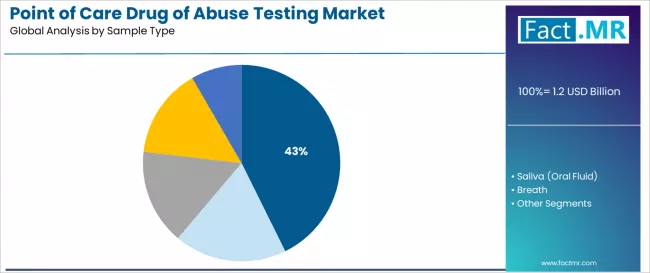
Urine dominates the point of care drug of abuse testing sample type landscape with approximately 42.7% market share in 2025, reflecting the critical role of urine specimens in supporting comprehensive drug detection panels, extended detection windows, and established clinical validation protocols across testing populations worldwide.

The urine segment's market leadership is reinforced by healthcare provider familiarity with collection procedures, regulatory acceptance for workplace and legal testing programs, and compatibility with diverse immunoassay platforms that characterize comprehensive substance abuse screening protocols.

Within this segment, urine collection represents the preferred specimen type for many testing scenarios, driven by its ability to detect recent drug use across multiple substance categories, accommodate standardized collection protocols, and support temperature verification for specimen validity assessment. This sub-segment benefits from established regulatory frameworks and extensive clinical precedent supporting admissibility in legal proceedings.

The saliva (oral fluid) segment represents a rapidly growing sample type category, demonstrating strong expansion through specialized requirements for non-invasive collection, reduced adulteration potential, and roadside testing applications in law enforcement environments. This segment benefits from donor acceptance patterns that prioritize dignity and convenience in observed collection scenarios.

The breath segment maintains meaningful presence through alcohol detection applications and immediate impairment assessment capabilities, while the blood category serves specific scenarios requiring definitive confirmation and medical-legal documentation.

Key market dynamics supporting sample type growth include:

  • Urine specimen expansion driven by comprehensive drug panels and extended detection windows, requiring standardized collection procedures and temperature monitoring
  • Saliva format modernization trends require specialized collection devices for adequate specimen volume and stability preservation
  • Integration of specimen validity testing enabling adulteration detection and improved result reliability across testing populations
  • Growing emphasis on alternative specimen types and collection convenience driving specimen diversification without compromising detection capabilities

By Technology, Which Segment Accounts for a Significant Market Share?

Point Of Care Drug Of Abuse Testing Market Analysis By Technology

Lateral flow assay (LFA) represents the leading technology segment in the point of care drug of abuse testing market with approximately 50.8% market share in 2025, reflecting the fundamental role of immunochromatographic platforms in rapid screening applications and visual result interpretation. The lateral flow technology segment demonstrates consistent demand driven by the need to provide immediate drug detection without instrument dependencies, laboratory infrastructure, or extensive operator training across diverse testing environments and user skill levels.

The chromatographic immunoassays segment emerges as an important technology category with robust presence, driven by organizations requiring enhanced sensitivity and quantitative capabilities while maintaining point of care accessibility. Testing facilities seeking improved detection limits require specialized immunoassay platforms capable of supporting regulatory thresholds and confirmation pathways for positive screening results.

Within technology applications, enzyme-linked immunosorbent assay (ELISA) demonstrates established adoption as organizations seek laboratory-quality performance in decentralized settings. Mass spectrometry applications address definitive identification needs, including confirmatory testing and forensic documentation that support legal proceedings and medical review processes.

Key technology dynamics include:

  • Lateral flow assay requirements accelerating across workplace and emergency settings with emphasis on rapid results and operational simplicity
  • Chromatographic immunoassay applications driving demand for enhanced analytical performance and quantitative measurement capabilities
  • ELISA platform adoption prioritizing batch testing efficiency and comprehensive quality control integration
  • Mass spectrometry integration emphasizing definitive substance identification and forensic documentation supporting legal defensibility

By End Use, Which Segment Accounts for the Dominant Market Share?

Point Of Care Drug Of Abuse Testing Market Analysis By End Use

Hospitals and emergency departments dominate the point of care drug of abuse testing end use landscape with a 44.3% market share in 2025, reflecting the critical role of immediate diagnostic capabilities in supporting acute care decisions, overdose management protocols, and trauma assessment procedures across emergency medicine applications worldwide. The hospital segment's market leadership is reinforced by clinical requirements for rapid turnaround times, comprehensive drug screening capabilities, and integration with electronic medical records that reduce treatment delays in time-sensitive clinical scenarios.

Within this segment, emergency departments represent the primary implementation environment, driven by acute intoxication presentations, trauma evaluations requiring toxicology assessment, and behavioral health consultations demanding immediate substance use documentation. This sub-segment benefits from superior reimbursement structures and clinical decision support protocols that justify point of care testing investments.

The workplace and occupational health centers segment represents an important end use category demonstrating steady growth through regulatory compliance requirements, pre-employment screening mandates, and post-accident investigation protocols. Employers implementing drug-free workplace programs require accessible testing solutions that minimize operational disruption and support timely hiring decisions.

The home care and remote users segment maintains meaningful presence through consumer demand for personal monitoring tools and parental supervision applications, while other settings serve niche requirements including correctional facilities and rehabilitation programs.

Key market dynamics supporting end use growth include:

  • Hospital channel expansion driven by emergency department protocols and acute care requirements, requiring comprehensive panel coverage and rapid result delivery
  • Workplace testing modernization trends require mobile collection capabilities and chain of custody documentation supporting legal defensibility
  • Integration of telehealth supervision models enabling remote witnessed collection and real-time result transmission
  • Growing emphasis on decentralized testing strategies driving adoption beyond traditional laboratory settings without sacrificing quality standards

What are the Drivers, Restraints, and Key Trends of the Point of Care Drug of Abuse Testing Market?
The market is driven by three concrete demand factors tied to public health and safety outcomes. First, expanding workplace drug testing mandates and occupational safety regulations create growing testing volumes seeking efficient screening solutions, with point of care platforms representing a critical operational approach to regulatory compliance in comprehensive workplace health programs, requiring widespread product availability. Second, increasing law enforcement focus on impaired driving prevention drives roadside testing adoption, with numerous jurisdictions implementing mandatory screening programs demonstrating significant improvements in traffic safety and deterrence effectiveness through immediate detection capabilities by 2030. Third, rising substance abuse prevalence and opioid epidemic concerns enable more comprehensive emergency department screening approaches that improve clinical outcomes while supporting appropriate treatment referrals and reducing misdiagnosis risks.

Market restraints include variable regulatory acceptance and quality control requirements across jurisdictions that can challenge consistent implementation and result defensibility, particularly in regions where point of care testing faces stricter oversight and confirmation testing mandates proving more stringent. Specimen adulteration concerns and collection integrity challenges pose another significant obstacle, as drug screening programs depend on valid specimens and chain of custody documentation, potentially affecting result reliability and legal admissibility. Healthcare reimbursement limitations and cost containment pressures create additional barriers for hospital adoption, demanding extensive clinical justification and operational efficiency demonstrations.

Key trends indicate accelerated digital connectivity adoption in developed markets, particularly North America and Europe, where organizations demonstrate willingness to invest in cloud-based platforms enabling remote result management, quality control monitoring, and regulatory reporting automation. Oral fluid testing expansion trends toward roadside screening applications and workplace programs with supervised collection requirements and reduced privacy concerns that optimize compliance and donor acceptance. However, the market thesis could face disruption if significant advances in wearable biosensors or continuous monitoring technologies reduce reliance on traditional point of care screening methodologies.

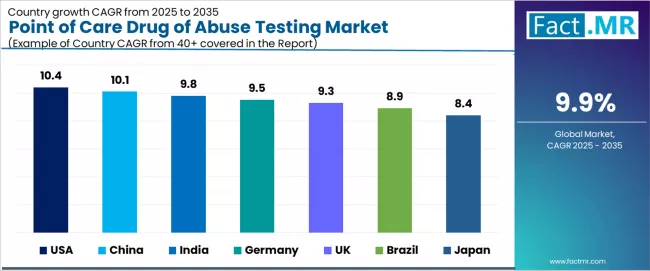
Analysis of the Point of Care Drug of Abuse Testing Market by Key Countries

Point Of Care Drug Of Abuse Testing Market Cagr Analysis By Country

Country CAGR (2025 to 2035)
USA 10.4%
China 10.1%
India 9.8%
Germany 9.5%
UK 9.3%
Brazil 8.9%
Japan 8.4%

The global point of care drug of abuse testing market is expanding rapidly, with USA leading at a 10.4% CAGR through 2035, driven by comprehensive workplace regulations, law enforcement adoption, and established emergency department protocols. China follows at 10.1%, supported by expanding road safety programs, workplace testing requirements, and government anti-drug initiatives. India records 9.8%, reflecting growing awareness about substance abuse prevention and expanding occupational health infrastructure.

Germany advances at 9.5%, leveraging quality standards and workplace safety emphasis. UK posts 9.3%, focusing on roadside testing programs and occupational health integration, while Japan grows steadily at 8.4%, emphasizing quality manufacturing and clinical validation. Brazil demonstrates 8.9% growth, anchored by expanding workplace safety regulations and transportation sector requirements.

How is USA Leading Global Market Expansion?

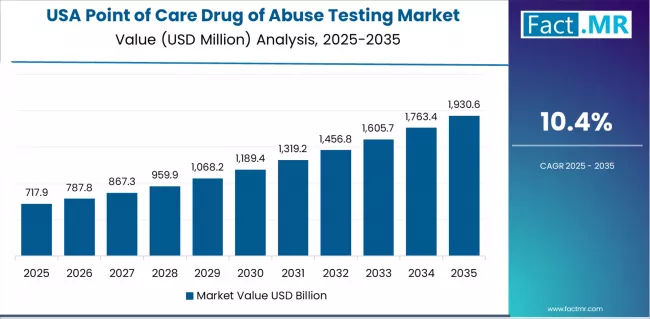
Point Of Care Drug Of Abuse Testing Market Country Value Analysis

USA demonstrates the strongest growth potential in the point of care drug of abuse testing market with a CAGR of 10.4% through 2035. The country's leadership position stems from comprehensive federal workplace drug testing regulations, extensive law enforcement roadside screening programs, and established emergency department toxicology protocols driving adoption of rapid diagnostic solutions.

Growth is concentrated in major metropolitan areas and industrial regions, including Texas, California, Florida, and the Northeast corridor, where organizations are increasingly implementing mandatory drug-free workplace programs and transportation safety requirements beyond conventional laboratory-based approaches.

Distribution channels through occupational health service providers, hospital purchasing groups, and law enforcement supply networks expand product accessibility across employer populations and public safety agencies. The country's established testing infrastructure combined with regulatory enforcement provides strong momentum for point of care solutions, including comprehensive adoption across industries with safety-sensitive positions and federal contractor requirements.

Key market factors:

  • Workplace populations concentrated in manufacturing, transportation, and construction sectors with mandatory screening requirements
  • Distribution growth through national occupational health chains including Concentra, WorkCare, and regional providers enabling convenient access
  • Comprehensive law enforcement adoption ecosystem, including state police agencies with proven roadside testing capabilities
  • Domestic manufacturing presence featuring companies like Abbott and Premier Biotech offering FDA-cleared devices and competitive pricing

Why is China Emerging as a High-Growth Market?

In major urban centers including Beijing, Shanghai, Guangzhou, and Shenzhen, the adoption of point of care drug testing solutions is accelerating across workplace and transportation sectors, driven by government anti-drug campaigns and growing emphasis on road safety enforcement. The market demonstrates strong growth momentum with a CAGR of 10.1% through 2035, linked to comprehensive workplace safety modernization trends and increasing focus on substance abuse prevention across employment sectors.

Chinese organizations are implementing mandatory drug testing programs integrated with occupational health assessments to enhance workplace safety while meeting growing regulatory expectations in manufacturing environments. The country's expanding middle class creates ongoing demand for quality-assured diagnostic products, while increasing emphasis on traffic safety drives adoption of roadside screening devices among law enforcement agencies.

Key development areas:

  • Urban workplace populations leading drug testing adoption with emphasis on manufacturing safety and transportation compliance
  • Distribution expansion through both hospital procurement channels and occupational health service networks
  • Technology integration enabling smartphone connectivity and cloud-based result management systems
  • Growing preference for domestically manufactured products alongside imported premium brands offering advanced capabilities

What Drives USA Market Resilience?

USA’s market expansion is driven by diverse regulatory requirements, including federal contractor mandates in government-regulated industries and Department of Transportation rules across commercial transportation segments. The country demonstrates steady growth potential with a CAGR of 10.4% through 2035, supported by continuous product innovation from established diagnostic manufacturers and specialized occupational health testing providers.

American organizations face implementation challenges related to state-level regulatory variations and workplace privacy considerations, requiring testing programs to balance compliance obligations with employee rights protections. However, established drug-free workplace cultures and high litigation awareness create stable baseline demand for point of care testing, particularly among employers in safety-sensitive industries where immediate results drive primary operational decisions.

Market characteristics:

  • Safety-sensitive employment sectors showing robust demand with substantial annual testing volumes across transportation and construction applications
  • Regional preferences varying between comprehensive panel testing in urban markets and targeted screening in rural employment settings
  • Future projections indicate continued technology advancement with emphasis on oral fluid testing and digital connectivity
  • Growing emphasis on medication-assisted treatment monitoring and prescription drug abuse detection supporting expanded testing applications

How does Germany Demonstrate Quality Leadership?

The market in Germany leads in quality-assured point of care testing adoption based on integration with occupational health frameworks and pharmaceutical-grade manufacturing standards for enhanced diagnostic reliability. The country shows strong potential with a CAGR of 9.5% through 2035, driven by strict quality control oversight and preference for clinically validated products in major markets, including North Rhine-Westphalia, Bavaria, Baden-Württemberg, and Hesse.

German employers are adopting point of care testing through occupational health physicians and workplace safety consultants for comprehensive screening programs, particularly in manufacturing sectors and professionally guided implementation protocols demanding rigorous quality credentials. Distribution channels through pharmacy networks and occupational medicine providers expand coverage across industrial centers and quality-conscious employer communities.

Leading market segments:

  • Quality-assured product adoption in manufacturing centers implementing comprehensive workplace safety requirements
  • Occupational physician partnerships with diagnostic manufacturers achieving high professional endorsement rates
  • Strategic collaborations between testing manufacturers and automotive industry achieving sector-specific validation
  • Focus on CE-marked products and ISO certification programs addressing quality assurance requirements

What Positions UK for Roadside Testing Leadership?

In London, Manchester, Birmingham, and other major cities, law enforcement agencies are implementing point of care drug testing solutions through roadside screening programs and traffic safety initiatives, with documented case studies showing substantial improvements in impaired driving detection through professionally administered protocols. The market shows steady growth potential with a CAGR of 9.3% through 2035, linked to ongoing roadside testing program expansion, workplace safety initiatives, and emerging occupational health consultation models in major regions.

Organizations are adopting oral fluid testing devices with professional oversight to enhance road safety while maintaining standards demanded by legal admissibility requirements. The country's established law enforcement infrastructure creates ongoing opportunities for advanced screening devices that differentiate through regulatory approval and evidential quality standards.

Market development factors:

  • Law enforcement agencies leading adoption of roadside screening devices across UK
  • Workplace testing consultation services providing growth opportunities in occupational health settings
  • Strategic partnerships between diagnostic manufacturers and occupational health providers expanding professional distribution
  • Emphasis on Home Office approval and forensic validation supporting evidential quality across enforcement applications

How Does Japan Show Quality Excellence Leadership?

Japan's point of care drug testing market demonstrates sophisticated quality preferences focused on manufacturing excellence and clinical validation optimization, with documented integration of advanced biosensor technologies achieving substantial improvement in detection sensitivity and specificity across workplace applications.

The country maintains steady growth momentum with a CAGR of 8.4% through 2035, driven by mature market dynamics emphasizing product reliability and continuous quality improvement methodologies that align with Japanese manufacturing standards applied to diagnostic products.

Major metropolitan areas, including Tokyo, Osaka, Nagoya, and Fukuoka, showcase advanced adoption of point of care testing protocols where pharmaceutical-grade quality integrates seamlessly with occupational health programs and comprehensive workplace safety initiatives.

Key market characteristics:

  • Quality-conscious employer populations driving demand for validated products with emphasis on false-positive minimization
  • Quality partnerships enabling consistent product excellence with comprehensive performance verification programs
  • Technology collaboration between Japanese diagnostic companies and international manufacturers expanding device capabilities
  • Emphasis on workplace harmony preservation and non-confrontational testing approaches addressing cultural considerations

What Characterizes Brazil's Market Development?

In major metropolitan centers including São Paulo, Rio de Janeiro, Brasília, and Belo Horizonte, the adoption of point of care drug testing solutions is expanding across workplace and transportation sectors, driven by workplace safety awareness and transportation industry requirements. The market demonstrates solid growth potential with a CAGR of 8.9% through 2035, linked to comprehensive labor law modernization and increasing focus on occupational health product availability in workplace and roadside channels.

Brazilian employers are implementing drug testing programs and purchasing accessible screening products to enhance workplace safety while meeting growing regulatory expectations in transportation environments. The country's expanding occupational health service networks create ongoing demand for cost-effective testing solutions, while increasing commercial driver licensing requirements drive adoption of screening protocols.

Key development areas:

  • Transportation sector employers leading drug testing adoption with emphasis on commercial driver screening
  • Distribution expansion through occupational health clinics and workplace safety consultants providing accessible product availability
  • Local distribution partnerships supporting competitive pricing and market-appropriate product configurations
  • Integration of workplace safety education programs and employer awareness campaigns supporting category growth

Europe Market Split by Country

Point Of Care Drug Of Abuse Testing Market Europe Country Market Share Analysis, 2025 & 2035

The point of care drug of abuse testing market in Europe is projected to grow from USD 0.28 billion in 2025 to USD 0.73 billion by 2035, registering a CAGR of 10.1% over the forecast period. Germany is expected to maintain its leadership position with a 29.2% market share in 2025, adjusting to 28.7% by 2035, supported by its comprehensive occupational health frameworks, workplace safety regulations, and quality-assured diagnostic standards serving major European markets.

UK follows with a 23.5% share in 2025, projected to reach 24.1% by 2035, driven by comprehensive roadside drug testing programs and law enforcement adoption in major regions implementing traffic safety protocols. France holds a 18.7% share in 2025, expected to maintain 19.0% by 2035 through ongoing development of workplace testing programs and transportation safety initiatives.

Italy commands a 14.3% share, while Spain accounts for 10.8% in 2025. The rest of Europe region is anticipated to gain momentum, expanding its collective share from 3.5% to 3.9% by 2035, attributed to increasing workplace drug testing adoption in Nordic countries and emerging Eastern European markets implementing occupational safety practices.

How does Quality Define Drug Testing Adoption in Japan?

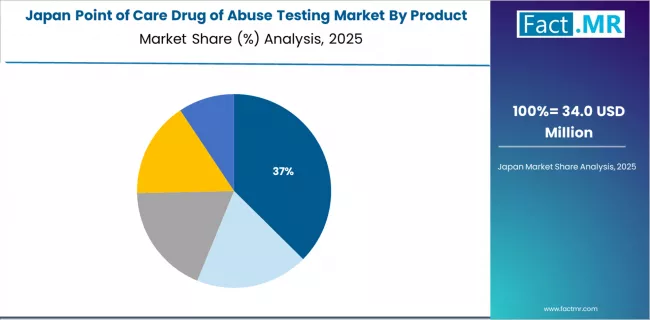
Point Of Care Drug Of Abuse Testing Market Japan Market Share Analysis By Product

The Japanese point of care drug testing market demonstrates a mature and quality-focused landscape, characterized by sophisticated integration of precision manufacturing with workplace safety technologies across occupational health applications, employer consultation services, and industrial hygiene programs. Japan's emphasis on product excellence and comprehensive validation drives demand for pharmaceutical-grade testing solutions that support holistic workplace safety initiatives and employee wellness requirements in daily occupational health routines.

The market benefits from strong partnerships between international diagnostic manufacturers and domestic distribution companies, including established occupational health service providers and workplace safety consultants, creating comprehensive distribution ecosystems that prioritize product quality and employer education programs. Metropolitan employer segments showcase advanced testing implementations where multi-substance detection capabilities achieve performance improvements through integrated workplace health approaches and comprehensive safety optimization programs.

What Drives Technology Emphasis in South Korea's Market?

Point Of Care Drug Of Abuse Testing Market South Korea Market Share Analysis By Sample Type

The South Korean point of care drug testing market is characterized by strong technology integration presence, with companies like domestic diagnostic manufacturers and international players including specialized occupational health providers maintaining significant positions through comprehensive product portfolios and digitally connected testing platforms for workplace screening and transportation safety applications.

The market is demonstrating a growing emphasis on smartphone integration and cloud-based result management, as Korean employers increasingly demand advanced testing devices that combine rapid detection with digital connectivity and automated documentation capabilities deployed across workplace populations and safety-conscious employer segments.

Local innovation and specialty product launches are gaining market share through strategic emphasis on biosensor advancement, offering specialized capabilities including breath alcohol monitoring and integrated biometric verification for comprehensive workplace safety support. The competitive landscape shows increasing collaboration between diagnostic manufacturers and occupational health service providers, creating hybrid service models that combine testing technology with professional interpretation and social media-based employer education capabilities.

Competitive Landscape of the Point of Care Drug of Abuse Testing Market

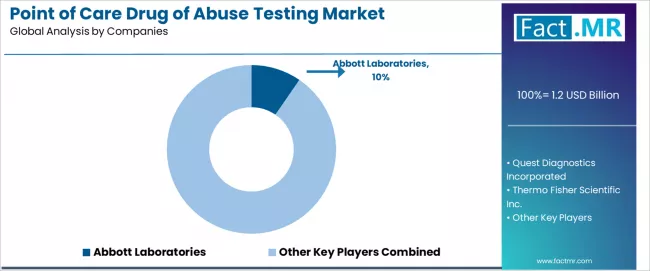
Point Of Care Drug Of Abuse Testing Market Analysis By Company

The point of care drug of abuse testing market features approximately 20-25 meaningful players with moderate concentration, where the top three companies control roughly 30-40% of global market share through established brand recognition, regulatory approvals, and multi-channel distribution networks. Competition centers on product reliability, regulatory compliance, and comprehensive service offerings rather than price competition alone.

Market leaders include Abbott, Quest Diagnostics, and Thermo Fisher Scientific, which maintain competitive advantages through comprehensive product portfolios, established laboratory service integration, and deep expertise in diagnostic testing, creating high brand trust among healthcare providers and employers seeking reliable screening solutions. These companies leverage regulatory clearances and ongoing clinical validation studies to defend market positions while expanding into adjacent categories including clinical chemistry and infectious disease diagnostics.

Challengers encompass specialized drug testing manufacturers including OraSure Technologies, Premier Biotech, and Drägerwerk AG, which compete through targeted product positioning and strong engagement with law enforcement and occupational health communities through direct sales teams and specialized distribution partnerships.

Diagnostic service providers, including LabCorp, focus on integrated testing solutions combining point of care screening with confirmatory laboratory services, offering differentiated capabilities in comprehensive drug testing programs, medical review officer services, and chain of custody documentation.

Emerging technology companies and specialty device manufacturers create competitive pressure through innovative biosensor platforms and digital connectivity features, particularly in high-growth markets including USA and China, where smartphone integration provides advantages in result management and ongoing compliance monitoring approaches.

Market dynamics favor companies that combine regulatory credibility with operational ease of use that addresses the complete testing workflow from specimen collection through result reporting and documentation. Strategic emphasis on multi-panel configurations, oral fluid testing innovation, and digital health integration enables differentiation in increasingly competitive workplace health and law enforcement segments across developed and emerging markets.

Global Point of Care Drug of Abuse Testing Market - Stakeholder Contribution Framework

Point of care drug of abuse testing represents a critical public health diagnostic category that enables healthcare providers, employers, and law enforcement agencies to implement immediate substance screening while addressing workplace safety goals and traffic enforcement requirements without exclusive laboratory dependency, typically providing rapid detection including instant results, comprehensive panel coverage, and chain of custody support compared to centralized laboratory methods alone while ensuring improved operational efficiency and comprehensive safety outcomes.

With the market projected to grow from USD 1.18 billion in 2025 to USD 3.04 billion by 2035 at a 9.8% CAGR, these solutions offer compelling advantages for workplace screening applications, hospital emergency departments, and diverse organizational populations seeking evidence-based immediate diagnostics. Scaling market penetration and regulatory acceptance requires coordinated action across public health policy, quality standards development, diagnostic manufacturers, healthcare providers, and employer education initiatives.

How Could Governments Spur Local Development and Adoption?

  • Workplace Safety Programs: Include drug testing requirements in occupational health regulations, providing targeted support for small employer compliance in workplace settings and supporting research institutions through development grants and validation study funding.
  • Tax Policy & Investment Support: Implement reduced tax rates for diagnostic device manufacturers, provide tax incentives for companies investing in quality assurance systems and regulatory compliance practices, and establish favorable import duty structures that encourage advanced biosensor procurement over conventional alternatives.
  • Regulatory Framework Development: Create streamlined approval processes for new testing devices across workplace and law enforcement applications, establish clear performance standards and quality documentation requirements for user protection, and develop international harmonization protocols that facilitate cross-border regulatory recognition.
  • Law Enforcement Integration & Training: Fund integration of roadside testing in traffic safety programs, invest in officer training initiatives that ensure proper device operation and chain of custody compliance, and explore funding models for equipment acquisition supporting impaired driving prevention.
  • Research & Innovation Support: Establish public-private partnerships for diagnostic technology research, support academic-industry collaborations investigating detection methodologies and cutoff optimization, and create regulatory environments that encourage innovation in non-invasive specimen collection approaches.

How Could Industry Bodies Support Market Development?

  • Quality Standards & Performance: Define standardized performance specifications for drug testing devices across sensitivity, specificity, and cross-reactivity characteristics, establish universal quality control protocols and proficiency testing requirements, and create performance databases that users can rely on for device selection.
  • Market Education & Best Practices: Lead messaging that demonstrates point of care testing benefits, emphasizing appropriate use cases with confirmatory testing protocols, evidence-based cutoff thresholds, and realistic detection window expectations compared to laboratory-only approaches.
  • Quality Assurance Standards: Develop guidelines for device manufacturing, lot-to-lot consistency, stability requirements, and label accuracy, ensuring user safety across production and distribution operations.
  • Professional Development: Run certification programs for medical review officers, collection site personnel, and occupational health professionals on optimizing testing protocols, specimen validity assessment, and legal compliance requirements in diverse organizational settings.

How Could Manufacturers and Technology Players Strengthen the Ecosystem?

  • Advanced Product Development: Develop next-generation drug testing devices with enhanced detection capabilities, expanded substance panels, and digital connectivity characteristics that enhance diagnostic accuracy while reducing operational complexity and improving user compliance.
  • Clinical Validation Programs: Provide comprehensive performance data, cross-reactivity studies, and real-world effectiveness evidence that supports regulatory clearance and informed purchasing decisions.
  • User Education Initiatives: Offer comprehensive information about proper device operation, specimen collection techniques, and result interpretation that help users implement effective programs aligned with organizational policies and legal requirements.
  • Research & Development Networks: Build comprehensive R&D capabilities, collaborative validation programs, and sensitivity optimization systems that ensure drug testing devices maintain high performance standards and consistent quality across diverse testing populations.

How Could Healthcare Providers and Educators Navigate the Market?

  • Evidence-Based Protocol Integration: Incorporate validated drug testing protocols into emergency department workflows, with particular focus on comprehensive toxicology assessment, clinical correlation, and appropriate confirmatory pathways for patient care.
  • Staff Training Excellence: Establish comprehensive education programs addressing device operation, quality control procedures, and result documentation through optimized training frameworks and competency assessment protocols.
  • Multidisciplinary Care Models: Implement integrated care teams combining emergency physicians, toxicologists, addiction specialists, and laboratory professionals that provide comprehensive substance abuse assessment addressing medical, diagnostic, and treatment aspects.
  • Quality Monitoring Systems: Develop standardized quality control tracking, proficiency testing participation, and performance review assessments that enable continuous protocol optimization and regulatory compliance.

How Could Investors and Financial Enablers Unlock Value?

  • Technology Innovation Financing: Provide growth capital for established companies like Abbott, Thermo Fisher Scientific, and emerging device manufacturers to fund biosensor development and digital connectivity initiatives that support market differentiation.
  • Market Expansion Investment: Back companies developing advanced detection platforms, artificial intelligence-based result interpretation, and blockchain-enabled chain of custody technologies that enhance diagnostic reliability and legal defensibility.
  • Distribution Network Funding: Finance channel expansion strategies for diagnostic manufacturers establishing operations in high-growth regions including China and India, supporting localization initiatives that address regulatory requirements while maintaining quality standards.
  • Digital Health Integration: Support companies developing mobile applications, cloud-based compliance platforms, and telehealth supervision technologies that enhance testing accessibility and operational outcomes through technology-enabled service delivery.

Key Players in the Point of Care Drug of Abuse Testing Market

  • Abbott Laboratories
  • Quest Diagnostics Incorporated
  • Thermo Fisher Scientific Inc.
  • OraSure Technologies, Inc.
  • Siemens Healthineers AG
  • F. Hoffmann-La Roche Ltd
  • Drägerwerk AG & Co. KGaA
  • Premier Biotech, Inc.
  • Laboratory Corporation of America Holdings (LabCorp)
  • Greenlane Holdings, Inc.

Scope of the Report

Items Values
Quantitative Units USD 1.18 Billion
Product Immunoassay Test Strips and Cassettes, Oral Fluid Testing Kits, Breath Analyzers, Urine Collection Cups, Digital/Portable Analyzers
Sample Type Urine, Saliva (Oral Fluid), Breath, Blood, Sweat/Hair
Technology Lateral Flow Assay (LFA), Chromatographic Immunoassays, Enzyme-Linked Immunosorbent Assay (ELISA), Mass Spectrometry (Portable or Hybrid POC Units)
End Use Hospitals & Emergency Departments, Workplace & Occupational Health Centers, Home Care & Remote Users, Others
Regions Covered Asia Pacific, Europe, North America, Latin America, Middle East & Africa
Country Covered USA, China, India, Germany, UK, Japan, Brazil, and 40+ countries
Key Companies Profiled Abbott, Quest Diagnostics, Thermo Fisher Scientific, OraSure Technologies, Siemens Healthineers, F. Hoffmann-La Roche Ltd., Drägerwerk AG & Co. KGaA, Premier Biotech, Inc., LabCorp, Greenlane Holdings
Additional Attributes Dollar sales by product and sample type categories, regional adoption trends across North America, Asia Pacific, and Europe, competitive landscape with diagnostic manufacturers and occupational health service providers, product specifications and performance requirements, integration with workplace safety programs and law enforcement protocols, innovations in oral fluid testing and digital connectivity, and development of specialized applications with regulatory clearance and evidence-based screening capabilities.

Point of Care Drug of Abuse Testing Market by Segments

  • Product :

    • Immunoassay Test Strips and Cassettes
    • Oral Fluid Testing Kits
    • Breath Analyzers
    • Urine Collection Cups
    • Digital/Portable Analyzers
  • Sample Type :

    • Urine
    • Saliva (Oral Fluid)
    • Breath
    • Blood
    • Sweat/Hair
  • Technology :

    • Lateral Flow Assay (LFA)
    • Chromatographic Immunoassays
    • Enzyme-Linked Immunosorbent Assay (ELISA)
    • Mass Spectrometry (Portable or Hybrid POC Units)
  • End Use :

    • Hospitals & Emergency Departments
    • Workplace & Occupational Health Centers
    • Home Care & Remote Users
    • Others
  • Region :

    • Asia Pacific
      • China
      • Japan
      • South Korea
      • India
      • Australia
      • Thailand
      • Rest of Asia Pacific
    • Europe
      • Germany
      • UK
      • France
      • Italy
      • Spain
      • Denmark
      • Sweden
      • Norway
      • Rest of Europe
    • North America
      • USA
      • Canada
      • Mexico
    • Latin America
      • Brazil
      • Argentina
      • Rest of Latin America
    • Middle East & Africa
      • South Africa
      • Saudi Arabia
      • UAE
      • Kuwait
      • Rest of Middle East & Africa

Table of Content

  1. Executive Summary
    • USA Market Outlook
    • Demand to side Trends
    • Supply to side Trends
    • Technology Roadmap Analysis
    • Analysis and Recommendations
  2. Market Overview
    • Market Coverage / Taxonomy
    • Market Definition / Scope / Limitations
  3. Market Background
    • Market Dynamics
      • Drivers
      • Restraints
      • Opportunity
      • Trends
    • Scenario Forecast
      • Demand in Optimistic Scenario
      • Demand in Likely Scenario
      • Demand in Conservative Scenario
    • Opportunity Map Analysis
    • Product Life Cycle Analysis
    • Supply Chain Analysis
    • Investment Feasibility Matrix
    • Value Chain Analysis
    • PESTLE and Porter’s Analysis
    • Regulatory Landscape
    • Regional Parent Market Outlook
    • Production and Consumption Statistics
    • Import and Export Statistics
  4. USA Market Analysis 2020 to 2024 and Forecast, 2025 to 2035
    • Historical Market Size Value (USD Million) Analysis, 2020 to 2024
    • Current and Future Market Size Value (USD Million) Projections, 2025 to 2035
      • Y to o to Y Growth Trend Analysis
      • Absolute $ Opportunity Analysis
  5. USA Market Pricing Analysis 2020 to 2024 and Forecast 2025 to 2035
  6. USA Market Analysis 2020 to 2024 and Forecast 2025 to 2035, By Product
    • Introduction / Key Findings
    • Historical Market Size Value (USD Million) Analysis By Product, 2020 to 2024
    • Current and Future Market Size Value (USD Million) Analysis and Forecast By Product, 2025 to 2035
      • Immunoassay Test Strips and Cassettes
      • Oral Fluid Testing Kits
      • Breath Analyzers
      • Urine Collection Cups
      • Digital/Portable Analyzers
    • Y to o to Y Growth Trend Analysis By Product, 2020 to 2024
    • Absolute $ Opportunity Analysis By Product, 2025 to 2035
  7. USA Market Analysis 2020 to 2024 and Forecast 2025 to 2035, By Sample Type
    • Introduction / Key Findings
    • Historical Market Size Value (USD Million) Analysis By Sample Type, 2020 to 2024
    • Current and Future Market Size Value (USD Million) Analysis and Forecast By Sample Type, 2025 to 2035
      • Urine
      • Saliva (Oral Fluid)
      • Breath
      • Blood
      • Sweat/Hair
    • Y to o to Y Growth Trend Analysis By Sample Type, 2020 to 2024
    • Absolute $ Opportunity Analysis By Sample Type, 2025 to 2035
  8. USA Market Analysis 2020 to 2024 and Forecast 2025 to 2035, By Technology
    • Introduction / Key Findings
    • Historical Market Size Value (USD Million) Analysis By Technology, 2020 to 2024
    • Current and Future Market Size Value (USD Million) Analysis and Forecast By Technology, 2025 to 2035
      • Lateral Flow Assay (LFA)
      • Chromatographic Immunoassays
      • Enzyme-Linked Immunosorbent Assay (ELISA)
      • Mass Spectrometry (Portable or Hybrid POC Value (USD Million)s)
    • Y to o to Y Growth Trend Analysis By Technology, 2020 to 2024
    • Absolute $ Opportunity Analysis By Technology, 2025 to 2035
  9. USA Market Analysis 2020 to 2024 and Forecast 2025 to 2035, By End Use
    • Introduction / Key Findings
    • Historical Market Size Value (USD Million) Analysis By End Use, 2020 to 2024
    • Current and Future Market Size Value (USD Million) Analysis and Forecast By End Use, 2025 to 2035
      • Hospitals & Emergency Departments
      • Workplace & Occupational Health Centers
      • Home Care & Remote Users
      • Others
    • Y to o to Y Growth Trend Analysis By End Use, 2020 to 2024
    • Absolute $ Opportunity Analysis By End Use, 2025 to 2035
  10. USA Market Analysis 2020 to 2024 and Forecast 2025 to 2035, By Region
    • Introduction
    • Historical Market Size Value (USD Million) Analysis By Region, 2020 to 2024
    • Current Market Size Value (USD Million) Analysis and Forecast By Region, 2025 to 2035
      • USA
    • Market Attractiveness Analysis By Region
  11. USA Market Analysis 2020 to 2024 and Forecast 2025 to 2035, By Country
    • Historical Market Size Value (USD Million) Trend Analysis By Market Taxonomy, 2020 to 2024
    • Market Size Value (USD Million) Forecast By Market Taxonomy, 2025 to 2035
      • By Country
      • By Product
      • By Sample Type
      • By Technology
      • By End Use
    • Market Attractiveness Analysis
      • By Country
      • By Product
      • By Sample Type
      • By Technology
      • By End Use
    • Key Takeaways
  12. Market Structure Analysis
    • Competition Dashboard
    • Competition Benchmarking
    • Market Share Analysis of Top Players
      • By Regional
      • By Product
      • By Sample Type
      • By Technology
      • By End Use
  13. Competition Analysis
    • Competition Deep Dive
      • Abbott Laboratories
        • Overview
        • Product Portfolio
        • Profitability by Market Segments (Product/Age /Sales Channel/Region)
        • Sales Footprint
        • Strategy Overview
          • Marketing Strategy
          • Product Strategy
          • Channel Strategy
      • Quest Diagnostics Incorporated
      • Thermo Fisher Scientific Inc.
      • OraSure Technologies, Inc.
      • Siemens Healthineers AG
      • F. Hoffmann-La Roche Ltd
      • Drägerwerk AG & Co. KGaA
      • Premier Biotech, Inc.
      • Laboratory Corporation of America Holdings (LabCorp)
      • Greenlane Holdings, Inc.
  14. Assumptions & Acronyms Used
  15. Research Methodology

List Of Table

  • Table 1: USA Market Value (USD Million) Forecast by Region, 2020 to 2035
  • Table 2: USA Market Value (USD Million) Forecast by Product, 2020 to 2035
  • Table 3: USA Market Value (USD Million) Forecast by Sample Type, 2020 to 2035
  • Table 4: USA Market Value (USD Million) Forecast by Technology, 2020 to 2035
  • Table 5: USA Market Value (USD Million) Forecast by End Use, 2020 to 2035
  • Table 6: USA Market Value (USD Million) Forecast by Country, 2020 to 2035
  • Table 7: USA Market Value (USD Million) Forecast by Product, 2020 to 2035
  • Table 8: USA Market Value (USD Million) Forecast by Sample Type, 2020 to 2035
  • Table 9: USA Market Value (USD Million) Forecast by Technology, 2020 to 2035
  • Table 10: USA Market Value (USD Million) Forecast by End Use, 2020 to 2035

List Of Figures

  • Figure 1: USA Market Pricing Analysis
  • Figure 2: USA Market Value (USD Million) Forecast 2020 to 2035
  • Figure 3: USA Market Value Share and BPS Analysis by Product, 2025 and 2035
  • Figure 4: USA Market Y to o to Y Growth Comparison by Product, 2025 to 2035
  • Figure 5: USA Market Attractiveness Analysis by Product
  • Figure 6: USA Market Value Share and BPS Analysis by Sample Type, 2025 and 2035
  • Figure 7: USA Market Y to o to Y Growth Comparison by Sample Type, 2025 to 2035
  • Figure 8: USA Market Attractiveness Analysis by Sample Type
  • Figure 9: USA Market Value Share and BPS Analysis by Technology, 2025 and 2035
  • Figure 10: USA Market Y to o to Y Growth Comparison by Technology, 2025 to 2035
  • Figure 11: USA Market Attractiveness Analysis by Technology
  • Figure 12: USA Market Value Share and BPS Analysis by End Use, 2025 and 2035
  • Figure 13: USA Market Y to o to Y Growth Comparison by End Use, 2025 to 2035
  • Figure 14: USA Market Attractiveness Analysis by End Use
  • Figure 15: USA Market Value (USD Million) Share and BPS Analysis by Region, 2025 and 2035
  • Figure 16: USA Market Y to o to Y Growth Comparison by Region, 2025 to 2035
  • Figure 17: USA Market Attractiveness Analysis by Region
  • Figure 18: USA Market Incremental Dollar Opportunity, 2025 to 2035
  • Figure 19: USA Market Value Share and BPS Analysis by Country, 2025 and 2035
  • Figure 20: USA Market Value Share and BPS Analysis by Product, 2025 and 2035
  • Figure 21: USA Market Y to o to Y Growth Comparison by Product, 2025 to 2035
  • Figure 22: USA Market Attractiveness Analysis by Product
  • Figure 23: USA Market Value Share and BPS Analysis by Sample Type, 2025 and 2035
  • Figure 24: USA Market Y to o to Y Growth Comparison by Sample Type, 2025 to 2035
  • Figure 25: USA Market Attractiveness Analysis by Sample Type
  • Figure 26: USA Market Value Share and BPS Analysis by Technology, 2025 and 2035
  • Figure 27: USA Market Y to o to Y Growth Comparison by Technology, 2025 to 2035
  • Figure 28: USA Market Attractiveness Analysis by Technology
  • Figure 29: USA Market Value Share and BPS Analysis by End Use, 2025 and 2035
  • Figure 30: USA Market Y to o to Y Growth Comparison by End Use, 2025 to 2035
  • Figure 31: USA Market Attractiveness Analysis by End Use
  • Figure 32: USA Market - Tier Structure Analysis
  • Figure 33: USA Market - Company Share Analysis

- FAQs -

How big is the point of care drug of abuse testing market in 2025?

The global point of care drug of abuse testing market is estimated to be valued at USD 1.2 billion in 2025.

What will be the size of point of care drug of abuse testing market in 2035?

The market size for the point of care drug of abuse testing market is projected to reach USD 3.0 billion by 2035.

How much will be the point of care drug of abuse testing market growth between 2025 and 2035?

The point of care drug of abuse testing market is expected to grow at a 9.9% CAGR between 2025 and 2035.

What are the key product types in the point of care drug of abuse testing market?

The key product types in point of care drug of abuse testing market are immunoassay test strips and cassettes, oral fluid testing kits, breath analyzers, urine collection cups and digital/portable analyzers.

Which sample type segment to contribute significant share in the point of care drug of abuse testing market in 2025?

In terms of sample type, urine segment to command 42.7% share in the point of care drug of abuse testing market in 2025.

Point of Care Drug of Abuse Testing Market