- Market Value (2025): USD 600.0 Mn
- Estimated Value (2026): USD 720 Mn
- Forecast Value (2036): USD 4458 Mn
- CAGR (2026-2036): 20.0%
What is the Hygienic Food Cobots Market forecast to be worth by 2036?
USD 720 million in 2026 to USD 4,458 million by 2036 at a 20.0% CAGR.
- The hygienic food cobots market reached USD 600.0 million in 2025.
- Demand is projected to increase from USD 720 million in 2026 to USD 4,458 million by 2036.
- The market is forecast to record a 20.0% CAGR from 2026 to 2036.
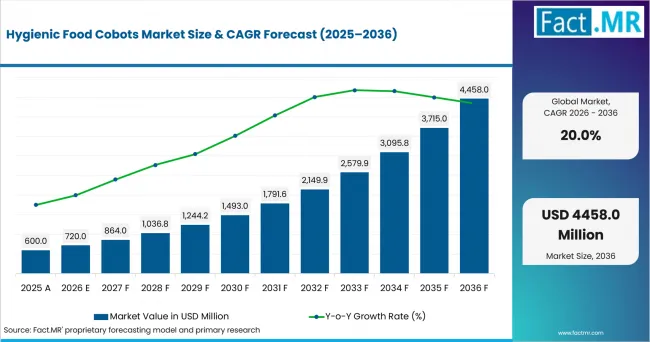
Hygienic Food Cobots Market Value Analysis | Source: Fact.MR
What are the defining numbers behind Hygienic Food Cobots Market growth?
An absolute opportunity of USD 3,738 million is expected between 2026 and 2036.
- Demand Drivers in the Market
- Food processors need washable automation where hands, tools and robot surfaces operate near exposed ingredients. IFR reported on 18 June 2026 that U.S. industrial-robot installations in the food industry rose 30% in 2025 to approximately 3,000 units.
- Quality teams need food-contact compatible surfaces and documented grease choices before approving robots near open product zones. FANUC CORPORATION introduced food/cleanroom-specification robot models in August 2025 using FDA-approved epoxy paint, hygienic stainless-steel wrist flanges and NSF H1 food-grade grease.
- Operations managers need flexible cells for tray loading, case packing and inspection when product runs change often.
- Key Segments Analyzed
- By Hygiene Design: Washdown-rated is expected to hold 45.0% share in 2026 owing to cleaning routines that screen out arms without sealed housings and cleanable surfaces.
- By Payload: Up to 5 kg is projected to account for 35.0% share in 2026 since bakery items, trays and pouches need precision more than heavy lifting.
- By Application: Primary handling is anticipated to capture 52.0% share in 2026 because product transfer and orientation remain the most repetitive food-line tasks.
- By Food Sector: Bakery is estimated to represent 34.0% share in 2026 as frequent changeovers favor cobots that can shift between trays, packs and cases.
- By Component: Robot arm is forecast to hold 46.0% share in 2026 due to its role in determining payload, reach, cleanability and installation cost.
- Analyst Opinion at Fact.MR
- Shambhu Nath Jha, Principal Consultant at Fact.MR, states, "Food cobot purchasing is becoming a hygiene and uptime decision before it becomes a robotics decision. Plants are expected to favor arms that document cleanability, food-safe surfaces and quick tool changes. Suppliers that combine hygienic design proof with ready handling templates should face shorter trials."
- Strategic Implications
- Robot suppliers should give plant engineers one technical file covering ingress protection, cleanability, grease grade and food-contact limits.
- System integrators should build pre-validated cells for bakery, meat and dairy lines instead of offering generic cobot demonstrations.
- Gripper developers should pair soft contact materials with washdown assemblies so primary handling trials meet both yield and hygiene reviews.
- Food manufacturers should compare cycle time and cleaning time with operator injury exposure when reviewing manual and cobot workflows.
Japan is projected to record 25.8% CAGR through 2036 due to robot production and export-led food automation needs. South Korea is anticipated to post 24.7% CAGR, supported by high robot density and food output. Germany is forecast to advance at 23.3% CAGR as automation depth meets labor pressure. The UK is estimated to hold 21.0% CAGR. The USA is expected to reach 20.5% CAGR.
How does the Hygienic Food Cobots Market break down by segment?
Primary handling leads Application at 52.0% share; robot arm leads Component at 46.0% share.
Which Hygiene Design dominates?
Washdown-rated is expected to hold 45.0% share in 2026.
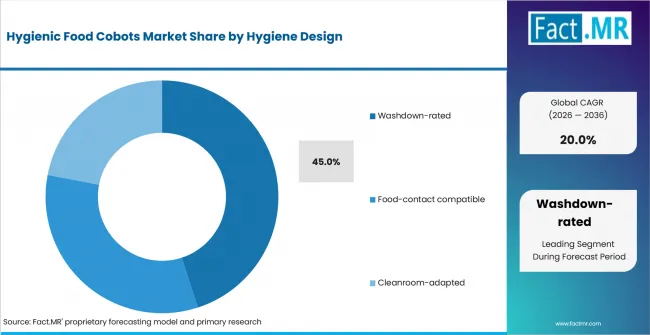
Hygienic Food Cobots Market Analysis By Hygiene Design | Source: Fact.MR
Washdown-rated cobots lead because cleaning compatibility decides whether a robot can work near exposed food. FANUC CORPORATION expanded food and cleanroom specification models in August 2025 with FDA-approved epoxy paint, stainless-steel wrist flanges and NSF H1 food-grade grease.
What leads the Payload segment?
Up to 5 kg is projected to account for 35.0% share in 2026.
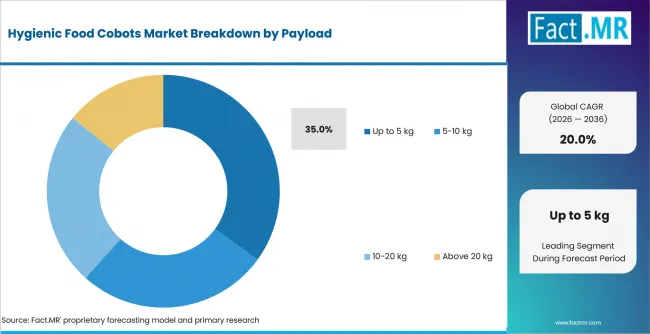
Hygienic Food Cobots Market Analysis By Payload | Source: Fact.MR
Up to 5 kg leads because many food cobot jobs involve baked goods, wrapped packs, trays and pouches. These tasks need reach and repeatability more than heavy lifting. Smaller payload arms also fit bench-side stations where floor space is limited.
How does Application shape demand?
Primary handling is anticipated to capture 52.0% share in 2026.
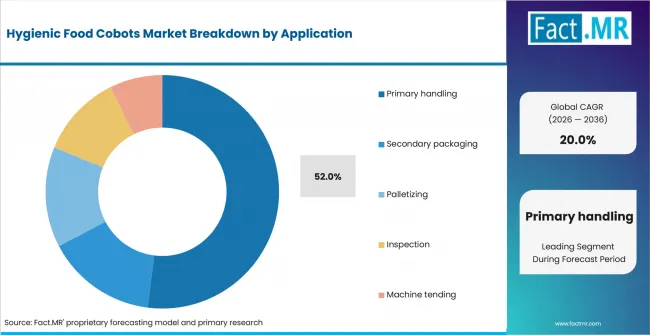
Hygienic Food Cobots Market Analysis By Application | Source: Fact.MR
Primary handling leads because it covers repetitive work near the product stream. Picking and placing food items require steady motion and controlled contact pressure. The segment benefits from soft grippers and vision tools that reduce product damage during high-volume line work.
What supports Bakery within Food Sector?
Bakery is estimated to represent 34.0% share in 2026.
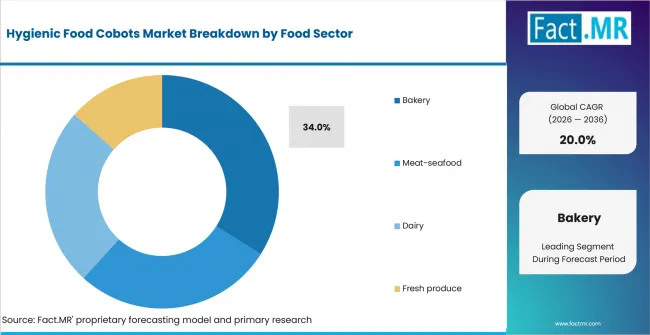
Hygienic Food Cobots Market Analysis By Food Sector | Source: Fact.MR
Bakery leads because products move in repeatable patterns while shape, topping and pack sizes change often. Cobots can serve tray loading, depanning and case packing without locking a plant into one product format. BLS projected that bakeries and tortilla manufacturing would add 18,800 U.S. jobs from 2024 to 2034.
What leads Component demand?
Robot arm is forecast to hold 46.0% share in 2026.
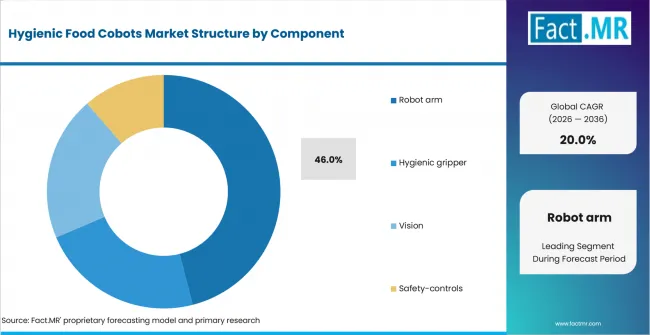
Hygienic Food Cobots Market Analysis By Component | Source: Fact.MR
Robot arm leads because hygiene grade, reach and payload are evaluated before end effectors are selected. The arm defines where a cobot cell can be installed and how often it can survive cleaning cycles.
What is accelerating Hygienic Food Cobots Market adoption, and what is holding it back?
Demand is expected to rise through food automation, hygiene validation and labor pressure. Growth is constrained by cleaning qualification, integration cost and payload limits.
Drivers Impact Analysis
| DRIVER | (~) % IMPACT ON CAGR | GEOGRAPHIC RELEVANCE | IMPACT TIMELINE |
|---|---|---|---|
| Food-industry robot installation gains | +2.4% | USA, East Asia | Short term (<= 2 years) |
| Washdown and food-contact design requirements | +1.8% | Global | Medium term (2-4 years) |
| Primary handling and packaging automation | +1.5% | North America, Europe | Medium term (2-4 years) |
| Workforce safety and labor constraints | +1.1% | USA, UK, Germany | Long term (>= 4 years) |
- Washdown and food-contact design requirements: Food plants compare robot surfaces, grease, sealing and cable routing before pilot approval. Suppliers that provide hygiene documentation reduce engineering review time.
- Primary handling and packaging automation: Manual transfer near product flow is repetitive and visible to quality teams. Cobots fit these stations when lines need automation without a full fixed cell.
- Workforce safety and labor constraints: Repetitive lifting and awkward motion keep safety reviews active in food facilities. Collaborative cells are expected to shift workers away from high-repeat handling jobs.
Opportunity Impact Analysis
| OPPORTUNITY | (~) % IMPACT ON CAGR | GEOGRAPHIC RELEVANCE | IMPACT TIMELINE |
|---|---|---|---|
| Pre-engineered bakery cells | +1.2% | USA, UK, Japan | Medium term (2-4 years) |
| Hygienic gripper and vision bundles | +1.0% | Global | Short term (<= 2 years) |
| Compact cells for fresh and chilled products | +0.8% | Europe, East Asia | Long term (>= 4 years) |
- Pre-engineered bakery cells: Bakery lines often need gentle handling with rapid format change. Pre-tested loading and packing cells are expected to shorten trials for small and mid-sized plants.
- Hygienic gripper and vision bundles: End effectors that combine soft touch with washable parts are expected to open more primary handling work. Vision improves picking accuracy when product shape varies.
- Compact cells for fresh and chilled products: Fresh products require careful contact and short changeovers. Cobots with smaller footprints are projected to fit refrigerated or space-constrained processing areas.
Restraints Impact Analysis
| RESTRAINT | (~) % IMPACT ON CAGR | GEOGRAPHIC RELEVANCE | IMPACT TIMELINE |
|---|---|---|---|
| Cleaning validation and downtime risk | -0.7% | Global | Short term (<= 2 years) |
| Integrator availability in food plants | -0.5% | USA, UK, Germany | Medium term (2-4 years) |
| Payload limits in heavy food handling | -0.4% | Meat, dairy, frozen food | Long term (>= 4 years) |
- Cleaning validation and downtime risk: Plants can delay installation when a cobot cell adds sanitation steps or makes cleaning records harder to maintain.
- Integrator availability in food plants: Food applications require both robotics skill and hygiene knowledge. Limited local integrator capacity can slow project conversion.
- Payload limits in heavy food handling: Cobots can struggle with heavier boxes, tubs and frozen blocks. Conventional industrial robots remain better suited to some palletizing jobs.
Which countries are scaling the Hygienic Food Cobots Market through 2036?
- The country comparison spans 5.3 percentage points and forms three practical growth bands across the forecast period.
- Japan remains 1.1 percentage points above South Korea because robot production depth and food exports support automation projects.
- South Korea remains 1.4 percentage points above Germany as high robot density gives processors more automation familiarity.
- Germany remains 2.3 percentage points above the UK through European robot depth and food-factory engineering capability.
- The UK remains 0.5 percentage point above the USA while both markets lean on food manufacturing scale and workplace safety needs.
Comparable CAGRs can create different entry conditions due to food safety rules, cleaning practices, labor availability and integrator networks. Full report coverage includes North America, Latin America, Western Europe, Eastern Europe, East Asia, South Asia & Pacific, Middle East & Africa.
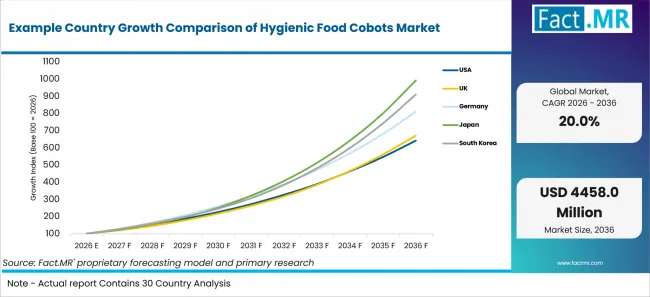
Example Country Growth Comparison Of Hygienic Food Cobots Market | Source: Fact.MR
| Country | CAGR |
|---|---|
| Japan | 25.8% |
| South Korea | 24.7% |
| Germany | 23.3% |
| United Kingdom | 21.0% |
| United States | 20.5% |
What supports Japan adoption?
25.8% CAGR, supported by robot manufacturing depth and food export scale.
Japan combines a large robot base with export-facing food demand. MAFF reported in February 2026 that exports of agricultural, forestry, fishery and food products reached JPY 1.7005 trillion in 2025, up 12.8%. JARA reported that domestic robot shipment units fell 18.3% in 2025 to 37,816.
How is South Korea scaling demand?
24.7% CAGR, led by food-industry output and high automation density.
South Korea has a strong automation base and a food sector with export momentum. MFDS reported in May 2026 that 2025 food industry production reached KRW 119 trillion, up 4.3%. MAFRA reported in January 2026 that K-Food Plus exports reached USD 13.6 billion in 2025, up 5.1%.
What supports Germany’s adoption?
23.3% CAGR, backed by European robot scale and food-factory labor pressure.
Germany has a large industrial-robot base. IFR reported 26,982 industrial-robot installations in Germany in 2024, equal to 32% of Europe's annual installations. Food processors to prioritize cobot cells that demonstrate measurable cleaning-time, throughput and labor-use benefits.
What supports the United Kingdom’s growth?
21.0% CAGR, driven by food manufacturing scale and workplace-safety needs.
The United Kingdom has a large food manufacturing base and visible safety pressure. ONS reported in July 2026 that food manufacturing represented 22.9% of total UK manufacturers' product sales in 2025. Defra's provisional release reported UK food, feed and drink exports of GBP 25.7 billion in 2025, 5% above 2024 in current prices but 0.9% lower in real terms after adjusting for trade-price inflation.
How does the USA perform?
20.5% CAGR, supported by large food spending and processor scale.
The USA has a broad food-processing base and rising robot use in food. USDA ERS reported total U.S. food spending of USD 2.51 trillion in 2025 in inflation-adjusted 2025 dollars. BLS listed 43,328 private food-manufacturing establishments in Q4 2025, with the establishment figure marked preliminary.
Who leads the Hygienic Food Cobots Market?
FANUC CORPORATION, ABB LTD., Stäubli International AG and Yaskawa Electric Corporation are profiled providers.
FANUC CORPORATION is active through CRX food-grade cobots and food/cleanroom-specification robots. In August 2025, FANUC CORPORATION described new food/cleanroom models using FDA-approved epoxy paint, hygienic stainless-steel wrist flanges, and NSF H1-grade food-grade grease. Its food-focused portfolio spans lighter collaborative handling applications and higher-payload material movement.
Which companies are the key providers?
Key companies include FANUC CORPORATION, ABB LTD., Stäubli International AG, Yaskawa Electric Corporation.
- FANUC CORPORATION
- ABB LTD.
- Stäubli International AG
- Yaskawa Electric Corporation
Bibliography
- U.S. Bureau of Labor Statistics. (2026, July 1). A recipe for growth: Food and beverage manufacturing projected to expand through 2034.
- International Federation of Robotics. (2025, September 25). World Robotics 2025 report – industrial robots – released by IFR.
- International Federation of Robotics. (2026, April 8). Robot density surges in Europe, Asia, and Americas.
- International Federation of Robotics. (2026, June 18). US robot industry returns to double digit growth.
- Office for National Statistics. (2026, July 24). UK manufacturers' sales by product: 2025.
- Department for Environment, Food & Rural Affairs. (2026, April 30). UK trade in Food, Feed and Drink, 2025 provisional. GOV.UK.
- Federal Statistical Office. (2026, January 15). Gross domestic product up 0.2% in 2025.
- Ministry of Agriculture, Food and Rural Affairs. (2026, January 20). Exports of K-Food Plus reached USD 13.6 billion in 2025, up 5.1% year-over-year.
- FANUC Corporation. (2025, August 22). ROBOT new product: Food/Cleanroom Specification Robot.
- ABB. (2025, April 29). ABB and BurgerBots unveil robotic burger-making to revolutionize fast food prep.
This Report Addresses
- The report explains where hygienic food cobots are used across hygiene design and payload class. It also covers application, food sector and component demand.
- Segment analysis identifies the leading subsegments and the operational reasons plants prioritize them.
- Country analysis examines the listed markets and the food automation, labor and hygiene factors shaping adoption.
- Competitive analysis reviews current providers across collaborative robot arms, food-grade variants and integrated food-handling cells.
- Application analysis assesses how cleaning, product contact and changeover needs influence purchasing decisions.
What does the Hygienic Food Cobots Market cover?
The Hygienic Food Cobots Market covers collaborative robot systems used near food products or in food production environments. It includes washable arms, food-contact compatible equipment, hygienic grippers, vision and safety controls used for primary handling, packaging and inspection. Adjacent coverage includes food robotics, robot arms and soft grippers for food handling robots.
The assessment covers cobots used in bakery, meat-seafood, dairy and fresh produce applications. It connects food plant automation with packaging robots, packaging automation solutions and food processing and handling equipment.
What is included in the scope?
The scope includes collaborative robot arms, hygienic end effectors, vision modules and safety controls sold for food handling or food-adjacent production work. Related automation areas include industrial robot systems, factory robots and robotic end-of-arm tooling.
The analysis also includes cells where integrators combine cobots with conveyors, guarding and washdown components. It includes palletizing robots when collaborative or food-adapted systems are used in hygiene-sensitive facilities.
What is excluded from the scope?
The scope excludes conventional industrial robots that are not used in collaborative settings or are sold without hygienic configuration for food environments.
It also excludes food-processing machinery without robotic motion, non-food cobots, raw conveyors, warehouse automation that does not handle food products and general machine vision software sold without a food-handling cobot system.
How Was the Analysis Built?
The analysis draws on 120+ sources, 35+ company portfolios, 25+ countries, and more than 20 industry interviews.
- Primary Research: Primary research includes discussions with manufacturers, service providers, technology developers, distributors, end users, procurement teams, and subject-matter experts. These conversations examine purchasing priorities, product adoption, operational challenges, approval requirements, competitive positioning, and the factors that influence wider market acceptance.
- Desk Research: Desk research covers government statistics, regulatory publications, company filings, trade data, technical studies, industry associations, standards, public policy, and other authoritative sources. Every source used in the analysis is documented in the bibliography.
- Market Sizing and Forecasting: Market estimates combine historical performance, demand indicators, pricing and volume trends, segment shares, company participation, country-level growth, adoption patterns, investment activity, and barriers to market expansion.
- Data Validation and Update Cycle: Findings are validated by comparing primary interviews with public data, company activity, regulatory changes, trade patterns, and industry developments. Regular updates review new product launches, capacity changes, partnerships, approvals, procurement trends, and shifts in commercial adoption.
What is the report’s scope and coverage?
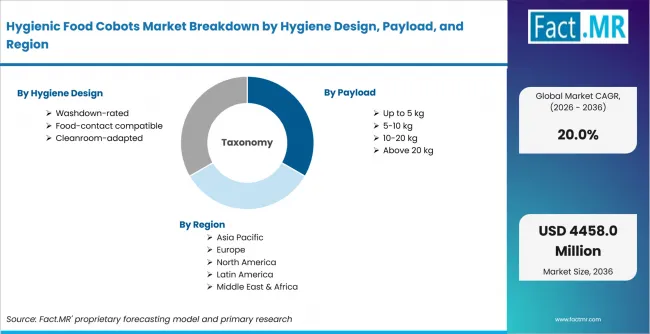
Hygienic Food Cobots Market Breakdown By Hygiene Design, Payload, And Region | Source: Fact.MR
| Attribute | Details |
|---|---|
| Quantitative Units | USD million |
| Market Definition | Collaborative robots designed or configured for hygienic food environments, including washable arms, food-contact compatible surfaces, grippers, vision and safety controls used in food handling and packaging. |
| Hygiene Design | Washdown-rated; Food-contact compatible; Cleanroom-adapted |
| Payload | Up to 5 kg; 5-10 kg; 10-20 kg; Above 20 kg |
| Application | Primary handling; Secondary packaging; Palletizing; Inspection; Machine tending |
| Food Sector | Bakery; Meat-seafood; Dairy; Fresh produce |
| Component | Robot arm; Hygienic gripper; Vision; Safety-controls |
| Regions Covered | North America; Latin America; Western Europe; Eastern Europe; East Asia; South Asia & Pacific; Middle East & Africa |
| Countries Covered | United States; United Kingdom; Germany; Japan; South Korea |
| Key Companies Profiled | FANUC CORPORATION, ABB LTD., Stäubli International AG, Yaskawa Electric Corporation |
| Forecast Period | 2026 to 2036 |
| Approach | Hybrid top-down and bottom-up approach using food automation demand; robot installation signals; hygiene design requirements; country adoption; and provider portfolio review. |
How is the market segmented?
-
By Hygiene Design:
- Washdown-rated
- Food-contact compatible
- Cleanroom-adapted
-
By Payload:
- Up to 5 kg
- 5-10 kg
- 10-20 kg
- Above 20 kg
-
By Application:
- Primary handling
- Secondary packaging
- Palletizing
- Inspection
- Machine tending
-
By Food Sector:
- Bakery
- Meat-seafood
- Dairy
- Fresh produce
-
By Component:
- Robot arm
- Hygienic gripper
- Vision
- Safety-controls
-
By Region:
- North America
- Latin America
- Western Europe
- Eastern Europe
- East Asia
- South Asia & Pacific
- Middle East & Africa