Infant Nutrition Market
Infant Nutrition Market Size and Share Forecast Outlook 2025 to 2035
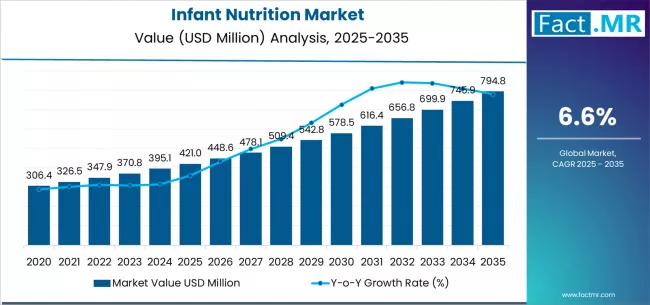
Infant nutrition market is projected to grow from USD 421.0 million in 2025 to USD 794.8 million by 2035, at a CAGR of 6.6%. Infant Milk Formula will dominate with a 39.3% market share, while solid will lead the form segment with a 62.9% share.
Infant Nutrition Market Forecast and Outlook 2025 to 2035
The global infant nutrition market is projected to reach USD 794.8 million by 2035, recording an absolute increase of USD 373.8 million over the forecast period. The market is valued at USD 421.0 million in 2025 and is set to rise at a CAGR of 6.6% during the assessment period.
Demand for infant nutrition products is expected to grow by approximately 1.9 times during the same period, supported by increasing birth rates in emerging economies worldwide, driving demand for specialized nutritional products and rising investments in premium formulation technologies with enhanced nutritional profiles across infant feeding and early childhood development applications globally.
Quick Stats for Infant Nutrition Market
- Infant Nutrition Market Value (2025): USD 421.0 million
- Infant Nutrition Market Forecast Value (2035): USD 794.8 million
- Infant Nutrition Market Forecast CAGR: 6.6%
- Leading Product Type in Infant Nutrition Market: Infant Milk Formula (39.3%)
- Key Growth Regions in Infant Nutrition Market: Asia Pacific, North America, and Europe
- Top Players in Infant Nutrition Market: Nestlé, Arla Foods amba, Nutricia, Abbott, The Hain Celestial Group Inc., Holle baby food AG, China Mengniu Dairy Company Limited, Perrigo Company plc, The Kraft Heinz Company, DANA DAIRY GROUP

Parents face mounting pressure to provide optimal nutrition for infant growth while addressing developmental milestones and immune system strengthening, with modern infant nutrition products providing documented health benefits including complete nutritional adequacy, enhanced cognitive development support, and fortified immune function compared to conventional feeding alternatives alone.
Rising awareness about early childhood nutrition importance and expanding retail accessibility enabling convenient product procurement create substantial opportunities for manufacturers and healthcare partners. However, breastfeeding advocacy campaigns and regulatory complexities across markets may pose obstacles to widespread commercial expansion.
The infant milk formula segment dominates market activity, driven by extensive adoption supporting convenient infant feeding and complete nutritional delivery across diverse parenting situations worldwide. Parents increasingly recognize the practical benefits of infant formula products, with typical offerings providing effective nutritional support and feeding flexibility at accessible price points through established retail distribution networks. The solid form segment demonstrates robust presence, supported by weaning transition requirements and age-appropriate food introduction protocols integrating textured nutrition products in modern infant feeding approaches.
Hypermarkets & supermarkets emerge as the dominant distribution channel, reflecting consumer preference for convenient one-stop shopping and comprehensive product selection in infant nutrition purchasing routines. Infant milk formula represents the leading product category, driven by widespread adoption patterns and established feeding protocols enabling reliable infant nutrition delivery.
Regional dynamics show India maintaining the fastest growth trajectory, supported by rising birth rates and expanding working mother populations driving infant nutrition demand across urban centers. China demonstrates strong development momentum driven by large infant populations and premium formula preferences, while USA emphasizes high parental awareness and online retail penetration, and Germany focuses on quality standards and organic product demand.
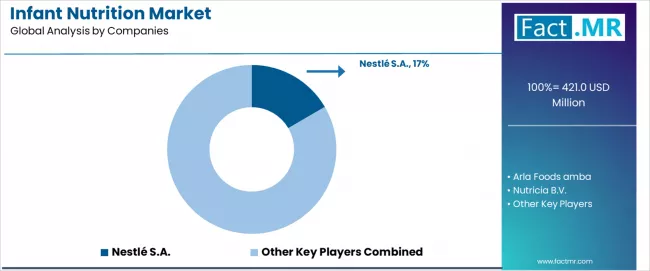
Brazil advances through urbanization and middle-class expansion, followed by Japan supported by fertility incentives and working mother demographics. The competitive landscape features moderate concentration with Nestlé S.A. maintaining market leadership position, while established players including Arla Foods amba, Nutricia, and Abbott compete through comprehensive infant nutrition portfolios and extensive pediatric education programs across diverse feeding applications.
Infant Nutrition Market Year-over-Year Forecast 2025 to 2035
Between 2025 and 2029, the infant nutrition market is projected to expand from USD 421.0 million to USD 568.9 million, resulting in a value increase of USD 147.9 million, which represents 39.6% of the total forecast growth for the period. This phase of development will be shaped by rising demand for premium infant formulas and organic baby food options addressing health-conscious parenting trends, product innovation in fortified formulations and allergen-free variants with enhanced digestibility and nutritional completeness, as well as expanding integration with pediatric consultation services and digital parenting platforms. Companies are establishing competitive positions through investment in clinical nutrition research, advanced processing technologies, and strategic market expansion across modern retail channels, e-commerce platforms, and healthcare professional recommendation networks.
From 2029 to 2035, the market is forecast to grow from USD 568.9 million to USD 794.8 million, adding another USD 225.9 million, which constitutes 60.4% of the overall expansion. This period is expected to be characterized by the expansion of specialized product applications, including hypoallergenic formulas and developmental stage-specific nutrition tailored for premature infants and specific dietary requirements, strategic collaborations between infant nutrition manufacturers and pediatric healthcare institutions, and an enhanced focus on clean label formulations and sustainability certifications. The growing emphasis on personalized infant nutrition protocols and rising consumer preference for organic and natural ingredient formulations will drive demand for comprehensive nutritional solutions across diverse infant populations.
Infant Nutrition Market Key Takeaways
| Metric | Value |
|---|---|
| Market Value (2025) | USD 421.0 million |
| Market Forecast Value (2035) | USD 794.8 million |
| Forecast CAGR (2025-2035) | 6.6% |
Why is the Infant Nutrition Market Growing?
The infant nutrition market grows by enabling parents and caregivers to provide complete and balanced nutritional support for infant growth and development while addressing feeding challenges and dietary requirements without exclusive dependence on breastfeeding alternatives.
Parents with feeding responsibilities face mounting pressure to ensure adequate caloric intake and nutrient provision while managing work commitments, lactation difficulties, and infant health conditions, with modern infant nutrition formulations typically providing comprehensive nutritional profiles including essential proteins for growth support, fortified vitamins and minerals for immune development, and specialized lipids for cognitive enhancement compared to inadequate feeding approaches alone, making commercial infant nutrition essential for comprehensive childcare strategies.
The childcare industry's need for convenient and scientifically validated nutritional solutions creates demand for specialized infant products that can provide complete nutrition delivery, support developmental milestones, and ensure feeding security without compromising infant health outcomes or parental confidence.
Healthcare provider endorsements and clinical evidence supporting formula safety drive adoption in pediatric care environments, maternity hospitals, and family healthcare settings, where nutritional outcomes have direct impact on infant growth trajectories and developmental success rates. The increasing working mother populations globally, affecting millions of families requiring feeding flexibility solutions, create expanding consumer segments seeking reliable nutrition alternatives.
Rising awareness about early childhood nutrition science and evidence-based feeding protocols enables informed product selection and adherence to age-appropriate nutritional guidelines. However, breastfeeding promotion initiatives and cultural feeding preferences may limit market penetration in regions prioritizing natural feeding methods and traditional childcare practices among diverse parenting communities with varying nutritional perspectives.
Segmental Analysis
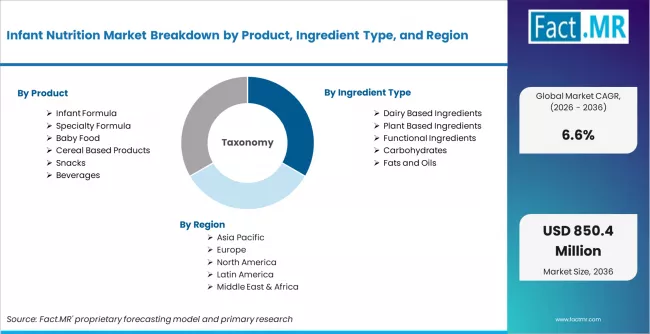
The market is segmented by product type, form, distribution channel, and region. By product type, the market is divided into infant milk formula, baby food, follow-on milk, and others. Based on form, the market is categorized into solid and liquid.
By distribution channel, the market includes hypermarkets/supermarkets, online channels, pharmacy/medical stores, specialty stores, and others. Regionally, the market is divided into Asia Pacific, Europe, North America, Latin America, and Middle East & Africa.
By Product Type, Which Segment Accounts for the Dominant Market Share?

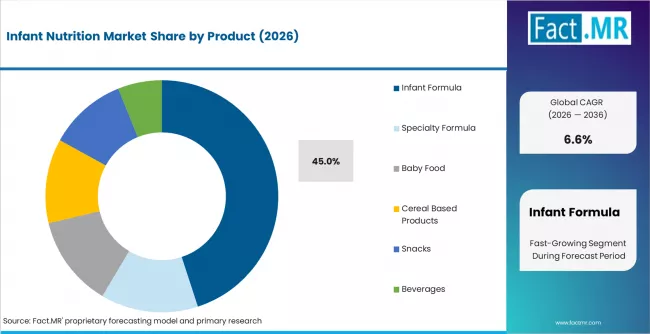
The infant milk formula segment represents the dominant force in the infant nutrition market, capturing 39.3% of the total market share in 2025. This established product category encompasses solutions featuring complete nutritional formulations and breast milk substitute capabilities, including advanced compositions combining proteins, carbohydrates, lipids, vitamins, and minerals with digestibility optimization technologies that enable superior infant feeding outcomes and parental convenience across diverse feeding scenarios and infant age groups worldwide.
The infant milk formula segment's market leadership stems from its proven nutritional adequacy profiles, with products capable of providing complete infant nutrition from birth through early childhood while maintaining rigorous safety standards and quality control measures across diverse manufacturing operations.
The baby food segment maintains a substantial market share in the 31.5% range, serving parents requiring complementary feeding solutions addressing weaning transitions and solid food introduction where pureed vegetables, fruits, and cereals provide age-appropriate nutritional variety supporting developmental progression.
These products offer convenient preparation advantages for caregivers managing busy schedules while providing sufficient nutritional density to support infant growth requirements. The baby food segment demonstrates strong growth potential, driven by expanding awareness of proper weaning practices and increasing emphasis on diverse flavor exposure during critical developmental windows.
Within the product category, follow-on milk formulations designed for older infants demonstrate meaningful adoption at 20.0% market share, driven by parental preferences for continued formula feeding beyond primary infant stages and nutritional support during toddler transitions. The others category maintains 9.2% share through specialized products including therapeutic formulas and nutritional supplements.
Key nutritional advantages driving the infant milk formula segment include:
- Advanced nutritional completeness mechanisms with scientifically formulated compositions providing all essential macronutrients and micronutrients required for healthy infant growth across age-specific requirements
- Established feeding convenience characteristics allowing reliable preparation protocols and consistent nutritional delivery without extensive lactation dependencies or preparation complexities
- Enhanced digestibility features enabling efficient nutrient absorption and reduced gastrointestinal discomfort while maintaining formula stability and nutritional integrity
- Superior safety profile providing optimal quality assurance through stringent manufacturing controls for vulnerable infant populations across various health conditions and feeding sensitivities
By Form, Which Segment Accounts for the Largest Market Share?

Solid form dominates the infant nutrition product landscape with a 62.9% market share in 2025, reflecting the critical role of textured food products in supporting weaning transitions, chewing development, and age-appropriate feeding progression across infant populations worldwide.
The solid form segment's market leadership is reinforced by parental preferences for developmental milestone support, comprehensive food introduction protocols, and compatibility with self-feeding skill development that characterizes modern infant feeding approaches.
Within this segment, powder formulations represent the preferred format for many formula manufacturers, driven by extended shelf stability, convenient storage requirements, and flexible preparation quantities enabling customized feeding volumes. This sub-segment benefits from established consumer familiarity and economic advantages through concentrated product formats.
The liquid form segment represents a substantial product category at 37.1% market share, demonstrating specialized requirements through ready-to-feed convenience, immediate consumption readiness, and travel-friendly packaging where liquid formulations provide maximum preparation simplicity. This segment benefits from premium positioning and on-the-go feeding scenarios.
Key market dynamics supporting form segment growth include:
- Solid form expansion driven by weaning requirements and developmental feeding progression, requiring diverse texture options and flavor variety optimization
- Powder format innovations emphasizing dissolution characteristics and preparation convenience enabling consistent formula reconstitution
- Integration of portion control technologies enabling accurate serving sizes and reduced preparation waste across feeding occasions
- Growing emphasis on packaging innovations and single-serve formats driving consumption convenience without refrigeration limitations
By Distribution Channel, Which Segment Accounts for a Significant Market Share?

Hypermarkets/supermarkets represent the leading distribution segment in the infant nutrition market with a 31.9% market share in 2025, reflecting the fundamental role of large-format retail venues in supporting convenient product access and comprehensive brand selection across consumer shopping patterns.
The hypermarkets/supermarkets segment demonstrates consistent demand driven by the need to provide one-stop shopping experiences, competitive pricing structures, and immediate product availability across routine grocery purchasing occasions.
The online channels segment emerges as an important distribution category at 25.0% market share with robust growth potential, driven by the increasing proportion of parents preferring home delivery convenience, subscription-based automatic replenishment, and access to specialized product varieties unavailable in physical retail locations. E-commerce platforms enable detailed product information review, customer feedback consultation, and discreet purchasing for parents seeking specific nutritional formulations.
Within distribution applications, pharmacy/medical stores demonstrate strong presence at 22.0% market share as parents seek professional consultation availability and healthcare provider recommendations supporting informed product selection. Specialty stores maintain 12.0% through curated organic and premium product offerings, while others category captures 9.1% through traditional grocery stores and convenience retail formats.
Key distribution dynamics include:
- Hypermarket expansion requirements accelerating across emerging markets with emphasis on modern retail infrastructure and organized supply chains
- Online channel applications driving demand for direct-to-consumer brand strategies and subscription commerce models supporting repeat purchasing
- Pharmacy channel prioritizing professional guidance and healthcare integration enabling evidence-based product recommendations
- Specialty store emphasizing premium positioning and organic product curation for health-conscious consumer segments seeking differentiated offerings
What are the Drivers, Restraints, and Key Trends of the Infant Nutrition Market?
The market is driven by three concrete demand factors tied to infant health outcomes. First, rising working mother populations and dual-income household prevalence create expanding consumer segments requiring convenient infant feeding solutions, with commercial nutrition products representing a critical support mechanism for balancing professional responsibilities with childcare obligations, requiring widespread retail availability. Second, growing awareness about early childhood nutrition science drives parental investment in premium formulations and evidence-based products, with increasing understanding of nutritional impacts on cognitive development, immune function, and growth trajectories supporting willingness to purchase specialized infant nutrition by 2030. Third, increasing disposable incomes in emerging economies enable more parents to afford commercial infant nutrition products that improve feeding convenience while supporting optimal infant development compared to limited dietary alternatives.
Market restraints include aggressive breastfeeding promotion campaigns and public health initiatives emphasizing natural feeding that can challenge commercial formula acceptance and create negative perceptions about manufactured infant nutrition products, particularly in regions where breastfeeding advocacy proves culturally influential and medically endorsed. Regulatory complexity and stringent approval requirements for infant formula products pose another significant obstacle, as market entry depends on extensive safety testing protocols, nutritional adequacy validation, and labeling compliance standards, potentially affecting innovation timelines and market expansion strategies. High product costs relative to household incomes in developing regions create additional barriers for mass market penetration, demanding affordable product development and tiered pricing strategies.
Key trends indicate accelerated organic and clean label adoption in developed markets, particularly Europe and North America, where parents demonstrate willingness to pay premium prices for certified organic ingredients, non-GMO formulations, and transparent supply chain documentation. Personalized nutrition trends toward customized formula recommendations based on infant health profiles and genetic predispositions enable targeted nutritional interventions that optimize developmental outcomes. However, the market thesis could face disruption if significant advances in breastfeeding support technologies or major shifts in maternal leave policies reduce commercial infant nutrition dependency.
Analysis of the Infant Nutrition Market by Key Countries

| Country | CAGR (2025 to 2035) |
|---|---|
| India | 12.3% |
| China | 10.7% |
| USA | 6.5% |
| Germany | 5.8% |
| Brazil | 7.2% |
| Japan | 6.0% |
| South Africa | 6.8% |
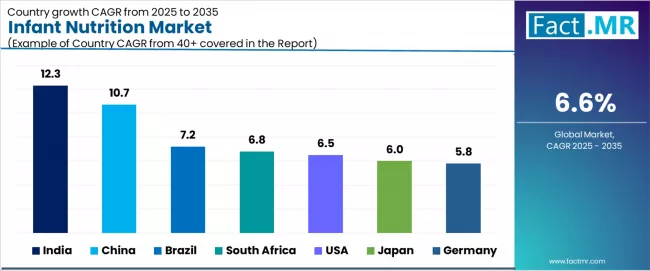
The global infant nutrition market is expanding rapidly, with India leading at a 12.3% CAGR through 2035, driven by rising birth rates, growing working mother populations, and increasing awareness of infant nutrition supporting product adoption. China follows at 10.7%, supported by large infant populations, rising disposable incomes, and demand for premium formula products.
USA records 6.5%, reflecting high parental awareness, strong online retail penetration, and premium product preferences. Germany advances at 5.8%, leveraging high-quality standards and strong organic baby food demand. Brazil posts 7.2%, focusing on urbanization and middle-class expansion, while Japan grows at 6.0%, emphasizing government fertility incentives and working mother support. South Africa demonstrates 6.8% growth, anchored by growing infant populations and retail expansion.
How is India Leading Global Market Expansion?
India demonstrates the strongest growth potential in the infant nutrition market with a CAGR of 12.3% through 2035. The country's leadership position stems from rapidly rising birth rates, expanding working mother demographics, and growing awareness about scientific infant nutrition driving adoption of commercial feeding products. Growth is concentrated in major metropolitan areas and tier-1 cities, including Mumbai, Delhi, Bangalore, and Hyderabad, where urban parents are increasingly purchasing infant formula and baby food products to support convenient feeding while managing professional commitments beyond traditional extended family childcare approaches.
Distribution channels through modern retail chains, pharmacy networks, and e-commerce platforms expand product accessibility across urban populations and middle-class consumer segments. The country's growing integration of international nutrition brands and domestic manufacturing expansion provides strong momentum for affordable yet quality-assured infant nutrition solutions, including comprehensive adoption across income segments seeking reliable feeding alternatives.
Key market factors:
- Urban parent populations concentrated in metropolitan areas and technology hubs with rising dual-income household prevalence
- Modern retail growth through organized supermarket chains and hypermarkets enabling convenient product access
- Comprehensive e-commerce expansion ecosystem, including specialized baby product platforms with proven delivery capabilities
- Local manufacturing development featuring domestic companies offering competitively priced formulations and culturally appropriate product variants
Why is China Emerging as a High-Growth Market?
In major urban centers including Beijing, Shanghai, Guangzhou, and Shenzhen, the adoption of infant nutrition solutions is accelerating across middle-class families, driven by increasing quality consciousness and comprehensive emphasis on child development excellence. The market demonstrates strong growth momentum with a CAGR of 10.7% through 2035, linked to large infant populations and rising disposable incomes supporting premium product purchases.
Chinese parents are implementing international formula brands integrated with traditional feeding practices to enhance infant nutrition while meeting growing expectations for optimal child development outcomes. The country's expanding premium segment creates ongoing demand for imported formula brands, while increasing emphasis on safety and quality drives adoption of certified products with comprehensive traceability systems.
Key development areas:
- Middle-class families leading premium formula adoption with emphasis on imported brands and quality certifications
- Distribution expansion through both traditional mother-baby stores and rapidly growing cross-border e-commerce platforms
- Technology integration enabling product authentication systems and quality verification applications
- Growing preference for organic and specialized formulas addressing specific dietary requirements alongside domestic manufacturers offering safety-certified alternatives
What drives USA’s Market Maturity?

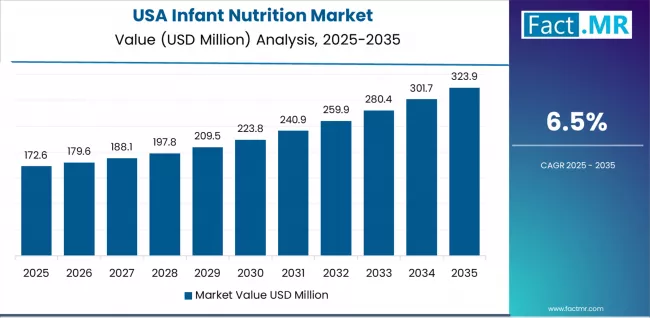
USA’s market expansion is driven by sophisticated consumer preferences, including evidence-based product selection in health-conscious markets and comprehensive infant nutrition solutions across mainstream parenting segments. The country demonstrates steady growth potential with a CAGR of 6.5% through 2035, supported by high parental awareness from pediatric guidance and established formula consumption patterns.
American parents face purchasing decisions related to extensive product variety and specialized formulation options, requiring brands to demonstrate clear nutritional advantages and clinical validation. However, established retail infrastructure and high e-commerce penetration create stable baseline demand for infant nutrition products, particularly among working parents managing feeding schedules where convenient formula delivery drives primary purchasing decisions.
Market characteristics:
- New parents and working mothers showing robust demand with substantial annual consumption across feeding applications
- Regional preferences varying between organic product emphasis in coastal metropolitan areas and value-focused options in mainstream markets
- Future projections indicate continued premiumization with emphasis on clean label formulations and sustainability credentials
- Growing emphasis on subscription services and direct-to-consumer brands supporting parental convenience and brand loyalty
How does Germany Demonstrate Quality Leadership?
The market in Germany leads in quality-focused infant nutrition adoption based on integration with strict regulatory standards and comprehensive organic product preferences for enhanced safety assurance. The country shows steady potential with a CAGR of 5.8% through 2035, driven by stringent quality requirements and consumer preferences for certified organic formulations in major markets, including Bavaria, North Rhine-Westphalia, Baden-Württemberg, and Hesse.
German parents are adopting infant nutrition products through pharmacy consultations and pediatrician recommendations for comprehensive feeding support, particularly in quality-conscious populations and professionally guided childcare protocols demanding rigorous safety credentials. Distribution channels through pharmacy networks and specialized baby stores expand coverage across urban centers and health-focused consumer communities.
Leading market segments:
- Organic product adoption in major urban centers implementing comprehensive certification requirements
- Pharmacy partnerships with pediatric healthcare providers achieving high professional endorsement rates
- Strategic collaborations between infant nutrition manufacturers and medical research institutions expanding credibility
- Focus on clean label certifications and sustainability programs addressing environmental responsibility requirements
What positions Brazil for Emerging Market Leadership?
In major metropolitan centers including São Paulo, Rio de Janeiro, Brasília, and Belo Horizonte, the adoption of infant nutrition solutions is expanding across urban middle-class families, driven by increasing urbanization and rising spending power supporting commercial product purchases. The market shows solid growth potential with a CAGR of 7.2% through 2035, linked to comprehensive retail expansion and increasing focus on infant health product availability in modern trade channels.
Brazilian parents are implementing commercial infant nutrition practices and purchasing affordable formula products to enhance feeding convenience while meeting growing expectations in urban childcare environments. The country's expanding organized retail networks create ongoing demand for competitively priced infant formulations, while increasing healthcare provider awareness drives adoption of evidence-based nutritional products.
Market development factors:
- Urban middle-class families leading infant nutrition adoption with emphasis on convenience and nutritional adequacy
- Distribution expansion through supermarket chains and pharmacy networks providing accessible product availability
- Local manufacturing capabilities supporting competitive pricing and market-appropriate product formulations
- Integration of pediatric education programs and parental awareness campaigns supporting category growth
How does Japan Show Demographic Support Leadership?

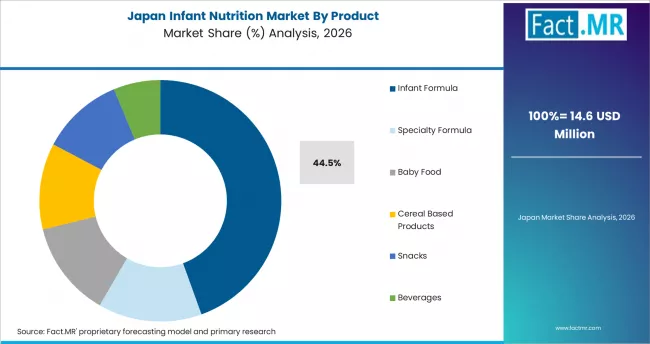
In major metropolitan areas including Tokyo, Osaka, Nagoya, and Fukuoka, parents are implementing infant nutrition solutions through comprehensive retail networks and healthcare provider recommendations, with documented adoption patterns showing substantial product utilization supporting infant feeding programs.
The market shows steady growth potential with a CAGR of 6.0% through 2035, linked to government fertility support initiatives, high working mother prevalence, and established retail infrastructure in major consumption regions.
Japanese parents are adopting premium infant nutrition products with quality oversight to ensure developmental support while maintaining standards demanded by health-conscious purchasing pathways. The country's comprehensive retail presence creates ongoing opportunities for specialized formula launches that differentiate through quality positioning and pediatric endorsement.
Market development factors:
- Quality-focused parents leading adoption of premium infant nutrition products across Japan
- Retail-led distribution services providing growth opportunities in specialized baby product channels
- Strategic partnerships between formula manufacturers and healthcare institutions expanding professional recommendations
- Emphasis on safety testing and quality assurance supporting consumer confidence across product applications
What Characterizes South Africa's Market Development?
In major metropolitan centers including Johannesburg, Cape Town, Durban, and Pretoria, the adoption of infant nutrition solutions is expanding across urban populations, driven by growing infant demographics and increasing retail accessibility. The market demonstrates solid growth potential with a CAGR of 6.8% through 2035, linked to comprehensive retail infrastructure development and increasing emphasis on specialized infant nutrition awareness in major consumption regions.
South African parents are implementing modern feeding practices and purchasing commercial infant nutrition products to support optimal infant development while meeting healthcare recommendations in urban environments. The country's expanding pharmacy networks create ongoing demand for formula products, while increasing middle-class growth drives adoption of premium nutritional formulations.
Key development areas:
- Urban families leading infant nutrition adoption with emphasis on convenience and developmental support
- Distribution expansion through retail pharmacy chains and supermarket networks providing comprehensive coverage
- Healthcare integration supporting clinical protocol adoption and professional product recommendations
- Focus on affordable product options and nutritional education supporting market accessibility and awareness building
Europe Market Split by Country

The infant nutrition market in Europe is projected to grow from USD 132.4 million in 2025 to USD 209.7 million by 2035, registering a CAGR of 5.9% over the forecast period. Germany is expected to maintain its leadership position with a 28.5% market share in 2025, adjusting to 28.0% by 2035, supported by its extensive organic product standards, comprehensive regulatory compliance frameworks, and established quality-focused infant nutrition consumption serving major European markets.
UK follows with a 21.0% share in 2025, projected to reach 21.5% by 2035, driven by comprehensive retail distribution and professional consultation availability in major urban regions implementing evidence-based infant feeding protocols. France holds a 19.0% share in 2025, expected to maintain 19.3% by 2035 through ongoing development of premium infant nutrition products and specialized pediatric care networks.
Italy commands a 15.5% share, while Spain accounts for 12.0% in 2025. The rest of Europe region is anticipated to gain momentum, expanding its collective share from 4.0% to 4.2% by 2035, attributed to increasing infant nutrition adoption in Nordic countries and emerging Eastern European markets implementing modern childcare practices.
How Does Quality Define Infant Nutrition Adoption in Switzerland?
The Swiss infant nutrition market demonstrates a mature and quality-focused landscape, characterized by sophisticated integration of organic formulations with premium positioning across childcare applications, pharmacy distribution channels, and pediatric clinic recommendations. Switzerland's emphasis on product excellence and comprehensive safety validation drives demand for pharmaceutical-grade infant nutrition solutions that support rigorous quality standards and nutritional adequacy requirements in early childhood healthcare delivery.
The market benefits from strong partnerships between international infant nutrition manufacturers and Swiss retail chains, including established pharmacy systems and specialty baby stores, creating comprehensive distribution ecosystems that prioritize product quality and parental education programs. Metropolitan consumer segments showcase advanced infant nutrition implementations where certified organic formulations achieve performance improvements through integrated nutritional optimization approaches and comprehensive developmental support programs.
What Drives Premium Positioning in Netherlands' Market?
The Netherlands infant nutrition market is characterized by strong organic product presence, with companies like international formula leaders and specialized baby food manufacturers maintaining significant positions through comprehensive product portfolios and quality-certified formulations for infant feeding and developmental nutrition applications. The market is demonstrating a growing emphasis on sustainability credentials and clean label requirements, as Dutch parents increasingly demand infant nutrition products that combine nutritional excellence with environmental responsibility deployed across retail networks and healthcare-integrated channels.
Organic brand innovations and specialty product launches are gaining market share through strategic emphasis on certified ingredients, offering specialized formulations including hypoallergenic variants and probiotic-enhanced solutions for comprehensive infant wellness support. The competitive landscape shows increasing collaboration between infant nutrition manufacturers and pediatric healthcare providers, creating integrated care models that combine medical expertise with nutritional guidance capabilities and parental support services.
Competitive Landscape of the Infant Nutrition Market

The infant nutrition market features approximately 10-15 meaningful players with moderate concentration, where the top three companies control roughly 35-45% of global market share through established brand recognition, extensive distribution networks, and comprehensive pediatric endorsement programs. Competition centers on nutritional formulation innovation, safety assurance, and parental trust building rather than price competition alone.
Market leaders include Nestlé, Arla Foods amba, and Nutricia, which maintain competitive advantages through comprehensive infant nutrition product portfolios, extensive clinical research capabilities, and deep expertise in early childhood nutrition science, creating high consumer confidence among parents seeking trusted feeding solutions.
These companies leverage global manufacturing operations and ongoing pediatric collaboration programs to defend market positions while expanding into adjacent categories including toddler nutrition and specialized therapeutic formulas.
Challengers encompass established nutrition companies including Abbott, The Hain Celestial Group Inc., and Holle baby food AG, which compete through targeted product positioning and strong engagement with health-conscious parent communities through organic certifications and natural ingredient emphasis.
Regional specialists, including China Mengniu Dairy Company Limited, Perrigo Company plc, and The Kraft Heinz Company, focus on specific market segments or geographic regions, offering differentiated capabilities in local taste preferences, cultural feeding practices, and price-competitive formulations.
Emerging organic brands and direct-to-consumer companies create competitive pressure through innovative subscription models and community-building strategies, particularly in high-growth markets including China and India, where e-commerce adoption provides advantages in parental education and ongoing engagement approaches.
Market dynamics favor companies that combine scientific credibility with parent-centric brand positioning that addresses the complete feeding journey from birth through early childhood development and weaning transitions. Strategic emphasis on transparent ingredient sourcing, rigorous quality testing, and pediatric healthcare provider education programs enables differentiation in increasingly competitive infant nutrition segments across developed and emerging markets.
Global Infant Nutrition Market - Stakeholder Contribution Framework
Infant nutrition represents a critical childcare product category that enables parents and caregivers to provide complete and balanced nutritional support for infant growth and development while addressing feeding challenges and dietary requirements without exclusive breastfeeding dependency, typically providing comprehensive nutritional profiles including essential proteins for growth support, fortified vitamins and minerals for immune development, and specialized lipids for cognitive enhancement compared to inadequate feeding approaches alone while ensuring optimal infant health outcomes and comprehensive developmental progression.
With the market projected to grow from USD 421.0 million in 2025 to USD 794.8 million by 2035 at a 6.6% CAGR, these solutions offer compelling advantages for formula-based feeding applications, hypermarket distribution channels, and diverse parent populations seeking convenient and scientifically validated nutritional interventions. Scaling market penetration and consumer acceptance requires coordinated action across public health policy, nutritional science standards, infant nutrition manufacturers, pediatric healthcare providers, and parental education initiatives.
How Could Governments Spur Local Development and Adoption?
- Early Childhood Nutrition Programs: Include infant nutrition awareness in national health initiatives, providing targeted support for proper feeding education campaigns in healthcare settings and supporting research institutions through development grants and clinical nutrition funding.
- Tax Policy & Investment Support: Implement reduced tax rates for infant nutrition products, provide tax incentives for companies investing in nutritional research and quality manufacturing practices, and establish favorable import duty structures that encourage premium ingredient procurement over conventional alternatives.
- Regulatory Framework Development: Create streamlined approval processes for new infant formula innovations across nutritional applications, establish clear safety standards and compositional requirements for consumer protection, and develop international harmonization protocols that facilitate cross-border evidence sharing.
- Healthcare Integration & Support: Fund integration of infant nutrition counseling in pediatric care pathways, invest in healthcare provider education initiatives that bridge breastfeeding support with appropriate formula supplementation, and ensure access to affordable infant nutrition for vulnerable populations.
- Research & Innovation Support: Establish public-private partnerships for infant nutrition research, support academic-industry collaborations investigating optimal formulation compositions and developmental outcomes, and create regulatory environments that encourage innovation in specialized nutrition approaches.
How Could Industry Bodies Support Market Development?
- Nutritional Standards & Evidence: Define standardized compositional requirements for infant nutrition products across age groups, establish universal quality testing protocols and safety verification standards, and create evidence databases that healthcare providers can reference for feeding recommendations.
- Market Education & Best Practices: Lead messaging that demonstrates infant nutrition benefits, emphasizing complementary role with breastfeeding support, evidence-based product selection, and realistic nutritional expectations compared to inadequate feeding alternatives.
- Quality Assurance Standards: Develop guidelines for ingredient sourcing, manufacturing excellence, contamination prevention requirements, and label accuracy, ensuring infant safety across production and distribution operations.
- Professional Development: Run certification programs for healthcare providers, nutritionists, and retail professionals on optimizing infant feeding protocols, product selection guidance, and parental counseling in diverse childcare environments.
How Could Manufacturers and Technology Players Strengthen the Ecosystem?
- Advanced Product Development: Develop next-generation infant nutrition formulations with enhanced nutritional profiles, optimized digestibility characteristics, and age-specific compositions that improve infant health outcomes while addressing diverse dietary requirements and feeding preferences.
- Clinical Validation Programs: Provide comprehensive clinical trial data, real-world feeding studies, and developmental outcome research that supports healthcare provider confidence and informed parental decision-making.
- Parental Education Initiatives: Offer comprehensive information about infant nutritional requirements, product selection guidance, and age-appropriate feeding protocols that help parents make informed decisions aligned with infant health priorities and developmental needs.
- Research & Development Networks: Build comprehensive R&D capabilities, collaborative pediatric research programs, and nutritional testing systems that ensure infant nutrition products maintain high safety standards and consistent quality across diverse manufacturing operations.
How Could Healthcare Providers and Educators Navigate the Market?
- Evidence-Based Feeding Protocol Integration: Incorporate validated infant nutrition recommendations into comprehensive childcare plans, with particular focus on appropriate formula selection, complementary feeding timing, and nutritional adequacy assessment for holistic infant care.
- Parental Counseling Excellence: Establish comprehensive parental education programs addressing feeding options, realistic expectations, and integration with developmental monitoring through optimized consultation frameworks and follow-up protocols.
- Multidisciplinary Care Models: Implement integrated care teams combining pediatricians, lactation consultants, nutritionists, and child development specialists that provide comprehensive infant care addressing medical, nutritional, and developmental aspects.
- Outcomes Monitoring Systems: Develop standardized infant growth tracking, developmental milestone assessment, and nutritional adequacy evaluations that enable continuous protocol optimization and evidence generation.
How Could Investors and Financial Enablers Unlock Value?
- Clinical Research Financing: Provide growth capital for established companies like Nestlé, Abbott, and emerging brands to fund clinical trials and nutritional evidence generation initiatives that support mainstream pediatric acceptance.
- Innovation Investment: Back startups developing advanced formulation technologies, personalized nutrition platforms, and sustainable ingredient sourcing innovations that enhance nutritional efficacy and environmental responsibility.
- Market Expansion Funding: Finance distribution expansion strategies for infant nutrition manufacturers establishing operations in high-growth regions including India and China, supporting localization initiatives that address cultural preferences while maintaining quality standards.
- Digital Integration Support: Support companies developing parental education applications, feeding tracking systems, and telemedicine consultation platforms that enhance feeding success through technology-enabled childcare support.
Key Players in the Infant Nutrition Market
- Nestlé S.A.
- Arla Foods amba
- Nutricia B.V.
- Abbott Laboratories
- The Hain Celestial Group, Inc.
- Holle baby food AG
- China Mengniu Dairy Company Limited
- Perrigo Company plc
- The Kraft Heinz Company
- Dana Dairy Group Ltd.
Scope of the Report
| Items | Values |
|---|---|
| Quantitative Units | USD 421.0 Million |
| Product Type | Infant Milk Formula, Baby Food, Follow-on Milk, Others |
| Form | Solid, Liquid |
| Distribution Channel | Hypermarkets/Supermarkets, Online Channels, Pharmacy/Medical Stores, Specialty Stores, Others |
| Regions Covered | Asia Pacific, Europe, North America, Latin America, Middle East & Africa |
| Country Covered | India, China, USA, Germany, UK, Japan, Brazil, South Africa, and 40+ countries |
| Key Companies Profiled | Nestlé, Arla Foods amba, Nutricia, Abbott, The Hain Celestial Group Inc., Holle baby food AG, China Mengniu Dairy Company Limited, Perrigo Company plc, The Kraft Heinz Company, DANA DAIRY GROUP |
| Additional Attributes | Dollar sales by product type and form categories, regional adoption trends across Asia Pacific, Europe, and North America, competitive landscape with infant nutrition manufacturers and childcare product companies, product specifications and formulation requirements, integration with pediatric healthcare recommendations and parental education platforms, innovations in organic formulations and specialized dietary solutions, and development of age-specific applications with clinical validation and developmental support capabilities. |
Infant Nutrition Market by Segments
-
Product Type :
- Infant Milk Formula
- Baby Food
- Follow-on Milk
- Others
-
Form :
- Solid
- Liquid
-
Distribution Channel :
- Hypermarkets/Supermarkets
- Online Channels
- Pharmacy/Medical Stores
- Specialty Stores
- Others
-
Region :
- Asia Pacific
- China
- Japan
- South Korea
- India
- Australia
- Thailand
- Rest of Asia Pacific
- Europe
- Germany
- UK
- France
- Italy
- Spain
- Denmark
- Sweden
- Norway
- Rest of Europe
- North America
- USA
- Canada
- Mexico
- Latin America
- Brazil
- Argentina
- Rest of Latin America
- Middle East & Africa
- South Africa
- Saudi Arabia
- UAE
- Kuwait
- Rest of Middle East & Africa
- Asia Pacific
Table of Content
- Executive Summary
- Global Market Outlook
- Demand to side Trends
- Supply to side Trends
- Technology Roadmap Analysis
- Analysis and Recommendations
- Market Overview
- Market Coverage / Taxonomy
- Market Definition / Scope / Limitations
- Market Background
- Market Dynamics
- Drivers
- Restraints
- Opportunity
- Trends
- Scenario Forecast
- Demand in Optimistic Scenario
- Demand in Likely Scenario
- Demand in Conservative Scenario
- Opportunity Map Analysis
- Product Life Cycle Analysis
- Supply Chain Analysis
- Investment Feasibility Matrix
- Value Chain Analysis
- PESTLE and Porter’s Analysis
- Regulatory Landscape
- Regional Parent Market Outlook
- Production and Consumption Statistics
- Import and Export Statistics
- Market Dynamics
- Global Market Analysis 2020 to 2024 and Forecast, 2025 to 2035
- Historical Market Size Value (USD Million) Analysis, 2020 to 2024
- Current and Future Market Size Value (USD Million) Projections, 2025 to 2035
- Y to o to Y Growth Trend Analysis
- Absolute $ Opportunity Analysis
- Global Market Pricing Analysis 2020 to 2024 and Forecast 2025 to 2035
- Global Market Analysis 2020 to 2024 and Forecast 2025 to 2035, By Product Type
- Introduction / Key Findings
- Historical Market Size Value (USD Million) Analysis By Product Type, 2020 to 2024
- Current and Future Market Size Value (USD Million) Analysis and Forecast By Product Type, 2025 to 2035
- Infant Milk Formula
- Baby Food
- Follow-on Milk
- Others
- Y to o to Y Growth Trend Analysis By Product Type, 2020 to 2024
- Absolute $ Opportunity Analysis By Product Type, 2025 to 2035
- Global Market Analysis 2020 to 2024 and Forecast 2025 to 2035, By Form
- Introduction / Key Findings
- Historical Market Size Value (USD Million) Analysis By Form, 2020 to 2024
- Current and Future Market Size Value (USD Million) Analysis and Forecast By Form, 2025 to 2035
- Solid
- Liquid
- Y to o to Y Growth Trend Analysis By Form, 2020 to 2024
- Absolute $ Opportunity Analysis By Form, 2025 to 2035
- Global Market Analysis 2020 to 2024 and Forecast 2025 to 2035, By Distribution Channel
- Introduction / Key Findings
- Historical Market Size Value (USD Million) Analysis By Distribution Channel, 2020 to 2024
- Current and Future Market Size Value (USD Million) Analysis and Forecast By Distribution Channel, 2025 to 2035
- Hypermarkets/Supermarkets
- Online Channels
- Pharmacy/Medical Stores
- Specialty Stores
- Others
- Y to o to Y Growth Trend Analysis By Distribution Channel, 2020 to 2024
- Absolute $ Opportunity Analysis By Distribution Channel, 2025 to 2035
- Global Market Analysis 2020 to 2024 and Forecast 2025 to 2035, By Region
- Introduction
- Historical Market Size Value (USD Million) Analysis By Region, 2020 to 2024
- Current Market Size Value (USD Million) Analysis and Forecast By Region, 2025 to 2035
- North America
- Latin America
- Western Europe
- Eastern Europe
- East Asia
- South Asia and Pacific
- Middle East & Africa
- Market Attractiveness Analysis By Region
- North America Market Analysis 2020 to 2024 and Forecast 2025 to 2035, By Country
- Historical Market Size Value (USD Million) Trend Analysis By Market Taxonomy, 2020 to 2024
- Market Size Value (USD Million) Forecast By Market Taxonomy, 2025 to 2035
- By Country
- USA
- Canada
- Mexico
- By Product Type
- By Form
- By Distribution Channel
- By Country
- Market Attractiveness Analysis
- By Country
- By Product Type
- By Form
- By Distribution Channel
- Key Takeaways
- Latin America Market Analysis 2020 to 2024 and Forecast 2025 to 2035, By Country
- Historical Market Size Value (USD Million) Trend Analysis By Market Taxonomy, 2020 to 2024
- Market Size Value (USD Million) Forecast By Market Taxonomy, 2025 to 2035
- By Country
- Brazil
- Chile
- Rest of Latin America
- By Product Type
- By Form
- By Distribution Channel
- By Country
- Market Attractiveness Analysis
- By Country
- By Product Type
- By Form
- By Distribution Channel
- Key Takeaways
- Western Europe Market Analysis 2020 to 2024 and Forecast 2025 to 2035, By Country
- Historical Market Size Value (USD Million) Trend Analysis By Market Taxonomy, 2020 to 2024
- Market Size Value (USD Million) Forecast By Market Taxonomy, 2025 to 2035
- By Country
- Germany
- UK
- Italy
- Spain
- France
- Nordic
- BENELUX
- Rest of Western Europe
- By Product Type
- By Form
- By Distribution Channel
- By Country
- Market Attractiveness Analysis
- By Country
- By Product Type
- By Form
- By Distribution Channel
- Key Takeaways
- Eastern Europe Market Analysis 2020 to 2024 and Forecast 2025 to 2035, By Country
- Historical Market Size Value (USD Million) Trend Analysis By Market Taxonomy, 2020 to 2024
- Market Size Value (USD Million) Forecast By Market Taxonomy, 2025 to 2035
- By Country
- Russia
- Poland
- Hungary
- Balkan & Baltic
- Rest of Eastern Europe
- By Product Type
- By Form
- By Distribution Channel
- By Country
- Market Attractiveness Analysis
- By Country
- By Product Type
- By Form
- By Distribution Channel
- Key Takeaways
- East Asia Market Analysis 2020 to 2024 and Forecast 2025 to 2035, By Country
- Historical Market Size Value (USD Million) Trend Analysis By Market Taxonomy, 2020 to 2024
- Market Size Value (USD Million) Forecast By Market Taxonomy, 2025 to 2035
- By Country
- China
- Japan
- South Korea
- By Product Type
- By Form
- By Distribution Channel
- By Country
- Market Attractiveness Analysis
- By Country
- By Product Type
- By Form
- By Distribution Channel
- Key Takeaways
- South Asia and Pacific Market Analysis 2020 to 2024 and Forecast 2025 to 2035, By Country
- Historical Market Size Value (USD Million) Trend Analysis By Market Taxonomy, 2020 to 2024
- Market Size Value (USD Million) Forecast By Market Taxonomy, 2025 to 2035
- By Country
- India
- ASEAN
- Australia & New Zealand
- Rest of South Asia and Pacific
- By Product Type
- By Form
- By Distribution Channel
- By Country
- Market Attractiveness Analysis
- By Country
- By Product Type
- By Form
- By Distribution Channel
- Key Takeaways
- Middle East & Africa Market Analysis 2020 to 2024 and Forecast 2025 to 2035, By Country
- Historical Market Size Value (USD Million) Trend Analysis By Market Taxonomy, 2020 to 2024
- Market Size Value (USD Million) Forecast By Market Taxonomy, 2025 to 2035
- By Country
- Kingdom of Saudi Arabia
- Other GCC Countries
- Turkiye
- South Africa
- Other African Union
- Rest of Middle East & Africa
- By Product Type
- By Form
- By Distribution Channel
- By Country
- Market Attractiveness Analysis
- By Country
- By Product Type
- By Form
- By Distribution Channel
- Key Takeaways
- Key Countries Market Analysis
- USA
- Pricing Analysis
- Market Share Analysis, 2024
- By Product Type
- By Form
- By Distribution Channel
- Canada
- Pricing Analysis
- Market Share Analysis, 2024
- By Product Type
- By Form
- By Distribution Channel
- Mexico
- Pricing Analysis
- Market Share Analysis, 2024
- By Product Type
- By Form
- By Distribution Channel
- Brazil
- Pricing Analysis
- Market Share Analysis, 2024
- By Product Type
- By Form
- By Distribution Channel
- Chile
- Pricing Analysis
- Market Share Analysis, 2024
- By Product Type
- By Form
- By Distribution Channel
- Germany
- Pricing Analysis
- Market Share Analysis, 2024
- By Product Type
- By Form
- By Distribution Channel
- UK
- Pricing Analysis
- Market Share Analysis, 2024
- By Product Type
- By Form
- By Distribution Channel
- Italy
- Pricing Analysis
- Market Share Analysis, 2024
- By Product Type
- By Form
- By Distribution Channel
- Spain
- Pricing Analysis
- Market Share Analysis, 2024
- By Product Type
- By Form
- By Distribution Channel
- France
- Pricing Analysis
- Market Share Analysis, 2024
- By Product Type
- By Form
- By Distribution Channel
- India
- Pricing Analysis
- Market Share Analysis, 2024
- By Product Type
- By Form
- By Distribution Channel
- ASEAN
- Pricing Analysis
- Market Share Analysis, 2024
- By Product Type
- By Form
- By Distribution Channel
- Australia & New Zealand
- Pricing Analysis
- Market Share Analysis, 2024
- By Product Type
- By Form
- By Distribution Channel
- China
- Pricing Analysis
- Market Share Analysis, 2024
- By Product Type
- By Form
- By Distribution Channel
- Japan
- Pricing Analysis
- Market Share Analysis, 2024
- By Product Type
- By Form
- By Distribution Channel
- South Korea
- Pricing Analysis
- Market Share Analysis, 2024
- By Product Type
- By Form
- By Distribution Channel
- Russia
- Pricing Analysis
- Market Share Analysis, 2024
- By Product Type
- By Form
- By Distribution Channel
- Poland
- Pricing Analysis
- Market Share Analysis, 2024
- By Product Type
- By Form
- By Distribution Channel
- Hungary
- Pricing Analysis
- Market Share Analysis, 2024
- By Product Type
- By Form
- By Distribution Channel
- Kingdom of Saudi Arabia
- Pricing Analysis
- Market Share Analysis, 2024
- By Product Type
- By Form
- By Distribution Channel
- Turkiye
- Pricing Analysis
- Market Share Analysis, 2024
- By Product Type
- By Form
- By Distribution Channel
- South Africa
- Pricing Analysis
- Market Share Analysis, 2024
- By Product Type
- By Form
- By Distribution Channel
- USA
- Market Structure Analysis
- Competition Dashboard
- Competition Benchmarking
- Market Share Analysis of Top Players
- By Regional
- By Product Type
- By Form
- By Distribution Channel
- Competition Analysis
- Competition Deep Dive
- Nestlé S.A.
- Overview
- Product Portfolio
- Profitability by Market Segments (Product/Age /Sales Channel/Region)
- Sales Footprint
- Strategy Overview
- Marketing Strategy
- Product Strategy
- Channel Strategy
- Arla Foods amba
- Nutricia B.V.
- Abbott Laboratories
- The Hain Celestial Group, Inc.
- Holle baby food AG
- China Mengniu Dairy Company Limited
- Perrigo Company plc
- The Kraft Heinz Company
- Dana Dairy Group Ltd.
- Nestlé S.A.
- Competition Deep Dive
- Assumptions & Acronyms Used
- Research Methodology
List Of Table
- Table 1: Global Market Value (USD Million) Forecast by Region, 2020 to 2035
- Table 2: Global Market Value (USD Million) Forecast by Product Type, 2020 to 2035
- Table 3: Global Market Value (USD Million) Forecast by Form, 2020 to 2035
- Table 4: Global Market Value (USD Million) Forecast by Distribution Channel, 2020 to 2035
- Table 5: North America Market Value (USD Million) Forecast by Country, 2020 to 2035
- Table 6: North America Market Value (USD Million) Forecast by Product Type, 2020 to 2035
- Table 7: North America Market Value (USD Million) Forecast by Form, 2020 to 2035
- Table 8: North America Market Value (USD Million) Forecast by Distribution Channel, 2020 to 2035
- Table 9: Latin America Market Value (USD Million) Forecast by Country, 2020 to 2035
- Table 10: Latin America Market Value (USD Million) Forecast by Product Type, 2020 to 2035
- Table 11: Latin America Market Value (USD Million) Forecast by Form, 2020 to 2035
- Table 12: Latin America Market Value (USD Million) Forecast by Distribution Channel, 2020 to 2035
- Table 13: Western Europe Market Value (USD Million) Forecast by Country, 2020 to 2035
- Table 14: Western Europe Market Value (USD Million) Forecast by Product Type, 2020 to 2035
- Table 15: Western Europe Market Value (USD Million) Forecast by Form, 2020 to 2035
- Table 16: Western Europe Market Value (USD Million) Forecast by Distribution Channel, 2020 to 2035
- Table 17: Eastern Europe Market Value (USD Million) Forecast by Country, 2020 to 2035
- Table 18: Eastern Europe Market Value (USD Million) Forecast by Product Type, 2020 to 2035
- Table 19: Eastern Europe Market Value (USD Million) Forecast by Form, 2020 to 2035
- Table 20: Eastern Europe Market Value (USD Million) Forecast by Distribution Channel, 2020 to 2035
- Table 21: East Asia Market Value (USD Million) Forecast by Country, 2020 to 2035
- Table 22: East Asia Market Value (USD Million) Forecast by Product Type, 2020 to 2035
- Table 23: East Asia Market Value (USD Million) Forecast by Form, 2020 to 2035
- Table 24: East Asia Market Value (USD Million) Forecast by Distribution Channel, 2020 to 2035
- Table 25: South Asia and Pacific Market Value (USD Million) Forecast by Country, 2020 to 2035
- Table 26: South Asia and Pacific Market Value (USD Million) Forecast by Product Type, 2020 to 2035
- Table 27: South Asia and Pacific Market Value (USD Million) Forecast by Form, 2020 to 2035
- Table 28: South Asia and Pacific Market Value (USD Million) Forecast by Distribution Channel, 2020 to 2035
- Table 29: Middle East & Africa Market Value (USD Million) Forecast by Country, 2020 to 2035
- Table 30: Middle East & Africa Market Value (USD Million) Forecast by Product Type, 2020 to 2035
- Table 31: Middle East & Africa Market Value (USD Million) Forecast by Form, 2020 to 2035
- Table 32: Middle East & Africa Market Value (USD Million) Forecast by Distribution Channel, 2020 to 2035
List Of Figures
- Figure 1: Global Market Pricing Analysis
- Figure 2: Global Market Value (USD Million) Forecast 2020 to 2035
- Figure 3: Global Market Value Share and BPS Analysis by Product Type, 2025 and 2035
- Figure 4: Global Market Y to o to Y Growth Comparison by Product Type, 2025 to 2035
- Figure 5: Global Market Attractiveness Analysis by Product Type
- Figure 6: Global Market Value Share and BPS Analysis by Form, 2025 and 2035
- Figure 7: Global Market Y to o to Y Growth Comparison by Form, 2025 to 2035
- Figure 8: Global Market Attractiveness Analysis by Form
- Figure 9: Global Market Value Share and BPS Analysis by Distribution Channel, 2025 and 2035
- Figure 10: Global Market Y to o to Y Growth Comparison by Distribution Channel, 2025 to 2035
- Figure 11: Global Market Attractiveness Analysis by Distribution Channel
- Figure 12: Global Market Value (USD Million) Share and BPS Analysis by Region, 2025 and 2035
- Figure 13: Global Market Y to o to Y Growth Comparison by Region, 2025 to 2035
- Figure 14: Global Market Attractiveness Analysis by Region
- Figure 15: North America Market Incremental Dollar Opportunity, 2025 to 2035
- Figure 16: Latin America Market Incremental Dollar Opportunity, 2025 to 2035
- Figure 17: Western Europe Market Incremental Dollar Opportunity, 2025 to 2035
- Figure 18: Eastern Europe Market Incremental Dollar Opportunity, 2025 to 2035
- Figure 19: East Asia Market Incremental Dollar Opportunity, 2025 to 2035
- Figure 20: South Asia and Pacific Market Incremental Dollar Opportunity, 2025 to 2035
- Figure 21: Middle East & Africa Market Incremental Dollar Opportunity, 2025 to 2035
- Figure 22: North America Market Value Share and BPS Analysis by Country, 2025 and 2035
- Figure 23: North America Market Value Share and BPS Analysis by Product Type, 2025 and 2035
- Figure 24: North America Market Y to o to Y Growth Comparison by Product Type, 2025 to 2035
- Figure 25: North America Market Attractiveness Analysis by Product Type
- Figure 26: North America Market Value Share and BPS Analysis by Form, 2025 and 2035
- Figure 27: North America Market Y to o to Y Growth Comparison by Form, 2025 to 2035
- Figure 28: North America Market Attractiveness Analysis by Form
- Figure 29: North America Market Value Share and BPS Analysis by Distribution Channel, 2025 and 2035
- Figure 30: North America Market Y to o to Y Growth Comparison by Distribution Channel, 2025 to 2035
- Figure 31: North America Market Attractiveness Analysis by Distribution Channel
- Figure 32: Latin America Market Value Share and BPS Analysis by Country, 2025 and 2035
- Figure 33: Latin America Market Value Share and BPS Analysis by Product Type, 2025 and 2035
- Figure 34: Latin America Market Y to o to Y Growth Comparison by Product Type, 2025 to 2035
- Figure 35: Latin America Market Attractiveness Analysis by Product Type
- Figure 36: Latin America Market Value Share and BPS Analysis by Form, 2025 and 2035
- Figure 37: Latin America Market Y to o to Y Growth Comparison by Form, 2025 to 2035
- Figure 38: Latin America Market Attractiveness Analysis by Form
- Figure 39: Latin America Market Value Share and BPS Analysis by Distribution Channel, 2025 and 2035
- Figure 40: Latin America Market Y to o to Y Growth Comparison by Distribution Channel, 2025 to 2035
- Figure 41: Latin America Market Attractiveness Analysis by Distribution Channel
- Figure 42: Western Europe Market Value Share and BPS Analysis by Country, 2025 and 2035
- Figure 43: Western Europe Market Value Share and BPS Analysis by Product Type, 2025 and 2035
- Figure 44: Western Europe Market Y to o to Y Growth Comparison by Product Type, 2025 to 2035
- Figure 45: Western Europe Market Attractiveness Analysis by Product Type
- Figure 46: Western Europe Market Value Share and BPS Analysis by Form, 2025 and 2035
- Figure 47: Western Europe Market Y to o to Y Growth Comparison by Form, 2025 to 2035
- Figure 48: Western Europe Market Attractiveness Analysis by Form
- Figure 49: Western Europe Market Value Share and BPS Analysis by Distribution Channel, 2025 and 2035
- Figure 50: Western Europe Market Y to o to Y Growth Comparison by Distribution Channel, 2025 to 2035
- Figure 51: Western Europe Market Attractiveness Analysis by Distribution Channel
- Figure 52: Eastern Europe Market Value Share and BPS Analysis by Country, 2025 and 2035
- Figure 53: Eastern Europe Market Value Share and BPS Analysis by Product Type, 2025 and 2035
- Figure 54: Eastern Europe Market Y to o to Y Growth Comparison by Product Type, 2025 to 2035
- Figure 55: Eastern Europe Market Attractiveness Analysis by Product Type
- Figure 56: Eastern Europe Market Value Share and BPS Analysis by Form, 2025 and 2035
- Figure 57: Eastern Europe Market Y to o to Y Growth Comparison by Form, 2025 to 2035
- Figure 58: Eastern Europe Market Attractiveness Analysis by Form
- Figure 59: Eastern Europe Market Value Share and BPS Analysis by Distribution Channel, 2025 and 2035
- Figure 60: Eastern Europe Market Y to o to Y Growth Comparison by Distribution Channel, 2025 to 2035
- Figure 61: Eastern Europe Market Attractiveness Analysis by Distribution Channel
- Figure 62: East Asia Market Value Share and BPS Analysis by Country, 2025 and 2035
- Figure 63: East Asia Market Value Share and BPS Analysis by Product Type, 2025 and 2035
- Figure 64: East Asia Market Y to o to Y Growth Comparison by Product Type, 2025 to 2035
- Figure 65: East Asia Market Attractiveness Analysis by Product Type
- Figure 66: East Asia Market Value Share and BPS Analysis by Form, 2025 and 2035
- Figure 67: East Asia Market Y to o to Y Growth Comparison by Form, 2025 to 2035
- Figure 68: East Asia Market Attractiveness Analysis by Form
- Figure 69: East Asia Market Value Share and BPS Analysis by Distribution Channel, 2025 and 2035
- Figure 70: East Asia Market Y to o to Y Growth Comparison by Distribution Channel, 2025 to 2035
- Figure 71: East Asia Market Attractiveness Analysis by Distribution Channel
- Figure 72: South Asia and Pacific Market Value Share and BPS Analysis by Country, 2025 and 2035
- Figure 73: South Asia and Pacific Market Value Share and BPS Analysis by Product Type, 2025 and 2035
- Figure 74: South Asia and Pacific Market Y to o to Y Growth Comparison by Product Type, 2025 to 2035
- Figure 75: South Asia and Pacific Market Attractiveness Analysis by Product Type
- Figure 76: South Asia and Pacific Market Value Share and BPS Analysis by Form, 2025 and 2035
- Figure 77: South Asia and Pacific Market Y to o to Y Growth Comparison by Form, 2025 to 2035
- Figure 78: South Asia and Pacific Market Attractiveness Analysis by Form
- Figure 79: South Asia and Pacific Market Value Share and BPS Analysis by Distribution Channel, 2025 and 2035
- Figure 80: South Asia and Pacific Market Y to o to Y Growth Comparison by Distribution Channel, 2025 to 2035
- Figure 81: South Asia and Pacific Market Attractiveness Analysis by Distribution Channel
- Figure 82: Middle East & Africa Market Value Share and BPS Analysis by Country, 2025 and 2035
- Figure 83: Middle East & Africa Market Value Share and BPS Analysis by Product Type, 2025 and 2035
- Figure 84: Middle East & Africa Market Y to o to Y Growth Comparison by Product Type, 2025 to 2035
- Figure 85: Middle East & Africa Market Attractiveness Analysis by Product Type
- Figure 86: Middle East & Africa Market Value Share and BPS Analysis by Form, 2025 and 2035
- Figure 87: Middle East & Africa Market Y to o to Y Growth Comparison by Form, 2025 to 2035
- Figure 88: Middle East & Africa Market Attractiveness Analysis by Form
- Figure 89: Middle East & Africa Market Value Share and BPS Analysis by Distribution Channel, 2025 and 2035
- Figure 90: Middle East & Africa Market Y to o to Y Growth Comparison by Distribution Channel, 2025 to 2035
- Figure 91: Middle East & Africa Market Attractiveness Analysis by Distribution Channel
- Figure 92: Global Market - Tier Structure Analysis
- Figure 93: Global Market - Company Share Analysis
- FAQs -
How big is the infant nutrition market in 2025?
The global infant nutrition market is estimated to be valued at USD 421.0 million in 2025.
What will be the size of infant nutrition market in 2035?
The market size for the infant nutrition market is projected to reach USD 794.8 million by 2035.
How much will be the infant nutrition market growth between 2025 and 2035?
The infant nutrition market is expected to grow at a 6.6% CAGR between 2025 and 2035.
What are the key product types in the infant nutrition market?
The key product types in infant nutrition market are infant milk formula, baby food, follow-on milk and others.
Which form segment to contribute significant share in the infant nutrition market in 2025?
In terms of form, solid segment to command 62.9% share in the infant nutrition market in 2025.