- Estimated Value(2026): 10.0 Bn
- Forecast Value (2036): 43.2 Bn
- CAGR (2026 - 2036): 15.8%
Hexacopter Market Size, Market Forecast and Outlook by Fact.MR
- The hexacopter market valuation a crossed of USD 8.6 billion in 2025.
- Demand is estimated to reach USD 10.0 billion in 2026.
- The market is expected to grow at 15.8% CAGR from 2026 to 2036.
- Stable payload demand lift the market to USD 43.2 billion by 2036 as industrial operators and defense agencies need safer aerial review.
- Drone operators are moving from basic aerial capture toward stable payload missions.
- Hexacopters support this shift as six rotors improve lift and flight balance.
- FAA’s 2025 BVLOS proposal covers operating rules and aircraft manufacturing. It includes safe separation and recordkeeping for drone operations. [1]
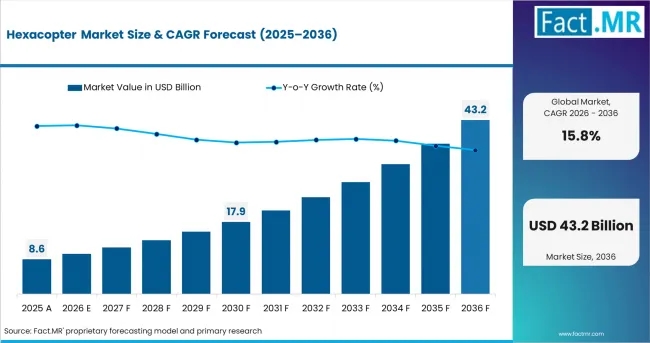
Hexacopter Market Market Value Analysis | Source: Fact.MR
Summary of hexacopter market
- Market Definition
- The hexacopters market covers six-rotor unmanned aerial vehicles used for inspection and agriculture tasks requiring stable lift, payload handling, reliable flight performance, and service support across global commercial field operations.
- Demand Drivers in the Market
- Inspection Services: Inspection service heads need hexacopters for safer review of towers and industrial assets. Stable lift helps operators assess structures from safer distances.
- Agriculture Services: Agriculture service providers use hexacopters for crop monitoring and selective spray work. Multi-rotor stability supports controlled field coverage.
- Security Agencies: Security agencies need stable drone footage for border watch and site assessment. Hexacopters support clearer aerial review across sensitive areas.
- Key Segments Analyzed
- Military Drones: Military drones are projected to account for 68.0% share of hexacopter demand by drone type in 2026 as defense users need stable aerial surveillance and payload support.
- 5 to 10 kg Payload: Inspection and mapping users need stable lift for camera payloads. The 5 to 10 kg payload segment is expected to account for 43.0% share of hexacopter demand by payload in 2026.
- Mapping & Surveying: Mapping & surveying is estimated to capture 19.5% share of hexacopter demand by application in 2026 as land survey users need stable flight and cleaner aerial data.
- Security & Law Enforcement: Security & law enforcement is expected to represent 31.0% share of hexacopter demand by end user in 2026 as agencies need safer aerial review and longer field visibility.
- OEMs: OEMs are expected to account for 53.0% share of hexacopter demand by sales channel in 2026 as professional operators need payload setup and service access.
- Geography: United States hexacopter demand is forecast to grow at 16.8% CAGR from 2026 to 2036 as inspection and public safety missions expand.
- Analyst Opinion at Fact.MR
- Shambhu Nath Jha, Senior Analyst at Fact.MR, notes, “Hexacopter adoption is shifting from camera novelty to platform dependability. Defense users want stable aerial review. Industrial users want payload balance and service support. Suppliers will gain if six-rotor stability is paired with simple maintenance and field training.”
- Strategic Implications
- Manufacturer Design: Drone manufacturers must align hexacopter designs with payload stability and field service needs. Strong lift support helps platforms serve inspection and crop monitoring work.
- Operator Assessment: Industrial operators should assess drones through lift capacity and data quality. Stable flight improves review of towers and hard-to-access assets.
- Service Support: Agriculture service providers need maintenance support to protect repeat field use. Battery access and repair support help reduce downtime during spray cycles.
- Methodology
- Fact.MR interviews drone operators and inspection service heads, while agriculture service providers contribute application-level insights.
- Research incorporates aviation regulations and company disclosures to support supplier verification and competitive assessment.
- Market estimates are developed using payload demand patterns and drone-type mix analysis, with regional adoption trends applied for validation.
- Forecast assumptions are validated through supplier checks and distributor channel reviews to support application-level accuracy.
| Metric | Details |
|---|---|
| Industry Size (2026) | USD 10.0 billion |
| Industry Value (2036) | USD 43.2 billion |
| CAGR (2026 to 2036) | 15.8% |
Source: Fact.MR analysis. Updated May 23, 2026
Stable multirotor work is entering scheduled field operations. Inspection service providers need reliable platforms for cameras and thermal payloads. Agriculture service providers use hexacopters for crop review and selective spraying. Structured flight workflows move hexacopters beyond occasional aerial photography.
United States hexacopter demand is expected to reach 16.8% CAGR from 2026 to 2036 as infrastructure inspection and public safety missions expand. China is likely to record 16.4% CAGR as registered UAV activity and drone manufacturing support adoption. India is forecast to post 16.2% CAGR as agriculture services and public-sector mapping lift use. Germany is projected to grow at 15.0% CAGR through industrial inspection and surveying demand. Japan registers at 14.6% CAGR as infrastructure review uses safer aerial platforms. UK demand is rises at 14.2% CAGR. Brazil records 13.6% CAGR through agriculture monitoring and mine surveying.
Segmental Analysis
Hexacopter Market Analysis by Payload
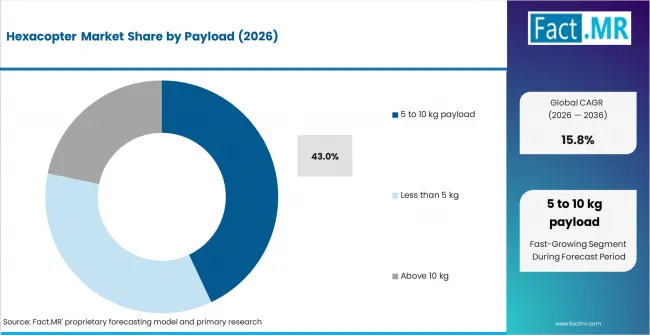
Hexacopter Market Analysis By Payload | Source: Fact.MR
The 5 to 10 kg payload segment is expected to account for 43.0% share of hexacopter demand by payload in 2026 as inspection and mapping users need stable lift for cameras and small sensor payloads. Less than 5 kg platforms serve filming and basic survey work. Above 10 kg systems remain selective for heavier field missions.
- Mid Payload Use: 5 to 10 kg hexacopters help inspection crews carry thermal cameras and compact LiDAR units across plant sites.
- Light Payload Work: Less than 5 kg drones suit media crews and local contractors that need easier transport between short assignments.
- Heavy Payload Demand: Above 10 kg platforms support farm spraying and industrial sensor jobs that require stronger motors and reinforced frames.
Hexacopter Market Analysis by Drone Type
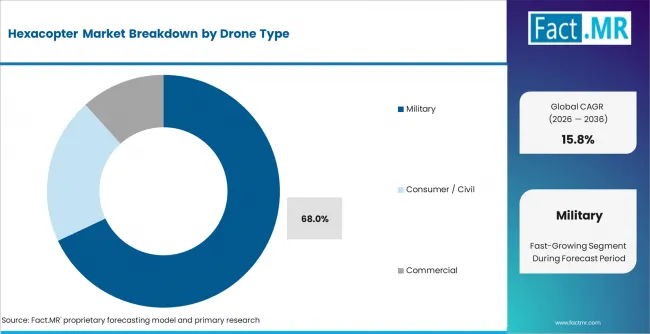
Hexacopter Market Analysis By Drone Type | Source: Fact.MR
Military drones are projected to account for 68.0% share of hexacopter demand by drone type in 2026 as defense users need stable aerial surveillance and payload support. Commercial drones gain demand through inspection and agriculture work. Consumer / civil drones serve filming and local field uses.
- Defense Demand: Military hexacopters help field units monitor convoy routes and temporary bases with steady low-altitude imaging.
- Commercial Use: Inspection firms and farm service providers use hexacopters to carry thermal cameras or spray modules across work sites.
- Civil Demand: Municipal agencies and media crews use hexacopters for emergency footage and local event coverage that needs stable aerial framing.
Hexacopter Market Analysis by Application
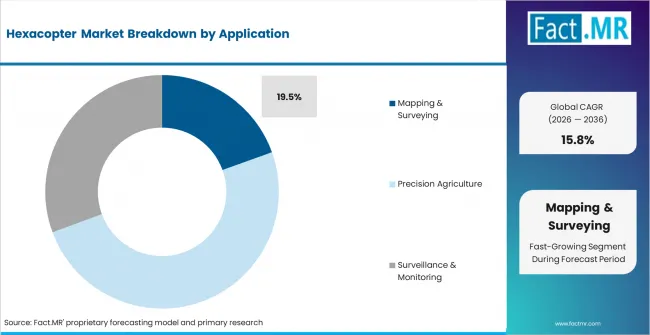
Hexacopter Market Analysis By Application | Source: Fact.MR
Mapping and surveying applications continue to drive strong demand for hexacopter drones across construction and agricultural operations. Mapping & surveying is estimated to capture 19.5% share of hexacopter demand by application in 2026 as survey users require stable aerial imaging and accurate data collection across farms and construction sites. Inspection and maintenance applications are also expanding among utility and industrial operators that need reliable drone platforms for asset monitoring. In precision agriculture, hexacopters support crop monitoring and targeted spraying where stable flight and payload flexibility improve operational efficiency and coverage.
- Survey Demand: Site engineers use hexacopters to create progress records before earthwork measurement and contractor billing reviews.
- Asset Review: Utility crews use hexacopters to capture fault evidence before sending technicians near towers or line assets.
- Farm Use: Farm service providers use hexacopters to check crop stress and apply inputs across uneven plots.
Hexacopter Market Analysis by End User
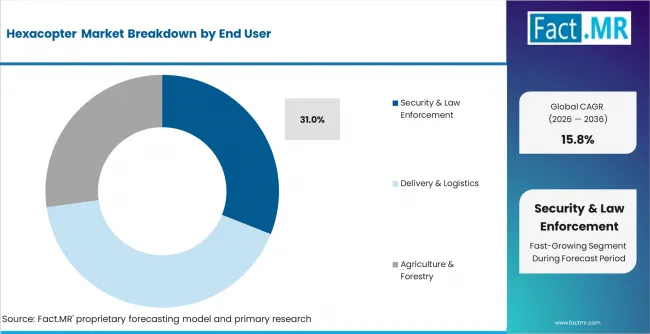
Hexacopter Market Analysis By End User | Source: Fact.MR
Security & law enforcement leads as agencies need aerial review for surveillance and emergency response. Construction and mining operators use hexacopters for site checks and progress review. Security & law enforcement is expected to represent 31.0% share of hexacopter demand by end user in 2026 as public safety users need stable imaging and field visibility. Agriculture users apply hexacopters for crop review and spray work.
- Security Demand: Law enforcement agencies use hexacopters to document crowd flow and accident scenes before ground units enter risk zones.
- Site Monitoring: Construction and mining operators use six-rotor drones to verify stockpile changes and contractor progress from safer points.
- Farm Support: Agriculture service providers use hexacopters to manage spot spraying and low-altitude crop stress checks across uneven plots.
Hexacopter Market Analysis by Sales Channel
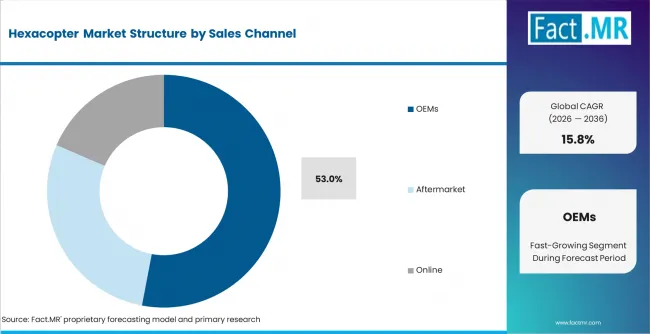
Hexacopter Market Analysis By Sales Channel | Source: Fact.MR
OEMs are expected to account for 53.0% share of hexacopter demand by sales channel in 2026 as professional operators need platform setup and service access. Online channels support smaller drone purchases and product comparison. Offline channels are useful for demonstrations and training discussions.
- OEM Integration: OEM channels help fleet managers match hexacopters with payload mounts and firmware before field deployment.
- Online Screening: Online platforms help small contractors compare flight time and warranty terms before trial orders.
- Aftermarket Pull: Battery packs and propeller sets create repeat orders as heavy sensor work raises replacement frequency.
Hexacopter Market Drivers, Restraints, and Opportunities
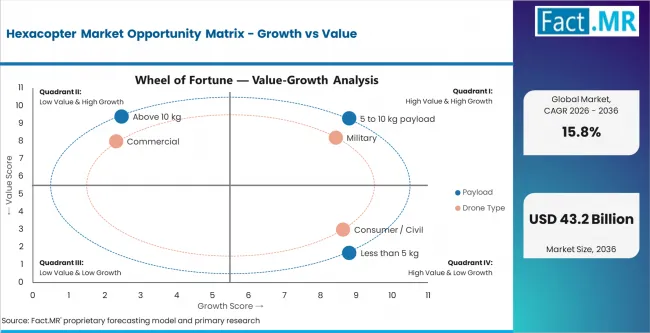
Hexacopter Market Opportunity Matrix Growth Vs Value | Source: Fact.MR
Stable payload flight is the primary demand driver for hexacopter drone adoption across industrial and agricultural applications. Inspection operators increasingly rely on hexacopters for carrying cameras and monitoring payloads that require reliable lift and steady flight performance. Agriculture drone service providers use these platforms for crop inspection, precision spraying, and field analysis where payload flexibility and controlled maneuverability improve operational efficiency.
The main restraints continue to be operator readiness and regulatory approval complexity. Commercial deployment can slow when organizations lack trained pilots, standardized flight procedures, or internal compliance capabilities. Hexacopter systems involve higher maintenance requirements than smaller drone platforms because of their additional drone motors and power systems. Battery expenses and servicing requirements further limit adoption among price-sensitive operators and smaller commercial users.
Opportunities in the Hexacopter Market
- Industrial Inspection: Drone manufacturers can target utility and plant inspection with stronger frames built for thermal cameras and compact LiDAR.
- Agriculture Spraying: Farm service providers need hexacopters that manage tank weight and low-altitude control across uneven fields.
- Public Safety: Emergency agencies use hexacopters for accident scenes and flood review before ground crews enter risk areas.
Regional Analysis
.webp "Top Country Growth Comparison Hexacopter Market Cagr (2026 2036)")
Top Country Growth Comparison Hexacopter Market Cagr (2026 2036) | Source: Fact.MR
Based on regional analysis, the hexacopter market is segmented into North America, Latin America, Western Europe, Eastern Europe, East Asia, South Asia and Pacific, and Middle East and Africa across 30 plus countries.
|
Country |
CAGR (2026 to 2036) |
|
United States |
16.8% |
|
China |
16.4% |
|
India |
16.2% |
|
Germany |
15.0% |
|
Japan |
14.6% |
|
UK |
14.2% |
|
Brazil |
13.6% |
Source: Fact.MR analysis. Updated May 23, 2026
Source: Fact.MR analysis, based on proprietary forecasting model and primary research.
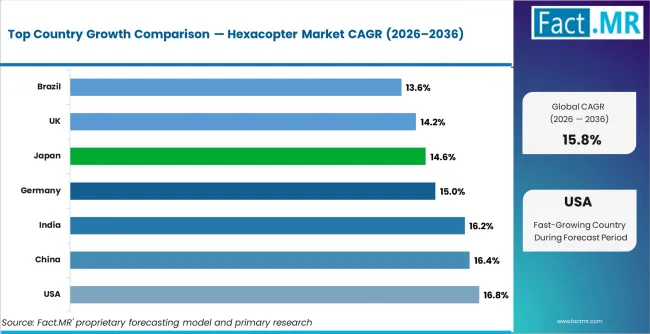
Hexacopter Market Cagr Analysis By Country | Source: Fact.MR
North America Hexacopter Market Analysis
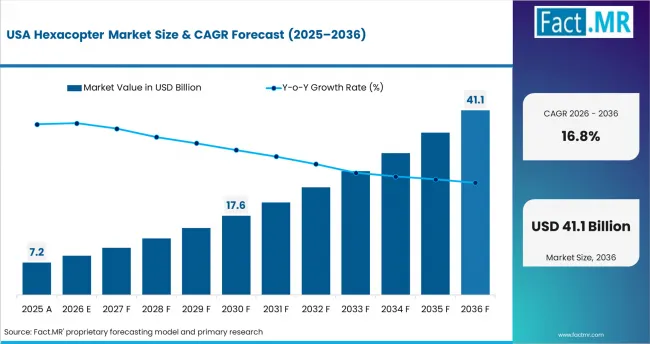
Hexacopter Market Country Value Analysis | Source: Fact.MR
North America shows steady demand as industrial inspection and public safety drone use expand. The United States remains the main country opportunity in the region. Hexacopters serve mapping and asset review. They support emergency response use. Stable lift supports cameras and thermal payloads.
- United States: Hexacopter demand in the United States is expected to record 16.8% CAGR over the assessment period as infrastructure inspection and public safety missions expand. The White House stated in 2025 that drones are transforming U.S. infrastructure inspection, emergency response, and public safety operations. [2]
East Asia Hexacopter Market Analysis
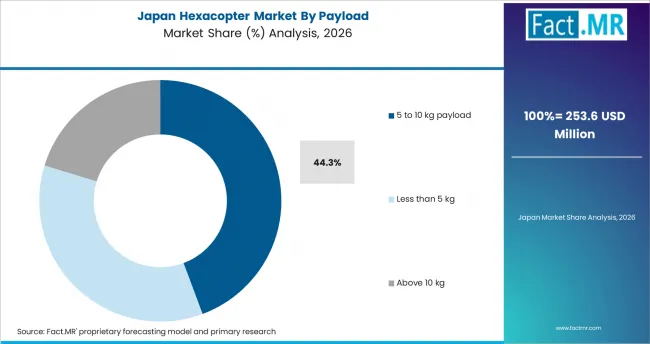
Hexacopter Market Japan Market Share Analysis By Payload | Source: Fact.MR
East Asia demand comes from drone manufacturing and industrial monitoring. China serves as a major production center and large domestic demand base. Japan has steady adoption due to infrastructure review and disaster response needs. Supplier strength comes from payload integration and service reach.
- China: China is forecast to post 16.4% CAGR in hexacopter demand from 2026 to 2036 as UAV activity and low-altitude operations expand. Civil Aviation Administration of China reported more than 2 million registered UAVs and more than 26 million annual flight hours in 2024. Local supply improves product access for industrial users. [3]
- Japan: Infrastructure inspection and disaster response create demand for stable multirotor drones in Japan. Japan’s hexacopter demand is expected to grow at 14.6% CAGR over the assessment period as asset review needs increase. Supplier service can improve repeat sales.
South Asia and Pacific Hexacopter Market Analysis
South Asia and Pacific benefits from agriculture spraying and public-sector drone use. India is the key growth country as drone use expands across farm services and infrastructure checks. Local drone capability supports organized adoption. Cost control remains important outside large cities.
- India: India is forecast to record 16.2% CAGR in hexacopter demand by 2036 as agriculture services and public-sector mapping adopt stable six-rotor platforms. India had 38,500+ registered drones, 39,890 DGCA-certified remote pilots, and 244 approved training organizations as of February 2026. SVAMITVA used drones to survey 3.28 lakh villages, which supports public-sector mapping demand. [4]
Western Europe Hexacopter Market Analysis
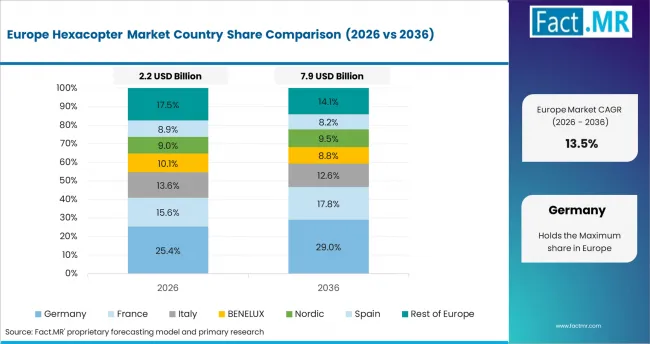
Hexacopter Market Europe Country Market Share Analysis, 2026 & 2036 | Source: Fact.MR
Western Europe demand reflects industrial inspection and structured drone operations. Germany leads through engineering-led inspection and infrastructure monitoring. The UK supports hexacopter use through public safety and surveying.
- Germany: Germany is expected to remain an important market for hexacopter drones as industrial inspection and surveying activities increase demand for stable aerial imaging platforms. Industrial operators and survey firms increasingly require drones capable of carrying imaging and thermal payloads with reliable flight performance across construction and industrial sites. Germany is projected to grow at 15.0% CAGR in hexacopter demand from 2026 to 2036.
- UK: Public safety and infrastructure inspection support hexacopter demand in the UK. The UK is expected to expand at 14.2% CAGR over the foreseen period as operators use six-rotor platforms for stable aerial inspection services. Managed drone planning supports enterprise adoption.
Latin America Hexacopter Market Analysis
Latin America demand comes from agriculture and mining. Public safety creates further use in urban and remote areas. Brazil leads regional adoption as large farms and mining sites support hexacopter use. Cost sensitivity affects premium platform adoption.
- Brazil: Brazil is expected to see rising demand for hexacopter drones as agriculture monitoring and land inspection activities expand across large operational areas. Commercial users increasingly rely on stable six-rotor platforms for aerial review and terrain mapping where reliable flight performance improves coverage and operational efficiency. Brazil hexacopter demand is projected to record 13.6% CAGR over the assessment period.
Competitive Aligners for Market Players
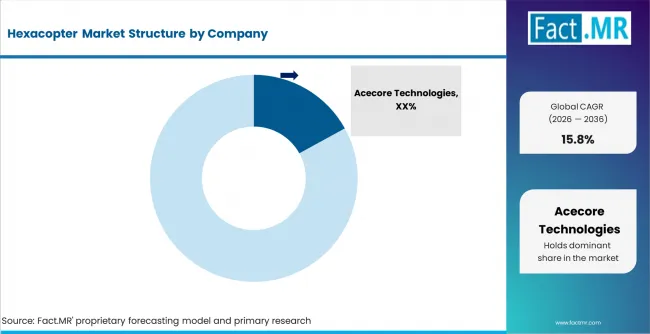
Hexacopter Market Analysis By Company | Source: Fact.MR
The hexacopter market includes industrial UAV makers and commercial drone suppliers. Acecore Technologies, AirRobot, AutoCopter Corporation, Elistair, MikroKopter, Vision Aerial, and Yuneec compete through payload handling and flight stability. Operators evaluate hexacopters through lift capacity and motor redundancy. Service access and field repair influence supplier selection.
Competitive advantage comes from pairing six-rotor stability with safe operating support. CSIR-NAL lists hexacopter and dual-hexacopter systems with carbon fiber frames and quick-release propellers.
Portfolio depth is important as users move from basic aerial imaging to repeat payload missions. Premium accounts will favor drones that reduce payload failure risk and improve mission continuity. Service access can protect supplier position because industrial operators need faster support during active work.
Key Players in Hexacopter Market
- Acecore Technologies
- AirRobot
- Ascending Technologies
- ATYges Engineering
- Aurelia Technologies Inc.
- AutoCopter Corporation
- BLUE BEAR
- Challenger Aerospace & Defense
- Elistair
- FalconViz
- MikroKopter
- Shenzhen Keweitai Enterprise Development Co., Ltd.
- Vision Aerial, Inc.
- Yuneec Holding Ltd.
Hexacopter Market Analysis by Segments
-
By Payload:
- Less than 5 kg
- 5 to 10 kg
-
Above 10 kg By Drone Type:
- ·Consumer / Civil
- Commercial
-
Military By Application:
- Filming & Photography
- Inspection & Maintenance
- Mapping & Surveying
- Precision Agriculture
-
Surveillance & Monitoring By End User:
- Agriculture & Forestry
- Construction & Mining
- Media & Entertainment
- Security & Law Enforcement
-
Delivery & Logistics By Sales Channel:
- Online
- Offline
- OEMs
-
Aftermarket Region:
- North America
- United States
- Canada
- Europe
- Germany
- United Kingdom
- France
- Italy
- Spain
- Asia Pacific
- China
- Japan
- South Korea
- Taiwan
- Singapore
- Latin America
- Brazil
- Mexico
- Argentina
- Middle East & Africa
- GCC Countries
- South Africa
- Israel
Bibliography
- [1]. Federal Aviation Administration. (2025). Beyond Visual Line of Sight (BVLOS). FAA.
- [2] The White House. (2025, June 6). Unleashing American drone dominance.
- [3]. Civil Aviation Administration of China. (2025). CAAC Releases Two Mandatory National Standards for UAV. CAAC.
- [4] Press Information Bureau. (2026, February 17). India’s drone ecosystem: From policy to public service transformation. Government of India.
This Reprt Addresses
- Strategic intelligence on hexacopter demand across inspection and mapping globally.
- Growth opportunity mapping across United States inspection demand and China UAV activity.
- Segment analysis by payload, drone type, application, end user, and sales channel.
- Regional outlook covering North America inspection demand and East Asia drone production.
- Competitive analysis of Acecore Technologies, AirRobot, AutoCopter, Elistair, and Yuneec.
- Product assessment covering 5 to 10 kg hexacopters and military hexacopter platforms.
- Report delivered through PDF, Excel datasets, and presentation formats.
- Primary interviews, regulatory review, and supplier portfolio analysis support validation.
Hexacopter Market Definition
The hexacopter market covers unmanned aerial systems built with six motors and propellers. These platforms are used for filming and inspection. Mapping and agriculture applications are included. The market differs from quadcopters as six-rotor design improves lift stability and supports larger payloads.
Hexacopter Market Inclusions
The scope includes consumer / civil hexacopters and commercial hexacopters. It covers military hexacopters and payload-integrated platforms sold for mapping or inspection. Systems used for filming, agriculture, surveillance, and delivery trials are included if six-rotor flight is the core platform design.
Hexacopter Market Exclusions
The scope excludes quadcopters and octocopters. Fixed-wing drones without six-rotor lift are outside the scope. Stand-alone sensors are not counted. Drone services and software sold without hexacopter hardware are excluded. Weapons and munitions are outside this platform-focused scope.
Hexacopter Market Research Methodology
- Primary Research
- Primary research includes interviews with drone fleet managers and inspection service heads. Agriculture service providers and public safety drone managers are covered separately. Hexacopter suppliers provide supplier-level inputs.
- Desk Research
- Desk research reviews aviation rulemaking and product datasheets. Company disclosures and operator guidance support supplier checks. Payload specifications and commercial drone regulations are reviewed separately.
- Market-Sizing and Forecasting
- Forecasting uses hexacopter platform demand and payload mix. BVLOS readiness guides commercial inspection adoption.
- Data Validation and Update Cycle
- Forecasts are validated through supplier checks and operator interviews. Distributor feedback is used with regional drone program review.
Segmentation
Scope of the Report
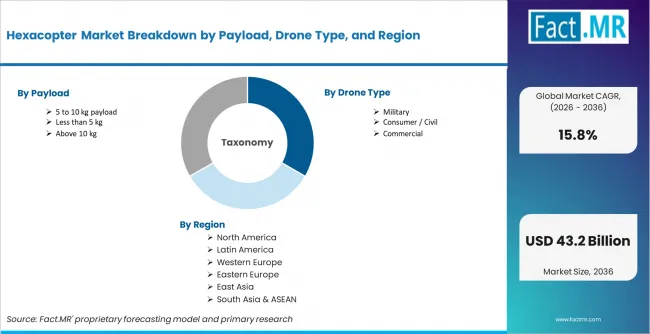
Hexacopter Market Breakdown By Payload, Drone Type, And Region | Source: Fact.MR
| Attribute | Details |
|---|---|
| Quantitative Units | USD 10.0 billion in 2026 to USD 43.2 billion by 2036, at a 15.8% CAGR |
| Market Definition | Six-motor unmanned aerial systems used for stable aerial lift and inspection-oriented missions. |
| Payload | Less than 5 kg; 5 to 10 kg; Above 10 kg |
| Drone Type | Consumer / Civil; Commercial; Military |
| Application | Filming & Photography; Inspection & Maintenance; Mapping & Surveying; Precision Agriculture; Surveillance & Monitoring |
| End User | Agriculture & Forestry; Construction & Mining; Media & Entertainment; Security & Law Enforcement; Delivery & Logistics |
| Sales Channel | Online; Offline; OEMs; Aftermarket |
| Regions Covered | North America; Latin America; Western Europe; Eastern Europe; East Asia; South Asia and Pacific; Middle East and Africa |
| Countries Covered | United States; China; India; Germany; Japan; UK; Brazil; 30 plus countries |
| Key Companies Profiled | Acecore Technologies; AirRobot; Ascending Technologies; ATYges Engineering; Aurelia Technologies; AutoCopter; BLUE BEAR; Elistair; MikroKopter; Vision Aerial; Yuneec |
| Forecast Period | 2026 to 2036 |
| Approach | Hybrid top-down and bottom-up model using hexacopter demand, payload mix, application use, and primary interviews with drone operators. |
Source: Fact.MR analysis. Updated May 23, 2026
Frequently Asked Questions
Hw large is the hexacpter market in 2025?
What is the expected value in 2026?
What is the frecast value by 2036?
What CAGR is prjected fr 2026 t 2036?
Which paylad segment leads hexacpter demand?
Which drne type leads demand?
Which applicatin leads hexacpter demand?
Which end user accunts fr the highest share?
Which sales channel leads demand?
Which cuntry shws the fastest grwth?
Why des the 5 t 10 kg paylad segment lead demand?
Why d military drnes lead demand?
Why des mapping & surveying lead applicatin demand?
Why d EMs lead sales channel demand?
What is the main restraint in this market?
What supprts demand in the United States?
What supprts demand in China?
What supprts demand in India?
Why is six-rtr design imprtant?
Why is service supprt imprtant?
What defines cmpetitin in this market?
Wh are the leading cmpanies?
Who worked on this report


Preview the report firsthand - request a free sample
Free SampleGet the brochure for pricing and purchase details
Download PDF