- Market Value (2025): USD 842.6 Mn
- Estimated Value (2026): USD 886.4 Mn
- Forecast Value (2036): USD 1471.6 Mn
- CAGR (2026-2036): 5.2%
What is the Kapok Fiber Market forecast to be worth by 2036?
USD 886.4 million in 2026 to USD 1,471.6 million by 2036, at 5.2% CAGR.
- The kapok fiber market crossed a valuation of USD 842.6 million in 2025, led by bedding-fill conversion and natural fiber trials.
- Demand is projected to increase from USD 886.4 million in 2026 to USD 1,471.6 million by 2036.
- The sector is forecast to record 5.2% CAGR from 2026 to 2036 as bedding brands and fiber processors qualify plant-based fill systems.
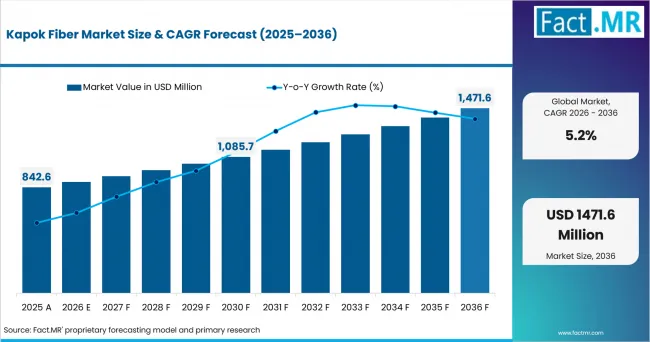
Kapok Fiber Market Market Value Analysis | Source: Fact.MR
What are the defining numbers behind Kapok Fiber Market expansion?
USD 585.2 million absolute opportunity by 2036, led by led by Raw Fiber and Home Furnishing.
- Demand Drivers in the Market
- Bedding manufacturers use clean kapok fill supported by soft-loft performance and vegan down positioning in pillow formats.
- Apparel developers require light plant-based insulation reinforced by sheeted kapok trials for down-alternative outerwear.
- Nonwoven processors depend on blending support driven by kapok’s short staple and smooth fiber surface.
- Industrial absorbent producers need hydrophobic fiber input shaped by oil-sorption use cases and testing discipline.
- Key Segments Analyzed
- By Grade: Premium Grade is estimated to represent 43% share in 2026, shaped by cleaner fiber selection and higher-value textile applications.
- By Application: Bedding & Upholstery is forecast to account for 38% share in 2026, reinforced by pillow filling and cushion replacement demand.
- By End use: Home Furnishing is projected to account for 44% share in 2026, backed by bedding, cushion, and comfort accessory demand.
- Analyst Opinion at Fact.MR
- Shambhu Nath Jha, Senior Analyst at Fact.MR, states, “Kapok fiber is drawing buyer attention due to a supply and processing problem beyond a simple natural-material story. Adoption is expected to favor suppliers proving clean fiber consistency and blend compatibility across bedding and apparel trials. Stronger suppliers are expected to combine sheet conversion and direct sampling support.”
- Strategic Implications
- Fiber suppliers are expected to document harvest origin and bale consistency before approaching certified bedding brands.
- Bedding brands are likely to test loft recover and refill performance across standard pillow sizes.
- Apparel teams are projected to validate sheet stability and wash-care behavior before replacing down or polyester insulation.
- Industrial users are anticipated to compare untreated kapok and blended absorbent pads under real spill conditions.
Organic Textiles presented kapok in January 2025 as a natural fiber sourced from tropical seed pods and positioned it for adjustable loft and synthetic-fill reduction. Brand education around biodegradable and renewable fill supports consumer-facing adoption, especially as kapok pillows need clear care guidance and refill messaging.
India is expected to record 7.0% CAGR between 2026 and 2036, led by natural fiber supply chains and textile conversion capacity. China is projected to post 6.3% CAGR by 2036, driven by textile manufacturing scale and plant-fiber blending trials. Australia is anticipated to advance at 5.0% CAGR through 2036, shaped by clothing waste pressure and circular textile programs. United Kingdom is estimated to post 4.7% CAGR between 2026 and 2036, influenced by recycling and natural-fill bedding demand. United States is forecast to record 4.5% CAGR by 2036, supported by certified bedding brands and cotton-adjacent natural fiber acceptance. Germany is projected to hold 4.2% CAGR during the forecast period, reinforced by online textile purchasing and eco-design pressure. Japan is expected to record 3.9% CAGR during the study period, driven by kapok apparel innovation and Southeast Asian sourcing links.
How does the Kapok Fiber Market break down by segment?
Raw Fiber is likely to lead at 57%; Home Furnishing is anticipated to lead at 44%.
Which grade category is projected to lead?
Premium Grade is estimated to hold 43% share in 2026.
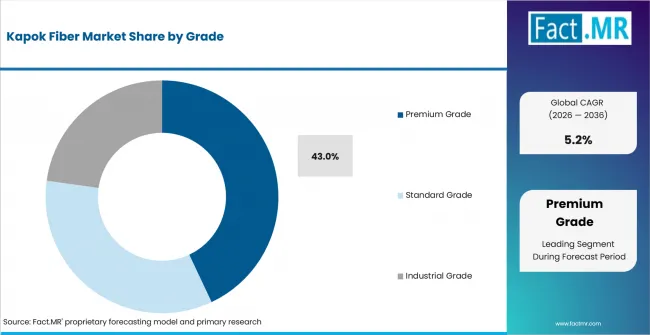
Kapok Fiber Market Analysis By Grade | Source: Fact.MR
Premium Grade is expected to garner 43% share in 2026, driven by cleaner fiber use and higher product-quality expectations. Standard Grade follows through broader filling and value-line textile applications. Industrial Grade remains linked to absorbent and functional material uses requiring less refined fiber. Government of Japan reported in December 2025 kapok fibers are 80% hollow and weigh one-eighth as much as cotton, giving suppliers a measurable performance case for premium lightweight fill.
Which application area is forecast to capture the leading share?
Bedding & upholstery is estimated to secure 38% share in 2026.
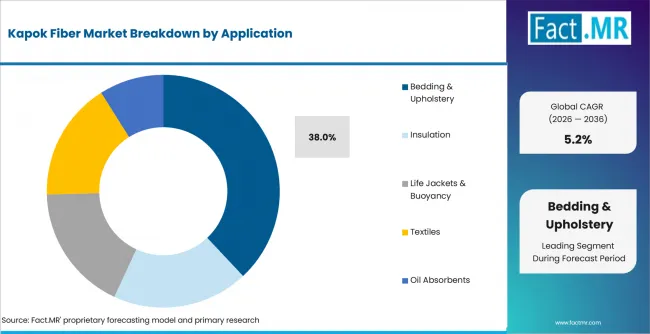
Kapok Fiber Market Analysis By Application | Source: Fact.MR
Bedding & upholstery is projected to account for 38% share in 2026, led by pillow filling, cushions, and comfort accessories. Insulation follows as apparel teams test kapok sheets and blended fill systems. Life Jackets & Buoyancy supports selective use cases linked to low fiber weight. Textiles and Oil Absorbents retain use across fabric trials and hydrophobic fiber formats. Organic Textiles stated in April 2025 kapok pillows generally last 2–4 years, making fill quality and repeat replacement cycles relevant to bedding demand.
Which end use is likely to see the strongest demand?
Home Furnishing is set to account for 44% share in 2026.
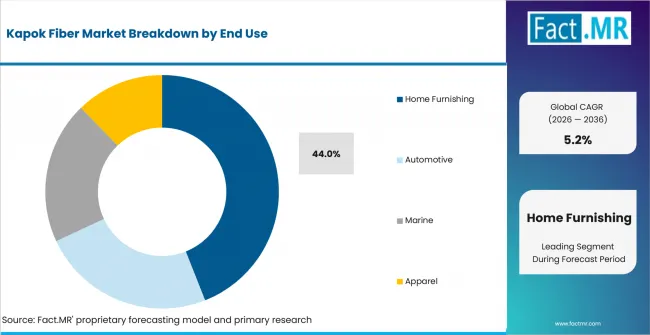
Kapok Fiber Market Analysis By End Use | Source: Fact.MR
Home Furnishing is estimated to represent 44% share in 2026, shaped by pillows, cushions, mattress accessories, and refillable bedding products. Automotive follows through insulation and lightweight natural fiber trials. Marine remains linked to buoyancy and specialty use cases. Apparel supports kapok sheet development for down-alternative garments. United Nations Environment Programme reported in March 2025 nearly 92 million tonnes of textile waste is produced globally each year, reinforcing interest in plant-based and longer-use home textile systems.
What is accelerating Kapok Fiber Market adoption, and what is holding it back?
Natural-fill substitution drives adoption; processing inconsistency restrains it.
Drivers Impact Analysis
| Driver | (~) % Impact on CAGR | Geographic Relevance | Impact Timeline |
|---|---|---|---|
| Natural bedding fill substitution | +0.7% | North America, Europe, Japan | Medium term (2–4 years) |
| Plant-based apparel insulation | +0.6% | Japan, China, Europe | Medium term (2–4 years) |
| Circular textile pressure | +0.5% | United Kingdom, Australia, European Union | Short term (≤2 years) |
| Lightweight nonwoven trials | +0.4% | China, India, United States | Medium term (2–4 years) |
| Oil absorbent applications | +0.3% | United States, China, Australia | Long term (≥4 years) |
Source: Fact.MR analysis. Updated Jul 13, 2026
- Natural bedding fill substitution: Bedding producers are rebuilding pillow portfolios around latex and kapok blends. Kapok gives soft loft without animal down and allergy-focused claims. Textile Exchange reported in September 2025 stating global fiber production reached 132 million tonnes in 2024, making differentiated plant-based fillers more visible inside a high-volume fiber system. Adoption is expected to expand as refillable pillow formats create repeat purchases and reduce full-product replacement.
- Plant-based apparel insulation: Apparel teams are testing kapok sheets for light outerwear and roomwear products. KAPOK JAPAN’s KAPOK KNOT brand shows how kapok moves from stuffing into wearable insulation through sheet conversion. Government of Japan reported in December 2025 for the Air Light jacket using kapok weighing 500 grams, proving a measurable lightweight apparel case. Demand is projected to rise as fabric mills improve bonding and quilting stability.
- Circular textile pressure: Waste policy and textile stewardship programs are forcing brands to explain material selection more clearly. WRAP reported in October 2025 stating 62% of textiles placed on the market by UK Textiles Pact signatories had reduced environmental impacts, up from 25% in 2019. Kapok gains attention as a plant-based fill option for brands reducing dependence on synthetic stuffing. Demand is anticipated to improve in bedding and apparel programs with clearer material documentation.
- Lightweight nonwoven trials: Nonwoven developers are studying kapok as a low-density input for insulation and absorbent layers. Fiber length and smoothness create handling limits, requiring blending with viscose or binder fibers. Textile Exchange stated in September 2025, fiber production is expected to reach about 169 million tonnes in 2030 under business-as-usual conditions. Adoption is estimated to improve as processors refine carding and bonding steps.
- Oil absorbent applications: Industrial users value kapok’s hydrophobic fiber surface for oil separation and spill-pad trials. Commercial scale remains smaller than bedding due to certification and disposal requirements. European Parliament reported in September 2025 claiming the European Union generates 12.6 million tonnes of textile waste each year, encouraging material teams to examine bio-based absorbent and reuse pathways. Demand is forecast to improve in applications needing light natural fiber pads.
Opportunity Impact Analysis
| Opportunity | (~) % Impact on CAGR | Geographic Relevance | Impact Timeline |
|---|---|---|---|
| Certified kapok bedding blends | +0.5% | United States, Germany, United Kingdom | Short term (≤2 years) |
| Kapok sheet insulation | +0.4% | Japan, China, Europe | Medium term (2–4 years) |
| Industrial absorbent pads | +0.3% | United States, Australia, China | Long term (≥4 years) |
| Supplier traceability programs | +0.3% | India, Indonesia, Japan | Medium term (2–4 years) |
Source: Fact.MR analysis. Updated Jul 13, 2026
- Certified kapok bedding blends: Certification-led bedding brands need plant fibers supporting product safety and material-origin claims. Kapok blends with organic cotton and latex give a practical route for pillows and toppers. National Cotton Council reported in May 2025 announcing for USDA placing the 2024–25 United States cotton crop at 14.41 million bales, reflecting strong domestic familiarity with plant fiber messaging. Opportunity is forecast to expand as retailers request clearer fiber documentation and product-level proof.
- Kapok sheet insulation: Sheet conversion opens apparel routes beyond loose stuffing. Kapok’s hollow structure supports warmth at low weight, although bonding quality decides garment durability. National Bureau of Statistics of China reported in December 2025 claiming cotton output having reached 6,641 thousand tonnes in 2025, up 7.7% from 2024, highlighting a large fiber-processing base for plant-fiber trials. Opportunity is expected to rise as Chinese and Japanese processors test quilted panels.
- Industrial absorbent pads: Oil-sorption pads offer a technical route outside bedding and apparel. Kapok’s natural waxy surface supports oil affinity, although treated products need performance evidence. Seamless Australia reported in August 2025, Australia sent 220,000 tonnes of clothing to landfill in 2024 amounting to 880 million items. Opportunity is projected to grow in facilities seeking bio-based absorbent alternatives with clear disposal instructions.
- Supplier traceability programs: Brands need harvest and labor visibility before scaling kapok claims. Direct contracts with growers and processors improve quality control and buyer trust. OECD and FAO projected in July 2025 reporting global cotton production being expected to reach 29.5 Mt by 2034, keeping kapok suppliers under pressure to prove why a less familiar fiber deserves shelf space. Supplier programs are anticipated to gain weight as buyers screen natural fibers against claim risk.
Restraints Impact Analysis
| Restraint | (~) % Impact on CAGR | Geographic Relevance | Impact Timeline |
|---|---|---|---|
| Fiber spinning difficulty | -0.5% | Global processors | Medium term (2–4 years) |
| Supply grade inconsistency | -0.4% | India, China, Japan | Short term (≤2 years) |
| Synthetic fill price competition | -0.3% | Global bedding markets | Medium term (2–4 years) |
| Certification and claim burden | -0.2% | North America, Europe | Long term (≥4 years) |
Source: Fact.MR analysis. Updated Jul 13, 2026
- Fiber spinning difficulty: Kapok fibers are short and light, making pure yarn production difficult for standard spinning routes. Blending improves processability, even though high kapok content requires tighter fiber preparation. European Environment Agency reported in March 2025 stating total textile waste generation in the EU27 was 16 kilograms per person in 2022, keeping fiber circularity pressure high despite processing limits. Adoption is expected to stay selective in yarn applications until mills achieve stable speeds and acceptable yarn strength.
- Supply grade inconsistency: Fiber quality shifts across harvest regions and storage conditions. Dust and bale compression affect buyer acceptance. Ministry of Textiles reported in December 2025 noting India’s cotton sector supports nearly 6 million farmers and 40–50 million people across the value chain, showing how natural-fiber systems depend on wide rural networks. Brands are projected to require supplier audits and incoming inspection before larger kapok orders move into repeat programs.
- Synthetic fill price competition: Polyester remains widely available and easier to process at industrial scale. Natural fillers need a stronger story around comfort and product safety to justify added development work. Textile Exchange reported in September 2025 claiming fossil-based synthetic fibers remained the main share of global fiber output in 2024, keeping price pressure on plant-fill alternatives. Adoption is anticipated to stay slower in cost-led pillow and cushion lines.
- Certification and claim burden: Brands using kapok in sleep products need fiber origin and chemical testing support. Small suppliers often lack complete documentation packages. Avocado Green Mattress lists organic latex and kapok fill in its organic pillow product, highlighting how certified bedding brands frame kapok alongside other verified materials. Adoption is forecast to slow in regulated retail channels unless suppliers provide certificates and consistent labeling support.
Which countries are scaling Kapok Fiber Market at sharper CAGRs?
India 7.0%; China 6.3%; Australia 5.0%; United Kingdom 4.7%; United States 4.5%; Germany 4.2%; Japan 3.9%.
Kapok Fiber Market is segmented into North America, Latin America, Europe, East Asia, South Asia and Pacific, and Middle East and Africa.
.webp "Top Country Growth Comparison Kapok Fiber Market Cagr (2026 2036)")
Top Country Growth Comparison Kapok Fiber Market Cagr (2026 2036) | Source: Fact.MR
| Country | CAGR |
|---|---|
| India | 7.0% |
| China | 6.3% |
| Australia | 5.0% |
| United Kingdom | 4.7% |
| United States | 4.5% |
| Germany | 4.2% |
| Japan | 3.9% |
Source: Fact.MR analysis. Updated Jul 13, 2026
How is India scaling Kapok Fiber demand?
7.0% CAGR through 2036, driven by textile conversion capacity and natural fiber sourcing.
India benefits from textile manufacturing depth and established natural fiber handling skills. Market in India is expected to record 7.0% CAGR between 2026 and 2036 since bedding brands and processors test kapok alongside cotton and latex. Ministry of Textiles reported in December 2025 noting cotton supports nearly 6 million farmers and 40–50 million linked workers, giving natural fiber supply chains a strong skill base.
What underpins China’s Kapok Fiber outlook?
6.3% CAGR by 2036, driven by textile manufacturing scale and fiber blending trials.
China’s textile mills provide scale for trials involving kapok blends and insulation sheets. Demand in China is projected to post 6.3% CAGR from 2026 to 2036, led by processors adding plant fiber inputs to apparel and home-textile programs. National Bureau of Statistics reported China’s cotton output at 6.64 million tonnes in 2025, up 7.7% from 2024, supporting a large fiber-processing ecosystem.
What supports Australia’s Kapok Fiber demand?
5.0% CAGR from 2026 to 2036, supported by clothing waste pressure and natural home-textile demand.
Australia’s bedding brands and circular textile stakeholders are testing natural fillers as waste scrutiny rises. The Australian market is anticipated to expand at a 5.0% CAGR during the study period as home-textile sellers use kapok in pillows and comfort accessories. Seamless reported in March 2026 stating Australians having purchased 1.51 billion clothing items in 2024, amounting to 55 items per person, strengthening the case for better fiber choices.
What shapes the United Kingdom outlook?
4.7% CAGR through 2036, driven by circular textile programs and natural-fill bedding.
United Kingdom demand is linked to reuse programs and stricter textile waste expectations. Industry in the United Kingdom is estimated to post 4.7% brands compare kapok with polyester and latex fills. WRAP reported in October 2025 that reuse and recycling organizations handled 210,000 tonnes of used textiles in 2024, a 27% increase from 2019.
How is the United States developing Kapok Fiber demand?
4.5% CAGR from 2026 to 2036, supported by certified bedding brands and cotton-adjacent acceptance.
United States adoption is led by natural bedding brands using kapok in organic pillows and refill products. Market demand is forecast to record 4.5% CAGR during the forecast period due to direct-to-consumer bedding sellers explaining kapok as a vegan down alternative. National Cotton Council reported in May 2025 that USDA placed the 2024–25 United States cotton crop at 14.41 million bales, showing continued familiarity with plant fiber systems.
What supports Germany’s Kapok Fiber outlook?
4.2% CAGR during the study period, reinforced by online textile purchasing and eco-design pressure.
Germany’s home-textile market benefits from online comparison shopping and strong certification awareness. Market value is projected to hold 4.2% CAGR between 2026 and 2036, reflected by kapok pillows and natural bedding products reach specialty retail channels. Destatis reported in January 2025 stating 83% of German internet users shopped online in 2024, supporting direct-to-consumer bedding discovery.
How is Japan positioning Kapok Fiber demand?
3.9% CAGR by 2036, driven by kapok apparel innovation and Southeast Asian sourcing links.
Japan is developing kapok through apparel insulation and lifestyle products beyond raw fiber. Sector in Japan is expected to record 3.9% CAGR by 2036 due to brands applying sheet-processing technology to down-alternative garments. Government of Japan reported in December 2025 noting for kapok being able to be harvested from seedpods without felling the tree, supporting long-term plantation use.
Who leads the Kapok Fiber Market?
Flocus and KAPOK JAPAN lead direct kapok fiber innovation, while Organic Textiles and Avocado Green Mattress strengthen bedding adoption.
Flocus brings direct kapok fiber positioning led by certified fiber solutions and textile application work. KAPOK JAPAN adds sheeted kapok apparel development based on KAPOK Indonesian sourcing and Japanese material processing. Organic Textiles supports bedding adoption depending on kapok and consumer education, giving the market a practical retail route.
Avocado Green Mattress, White Lotus Home, and The Futon Shop complete the provider set driven by handcrafted kapok pillows and natural-fill retail positioning. Competition through 2036 is expected to be shaped by clean fiber grading and proof of stable loft after repeated use.
Which companies are the key providers?
Flocus and KAPOK JAPAN are key providers. Organic Textiles and Avocado Green Mattress are also profiled. White Lotus Home and The Futon Shop complete the company set.
- Flocus
- KAPOK JAPAN
- Organic Textiles
- Avocado Green Mattress
- White Lotus Home
- The Futon Shop
Bibliography
- European Environment Agency. (2025, March 19). Textile waste generation per person in the EU per year. European Environment Agency.
- European Parliament. (2025, September 9). Parliament adopts new EU rules to reduce textile and food waste. European Parliament.
- Federal Statistical Office of Germany. (2025, January 14). Europe European Union: 8 out of 10 internet users shop online. Federal Statistical Office of Germany.
- Government of Japan. (2025, December 5). Kapok: A New Fiber Offering Sustainable Solutions for the Fashion Industry. Government of Japan.
- Ministry of Textiles. (2025, December 24). Year End Review 2025 of Ministry of Textiles. Press Information Bureau.
- National Bureau of Statistics of China. (2025, December 27). Bulletin on the National Cotton Output in 2025. National Bureau of Statistics of China.
- National Cotton Council of America. (2025, May 12). Final 2024 USDA Crop Estimates. National Cotton Council of America.
- OECD and Food and Agriculture Organization of the United Nations. (2025, July 15). Cotton: OECD-FAO Agricultural Outlook 2025–2034. OECD.
- Organic Textiles. (2025, January 15). Why Kapok is the Future of Sustainable Comfort. Organic Textiles.
- Organic Textiles. (2025, April 23). How Often Should I Change My Pillow? Organic Textiles.
- Press Information Bureau. (2026, February 4). Union Budget 2026-27: Strengthening India’s Textile Sector. Press Information Bureau.
- Seamless Australia. (2025, August 13). 2024 national clothing benchmark for Australia. Seamless Australia.
- Seamless Australia. (2026, March 23). Australia’s clothing waste challenge. Seamless Australia.
- Textile Exchange. (2025, September 18). Materials Market Report 2025. Textile Exchange.
- United Nations Environment Programme. (2025, March 27). Unsustainable fashion and textiles in focus for International Day of Zero Waste 2025. United Nations Environment Programme.
- Waste and Resources Action Programme. (2025, October 28). UK Textiles Pact Annual Progress Update 2024–25. WRAP.
This Report Addresses
- The report provides strategic intelligence on kapok fiber.
- Segment analysis covers SME brands and loose fiber as
leading segmentswithin the 2026 market structure. - Regional outlook evaluates India, China, Australia, United Kingdom, United States, Germany, and Japan.
- Competitive analysis profiles Flocus, KAPOK JAPAN, Organic Textiles, Avocado Green Mattress, White Lotus Home, and The Futon Shop.
- Product assessment covers raw fiber and sheet kapok across bedding and apparel use.
- Application assessment covers bedding fill, apparel insulation, oil absorbents, and biocomposites.
- The forecast uses official fiber statistics, textile waste evidence, to interpret
market estimates.
What does the Kapok Fiber Market cover?
Raw Fiber, Cleaned Fiber, Blended Fiber, and Sheet Kapok used for filling, insulation, absorbent, and composite applications.
Kapok Fiber Market covers plant fiber obtained from Ceiba seed pods and processed into loose fill, bales, blends, and sheeted formats. Commercial use centers on pillows, cushions, jackets, nonwovens, absorbent pads, and selected bio-based composite trials.
Market coverage differs from general natural fibers because kapok’s hollow and waxy fiber structure creates distinct loft and hydrophobic behavior. Whole kapok pods, ornamental trees, and finished garments are excluded unless fiber supply or converted kapok input is the purchased function.
What is included in the scope?
Kapok fiber systems used in bedding, apparel insulation, nonwovens, absorbents, and selected bio-based material applications.
Scope includes Raw Fiber, Cleaned Fiber, Blended Fiber, and Sheet Kapok across Loose Fiber, Bale, Yarn Blend, Processed Wadding, and Sheet Form. Application coverage includes Bedding Fill, Apparel Insulation, Oil Absorbents, and Biocomposites. End-use coverage includes Home Textiles, Apparel, Industrial, Automotive, and Packaging. Regional coverage includes North America, Latin America, Europe, East Asia, South Asia and Pacific, and Middle East and Africa.
What is excluded from the scope?
Finished apparel and general cotton fiber products are outside the scope.
Finished jackets, pillows, and mattresses are excluded unless used to verify kapok fiber adoption. Cotton, jute, hemp, wool, and polyester fiber markets are excluded unless used for comparison against kapok fill or blends.
How was the analysis built?
120+ sources, 40+ company portfolios, 25+ countries, 20+ interviews.
- Primary Research
- Primary research includes interviews with fiber suppliers, kapok processors, bedding manufacturers, apparel material teams, nonwoven converters, and natural product distributors. It also includes input from quality managers, product development heads, textile sourcing teams, and retail category managers involved in kapok fiber commercialization.
- Desk Research
- Desk research reviews official textile statistics, natural fiber production evidence, textile waste policy updates, kapok product pages, supplier portfolios, certification signals, and bedding product catalogs. Company announcements, government textile releases, official association reports, and circular textile evidence are evaluated to assess market development and competitive positioning.
- Market-Sizing and Forecasting
- Forecasting uses market values, kapok application mapping, bedding-fill attachment rates, apparel insulation trials, fiber-form preferences, buyer-type adoption, regional textile activity, and supplier qualification patterns. Forecast models also consider refill cycles, natural fiber substitution, processing loss, grade consistency, and country-level CAGR inputs.
- Data Validation and Update Cycle
- Forecasts are validated through industry interviews testing assumptions on product demand, fiber cleaning, sheet conversion, and application adoption. Regional demand assessment, company activity checks, and official source reviews help confirm market direction, while recurring updates track textile waste policy and product launches.
Segmentation
What is the report’s scope and coverage?
| Attribute | Details |
|---|---|
| Quantitative Units | USD million in 2026 to USD million by 2036 at CAGR |
| Market Definition | Plant fiber obtained from Ceiba seed pods and processed for bedding fill, apparel insulation, nonwovens, absorbents, and selected bio-based material applications |
| Grade | Premium Grade; Standard Grade; Industrial Grade |
| Application | Bedding & Upholstery; Insulation; Life Jackets & Buoyancy;Textiles; Oil Absorbents |
| End Use | Home Furnishing; Automotive; Marine; Apparel |
| Regions Covered | North America; Latin America; Europe; East Asia; South Asia and Pacific; Middle East and Africa |
| Countries Covered | India; China; Australia; United Kingdom; United States; Germany; Japan |
| Key Companies Profiled | Flocus; KAPOK JAPAN; Organic Textiles; Avocado Green Mattress; White Lotus Home; The Futon Shop |
| Forecast Period | 2026 to 2036 |
| Approach | Hybrid top-down and bottom-up approach using natural fiber output, bedding-fill adoption, textile waste evidence, kapok product mapping, country CAGR inputs, fiber-form qualification. |
Source: Fact.MR analysis. Updated Jul 13, 2026
How is the market segmented?
-
By Grade:
- Premium Grade
- Standard Grade
- Industrial Grade
-
Application:
- Bedding & Upholstery
- Insulation
- Life Jackets & Buoyancy
- Textiles
- Oil Absorbents
-
End Use:
- Home Furnishing
- Automotive
- Marine
- Apparel
-
By Region:
- North America
- United States
- Canada
- Europe
- Germany
- United Kingdom
- France
- Italy
- Spain
- East Asia
- China
- Japan
- South Korea
- South Asia and Pacific
- India
- Australia
- Indonesia
- Thailand
- Latin America
- Brazil
- Argentina
- Mexico
- Chile
- Middle East and Africa
- UAE
- Saudi Arabia
- South Africa
- North America
Frequently Asked Questions
How big is the Kapok Fiber Market in 2025?
How much will the Kapok Fiber Market grow between 2026 and 2036?
What are the key grades in the Kapok Fiber Market?
Which application holds the highest share in the Kapok Fiber Market in 2026?
Which end-use segment holds the highest share in the Kapok Fiber Market in 2026?
How is the United Kingdom likely to perform in kapok fiber market?
How is the United States expected to rise in kapok fiber market?
How is Germany likely to expand in kapok fiber market?
How is Japan set to perform in kapok fiber market?
What is the primary driver in kapok fiber market?
What is the main restraint in kapok fiber market?
Why is loose fiber significant?
Which form holds the highest share in the Kapok Fiber Market in 2026?
Who worked on this report


Preview the report firsthand - request a free sample
Free SampleGet the brochure for pricing and purchase details
Download PDF