- Forecast Value (2036): 20.0 Bn
- CAGR (2036): 33.1%
What is the kinless aging and elder guardianship services market forecast By Fact.MR
USD 1.15 billion in 2026 to USD 20.0 billion by 2036, at 33.1% CAGR.
- The kinless aging and elder guardianship services market crossed a valuation of USD 0.86 billion in 2025.
- Demand is expected to increase from USD 1.15 billion in 2026 to USD 20.0 billion by 2036.
- The market is forecast to record 33.1% CAGR during 2026 to 2036 as solo older adults need decision support, fiduciary checks and care coordination before a crisis reaches court.
What are the defining numbers behind kinless aging and elder guardianship services growth?
USD 18.85 billion absolute opportunity by 2036, led by Japan and South Korea.
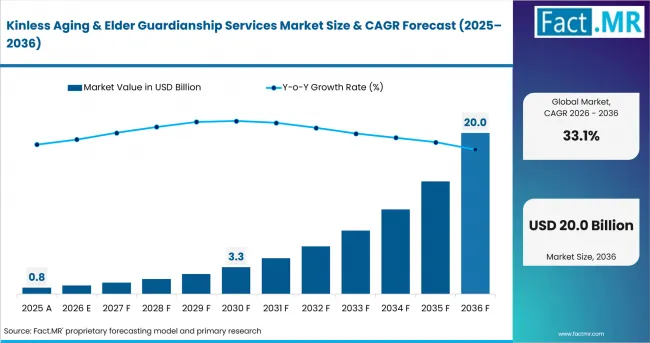
Kinless Aging & Elder Guardianship Services Market Value Analysis | Source: Fact.MR
- Demand Drivers in the Market
- Solo older adults need named decision pathways before medical consent, housing or bill-payment events become urgent.
- Courts need better case records because guardianship can remove legal rights and requires ongoing oversight.
- Employer benefit channels create referrals when workers spend paid time coordinating elder care without clear documentation.
- Financial advisors add estate planning pathways because clients expect help with incapacity documents and fiduciary choices.
- Key Segments Analyzed
- By Service Type: Guardianship Case Management is expected to hold 31.5% share in 2026 because many referrals begin with health, housing and money decisions.
- By Client Type: Solo Older Adults lead because they have the clearest need for backup decision support. The segment is projected to capture 38.0% share in 2026.
- By Delivery Model: Professional Care Managers are likely to account for 34.0% share in 2026 since buyers need a named coordinator across care, legal and financial tasks.
- By Payer Type: Private Pay is projected to hold 42.0% share in 2026 due to many cases begin before public funding or court assignment.
- By Need Area: Financial Oversight is expected to hold 33.0% share in 2026 because fraud prevention and bill control often trigger service engagement.
- By Geography: Japan is projected to record 34.4% CAGR through 2036 as solo aging and dementia planning needs expand the service pool.
- Analyst Opinion at Fact.MR
- Shambhu Nath Jha of Fact.MR states, “Kinless aging is no longer a quiet family issue. I see it becoming a planning and oversight service category because hospitals, courts and advisors need a named decision pathway when no close relative is ready to act. Providers that combine care management with fiduciary discipline are better placed than single-service firms. Buyers are paying for accountability, not only companionship or paperwork.”
- Strategic Implications
- Care managers should build referral ties with elder law firms because planning often begins before court involvement.
- Financial institutions need screened fiduciary pathways for older clients who lack trusted family agents.
- Employers can reduce absenteeism by linking caregiving benefits with document navigation and decision support.
- Public agencies should improve case data systems because oversight gaps increase harm risk for isolated adults.
Guardianship case management forms the core of this market. United States Department of Justice guidance states that courts appoint guardians when a person cannot make critical decisions, no alternate arrangement exists and assets or welfare face harm risk. This supports paid services that keep records, review less restrictive options and coordinate accountable support before guardianship becomes the only available path. [3]
Japan is projected to record 34.4% CAGR through 2036 as solo aging and dementia planning needs expand. South Korea is expected to expand at 34.0% CAGR because elderly one-person households create a larger service pool. The United Kingdom is forecast to grow at 33.2% CAGR as power of attorney and deputyship activity creates formal referral routes. The United States records 32.9% CAGR because court reform and private planning channels operate at scale.
How does the kinless aging and elder guardianship services market break down by segment?
Guardianship case management leads at 31.5%; solo older adults lead at 38.0%.
Service boundaries overlap with medical case management when providers coordinate decisions across physicians, payers and family substitutes. The difference is the buyer need. Kinless aging services are purchased because no reliable personal decision maker is available.
Online entry routes are shaped by senior tech services because intake, document storage and reminders reduce friction for solo older adults. Providers still need human review when legal authority, fiduciary control or housing decisions are involved.
Which service type dominates?
Guardianship Case Management holds 31.5% share in 2026.
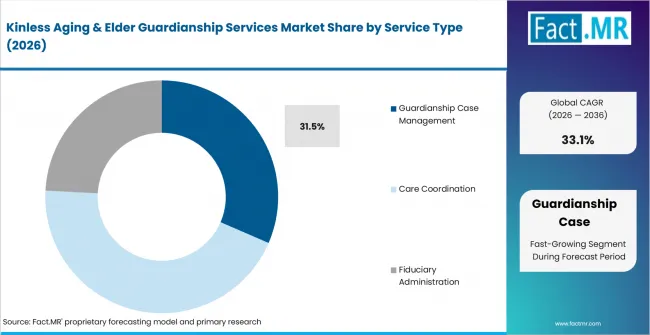
Kinless Aging & Elder Guardianship Services Market Analysis By Service Type | Source: Fact.MR
Guardianship Case Management is expected to hold 31.5% share in 2026 because referrals often begin with urgent decisions. Hospitals and courts need a named person to document consent, housing decisions and bill control. Care teams need the same record when risk crosses settings. The service also anchors follow-on work such as care coordination and fiduciary administration.
Which client type dominates?
Solo Older Adults hold 38.0% share in 2026.
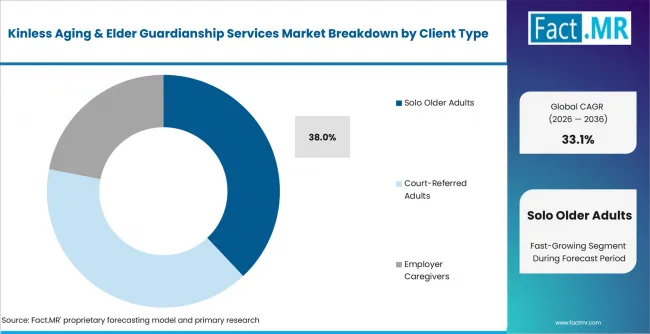
Kinless Aging & Elder Guardianship Services Market Analysis By Client Type | Source: Fact.MR
Solo Older Adults lead because the absence of family backup is the main reason buyers seek paid support. United States Census Bureau data published in August 2024 show that 25.8% of older adults lived alone in 2022. That figure supports a clear addressable pool for planning, monitoring and emergency decision pathways. [2]
Which delivery model dominates?
Professional Care Managers hold 34.0% share in 2026.
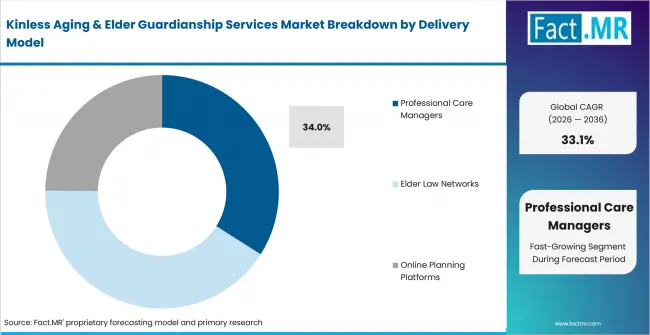
Kinless Aging & Elder Guardianship Services Market Analysis By Delivery Model | Source: Fact.MR
Professional Care Managers lead because they connect assessments, referrals and follow-up. This model sits near health caregiving but focuses more on decision authority and oversight records than on routine care hours.
Aging Life Care Association research published in May 2025 reported that 99% of surveyed clients would recommend an Aging Life Care Manager. The same research reported that 97% felt grateful for the support. These figures support buyer trust in specialist care coordination. [14]
Which payer type dominates?
Private Pay holds 42.0% share in 2026.
Private Pay leads because many cases begin before eligibility for public guardian support. Older adults and their advisors purchase planning support when they can still authorize decisions. Public contracts remain important, but they usually serve more complex last-resort cases.
Which need area dominates?
Financial Oversight holds 33.0% share in 2026.
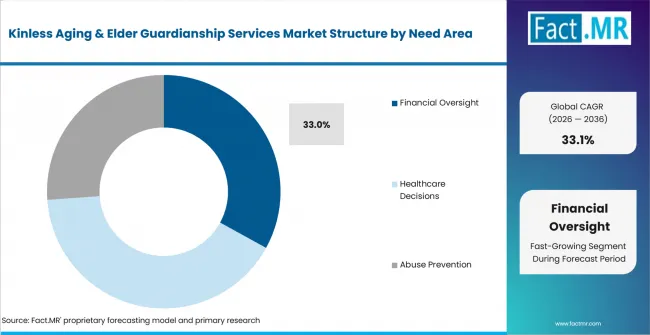
Kinless Aging & Elder Guardianship Services Market Analysis By Need Area | Source: Fact.MR
Financial Oversight leads because fraud prevention, bill review and benefit management are frequent referral triggers. Adjacent elder care product categories address physical needs, but this market centers on authority, records and accountable decisions.
True Link Financial states that its Visa prepaid card with spending settings helps families and professionals manage spending for vulnerable older adults, people with disabilities and other supported groups. That confirms an active provider focus on monitored financial control. [15]
Which channel dominates?
Care Managers hold 28.5% share in 2026.
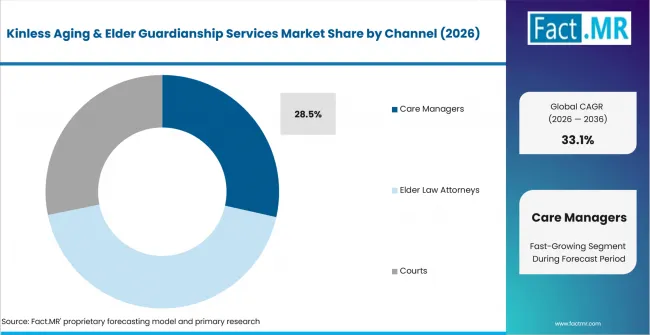
Kinless Aging & Elder Guardianship Services Market Analysis By Channel | Source: Fact.MR
Care Managers lead because they are contacted when daily life, care decisions and documentation problems appear together. Elder law attorneys follow because legal documents often reveal missing support. Courts and health systems remain important referral routes when risk becomes visible late.
What is accelerating kinless aging and elder guardianship services demand, and what is holding it back?
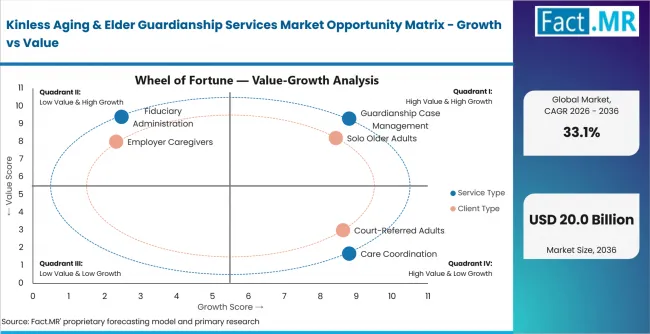
Kinless Aging & Elder Guardianship Services Market Opportunity Matrix Growth Vs Value | Source: Fact.MR
Solo aging and formal oversight drive the market; affordability and local service capacity restrain it.
The main driver is the growth of older adults who live alone and need a backup decision pathway. The Office for National Statistics reported in July 2025 that 8.4 million people in the United Kingdom lived alone in 2024. It also found that 51.1% of them were aged 65 years or over. [5]
Demand also connects with care management solution tools because providers need task records, consent notes and referral histories. Software does not replace professional judgment, but it improves follow-up discipline.
The main restraint is affordability. Professional oversight requires repeat human review and fiduciary controls. Low-asset older adults often rely on public guardian programs, so service availability depends on contracts and public capacity.
Where do the biggest kinless aging and elder guardianship services opportunities sit?
Solo aging planning, fiduciary monitoring and employer caregiving navigation.
- Solo Aging Planning: Providers can bundle document review, emergency contacts and care coordination for older adults without reliable family backup.
- Fiduciary Monitoring: Banks, trust firms and card-based controls can support older adults who need bill review and spending safeguards.
- Employer Caregiving Navigation: Benefit platforms can support workers who coordinate elder care while managing job responsibilities.
Which countries are scaling kinless aging and elder guardianship services fastest?
Japan leads at 34.4% CAGR. South Korea follows at 34.0% CAGR. The United Kingdom records 33.2% CAGR. Australia records 33.1% CAGR. The United States records 32.9% CAGR. Germany records 32.3% CAGR. Canada records 32.0% CAGR.
Based on regional analysis, the kinless aging and elder guardianship services market is segmented into North America and Europe. It also covers Asia Pacific and Oceania, Latin America and Middle East and Africa.
.webp "Top Country Growth Comparison Kinless Aging & Elder Guardianship Services Market Cagr (2026 2036)")
Top Country Growth Comparison Kinless Aging & Elder Guardianship Services Market Cagr (2026 2036) | Source: Fact.MR
| Country | CAGR |
|---|---|
| Japan | 34.4% |
| South Korea | 34.0% |
| United Kingdom | 33.2% |
| Australia | 33.1% |
| United States | 32.9% |
| Germany | 32.3% |
| Canada | 32.0% |
Source: Fact.MR analysis. Updated Jun 19, 2026
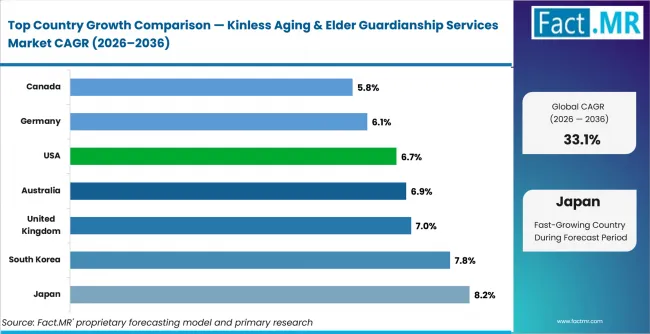
Kinless Aging & Elder Guardianship Services Market Cagr Analysis By Country | Source: Fact.MR
What is powering Japan’s lead?
34.4% CAGR, supported by solo aging and dementia planning needs.
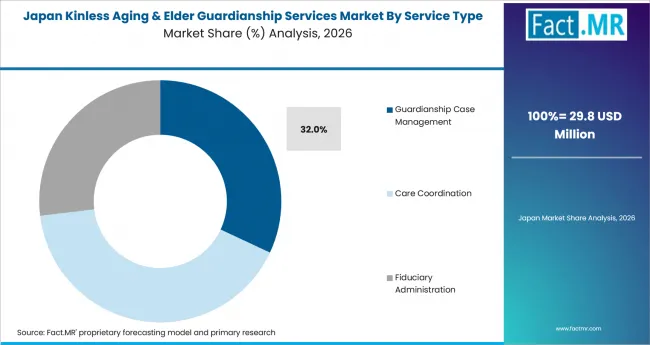
Kinless Aging & Elder Guardianship Services Market Japan Market Share Analysis By Service Type | Source: Fact.MR
Japan is projected to record 34.4% CAGR through 2036 because the country has the clearest demographic trigger among major economies. The Cabinet Office reported in June 2025 that Japan had 36.24 million people aged 65 and over, equal to 29.3% of the total population. Older adults who lack nearby family need advance planning, fiduciary controls and emergency decision support. Providers with care planning and legal referral discipline gain stronger access here. [6]
How is South Korea expanding service need?
34.0% CAGR, supported by fast aging and one-person household exposure.
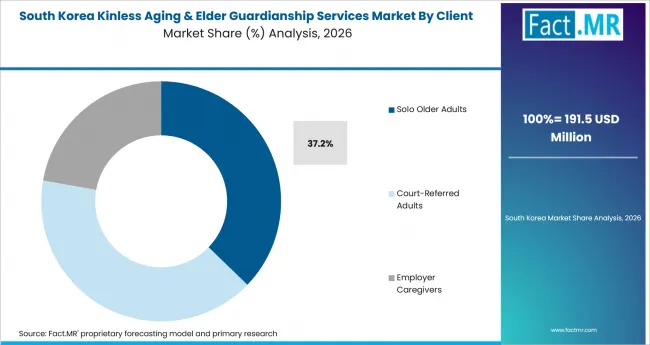
Kinless Aging & Elder Guardianship Services Market South Korea Market Share Analysis By Client Type | Source: Fact.MR
South Korea is expected to expand at 34.0% CAGR through 2036 because elderly households are becoming a larger service pool. Statistics Korea reported in December 2025 that people aged 65 or more reached 10.0 million and accounted for 20.1% of the population in 2024. The same release showed that the elderly population increased 5.3% from the prior year. Service providers need local partnerships because referrals often pass through health systems, municipalities and family-support agencies. [7]
Why is the United Kingdom important for formal channels?
33.2% CAGR, supported by power of attorney and deputyship activity.
The United Kingdom is forecast to grow at 33.2% CAGR through 2036 because formal decision routes are already visible. The Office of the Public Guardian reported in July 2025 that it received 1.367 million power of attorney applications during 2024 to 2025. It also supervised 61.0 thousand deputyship orders as of 31 March 2025. These volumes create referral points for document navigation, supervision support and fiduciary review. Buyers value providers that can explain both planning and court-linked oversight. [4]
What supports Australia’s service case?
33.1% CAGR, supported by disability assistance and public advocate activity.
Australia is expected to advance at 33.1% CAGR through 2036 as older adults with disability need more coordinated assistance. The Australian Bureau of Statistics reported in July 2024 that 2.3 million people aged 65 years and over had disability, representing 52.3% of older Australians. Kinless adults in this group may need support across benefits, medical choices and housing decisions. Growth is constrained by availability of trained guardianship and advocacy professionals. [8]
What supports the United States outlook?
32.9% CAGR, supported by solo living and court reform activity.
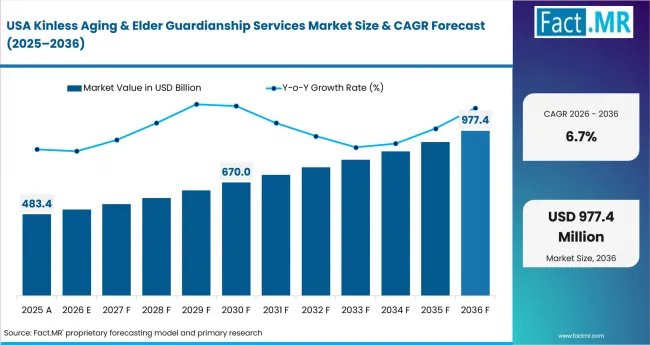
Kinless Aging & Elder Guardianship Services Market Country Value Analysis | Source: Fact.MR
The United States is projected to rise at 32.9% CAGR through 2036 because private pay and legal referral channels operate at scale. The Administration for Community Living awarded more than USD 1.8 million in September 2024 to improve protections for people under or at risk of guardianship or conservatorship. That funding does not size the market, but it confirms public attention to oversight quality. Suppliers that combine care management with fiduciary evidence are better placed than referral-only firms. [1]
What limits and supports Germany?
32.3% CAGR, supported by senior one-person households and restrained by local service variation.
Germany is forecast at 32.3% CAGR through 2036 because senior one-person households create a clear planning need. The Federal Statistical Office of Germany reported in July 2024 that 6.1 million households were one-person households of senior citizens on 15 May 2022. That represented 15.1% of all households. The service opportunity is practical, but expansion is lower than Japan. Care, legal and municipal channels remain more locally defined. [9]
How does Canada perform in this market?
32.0% CAGR, supported by aging population size and moderated by community service access.
Canada is expected to post 32.0% CAGR through 2036 because the older population base is large, but service pathways are spread across provincial systems. Statistics Canada reported in April 2025 that Canada had 8.11 million people aged 65 years and older as of July 1 2025. Statistics Canada also reported in July 2025 that 31.8% of people aged 80 or older reported no support services use. This indicates whitespace for planning support, but payment and awareness gaps slow conversion. [10] [11]
Who leads the kinless aging and elder guardianship services landscape?
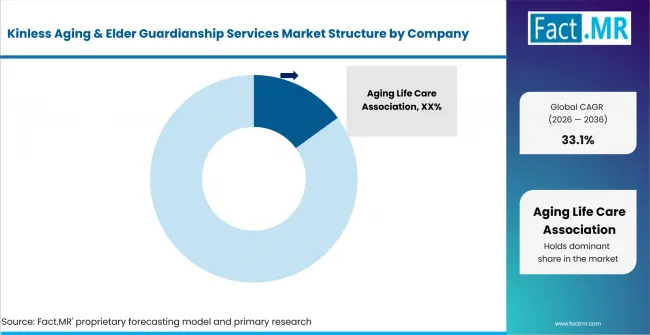
Kinless Aging & Elder Guardianship Services Market Analysis By Company | Source: Fact.MR
Aging Life Care Association and Wellthy shape the care coordination layer. Trust & Will and True Link Financial support planning and financial oversight. CareScout, Bessemer Trust and Bank of America Private Bank complete the field. Kinless aging and elder guardianship services are used by buyers who need accountable support across care, finance and legal planning. Adjacent home healthcare providers address clinical or personal care hours, but this category depends on decision records and fiduciary safeguards.
Aging Life Care Association supports the professional care manager base through standards, education and member visibility. Wellthy expands the employer benefit route through caregiving navigation. Trust & Will supports estate planning entry points for advisors and consumers. True Link Financial supports monitored spending tools for vulnerable adults.
CareScout informs buyers on aging care options and cost benchmarks, while adult day care remains a downstream service that coordinators may use when daytime supervision is needed. Trust and fiduciary providers such as Bessemer Trust Company, N.A. and Bank of America, N.A. Private Bank support clients who need trustee, estate or fiduciary administration.
Competitive advantage is not only brand reach. Providers that connect senior care technologies with professional review can document decisions, reduce missed tasks and support referrals from attorneys, courts and employers. Service bundles can also touch assisted living decisions when older adults need housing transitions. Providers that can compare housing, benefits and fiduciary limits are better placed for complex cases. Medication and chronic-care coordination can create referrals near geriatric medicines when decision capacity changes. The winning providers are those that clarify who decides, who pays and who documents the next step.
Which companies and organizations are the key players?
Aging Life Care Association and Wellthy. Trust & Will and True Link Financial. CareScout, Bessemer Trust Company, N.A. and Bank of America, N.A. Private Bank.
- Aging Life Care Association
- Wellthy Inc.
- True Link Financial, Inc.
- CareScout
- Bessemer Trust Company, N.A.
- Bank of America, N.A. Private Bank
Bibliography
- [1] Administration for Community Living. (2024, September 13). ACL awards over $1.8M in grants to improve protection for rights of people under or at risk of guardianship or conservatorship.
- [2] U.S. Census Bureau. (2024, August 28). Older adults in the United States: 2019 and 2022.
- [3] U.S. Department of Justice. (2024, September 30). Guardianship overview.
- [4] Office of the Public Guardian. (2025, July 17). OPG annual report and accounts 2024 to 2025. GOV.UK.
- [5] Office for National Statistics. (2025, July 23). Families and households in the UK: 2024.
- [6] Cabinet Office, Government of Japan. (2025, June). Annual Report on the Ageing Society [Summary] FY2025.
- [7] Statistics Korea. (2025, December 23). Administrative Statistics by Life Cycle in 2024.
- [8] Australian Bureau of Statistics. (2024, July 4). Disability, Ageing and Carers, Australia: Summary of Findings.
- [9] German Federal Statistical Office. (2024, August 15). 2022 Census: 57% of families living in their own home. Destatis.
- [10] Statistics Canada. (2025, April 23). Older adults and population aging statistics.
- [11] Statistics Canada. (2025, July 16). Aging in the community: Factors associated with home adaptations and receipt of informal care, home care, and community support services among older Canadians.
- [12] Wellthy Inc. (2024, November 19). Wellthy and New York Life Group Benefit Solutions announce partnership.
- [13] Trust & Will Inc. (2025, April 3). New report reveals a wake-up call for financial advisors.
- [14] Aging Life Care Association. (2025, May 27). How Aging Life Care Managers® support families: Insights from new research.
- [15] True Link Financial, Inc. (n.d.). Prepaid card with spending monitor.
- [16] CareScout. (2026, March 5). A guide to adult day health.
- [17] Bessemer Trust Company, N.A. (n.d.). Trust and Estate Planning.
- [18] Bank of America, N.A. (n.d.). Trust & Estate Services & Solutions for Individuals & Families.
This Report Address
- Strategic intelligence on kinless aging and elder guardianship services across service type, client type and payer type.
- Segment analysis covering Guardianship Case Management, Solo Older Adults, Professional Care Managers, Private Pay and Financial Oversight.
- Regional outlook covering Japan, South Korea, United Kingdom, Australia, United States, Germany and Canada.
- Competitive analysis of Aging Life Care Association, Wellthy, Trust & Will, True Link Financial, CareScout, Bessemer Trust and Bank of America Private Bank.
- Service assessment covering guardianship case management, fiduciary administration, care coordination and solo aging planning.
- Source review, provider checks and demographic validation support the forecast.
What does the kinless aging and elder guardianship services market cover?
Paid planning, coordination and oversight services for older adults without reliable family decision support.
The kinless aging and elder guardianship services market covers professional services used when older adults lack a willing, available or suitable family decision agent. It includes guardianship case management and solo aging planning. It also includes fiduciary administration, care coordination and referral support. The market differs from general home care because the service focus is decision accountability rather than daily personal care hours.
What is included in the scope?
Guardianship case management, fiduciary oversight and solo aging coordination.
The scope includes court-referred guardianship case management and privately arranged professional care coordination. It covers advance planning support when the service connects decision agents, documents and care pathways. It also includes financial oversight, bill review and abuse-risk monitoring when sold as part of elder guardianship support.
What is excluded from the scope?
Unpaid family caregiving and general home care hours without decision-support work.
The scope excludes unpaid family caregiving, routine home care hours and long-term care room charges. It excludes standard estate documents when sold without ongoing support. It also excludes hospital discharge planning when no solo aging, fiduciary or guardianship coordination service is attached.
How was the analysis built?
110+ sources and 35+ provider portfolios. The work also used 20+ country policy checks and 18 expert-style validation interviews.
- Primary Research: Primary research includes structured discussions with elder law professionals, care managers and fiduciary advisors. It also reviews provider intake logic for older adults who lack a reliable family decision maker.
- Desk Research: Desk research reviews government aging datasets and public guardian reports. It also covers court oversight guidance, official provider service pages and power of attorney activity.
- Market-Sizing and Forecasting: Forecasting uses a bottom-up model based on older-adult isolation pools, service intensity and case conversion. Values were reconciled against public guardian activity and private planning channels.
- Data Validation and Update Cycle: Forecasts were validated through provider checks and source triangulation. Updates should be refreshed when countries publish guardianship caseloads, power of attorney volumes and older-adult living arrangement data.
Segmentation
What is the report’s scope and coverage?
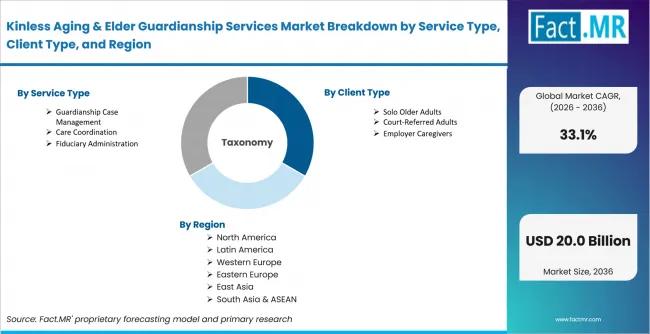
Kinless Aging & Elder Guardianship Services Market Breakdown By Service Type, Client Type, And Region | Source: Fact.MR
| Attribute | Details |
|---|---|
| Quantitative Units | USD Billion in 2026 to USD Billion by 2036 at CAGR |
| Market Definition | Paid decision-support, guardianship case management and fiduciary coordination for older adults without reliable family backup |
| Service Type | Guardianship Case Management, Care Coordination, Fiduciary Administration, Advance Planning, Safety Monitoring |
| Client Type | Solo Older Adults, Court-Referred Adults, Dementia Clients, Employer Caregivers, Estate Clients |
| Delivery Model | Professional Care Managers, Elder Law Networks, Public Guardian Programs, Online Planning Platforms, Trust Fiduciary Firms |
| Payer Type | Private Pay, Public Contract, Employer Benefit, Insurance Referral, Nonprofit Grant |
| Need Area | Financial Oversight, Healthcare Decisions, Housing Transition, Abuse Prevention, End-of-Life Coordination |
| Channel | Care Managers, Elder Law Attorneys, Courts, Health Systems, Online Platforms |
| Regions Covered | North America, Europe, Asia Pacific and Oceania, Latin America, Middle East and Africa |
| Countries Covered | Japan, South Korea, United Kingdom, Australia, United States, Germany, Canada |
| Key Companies Profiled | Aging Life Care Association, Wellthy, Trust & Will, True Link Financial, CareScout, Bessemer Trust Company, N.A., Bank of America, N.A. Private Bank |
| Forecast Period | 2026 to 2036 |
Source: Fact.MR analysis. Updated Jun 19, 2026
How is the market segmented?
-
By Service Type:
- Guardianship Case Management
- Care Coordination
- Fiduciary Administration
- Advance Planning
- Safety Monitoring
-
By Client Type:
- Solo Older Adults
- Court-Referred Adults
- Dementia Clients
- Employer Caregivers
- Estate Clients
-
By Delivery Model:
- Professional Care Managers
- Elder Law Networks
- Public Guardian Programs
- Online Planning Platforms
- Trust Fiduciary Firms
-
By Payer Type:
- Private Pay
- Public Contract
- Employer Benefit
- Insurance Referral
- Nonprofit Grant
-
By Need Area:
- Financial Oversight
- Healthcare Decisions
- Housing Transition
- Abuse Prevention
- End-of-Life Coordination
-
By Channel:
- Care Managers
- Elder Law Attorneys
- Courts
- Health Systems
- Online Platforms
-
By Region:
- North America
- United States
- Canada
- Europe
- Germany
- United Kingdom
- France
- Ireland
- Netherlands
- Asia Pacific
- China
- Japan
- Singapore
- Malaysia
- South Korea
- Latin America
- Brazil
- Mexico
- Chile
- Middle East & Africa
- GCC Countries
- South Africa
- Israel
- North America
Frequently Asked Questions
Which service type leads the Kinless Aging & Elder Guardianship Services Market?
Which client type leads the Kinless Aging & Elder Guardianship Services Market?
Which country expands faster in the Kinless Aging & Elder Guardianship Services Market?
How does South Korea perform in the Kinless Aging & Elder Guardianship Services Market?
How does the United Kingdom perform in the Kinless Aging & Elder Guardianship Services Market?
What is the primary driver in the Kinless Aging & Elder Guardianship Services Market?
What is the main restraint in the Kinless Aging & Elder Guardianship Services Market?
Why are professional care managers important in this market?
Who worked on this report


Preview the report firsthand - request a free sample
Free SampleGet the brochure for pricing and purchase details
Download PDF