- Base Value(2025): 2.0 Bn
- Estimated Value(2026): 2.2 Bn
- Forecast Value (2036): 6.8 Bn
- CAGR (2026 - 2036): 11.8%
Lithium Metal Market Size, Share and Forecast and Outlook By Fact.MR
In 2025, the lithium metal market was valued at USD 2.0 billion. Fact MR analysis indicates demand for lithium metal is expected to reach USD 2.2 billion in 2026 and USD 6.8 billion by 2036. FMR estimates the market will expand at a CAGR of 11.8% across the forecast period.
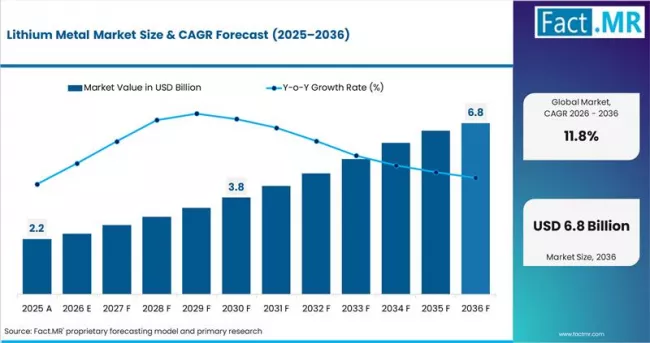
Lithium Metal Market Value Analysis | Source: Fact.MR
Lithium Metal Market
| Metric | Details |
|---|---|
| Industry Size (2026E) | USD 2.2 billion |
| Industry Value (2036F) | USD 6.8 billion |
| CAGR (2026 to 2036) | 11.8% |
Source: Fact.MR analysis. Updated May 4, 2026
Summary of the Lithium Metal Market
- Market Definition
- The lithium metal market comprises production and refinement of elemental lithium supplied in foil, ingot, powder, rod, and granular forms for electrochemical, metallurgical, and specialty chemical applications. Lithium metal functions as a high-reactivity material with high theoretical specific capacity, enabling use as an anode material in advanced battery chemistries as well as in aerospace alloys, polymer synthesis, and pharmaceutical intermediates requiring high electrochemical performance characteristics.
- Demand Drivers
- Increasing development of high energy density battery chemistries utilizing lithium metal anodes supporting extended runtime performance characteristics.
- Expansion of electric mobility supply chains requiring advanced electrochemical materials supporting improved charge storage capacity.
- Growing investment in solid-state battery technologies requiring lithium metal inputs with controlled purity thresholds.
- Rising demand for lightweight metal alloys supporting aerospace and defense applications requiring high strength-to-weight ratios.
- Expansion of grid-scale energy storage systems requiring advanced electrochemical materials supporting high cycle efficiency.
- Increasing research activity focused on improving dendrite suppression characteristics supporting safer lithium metal battery operation.
- Key Segments Analyzed
- Application: Batteries account for 57.4% share supported by development of high-performance electrochemical storage technologies.
- Purity Level: Battery-grade lithium metal represents 49.3% share supported by controlled impurity thresholds required for electrochemical stability.
- Product Type: Lithium metal foil demonstrates increasing use in electrode fabrication processes requiring uniform thickness characteristics.
- End Use Industry: Automotive and energy storage industries demonstrate strongest demand supported by electrification investment trends.
- Geography: China and India demonstrate strongest growth supported by expansion of battery material processing capacity, while the USA and Japan reflect mature advanced materials research ecosystems.
- Analyst Opinion at Fact MR
- Karan Chechi, Research Director at Fact MR, states, "Lithium metal represents a high-performance electrochemical material positioned at the center of next-generation battery architecture development. Demand expansion reflects increasing focus on improving energy density performance beyond graphite-based lithium-ion systems. Market participants are prioritizing purification efficiency, controlled atmosphere processing capability, and scalable metal handling technologies supporting commercialization of lithium metal battery chemistries through 2036."
- Strategic Implications
- Expand battery-grade lithium metal production capacity supporting electrochemical performance requirements in solid-state battery development.
- Improve impurity control processes supporting electrochemical stability and cycle life consistency across battery cell manufacturing.
- Strengthen refining capability supporting production of ultra-high purity lithium metal aligned with advanced material specifications.
- Expand supply chain integration supporting stable lithium feedstock conversion into metallic lithium forms.
- Improve controlled atmosphere processing infrastructure supporting safe handling of reactive lithium metal materials.
- Strengthen collaboration with battery manufacturers supporting qualification of lithium metal inputs across pilot-scale cell production programs.
- Methodology
- Developed using primary interviews with lithium producers, battery material manufacturers, specialty alloy producers, and procurement specialists.
- Supported through analysis of mining production statistics, electrochemical research publications, and manufacturer technical documentation.
- Market estimation applied hybrid modeling combining bottom-up production capacity evaluation with top-down assessment of advanced battery material demand.
- Data validated through triangulation using supplier disclosures, technical literature, and expert consultation inputs.
- Periodic updates incorporate developments in solid-state battery research, lithium refining technologies, and supply chain investment activity across advanced energy storage materials.
A CAGR of 11.8%, with value rising from USD 2.2 billion to USD 6.8 billion, indicates a breakpoint shift toward commercialization of next-generation batteries using lithium metal anodes. Growth is supported by energy density requirements in electric mobility and storage systems, while constrained by dendrite control challenges, raw lithium supply volatility, and manufacturing scalability risks.
China records the fastest growth at 13.4%, supported by expansion of high energy density battery component manufacturing capacity. India follows at 13.0%, driven by increasing investment in advanced battery material processing infrastructure. South Korea shows 12.6% growth, linked to demand from next-generation battery cell technology development programs. Japan at 12.1% and the USA at 11.7% represent relatively mature markets where demand is largely replacement and efficiency upgrade driven due to established battery research and specialty materials supply chains. A structural constraint across mature markets is stringent handling and safety requirements, which limits rapid scaling of lithium metal processing capacity.
Segmental Analysis
Lithium Metal Market Analysis by Application
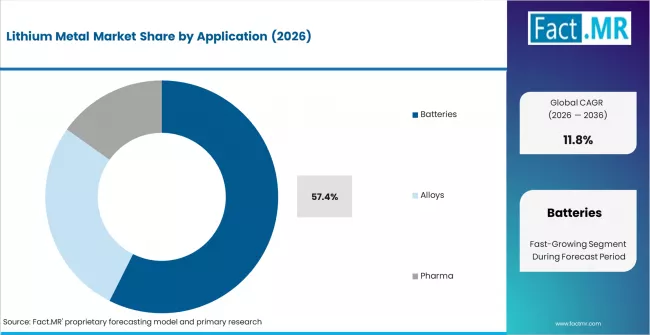
Lithium Metal Market Analysis By Application | Source: Fact.MR
- Market Overview: Batteries are projected to hold 57.4% share of the lithium metal market in 2026. Demand concentration reflects increasing utilization of lithium metal as an anode material in high-energy-density battery chemistries requiring improved electrochemical performance characteristics. Material selection patterns indicate growing interest in lithium metal for next-generation rechargeable battery configurations used in advanced electronics and electric mobility applications.
- Demand Drivers:
- Energy Density Requirements: Lithium metal demonstrates high theoretical capacity, supporting development of battery systems requiring extended runtime and reduced weight characteristics.
- Next-Generation Battery Development: Research and pilot-scale manufacturing activities focus on lithium metal integration within solid-state and high-performance rechargeable battery architectures.
- Electronics and Mobility Demand: Increasing production of electric mobility systems and advanced electronic devices supports material demand for battery components requiring enhanced charge storage capability.
Lithium Metal Market Analysis by Purity Level
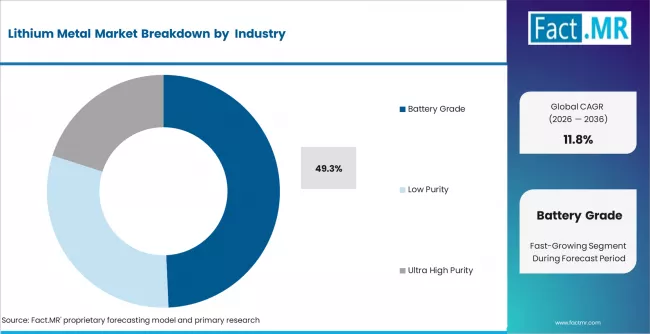
Lithium Metal Market Analysis By Purity Level | Source: Fact.MR
- Market Overview: Battery grade lithium metal is estimated to account for 49.3% share in 2026, supported by material specifications requiring controlled impurity thresholds to maintain electrochemical stability and safety performance across rechargeable battery manufacturing processes. Purity level selection influences conductivity behavior and cycle life characteristics of lithium-based battery cells.
- Demand Drivers:
- Electrochemical Stability Requirements: Battery-grade lithium metal demonstrates controlled impurity levels necessary to reduce unwanted side reactions within electrochemical cell environments.
- Manufacturing Quality Standards: Battery component producers specify high-purity lithium inputs to support consistent electrode fabrication processes across commercial-scale production systems.
- Performance Consistency: Material purity supports predictable battery efficiency, cycle durability, and operational stability across advanced rechargeable energy storage technologies.
Key Dynamics
Lithium Metal Market Drivers, Restraints, and Opportunities
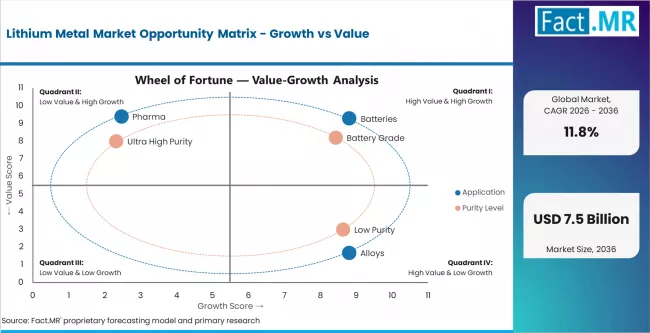
Lithium Metal Market Opportunity Matrix Growth Vs Value | Source: Fact.MR
Fact MR analysis indicates the market reflects a transitioning advanced materials segment positioned between specialty metals and next-generation battery chemistries. Market size exists because lithium metal offers the highest theoretical specific capacity among anode materials, enabling energy densities significantly above conventional graphite-based lithium-ion batteries. Historical demand remained limited to niche applications such as pharmaceuticals, aerospace alloys, and primary batteries, while current valuation is increasingly shaped by the shift toward solid-state batteries and high-performance electric mobility systems. The structural reality is early commercialization stage with rapid capacity investments aligned with electrification strategies across automotive and grid storage sectors.
Current dynamics show declining relative dominance of lithium-ion graphite anodes as manufacturers evaluate lithium metal chemistries capable of delivering longer range and faster charging performance. Lithium metal materials command higher per-unit pricing due to purity requirements and manufacturing complexity, while commercialization volumes remain constrained by safety concerns such as dendrite formation and electrolyte compatibility challenges. The market reflects a value-driven transition where higher material performance compensates for slower scaling of commercial production capacity.
- Solid-State Transition: Government-backed electrification strategies and battery innovation programs are accelerating development of lithium metal anodes for solid-state batteries capable of improving energy density and vehicle range.
- Asia Supply Concentration: China dominates refining capacity and battery manufacturing ecosystems, creating geographic concentration in lithium processing and downstream energy storage supply chains.
- Price Volatility Cycle: Oversupply conditions have reduced lithium prices despite rising long-term demand from EV and grid storage markets, creating short-term margin pressure across upstream producers.
Regional Analysis
Regions Covered and Geographic Segmentation
The lithium metal market is assessed across Asia Pacific and North America, segmented by country-level demand for battery-grade lithium metal used in solid-state batteries, high-energy-density storage systems, aerospace alloys, and advanced electronics. Geographic variation reflects battery manufacturing capacity expansion, electric mobility investment, and strategic raw material supply chain development. The full report offers market attractiveness analysis.
.webp "Top Country Growth Comparison Lithium Metal Market Cagr (2026 2036)")
Top Country Growth Comparison Lithium Metal Market Cagr (2026 2036) | Source: Fact.MR
CAGR Table
| Country | CAGR (2026–2036) |
|---|---|
| China | 13.4% |
| India | 13.0% |
| South Korea | 12.6% |
| Japan | 12.1% |
| USA | 11.7% |
Source: Fact.MR analysis. Updated May 4, 2026
Source: Fact MR analysis, based on proprietary forecasting model and primary research
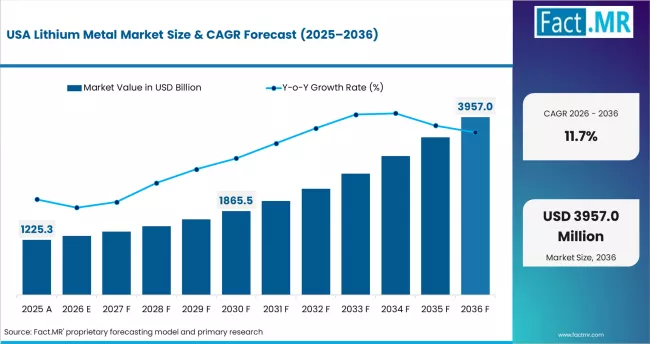
Lithium Metal Market Country Value Analysis | Source: Fact.MR
Asia Pacific
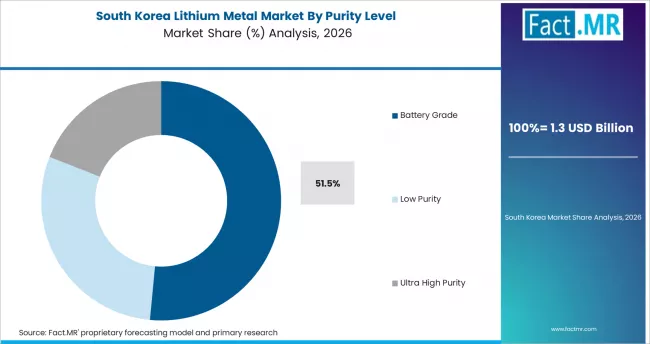
Lithium Metal Market South Korea Market Share Analysis By Purity Level | Source: Fact.MR
Asia Pacific functions as the battery materials production hub supported by expansion of electric vehicle supply chains and increasing investment in solid-state battery chemistry. Ganfeng Lithium Co., Ltd. strengthens lithium metal refining capability. POSCO Future M expands advanced battery material portfolio depth. Mitsubishi Chemical Group supports specialty lithium processing expertise.
- China: China is projected to record 13.4% CAGR in lithium metal through 2036. New Energy Vehicle industry development plan update (Ministry of Industry and Information Technology, January 2023) supports high energy density battery material demand. Ganfeng Lithium Co., Ltd. expanded lithium metal refining capacity (June 2023).
- India: India is expected to observe 13.0% CAGR in lithium metal through 2036. National Mission on Transformative Mobility update (NITI Aayog, February 2023) supports domestic battery manufacturing capability. Hindustan Zinc Ltd. announced battery materials collaboration initiative (August 2023).
- South Korea: South Korea is anticipated to expand at 12.6% CAGR in lithium metal through 2036. K Battery Strategy framework update (Ministry of Trade, Industry and Energy, March 2023) supports next generation battery material development. POSCO Future M expanded lithium processing investment (May 2023).
- Japan: Japan is forecast to grow at 12.1% CAGR in lithium metal through 2036. Green Growth Strategy update (Ministry of Economy, Trade and Industry, April 2023) supports solid-state battery material innovation. Mitsubishi Chemical Group expanded lithium metal processing research program (July 2023).
North America
Lithium Metal Market Country Value Analysis | Source: Fact.MR
North America operates as the advanced battery commercialization center supported by electric vehicle production expansion and strong investment in domestic battery material supply chains. Albemarle Corporation strengthens lithium metal refining capability. Livent Corporation expands battery grade lithium production capacity. FMC Corporation supports specialty lithium material processing expertise.
- USA: The USA is projected to register 11.7% CAGR in lithium metal through 2036. Inflation Reduction Act battery manufacturing incentive framework (U.S. Department of Energy, January 2023) supports domestic lithium supply chain development. Albemarle Corporation expanded lithium processing investment (September 2023).
Fact MR's analysis of lithium metal market in global regions consists of country-wise assessment that includes China, India, South Korea, Japan, and USA. Readers can find battery material demand trends, supply chain developments, regulatory positioning frameworks, and competitive material processing innovation insights.
Competitive Landscape
What is the Competitive Structure of the Lithium Metal Market?
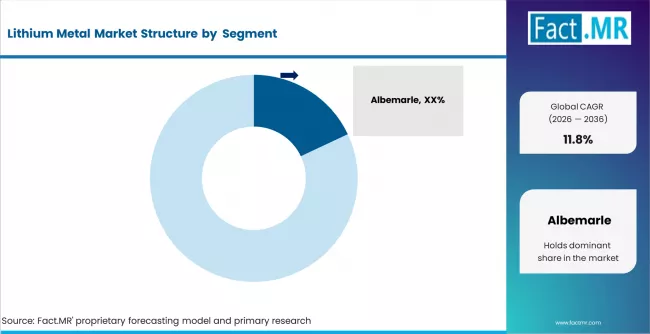
Lithium Metal Market Analysis By Company | Source: Fact.MR
The Lithium Metal Market demonstrates a moderately concentrated competitive structure, supported by a limited number of producers with expertise in lithium refining and metal conversion processes. Leading companies including Albemarle, SQM, Ganfeng Lithium, Tianqi Lithium, Livent, and China Energy Lithium collectively account for nearly 60–70% of global supply, particularly in battery-grade lithium metal used in high-energy-density applications. Competitive positioning is primarily determined by metal purity, conversion efficiency, process safety, and consistency of electrochemical performance. High technical barriers related to reactive metal handling and controlled atmosphere processing restrict entry of new participants. Suppliers with established lithium compound refining capabilities maintain stronger positioning due to reliable feedstock conversion and stable material quality required in advanced battery manufacturing.
Structural advantages are observed among companies maintaining integrated lithium resource access and downstream refining infrastructure supporting stable production output. Ganfeng Lithium and Albemarle benefit from diversified lithium supply chains and long-term agreements with battery manufacturers seeking consistent metal purity and supply reliability. Buyers typically manage supplier dependency through multi-source procurement strategies and qualification of equivalent lithium metal specifications across approved vendors. Procurement decisions often consider impurity tolerance thresholds, supply continuity, and material handling consistency aligned with battery cell production requirements. Pricing power remains relatively balanced, though suppliers retain moderate leverage where high purity requirements and limited large-scale production capacity create switching constraints for manufacturers developing lithium metal battery technologies.
Key Players of the Lithium Metal Market
- Albemarle
- SQM
- Ganfeng Lithium
- Tianqi Lithium
- Livent
- American Elements
- Targray
- China Energy Lithium
- FMC
- Lithium Werks
Bibliographies
- [1] Ministry of Industry and Information Technology (China). (2023, January). New Energy Vehicle industry development plan update.
- [2] NITI Aayog (India). (2023, February). National Mission on Transformative Mobility update.
- [3] Ministry of Trade, Industry and Energy (South Korea). (2023, March). K-Battery Strategy framework update.
- [4] Ministry of Economy, Trade and Industry (Japan). (2023, April). Green Growth Strategy update.
- [5] U.S. Department of Energy. (2023, January). Inflation Reduction Act battery manufacturing incentives.
- [6] Ganfeng Lithium Co., Ltd. (2023, June). Lithium metal refining capacity expansion.
- [7] Hindustan Zinc Ltd. (2023, August). Battery materials collaboration initiative.
- [8] POSCO Future M. (2023, May). Lithium processing investment expansion.
- [9] Mitsubishi Chemical Group. (2023, July). Lithium metal processing research program expansion.
- [10] Albemarle Corporation. (2023, September). Lithium processing investment expansion.
This Report Addresses
- Market size estimation and revenue forecasts from 2026 to 2036, supported by validated lithium refining capacity benchmarks and demand indicators across advanced battery and specialty metal applications.
- Growth opportunity mapping across lithium metal foil, ingots, powder, rods, and granules aligned with electrochemical performance requirements for high-energy-density storage systems and metallurgical processes.
- Segment and regional revenue forecasts covering low purity, battery grade, and ultra-high purity lithium metal used in batteries, specialty alloys, pharmaceutical synthesis, polymer processing, and aerospace material applications.
- Competition strategy assessment including benchmarking of impurity control thresholds, electrochemical stability characteristics, controlled atmosphere processing capability, and scalability of lithium metal conversion technologies.
- Regulatory impact analysis covering battery safety certification frameworks, hazardous material handling standards, and strategic mineral supply chain policies influencing lithium metal production and commercialization.
- Market report delivery in PDF, Excel, PPT, and structured data formats designed for battery manufacturers, specialty chemical producers, alloy fabricators, and energy storage material procurement teams.
- Supply chain vulnerability assessments identifying concentration risks in lithium feedstock conversion capacity, controlled environment refining infrastructure, and purification technology availability supporting battery-grade lithium metal production.
Lithium Metal Market Definition
The lithium metal market refers to the production, refining, and supply of elemental lithium used as a high-reactivity, lightweight metal in advanced energy storage and specialty industrial applications. Lithium metal serves as a key anode material in high-energy batteries and is also used in alloys, lubricants, and chemical synthesis requiring high electrochemical performance.
Lithium Metal Market Inclusions
The report covers global and regional market size, historical demand patterns, and forecast outlook across the defined period. It includes segmentation by product form such as lithium metal foil, ingots, and powder, applications in batteries, alloys, and specialty chemicals, and end users including electronics, automotive, aerospace, and energy storage industries. Pricing trends and trade flow analysis are included.
Lithium Metal Market Exclusions
The scope excludes lithium-ion battery packs, cathode materials, and downstream energy storage systems. Lithium compounds such as lithium carbonate, lithium hydroxide, and lithium salts are not included unless converted into metallic lithium. Finished consumer electronics, electric vehicles, and pharmaceutical formulations are excluded, focusing strictly on lithium metal and immediate intermediates.
Lithium Metal Market Research Methodology
- Primary Research
- Interviews were conducted with lithium producers, battery material manufacturers, specialty chemical suppliers, and procurement specialists involved in energy storage material sourcing.
- Desk Research
- Public data sources including mining statistics, chemical industry publications, technical journals, and company disclosures were reviewed to evaluate supply-demand trends and industrial adoption patterns.
- Market-Sizing and Forecasting
- A hybrid model combining bottom-up supplier production capacity assessment and top-down evaluation of battery material demand was applied to estimate market size and growth trajectory.
- Data Validation and Update Cycle
- Findings were cross-verified through technical literature, industry databases, and expert consultations. Periodic updates reflect changes in battery technology development, raw material supply conditions, and industrial consumption trends.
Segmentation
Report Scope
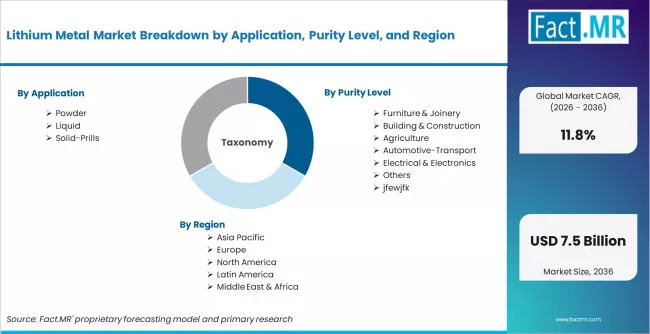
Lithium Metal Market Breakdown By Application, Purity Level, And Region | Source: Fact.MR
| Metric | Value |
|---|---|
| Quantitative Units | USD 2.2 billion (2026) to USD 6.8 billion (2036), at a CAGR of 11.8% |
| Market Definition | The lithium metal market includes production and processing of elemental lithium supplied in various physical forms for electrochemical, metallurgical, and specialty chemical applications. Lithium metal is utilized as an active material in advanced battery systems, alloy manufacturing, pharmaceutical synthesis, polymer production, and aerospace components requiring high reactivity and low density characteristics. |
| Product Type Segmentation | Foil, Ingots, Powder, Rods, Granules |
| Purity Level Segmentation | Low purity, Battery grade, Ultra high purity |
| Application Segmentation | Batteries, Alloys, Pharma, Polymers, Aerospace |
| End Use Industry Segmentation | Automotive, Electronics, Energy storage, Aerospace & defense, Industrial |
| Regions Covered | North America, Latin America, Europe, East Asia, South Asia, Oceania, Middle East and Africa |
| Countries Covered | United States, Canada, Mexico, Brazil, Argentina, Germany, France, United Kingdom, Italy, Spain, China, India, Japan, South Korea, Indonesia, Australia, and 40+ countries |
| Key Companies Profiled | Albemarle, SQM, Ganfeng Lithium, Tianqi Lithium, Livent, American Elements, Targray, China Energy Lithium, FMC, Lithium Werks |
| Forecast Period | 2026 to 2036 |
| Approach | Hybrid top-down and bottom-up market estimation validated through primary interviews with lithium producers, battery material suppliers, alloy manufacturers, and specialty chemical companies, supported by trade flow benchmarking, production capacity assessment, and evaluation of adoption trends across advanced energy storage and high-performance material applications |
Source: Fact.MR analysis. Updated May 4, 2026
Lithium Metal Market Key Segments
-
Product Type:
- Foil
- Ingots
- Powder
- Rods
- Granules
-
Purity Level:
- Low Purity
- Battery Grade
- Ultra High Purity
-
Application:
- Batteries
- Alloys
- Pharma
- Polymers
- Aerospace
-
End Use Industry:
- Automotive
- Electronics
- Energy Storage
- Aerospace and Defense
- Industrial
-
Region:
- North America
- USA
- Canada
- Mexico
- Europe
- Germany
- UK
- France
- Italy
- Spain
- Nordic Countries
- BENELUX
- Rest of Europe
- Asia Pacific
- China
- Japan
- South Korea
- India
- Australia
- Rest of Asia Pacific
- Latin America
- Brazil
- Argentina
- Rest of Latin America
- Middle East and Africa
- Kingdom of Saudi Arabia
- United Arab Emirates
- South Africa
- Rest of Middle East and Africa
- Other Regions
- Oceania
- Central Asia
- Other Markets
- North America
Frequently Asked Questions
How large is the demand for Lithium Metal in the global market in 2026?
What will be the market size of Lithium Metal in the global market by 2036?
What is the expected demand growth for Lithium Metal in the global market between 2026 and 2036?
Which Application is poised to lead global demand by 2026?
What is Driving Lithium Metal Demand in China?
What is the China Growth Outlook in this Report?
What is Driving Lithium Metal Demand in India?
What is the India Growth Outlook in this Report?
What is Driving Lithium Metal Demand in South Korea?
What is the South Korea Growth Outlook in this Report?
What is Driving Lithium Metal Demand in Japan?
What is the Japan Growth Outlook in this Report?
What is Driving Lithium Metal Demand in the United States?
What is the United States Growth Outlook in this Report?
Which Companies are Identified as Leading Participants in the Lithium Metal Market?
What is Lithium Metal and What is It Mainly Used For?
What does Lithium Metal Market Mean in this Report?
What is Included in the Scope of this Lithium Metal Market Report?
What is Excluded from the Scope of this Report?
What does Market Forecast Mean on this Page?
How is the Lithium Metal Market Forecast Developed in this Report?
What does Data Validation Approach Mean in this Report?
Who worked on this report


Preview the report firsthand - request a free sample
Free SampleGet the brochure for pricing and purchase details
Download PDF