- Base Value(2025): 6.1 Bn
- Estimated Value(2026): 6.7 Bn
- Forecast Value (2036): 19.6 Bn
- CAGR (2026 - 2036): 11.2%
Lithium Extraction Chemicals Market Forecast and Outlook By Fact.MR
In 2025, the global lithium extraction chemicals market was valued at USD 6.1 billion. Based on Fact.MR analysis, demand for lithium extraction chemicals is estimated to grow to USD 6.7 billion in 2026 and USD 19.6 billion by 2036. FACT.MR projects a CAGR of 11.2% during the forecast period.
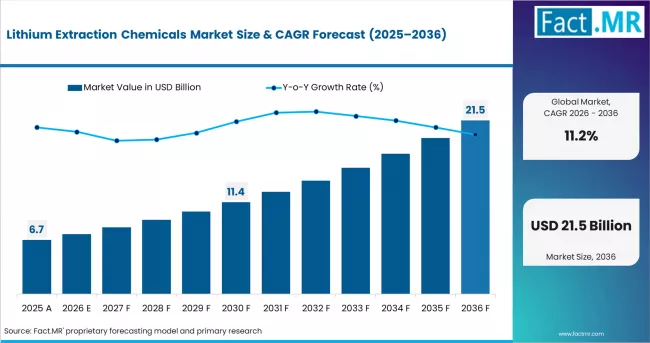
Lithium Extraction Chemicals Market Market Value Analysis | Source: Fact.MR
| Metric | Value |
|---|---|
| Estimated Value in 2026 | USD 6.7 billion |
| Forecast Value in 2036 | USD 19.6 billion |
| Forecast CAGR (2026 to 2036) | 11.2 |
Source: Fact.MR analysis. Updated Apr 15, 2026
Summary of the Lithium Extraction Chemicals Market
- Market Definition
- The market covers solvents, extractants, acids, and alkalis used in brine and hard rock lithium extraction processes to produce battery-grade lithium compounds for EV battery and energy storage supply chains globally.
- Demand Drivers
- China's EV battery gigafactory scale-up is driving integrated lithium chemical procurement contracts as manufacturers localize brine and spodumene processing supply chains under domestic critical mineral policies.
- Chile's National Lithium Strategy, updated in 2024, mandates expanded state-led lithium processing investment that directly increases solvent extraction and precipitation chemical volumes at SQM and Albemarle-operated brine facilities.
- The U.S. Inflation Reduction Act's domestic critical mineral provisions are compelling North American lithium refiners to commission new extraction chemical supply agreements as greenfield brine projects advance to production.
- Key Segments Analyzed
- By Chemical Type: Solvents & Extractants lead with 47% share in 2026, driven by selectivity in lithium separation from brine and spodumene leach solutions.
- By Extraction Method: Solvent Extraction leads with 40% share in 2026, driven by commercial maturity across Chilean brine and Australian hard rock operations. Ion Exchange, Precipitation, and DLE are growing segments.
- By Application: Brine Extraction leads with 56% share in 2026 due to scale of Atacama and Lithium Triangle brine resource development.
- By Geography: China leads at 13.5% CAGR through integrated processing infrastructure expansion.
- Analyst Opinion at FACT.MR
- Shambhu Nath Jha, Principal Consultant at Fact.MR, opines, ‘CXOs sourcing lithium extraction chemicals are facing a clear shift in procurement priorities. DLE-compatible reagent capability is becoming essential. Battery-grade purity documentation is no longer optional. These factors are rapidly turning into non-negotiable criteria. Tier-one battery manufacturers are driving this change. They are embedding strict chemical specifications directly into lithium feedstock supply contracts.’
- Strategic Implications
- Develop DLE-compatible solvent and extractant systems. This positions suppliers for the next generation of brine extraction projects scaling through 2030.
- Secure long-term acid and alkali supply agreements with Lithium Triangle processors. Chile and Argentina project pipelines create sustained multi-year procurement demand.
- Invest in closed-loop reagent recovery technology. This reduces operating cost per tonne and supports battery-grade lithium carbonate purity compliance.
- Methodology
- Based on reagent consumption volumes and pricing by chemical type and process. Validated with 2024–2025 plant commissioning and producer revenue data.
- Uses Chile CORFO, U.S. DOE, and Australian CSIRO critical mineral and extraction technology sources. Supports regional demand analysis.
- Forecasts include brine project pipeline capacity, DLE technology adoption curves, and EV battery supply chain procurement trend data.
Between 2026 and 2036, the market is expected to generate USD 13.5 billion in absolute opportunity. This is transformational growth, not incremental. Demand is accelerated by battery-grade lithium supply commitments tied to EV manufacturing scale-up across China, Europe, and North America. Growth is moderated by volatile spodumene prices, acid reagent cost inflation, and the early-stage commercial readiness of DLE chemical systems at consistent throughput.
China leads at 13.5% CAGR through rapid lithium processing infrastructure scale-up and EV supply chain localization mandates. Chile follows at 12.7% driven by brine resource expansion and National Lithium Strategy chemical processing investment. Argentina records 12.0% through Lithium Triangle brine project commissioning and solvent extraction facility buildout. Australia posts 11.8% through spodumene hard rock processing chemical demand at expanding Pilbara operations. The United States records 10.0% through Inflation Reduction Act-backed domestic lithium refining investments. Mature markets generate compliance-driven specification upgrades rather than volume growth, constrained by legacy hydrometallurgical plant conversion costs.
Segmental Analysis
Lithium Extraction Chemicals Market Analysis by Chemical Type
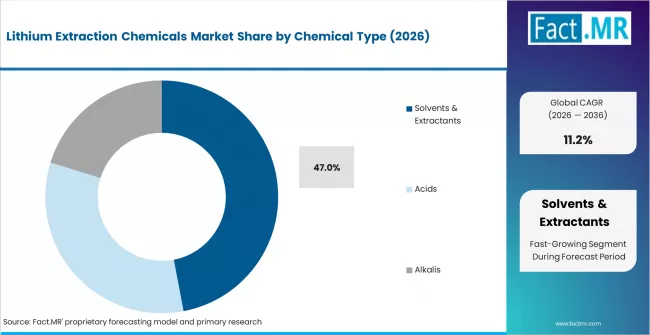
Lithium Extraction Chemicals Market Analysis By Chemical Type | Source: Fact.MR
Based on FACT.MR's lithium extraction chemicals market report, consumption of solvents & extractants is estimated to hold 47% share in 2026. This segment dominates because selective extractant systems including D2EHPA and Cyanex 272 are integral to lithium separation from brine leach and spodumene leach solutions across both established and emerging project configurations.
- BASF Extractant Expansion: BASF SE expanded production of its Ionquest lithium-selective extractant range at Ludwigshafen in Q3 2024, targeting brine project operators in Chile and Argentina scaling under National Lithium Strategy processing mandates. The expansion reflects direct demand growth from Lithium Triangle project operators. [5]
- Solvay Reagent Development: Solvay launched its Aliquat 336S lithium extractant reformulation in 2025 with improved selectivity for DLE-adjacent solvent wash circuits. The product targets Australian hard rock and North American brine operators adopting hybrid conventional-DLE processing configurations. [6]
- Closed-Loop Solvent Trend: Lithium extraction plant operators in Chile and Australia reported closed-loop solvent recovery specifications as standard procurement requirements in 2024 contract tenders, driven by water-scarce brine operating environments and increasingly stringent environmental compliance for Atacama brine operations. [7]
Lithium Extraction Chemicals Market Analysis by Extraction Method
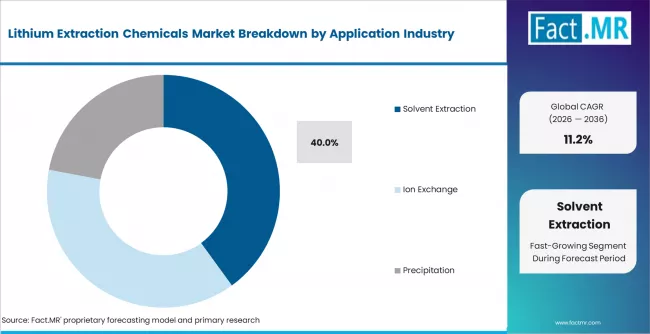
Lithium Extraction Chemicals Market Analysis By Extraction Method | Source: Fact.MR
Based on FACT.MR's lithium extraction chemicals market report, solvent extraction is estimated to hold 40% share in 2026. Solvent extraction leads because it is the proven commercial-scale methodology at SQM, Albemarle, and Allkem brine and spodumene operations, with established chemical reagent supply chains and operator familiarity across the Lithium Triangle and Australian Pilbara processing hubs.
- SQM Atacama Expansion: SQM disclosed a USD 1.6 billion investment in Atacama brine processing capacity expansion in its 2024 annual report, directly increasing solvent extraction and precipitation chemical procurement volumes at its Chilean lithium carbonate and hydroxide production facilities. [8]
- Lilac Solutions DLE Scale-Up: Lilac Solutions completed its Series B funding round of USD 145 million in 2024 to advance ion exchange sorbent DLE technology to commercial-scale brine processing. [9]
Ion Exchange Adoption Trend: Ion exchange resin procurement for lithium extraction applications grew measurably at South American brine projects in 2024. Operators evaluated hybrid solvent-ion exchange configurations to improve lithium recovery rates from lower-grade brine feedstocks without full DLE conversion capital investment. [10]
Drivers, Restraints, and Opportunities
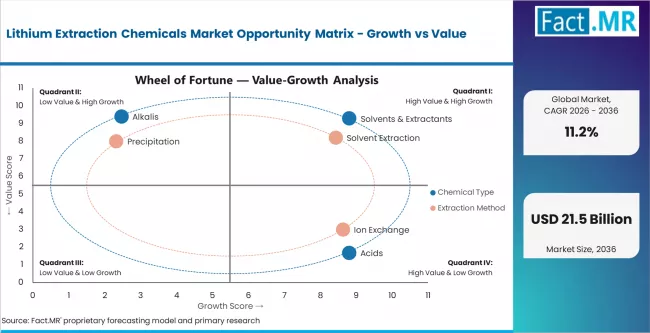
Lithium Extraction Chemicals Market Opportunity Matrix Growth Vs Value | Source: Fact.MR
FACT.MR analysts observe the lithium extraction chemicals market has shifted from a niche mining reagent category to a critical battery supply chain input, valued at USD 6.1 billion in 2025. Growth is directly correlated to lithium project commissioning cycles and battery-grade specification tightening by EV manufacturers.
The core tension is between DLE technology promise and conventional solvent extraction incumbency. Standard hydrometallurgical chemical consumption is growing with brine project expansions.
- Battery-Grade Mandate Pressure: IEC 62660 and USABC battery specification frameworks require lithium feedstock with sub-100ppm impurity thresholds. This is driving extraction chemical reformulation investments at Albemarle's Silver Peak and Livent's Argentina operations, disclosed in 2024 sustainability reports. [2]
- Chile National Lithium Strategy: Chile's CORFO-led National Lithium Strategy, formalized in 2023 and operationalized through 2024 SQM contract renegotiations, mandates downstream lithium processing value addition within Chile. This creates sustained in-country demand for solvent extraction and precipitation chemicals as processing capacity expands at Atacama brine operations. [3]
- DLE Pilot Commercialization: Direct Lithium Extraction pilots by Lilac Solutions and EnergySource Minerals in the United States reached 2,000-tonne/year equivalent throughput in 2024, validating ion-selective sorbent chemical systems at near-commercial scale. [4]
Regional Analysis
The lithium extraction chemicals market is analysed across Asia Pacific, Latin America, North America, Europe, and Middle East and Africa, covering 40+ key countries with distinct demand profiles shaped by brine and hard rock resource endowment, EV supply chain policy, and lithium project commissioning pipelines. The full report offers market attractiveness analysis by region and country.
.webp "Top Country Growth Comparison Lithium Extraction Chemicals Market Cagr (2026 2036)")
Top Country Growth Comparison Lithium Extraction Chemicals Market Cagr (2026 2036) | Source: Fact.MR
| Country | CAGR (2026 to 2036) |
|---|---|
| China | 13.5% |
| Chile | 12.7% |
| Argentina | 12.0% |
| Australia | 11.8% |
| United States | 10.0% |
Source: Fact.MR analysis. Updated Apr 15, 2026
Source: Fact.MR (FACT.MR) analysis, based on proprietary forecasting model and primary research
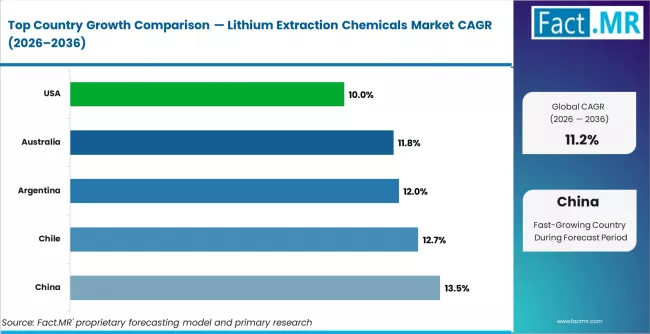
Lithium Extraction Chemicals Market Cagr Analysis By Country | Source: Fact.MR
Asia Pacific Lithium Extraction Chemicals Market
Asia Pacific remains the central processing hub of the global lithium value chain, with China anchoring integrated refining operations supported by domestic brine resources and imported Australian spodumene. Regional chemical consumption is closely linked to large-scale lithium carbonate and hydroxide production capacity.
- China: China records a CAGR of 13.5% through 2036, the highest globally. Its dominant role in processing Australian spodumene through acid roast and leach circuits sustains substantial chemical utilization. Policy direction from the Ministry of Industry and Information Technology continues to emphasize domestic lithium hydroxide capacity expansion, while ongoing investments by Ganfeng Lithium and Tianqi Lithium reinforce long-term reagent consumption across major processing hubs.
- Australia: Australia reflects a CAGR of 11.8% through 2036, driven by a structural shift toward downstream lithium processing. The transition from concentrate exports to in-country conversion increases reliance on acid leaching and neutralization reagents. Expansion projects such as Pilbara Minerals’ P680 and the Wodgina restart, supported by incentives under the Critical Minerals Strategy 2030, continue to strengthen domestic lithium chemical infrastructure.
Fact.MR analysis indicates that Asia Pacific will remain the dominant lithium extraction chemicals hub, driven by integrated refining capacity, strong policy backing, and sustained spodumene-to-chemical conversion demand.
Latin America Lithium Extraction Chemicals Market
Latin America serves as the global center for lithium brine extraction, with Chile and Argentina driving regional chemical consumption across large-scale salar operations.
- Chile: Chile registers a CAGR of 12.7% through 2036, supported by its control over the Atacama Salar, the world’s largest proven lithium brine reserve. The National Lithium Strategy increases state participation in downstream processing, resulting in higher in-country chemical utilization. Expansion investments by SQM and public funding for advanced extraction technologies continue to shape evolving reagent requirements.
- Argentina: Argentina records a CAGR of 12.0% through 2036, supported by rapid project development across the Lithium Triangle in Jujuy and Salta. Expansion activities by Livent and large-scale investments under the RIGI incentive regime strengthen long-term chemical procurement pipelines, with multiple projects progressing toward commercial-scale operations.
FACT.MR's analysis of the lithium extraction chemicals market in Latin America consists of country-wise assessment including Chile, Argentina, Brazil, and Bolivia. Readers can find National Lithium Strategy procurement data, Lithium Triangle project pipeline analysis, and brine extraction chemical volume forecasts.
North America Lithium Extraction Chemicals Market
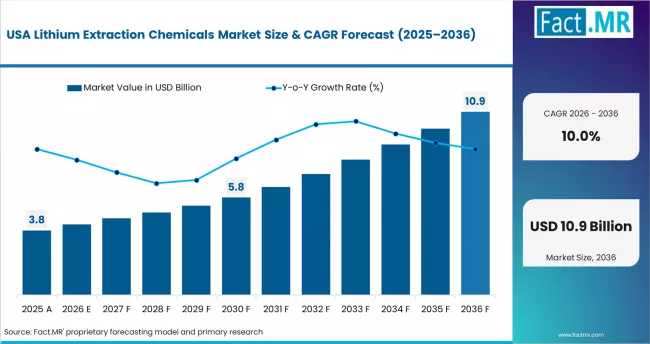
Lithium Extraction Chemicals Market Country Value Analysis | Source: Fact.MR
North America is advancing toward domestic lithium production, supported by policy incentives and new project development.
- United States: The United States reflects a CAGR of 10.0% through 2036. Federal incentives under the Inflation Reduction Act support refinery and extraction project development, strengthening domestic supply chains. Large-scale developments such as Thacker Pass and the ongoing transition of Silver Peak toward direct lithium extraction contribute to sustained chemical consumption across emerging operations.
FACT.MR's analysis of the lithium extraction chemicals market in North America consists of country-wise assessment including the United States, Canada, and Mexico. Readers can find IRA policy impact analysis, DLE chemical adoption data, domestic refinery commissioning timelines, and lithium project pipeline procurement forecasts.
Competitive Aligners for Market Players
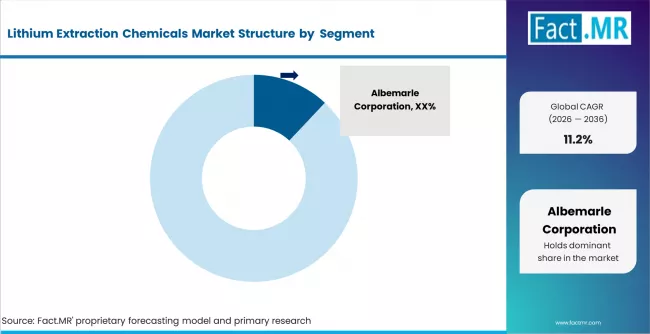
Lithium Extraction Chemicals Market Analysis By Company | Source: Fact.MR
The lithium extraction chemicals market exhibits a dual structure, with moderate fragmentation at the commodity level and increasing concentration within the specialty performance segment. Suppliers of conventional acids and alkalis, including BASF, Solvay, and Albemarle Chemicals, primarily compete on pricing efficiency and supply reliability, particularly for high-volume brine processing operations. In contrast, specialty extractant and direct lithium extraction (DLE) sorbent providers maintain differentiated positioning through proprietary chemistries that have been validated at commercial scale. As a result, competitive dynamics are shifting away from volume-based supply toward performance-driven criteria aligned with battery-grade lithium specifications.
Sustained competitive advantage is increasingly linked to established relationships with lithium producers and the ability to deliver integrated reagent management solutions. Product lines such as BASF’s Ionquest, Solvay’s CYANEX series, and Chemours’ specialty reagents benefit from long-standing technical integration within operating facilities. These embedded positions create significant switching barriers, as any change in reagent formulation requires extensive requalification against plant performance benchmarks.
Vertical integration into reagent recovery and recycling services, particularly through models adopted by Albemarle and SQM, further reinforces supplier retention at large-scale operations. Procurement practices across the value chain are also evolving. Lithium producers and battery manufacturers are consolidating sourcing strategies, with companies such as CATL, LG Energy Solution, and Panasonic increasingly influencing upstream chemical specifications through offtake agreements. This integration extends quality requirements beyond lithium processors to chemical suppliers, elevating the importance of traceability and documentation. While dual sourcing strategies remain in place to mitigate supply risk, they simultaneously raise qualification standards, favoring globally established suppliers with comprehensive technical support capabilities.
Key Players
- Albemarle Corporation
- Arcadium Lithium
- Ganfeng Lithium
- IGO Limited
- Lithium Americas Corp.
- Mineral Resources Limited
- Pilbara Minerals
- SQM (Sociedad Química y Minera de Chile)
- Tianqi Lithium
- Zijin Mining Group
Bibliography
- [2] Albemarle Corporation. (2024). 2024 Sustainability Report: Battery-Grade Lithium Purity Specifications and Extraction Chemical Reagent Investment at La Negra and Silver Peak Operations. 2024. albemarle.com
- [3] CORFO (Corporación de Fomento de la Producción). (2024). National Lithium Strategy Operational Update: SQM Contract Renegotiation Terms, In-Country Processing Value-Addition Mandates, and Lithium Technology Development Programme Funding. 2024. corfo.cl
- [4] Lilac Solutions Inc. (2024). DLE Technology Scale-Up Report: Ion-Selective Sorbent Pilot Performance at 2,000 Tonne/Year Equivalent Brine Processing Throughput. Q4 2024. lilacsolutions.com
- [5] BASF SE. (2024). Ionquest Lithium Extractant Production Expansion: Ludwigshafen Capacity Increase Targeting Lithium Triangle Brine Operators. Q3 2024. basf.com
- [6] Solvay SA. (2025). Aliquat 336S Reformulation Launch: Improved Selectivity for DLE-Adjacent Solvent Wash Circuits in Hard Rock and Brine Lithium Processing. January 2025. solvay.com
- [7] Atacama Water Authority (DGA Chile). (2024). Brine Extraction Environmental Compliance Report: Closed-Loop Solvent Recovery Requirements for Atacama Lithium Operations Under Updated Environmental Standards. 2024. dga.cl
- [8] SQM (Sociedad Química y Minera de Chile). (2024). Annual Report 2024: USD 1.6 Billion Atacama Brine Processing Capacity Expansion Investment Plan and Lithium Chemical Production Targets. 2024. sqm.com
- [9] Lilac Solutions Inc. (2024). Series B Funding Announcement: USD 145 Million Raised for Commercial-Scale DLE Ion Exchange Sorbent Technology Deployment at Brine Lithium Projects. 2024. lilacsolutions.com
- [10] Roskill Information Services. (2024). Lithium Extraction Technology Market Update: Ion Exchange Resin Adoption Trends at South American Brine Projects and Hybrid Process Configuration Assessment. 2024. roskill.com
This Report Addresses
- Strategic insights across Lithium Triangle brine operations, Australian spodumene conversion, U.S. IRA-driven refinery expansion, China’s integrated processing, and DLE commercialization
- Market outlook from USD 6.7 billion in 2026 to USD 19.6 billion by 2036, reflecting an 11.2% CAGR
- Opportunity assessment in DLE-compatible reagents, Latin American brine expansion, U.S. refinery procurement, and battery-grade compliant chemical supply
- Segment analysis by chemical type, extraction method, and application across key lithium processing routes
- Regional coverage spanning Latin America brine pipelines, Asia Pacific processing scale-up, and North America domestic production growth
- Competitive benchmarking of leading players including Albemarle, Arcadium Lithium, Ganfeng, SQM, Tianqi, and Zijin based on performance and purity standards
- Regulatory analysis covering Chile’s National Lithium Strategy, U.S. IRA provisions, Australia’s Critical Minerals Strategy, and global battery-grade specifications
- Report delivery in PDF, Excel datasets, and presentation formats supported by primary interviews, producer capital expenditure disclosures.
Lithium Extraction Chemicals Market Definition
The lithium extraction chemicals market covers solvents, extractants, acids, alkalis, and specialty reagents used in the hydrometallurgical and direct extraction processing of lithium from brine deposits and hard rock spodumene ore.
Lithium Extraction Chemicals Market Inclusions
Includes global and regional forecasts from 2026 to 2036 segmented by chemical type, extraction method, and application. Covers solvents, extractants, acids, and alkalis used in brine and hard rock lithium extraction. Regional analysis spans North America, Europe, Asia Pacific, Latin America, and Middle East and Africa.
Lithium Extraction Chemicals Market Exclusions
Excludes downstream battery-grade lithium carbonate and lithium hydroxide product sales, mechanical ore concentration equipment, and brine evaporation pond infrastructure. Omits lithium recycling chemicals from spent battery streams and non-lithium battery cathode processing reagents.
Lithium Extraction Chemicals Research Methodology
- Primary Research: Interviews with extraction chemical suppliers, lithium processing plant operators, and procurement heads at EV battery manufacturers across Chile, Australia, China, and the United States.
- Desk Research: Uses Chile CORFO lithium policy data, U.S. DOE critical minerals reports, Australian CSIRO extraction technology assessments, and company annual reports from 2024 to 2025.
- Market-Sizing and Forecasting: Hybrid model integrating top-down lithium project pipeline capacity with bottom-up chemical reagent consumption estimates by extraction method and application type.
- Data Validation and Update Cycle: Validated using producer revenues, plant commissioning data, and regulatory procurement records. Cross-checked with critical minerals databases. Updated regularly.
Segmentation
Scope of Report
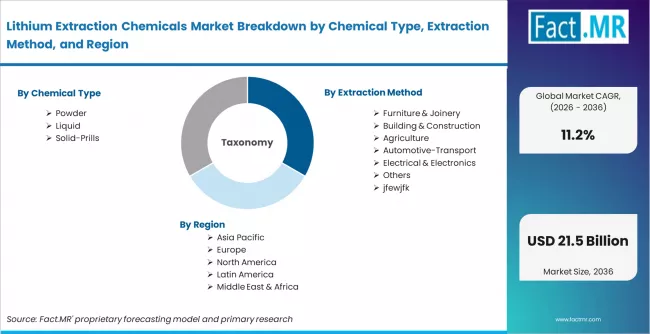
Lithium Extraction Chemicals Market Breakdown By Chemical Type, Extraction Method, And Region | Source: Fact.MR
| Attribute | Details |
|---|---|
| Quantitative Units | USD 6.7 billion (2026) to USD 19.6 billion (2036), at a CAGR of 11.2% |
| Market Definition | Market covers solvents, extractants, acids, alkalis, and specialty reagents used in brine and hard rock lithium extraction processes to produce battery-grade lithium carbonate and hydroxide. |
| Chemical Type Segmentation | Solvents & Extractants, Acids, Alkalis, Others |
| Extraction Method Segmentation | Solvent Extraction, Ion Exchange, Precipitation, Direct Lithium Extraction (DLE) |
| Application Coverage | Brine extraction, hard rock (spodumene) processing, and other lithium source applications. |
| Regions Covered | North America, Europe, Asia Pacific, Latin America, Middle East and Africa |
| Countries Covered | USA, Canada, Mexico, Germany, UK, France, Italy, Spain, Nordic, BENELUX, China, Japan, South Korea, India, Australia, ASEAN, Brazil, Chile, Argentina, Saudi Arabia, GCC, Turkey, South Africa, Rest of MEA |
| Key Companies Profiled | Albemarle Corporation, Arcadium Lithium, Ganfeng Lithium, IGO Limited, Lithium Americas Corp., Mineral Resources Limited, Pilbara Minerals, SQM, Tianqi Lithium, Zijin Mining Group |
| Forecast Period | 2026 to 2036 |
| Approach | Hybrid top-down and bottom-up model using lithium project capacity pipelines, reagent consumption ratios by extraction method, battery-grade specification procurement data, and primary interviews with chemical suppliers and lithium plant operators. |
Source: Fact.MR analysis. Updated Apr 15, 2026
Lithium Extraction Chemicals Market by Segments
-
By Chemical Type:
- Solvents & Extractants
- Acids
- Alkalis
- Others
-
By Extraction Method:
- Solvent Extraction
- Ion Exchange
- Precipitation
- Direct Lithium Extraction (DLE)
-
By Application:
- Brine Extraction
- Hard Rock (Spodumene)
- Others
-
By Region:
- North America
- United States
- Canada
- Mexico
- Latin America
- Brazil
- Chile
- Argentina
- Bolivia
- Rest of Latin America
- Western Europe
- Germany
- United Kingdom
- France
- Italy
- Spain
- Nordic Countries
- BENELUX
- Rest of Western Europe
- Eastern Europe
- Russia
- Poland
- Hungary
- Balkan and Baltic
- Rest of Eastern Europe
- East Asia
- China
- Japan
- South Korea
- South Asia and Pacific
- India
- Australia
- ASEAN
- Rest of South Asia and Pacific
- Middle East and Africa
- Kingdom of Saudi Arabia
- Other GCC Countries
- Turkey
- South Africa
- Rest of Middle East and Africa
- North America
Frequently Asked Questions
How large is the global lithium extraction chemicals market in 2025?
What will the global lithium extraction chemicals market size be by 2036?
What is the expected CAGR for the lithium extraction chemicals market from 2026 to 2036?
Which chemical type segment is poised to lead the market?
Which extraction method holds the largest share?
Which application segment holds the largest share?
How significant is Asia Pacific in the global lithium extraction chemicals market?
Which country shows the fastest growth?
How are battery manufacturers influencing chemical procurement?
What role do government policies play in market expansion?
Which chemical types are most widely used in lithium extraction?
How is the competitive landscape evolving?
What challenges do suppliers face in this market?
Why is supplier validation critical in lithium processing?
What opportunities exist for new entrants?
Who worked on this report


Preview the report firsthand - request a free sample
Free SampleGet the brochure for pricing and purchase details
Download PDF