The Low-Smoke Low-Toxicity Flame Retardants Market is analyzed across its key product, application and end-use segments, with the study covering market dynamics, regional trends and demand outlook, forecast 2026 to 2036.
By Fact.MR Chemical & Materials DeskLead analyst:
S.N. JhaPublished :
Updated :
11 min read
Fact-checked under the Fact.MR editorial process
Low-Smoke Low-Toxicity Flame Retardants Market Forecast and Outlook 2026 to 2036
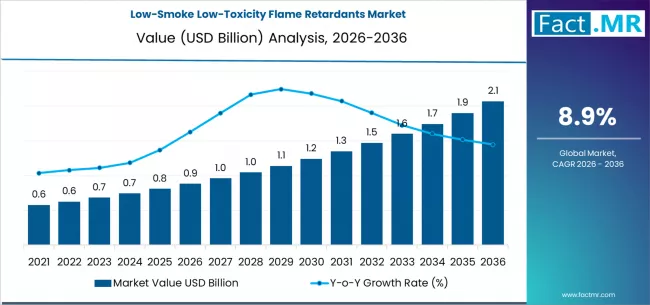
The global market for low-smoke, low-toxicity (LSLT) flame retardants, valued at an estimated USD 0.88 billion in 2026, is projected to more than double, reaching USD 2.06 billion by 2036, progressing at an 8.9% CAGR. The market is entering a period of accelerated transformation, propelled by a fundamental shift in safety paradigms across industries.
Summary of Low-Smoke Low-Toxicity Flame Retardants Market
Market Snapshot
Global low-smoke low-toxicity (LSLT) flame retardants market revenue stood at USD 0.88 billion in 2026 and is forecast to reach USD 2.06 billion by 2036.
At an 8.9%CAGRfrom 2026 to 2036, this market is entering a period of accelerated transformation driven by a fundamental shift in safety paradigms.
Growth is driven by the global proliferation and tightening of safety standards that explicitly limit smoke density and toxicity in mass transit, aerospace, marine, and public buildings.
The market is evolving beyond the singular goal of preventing ignition to demand solutions that minimize smoke opacity and toxic fume generation for enhanced occupant survivability.
Demand and Growth Drivers
Global proliferation and tightening of enforceable safety standards likeEN45545, IMO FTP Code, and FAA requirements that explicitly limit smoke density and toxicity.
Growing public awareness and liability litigation following fire tragedies push architects, OEMs, and operators to adopt the highest available safety technologies.
Trend toward sustainable construction and green building certificationsfavorsnon-halogenated, lower-toxicity solutions.
Development of bio-based and renewable raw material sources for flame retardant synthesis is aligningLSLTchemistry with circular economy goals.
Market is seeing a rise in tailored solutions for high-performance engineering plastics used in electric vehicles and miniaturized electronics, where space constraints demand ultra-efficient additives.
Product and Segment View
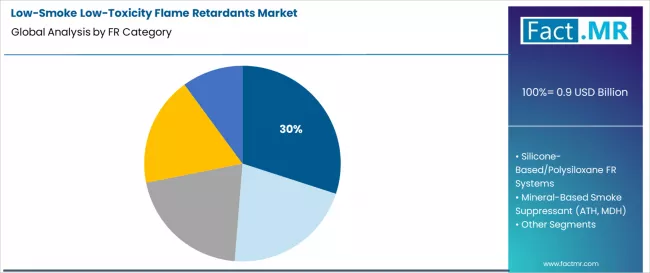
Phosphorus-Based Smoke-SuppressionFRslead the FR Category segment with a 30.0% market share in 2026, valued for their char-forming mechanism that simultaneously insulates material and reduces flammable volatiles.
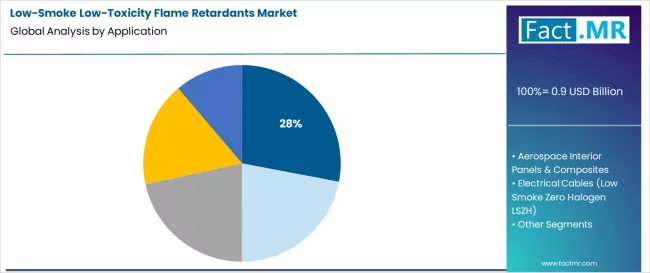
Rail & Metro Interior Materials (EN45545) leads the Application segment with a 28.0% share in 2026, driven by mandatory compliance with one of the world's most stringent fire safety standards.
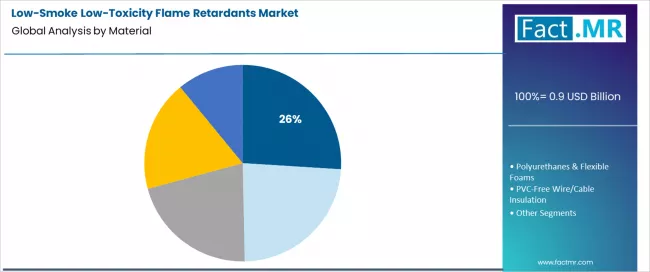
Thermoset Composites (Epoxy, Phenolic) lead the Material segment with a 26% share in 2026, as the substrate most widely used across the very applications demandingLSLTadditives.
Additional segments include Silicone-Based/PolysiloxaneFR Systems, Mineral-BasedATH/MDH, Metal Complex Smoke Reducers, Hybrid Intumescent Coatings, and Aerospace,LSZHCable, and Marine applications.
Geography and Competitive Outlook
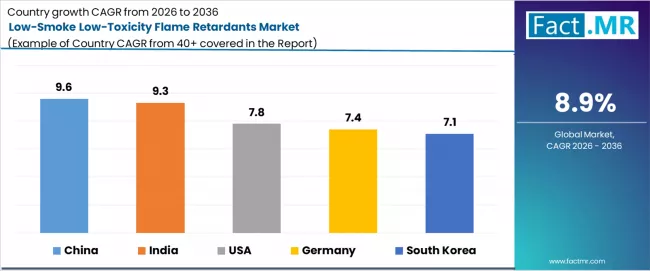
China (9.60%CAGR), India (9.30%), USA (7.80%), Germany (7.40%), and South Korea (7.10%) are the key growth countries across this market.
East Asia, South Asia & Pacific, North America, and Western Europe are primary regional markets, driven by metro/HSRexpansion, aviation growth, and building safety regulation.
Market expansion is closely tied to urban transit investment, aerospace OEM activity, offshore and cruise ship construction, and public building fire code modernization.
Key companies active in this market includeClariantAG,LanxessAG,FRXInnovations, BASF SE, and Huber Engineered Materials.
Low-Smoke Low-Toxicity Flame Retardants Market — At a Glance
Attribute
Details
Market Value 2026
USD 0.88 Billion
Market Value 2036
USD 2.06 Billion
Absolute Dollar Opportunity 2026-2036
USD 1.18 Billion
Total Growth 2026-2036
134%
CAGR2026-2036
8.9%
Growth Multiple
2.3x
Key Demand Theme
Regulatory-driven shift to advancedLSLTflame retardant chemistries for mass transit, aerospace, marine, and public infrastructure that minimize smoke density and toxic combustion gases
Leading Segment by FR Category (2026)
Phosphorus-Based Smoke-SuppressionFRs
FR Category Segment Share (2026)
30.0%
Leading Segment by Application (2026)
Rail & Metro Interior Materials (EN45545)
Application Segment Share (2026)
28.0%
Leading Segment by Material (2026)
Thermoset Composites (Epoxy, Phenolic)
Material Segment Share (2026)
26%
Key Growth Regions
East Asia, South Asia & Pacific, North America, Western Europe
CountryCAGRs
China 9.60%, India 9.30%, USA 7.80%, Germany 7.40%, South Korea 7.10%
Top Companies
ClariantAG,LanxessAG,FRXInnovations, BASF SE, Huber Engineered Materials
Segmentation by FR Category
Phosphorus-Based, Silicone-Based/Polysiloxane, Mineral-Based (ATH,MDH), Metal Complex, Hybrid Intumescent
Segmentation by Application
Rail & Metro (EN45545), Aerospace Interiors, Electrical Cables (LSZH), Public Buildings, Marine (IMOFTPC)
North America, Latin America, Western Europe, Eastern Europe, East Asia, South Asia & Pacific, MEA
Source: Fact.MR analysis. Updated Apr 14, 2026
Moving beyond the singular goal of preventing ignition, modern material specifications demand solutions that minimize smoke opacity and toxic fume generation during a fire event, directly enhancing occupant survivability and egress. Phosphorus-based smoke-suppression flame retardants currently represent the most adopted category, commanding a 30% market share. Their prominence is linked to a favorable balance of fire performance and reduced environmental impact. The application segment for rail and metro interior materials, governed by stringent standards like EN 45545, leads with a 28% share, highlighting the critical role of these retardants in enclosed public transport systems. Among material substrates, thermoset composites such as epoxy and phenolic resins account for 26% of demand, favored for their inherent stability and the performance enhancement offered by advanced LSLT additives. Expansion is fundamentally driven by an escalating regulatory and specification framework that prioritizes human safety over pure fire resistance. Standards for mass transit, aerospace, marine vessels, and public buildings increasingly mandate the use of materials that produce lower smoke density and less toxic combustion gases. This regulatory push is compounded by rising insurance premiums and liability concerns for building and vehicle operators, making investments in advanced material safety economically prudent. The industry’s evolution is marked by a relentless pursuit of chemistries that deliver superior fire safety without compromising material processability, mechanical properties, or end-of-life environmental footprint.
Phosphorus-based smoke-suppression flame retardants lead this segment with a 30% share. Their dominance stems from a versatile mechanism of action that promotes char formation in the condensed phase, simultaneously insulating the material and reducing the release of flammable volatiles and smoke particles.
This chemistry is seen as a reliable drop-in solution for many polymer systems, offering an effective bridge between legacy halogenated systems and emerging novel technologies. Their ability to function across a range of polymers including epoxies, polyurethanes, and some engineering plastics secures their central role in formulation strategies.
By Application, Where is Demand Most Concentrated?
The development and manufacture of rail and metro interior materials generate the most significant demand, holding a 28% share. This is a direct consequence of the enforcement of the EN 45545 standard in Europe and its influence globally, which sets rigorous requirements for heat release, smoke opacity, and toxicity.
Every component must comply, creating a vast, specification-driven market. The high passenger density and underground operation of metro systems make smoke and toxicity management a non-negotiable safety priority, funneling consistent investment into advanced LSLT formulations.
By Material, Which Substrate Relies Heavily on LSLT Additives?
Low Smoke Low Toxicity Flame Retardants Market Analysis By Material | Source: Fact.MR
Thermoset composites, particularly epoxy and phenolic resins, represent the leading material segment with a 26% share. These composites are extensively used in the very applications driving LSLT demand: mass transit interiors, aerospace components, and electrical systems. Their cross-linked structure provides excellent thermal and dimensional stability, but modifying their fire behavior requires integrated additive solutions.
LSLT flame retardants are engineered to be incorporated during the composite manufacturing process without degrading the critical mechanical properties that make these materials desirable, creating a synergistic relationship between substrate and additive.
What are the Drivers, Restraints, and Key Trends of the Low-Smoke, Low-Toxicity Flame Retardants Market?
The primary market driver is the global proliferation and tightening of safety standards that explicitly limit smoke density and toxicity. Regulations like EN 45545, IMO FTP Code, and FAA requirements are moving from guidelines to enforceable mandates.
Growing public awareness and liability litigation following fire tragedies are pushing architects, OEMs, and operators to adopt the highest available safety technologies. The trend towards sustainable construction and green building certifications is also favoring non-halogenated, lower-toxicity solutions.
A key market restraint is the technical challenge of balancing multiple performance metrics. Achieving superior smoke and toxicity suppression can sometimes come at the cost of flame retardant efficacy, material mechanical strength, or processability.
Many high-performance LSLT solutions also carry a significant cost premium compared to conventional halogenated or even mineral-based retardants, which can deter adoption in highly price-sensitive segments. The lengthy and expensive testing and certification process for new materials, especially in aerospace and rail, can slow the commercialization of innovative chemistries.
Notable trends include the development of bio-based and renewable raw material sources for flame retardant synthesis, aligning with circular economy goals. There is significant innovation in multifunctional additive systems where a single agent provides flame retardancy, smoke suppression, and enhanced mechanical properties like toughness or UV stability.
The market is also seeing a rise in tailored solutions for high-performance engineering plastics used in electric vehicles and miniaturized electronics, where space constraints and high operating temperatures demand ultra-efficient additives.
Analysis of the Low-Smoke, Low-Toxicity Flame Retardants Market by Key Countries
Low Smoke Low Toxicity Flame Retardants Market Cagr Analysis By Country | Source: Fact.MR
Country
CAGR (2026-2036)
China
9.60%
India
9.30%
USA
7.80%
Germany
7.40%
South Korea
7.10%
Source: Fact.MR analysis. Updated Apr 14, 2026
How is China's Metro and HSR Expansion Fueling Demand?
China's leading CAGR of 9.60% is intrinsically linked to its unparalleled investment in urban metro systems and high-speed rail (HSR) networks. As hundreds of kilometers of new track and thousands of new rail cars are commissioned annually, domestic manufacturing must adhere to EN 45545-inspired national standards.
This creates a massive, sustained demand for certified interior materials and LSZH cables, with domestic chemical producers rapidly scaling up advanced phosphorus and mineral-based LSLT retardant production to supply this ecosystem.
What Drives Adoption in India's Modernizing Infrastructure?
India's 9.30% growth is powered by concurrent developments in urban metro projects, aviation expansion, and national initiatives for infrastructure modernization and fire safety in public buildings.
The growing technical capabilities of domestic compounders and a shift in procurement policies towards higher safety specifications are pulling advanced LSLT technologies into the market. India’s cost-sensitive environment also fosters innovation in optimizing additive loadings and developing cost-effective hybrid systems for a wide range of polymers.
Why Does the USA Represent a High-Value Innovation Market?
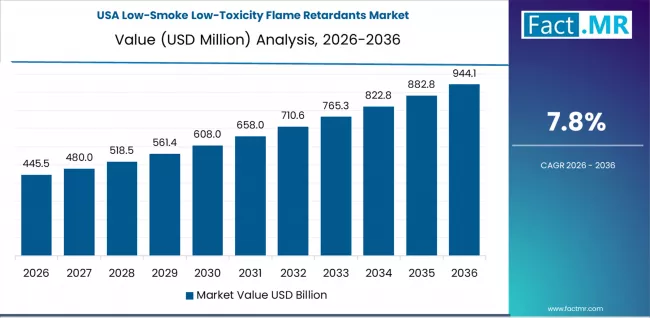
Low Smoke Low Toxicity Flame Retardants Market Country Value Analysis | Source: Fact.MR
The USA's 7.80% CAGR reflects a mature market where growth is driven by technological upgrades and stringent sector-specific regulations, particularly in aerospace (FAA) and evolving building codes for high-occupancy structures.
The presence of leading aerospace OEMs and a strong focus on litigation-driven risk mitigation pushes demand for the most advanced, performance-proven LSLT systems, especially silicone-based and specialized intumescent coatings for critical applications.
How Does Germany's Engineering Precision Influence the Market?
Germany's 7.40% growth underscores its role as the European hub for precision engineering, particularly in rail transportation. As the home of major rail OEMs and a strict enforcer of EN 45545, German material suppliers and chemical companies focus on ultra-high-performance, reliably certified solutions. The market demands precise data on toxicity profiles and long-term material durability, favoring suppliers with deep application engineering expertise and robust technical dossiers.
What is South Korea's Strategic Focus in this Market?
South Korea's 7.10% growth is anchored in its world-leading electronics and shipbuilding industries, both major consumers of engineering plastics and composite materials requiring advanced fire safety.
The need for LSLT solutions in high-performance plastics for consumer electronics, electric vehicle components, and sophisticated marine interiors drives demand for specialized, high-efficiency additive systems compatible with challenging polymer matrices.
Competitive Landscape of the Low-Smoke, Low-Toxicity Flame Retardants Market
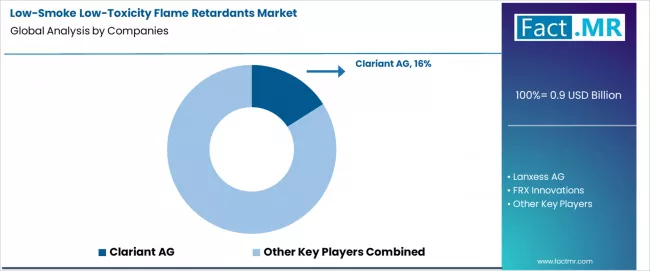
Low Smoke Low Toxicity Flame Retardants Market Analysis By Company | Source: Fact.MR
Established specialty chemical giants and agile innovators specializing in polymer additives define the competitive arena. Competition centers on proprietary molecular design, the ability to provide comprehensive formulation support, and a deep library of certification data for key applications like rail and aerospace.
Success hinges on collaborating directly with OEMs and compounders to solve specific material challenges, offering globally consistent quality, and navigating complex regulatory landscapes across different regions. Continuous R&D to improve the environmental profile and efficiency of LSLT systems is a critical battleground.
Key Players in the Low-Smoke, Low-Toxicity Flame Retardants Market
Clariant AG
Lanxess AG
FRX Innovations
BASF SE
Huber Engineered Materials
Market Breakdown
Segmentation
Scope of Report
Items
Values
Quantitative Units
USD Billion
FR Category
Phosphorus-Based, Silicone-Based, Mineral-Based, Metal Complex, Hybrid Intumescent
Application
Rail & Metro Interiors, Aerospace Interiors, Electrical Cables, Public Buildings, Marine Interiors
Comparative analysis of smoke generation mechanisms (condensed vs. gas phase); toxicity profiling of combustion gases; impact of LSLT additives on polymer processing and recyclability; cost-performance analysis across different chemistries; review of major global and regional fire safety standards.
Source: Fact.MR analysis. Updated Apr 14, 2026
Market by Segments
FR Category :
Phosphorus-Based Smoke-Suppression FRs
Silicone-Based/Polysiloxane FR Systems
Mineral-Based Smoke Suppressant (ATH, MDH)
Metal Complex Smoke Reducers (Zinc Borate, Antimony-Free)
Hybrid Low-Smoke Intumescent Coatings
Application :
Rail & Metro Interior Materials (EN 45545)
Aerospace Interior Panels & Composites
Electrical Cables (Low Smoke Zero Halogen LSZH)
Public Infrastructure & High-Occupancy Buildings
Marine & Cruise Ship Interiors (IMO FTPC)
Material :
Thermoset Composites (Epoxy, Phenolic)
Polyurethanes & Flexible Foams
PVC-Free Wire/Cable Insulation
Engineering Plastics (PEEK, PPS, PC)
Specialty Coatings & Intumescent Paints
Region :
North America
USA
Canada
Latin America
Brazil
Mexico
Argentina
Rest of Latin America
Western Europe
Germany
UK
France
Spain
Italy
BENELUX
Rest of Western Europe
Eastern Europe
Russia
Poland
Czech Republic
Rest of Eastern Europe
East Asia
China
Japan
South Korea
Rest of East Asia
South Asia & Pacific
India
ASEAN
Australia
Rest of South Asia & Pacific
MEA
Saudi Arabia
UAE
Turkiye
Rest of MEA
Questions Answered
Frequently Asked Questions
How big is the low-smoke low-toxicity flame retardants market in 2026?
The global low-smoke low-toxicity flame retardants market is estimated to be valued at USD 0.9 billion in 2026.
What will be the size of low-smoke low-toxicity flame retardants market in 2036?
The market size for the low-smoke low-toxicity flame retardants market is projected to reach USD 2.1 billion by 2036.
How much will be the low-smoke low-toxicity flame retardants market growth between 2026 and 2036?
The low-smoke low-toxicity flame retardants market is expected to grow at a 8.9% CAGR between 2026 and 2036.
What are the key product types in the low-smoke low-toxicity flame retardants market?
The key product types in low-smoke low-toxicity flame retardants market are phosphorus-based smoke-suppression frs, silicone-based/polysiloxane fr systems, mineral-based smoke suppressant (ath, mdh), metal complex smoke reducers (zinc borate, antimony-free) and hybrid low-smoke intumescent coatings.
Which application segment to contribute significant share in the low-smoke low-toxicity flame retardants market in 2026?
In terms of application, rail & metro interior materials (en 45545) segment to command 28.0% share in the low-smoke low-toxicity flame retardants market in 2026.