Halogen-Free Flame Retardant Systems Market
Halogen-Free Flame Retardant Systems Market Size and Share Forecast Outlook 2026 to 2036
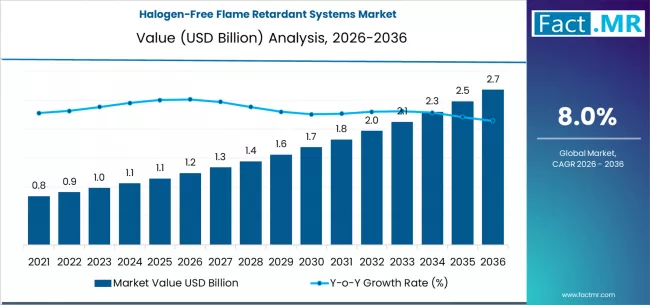
Halogen-free flame retardant systems market is projected to grow from USD 1.2 billion in 2026 to USD 2.7 billion by 2036, at a CAGR of 8.0%. Phosphorus-Based Flame Retardants (APP, DOPO, MELAM) will dominate with a 35.0% market share, while polyolefins (pp, pe) will lead the polymer type segment with a 28.0% share.
Halogen-Free Flame Retardant Systems Market Forecast and Outlook 2026 to 2036
The global market for halogen-free flame retardant systems is projected to reach USD 2.68 billion by 2036. With a starting value of USD 1.24 billion in 2026, the market is anticipated to progress at a CAGR of 8.0% during the forecast period.
Key Takeaways from the Halogen-Free Flame Retardant Systems Market
- Market Value for 2026: USD 1.24 Billion
- Market Value for 2036: USD 2.68 Billion
- Forecast CAGR (2026-2036): 8.0%
- Leading Chemistry Type Share (2026): Phosphorus-Based Flame Retardants (APP, DOPO, MELAM, etc.) (35%)
- Leading Polymer Type Share (2026): Polyolefins (PP, PE) (28%)
- Leading End-Use Industry Share (2026): Electrical & Electronics (28%)
- Key Players in the Market: Clariant AG, Lanxess AG, BASF SE, ICL Group, Adeka Corporation
Phosphorus-based flame retardants, including ammonium polyphosphate and DOPO derivatives, lead the market by chemistry type with a 35% share. Among polymer substrates, polyolefins such as polypropylene and polyethylene constitute the largest segment at 28%. The electrical and electronics industry is the dominant end-user, accounting for 28% of total demand.
This growth trajectory is driven by stringent global regulations phasing out halogenated compounds due to toxicity concerns associated with their smoke and combustion by-products. Increasing safety standards across industries, coupled with consumer and brand preferences for environmentally safer materials, are accelerating the shift toward halogen-free alternatives. These systems are essential for meeting fire safety codes while addressing environmental and health impact criteria.
Halogen-free flame retardants function primarily through condensed-phase mechanisms like char formation or through endothermic reactions, cooling the substrate. Their development focuses on achieving high flame retardant efficacy at optimal loadings, maintaining the mechanical and processing properties of the base polymer, and improving thermal stability to meet the demands of high-performance applications.
Metric
| Metric | Value |
|---|---|
| Market Value (2026) | USD 1.24 Billion |
| Market Forecast Value (2036) | USD 2.68 Billion |
| Forecast CAGR (2026-2036) | 8.0% |
Category
| Category | Segments |
|---|---|
| Chemistry Type | Phosphorus-Based (APP, DOPO, MELAM), Mineral-Based (ATH, MDH), Nitrogen-Based (MEL, MCA), Inorganic Hydroxide Blends, Other Halogen-Free Hybrid Systems |
| Polymer Type | Polyolefins (PP, PE), Engineering Plastics (PC, PA, PBT, PPS), Epoxy & Polyurethane Systems, PVC (Flexible & Rigid), Rubber & Elastomers |
| End-Use Industry | Electrical & Electronics, Construction & Building Materials, Automotive & Transportation, Textiles & Furnishing, Aerospace, Energy & Industrial |
| Region | North America, Latin America, Western Europe, Eastern Europe, East Asia, South Asia & Pacific, MEA |
Segmental Analysis
By Chemistry Type, Which Segment is the Most Prevalent?

Phosphorus-based flame retardants lead the market with a 35% share. Their dominance is attributed to a favorable balance of efficacy, versatility across polymers, and relatively lower loading requirements compared to mineral fillers.
They operate effectively in both the condensed and gas phases, promoting char formation that insulates the underlying material. Their compatibility with engineering plastics and epoxy systems used in electronics and automotive applications solidifies their central role.
By Polymer Type, Which Substrate Demands the Highest Volume?

Polyolefins, particularly polypropylene and polyethylene, represent the largest polymer segment at 28%. These high-volume commodity plastics are ubiquitous in applications ranging from electrical casings and automotive interiors to construction films.
Their inherent flammability creates a substantial, consistent demand for flame retardant additives. The technical challenge lies in incorporating effective halogen-free systems into these polymers without severely compromising their mechanical properties or processability.
By End-Use Industry, Which Sector Drives Technical Innovation?
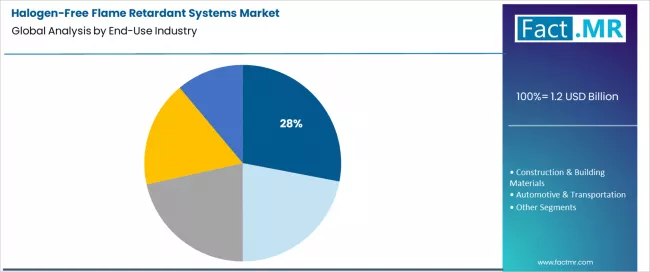
The electrical and electronics industry generates the most significant demand, holding a 28% share. This sector requires flame retardancy for safety in devices, wiring, circuit boards, and enclosures. The miniaturization of electronics and the trend towards high-power density devices generate more heat, elevating fire risks.
Regulations like the EU's RoHS and consumer electronics safety standards push for halogen-free solutions that also meet critical requirements for dielectric properties, thermal management, and dimensional stability.
What are the Drivers, Restraints, and Key Trends of the Halogen-Free Flame Retardant Systems Market?
The principal market driver is the expanding global regulatory landscape restricting halogenated flame retardants, particularly brominated and chlorinated types, in electronics, construction, and transportation. Sustainability initiatives from OEMs and growing end-user awareness about toxic smoke inhalation risks further propel adoption. The demand for lighter, high-performance materials in electric vehicles and next-generation electronics also favors advanced halogen-free systems compatible with engineering plastics.
A key market restraint is the often higher cost and required loading levels of halogen-free alternatives compared to their halogenated counterparts. Achieving required fire safety ratings such as the UL94 V-0 can necessitate significant additive loadings, which may adversely affect polymer mechanical properties, density, and processability. Formulation complexity and the need for precise synergist combinations to achieve efficiency can also pose technical hurdles for compounders.
Major trends include the development of synergistic blends combining phosphorus, nitrogen, and mineral components to enhance performance at lower total loadings. Innovation is strong in surface-treated and nano-sized mineral fillers like ATH and MDH to improve dispersion and polymer compatibility. Intumescent systems, which expand to form insulating char, are seeing advanced development for coatings and engineering plastics. There is also a growing focus on bio-based or recycled content within flame retardant chemistries to improve the overall sustainability profile of the finished product.
Analysis of the Halogen-Free Flame Retardant Systems Market by Key Countries
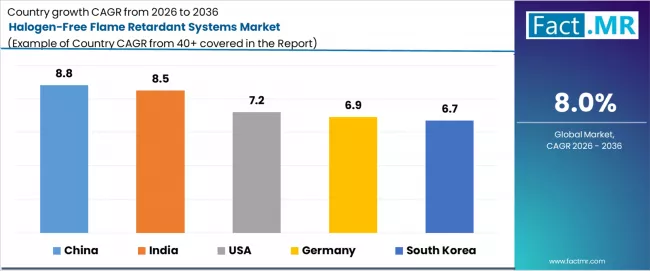
| Country | CAGR (2026-2036) |
|---|---|
| China | 8.80% |
| India | 8.50% |
| USA | 7.20% |
| Germany | 6.90% |
| South Korea | 6.70% |
How do China's Manufacturing and Regulatory Updates Fuel Growth?
China's leading CAGR of 8.80% is driven by its position as the world's primary manufacturer of electronics and consumer goods. Evolving national standards that align with international halogen-free trends, particularly for exports, compel domestic producers to adopt these systems. Massive investment in new energy vehicles and 5G infrastructure creates fresh demand for flame-retardant engineering plastics and compounds.
What is the Impact of India's Expanding Electronics and Automotive Production?
The Make in India initiative and rapidly growing domestic electronics, appliance, and automotive markets underpin India’s 8.50% growth. Increasing adoption of international safety standards by domestic manufacturers and rising foreign investment in production facilities are accelerating the shift from cheaper halogenated systems to compliant halogen-free alternatives to access global supply chains.
How Does the USA's Regulatory and Litigation Environment Shape the Market?

The USA's 7.20% CAGR is supported by strict state-level regulations (e.g., California TB117-2013 for furniture), federal aviation rules, and voluntary industry bans on halogenated compounds by major electronics brands.
The threat of litigation over toxic smoke exposure continues to drive specification changes in public transportation, construction, and consumer product sectors toward halogen-free solutions.
Why is Germany a Hub for High-Performance Engineering Solutions?
Germany's 6.90% growth reflects its leadership in high-end automotive engineering, industrial machinery, and chemical innovation. German OEMs demand flame retardant systems that meet the most stringent EU regulations while preserving the critical performance of engineering plastics used under the hood and in vehicle interiors, fostering a market for advanced, polymer-specific formulations.
How is South Korea's Flagship Electronics Industry Influencing Formulations?
South Korea's 6.70% growth is closely tied to its global electronics giants. The demand for thinner, lighter, and more powerful devices requires halogen-free flame retardants that offer exceptional performance at low loadings to avoid interfering with device design, heat dissipation, and signal integrity, driving innovation in ultra-efficient phosphorus and nitrogen synergists.
Competitive Landscape of the Halogen-Free Flame Retardant Systems Market
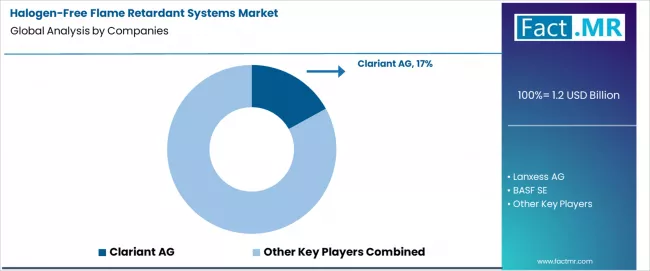
Global specialty chemical companies with deep expertise in additive and polymer chemistry define the competitive landscape. Leaders like Clariant, Lanxess, and BASF compete on the strength of their broad portfolios, which cover multiple halogen-free chemistries to serve diverse polymer families.
Competition centers on providing integrated solutions that include synergists and processing aids, delivering robust technical data for specific regulatory certifications, and offering co-development services for custom compound formulations. A key strategic focus is on developing systems that align with circular economy principles, such as compatibility with polymer recycling streams.
Key Players in the Halogen-Free Flame Retardant Systems Market
- Clariant AG
- Lanxess AG
- BASF SE
- ICL Group
- Adeka Corporation
Scope of Report
| Items | Values |
|---|---|
| Quantitative Units | USD Billion |
| Chemistry Type | Phosphorus-Based, Mineral-Based, Nitrogen-Based, Inorganic Blends, Hybrid Systems |
| Polymer Type | Polyolefins, Engineering Plastics, Epoxy & PU, PVC, Rubber |
| End-Use Industry | Electrical & Electronics, Construction, Automotive, Textiles, Aerospace & Industrial |
| Key Countries | China, India, USA, Germany, South Korea |
| Key Companies | Clariant AG, Lanxess AG, BASF SE, ICL Group, Adeka Corporation |
| Additional Analysis | Analysis of synergistic effects between chemistries; impact on polymer mechanical/electrical properties; regulatory landscape for specific applications (wire & cable, electronics, building); smoke density and toxicity testing; end-of-life considerations and recyclability. |
Market by Segments
-
Chemistry Type :
- Phosphorus-Based Flame Retardants (APP, DOPO, MELAM)
- Mineral-Based (ATH, MDH - high loading)
- Nitrogen-Based Flame Retardants (MEL, MCA)
- Inorganic Hydroxide Blends
- Other Halogen-Free Hybrid Systems
-
Polymer Type :
- Polyolefins (PP, PE)
- Engineering Plastics (PC, PA, PBT, PPS)
- Epoxy & Polyurethane Systems
- PVC (Flexible & Rigid)
- Rubber & Elastomers
-
End-Use Industry :
- Electrical & Electronics
- Construction & Building Materials
- Automotive & Transportation
- Textiles & Furnishing
- Aerospace, Energy & Industrial
-
Region :
- North America
- USA
- Canada
- Latin America
- Brazil
- Mexico
- Argentina
- Rest of Latin America
- Western Europe
- Germany
- UK
- France
- Spain
- Italy
- BENELUX
- Rest of Western Europe
- Eastern Europe
- Russia
- Poland
- Czech Republic
- Rest of Eastern Europe
- East Asia
- China
- Japan
- South Korea
- Rest of East Asia
- South Asia & Pacific
- India
- ASEAN
- Australia
- Rest of South Asia & Pacific
- MEA
- Saudi Arabia
- UAE
- Turkiye
- Rest of MEA
- North America
Table of Content
- Executive Summary
- Global Market Outlook
- Demand to side Trends
- Supply to side Trends
- Technology Roadmap Analysis
- Analysis and Recommendations
- Market Overview
- Market Coverage / Taxonomy
- Market Definition / Scope / Limitations
- Market Background
- Market Dynamics
- Drivers
- Restraints
- Opportunity
- Trends
- Scenario Forecast
- Demand in Optimistic Scenario
- Demand in Likely Scenario
- Demand in Conservative Scenario
- Opportunity Map Analysis
- Product Life Cycle Analysis
- Supply Chain Analysis
- Investment Feasibility Matrix
- Value Chain Analysis
- PESTLE and Porter’s Analysis
- Regulatory Landscape
- Regional Parent Market Outlook
- Production and Consumption Statistics
- Import and Export Statistics
- Market Dynamics
- Global Market Analysis 2021 to 2025 and Forecast, 2026 to 2036
- Historical Market Size Value (USD Million) Analysis, 2021 to 2025
- Current and Future Market Size Value (USD Million) Projections, 2026 to 2036
- Y to o to Y Growth Trend Analysis
- Absolute $ Opportunity Analysis
- Global Market Pricing Analysis 2021 to 2025 and Forecast 2026 to 2036
- Global Market Analysis 2021 to 2025 and Forecast 2026 to 2036, By Chemistry Type
- Introduction / Key Findings
- Historical Market Size Value (USD Million) Analysis By Chemistry Type, 2021 to 2025
- Current and Future Market Size Value (USD Million) Analysis and Forecast By Chemistry Type, 2026 to 2036
- Phosphorus-Based Flame Retardants (APP, DOPO, MELAM)
- Mineral-Based (ATH, MDH - high loading)
- Nitrogen-Based Flame Retardants (MEL, MCA)
- Inorganic Hydroxide Blends
- Other Halogen-Free Hybrid Systems
- Phosphorus-Based Flame Retardants (APP, DOPO, MELAM)
- Y to o to Y Growth Trend Analysis By Chemistry Type, 2021 to 2025
- Absolute $ Opportunity Analysis By Chemistry Type, 2026 to 2036
- Global Market Analysis 2021 to 2025 and Forecast 2026 to 2036, By Polymer Type
- Introduction / Key Findings
- Historical Market Size Value (USD Million) Analysis By Polymer Type, 2021 to 2025
- Current and Future Market Size Value (USD Million) Analysis and Forecast By Polymer Type, 2026 to 2036
- Polyolefins (PP, PE)
- Engineering Plastics (PC, PA, PBT, PPS)
- Epoxy & Polyurethane Systems
- PVC (Flexible & Rigid)
- Rubber & Elastomers
- Polyolefins (PP, PE)
- Y to o to Y Growth Trend Analysis By Polymer Type, 2021 to 2025
- Absolute $ Opportunity Analysis By Polymer Type, 2026 to 2036
- Global Market Analysis 2021 to 2025 and Forecast 2026 to 2036, By End-Use Industry
- Introduction / Key Findings
- Historical Market Size Value (USD Million) Analysis By End-Use Industry, 2021 to 2025
- Current and Future Market Size Value (USD Million) Analysis and Forecast By End-Use Industry, 2026 to 2036
- Electrical & Electronics
- Construction & Building Materials
- Automotive & Transportation
- Textiles & Furnishing
- Aerospace, Energy & Industrial
- Electrical & Electronics
- Y to o to Y Growth Trend Analysis By End-Use Industry, 2021 to 2025
- Absolute $ Opportunity Analysis By End-Use Industry, 2026 to 2036
- Global Market Analysis 2021 to 2025 and Forecast 2026 to 2036, By Region
- Introduction
- Historical Market Size Value (USD Million) Analysis By Region, 2021 to 2025
- Current Market Size Value (USD Million) Analysis and Forecast By Region, 2026 to 2036
- North America
- Latin America
- Western Europe
- Eastern Europe
- East Asia
- South Asia and Pacific
- Middle East & Africa
- Market Attractiveness Analysis By Region
- North America Market Analysis 2021 to 2025 and Forecast 2026 to 2036, By Country
- Historical Market Size Value (USD Million) Trend Analysis By Market Taxonomy, 2021 to 2025
- Market Size Value (USD Million) Forecast By Market Taxonomy, 2026 to 2036
- By Country
- USA
- Canada
- Mexico
- By Chemistry Type
- By Polymer Type
- By End-Use Industry
- By Country
- Market Attractiveness Analysis
- By Country
- By Chemistry Type
- By Polymer Type
- By End-Use Industry
- Key Takeaways
- Latin America Market Analysis 2021 to 2025 and Forecast 2026 to 2036, By Country
- Historical Market Size Value (USD Million) Trend Analysis By Market Taxonomy, 2021 to 2025
- Market Size Value (USD Million) Forecast By Market Taxonomy, 2026 to 2036
- By Country
- Brazil
- Chile
- Rest of Latin America
- By Chemistry Type
- By Polymer Type
- By End-Use Industry
- By Country
- Market Attractiveness Analysis
- By Country
- By Chemistry Type
- By Polymer Type
- By End-Use Industry
- Key Takeaways
- Western Europe Market Analysis 2021 to 2025 and Forecast 2026 to 2036, By Country
- Historical Market Size Value (USD Million) Trend Analysis By Market Taxonomy, 2021 to 2025
- Market Size Value (USD Million) Forecast By Market Taxonomy, 2026 to 2036
- By Country
- Germany
- UK
- Italy
- Spain
- France
- Nordic
- BENELUX
- Rest of Western Europe
- By Chemistry Type
- By Polymer Type
- By End-Use Industry
- By Country
- Market Attractiveness Analysis
- By Country
- By Chemistry Type
- By Polymer Type
- By End-Use Industry
- Key Takeaways
- Eastern Europe Market Analysis 2021 to 2025 and Forecast 2026 to 2036, By Country
- Historical Market Size Value (USD Million) Trend Analysis By Market Taxonomy, 2021 to 2025
- Market Size Value (USD Million) Forecast By Market Taxonomy, 2026 to 2036
- By Country
- Russia
- Poland
- Hungary
- Balkan & Baltic
- Rest of Eastern Europe
- By Chemistry Type
- By Polymer Type
- By End-Use Industry
- By Country
- Market Attractiveness Analysis
- By Country
- By Chemistry Type
- By Polymer Type
- By End-Use Industry
- Key Takeaways
- East Asia Market Analysis 2021 to 2025 and Forecast 2026 to 2036, By Country
- Historical Market Size Value (USD Million) Trend Analysis By Market Taxonomy, 2021 to 2025
- Market Size Value (USD Million) Forecast By Market Taxonomy, 2026 to 2036
- By Country
- China
- Japan
- South Korea
- By Chemistry Type
- By Polymer Type
- By End-Use Industry
- By Country
- Market Attractiveness Analysis
- By Country
- By Chemistry Type
- By Polymer Type
- By End-Use Industry
- Key Takeaways
- South Asia and Pacific Market Analysis 2021 to 2025 and Forecast 2026 to 2036, By Country
- Historical Market Size Value (USD Million) Trend Analysis By Market Taxonomy, 2021 to 2025
- Market Size Value (USD Million) Forecast By Market Taxonomy, 2026 to 2036
- By Country
- India
- ASEAN
- Australia & New Zealand
- Rest of South Asia and Pacific
- By Chemistry Type
- By Polymer Type
- By End-Use Industry
- By Country
- Market Attractiveness Analysis
- By Country
- By Chemistry Type
- By Polymer Type
- By End-Use Industry
- Key Takeaways
- Middle East & Africa Market Analysis 2021 to 2025 and Forecast 2026 to 2036, By Country
- Historical Market Size Value (USD Million) Trend Analysis By Market Taxonomy, 2021 to 2025
- Market Size Value (USD Million) Forecast By Market Taxonomy, 2026 to 2036
- By Country
- Kingdom of Saudi Arabia
- Other GCC Countries
- Turkiye
- South Africa
- Other African Union
- Rest of Middle East & Africa
- By Chemistry Type
- By Polymer Type
- By End-Use Industry
- By Country
- Market Attractiveness Analysis
- By Country
- By Chemistry Type
- By Polymer Type
- By End-Use Industry
- Key Takeaways
- Key Countries Market Analysis
- USA
- Pricing Analysis
- Market Share Analysis, 2025
- By Chemistry Type
- By Polymer Type
- By End-Use Industry
- Canada
- Pricing Analysis
- Market Share Analysis, 2025
- By Chemistry Type
- By Polymer Type
- By End-Use Industry
- Mexico
- Pricing Analysis
- Market Share Analysis, 2025
- By Chemistry Type
- By Polymer Type
- By End-Use Industry
- Brazil
- Pricing Analysis
- Market Share Analysis, 2025
- By Chemistry Type
- By Polymer Type
- By End-Use Industry
- Chile
- Pricing Analysis
- Market Share Analysis, 2025
- By Chemistry Type
- By Polymer Type
- By End-Use Industry
- Germany
- Pricing Analysis
- Market Share Analysis, 2025
- By Chemistry Type
- By Polymer Type
- By End-Use Industry
- UK
- Pricing Analysis
- Market Share Analysis, 2025
- By Chemistry Type
- By Polymer Type
- By End-Use Industry
- Italy
- Pricing Analysis
- Market Share Analysis, 2025
- By Chemistry Type
- By Polymer Type
- By End-Use Industry
- Spain
- Pricing Analysis
- Market Share Analysis, 2025
- By Chemistry Type
- By Polymer Type
- By End-Use Industry
- France
- Pricing Analysis
- Market Share Analysis, 2025
- By Chemistry Type
- By Polymer Type
- By End-Use Industry
- India
- Pricing Analysis
- Market Share Analysis, 2025
- By Chemistry Type
- By Polymer Type
- By End-Use Industry
- ASEAN
- Pricing Analysis
- Market Share Analysis, 2025
- By Chemistry Type
- By Polymer Type
- By End-Use Industry
- Australia & New Zealand
- Pricing Analysis
- Market Share Analysis, 2025
- By Chemistry Type
- By Polymer Type
- By End-Use Industry
- China
- Pricing Analysis
- Market Share Analysis, 2025
- By Chemistry Type
- By Polymer Type
- By End-Use Industry
- Japan
- Pricing Analysis
- Market Share Analysis, 2025
- By Chemistry Type
- By Polymer Type
- By End-Use Industry
- South Korea
- Pricing Analysis
- Market Share Analysis, 2025
- By Chemistry Type
- By Polymer Type
- By End-Use Industry
- Russia
- Pricing Analysis
- Market Share Analysis, 2025
- By Chemistry Type
- By Polymer Type
- By End-Use Industry
- Poland
- Pricing Analysis
- Market Share Analysis, 2025
- By Chemistry Type
- By Polymer Type
- By End-Use Industry
- Hungary
- Pricing Analysis
- Market Share Analysis, 2025
- By Chemistry Type
- By Polymer Type
- By End-Use Industry
- Kingdom of Saudi Arabia
- Pricing Analysis
- Market Share Analysis, 2025
- By Chemistry Type
- By Polymer Type
- By End-Use Industry
- Turkiye
- Pricing Analysis
- Market Share Analysis, 2025
- By Chemistry Type
- By Polymer Type
- By End-Use Industry
- South Africa
- Pricing Analysis
- Market Share Analysis, 2025
- By Chemistry Type
- By Polymer Type
- By End-Use Industry
- USA
- Market Structure Analysis
- Competition Dashboard
- Competition Benchmarking
- Market Share Analysis of Top Players
- By Regional
- By Chemistry Type
- By Polymer Type
- By End-Use Industry
- Competition Analysis
- Competition Deep Dive
- Clariant AG
- Overview
- Product Portfolio
- Profitability by Market Segments (Product/Age /Sales Channel/Region)
- Sales Footprint
- Strategy Overview
- Marketing Strategy
- Product Strategy
- Channel Strategy
- Lanxess AG
- BASF SE
- ICL Group
- Adeka Corporation
- Clariant AG
- Competition Deep Dive
- Assumptions & Acronyms Used
- Research Methodology
List Of Table
- Table 1: Global Market Value (USD Million) Forecast by Region, 2021 to 2036
- Table 2: Global Market Value (USD Million) Forecast by Chemistry Type, 2021 to 2036
- Table 3: Global Market Value (USD Million) Forecast by Polymer Type, 2021 to 2036
- Table 4: Global Market Value (USD Million) Forecast by End-Use Industry, 2021 to 2036
- Table 5: North America Market Value (USD Million) Forecast by Country, 2021 to 2036
- Table 6: North America Market Value (USD Million) Forecast by Chemistry Type, 2021 to 2036
- Table 7: North America Market Value (USD Million) Forecast by Polymer Type, 2021 to 2036
- Table 8: North America Market Value (USD Million) Forecast by End-Use Industry, 2021 to 2036
- Table 9: Latin America Market Value (USD Million) Forecast by Country, 2021 to 2036
- Table 10: Latin America Market Value (USD Million) Forecast by Chemistry Type, 2021 to 2036
- Table 11: Latin America Market Value (USD Million) Forecast by Polymer Type, 2021 to 2036
- Table 12: Latin America Market Value (USD Million) Forecast by End-Use Industry, 2021 to 2036
- Table 13: Western Europe Market Value (USD Million) Forecast by Country, 2021 to 2036
- Table 14: Western Europe Market Value (USD Million) Forecast by Chemistry Type, 2021 to 2036
- Table 15: Western Europe Market Value (USD Million) Forecast by Polymer Type, 2021 to 2036
- Table 16: Western Europe Market Value (USD Million) Forecast by End-Use Industry, 2021 to 2036
- Table 17: Eastern Europe Market Value (USD Million) Forecast by Country, 2021 to 2036
- Table 18: Eastern Europe Market Value (USD Million) Forecast by Chemistry Type, 2021 to 2036
- Table 19: Eastern Europe Market Value (USD Million) Forecast by Polymer Type, 2021 to 2036
- Table 20: Eastern Europe Market Value (USD Million) Forecast by End-Use Industry, 2021 to 2036
- Table 21: East Asia Market Value (USD Million) Forecast by Country, 2021 to 2036
- Table 22: East Asia Market Value (USD Million) Forecast by Chemistry Type, 2021 to 2036
- Table 23: East Asia Market Value (USD Million) Forecast by Polymer Type, 2021 to 2036
- Table 24: East Asia Market Value (USD Million) Forecast by End-Use Industry, 2021 to 2036
- Table 25: South Asia and Pacific Market Value (USD Million) Forecast by Country, 2021 to 2036
- Table 26: South Asia and Pacific Market Value (USD Million) Forecast by Chemistry Type, 2021 to 2036
- Table 27: South Asia and Pacific Market Value (USD Million) Forecast by Polymer Type, 2021 to 2036
- Table 28: South Asia and Pacific Market Value (USD Million) Forecast by End-Use Industry, 2021 to 2036
- Table 29: Middle East & Africa Market Value (USD Million) Forecast by Country, 2021 to 2036
- Table 30: Middle East & Africa Market Value (USD Million) Forecast by Chemistry Type, 2021 to 2036
- Table 31: Middle East & Africa Market Value (USD Million) Forecast by Polymer Type, 2021 to 2036
- Table 32: Middle East & Africa Market Value (USD Million) Forecast by End-Use Industry, 2021 to 2036
List Of Figures
- Figure 1: Global Market Pricing Analysis
- Figure 2: Global Market Value (USD Million) Forecast 2021 to 2036
- Figure 3: Global Market Value Share and BPS Analysis by Chemistry Type, 2026 and 2036
- Figure 4: Global Market Y to o to Y Growth Comparison by Chemistry Type, 2026 to 2036
- Figure 5: Global Market Attractiveness Analysis by Chemistry Type
- Figure 6: Global Market Value Share and BPS Analysis by Polymer Type, 2026 and 2036
- Figure 7: Global Market Y to o to Y Growth Comparison by Polymer Type, 2026 to 2036
- Figure 8: Global Market Attractiveness Analysis by Polymer Type
- Figure 9: Global Market Value Share and BPS Analysis by End-Use Industry, 2026 and 2036
- Figure 10: Global Market Y to o to Y Growth Comparison by End-Use Industry, 2026 to 2036
- Figure 11: Global Market Attractiveness Analysis by End-Use Industry
- Figure 12: Global Market Value (USD Million) Share and BPS Analysis by Region, 2026 and 2036
- Figure 13: Global Market Y to o to Y Growth Comparison by Region, 2026 to 2036
- Figure 14: Global Market Attractiveness Analysis by Region
- Figure 15: North America Market Incremental Dollar Opportunity, 2026 to 2036
- Figure 16: Latin America Market Incremental Dollar Opportunity, 2026 to 2036
- Figure 17: Western Europe Market Incremental Dollar Opportunity, 2026 to 2036
- Figure 18: Eastern Europe Market Incremental Dollar Opportunity, 2026 to 2036
- Figure 19: East Asia Market Incremental Dollar Opportunity, 2026 to 2036
- Figure 20: South Asia and Pacific Market Incremental Dollar Opportunity, 2026 to 2036
- Figure 21: Middle East & Africa Market Incremental Dollar Opportunity, 2026 to 2036
- Figure 22: North America Market Value Share and BPS Analysis by Country, 2026 and 2036
- Figure 23: North America Market Value Share and BPS Analysis by Chemistry Type, 2026 and 2036
- Figure 24: North America Market Y to o to Y Growth Comparison by Chemistry Type, 2026 to 2036
- Figure 25: North America Market Attractiveness Analysis by Chemistry Type
- Figure 26: North America Market Value Share and BPS Analysis by Polymer Type, 2026 and 2036
- Figure 27: North America Market Y to o to Y Growth Comparison by Polymer Type, 2026 to 2036
- Figure 28: North America Market Attractiveness Analysis by Polymer Type
- Figure 29: North America Market Value Share and BPS Analysis by End-Use Industry, 2026 and 2036
- Figure 30: North America Market Y to o to Y Growth Comparison by End-Use Industry, 2026 to 2036
- Figure 31: North America Market Attractiveness Analysis by End-Use Industry
- Figure 32: Latin America Market Value Share and BPS Analysis by Country, 2026 and 2036
- Figure 33: Latin America Market Value Share and BPS Analysis by Chemistry Type, 2026 and 2036
- Figure 34: Latin America Market Y to o to Y Growth Comparison by Chemistry Type, 2026 to 2036
- Figure 35: Latin America Market Attractiveness Analysis by Chemistry Type
- Figure 36: Latin America Market Value Share and BPS Analysis by Polymer Type, 2026 and 2036
- Figure 37: Latin America Market Y to o to Y Growth Comparison by Polymer Type, 2026 to 2036
- Figure 38: Latin America Market Attractiveness Analysis by Polymer Type
- Figure 39: Latin America Market Value Share and BPS Analysis by End-Use Industry, 2026 and 2036
- Figure 40: Latin America Market Y to o to Y Growth Comparison by End-Use Industry, 2026 to 2036
- Figure 41: Latin America Market Attractiveness Analysis by End-Use Industry
- Figure 42: Western Europe Market Value Share and BPS Analysis by Country, 2026 and 2036
- Figure 43: Western Europe Market Value Share and BPS Analysis by Chemistry Type, 2026 and 2036
- Figure 44: Western Europe Market Y to o to Y Growth Comparison by Chemistry Type, 2026 to 2036
- Figure 45: Western Europe Market Attractiveness Analysis by Chemistry Type
- Figure 46: Western Europe Market Value Share and BPS Analysis by Polymer Type, 2026 and 2036
- Figure 47: Western Europe Market Y to o to Y Growth Comparison by Polymer Type, 2026 to 2036
- Figure 48: Western Europe Market Attractiveness Analysis by Polymer Type
- Figure 49: Western Europe Market Value Share and BPS Analysis by End-Use Industry, 2026 and 2036
- Figure 50: Western Europe Market Y to o to Y Growth Comparison by End-Use Industry, 2026 to 2036
- Figure 51: Western Europe Market Attractiveness Analysis by End-Use Industry
- Figure 52: Eastern Europe Market Value Share and BPS Analysis by Country, 2026 and 2036
- Figure 53: Eastern Europe Market Value Share and BPS Analysis by Chemistry Type, 2026 and 2036
- Figure 54: Eastern Europe Market Y to o to Y Growth Comparison by Chemistry Type, 2026 to 2036
- Figure 55: Eastern Europe Market Attractiveness Analysis by Chemistry Type
- Figure 56: Eastern Europe Market Value Share and BPS Analysis by Polymer Type, 2026 and 2036
- Figure 57: Eastern Europe Market Y to o to Y Growth Comparison by Polymer Type, 2026 to 2036
- Figure 58: Eastern Europe Market Attractiveness Analysis by Polymer Type
- Figure 59: Eastern Europe Market Value Share and BPS Analysis by End-Use Industry, 2026 and 2036
- Figure 60: Eastern Europe Market Y to o to Y Growth Comparison by End-Use Industry, 2026 to 2036
- Figure 61: Eastern Europe Market Attractiveness Analysis by End-Use Industry
- Figure 62: East Asia Market Value Share and BPS Analysis by Country, 2026 and 2036
- Figure 63: East Asia Market Value Share and BPS Analysis by Chemistry Type, 2026 and 2036
- Figure 64: East Asia Market Y to o to Y Growth Comparison by Chemistry Type, 2026 to 2036
- Figure 65: East Asia Market Attractiveness Analysis by Chemistry Type
- Figure 66: East Asia Market Value Share and BPS Analysis by Polymer Type, 2026 and 2036
- Figure 67: East Asia Market Y to o to Y Growth Comparison by Polymer Type, 2026 to 2036
- Figure 68: East Asia Market Attractiveness Analysis by Polymer Type
- Figure 69: East Asia Market Value Share and BPS Analysis by End-Use Industry, 2026 and 2036
- Figure 70: East Asia Market Y to o to Y Growth Comparison by End-Use Industry, 2026 to 2036
- Figure 71: East Asia Market Attractiveness Analysis by End-Use Industry
- Figure 72: South Asia and Pacific Market Value Share and BPS Analysis by Country, 2026 and 2036
- Figure 73: South Asia and Pacific Market Value Share and BPS Analysis by Chemistry Type, 2026 and 2036
- Figure 74: South Asia and Pacific Market Y to o to Y Growth Comparison by Chemistry Type, 2026 to 2036
- Figure 75: South Asia and Pacific Market Attractiveness Analysis by Chemistry Type
- Figure 76: South Asia and Pacific Market Value Share and BPS Analysis by Polymer Type, 2026 and 2036
- Figure 77: South Asia and Pacific Market Y to o to Y Growth Comparison by Polymer Type, 2026 to 2036
- Figure 78: South Asia and Pacific Market Attractiveness Analysis by Polymer Type
- Figure 79: South Asia and Pacific Market Value Share and BPS Analysis by End-Use Industry, 2026 and 2036
- Figure 80: South Asia and Pacific Market Y to o to Y Growth Comparison by End-Use Industry, 2026 to 2036
- Figure 81: South Asia and Pacific Market Attractiveness Analysis by End-Use Industry
- Figure 82: Middle East & Africa Market Value Share and BPS Analysis by Country, 2026 and 2036
- Figure 83: Middle East & Africa Market Value Share and BPS Analysis by Chemistry Type, 2026 and 2036
- Figure 84: Middle East & Africa Market Y to o to Y Growth Comparison by Chemistry Type, 2026 to 2036
- Figure 85: Middle East & Africa Market Attractiveness Analysis by Chemistry Type
- Figure 86: Middle East & Africa Market Value Share and BPS Analysis by Polymer Type, 2026 and 2036
- Figure 87: Middle East & Africa Market Y to o to Y Growth Comparison by Polymer Type, 2026 to 2036
- Figure 88: Middle East & Africa Market Attractiveness Analysis by Polymer Type
- Figure 89: Middle East & Africa Market Value Share and BPS Analysis by End-Use Industry, 2026 and 2036
- Figure 90: Middle East & Africa Market Y to o to Y Growth Comparison by End-Use Industry, 2026 to 2036
- Figure 91: Middle East & Africa Market Attractiveness Analysis by End-Use Industry
- Figure 92: Global Market - Tier Structure Analysis
- Figure 93: Global Market - Company Share Analysis
- FAQs -
How big is the halogen-free flame retardant systems market in 2026?
The global halogen-free flame retardant systems market is estimated to be valued at USD 1.2 billion in 2026.
What will be the size of halogen-free flame retardant systems market in 2036?
The market size for the halogen-free flame retardant systems market is projected to reach USD 2.7 billion by 2036.
How much will be the halogen-free flame retardant systems market growth between 2026 and 2036?
The halogen-free flame retardant systems market is expected to grow at a 8.0% CAGR between 2026 and 2036.
What are the key product types in the halogen-free flame retardant systems market?
The key product types in halogen-free flame retardant systems market are phosphorus-based flame retardants (app, dopo, melam), mineral-based (ath, mdh – high loading), nitrogen-based flame retardants (mel, mca), inorganic hydroxide blends and other halogen-free hybrid systems.
Which polymer type segment to contribute significant share in the halogen-free flame retardant systems market in 2026?
In terms of polymer type, polyolefins (pp, pe) segment to command 28.0% share in the halogen-free flame retardant systems market in 2026.