- Base Value(2026): 2.2 Bn
- Estimated Value(2026): 2.2 Bn
- Forecast Value (2036): 4.0 Bn
- CAGR (2026 - 2036): 6.2%
Super-Concentrate Cleaning Chemical Market Forecast and Outlook 2026 to 2036
The super-concentrate cleaning chemical market is entering a strong growth phase. Global revenues are expected to rise from USD 2.2 billion in 2026 to about USD 4.1 billion by 2036, expanding at a CAGR of 6.2%. This growth reflects a clear shift in how organizations think about cleaning products.
Summary of Super-Concentrate Cleaning Chemical Market - Key Takeaways
- The market includes ultra-concentrated liquids, tablets, sachets, pods, and capsule-based cleaning formulations designed for extreme dilution across commercial facilities, healthcare institutions, hospitality, foodservice, and residential applications to reduce packaging waste, freight costs, and storage space requirements.
- The defined scope covers revenue generated by concentrate format, product family (general surface cleaners, restroom & disinfectants, kitchen & degreasers, floor care), use setting, dispensing model, and regional demand across North America, Europe, Asia Pacific, Latin America, and the Middle East & Africa, excluding ready-to-use cleaning products and non-chemical sanitation systems.
- The super-concentrate cleaning chemical market is projected to grow at a CAGR of 6.2% from 2026 to 2036, expanding from USD 2.2 billion in 2026 to approximately USD 4.1 billion by 2036, based on Fact.MR forecasting driven by ESG mandates, packaging reduction targets, cost optimization initiatives, and normalization of extreme dilution technologies in institutional cleaning programs.
- Dilution-control systems dominate the dispensing model with a 46% share, supported by automated accuracy, reduced operator error, improved safety, and consistent performance across multi-site facility management operations.
- Ultra-concentrated liquids lead format preferences with a 44% share, reflecting advances in surfactant stabilization, enzyme encapsulation, and long-term shelf stability at dilution ratios.
- China records the fastest growth at 7.2% CAGR, supported by Dual Carbon policies and packaging reduction mandates, while Brazil (7.0%) and the United States (5.9%) also show strong expansion due to commercial real estate growth, ESG-driven procurement, and logistics cost optimization.
- Competition is led by major players such as Ecolab, Diversey, SC Johnson Professional, Clorox, Reckitt, Procter & Gamble, Henkel, Zep, Betco, and 3M, with differentiation increasingly centered on integrated dilution equipment, digital monitoring systems, bio-based formulations, sustainability credentials, and long-term service partnerships rather than standalone chemical supply.
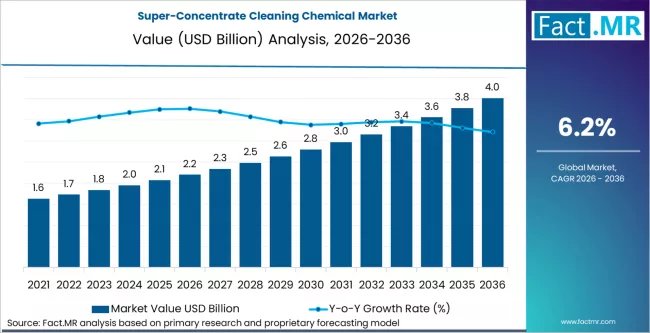
Super Concentrate Cleaning Chemical Market Market Value Analysis | Source: Fact.MR
Companies today are under pressure to cut waste, lower emissions, and reduce operating costs. Super-concentrated cleaning chemicals help address all three. Because they use extreme dilution ratios, they reduce packaging waste, shrink transportation loads, and lower storage requirements. One small container can replace multiple ready-to-use products. For facility managers, that means fewer deliveries, less plastic, and lower overall costs.
Dilution-control systems are becoming especially popular. These systems ensure the right amount of chemical is mixed every time. That reduces waste and prevents overuse. It also improves safety by limiting direct handling of concentrated formulas.
As Michael Chen, Vice President of Sustainability at Ecolab, explains, concentrated cleaning products are no longer just about saving money. They are becoming essential tools for sustainability and operational efficiency. Companies are investing in smarter dispensing systems, bio-based ingredients, and digital monitoring technologies to ensure consistent performance.
Super-Concentrate Cleaning Chemical Market
| Metric | Value |
|---|---|
| Estimated Value in (2026) | USD 2.2 billion |
| Forecast Value in (2036) | USD 4.1 billion |
| Forecast CAGR (2026 to 2036) | 6.2 % |
Source: Fact.MR analysis. Updated Feb 13, 2026
Category
| Category | Segments |
|---|---|
| Concentrate Format | Ultra-Concentrated Liquids, Tablets/Sachets, Pods/Capsules, Other Formats |
| Product Family | General Surface Cleaners, Restroom & Disinfectants, Kitchen & Degreasers, Floor Care |
| Use Setting | Commercial Facilities, Hospitality & Foodservice, Healthcare & Institutions, Residential |
| Concentrate Format | Ultra-Concentrated Liquids, Tablets/Sachets, Pods/Capsules, Other Formats |
| Region | North America; Europe; Asia Pacific; Latin America; Middle East & Africa |
Source: Fact.MR analysis. Updated Feb 13, 2026
Segmental Analysis
How are dilution-control systems becoming the preferred dispensing model?
Dilution-control systems now account for about 46% of the super-concentrate cleaning chemical market, and the reason is simple: they remove guesswork. In large commercial facilities, cleaning performance depends on getting the concentration exactly right. If a solution is too weak, surfaces are not cleaned properly. If it is too strong, chemicals are wasted and costs increase. Manual mixing often leads to these small but expensive mistakes. Automated dilution systems solve this problem. They deliver the correct concentration every time. Staff do not need to measure or estimate. This improves cleaning consistency across multiple sites, especially for facility management companies operating large portfolios. These systems also improve safety. Workers handle less raw concentrate, reducing exposure risks. At the same time, they help organizations protect their chemical investment and control costs without requiring complex retraining programs.
Why do ultra-concentrated liquids lead format preferences?
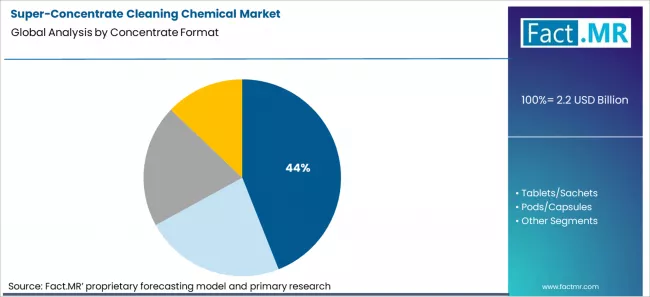
Super Concentrate Cleaning Chemical Market Analysis By Concentrate Format | Source: Fact.MR
Ultra-concentrated liquids hold about 44% market share because they combine performance with efficiency. Modern formulations are designed to stay stable even at very high dilution ratios, sometimes from 1:8 up to 1:256 depending on the application. This means a small container can serve a large facility for an extended period. Advances in surfactants, stabilizers, and enzyme encapsulation have solved earlier issues such as separation or reduced shelf life. Today’s ultra-concentrates offer long-term stability and predictable cleaning results. They also significantly reduce packaging waste and transportation costs. Fewer shipments are required, which aligns with sustainability goals and lowers carbon footprints.
Market Dynamics
- Drivers: Sustainability commitments are a major growth driver. Many large corporations now operate under strict ESG frameworks that prioritize waste reduction and lower emissions. In 2025, several global companies expanded concentrated chemical programs to meet carbon reduction targets. Cost control is another key factor. Super-concentrates reduce shipping frequency, packaging material, and storage space. For global facility management networks, these efficiencies translate into meaningful savings without compromising cleaning standards.
- Restraints: The biggest barrier is upfront cost. Dilution-control dispensers can range from USD 500 to USD 5,000 per unit. Smaller facilities often hesitate to make this investment. Training is another challenge. Staff must understand proper procedures, and high turnover can make this difficult. Older buildings may also face compatibility issues with legacy storage and dispensing infrastructure.
- Trend 1: Digital monitoring integration The market is moving toward smart dispensing systems. New dilution-control units offer cloud connectivity and real-time usage tracking. Facility managers can monitor chemical consumption, predict refill needs, and optimize performance across locations. North America is leading this transition as organizations adopt more data-driven facility management models.
- Trend 2: Single-dose packaging innovation Single-dose concentrates are gaining attention, especially in residential and light commercial settings. Water-soluble tablets and pods remove the need for measuring equipment. These formats make concentrated chemistry more accessible to everyday users. They reduce packaging waste, simplify usage, and improve convenience. As a result, they are expanding the market beyond traditional institutional buyers.
Super-Concentrate Cleaning Chemical Market Analysis by Country
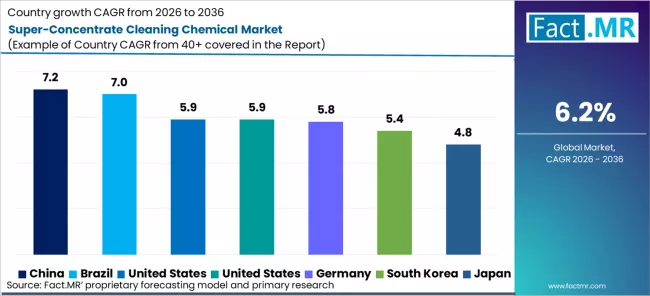
Super Concentrate Cleaning Chemical Market Cagr Analysis By Country | Source: Fact.MR
| Country | CAGR (2026 to 2036) |
|---|---|
| China | 7.2% |
| Brazil | 7.0% |
| United States | 5.9% |
| United Kingdom | 5.9% |
| Germany | 5.8% |
| South Korea | 5.4% |
| Japan | 4.8% |
Source: Fact.MR analysis. Updated Feb 13, 2026
What factors position China to lead global growth in super-concentrate cleaning chemical adoption?
China is emerging as the fastest-growing market, expanding at a 7.2% CAGR. This growth is closely linked to national sustainability priorities. The Dual Carbon policy and Green Factory initiatives are pushing industries to cut emissions and reduce packaging waste. Government targets call for up to a 30% reduction in packaging weight by 2030. As a result, super-concentrated cleaning chemicals are gaining strong traction. They help commercial buildings and public institutions lower packaging use while supporting zero-waste operations. Rapid commercial real estate expansion in tier-one cities is also increasing demand for high-efficiency cleaning systems. Major domestic players such as Sinopec and Liby Group are scaling up production of concentrated “Super-Pod” formats. A small 500 ml unit that creates 200 liters of usable solution is highly attractive in logistics-heavy markets. Strong regulatory backing and environmental enforcement continue to accelerate adoption across supply chains.
How does commercial real estate expansion support Brazil market development?
Brazil is growing at a 7.0% CAGR, supported by expanding urbanization and commercial infrastructure. Rising labor costs in building service operations are making concentrated products more attractive because they reduce handling frequency and storage needs. Transportation challenges across large geographic areas also make freight cost savings a major advantage. Local manufacturing expansion has improved supply stability and pricing competitiveness. As retail modernization continues and refill formats become more accessible, concentrated cleaning solutions are gaining popularity in both commercial and institutional markets.
How does Diversey product launch influence United States market expansion?
The United States market is growing at a 5.9% CAGR, supported by innovation and ESG-driven procurement. Diversey’s launch of Oxivir Three 64 Concentrate at the ISSA 2025-2026 exhibition, following its integration with Solenis, reflects this shift. The product targets hospitals and industrial facilities that require extreme dilution ratios such as 1:64 and 1:256. These ratios significantly reduce plastic waste and freight costs. Building service contractors are increasingly specifying such products to meet sustainability goals without compromising cleaning performance. Growth in the U.S. is strongly tied to corporate environmental commitments. Super-concentrates are now viewed not just as cost-saving tools, but as essential components of carbon footprint reduction strategies.
What role do hazard classification regulations play in United Kingdom market development?
The United Kingdom market is expanding at a 5.9% CAGR, shaped by regulatory tightening. The GB Mandatory Controlled List hazard classification requirements, effective August 15, 2026, are encouraging centralized and simplified labeling systems. Smart-dose dispensing systems make compliance easier. They allow controlled dilution and standardized labeling across multiple sites. Facility managers appreciate how concentrated programs reduce paperwork and safety data sheet complexity. Sustainability initiatives in commercial real estate and procurement standards from the National Health Service further reinforce this shift toward automated, concentrated solutions.
How does EU microplastic regulation influence Germany market trajectory?
Germany is growing at a 5.8% CAGR, driven by strong environmental regulation. EU Regulation 2023/2055, which bans microplastics, has accelerated the move toward plant-based super-concentrates. Henkel’s Net-Zero Raw Material Transition rollout in 2026 reflects this transformation. The company is replacing polymer-stabilized liquids with bio-based alternatives that contain significantly less water. Green Public Procurement policies also require environmental compliance in government contracts. German consumers and manufacturers alike favor precision, low-waste solutions. This supports both commercial and residential adoption of refillable concentrated systems.
What semiconductor manufacturing demands drive South Korea market growth?
South Korea’s market is advancing at a 5.4% CAGR, influenced by its strong manufacturing base. The country’s massive semiconductor and advanced electronics sectors demand ultra-clean, low-residue surfaces. LG Chem has been developing specialized concentrated formulations suitable for semiconductor facilities and high-specification industrial flooring. These ionic-free detergents prevent film buildup and support precision manufacturing standards. The Smart Green Industrial Complex initiative also promotes sustainable manufacturing practices. Concentrated chemicals reduce transportation burdens and packaging waste, aligning with national environmental priorities.
How do Kirei Life initiatives influence Japan market development?
Japan’s market is expanding at a 4.8% CAGR, guided by quality and efficiency rather than sheer volume growth. Kao’s K27 Mid-term Plan, launched in early 2026, emphasizes Precision Cleansing technologies under the broader Kirei Life initiative. These programs promote high-efficiency chemical use and reduced environmental impact. In dense urban environments where storage space is limited, hyper-concentrates offer clear benefits. Japanese buyers prioritize contamination-free performance, space optimization, and long-term stability. Growth reflects careful, performance-driven adoption rather than aggressive expansion.
Competitive Landscape of the Super-Concentrate Cleaning Chemical Market
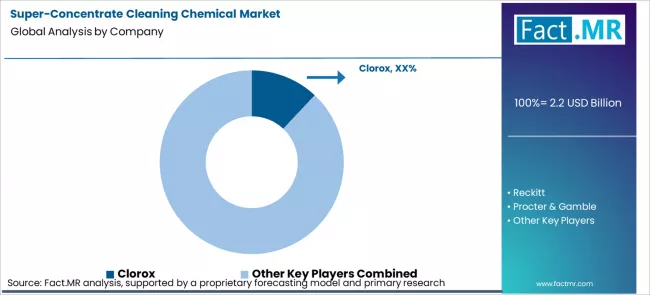
Super Concentrate Cleaning Chemical Market Analysis By Company | Source: Fact.MR
Competition in this market is increasingly centered on integrated solutions rather than just chemical formulations. Large global hygiene corporations compete alongside regional specialists, but success now depends on more than product strength alone. Facility managers want consistent dilution accuracy, contamination control, and measurable cost savings. This has shifted demand toward suppliers that offer complete systems.
Ecolab has strengthened its position by combining chemical innovation with advanced dilution-control equipment and strong service networks. Its technicians support multi-site operations, ensuring performance consistency. Diversey benefits from its integration with Solenis, allowing it to combine water treatment expertise with concentrated cleaning solutions tailored for hospitality and healthcare sectors. SC Johnson Professional differentiates through sustainability leadership and the credibility of a trusted consumer brand heritage.
Today, customers look for more than chemistry. They value equipment financing, digital monitoring, training programs, and long-term service agreements. These integrated offerings reduce implementation risk and create strong customer loyalty. In this market, success increasingly comes from delivering a complete solution rather than a standalone product.
Key Players in Super-Concentrate Cleaning Chemical Market
- Clorox
- Reckitt
- Procter & Gamble
- SC Johnson Professional
- Ecolab
- Diversey
- Unilever
- 3M
- Zep
- Betco
Bibliography
- Diversey. 2025-2026. Oxivir Three 64 Concentrate launch for water-intensive industrial applications. Official company press releases and ISSA trade show documentation.
- Henkel AG. 2025-2026. Net-Zero Raw Material Transition program rollout. Corporate sustainability announcements and investor relations materials.
- Kao Corporation. 2026. K27 Mid-term Plan Precision Cleansing technology platform. Company innovation announcements and fiscal year forecasts.
- Health and Safety Executive UK. 2026. GB Mandatory Controlled List implementation requirements. Official regulatory documentation and compliance guidelines.
- Future Market Insights. 2026. China Green Factory scaling initiative analysis. Industry association technical publications and market research.
- European Union. 2023. Regulation 2023/2055 microplastic restrictions. Official EU regulatory documentation and implementation frameworks.
- Government of China. 2025-2026. Dual Carbon policy framework and packaging reduction mandates. National Development and Reform Commission policy documentation.
- Ecolab Inc. 2025. Sustainability division corporate communications. Company environmental reports and industry conference presentations.
Segmentation
Scope of Report
| Items | Values |
|---|---|
| Quantitative Units (2026) | USD 2.2 Billion |
| Concentrate Format | Ultra-Concentrated Liquids, Tablets/Sachets, Pods/Capsules, Other Formats |
| Product Family | General Surface Cleaners, Restroom & Disinfectants, Kitchen & Degreasers, Floor Care |
| Use Setting | Commercial Facilities, Hospitality & Foodservice, Healthcare & Institutions, Residential |
| Concentrate Format | Ultra-Concentrated Liquids, Tablets/Sachets, Pods/Capsules, Other Formats |
| Regions Covered | North America, Europe, Asia Pacific, Latin America, Middle East & Africa |
| Countries Covered | U.S., Canada, Germany, Italy, UK, France, Japan, China, Brazil, South Korea, Australia, and other countries |
| Key Companies Profiled | Clorox, Reckitt, Procter & Gamble, SC Johnson Professional, Ecolab, Diversey, Unilever, 3M, Zep, Betco |
| Additional Attributes | Dollar revenue in the super-concentrate cleaning chemical market is segmented by concentrate format (ultra-concentrated liquids, tablets/sachets, pods/capsules, other formats), product family (general surface cleaners, restroom & disinfectants, kitchen & degreasers, floor care), use setting (commercial facilities, hospitality & foodservice, healthcare & institutions, residential), and region. |
Source: Fact.MR analysis. Updated Feb 13, 2026
Super-Concentrate Cleaning Chemical Market by Segments
-
Concentrate Format :
- Ultra-Concentrated Liquids
- Tablets/Sachets
- Pods/Capsules
- Other Formats
-
Product Family :
- General Surface Cleaners
- Restroom & Disinfectants
- Kitchen & Degreasers
- Floor Care
-
Use Setting :
- Commercial Facilities
- Hospitality & Foodservice
- Healthcare & Institutions
- Residential
-
Region :
- Asia Pacific
- China
- Japan
- South Korea
- Rest of Asia Pacific
- North America
- United States
- Canada
- Mexico
- Europe
- Germany
- France
- UK
- Spain
- Rest of Europe
- Latin America
- Brazil
- Mexico
- Rest of Latin America
- Asia Pacific
Frequently Asked Questions
How big is the super-concentrate cleaning chemical market in 2026?
What will be the size of super-concentrate cleaning chemical market in 2036?
How much will be the super-concentrate cleaning chemical market growth between 2026 and 2036?
What are the key product types in the super-concentrate cleaning chemical market?
Which segment to contribute significant share in the super-concentrate cleaning chemical market in 2026?
Who worked on this report


Preview the report firsthand - request a free sample
Free SampleGet the brochure for pricing and purchase details
Download PDF