Micro-Retirement & Sabbatical Planning Services Market Size, Share, Growth and Forecast (2026 - 2036)

The Micro-Retirement & Sabbatical Planning Services Market is segmented by Service Type, by Sabbatical Duration, by Delivery Model, by Organization Size, by End Use, by Pricing Model, and by Region. Forecast for 2026 to 2036.

What is the micro-retirement and sabbatical planning services market forecast to be worth by 2036?

USD 0.55 billion in 2026 to USD 11.50 billion by 2036, at 35.5% CAGR.

  • The micro-retirement and sabbatical planning services market crossed a valuation of USD 0.41 billion in 2025. Demand is estimated to increase from USD 0.55 billion in 2026 to USD 11.50 billion by 2036.
  • The market is forecast to record 35.5% CAGR during 2026 to 2036 as longer working lives make planned career pauses a financial and workforce planning need.
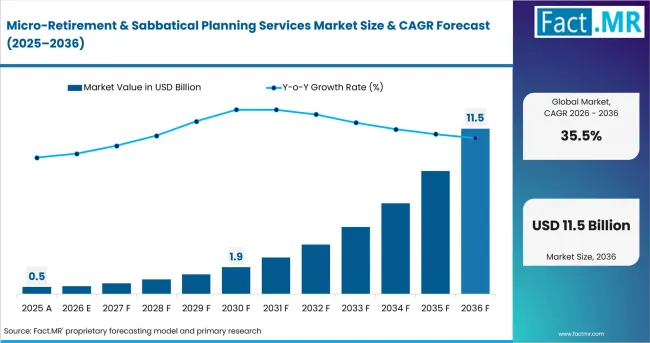
Micro Retirement & Sabbatical Planning Services Market Value Analysis

What are the defining numbers behind micro-retirement and sabbatical planning services growth?

USD 10.95 billion absolute opportunity by 2036, led by the United States and Australia.

  • Demand Drivers in the Market
    • Professionals need cash-flow checks before taking unpaid breaks from work.
    • Employers need consistent leave rules before managers approve longer career pauses.
    • Career coaches need return plans because clients want a break without a career penalty.
    • Financial advisors gain demand when clients need tax, savings and benefit review before a pause.
  • Key Segments Analyzed
    • By Service Type: Financial Readiness Planning is expected to hold 32.0% share in 2026 because cash-flow risk drives the first advisory conversation.
    • By Client Type: Individual Professionals lead because most purchases start outside employer systems. The segment is projected to capture 48.0% share in 2026.
    • By Delivery Model: Hybrid Advisory is likely to account for 38.0% share in 2026 because clients want coach access and planner review.
    • By Planning Horizon: The 3-6 Months horizon is projected to hold 34.0% share in 2026 because it balances recovery time with income risk.
    • By End Use: Burnout Recovery is expected to hold 31.0% share in 2026 because clients want a structured pause rather than an unplanned resignation.
    • By Revenue Model: Subscription Packages are estimated to account for 36.0% share in 2026 as buyers spread planning fees across milestones.
    • By Geography: The United States is projected to record 9.8% CAGR through 2036 as employer benefits and advisory channels scale.
  • Analyst Opinion at Fact.MR
    • Shambhu Nath Jha, Senior Analyst at Fact.MR, states, “Micro-retirement planning is becoming a financial confidence service first and a lifestyle service second. Clients ask whether they can pause work without damaging savings, benefits, or career standing. Providers that combine planner review with return-to-work coaching are better placed than firms that sell only inspiration or travel ideas.
  • Strategic Implications
    • Financial advisors should package sabbatical cash-flow checks as a separate planning offer.
    • Employers need documented leave rules before extended breaks become retention tools.
    • Coaching platforms should connect pause planning with manager communication and re-entry support.
    • Benefits consultants need country-specific leave knowledge because rules differ by market.

Career-break planning forms the core of this market. The Organisation for Economic Co-operation and Development reported that employment among people aged 55 to 64 averaged 64.6% across member countries in 2024. This keeps retirement less linear and raises demand for advice that connects savings, benefits and career re-entry.

The United States is projected to record 36.5% CAGR through 2036 as employer benefit channels and advisory access scale. Australia is expected to expand at 36.2% CAGR because long-service leave gives many workers a practical funding base. The United Kingdom is forecast to grow at 35.9% CAGR as statutory flexible-working requests have a clearer path. Canada is expected to advance at 35.5% CAGR as older-worker retention becomes a workforce issue. Germany is projected to rise at 35.1% CAGR where structured HR systems support formal pause planning. France is forecast at 34.9% CAGR as time-savings accounts create a leave-planning route. Japan is expected to post 34.3% CAGR as long careers require careful pacing.

How does the micro-retirement and sabbatical planning services market break down by segment?

Financial readiness planning leads at 32.0%; individual professionals lead at 48.0%.

Which service type dominates?

Financial Readiness Planning holds 32.0% share in 2026.
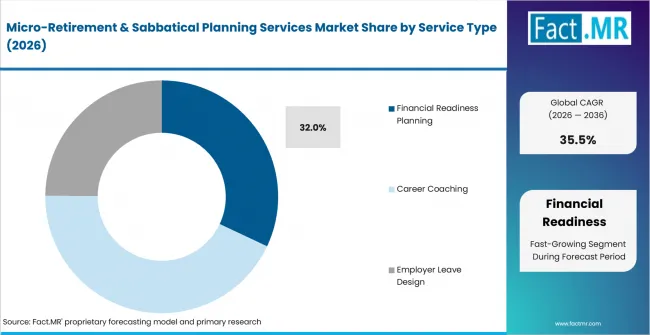
Micro Retirement & Sabbatical Planning Services Market Analysis By Service Type

Financial Readiness Planning is expected to hold 32.0% share in 2026 because unpaid leave starts with income risk. Advisors calculate savings buffers, insurance gaps and tax effects before clients set a break date. financial analytics tools help providers show cash-flow scenarios in language clients can act on.

Which client type dominates?

Individual Professionals hold 48.0% share in 2026.
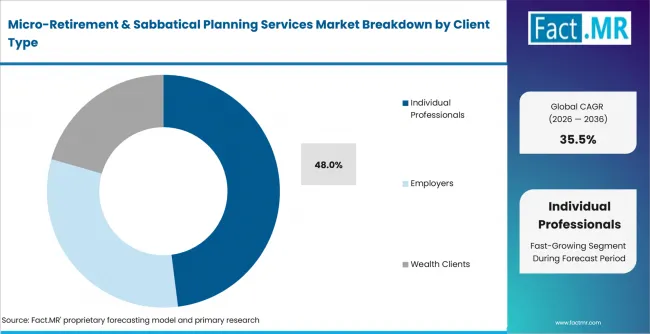
Micro Retirement & Sabbatical Planning Services Market Analysis By Client Type

Individual Professionals lead because many career breaks are initiated before an employer policy is available. These buyers compare cost, privacy and return-to-work support. succession advisory is relevant because family-owned firms face similar continuity questions when one person steps away for a defined period.

Which delivery model dominates?

Hybrid Advisory holds 38.0% share in 2026.
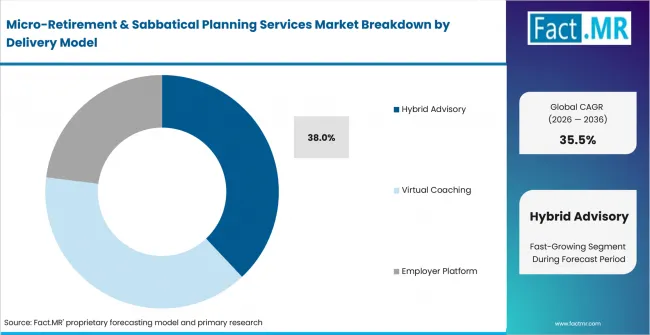
Micro Retirement & Sabbatical Planning Services Market Analysis By Delivery Model

Hybrid Advisory leads because clients want video coaching and licensed financial review in the same package. Pure self-service tools are cheaper but weaker when taxes, debt or employer benefits are complex. This model also gives providers a path to serve both individuals and employer-sponsored users.

Which planning horizon dominates?

3-6 Months holds 34.0% share in 2026.
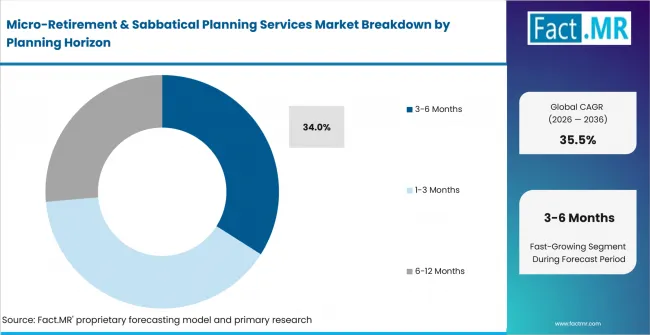
Micro Retirement & Sabbatical Planning Services Market Analysis By Planning Horizon

The 3-6 Months horizon leads because it is long enough for recovery, study or travel and short enough for clients to fund with savings. Travel-oriented breaks also create crossover demand with wellness tourism services when clients need budget discipline rather than open-ended trips.

Which end use dominates?

Burnout Recovery holds 31.0% share in 2026.
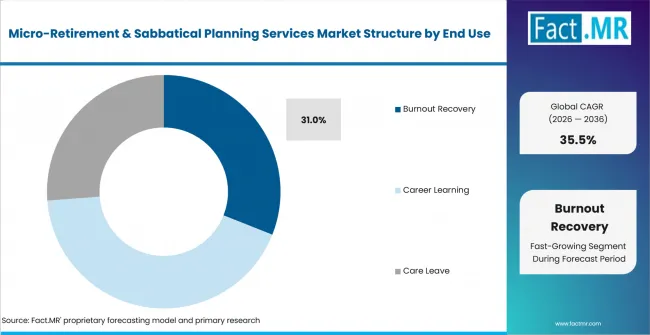
Micro Retirement & Sabbatical Planning Services Market Analysis By End Use

Burnout Recovery leads because many buyers want a managed pause instead of quitting work. Providers that connect recovery planning with health and fitness clubs can support physical routines during time away. The service value rises when the plan includes a return date and manager communication.

Which revenue model dominates?

Subscription Packages hold 36.0% share in 2026.
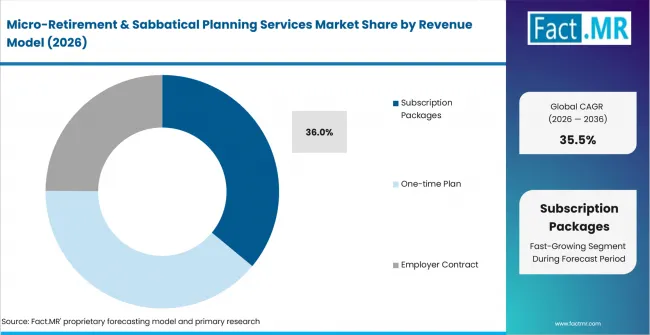
Micro Retirement & Sabbatical Planning Services Market Analysis By Revenue Model

Subscription Packages lead because clients prefer staged payments while they move from savings review to leave request and return planning. Employers also prefer recurring service fees when sabbatical advice is bundled into benefits navigation. The model supports annual check-ins for workers who plan more than one career pause.

What is accelerating micro-retirement and sabbatical planning services demand, and what is holding it back?

Longer working lives and flexible-work rules drive it; cash-flow risk and uneven employer approval restrain it.
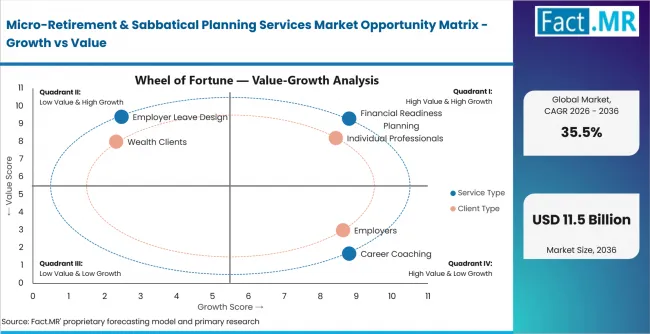
Micro Retirement & Sabbatical Planning Services Market Opportunity Matrix Growth Vs Value

The main driver is the move toward longer working lives. The U.S. Bureau of Labor Statistics projects participation for workers aged 55 to 64 to move from 65.9% in 2024 to 68.6% in 2034. [2] Workers who expect longer careers have more reason to plan breaks that preserve savings and job continuity.

Employer channels add a second driver. Employer support through corporate wellness programs increasingly includes mental health, coaching and navigation support. Planning services gain budget access when a sabbatical is framed as retention rather than absence alone.

The main restraint is the lack of consistent employer approval. Workers may have savings for a break but still lack a clear request process. Employer teams can use labor management software to record absence rules, but it does not replace manager judgment or country-specific leave law.

Where do the biggest micro-retirement and sabbatical planning services opportunities sit?

Employer leave design, financial readiness checks and re-entry coaching.

  • Employer Leave Design: Benefits consultants can help firms define eligibility, documentation and return rules for planned pauses.
  • Financial Readiness Checks: Advisors can sell limited-scope plans that test income, insurance and tax exposure before unpaid leave.
  • Re-entry Coaching: Coaches can support clients before they return so a sabbatical does not become a career gap.

Which countries are scaling micro-retirement and sabbatical planning services fastest?

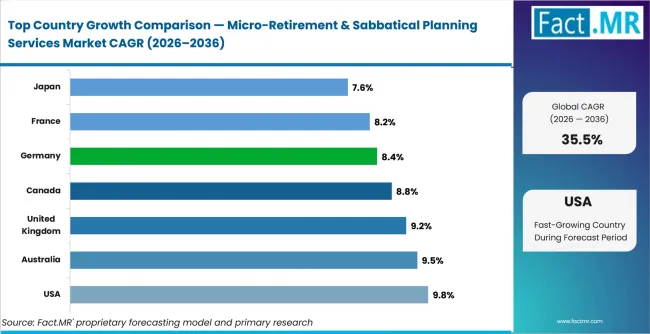
United States 36.5%, Australia 36.2%, United Kingdom 35.9%, Canada 35.5%, Germany 35.1%, France 34.9%, Japan 34.3%.

Based on regional analysis, the micro-retirement and sabbatical planning services market is segmented into North America, Europe, Asia Pacific, Latin America, and Middle East and Africa.

Top Country Growth Comparison Micro Retirement & Sabbatical Planning Services Market Cagr (2026 2036)

Country CAGR
United States 36.5%
Australia 36.2%
United Kingdom 35.9%
Canada 35.5%
Germany 35.1%
France 34.9%
Japan 34.3%

Micro Retirement & Sabbatical Planning Services Market Cagr Analysis By Country

What is powering the United States lead?

36.5% CAGR, supported by employer benefits and advisory access.
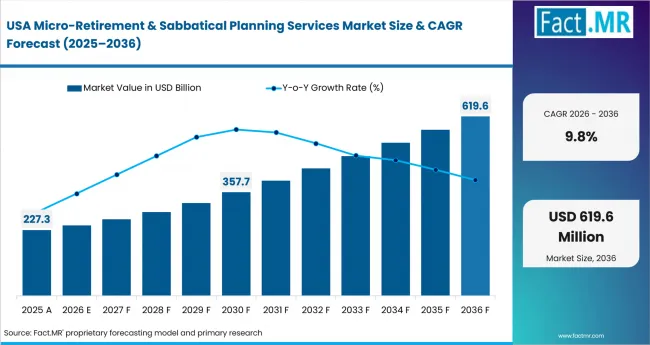
Micro Retirement & Sabbatical Planning Services Market Country Value Analysis

The United States has a large financial advice base and a mature employer benefits channel. The U.S. Bureau of Labor Statistics projects participation for workers aged 55 to 64 to reach 68.6% by 2034. [2] This makes late-career pacing more relevant for workers who do not want a full exit. Providers that connect retirement platforms with coaching can win higher-value employer programs.

Why is Australia an important career-break planning market?

36.2% CAGR, supported by long-service leave and later retirement planning.

Australia has a leave culture that makes planned breaks easier to discuss. The Australian Bureau of Statistics reported that 156,000 people aged 45 and over retired in 2024-25. [4] Long-service leave rules also give eligible workers a funding base for a break. Planning providers can convert that entitlement into structured cash-flow and return plans.

What supports the United Kingdom outlook?

35.9% CAGR, backed by day-one flexible-work request rights.

The United Kingdom now gives employees a clearer route to request flexible working from the first day of employment. The Advisory, Conciliation and Arbitration Service code that applies from 6 April 2024 allows two statutory requests in any 12-month period. [3] This does not guarantee sabbatical approval, but it increases the need for documented policies. Employer advisors can help firms handle requests without creating inconsistent decisions.

How does Canada scale this market?

35.5% CAGR, supported by older-worker retention needs.

Canada has a clear aging-workforce issue. Statistics Canada reported that 19% of the population was aged 50 to 64 and another 19% was aged 65 and older in 2024. [5] Employers face knowledge-transfer risk as more workers approach retirement. Sabbatical planning can help retain experienced staff who might otherwise leave permanently.

What underpins Germany’s growth?

35.1% CAGR, supported by structured work-time systems and older-worker participation.

Germany has formal HR governance and high older-worker participation. The German Federal Statistical Office, using European data, lists Germany’s 2025 employment rate for ages 55 to 64 at 75.3%. [6] This supports demand for documented pause rules rather than informal manager decisions. Providers with benefits consulting and coaching capability are better placed than single-service coaches.

Why does France require local leave knowledge?

34.9% CAGR, supported by time-savings accounts and later-career employment needs.

France has a formal time-savings account pathway that can convert unused leave into later time away. The National Institute of Statistics and Economic Studies reported that the employment rate for people aged 55 to 64 reached 61.8% in the second quarter of 2025. [7] This creates demand for advice that combines leave rights and re-entry planning. Suppliers need French labor knowledge before they sell standardized career-break packages.

How is Japan developing career-pacing demand?

34.3% CAGR, supported by long careers and aging labor conditions.
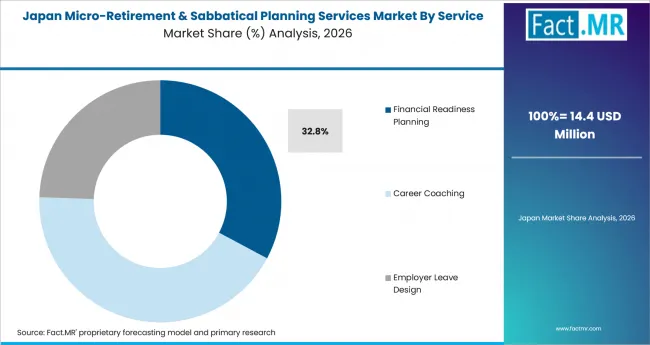
Micro Retirement & Sabbatical Planning Services Market Japan Market Share Analysis By Service Type

Japan has a large employed population and pressure to keep older workers active. The Statistics Bureau of Japan reported 67.81 million employed persons in 2024. [8] OECD notes that Japan’s working-age population fell 16% from its 1995 peak to 2024. [9] Planning services grow more slowly than in English-speaking markets because employer approval routes are less standardized.

Who leads the micro-retirement and sabbatical planning services landscape?

Mercer, WTW, BetterUp and CoachHub lead through benefits consulting, coaching scale and employer access.
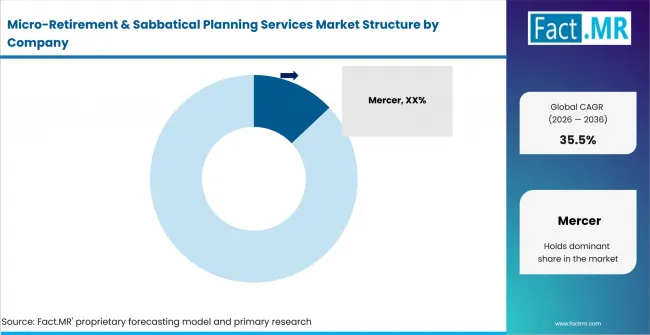
Micro Retirement & Sabbatical Planning Services Market Analysis By Company

Micro-retirement and sabbatical planning services are used by professionals and employers that need a safe pause from work. Mercer and WTW compete through benefits consulting and leave-policy design. BetterUp and CoachHub compete through coaching networks, while Fidelity Investments and The Vanguard Group can connect financial planning with retirement-readiness education.

Buyer selection depends on cash-flow modeling, leave-policy knowledge and coaching depth. CoachHub states that it works with more than 3,500 certified coaches across 90+ countries. [10] BetterUp states that its coaching network includes more than 4,000 global International Coaching Federation-certified coaches. [11] These networks matter because clients need human review when a break affects income and career standing.

Employer buyers also compare absence-management capability. WTW’s 2025 Absence, Disability and Medical Leave Survey covered 585 employers. [12] That service depth supports policy design where sabbaticals sit beside disability, medical leave and family leave. Providers that combine corporate training services with leave design are best placed for enterprise work.

Competition through 2036 is expected to remain spread across consultancies, coaching platforms and wealth advice firms. Smaller providers can use on-demand wellness software as an entry route, but larger providers have an advantage when the buyer needs legal review and benefit integration.

Specialist advisors can still win in owner-led firms and high-income professional segments. family business advisory services show how personal planning and business continuity can overlap when a founder or senior professional takes a planned break. education and learning platforms can also support learning-based sabbaticals when workers use the pause to reskill.

Which companies are the key players?

Mercer, WTW, BetterUp, CoachHub, Fidelity Investments, The Vanguard Group and Unum Group.

  • Mercer
  • WTW
  • BetterUp
  • CoachHub
  • Fidelity Investments
  • The Vanguard Group
  • Unum Group

Bibliography

  • [1] Organisation for Economic Co-operation and Development. (n.d.). Ageing and employment.
  • [2] U.S. Bureau of Labor Statistics. (2025, August 28). Civilian labor force participation rate by age, sex, race, and ethnicity.
  • [3] Advisory, Conciliation and Arbitration Service. (2024, April 6). Acas Code of Practice on requests for flexible working.
  • [4] Australian Bureau of Statistics. (2025, October 31). Retirement and retirement intentions, Australia, 2024-25 financial year.
  • [5] Statistics Canada. (2026, April 9). Retirement and post-retirement employment among older Canadians.
  • [6] German Federal Statistical Office. (n.d.). EU labour market: Important labour market indicators.
  • [7] National Institute of Statistics and Economic Studies. (2025, August 8). In Q2 2025, the unemployment rate was stable at 7.5%.
  • [8] Statistics Bureau of Japan. (2025). Statistical Handbook of Japan 2025. Ministry of Internal Affairs and Communications.
  • [9] Organisation for Economic Co-operation and Development. (2025, July 9). OECD Employment Outlook 2025: Japan.
  • [10] CoachHub GmbH. (n.d.). CoachHub: The digital coaching platform.
  • [11] BetterUp, Inc. (2025, August 12). Coaching: What it is and why it matters at work.
  • [12] WTW. (2026, January 26). Despite cost constraints, employers continue to invest in leave programs, WTW survey finds.

This Report Address

  • Strategic intelligence on micro-retirement and sabbatical planning services across service type, client type and delivery model.
  • Forecast mapping from USD 0.55 billion in 2026 to USD 11.50 billion by 2036.
  • Segment analysis covering Financial Readiness Planning, Individual Professionals, Hybrid Advisory and Burnout Recovery.
  • Regional outlook covering the United States, Australia, United Kingdom, Canada, Germany, France and Japan.
  • Competitive analysis of Mercer, WTW, BetterUp, CoachHub, Fidelity Investments, The Vanguard Group and Unum Group.
  • Service assessment covering financial readiness checks, leave design, career coaching and return-to-work planning.
  • Primary interviews, official source review, provider checks and service pricing review support the forecast.

What does the micro-retirement and sabbatical planning services market cover?

Paid planning services for short career breaks before full retirement.

The micro-retirement and sabbatical planning services market covers paid advice that helps people and employers plan short career breaks. It includes financial readiness planning, sabbatical coaching, employer leave design and return-to-work support. The market differs from general retirement planning because the service focus is a temporary pause and a planned return.

What is included in the scope?

Financial readiness planning, sabbatical coaching and employer leave design.

The scope includes cash-flow planning, tax-aware withdrawal review and benefits checks. It covers coaching for break design, return planning and manager communication. It also includes employer policy design, paid workshop support and travel budgeting when these services are tied to a structured career pause.

What is excluded from the scope?

Full retirement planning and standard travel booking without career-break advice.

The scope excludes full retirement wealth management when it does not address temporary leave. It excludes standard vacation booking and unpaid peer communities. It also excludes clinical burnout treatment unless the provider sells planning or coaching tied to a defined work pause.

How was the analysis built?

100+ sources, 45+ company portfolios, 25+ countries, 20+ interviews.

  • Primary Research:
    • Primary research includes interviews with benefits consultants, financial advisors, career coaches and HR policy specialists. It also includes checks with employer benefits teams that review extended leave requests.
  • Desk Research:
    • Desk research reviews labor statistics, flexible-working rules, retirement behavior and company service portfolios. It also checks active company names and current service coverage before inclusion.
  • Market-Sizing and Forecasting:
    • Forecasting uses advisory fee pools, coaching package prices and employer program adoption. Estimates were reconciled against older-worker participation and absence-management signals.
  • Data Validation and Update Cycle:
    • Forecasts were validated through source checks and company activity review. The update cycle tracks flexible-work rules, coaching platform launches and benefits consulting service changes.

What is the report’s scope and coverage?
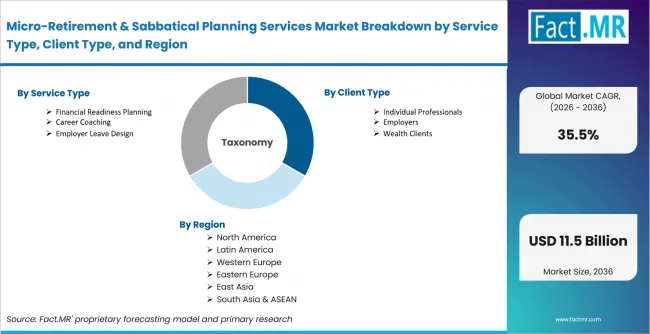
Micro Retirement & Sabbatical Planning Services Market Breakdown By Service Type, Client Type, And Region

Attribute Details
Quantitative Units USD Billion in 2026 to USD Billion by 2036 at CAGR
Market Definition Paid planning services for short career breaks before full retirement
Service Type Financial Readiness Planning, Career Coaching, Employer Leave Design, Travel Budget Planning, Return-to-Work Support
Client Type Individual Professionals, Employers, Self-employed Workers, Wealth Clients, Public-sector Staff
Delivery Model Hybrid Advisory, Virtual Coaching, Employer Platform, In-person Advisory, Group Workshop
Planning Horizon 3-6 Months, 1-3 Months, 6-12 Months, 12+ Months, Phased Retirement
End Use Burnout Recovery, Career Learning, Care Leave, Travel Reset, Mid-career Reset
Revenue Model Subscription Package, One-time Plan, Employer Contract, Referral Fee, Workshop Fee
Regions Covered North America, Europe, Asia Pacific, Latin America, Middle East and Africa
Countries Covered United States, Australia, United Kingdom, Canada, Germany, France, Japan
Key Companies Profiled Mercer, WTW, BetterUp, CoachHub, Fidelity Investments, The Vanguard Group and Unum Group
Forecast Period 2026 to 2036
Approach Hybrid top-down and bottom-up approach using advisory fee pools, coaching capacity, employer benefits signals and provider validation

How is the market segmented?

  • By Service Type:

    • Financial Readiness Planning
    • Career Coaching
    • Employer Leave Design
    • Travel Budget Planning
    • Return-to-Work Support
  • By Client Type:

    • Individual Professionals
    • Employers
    • Self-employed Workers
    • Wealth Clients
    • Public-sector Staff
  • By Delivery Model:

  • Hybrid Advisory
  • Virtual Coaching
  • Employer Platform
  • In-person Advisory
  • Group Workshop
  • By Planning Horizon:

    • 3-6 Months
    • 1-3 Months
    • 6-12 Months
    • 12+ Months
    • Phased Retirement
  • By End Use:

    • Burnout Recovery
    • Career Learning
    • Care Leave
    • Travel Reset
    • Mid-career Reset
  • By Revenue Model:

    • Subscription Package
    • One-time Plan
    • Employer Contract
    • Referral Fee
    • Workshop Fee
  • By Region:

    • North America
      • United States
      • Canada
      • Mexico
    • Latin America
      • Brazil
      • Argentina
      • Rest of Latin America
    • Europe
      • Germany
      • United Kingdom
      • France
      • Italy
      • Spain
      • Rest of Europe
    • Asia Pacific
      • China
      • India
      • Japan
      • Australia
      • South Korea
      • ASEAN
    • Middle East & Africa
      • GCC Countries
      • South Africa
      • UAE
      • Rest of Middle East & Africa

- Frequently Asked Questions -

Which service type leads the Micro-Retirement & Sabbatical Planning Services Market?

Financial Readiness Planning leads with 32.0% share in 2026 because cash-flow risk drives purchase decisions.

Which country expands faster in the Micro-Retirement & Sabbatical Planning Services Market?

The United States is projected to record 36.5% CAGR through 2036 due to employer benefits and advisory access.

How does Australia perform in the Micro-Retirement & Sabbatical Planning Services Market?

Australia is expected to expand at 36.2% CAGR through 2036 because long-service leave supports paid pause planning.

How does the United Kingdom perform in the Micro-Retirement & Sabbatical Planning Services Market?

The United Kingdom is forecast to grow at 35.9% CAGR through 2036 as flexible-work request rules support policy design.

What is the primary driver in the Micro-Retirement & Sabbatical Planning Services Market?

The primary driver is the need to plan a temporary career pause without damaging savings, benefits or career standing.

What is the main restraint in the Micro-Retirement & Sabbatical Planning Services Market?

The main restraint is inconsistent employer approval because many companies do not yet have formal sabbatical policies.

Why is hybrid advisory important in this market?

Hybrid advisory is important because clients need both coaching and financial review before they confirm an unpaid break.

Table of Content

  1. Executive Summary
    • Global Market Outlook
    • Demand to side Trends
    • Supply to side Trends
    • Technology Roadmap Analysis
    • Analysis and Recommendations
  2. Market Overview
    • Market Coverage / Taxonomy
    • Market Definition / Scope / Limitations
  3. Research Methodology
    • Chapter Orientation
    • Analytical Lens and Working Hypotheses
      • Market Structure, Signals, and Trend Drivers
      • Benchmarking and Cross-market Comparability
      • Market Sizing, Forecasting, and Opportunity Mapping
    • Research Design and Evidence Framework
      • Desk Research Programme (Secondary Evidence)
        • Company Annual and Sustainability Reports
        • Peer-reviewed Journals and Academic Literature
        • Corporate Websites, Product Literature, and Technical Notes
        • Earnings Decks and Investor Briefings
        • Statutory Filings and Regulatory Disclosures
        • Technical White Papers and Standards Notes
        • Trade Journals, Industry Magazines, and Analyst Briefs
        • Conference Proceedings, Webinars, and Seminar Materials
        • Government Statistics Portals and Public Data Releases
        • Press Releases and Reputable Media Coverage
        • Specialist Newsletters and Curated Briefings
        • Sector Databases and Reference Repositories
        • Fact.MR Internal Proprietary Databases and Historical Market Datasets
        • Subscription Datasets and Paid Sources
        • Social Channels, Communities, and Digital Listening Inputs
        • Additional Desk Sources
      • Expert Input and Fieldwork (Primary Evidence)
        • Primary Modes
          • Qualitative Interviews and Expert Elicitation
          • Quantitative Surveys and Structured Data Capture
          • Blended Approach
        • Why Primary Evidence is Used
        • Field Techniques
          • Interviews
          • Surveys
          • Focus Groups
          • Observational and In-context Research
          • Social and Community Interactions
        • Stakeholder Universe Engaged
          • C-suite Leaders
          • Board Members
          • Presidents and Vice Presidents
          • R&D and Innovation Heads
          • Technical Specialists
          • Domain Subject-matter Experts
          • Scientists
          • Physicians and Other Healthcare Professionals
        • Governance, Ethics, and Data Stewardship
          • Research Ethics
          • Data Integrity and Handling
      • Tooling, Models, and Reference Databases
    • Data Engineering and Model Build
      • Data Acquisition and Ingestion
      • Cleaning, Normalisation, and Verification
      • Synthesis, Triangulation, and Analysis
    • Quality Assurance and Audit Trail
  4. Market Background
    • Market Dynamics
      • Drivers
      • Restraints
      • Opportunity
      • Trends
    • Scenario Forecast
      • Demand in Optimistic Scenario
      • Demand in Likely Scenario
      • Demand in Conservative Scenario
    • Opportunity Map Analysis
    • Product Life Cycle Analysis
    • Supply Chain Analysis
    • Investment Feasibility Matrix
    • Value Chain Analysis
    • PESTLE and Porter’s Analysis
    • Regulatory Landscape
    • Regional Parent Market Outlook
    • Production and Consumption Statistics
    • Import and Export Statistics
  5. Global Market Analysis 2021 to 2025 and Forecast, 2026 to 2036
    • Historical Market Size Value (USD Million) Analysis, 2021 to 2025
    • Current and Future Market Size Value (USD Million) Projections, 2026 to 2036
      • Y to o to Y Growth Trend Analysis
      • Absolute $ Opportunity Analysis
  6. Global Market Pricing Analysis 2021 to 2025 and Forecast 2026 to 2036
  7. Global Market Analysis 2021 to 2025 and Forecast 2026 to 2036, By Service Type
    • Introduction / Key Findings
    • Historical Market Size Value (USD Million) Analysis By Service Type , 2021 to 2025
    • Current and Future Market Size Value (USD Million) Analysis and Forecast By Service Type , 2026 to 2036
      • Financial Readiness Planning
      • Career Coaching
      • Employer Leave Design
    • Y to o to Y Growth Trend Analysis By Service Type , 2021 to 2025
    • Absolute $ Opportunity Analysis By Service Type , 2026 to 2036
  8. Global Market Analysis 2021 to 2025 and Forecast 2026 to 2036, By Client Type
    • Introduction / Key Findings
    • Historical Market Size Value (USD Million) Analysis By Client Type, 2021 to 2025
    • Current and Future Market Size Value (USD Million) Analysis and Forecast By Client Type, 2026 to 2036
      • Individual Professionals
      • Employers
      • Wealth Clients
    • Y to o to Y Growth Trend Analysis By Client Type, 2021 to 2025
    • Absolute $ Opportunity Analysis By Client Type, 2026 to 2036
  9. Global Market Analysis 2021 to 2025 and Forecast 2026 to 2036, By Delivery Model
    • Introduction / Key Findings
    • Historical Market Size Value (USD Million) Analysis By Delivery Model, 2021 to 2025
    • Current and Future Market Size Value (USD Million) Analysis and Forecast By Delivery Model, 2026 to 2036
      • Hybrid Advisory
      • Virtual Coaching
      • Employer Platform
    • Y to o to Y Growth Trend Analysis By Delivery Model, 2021 to 2025
    • Absolute $ Opportunity Analysis By Delivery Model, 2026 to 2036
  10. Global Market Analysis 2021 to 2025 and Forecast 2026 to 2036, By Planning Horizon
    • Introduction / Key Findings
    • Historical Market Size Value (USD Million) Analysis By Planning Horizon, 2021 to 2025
    • Current and Future Market Size Value (USD Million) Analysis and Forecast By Planning Horizon, 2026 to 2036
      • 3-6 Months
      • 1-3 Months
      • 6-12 Months
    • Y to o to Y Growth Trend Analysis By Planning Horizon, 2021 to 2025
    • Absolute $ Opportunity Analysis By Planning Horizon, 2026 to 2036
  11. Global Market Analysis 2021 to 2025 and Forecast 2026 to 2036, By End Use
    • Introduction / Key Findings
    • Historical Market Size Value (USD Million) Analysis By End Use, 2021 to 2025
    • Current and Future Market Size Value (USD Million) Analysis and Forecast By End Use, 2026 to 2036
      • Burnout Recovery
      • Career Learning
      • Care Leave
    • Y to o to Y Growth Trend Analysis By End Use, 2021 to 2025
    • Absolute $ Opportunity Analysis By End Use, 2026 to 2036
  12. Global Market Analysis 2021 to 2025 and Forecast 2026 to 2036, By Revenue Model
    • Introduction / Key Findings
    • Historical Market Size Value (USD Million) Analysis By Revenue Model, 2021 to 2025
    • Current and Future Market Size Value (USD Million) Analysis and Forecast By Revenue Model, 2026 to 2036
      • Subscription Packages
      • One-time Plan
      • Employer Contract
    • Y to o to Y Growth Trend Analysis By Revenue Model, 2021 to 2025
    • Absolute $ Opportunity Analysis By Revenue Model, 2026 to 2036
  13. Global Market Analysis 2021 to 2025 and Forecast 2026 to 2036, By Region
    • Introduction
    • Historical Market Size Value (USD Million) Analysis By Region, 2021 to 2025
    • Current Market Size Value (USD Million) Analysis and Forecast By Region, 2026 to 2036
      • North America
      • Latin America
      • Western Europe
      • Eastern Europe
      • East Asia
      • South Asia and Pacific
      • Middle East & Africa
    • Market Attractiveness Analysis By Region
  14. North America Market Analysis 2021 to 2025 and Forecast 2026 to 2036, By Country
    • Historical Market Size Value (USD Million) Trend Analysis By Market Taxonomy, 2021 to 2025
    • Market Size Value (USD Million) Forecast By Market Taxonomy, 2026 to 2036
      • By Country
        • USA
        • Canada
        • Mexico
      • By Service Type
      • By Client Type
      • By Delivery Model
      • By Planning Horizon
      • By End Use
      • By Revenue Model
    • Market Attractiveness Analysis
      • By Country
      • By Service Type
      • By Client Type
      • By Delivery Model
      • By Planning Horizon
      • By End Use
      • By Revenue Model
    • Key Takeaways
  15. Latin America Market Analysis 2021 to 2025 and Forecast 2026 to 2036, By Country
    • Historical Market Size Value (USD Million) Trend Analysis By Market Taxonomy, 2021 to 2025
    • Market Size Value (USD Million) Forecast By Market Taxonomy, 2026 to 2036
      • By Country
        • Brazil
        • Chile
        • Rest of Latin America
      • By Service Type
      • By Client Type
      • By Delivery Model
      • By Planning Horizon
      • By End Use
      • By Revenue Model
    • Market Attractiveness Analysis
      • By Country
      • By Service Type
      • By Client Type
      • By Delivery Model
      • By Planning Horizon
      • By End Use
      • By Revenue Model
    • Key Takeaways
  16. Western Europe Market Analysis 2021 to 2025 and Forecast 2026 to 2036, By Country
    • Historical Market Size Value (USD Million) Trend Analysis By Market Taxonomy, 2021 to 2025
    • Market Size Value (USD Million) Forecast By Market Taxonomy, 2026 to 2036
      • By Country
        • Germany
        • UK
        • Italy
        • Spain
        • France
        • Nordic
        • BENELUX
        • Rest of Western Europe
      • By Service Type
      • By Client Type
      • By Delivery Model
      • By Planning Horizon
      • By End Use
      • By Revenue Model
    • Market Attractiveness Analysis
      • By Country
      • By Service Type
      • By Client Type
      • By Delivery Model
      • By Planning Horizon
      • By End Use
      • By Revenue Model
    • Key Takeaways
  17. Eastern Europe Market Analysis 2021 to 2025 and Forecast 2026 to 2036, By Country
    • Historical Market Size Value (USD Million) Trend Analysis By Market Taxonomy, 2021 to 2025
    • Market Size Value (USD Million) Forecast By Market Taxonomy, 2026 to 2036
      • By Country
        • Russia
        • Poland
        • Hungary
        • Balkan & Baltic
        • Rest of Eastern Europe
      • By Service Type
      • By Client Type
      • By Delivery Model
      • By Planning Horizon
      • By End Use
      • By Revenue Model
    • Market Attractiveness Analysis
      • By Country
      • By Service Type
      • By Client Type
      • By Delivery Model
      • By Planning Horizon
      • By End Use
      • By Revenue Model
    • Key Takeaways
  18. East Asia Market Analysis 2021 to 2025 and Forecast 2026 to 2036, By Country
    • Historical Market Size Value (USD Million) Trend Analysis By Market Taxonomy, 2021 to 2025
    • Market Size Value (USD Million) Forecast By Market Taxonomy, 2026 to 2036
      • By Country
        • China
        • Japan
        • South Korea
      • By Service Type
      • By Client Type
      • By Delivery Model
      • By Planning Horizon
      • By End Use
      • By Revenue Model
    • Market Attractiveness Analysis
      • By Country
      • By Service Type
      • By Client Type
      • By Delivery Model
      • By Planning Horizon
      • By End Use
      • By Revenue Model
    • Key Takeaways
  19. South Asia and Pacific Market Analysis 2021 to 2025 and Forecast 2026 to 2036, By Country
    • Historical Market Size Value (USD Million) Trend Analysis By Market Taxonomy, 2021 to 2025
    • Market Size Value (USD Million) Forecast By Market Taxonomy, 2026 to 2036
      • By Country
        • India
        • ASEAN
        • Australia & New Zealand
        • Rest of South Asia and Pacific
      • By Service Type
      • By Client Type
      • By Delivery Model
      • By Planning Horizon
      • By End Use
      • By Revenue Model
    • Market Attractiveness Analysis
      • By Country
      • By Service Type
      • By Client Type
      • By Delivery Model
      • By Planning Horizon
      • By End Use
      • By Revenue Model
    • Key Takeaways
  20. Middle East & Africa Market Analysis 2021 to 2025 and Forecast 2026 to 2036, By Country
    • Historical Market Size Value (USD Million) Trend Analysis By Market Taxonomy, 2021 to 2025
    • Market Size Value (USD Million) Forecast By Market Taxonomy, 2026 to 2036
      • By Country
        • Kingdom of Saudi Arabia
        • Other GCC Countries
        • Turkiye
        • South Africa
        • Other African Union
        • Rest of Middle East & Africa
      • By Service Type
      • By Client Type
      • By Delivery Model
      • By Planning Horizon
      • By End Use
      • By Revenue Model
    • Market Attractiveness Analysis
      • By Country
      • By Service Type
      • By Client Type
      • By Delivery Model
      • By Planning Horizon
      • By End Use
      • By Revenue Model
    • Key Takeaways
  21. Key Countries Market Analysis
    • USA
      • Pricing Analysis
      • Market Share Analysis, 2025
        • By Service Type
        • By Client Type
        • By Delivery Model
        • By Planning Horizon
        • By End Use
        • By Revenue Model
    • Canada
      • Pricing Analysis
      • Market Share Analysis, 2025
        • By Service Type
        • By Client Type
        • By Delivery Model
        • By Planning Horizon
        • By End Use
        • By Revenue Model
    • Mexico
      • Pricing Analysis
      • Market Share Analysis, 2025
        • By Service Type
        • By Client Type
        • By Delivery Model
        • By Planning Horizon
        • By End Use
        • By Revenue Model
    • Brazil
      • Pricing Analysis
      • Market Share Analysis, 2025
        • By Service Type
        • By Client Type
        • By Delivery Model
        • By Planning Horizon
        • By End Use
        • By Revenue Model
    • Chile
      • Pricing Analysis
      • Market Share Analysis, 2025
        • By Service Type
        • By Client Type
        • By Delivery Model
        • By Planning Horizon
        • By End Use
        • By Revenue Model
    • Germany
      • Pricing Analysis
      • Market Share Analysis, 2025
        • By Service Type
        • By Client Type
        • By Delivery Model
        • By Planning Horizon
        • By End Use
        • By Revenue Model
    • UK
      • Pricing Analysis
      • Market Share Analysis, 2025
        • By Service Type
        • By Client Type
        • By Delivery Model
        • By Planning Horizon
        • By End Use
        • By Revenue Model
    • Italy
      • Pricing Analysis
      • Market Share Analysis, 2025
        • By Service Type
        • By Client Type
        • By Delivery Model
        • By Planning Horizon
        • By End Use
        • By Revenue Model
    • Spain
      • Pricing Analysis
      • Market Share Analysis, 2025
        • By Service Type
        • By Client Type
        • By Delivery Model
        • By Planning Horizon
        • By End Use
        • By Revenue Model
    • France
      • Pricing Analysis
      • Market Share Analysis, 2025
        • By Service Type
        • By Client Type
        • By Delivery Model
        • By Planning Horizon
        • By End Use
        • By Revenue Model
    • India
      • Pricing Analysis
      • Market Share Analysis, 2025
        • By Service Type
        • By Client Type
        • By Delivery Model
        • By Planning Horizon
        • By End Use
        • By Revenue Model
    • ASEAN
      • Pricing Analysis
      • Market Share Analysis, 2025
        • By Service Type
        • By Client Type
        • By Delivery Model
        • By Planning Horizon
        • By End Use
        • By Revenue Model
    • Australia & New Zealand
      • Pricing Analysis
      • Market Share Analysis, 2025
        • By Service Type
        • By Client Type
        • By Delivery Model
        • By Planning Horizon
        • By End Use
        • By Revenue Model
    • China
      • Pricing Analysis
      • Market Share Analysis, 2025
        • By Service Type
        • By Client Type
        • By Delivery Model
        • By Planning Horizon
        • By End Use
        • By Revenue Model
    • Japan
      • Pricing Analysis
      • Market Share Analysis, 2025
        • By Service Type
        • By Client Type
        • By Delivery Model
        • By Planning Horizon
        • By End Use
        • By Revenue Model
    • South Korea
      • Pricing Analysis
      • Market Share Analysis, 2025
        • By Service Type
        • By Client Type
        • By Delivery Model
        • By Planning Horizon
        • By End Use
        • By Revenue Model
    • Russia
      • Pricing Analysis
      • Market Share Analysis, 2025
        • By Service Type
        • By Client Type
        • By Delivery Model
        • By Planning Horizon
        • By End Use
        • By Revenue Model
    • Poland
      • Pricing Analysis
      • Market Share Analysis, 2025
        • By Service Type
        • By Client Type
        • By Delivery Model
        • By Planning Horizon
        • By End Use
        • By Revenue Model
    • Hungary
      • Pricing Analysis
      • Market Share Analysis, 2025
        • By Service Type
        • By Client Type
        • By Delivery Model
        • By Planning Horizon
        • By End Use
        • By Revenue Model
    • Kingdom of Saudi Arabia
      • Pricing Analysis
      • Market Share Analysis, 2025
        • By Service Type
        • By Client Type
        • By Delivery Model
        • By Planning Horizon
        • By End Use
        • By Revenue Model
    • Turkiye
      • Pricing Analysis
      • Market Share Analysis, 2025
        • By Service Type
        • By Client Type
        • By Delivery Model
        • By Planning Horizon
        • By End Use
        • By Revenue Model
    • South Africa
      • Pricing Analysis
      • Market Share Analysis, 2025
        • By Service Type
        • By Client Type
        • By Delivery Model
        • By Planning Horizon
        • By End Use
        • By Revenue Model
  22. Market Structure Analysis
    • Competition Dashboard
    • Competition Benchmarking
    • Market Share Analysis of Top Players
      • By Regional
      • By Service Type
      • By Client Type
      • By Delivery Model
      • By Planning Horizon
      • By End Use
      • By Revenue Model
  23. Competition Analysis
    • Competition Deep Dive
      • Mercer
        • Overview
        • Product Portfolio
        • Profitability by Market Segments (Product/Age /Sales Channel/Region)
        • Sales Footprint
        • Strategy Overview
          • Marketing Strategy
          • Product Strategy
          • Channel Strategy
      • WTW
      • BetterUp
      • CoachHub
      • Fidelity Investments
      • The Vanguard Group
      • Unum Group
  24. Assumptions & Acronyms Used

List Of Table

  • Table 1: Global Market Value (USD Million) Forecast by Region, 2021 to 2036
  • Table 2: Global Market Value (USD Million) Forecast by Service Type, 2021 to 2036
  • Table 3: Global Market Value (USD Million) Forecast by Client Type, 2021 to 2036
  • Table 4: Global Market Value (USD Million) Forecast by Delivery Model, 2021 to 2036
  • Table 5: Global Market Value (USD Million) Forecast by Planning Horizon, 2021 to 2036
  • Table 6: Global Market Value (USD Million) Forecast by End Use, 2021 to 2036
  • Table 7: Global Market Value (USD Million) Forecast by Revenue Model, 2021 to 2036
  • Table 8: North America Market Value (USD Million) Forecast by Country, 2021 to 2036
  • Table 9: North America Market Value (USD Million) Forecast by Service Type, 2021 to 2036
  • Table 10: North America Market Value (USD Million) Forecast by Client Type, 2021 to 2036
  • Table 11: North America Market Value (USD Million) Forecast by Delivery Model, 2021 to 2036
  • Table 12: North America Market Value (USD Million) Forecast by Planning Horizon, 2021 to 2036
  • Table 13: North America Market Value (USD Million) Forecast by End Use, 2021 to 2036
  • Table 14: North America Market Value (USD Million) Forecast by Revenue Model, 2021 to 2036
  • Table 15: Latin America Market Value (USD Million) Forecast by Country, 2021 to 2036
  • Table 16: Latin America Market Value (USD Million) Forecast by Service Type, 2021 to 2036
  • Table 17: Latin America Market Value (USD Million) Forecast by Client Type, 2021 to 2036
  • Table 18: Latin America Market Value (USD Million) Forecast by Delivery Model, 2021 to 2036
  • Table 19: Latin America Market Value (USD Million) Forecast by Planning Horizon, 2021 to 2036
  • Table 20: Latin America Market Value (USD Million) Forecast by End Use, 2021 to 2036
  • Table 21: Latin America Market Value (USD Million) Forecast by Revenue Model, 2021 to 2036
  • Table 22: Western Europe Market Value (USD Million) Forecast by Country, 2021 to 2036
  • Table 23: Western Europe Market Value (USD Million) Forecast by Service Type, 2021 to 2036
  • Table 24: Western Europe Market Value (USD Million) Forecast by Client Type, 2021 to 2036
  • Table 25: Western Europe Market Value (USD Million) Forecast by Delivery Model, 2021 to 2036
  • Table 26: Western Europe Market Value (USD Million) Forecast by Planning Horizon, 2021 to 2036
  • Table 27: Western Europe Market Value (USD Million) Forecast by End Use, 2021 to 2036
  • Table 28: Western Europe Market Value (USD Million) Forecast by Revenue Model, 2021 to 2036
  • Table 29: Eastern Europe Market Value (USD Million) Forecast by Country, 2021 to 2036
  • Table 30: Eastern Europe Market Value (USD Million) Forecast by Service Type, 2021 to 2036
  • Table 31: Eastern Europe Market Value (USD Million) Forecast by Client Type, 2021 to 2036
  • Table 32: Eastern Europe Market Value (USD Million) Forecast by Delivery Model, 2021 to 2036
  • Table 33: Eastern Europe Market Value (USD Million) Forecast by Planning Horizon, 2021 to 2036
  • Table 34: Eastern Europe Market Value (USD Million) Forecast by End Use, 2021 to 2036
  • Table 35: Eastern Europe Market Value (USD Million) Forecast by Revenue Model, 2021 to 2036
  • Table 36: East Asia Market Value (USD Million) Forecast by Country, 2021 to 2036
  • Table 37: East Asia Market Value (USD Million) Forecast by Service Type, 2021 to 2036
  • Table 38: East Asia Market Value (USD Million) Forecast by Client Type, 2021 to 2036
  • Table 39: East Asia Market Value (USD Million) Forecast by Delivery Model, 2021 to 2036
  • Table 40: East Asia Market Value (USD Million) Forecast by Planning Horizon, 2021 to 2036
  • Table 41: East Asia Market Value (USD Million) Forecast by End Use, 2021 to 2036
  • Table 42: East Asia Market Value (USD Million) Forecast by Revenue Model, 2021 to 2036
  • Table 43: South Asia and Pacific Market Value (USD Million) Forecast by Country, 2021 to 2036
  • Table 44: South Asia and Pacific Market Value (USD Million) Forecast by Service Type, 2021 to 2036
  • Table 45: South Asia and Pacific Market Value (USD Million) Forecast by Client Type, 2021 to 2036
  • Table 46: South Asia and Pacific Market Value (USD Million) Forecast by Delivery Model, 2021 to 2036
  • Table 47: South Asia and Pacific Market Value (USD Million) Forecast by Planning Horizon, 2021 to 2036
  • Table 48: South Asia and Pacific Market Value (USD Million) Forecast by End Use, 2021 to 2036
  • Table 49: South Asia and Pacific Market Value (USD Million) Forecast by Revenue Model, 2021 to 2036
  • Table 50: Middle East & Africa Market Value (USD Million) Forecast by Country, 2021 to 2036
  • Table 51: Middle East & Africa Market Value (USD Million) Forecast by Service Type, 2021 to 2036
  • Table 52: Middle East & Africa Market Value (USD Million) Forecast by Client Type, 2021 to 2036
  • Table 53: Middle East & Africa Market Value (USD Million) Forecast by Delivery Model, 2021 to 2036
  • Table 54: Middle East & Africa Market Value (USD Million) Forecast by Planning Horizon, 2021 to 2036
  • Table 55: Middle East & Africa Market Value (USD Million) Forecast by End Use, 2021 to 2036
  • Table 56: Middle East & Africa Market Value (USD Million) Forecast by Revenue Model, 2021 to 2036

List Of Figures

  • Figure 1: Global Market Pricing Analysis
  • Figure 2: Global Market Value (USD Million) Forecast 2021-2036
  • Figure 3: Global Market Value Share and BPS Analysis by Service Type, 2026 and 2036
  • Figure 4: Global Market Y-o-Y Growth Comparison by Service Type, 2026 to 2036
  • Figure 5: Global Market Attractiveness Analysis by Service Type
  • Figure 6: Global Market Value Share and BPS Analysis by Client Type, 2026 and 2036
  • Figure 7: Global Market Y-o-Y Growth Comparison by Client Type, 2026 to 2036
  • Figure 8: Global Market Attractiveness Analysis by Client Type
  • Figure 9: Global Market Value Share and BPS Analysis by Delivery Model, 2026 and 2036
  • Figure 10: Global Market Y-o-Y Growth Comparison by Delivery Model, 2026 to 2036
  • Figure 11: Global Market Attractiveness Analysis by Delivery Model
  • Figure 12: Global Market Value Share and BPS Analysis by Planning Horizon, 2026 and 2036
  • Figure 13: Global Market Y-o-Y Growth Comparison by Planning Horizon, 2026 to 2036
  • Figure 14: Global Market Attractiveness Analysis by Planning Horizon
  • Figure 15: Global Market Value Share and BPS Analysis by End Use, 2026 and 2036
  • Figure 16: Global Market Y-o-Y Growth Comparison by End Use, 2026 to 2036
  • Figure 17: Global Market Attractiveness Analysis by End Use
  • Figure 18: Global Market Value Share and BPS Analysis by Revenue Model, 2026 and 2036
  • Figure 19: Global Market Y-o-Y Growth Comparison by Revenue Model, 2026 to 2036
  • Figure 20: Global Market Attractiveness Analysis by Revenue Model
  • Figure 21: Global Market Value (USD Million) Share and BPS Analysis by Region, 2026 and 2036
  • Figure 22: Global Market Y-o-Y Growth Comparison by Region, 2026 to 2036
  • Figure 23: Global Market Attractiveness Analysis by Region
  • Figure 24: North America Market Incremental Dollar Opportunity, 2026 to 2036
  • Figure 25: Latin America Market Incremental Dollar Opportunity, 2026 to 2036
  • Figure 26: Western Europe Market Incremental Dollar Opportunity, 2026 to 2036
  • Figure 27: Eastern Europe Market Incremental Dollar Opportunity, 2026 to 2036
  • Figure 28: East Asia Market Incremental Dollar Opportunity, 2026 to 2036
  • Figure 29: South Asia and Pacific Market Incremental Dollar Opportunity, 2026 to 2036
  • Figure 30: Middle East & Africa Market Incremental Dollar Opportunity, 2026 to 2036
  • Figure 31: North America Market Value Share and BPS Analysis by Country, 2026 and 2036
  • Figure 32: North America Market Value Share and BPS Analysis by Service Type, 2026 and 2036
  • Figure 33: North America Market Y-o-Y Growth Comparison by Service Type, 2026 to 2036
  • Figure 34: North America Market Attractiveness Analysis by Service Type
  • Figure 35: North America Market Value Share and BPS Analysis by Client Type, 2026 and 2036
  • Figure 36: North America Market Y-o-Y Growth Comparison by Client Type, 2026 to 2036
  • Figure 37: North America Market Attractiveness Analysis by Client Type
  • Figure 38: North America Market Value Share and BPS Analysis by Delivery Model, 2026 and 2036
  • Figure 39: North America Market Y-o-Y Growth Comparison by Delivery Model, 2026 to 2036
  • Figure 40: North America Market Attractiveness Analysis by Delivery Model
  • Figure 41: North America Market Value Share and BPS Analysis by Planning Horizon, 2026 and 2036
  • Figure 42: North America Market Y-o-Y Growth Comparison by Planning Horizon, 2026 to 2036
  • Figure 43: North America Market Attractiveness Analysis by Planning Horizon
  • Figure 44: North America Market Value Share and BPS Analysis by End Use, 2026 and 2036
  • Figure 45: North America Market Y-o-Y Growth Comparison by End Use, 2026 to 2036
  • Figure 46: North America Market Attractiveness Analysis by End Use
  • Figure 47: North America Market Value Share and BPS Analysis by Revenue Model, 2026 and 2036
  • Figure 48: North America Market Y-o-Y Growth Comparison by Revenue Model, 2026 to 2036
  • Figure 49: North America Market Attractiveness Analysis by Revenue Model
  • Figure 50: Latin America Market Value Share and BPS Analysis by Country, 2026 and 2036
  • Figure 51: Latin America Market Value Share and BPS Analysis by Service Type, 2026 and 2036
  • Figure 52: Latin America Market Y-o-Y Growth Comparison by Service Type, 2026 to 2036
  • Figure 53: Latin America Market Attractiveness Analysis by Service Type
  • Figure 54: Latin America Market Value Share and BPS Analysis by Client Type, 2026 and 2036
  • Figure 55: Latin America Market Y-o-Y Growth Comparison by Client Type, 2026 to 2036
  • Figure 56: Latin America Market Attractiveness Analysis by Client Type
  • Figure 57: Latin America Market Value Share and BPS Analysis by Delivery Model, 2026 and 2036
  • Figure 58: Latin America Market Y-o-Y Growth Comparison by Delivery Model, 2026 to 2036
  • Figure 59: Latin America Market Attractiveness Analysis by Delivery Model
  • Figure 60: Latin America Market Value Share and BPS Analysis by Planning Horizon, 2026 and 2036
  • Figure 61: Latin America Market Y-o-Y Growth Comparison by Planning Horizon, 2026 to 2036
  • Figure 62: Latin America Market Attractiveness Analysis by Planning Horizon
  • Figure 63: Latin America Market Value Share and BPS Analysis by End Use, 2026 and 2036
  • Figure 64: Latin America Market Y-o-Y Growth Comparison by End Use, 2026 to 2036
  • Figure 65: Latin America Market Attractiveness Analysis by End Use
  • Figure 66: Latin America Market Value Share and BPS Analysis by Revenue Model, 2026 and 2036
  • Figure 67: Latin America Market Y-o-Y Growth Comparison by Revenue Model, 2026 to 2036
  • Figure 68: Latin America Market Attractiveness Analysis by Revenue Model
  • Figure 69: Western Europe Market Value Share and BPS Analysis by Country, 2026 and 2036
  • Figure 70: Western Europe Market Value Share and BPS Analysis by Service Type, 2026 and 2036
  • Figure 71: Western Europe Market Y-o-Y Growth Comparison by Service Type, 2026 to 2036
  • Figure 72: Western Europe Market Attractiveness Analysis by Service Type
  • Figure 73: Western Europe Market Value Share and BPS Analysis by Client Type, 2026 and 2036
  • Figure 74: Western Europe Market Y-o-Y Growth Comparison by Client Type, 2026 to 2036
  • Figure 75: Western Europe Market Attractiveness Analysis by Client Type
  • Figure 76: Western Europe Market Value Share and BPS Analysis by Delivery Model, 2026 and 2036
  • Figure 77: Western Europe Market Y-o-Y Growth Comparison by Delivery Model, 2026 to 2036
  • Figure 78: Western Europe Market Attractiveness Analysis by Delivery Model
  • Figure 79: Western Europe Market Value Share and BPS Analysis by Planning Horizon, 2026 and 2036
  • Figure 80: Western Europe Market Y-o-Y Growth Comparison by Planning Horizon, 2026 to 2036
  • Figure 81: Western Europe Market Attractiveness Analysis by Planning Horizon
  • Figure 82: Western Europe Market Value Share and BPS Analysis by End Use, 2026 and 2036
  • Figure 83: Western Europe Market Y-o-Y Growth Comparison by End Use, 2026 to 2036
  • Figure 84: Western Europe Market Attractiveness Analysis by End Use
  • Figure 85: Western Europe Market Value Share and BPS Analysis by Revenue Model, 2026 and 2036
  • Figure 86: Western Europe Market Y-o-Y Growth Comparison by Revenue Model, 2026 to 2036
  • Figure 87: Western Europe Market Attractiveness Analysis by Revenue Model
  • Figure 88: Eastern Europe Market Value Share and BPS Analysis by Country, 2026 and 2036
  • Figure 89: Eastern Europe Market Value Share and BPS Analysis by Service Type, 2026 and 2036
  • Figure 90: Eastern Europe Market Y-o-Y Growth Comparison by Service Type, 2026 to 2036
  • Figure 91: Eastern Europe Market Attractiveness Analysis by Service Type
  • Figure 92: Eastern Europe Market Value Share and BPS Analysis by Client Type, 2026 and 2036
  • Figure 93: Eastern Europe Market Y-o-Y Growth Comparison by Client Type, 2026 to 2036
  • Figure 94: Eastern Europe Market Attractiveness Analysis by Client Type
  • Figure 95: Eastern Europe Market Value Share and BPS Analysis by Delivery Model, 2026 and 2036
  • Figure 96: Eastern Europe Market Y-o-Y Growth Comparison by Delivery Model, 2026 to 2036
  • Figure 97: Eastern Europe Market Attractiveness Analysis by Delivery Model
  • Figure 98: Eastern Europe Market Value Share and BPS Analysis by Planning Horizon, 2026 and 2036
  • Figure 99: Eastern Europe Market Y-o-Y Growth Comparison by Planning Horizon, 2026 to 2036
  • Figure 100: Eastern Europe Market Attractiveness Analysis by Planning Horizon
  • Figure 101: Eastern Europe Market Value Share and BPS Analysis by End Use, 2026 and 2036
  • Figure 102: Eastern Europe Market Y-o-Y Growth Comparison by End Use, 2026 to 2036
  • Figure 103: Eastern Europe Market Attractiveness Analysis by End Use
  • Figure 104: Eastern Europe Market Value Share and BPS Analysis by Revenue Model, 2026 and 2036
  • Figure 105: Eastern Europe Market Y-o-Y Growth Comparison by Revenue Model, 2026 to 2036
  • Figure 106: Eastern Europe Market Attractiveness Analysis by Revenue Model
  • Figure 107: East Asia Market Value Share and BPS Analysis by Country, 2026 and 2036
  • Figure 108: East Asia Market Value Share and BPS Analysis by Service Type, 2026 and 2036
  • Figure 109: East Asia Market Y-o-Y Growth Comparison by Service Type, 2026 to 2036
  • Figure 110: East Asia Market Attractiveness Analysis by Service Type
  • Figure 111: East Asia Market Value Share and BPS Analysis by Client Type, 2026 and 2036
  • Figure 112: East Asia Market Y-o-Y Growth Comparison by Client Type, 2026 to 2036
  • Figure 113: East Asia Market Attractiveness Analysis by Client Type
  • Figure 114: East Asia Market Value Share and BPS Analysis by Delivery Model, 2026 and 2036
  • Figure 115: East Asia Market Y-o-Y Growth Comparison by Delivery Model, 2026 to 2036
  • Figure 116: East Asia Market Attractiveness Analysis by Delivery Model
  • Figure 117: East Asia Market Value Share and BPS Analysis by Planning Horizon, 2026 and 2036
  • Figure 118: East Asia Market Y-o-Y Growth Comparison by Planning Horizon, 2026 to 2036
  • Figure 119: East Asia Market Attractiveness Analysis by Planning Horizon
  • Figure 120: East Asia Market Value Share and BPS Analysis by End Use, 2026 and 2036
  • Figure 121: East Asia Market Y-o-Y Growth Comparison by End Use, 2026 to 2036
  • Figure 122: East Asia Market Attractiveness Analysis by End Use
  • Figure 123: East Asia Market Value Share and BPS Analysis by Revenue Model, 2026 and 2036
  • Figure 124: East Asia Market Y-o-Y Growth Comparison by Revenue Model, 2026 to 2036
  • Figure 125: East Asia Market Attractiveness Analysis by Revenue Model
  • Figure 126: South Asia and Pacific Market Value Share and BPS Analysis by Country, 2026 and 2036
  • Figure 127: South Asia and Pacific Market Value Share and BPS Analysis by Service Type, 2026 and 2036
  • Figure 128: South Asia and Pacific Market Y-o-Y Growth Comparison by Service Type, 2026 to 2036
  • Figure 129: South Asia and Pacific Market Attractiveness Analysis by Service Type
  • Figure 130: South Asia and Pacific Market Value Share and BPS Analysis by Client Type, 2026 and 2036
  • Figure 131: South Asia and Pacific Market Y-o-Y Growth Comparison by Client Type, 2026 to 2036
  • Figure 132: South Asia and Pacific Market Attractiveness Analysis by Client Type
  • Figure 133: South Asia and Pacific Market Value Share and BPS Analysis by Delivery Model, 2026 and 2036
  • Figure 134: South Asia and Pacific Market Y-o-Y Growth Comparison by Delivery Model, 2026 to 2036
  • Figure 135: South Asia and Pacific Market Attractiveness Analysis by Delivery Model
  • Figure 136: South Asia and Pacific Market Value Share and BPS Analysis by Planning Horizon, 2026 and 2036
  • Figure 137: South Asia and Pacific Market Y-o-Y Growth Comparison by Planning Horizon, 2026 to 2036
  • Figure 138: South Asia and Pacific Market Attractiveness Analysis by Planning Horizon
  • Figure 139: South Asia and Pacific Market Value Share and BPS Analysis by End Use, 2026 and 2036
  • Figure 140: South Asia and Pacific Market Y-o-Y Growth Comparison by End Use, 2026 to 2036
  • Figure 141: South Asia and Pacific Market Attractiveness Analysis by End Use
  • Figure 142: South Asia and Pacific Market Value Share and BPS Analysis by Revenue Model, 2026 and 2036
  • Figure 143: South Asia and Pacific Market Y-o-Y Growth Comparison by Revenue Model, 2026 to 2036
  • Figure 144: South Asia and Pacific Market Attractiveness Analysis by Revenue Model
  • Figure 145: Middle East & Africa Market Value Share and BPS Analysis by Country, 2026 and 2036
  • Figure 146: Middle East & Africa Market Value Share and BPS Analysis by Service Type, 2026 and 2036
  • Figure 147: Middle East & Africa Market Y-o-Y Growth Comparison by Service Type, 2026 to 2036
  • Figure 148: Middle East & Africa Market Attractiveness Analysis by Service Type
  • Figure 149: Middle East & Africa Market Value Share and BPS Analysis by Client Type, 2026 and 2036
  • Figure 150: Middle East & Africa Market Y-o-Y Growth Comparison by Client Type, 2026 to 2036
  • Figure 151: Middle East & Africa Market Attractiveness Analysis by Client Type
  • Figure 152: Middle East & Africa Market Value Share and BPS Analysis by Delivery Model, 2026 and 2036
  • Figure 153: Middle East & Africa Market Y-o-Y Growth Comparison by Delivery Model, 2026 to 2036
  • Figure 154: Middle East & Africa Market Attractiveness Analysis by Delivery Model
  • Figure 155: Middle East & Africa Market Value Share and BPS Analysis by Planning Horizon, 2026 and 2036
  • Figure 156: Middle East & Africa Market Y-o-Y Growth Comparison by Planning Horizon, 2026 to 2036
  • Figure 157: Middle East & Africa Market Attractiveness Analysis by Planning Horizon
  • Figure 158: Middle East & Africa Market Value Share and BPS Analysis by End Use, 2026 and 2036
  • Figure 159: Middle East & Africa Market Y-o-Y Growth Comparison by End Use, 2026 to 2036
  • Figure 160: Middle East & Africa Market Attractiveness Analysis by End Use
  • Figure 161: Middle East & Africa Market Value Share and BPS Analysis by Revenue Model, 2026 and 2036
  • Figure 162: Middle East & Africa Market Y-o-Y Growth Comparison by Revenue Model, 2026 to 2036
  • Figure 163: Middle East & Africa Market Attractiveness Analysis by Revenue Model
  • Figure 164: Global Market - Tier Structure Analysis
  • Figure 165: Global Market - Company Share Analysis

Micro-Retirement & Sabbatical Planning Services Market

Buy Report Now