- Market Value (2025): USD 2.8 Bn
- Estimated Value (2026): USD 3.0 Bn
- Forecast Value (2036): USD 5.9 Bn
- CAGR (2026-2036): 7.0%
What is the Microemulsion Skin Complexes Market forecast to be worth by 2036?
USD 3.0 billion in 2026 to USD 5.9 billion by 2036 at a 7.0% CAGR.
- The Microemulsion Skin Complexes Market reached USD 2.8 billion in 2025.
- Demand is forecast to increase from USD 3.0 billion in 2026 to USD 5.9 billion by 2036.
- The market is forecast to record a 7.0% CAGR from 2026 to 2036.
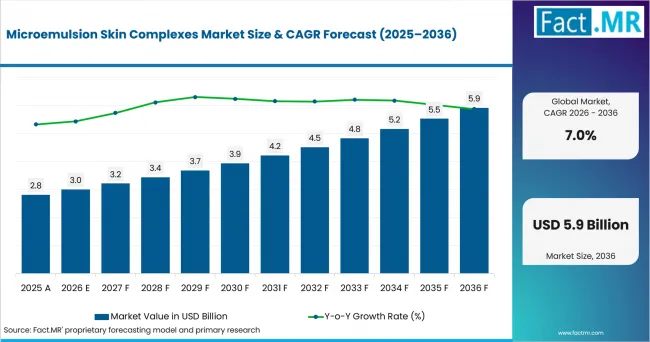
Microemulsion Skin Complexes Market Value Analysis | Source: Fact.MR
What are the defining numbers behind Microemulsion Skin Complexes Market growth?
USD 2.9 billion absolute opportunity is expected between 2026 and 2036.
- Demand Drivers in the Market
- Skin-care teams need easy ways to mix oil-based ingredients into light creams. Microemulsions help blend oil and water so products stay light, not heavy.
- Anti-aging product teams need stable retinoid delivery because light, oxygen, and formulation interactions can reduce usable active content. BASF reported in September 2025 that its solid-lipid retinol delivery system retained 83% after four months in a real-life study.
- Barrier-care teams need systems that protect ceramides and other lipids. The formula should keep them stable, feel light, and be simple to make.
- Sensitive-skin products need gentle systems. Encapsulation and slow release protect actives during storage and release them gradually, reducing irritation.
- Key Segments Analyzed
- By Active Class: Retinoids are expected to hold 35.0% share in 2026. Their established use in anti-aging creams and serums keeps stability and tolerability central to product design.
- By Microemulsion: O/W systems are forecast to account for 35.0% share in 2026. Their water-based structure fits light facial serums and creams used in daily skin care.
- By Skin Goal: Anti-aging is expected to capture 31.0% share in 2026. These products often combine retinoids, vitamin C, peptides, and lipid systems for wrinkle, firmness, and barrier care.
- By Format: Serum is expected to represent 36.0% share in 2026 owing to its fit with high-active positioning and light delivery systems.
- Analyst Opinion at Fact.MR
- Shambhu Nath Jha, Principal Consultant at Fact.MR, states, “The commercial question is less about whether an active is fashionable and more about whether it remains stable and usable inside the final formula. Microemulsion skin complexes are expected to gain value where product teams need a light format with controlled delivery. Suppliers should connect active chemistry with emulsion design and claim-support data.”
- Strategic Implications
- Product teams should choose the right oil phase and surfactant for each type of active ingredient. This can help keep the serum clear, pleasant on the skin, and stable over time.
- Brand teams should clearly understand the difference between a true microemulsion and other emulsion or encapsulation systems. This helps them choose the right technology partner and make accurate product claims.
- Contract manufacturers should keep mixing speed and temperature consistent. Changes in the process can affect droplet size, product texture, and overall consistency.
France is forecast to record 8.0% CAGR through 2036, supported by a large cosmetics production base and active product ecosystem. Japan is expected to post 6.6% as an aging population and established essence-serum routines support targeted skin care. The USA is projected at 6.3%, Germany at 6.0%, and the UK at 5.4% as product teams work within tighter product-safety and claims requirements.
How does the Microemulsion Skin Complexes Market break down by segment?
Retinoids lead Active Class at 35.0%; Serum leads Format at 36.0%.
Which Active Class dominates?
Retinoids are expected to hold 35.0% share in 2026.
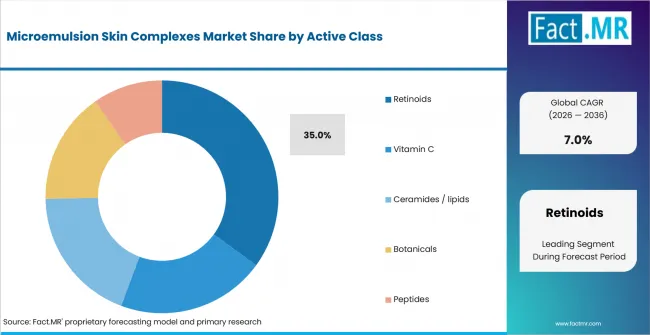
Microemulsion Skin Complexes Market Analysis By Active Class | Source: Fact.MR
Retinoids are the top choice because they’re widely used and proven to help skin. But brands still need to keep them stable and reduce irritation. Vitamin C is another big ingredient, often used for brightening and to fight oxidation. Ceramides and other lipids are best for barrier-repair products. Peptides and plant-based ingredients support many different skin-care claims. The main benefit comes from using the right delivery system, which protects each ingredient and makes the product feel good on the skin.
What leads the Microemulsion segment?
O/W is forecast to account for 35.0% share in 2026.
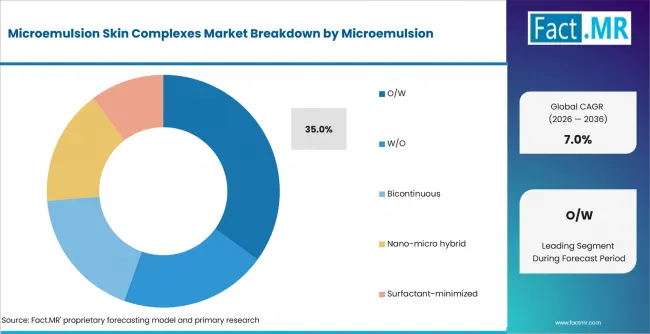
Microemulsion Skin Complexes Market Analysis By Microemulsion | Source: Fact.MR
Oil-in-water systems work well for light face creams because the water gives a fresh feel. The oil part carries oil-soluble ingredients in the same product. Water-in-oil systems are better for richer barrier creams. Bicontinuous structures help with special solubilization needs. Nano-micro hybrids and low-surfactant designs balance tricky formulation trade-offs. Evonik shares O/W and W/O face-care formulas, showing activity in both types.
How does Skin Goal shape demand?
Anti-aging is expected to lead with 31.0% share in 2026.
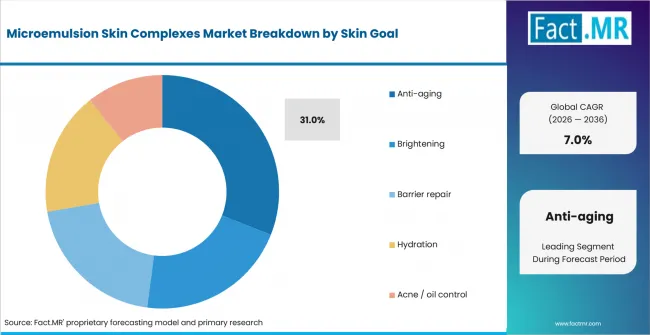
Microemulsion Skin Complexes Market Analysis By Skin Goal | Source: Fact.MR
Anti-aging products often mix retinoids and peptides with antioxidants or lipids. The delivery system must keep them stable and make the product feel good on skin. Brightening products use vitamin C and plant ingredients. Barrier-repair formulas rely on ceramides and lipids. Hydration products focus on humectants. Acne and oil-control products need ingredients that dissolve well and stay gentle. These needs guide teams in choosing the right delivery system for each skin-care goal.
What supports Serum within Format?
Serum is expected to represent 36.0% share in 2026.
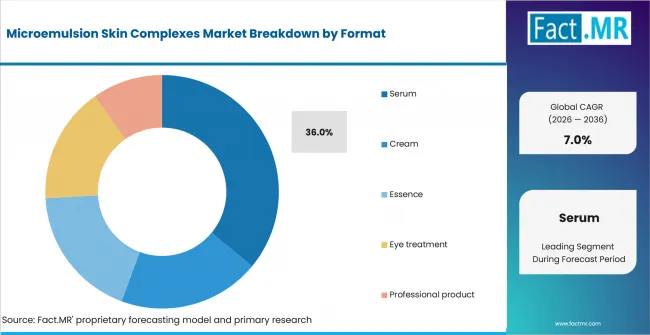
Microemulsion Skin Complexes Market Analysis By Format | Source: Fact.MR
Serums lead because light formats allow high actives, spread quickly, and layer easily. The concentrated serum drops category adds context for treatment-led formats. Creams stay central for richer barrier and anti-aging care. Essences fit water-rich delivery. Eye treatments need tighter tolerance and careful sensory control. In March 2026, Givaudan introduced VectorHyal as a hyaluronic-acid engineered delivery system designed for clear gels, serums and creams.
What is accelerating Microemulsion Skin Complexes Market adoption, and what is holding it back?
Active stability and light-format delivery support adoption; formula complexity and compliance rules restrain it.
Drivers Impact Analysis
| DRIVER | (~) % IMPACT ON CAGR | GEOGRAPHIC RELEVANCE | IMPACT TIMELINE |
|---|---|---|---|
| Retinoid and antioxidant stability needs | +1.3% | Global | Short term (<= 2 years) |
| Serum and essence format expansion | +1.0% | North America, Europe, East Asia | Medium term (2-4 years) |
| Barrier-repair and lipid delivery | +0.8% | Global | Medium term (2-4 years) |
| Controlled-release active systems | +0.6% | Europe, North America, Japan | Long term (>= 4 years) |
Source: Fact.MR analysis. Updated Sep 25, 2026
Opportunity Impact Analysis
| OPPORTUNITY | (~) % IMPACT ON CAGR | GEOGRAPHIC RELEVANCE | IMPACT TIMELINE |
|---|---|---|---|
| Retinoid delivery with lower irritation | +0.9% | North America, Europe, Japan | Short term (<= 2 years) |
| Ceramide and lipid complex delivery | +0.7% | Global | Medium term (2-4 years) |
| Transparent serum systems | +0.5% | East Asia, Europe | Medium term (2-4 years) |
| Professional treatment formats | +0.3% | USA, France, UK | Long term (>= 4 years) |
Source: Fact.MR analysis. Updated Sep 25, 2026
Restraints Impact Analysis
| RESTRAINT | (~) % IMPACT ON CAGR | GEOGRAPHIC RELEVANCE | IMPACT TIMELINE |
|---|---|---|---|
| Surfactant tolerance and sensory limits | -0.7% | Global | Short term (<= 2 years) |
| Complex stability validation | -0.6% | Global | Medium term (2-4 years) |
| Cosmetic safety and claims compliance | -0.5% | USA, UK, EU, Japan | Medium term (2-4 years) |
| Scale-up reproducibility | -0.3% | Global | Long term (>= 4 years) |
Source: Fact.MR analysis. Updated Sep 25, 2026
Which countries are scaling Microemulsion Skin Complexes Market fastest?
- The country comparison spans 2.6 percentage points and forms a clear range across the 2026 to 2036 forecast period.
- France remains 1.4 percentage points above Japan as its cosmetics product base supports premium active delivery concepts.
- Japan remains 0.3 percentage point above the United States as serum and essence formats keep light delivery systems relevant.
- The United States remains 0.3 percentage point above Germany as a broad cosmetics base supports active-led product design.
- Germany remains 0.6 percentage point above the United Kingdom as technical skill supports specialist skin-care systems.
- The United Kingdom closes the displayed range as digital beauty access and formal product-filing rules shape product design.
Comparable CAGRs can still create different entry conditions because active preferences, technical skill, and regulatory processes vary by country. Full report coverage includes North America, Latin America, Western Europe, Eastern Europe, East Asia, South Asia & Pacific, and Middle East & Africa.
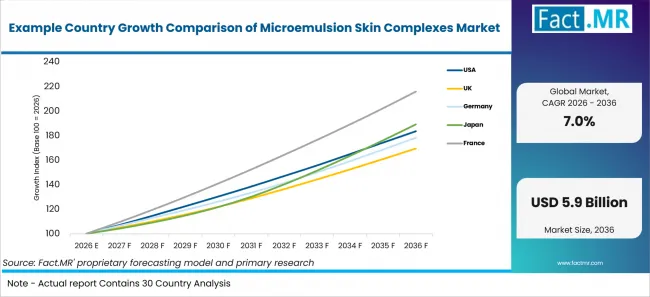
Example Country Growth Comparison Of Microemulsion Skin Complexes Market | Source: Fact.MR
| Country | CAGR (2026-2036) |
|---|---|
| France | 8.0% |
| Japan | 6.6% |
| United States | 6.3% |
| Germany | 6.0% |
| United Kingdom | 5.4% |
Source: Fact.MR analysis. Updated Sep 25, 2026
What supports the France outlook?
8.0% CAGR, supported by cosmetics product activity and premium skin-care positioning.
France combines established cosmetics know-how with a consumer base that supports premium facial care. Insee reported in June 2026 that French household spending on body care, social protection and miscellaneous goods and services reached EUR 96.7 billion in 2025. That spending base gives brands room to develop serums and treatment creams built around retinoids, vitamin C, peptides and barrier lipids. Microemulsion suppliers are likely to compete on product stability and skin feel. Premium products also need to feel light, support clear beauty claims, and deliver steady results throughout their shelf life.
How is Japan scaling demand?
6.6% CAGR, led by targeted skin-care routines and light facial formats.
Japanese skin-care routines place high value on essences and serums that layer easily, which suits water-rich microemulsion concepts. The Statistics Bureau of Japan reported in June 2026 that the country's population was 123.05 million in the preliminary 2025 Census count. That large consumer base supports targeted facial-care routines across hydration, anti-aging and barrier care.
What supports the United States outlook?
6.3% CAGR, driven by broad product activity and formal cosmetics listing requirements.
The United States gives ingredient suppliers access to a broad product base across anti-aging, brightening, barrier care, and hydration. The U.S. Food and Drug Administration reported 1,298,361 unique active cosmetic product listings under MoCRA as of June 30, 2026. This scale increases the number of formulas competing for distinct active delivery and clear result claims.
What supports Germany adoption?
6.0% CAGR, backed by technical skill and age-related skin-care needs.
Germany has a strong specialty-chemical and dermocosmetic base, giving product teams access to support for emulsifiers, actives, and delivery systems. Destatis reported in August 2026 that 19.3 million people in Germany were aged 65 or older in 2025, equal to 23% of the population. This age profile supports interest in anti-aging, hydration, and barrier-repair products.
What supports the United Kingdom outlook?
5.4% CAGR, shaped by digital beauty access and established product-notification processes.
The United Kingdom combines active online beauty retail with an established base of independent brands and contract formulators. The Office for National Statistics reported on January 23, 2026 that online sales represented 28.3% of total retail sales in Great Britain in December 2025. That channel mix supports discovery of treatment-led serums and other targeted facial products. Microemulsion suppliers can gain an advantage by offering systems that are easy to use and supported by clear product information. Smaller brands also need faster product development. At the same time, they must keep products safe, textures stable, and beauty claims clear.
Who leads the Microemulsion Skin Complexes Market?
BASF and Evonik offer a wide range of personal-care ingredients. Croda and Givaudan Active Beauty add more focused technologies for active ingredients and delivery systems.
BASF supplies personal-care ingredients and retinol delivery technologies. Its portfolio includes solid-lipid systems that help improve retinol stability and skin tolerance. Evonik offers both O/W and W/O emulsification technologies, along with cosmetic delivery systems for active ingredients.
Croda combines formulation ingredients with Beauty Actives and ceramide technologies for skin-barrier care and moisturisation. In February 2026, Croda reported that ceramide sales rose 36% at constant currency in 2025, although from a low base. The company linked this growth to wider global sales, stronger performance data, and continued work on new ceramides and delivery methods.
Which companies are the key providers?
Key companies include BASF, Evonik, Croda, Lipoid Kosmetik, and Givaudan Active Beauty.
- BASF
- Evonik
- Croda
- Lipoid Kosmetik
- Givaudan Active Beauty
Bibliography
- BASF. (2025, September 9). BASF to present the latest advancements in cosmetic science at IFSCC Congress.
- Evonik. (2025, February 12). PCHi 2025: Evonik introduces next-generation system solutions with stronger commitment to Chinese market.
- Givaudan. (2026, March 17). Givaudan Active Beauty elevates its delivery systems technology with VectorHyal™.
- Croda International Plc. (2026, February 24). 2025 full year results.
- Beretti, P.-A., & Pereira, É. (2026, June 16). La consommation des ménages en 2025 : La consommation des ménages ralentit en dépit d’une forte décélération des prix. Institut national de la statistique et des études économiques.
- Statistics Bureau of Japan. (2026, June 25). News Bulletin June 25, 2026 (No. 380).
- U.S. Food and Drug Administration. (2026, September 9). FDA clarifies it does not provide certificates or other documents to verify compliance for cosmetic product facility registration.
- Statistisches Bundesamt (Destatis). (2026, August 18). Die Bevölkerungsgruppe der älteren Menschen ab 65 Jahren.
- Office for National Statistics. (2026, January 23). Retail sales, Great Britain: December 2025.
This Report Answers
- The report explains strategic demand across Active Class and Microemulsion architecture, with emphasis on how active chemistry interacts with delivery design.
- Segment analysis identifies Retinoids at 35.0% of Active Class and Serum at 36.0% of Format in 2026.
- Country analysis covers France, Japan, the United States, Germany, and the United Kingdom with country-specific demand and restraint logic.
- Competitive analysis reviews BASF, Evonik, Croda, Lipoid Kosmetik, and Givaudan Active Beauty while keeping company-share figures outside the assessment.
What does the Microemulsion Skin Complexes Market cover?
Retinoid, vitamin C, ceramide, botanical and peptide complexes delivered through microemulsion-based skin-care formulations. Adjacent antioxidant-rich skincare demand helps frame vitamin C and botanical use.
The market covers microemulsion complexes used to solubilize, protect or deliver cosmetic actives in facial and professional skin care products. It includes O/W, W/O, bicontinuous, nano-micro hybrid and surfactant-minimized architectures.
What is included in the scope?
Microemulsion complexes used in serums, creams, essences, eye treatments and professional skin-care products. Adjacent barrier creams help define the boundary for richer barrier-support formats. Included coverage spans retinoids, vitamin C, ceramides and lipids, botanicals and peptides. It also covers oil-in-water and water-in-oil systems, bicontinuous structures, nano-micro hybrids and surfactant-minimized designs.
The broader ingredient boundary is checked against personal care active ingredients, while the linked adjacent categories above help frame active, barrier and finished-format demand. These interlinks provide context only and remain separate from the market sizing used in this assessment.
What is excluded from the scope?
Conventional emulsions without microemulsion functionality and standalone cosmetic actives sold without a delivery-system component are outside the scope.
The scope excludes finished skin-care revenue, general emulsifiers without a microemulsion delivery proposition, and non-microemulsion encapsulation platforms. Pharmaceutical transdermal systems are excluded when regulated as drug-delivery products.
How Was the Analysis Built?
The analysis draws on 120+ sources, 35+ company portfolios, 25+ countries, and more than 20 industry interviews.
- Primary Research: Primary research includes discussions with manufacturers, service providers, technology developers, distributors, end users, and subject-matter experts. These conversations examine purchasing priorities, product adoption, operational challenges, approval requirements, competitive positioning, and the factors that influence wider market acceptance.
- Desk Research: Desk research covers government statistics, regulatory publications, company filings, trade data, technical studies, industry associations, standards, public policy, and other authoritative sources. Every source used in the analysis is documented in the bibliography.
- Market Sizing and Forecasting: Market estimates combine historical performance, demand indicators, pricing and volume trends, segment shares, company participation, country-level growth, adoption patterns, investment activity, and barriers to market expansion.
- Data Validation and Update Cycle: Findings are validated by comparing primary interviews with public data, company activity, regulatory changes, trade patterns, and industry developments. Regular updates review new product launches, capacity changes, partnerships, approvals, and shifts in commercial adoption.
Segmentation
What is the report’s scope and coverage?
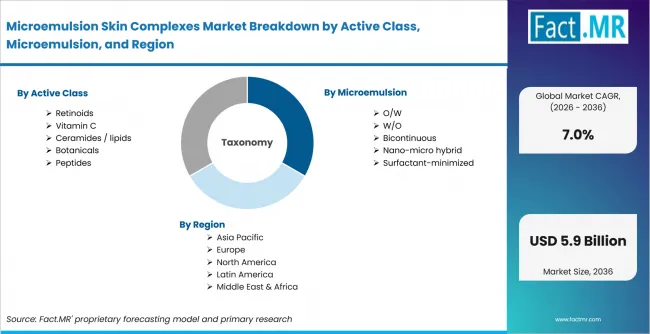
Microemulsion Skin Complexes Market Breakdown By Active Class, Microemulsion, And Region | Source: Fact.MR
| Attribute | Details |
|---|---|
| Quantitative Units | USD Billion |
| Market Definition | Microemulsion-based skin-care complexes that solubilize, stabilize, protect, or deliver cosmetic actives within serum, cream, essence, eye-treatment, and professional formulations. |
| Active Class | Retinoids; Vitamin C; Ceramides / lipids; Botanicals; Peptides |
| Microemulsion | O/W; W/O; Bicontinuous; Nano-micro hybrid; Surfactant-minimized |
| Skin Goal | Anti-aging; Brightening; Barrier repair; Hydration; Acne / oil control |
| Format | Serum; Cream; Essence; Eye treatment; Professional product |
| Regions Covered | North America; Latin America; Western Europe; Eastern Europe; East Asia; South Asia & Pacific; Middle East & Africa |
| Countries Covered | United States; United Kingdom; Germany; Japan; France |
| Key Companies Profiled | BASF; Evonik; Croda; Lipoid Kosmetik; Givaudan Active Beauty |
| Forecast Period | 2026 to 2036 |
| Approach | Hybrid top-down and bottom-up approach using active-class demand, formulation architecture, format mix, country conditions, provider portfolios, and official evidence review. |
Source: Fact.MR analysis. Updated Sep 25, 2026
How is the market segmented?
-
By Active Class
- Retinoids
- Vitamin C
- Ceramides / lipids
- Botanicals
- Peptides
-
By Microemulsion
- O/W
- W/O
- Bicontinuous
- Nano-micro hybrid
- Surfactant-minimized
-
By Skin Goal
- Anti-aging
- Brightening
- Barrier repair
- Hydration
- Acne / oil control
-
By Format
- Serum
- Cream
- Essence
- Eye treatment
- Professional product
-
By Region
- North America
- Latin America
- Western Europe
- Eastern Europe
- East Asia
- South Asia & Pacific
- Middle East & Africa
Frequently Asked Questions
How big is the Microemulsion Skin Complexes Market in 2026?
What is the CAGR of the Microemulsion Skin Complexes Market from 2026 to 2036?
Which active class leads the Microemulsion Skin Complexes Market?
Which format leads the Microemulsion Skin Complexes Market?
Who are the leading companies in the Microemulsion Skin Complexes Market?
Who worked on this report


Preview the report firsthand - request a free sample
Free SampleGet the brochure for pricing and purchase details
Download PDF