- Market Value (2025): USD 1.1 Bn
- Estimated Value (2026): USD 1.2 Bn
- Forecast Value (2036): USD 2.8 Bn
- CAGR (2026-2036): 8.9%
What is the Moisture-Cure Structural Adhesives Market forecast to be worth by 2036?
USD 1.2 billion in 2026 to USD 2.8 billion by 2036 at an 8.9% CAGR.
- The Moisture-Cure Structural Adhesives Market reached USD 1.1 billion in 2025.
- Demand is expected to increase from USD 1.2 billion in 2026 to USD 2.8 billion by 2036.
- The market is forecast to record an 8.9% CAGR from 2026 to 2036 as automotive assemblers and construction users adopt one-component structural bonding formats.
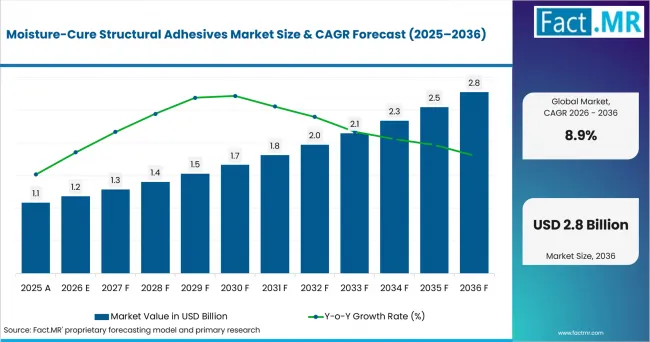
Moisture Cure Structural Adhesives Market Value Analysis | Source: Fact.MR
What are the defining numbers behind Moisture-Cure Structural Adhesives Market growth?
USD 1.6 billion absolute opportunity by 2036, led by 1K polyurethane, <15 min skin cure and automotive use.
- Demand Drivers in the Market
- Construction fabricators prefer one-component materials because they are easier to use during panel, facade, and modular assembly. They remove extra mixing steps and work well in both factory and on-site settings. Moisture-cure products also fit the wider construction adhesive category.
- Marine builders need flexible bonds that can handle vibration, moisture, and changing weather. Polyurethane systems are widely suited for glazing, decks, and panel bonding. These uses are also part of the broader marine adhesives category.
- Industrial assemblers value one-component systems because they are easy to store and dispense. They also reduce the need for meter-mix equipment. These materials can be used on selected metal, composite, glass, and plastic joints.
- A faster surface set helps parts move sooner through production. At the same time, the bond continues to cure inside. Product teams therefore balance working time, early hold, and full cure based on the needs of the assembly process.
- Key Segments Analyzed
- By Chemistry: 1K polyurethane is expected to hold 39.0% share in 2026 since it combines one-component use with elastic structural bonding across transport and construction uses.
- By Substrate: Metal-metal is expected to hold 29.0% share in 2026, supported by the large installed base of metallic frames, panels and assemblies that use flexible structural joints.
- By Cure Speed: <15 min skin is expected to capture 35.0% share in 2026 as production users seek faster handling without moving to two-component mixing equipment.
- By End-use: Automotive is expected to hold 31.0% share in 2026 owing to mixed-material joining, glazing, trim and body uses that benefit from flexible moisture-reactive bonding.
- Analyst Opinion at Fact.MR
- Shambhu Nath Jha, Principal Consultant at Fact.MR, states, “The commercial value of moisture-cure structural adhesives comes from process simplicity as much as bond performance. Demand is expected to favor systems that give predictable skin formation and reliable adhesion on mixed substrates. Suppliers that combine cure control with application support and documented durability are positioned to support qualification programs.”
- Strategic Implications
- Adhesive makers should clearly state skin time and full cure time at set temperature and humidity levels. This helps plant engineers choose the right working conditions and plan handling and fixture time.
- Automotive suppliers should provide bonding data for each type of surface. They should also explain the right pretreatment for metal, glass, composites, and plastics. Clear guidance can reduce testing time and speed up joint approval.
- Construction suppliers should support cartridge, sausage and bulk dispensing formats that match jobsite and factory workflows. In September 2026, Sika closed its acquisition of Akkim. Sika stated that Akkim generated net sales of about CHF 220 million in 2025. The acquisition expands distribution reach and production capacity.
- Distributors should separate structural elastic adhesives from general sealants in technical selection tools. Load transfer and cure depth need their own product checks. Movement needs must also be clear during use review.
How does the Moisture-Cure Structural Adhesives Market break down by segment?
1K polyurethane leads Chemistry at 39.0%; <15 min skin leads Cure Speed at 35.0%.
Which Chemistry category leads?
1K polyurethane holds 39.0% share in 2026.
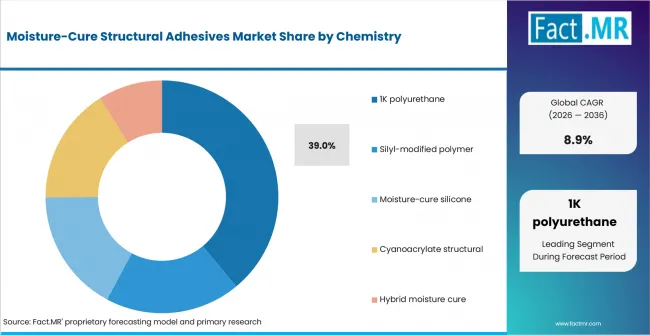
Moisture Cure Structural Adhesives Market Analysis By Chemistry | Source: Fact.MR
One-component polyurethane leads since it combines flexible structural bonding with a single-component process. Silyl-modified polymers serve similar flexible-bond needs. Henkel introduced Loctite MS 9650 in December 2025 as a one-component silane-modified polymer that cures through moisture and bonds glass, metal, painted surfaces and plastics. The chemistry mix also includes silicone adhesive systems and cyanoacrylate adhesive gels for narrower needs tied to temperature, handling or material type.
What leads the Substrate segment?
Metal-metal accounts for 29.0% share in 2026.
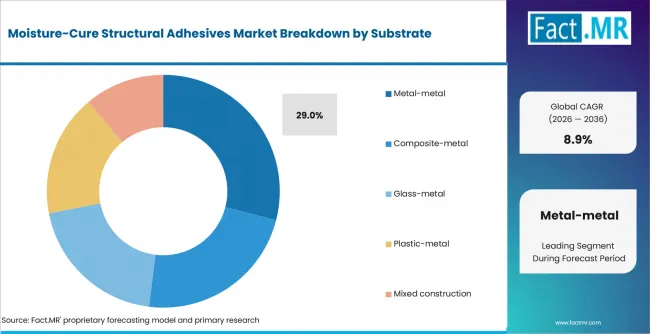
Moisture Cure Structural Adhesives Market Analysis By Substrate | Source: Fact.MR
Metal-metal bonding leads the substrate mix since steel and aluminium remain common in vehicles, industrial equipment, frames and construction assemblies. Elastic moisture-cure adhesives spread stress along the bond line. This can reduce point fastening in suitable designs. Composite-metal use expands where lightweight structures combine dissimilar materials. Glass-metal remains important in glazing and façade work. Plastic-metal and mixed construction need careful surface preparation. Some plastics and coated metals are harder to bond well.
How does Cure Speed shape demand?
<15 min skin represents 35.0% share in 2026.
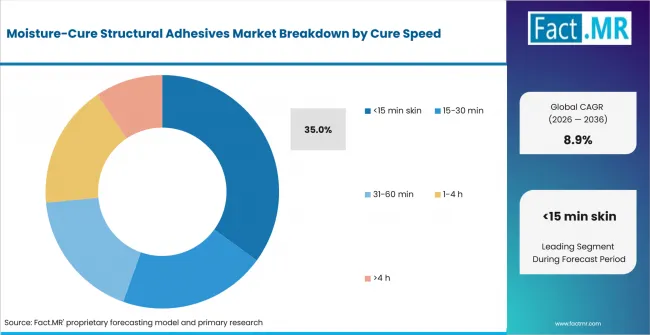
Moisture Cure Structural Adhesives Market Analysis By Cure Speed | Source: Fact.MR
Fast skin formation helps production teams keep the applied bead in place while deeper cure continues. The <15 minute category so suits faster lines and shorter fixture times. The 15–30 minute range supports assemblies that need more positioning time. The 31–60 minute and 1–4 hour formats suit larger bond areas or jobs that need more open time. >4 hour systems suit work that values longer positioning time before handling.
What supports Automotive within End-use?
Automotive holds 31.0% share in 2026.
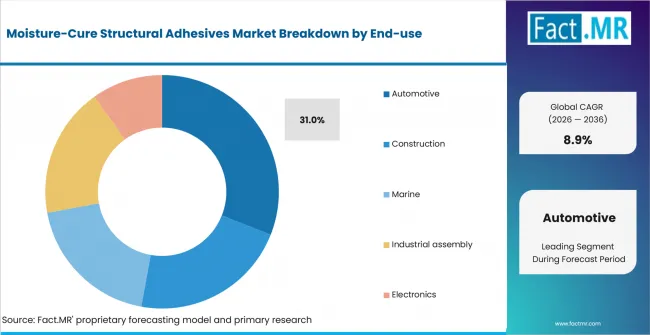
Moisture Cure Structural Adhesives Market Analysis By End Use | Source: Fact.MR
Automotive use leads because bonded joints must handle vibration and heat movement across different vehicle materials. One-component polyurethane and SMP products are used where flexible bonding, sealing and process simplicity overlap. The U.S. Bureau of Economic Analysis reported USD 19.0 billion in new foreign direct investment expenditures in plastics and rubber products manufacturing during 2025. The investment supports material-heavy production where engineered bonding is one route for joining parts.
What is accelerating Moisture-Cure Structural Adhesives Market adoption, and what is holding it back?
Mixed-material assembly and one-component processing drive adoption; humidity-sensitive cure and surface preparation restrain wider use.
Drivers Impact Analysis
| DRIVER | (~) % IMPACT ON CAGR | GEOGRAPHIC RELEVANCE | IMPACT TIMELINE |
|---|---|---|---|
| Mixed-material automotive joining | +1.7% | North America, Europe, East Asia | Medium term (2-4 years) |
| One-component process simplification | +1.4% | Global | Short term (<= 2 years) |
| Construction panel and façade bonding | +1.1% | Europe, North America, East Asia | Medium term (2-4 years) |
| Marine and transport vibration resistance | +0.8% | Europe, East Asia, North America | Long term (>= 4 years) |
Source: Fact.MR analysis. Updated Sep 25, 2026
Opportunity Impact Analysis
| OPPORTUNITY | (~) % IMPACT ON CAGR | GEOGRAPHIC RELEVANCE | IMPACT TIMELINE |
|---|---|---|---|
| Low-isocyanate and silane-modified structural systems | +1.0% | Europe, North America | Medium term (2-4 years) |
| Composite-metal mobility bonding | +0.8% | Europe, East Asia, North America | Long term (>= 4 years) |
| Modular construction and insulated panels | +0.6% | Europe, North America | Medium term (2-4 years) |
Source: Fact.MR analysis. Updated Sep 25, 2026
Restraints Impact Analysis
| RESTRAINT | (~) % IMPACT ON CAGR | GEOGRAPHIC RELEVANCE | IMPACT TIMELINE |
|---|---|---|---|
| Humidity-dependent cure variability | -0.8% | Global | Short term (<= 2 years) |
| Slow through-cure in thick bond lines | -0.6% | Global | Medium term (2-4 years) |
| Surface preparation and primer requirements | -0.5% | Global | Medium term (2-4 years) |
Source: Fact.MR analysis. Updated Sep 25, 2026
Which countries are scaling Moisture-Cure Structural Adhesives Market fastest?
- The country comparison spans 1.2 percentage points across the forecast period.
- The United Kingdom remains 0.3 percentage point above Japan as construction and transport assembly support one-component elastic bonding.
- Japan remains 0.3 percentage point above the United States through construction investment and precision production activity.
- The United States remains 0.3 percentage point above Germany as construction and industrial assembly sustain broad use coverage.
- Germany remains 0.3 percentage point above France through vehicle engineering and construction uses that use elastic structural joints.
- France closes the displayed range at 8.3% as automotive and building uses continue to support structural adhesive use.
Comparable CAGRs create different entry conditions since cure control, testing practices and end-use activity vary by country. Full report coverage includes North America, Latin America, Western Europe, Eastern Europe, East Asia, South Asia & Pacific, and Middle East & Africa.
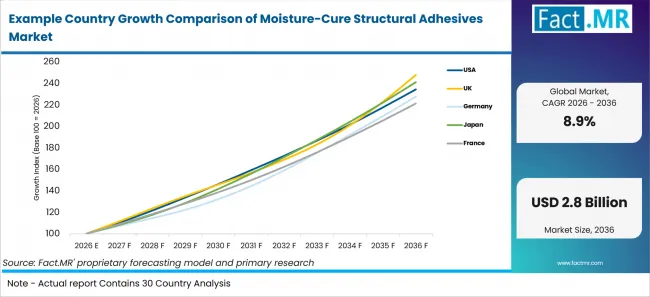
Example Country Growth Comparison Of Moisture Cure Structural Adhesives Market | Source: Fact.MR
| Country | CAGR (2026-2036) |
|---|---|
| United Kingdom | 9.5% |
| Japan | 9.2% |
| United States | 8.9% |
| Germany | 8.6% |
| France | 8.3% |
Source: Fact.MR analysis. Updated Sep 25, 2026
What supports the United Kingdom’s growth?
9.5% CAGR, supported by construction output and transport assembly.
UK construction gives adhesive suppliers a broad base of panel, facade and modular uses. The Office for National Statistics reported in February 2026 that annual construction output increased 1.8% in 2025 compared with 2024. One-component polyurethane and SMP systems suit projects that need flexible bonds and simple use. Cure time still depends on local temperature and humidity.
How is Japan scaling demand?
9.2% CAGR, shaped by construction investment and precision production.
Japan combines precise factory work with a large construction program. The Ministry of Land, Infrastructure, Transport and Tourism reported in August 2025 that FY2025 construction investment was forecast at JPY 75.57 trillion. Structural adhesives serve building, glazing and transport work. Engineers can set clear limits for skin time, surface preparation and deeper cure.
What supports USA adoption?
8.9% CAGR, supported by construction activity and mixed-material assembly.
The United States has a broad use base across construction, transport and industrial assembly. The U.S. Census Bureau reported in February 2026 that December 2025 construction spending ran at a seasonally adjusted annual rate of about USD 2.169 trillion. Moisture-cure products suit panels, frames and selected mixed-material joints. One-component use cuts mixing steps when plant teams can control humidity and bond depth.
What is supporting Germany’s adoption?
8.6% CAGR, reinforced by construction turnover and vehicle engineering.
Germany combines vehicle engineering with a large construction base. Destatis reported in February 2026 that nominal turnover in the main construction industry reached EUR 120.5 billion in 2025. Moisture-cure structural adhesives suit metal, glass and composite joints. Technical teams can approve primers, bead size and cure conditions before production starts.
How does France perform?
8.3% CAGR, supported by automotive and building uses.
France has a large vehicle market alongside building renovation and facade work. The Service des données et études statistiques reported in February 2026 that 1.665 million new passenger cars were registered in 2025. Adhesive suppliers serve glazing, body and interior bonding as well as construction joints. Product choice depends on material fit, movement needs and steady moisture cure.
Who leads the Moisture-Cure Structural Adhesives Market?
Sika sells polyurethane and silane-modified bonding systems for transportation and construction. Henkel offers LOCTITE and TEROSON products that include one-component moisture-curing systems. 3M provides PUR adhesives and polyurethane adhesive-sealant systems, while H.B. Fuller supplies moisture-curing polyurethane products for applications including industrial assembly and building construction.
Dow supplies silicone adhesive and structural-glazing materials for automotive and construction applications. Bostik, part of Arkema, offers SMP adhesive-sealants and related bonding technologies. In February 2025, Arkema announced that Bostik would unveil Prep DB at JEC World 2025, a primer designed to enable bond disassembly for vehicle repair and end-of-life recycling. Competitive context also overlaps with the wider adhesives and sealants category.
Which companies are the key providers?
Key companies include Sika; Henkel; 3M; H.B. Fuller; Dow; and Bostik.
- Sika
- Henkel
- 3M
- H.B. Fuller
- Dow
- Bostik
Bibliography
- International Energy Agency. (2025, May 14). Trends in electric car markets. In Global EV Outlook 2025.
- Sika. (2026, September 3). Sika closes acquisition of Akkim – Accelerating global expansion in adhesives and sealants.
- Henkel. (2025, December 12). Henkel launches Loctite MS 9650 for durable, lightweight structural bonding for automotive display.
- Arkema. (2025, February 25). Arkema at JEC World 2025: Lighter, more efficient, and sustainable innovations in specialty materials.
- Office for National Statistics. (2026, February 12). Construction output in Great Britain: December 2025, new orders and Construction Output Price Indices, October to December 2025.
- U.S. Census Bureau. (2026, February 27). Monthly construction spending, December 2025.
- Statistisches Bundesamt (Destatis). (2026, February 25). KORREKTUR: Auftragseingang im Bauhauptgewerbe 2025 um 6,8 % höher als im Vorjahr [Correction: Orders received in the main construction industry in 2025 up 6.8% on the previous year].
- Didou, O., & Limousin, F. (2026, February 11). Immatriculations de voitures en 2025 : le marché du neuf baisse, celui de l’occasion résiste. Service des données et études statistiques.
This Report Addresses
- The report explains where moisture-cure structural adhesives fit across chemistry, substrate, cure speed and end-use needs.
- Segment analysis identifies the four 2026 leaders and explains the process conditions that support their positions.
- Country analysis compares the five listed CAGRs and reviews use-specific demand and restraints for each market.
- Competitive analysis verifies the current provider set and reviews its current market activity.
- Application analysis considers cure depth, skin formation, substrate preparation and elastic load transfer in structural bonding decisions.
What does the Moisture-Cure Structural Adhesives Market cover?
The scope covers one-component polyurethane, silane-modified polymer, moisture-cure silicone, cyanoacrylate structural and hybrid moisture-cure products used for load-bearing or semi-structural bonding. The boundary stays focused on moisture-reactive products specified for structural bonding. General sealing volumes stay outside the scope.
Application coverage includes automotive, construction, marine, industrial assembly and electronics. Related technology context includes thermal conductive adhesives where bonds must also help manage heat in electronics and mobility assemblies.
What is included in the scope?
Included products use moisture in the air as a main cure stage. Coverage includes reactive polyurethane, SMP, selected silicone and cyanoacrylate structural formats when the product is used for structural or semi-structural bonding.
The analysis also considers fast skinning, mixed-material joints and controlled dispensing. Cure speed is assessed against surface preparation and joint shape. Air humidity and the needed handling window are part of the same check.
What is excluded from the scope?
The scope excludes pressure-sensitive tapes, water-based laminating adhesives and two-component structural systems whose primary cure is independent of ambient moisture. Standalone mechanical fastening, welding consumables and general adhesive equipment systems are outside the material boundary.
General caulking, gap filling and weather sealing are treated separately unless the same formulation is specified for load-transfer bonding. This keeps structural adhesive demand distinct from wider sealant consumption.
How Was the Analysis Built?
The analysis draws on 120+ sources, 35+ company portfolios, 25+ countries, and more than 20 industry interviews.
- Primary Research: Primary research includes discussions with manufacturers, service providers, technology developers, distributors, end users, and subject-matter experts. These conversations examine purchasing priorities, product adoption, operational challenges, approval requirements, competitive positioning, and the factors that influence wider market acceptance.
- Desk Research: Desk research covers government statistics, regulatory publications, company filings, trade data, technical studies, industry associations, standards, public policy, and other authoritative sources. Every source used in the analysis is documented in the bibliography.
- Market Sizing and Forecasting: Market estimates combine historical performance, demand indicators, pricing and volume trends, segment shares, company participation, country-level growth, adoption patterns, investment activity, and barriers to market expansion.
- Data Validation and Update Cycle: Findings are validated by comparing primary interviews with public data, company activity, regulatory changes, trade patterns, and industry developments. Regular updates review new product launches, capacity changes, partnerships, approvals, and shifts in commercial adoption.
Segmentation
What is the report’s scope and coverage?
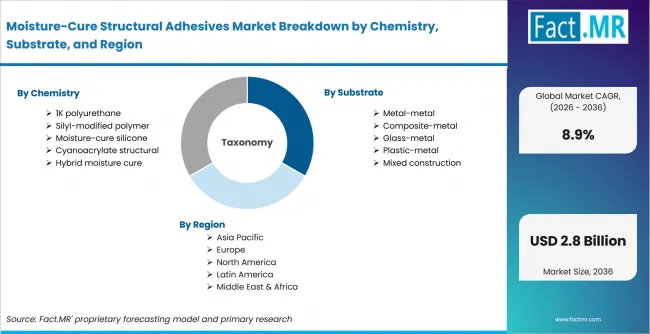
Moisture Cure Structural Adhesives Market Breakdown By Chemistry, Substrate, And Region | Source: Fact.MR
| Attribute | Details |
|---|---|
| Quantitative Units | USD billion |
| Market Definition | One-component or moisture-reactive structural adhesives formulated to develop load-bearing or semi-structural bonds through ambient moisture, including polyurethane, silane-modified polymer, silicone, cyanoacrylate structural and hybrid moisture-cure systems. |
| Chemistry | 1K polyurethane; Silyl-modified polymer; Moisture-cure silicone; Cyanoacrylate structural; Hybrid moisture cure |
| Substrate | Metal-metal; Composite-metal; Glass-metal; Plastic-metal; Mixed construction |
| Cure Speed | <15 min skin; 15-30 min; 31-60 min; 1-4 h; >4 h |
| End-use | Automotive; Construction; Marine; Industrial assembly; Electronics |
| Regions Covered | North America; Latin America; Western Europe; Eastern Europe; East Asia; South Asia & Pacific; Middle East & Africa |
| Countries Covered | United States; United Kingdom; Germany; Japan; France |
| Key Companies Profiled | Sika; Henkel; 3M; H.B. Fuller; Dow; Bostik |
| Forecast Period | 2026 to 2036 |
| Approach | Hybrid top-down and bottom-up review using end-use assembly activity, chemistry fit, substrate requirements, cure-speed selection and verified supplier participation. |
Source: Fact.MR analysis. Updated Sep 25, 2026
How is the market segmented?
-
By Chemistry
- 1K polyurethane
- Silyl-modified polymer
- Moisture-cure silicone
- Cyanoacrylate structural
- Hybrid moisture cure
-
By Substrate
- Metal-metal
- Composite-metal
- Glass-metal
- Plastic-metal
- Mixed construction
-
By Cure Speed
- <15 min skin
- 15-30 min
- 31-60 min
- 1-4 h
- >4 h
-
By End-use
- Automotive
- Construction
- Marine
- Industrial assembly
- Electronics
-
By Region
- North America
- Latin America
- Western Europe
- Eastern Europe
- East Asia
- South Asia & Pacific
- Middle East & Africa
Frequently Asked Questions
How big is the moisture-cure structural adhesives market in 2026?
What is the CAGR of the moisture-cure structural adhesives market from 2026 to 2036?
Which chemistry leads the moisture-cure structural adhesives market?
Which substrate leads the moisture-cure structural adhesives market?
Who are the leading companies in the moisture-cure structural adhesives market?
Who worked on this report


Preview the report firsthand - request a free sample
Free SampleGet the brochure for pricing and purchase details
Download PDF