- Market Value (2025): USD 149.2 Mn
- Estimated Value (2026): USD 185.0 Mn
- Forecast Value (2036): USD 1590.0 Mn
- CAGR (2026-2036): 24.0%
What is the Mycelium Packaging Films Market forecast to be worth by 2036?
USD 185.0 million in 2026 to USD 1,590.0 million by 2036, at a 24.0% CAGR.
- The mycelium packaging films market crossed a valuation of USD 149.2 million in 2025.
- Demand is projected to increase from USD 185.0 million in 2026 to USD 1,590.0 million by 2036.
- The market is forecast to record a 24.0% CAGR from 2026 to 2036 as produce brands and foodservice packers test low-waste film formats.
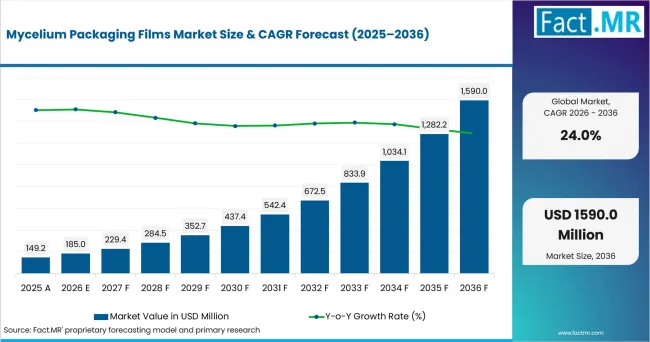
Mycelium Packaging Films Market Value Analysis | Source: Fact.MR
What are the defining numbers behind Mycelium Packaging Films Market growth?
USD 1,405.0 million absolute opportunity by 2036, led by bio-polymer blends, flexible film and produce packaging.
- Demand Drivers in the Market
- Produce packers need breathable films that manage surface moisture while keeping fruit and vegetable quality visible at retail.
- Snack brands need grease and aroma barriers that reduce dependence on fossil-based film layers in premium packs.
- Foodservice operators need compostable sachets and wraps that fit portion control while supporting local waste-sorting routines.
- Packaging converters need fungal composites that bond with bio-polymers during coating or forming.
- Key Segments Analyzed
- By Material: Bio-polymer blends are expected to hold 38.0% share in 2026, supported by their ability to combine fungal biomass with processable film matrices.
- By Format: Flexible film is projected to account for 41.0% share in 2026 since it fits produce bags, liners and flow-wrap trials.
- By Barrier Function: Moisture is anticipated to capture 44.0% share in 2026 owing to its direct role in fresh-food quality and shelf life.
- By Application: Produce is estimated to represent 44.0% share in 2026 as fruit and vegetable packs require breathable protection and visible freshness.
- Analyst Opinion at Fact.MR
- Shambhu Nath Jha, Principal Consultant at Fact.MR, states, “Mycelium films draw attention because biomaterials must prove real packaging performance before scale-up. Adoption is expected to widen where suppliers document moisture behavior and composability outcomes. Better-positioned providers should combine mycelium know-how with converter support and country-specific waste-rule guidance.”
- Strategic Implications
- Material developers should publish barrier data for moisture and grease under food-contact storage conditions.
- Converters should test bio-polymer blends on existing coating and film lines before investing in dedicated mycelium capacity.
- Food brands should qualify formats by application since produce packaging needs different breathing behavior than snack wraps.
- Retailers should link composability claims with collection guidance so packaging choices match local waste systems and zero waste packaging programs.
The UK is projected to record 30.5% CAGR through 2036, supported by food spending and packaging-compliance pressure. The USA is forecast to post 28.9% as large retail food flows meet produce-packaging trials. Japan is expected to advance at 27.5% as food exports and waste policy shape material choice. South Korea is anticipated to reach 19.0%, and Germany is estimated at 18.1% as recycling rules raise the proof burden for new packaging materials.
How does the Mycelium Packaging Films Market break down by segment?
Bio-polymer blends lead Material at 38.0%; Flexible film leads Format at 41.0%.
Which Material dominates?
Bio-polymer blends hold 38.0% share in 2026.
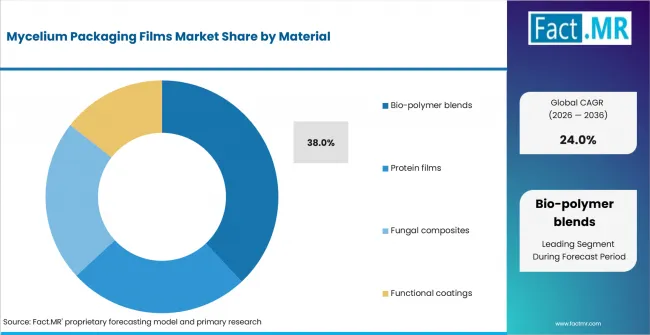
Mycelium Packaging Films Market Analysis By Material | Source: Fact.MR
Bio-polymer blends lead because pure fungal materials need support to meet thin-film strength and handling requirements. Blends help converters tune flexibility while retaining the mycelium material story that brand owners want in sustainable packaging trials.
What leads the Format segment?
Flexible film accounts for 41.0% share in 2026.
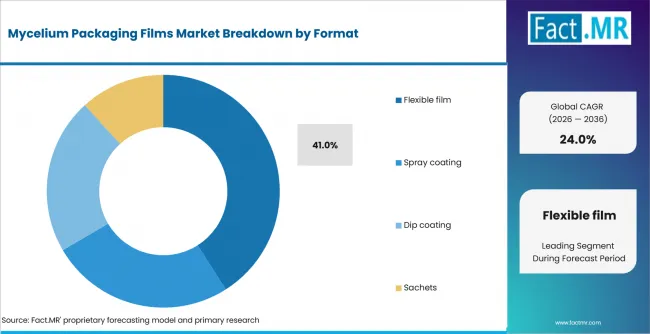
Mycelium Packaging Films Market Analysis By Format | Source: Fact.MR
Flexible film leads because brands already use thin wraps and liners across fresh-food distribution. Mycelium-based films must match filling-line handling before wider use. Spray and dip coating remain practical routes for adding a functional layer to paper or shaped substrates.
How does Barrier Function shape demand?
Moisture holds 44.0% share in 2026.
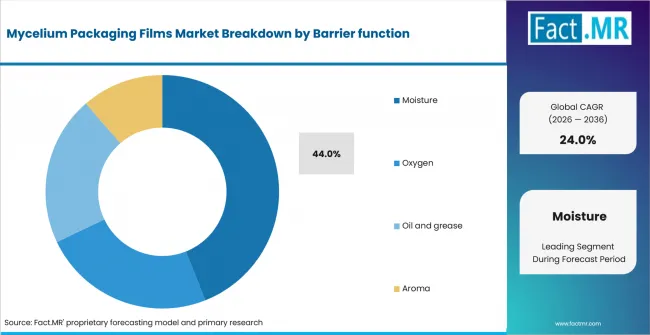
Mycelium Packaging Films Market Analysis By Barrier Function | Source: Fact.MR
Moisture control carries the main share because fresh foods fail quickly when packaging traps water or dries the surface. Suppliers need barrier data that compares moisture behavior with oxygen, oil and aroma functions in sustainable food packaging applications.
What supports Produce within Application?
Produce represents 44.0% share in 2026.
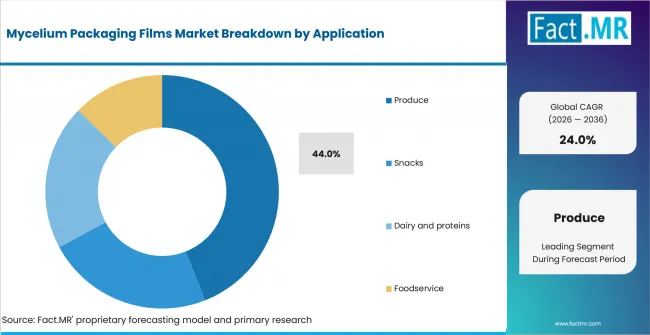
Mycelium Packaging Films Market Analysis By Application | Source: Fact.MR
Produce leads because fruit and vegetable packaging creates daily consumer contact with plastic-reduction claims. USDA NASS reported in February 2026 that vegetable and melon production was estimated for 28 U.S. crops in 2025.
What is accelerating Mycelium Packaging Films Market adoption, and what is holding it back?
Demand is rising through plastic-replacement pressure; adoption is constrained by film consistency and certification proof.
Drivers Impact Analysis
| Driver | (~) % Impact on CAGR | Geographic Relevance | Impact Timeline |
|---|---|---|---|
| Produce shelf-life and breathable barrier requirements | +2.3% | North America, Western Europe, East Asia | Short term (<= 2 years) |
| Replacement of EPS and rigid fossil-plastic packaging | +1.7% | North America, Western Europe | Medium term (2-4 years) |
| Moisture barrier qualification for fungal bio-polymer blends | +1.2% | Global | Medium term (2-4 years) |
| Retailer waste programs and packaging-data reporting | +0.8% | Europe, South Korea, Japan | Long term (>= 4 years) |
Source: Fact.MR analysis. Updated Aug 26, 2026
- Produce shelf-life and breathable barrier requirements: Fresh-food brands value packaging that controls moisture while keeping product quality visible to shoppers.
- Replacement of EPS and rigid fossil-plastic packaging: Mycelium packaging gains attention when packers need a bio-based substitute for protective formats facing disposal pressure.
- Moisture barrier qualification for fungal bio-polymer blends: Film trials become more credible when suppliers document moisture behavior under chilled and ambient distribution conditions.
Opportunity Impact Analysis
| Opportunity | (~) % Impact on CAGR | Geographic Relevance | Impact Timeline |
|---|---|---|---|
| Coated paper and produce liners for fresh-food packs | +1.3% | North America, Europe | Short term (<= 2 years) |
| Hybrid bio-polymer blends with mycelium functional layers | +1.0% | Global | Medium term (2-4 years) |
| Custom protective formats for premium goods | +0.7% | Europe, North America | Long term (>= 4 years) |
Source: Fact.MR analysis. Updated Aug 26, 2026
- Coated paper and produce liners: Film developers gain an entry point through formats that add a functional layer to familiar paper or tray systems.
- Hybrid bio-polymer blends: Blends create a path to better strength and converting behavior while retaining a bio-based position beside compostable laminate packaging materials.
- Custom protective formats: Premium goods and electronics are better able to absorb higher unit costs when packaging protection and low-waste branding both carry value.
Restraints Impact Analysis
| Restraint | (~) % Impact on CAGR | Geographic Relevance | Impact Timeline |
|---|---|---|---|
| Film-grade consistency across biological feedstocks | -0.9% | Global | Short term (<= 2 years) |
| Compostability claims that differ by local waste system | -0.7% | Europe, Japan, South Korea | Medium term (2-4 years) |
| Cost and throughput gap against commodity plastic films | -0.6% | Global | Long term (>= 4 years) |
Source: Fact.MR analysis. Updated Aug 26, 2026
- Film-grade consistency across biological feedstocks: Mycelium materials vary by fibre origin and growing conditions, raising the testing burden for converters.
- Compostability claims that differ by local waste system: Laboratory standards still need city-level collection routes before a pack claim works in everyday use.
- Cost and throughput gap against commodity plastic films: High-speed packers need reliable width, gauge and seal behavior before routine line replacement expands.
Which countries are scaling the Mycelium Packaging Films Market through 2036?
- The country comparison spans 12.4 percentage points between the UK and Germany.
- The UK remains 1.6 percentage points above the USA as food spending and packaging-compliance pressure support early trials.
- The USA remains 1.4 percentage points above Japan because large retail food flows give produce films a broader testing base.
- Japan remains 8.5 percentage points above South Korea as food exports and waste policy create a clearer route for bio-based packaging.
- South Korea remains 0.9 percentage point above Germany as K-Food exports and plastic-reduction planning support branded packaging shifts.
Comparable CAGRs create different entry conditions due to retail channels, produce supply, packaging-waste rules and film qualification routines. Coverage includes North America, Latin America, Western Europe, Eastern Europe, East Asia, South Asia & Pacific, Middle East & Africa.
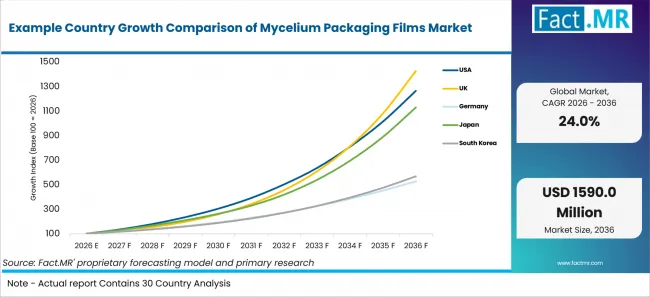
Example Country Growth Comparison Of Mycelium Packaging Films Market | Source: Fact.MR
| Country | CAGR (2026-2036) |
|---|---|
| UK | 30.5% |
| USA | 28.9% |
| Japan | 27.5% |
| South Korea | 19.0% |
| Germany | 18.1% |
Source: Fact.MR analysis. Updated Aug 26, 2026
What supports UK adoption?
30.5% CAGR, shaped by food spending, produce demand and packaging-compliance pressure.
The UK’s growth is supported by a large packaged-food market and active experimentation with biological packaging. Defra reported that, in real terms at constant 2023 prices, UK consumer expenditure on food and alcoholic drinks reached GBP 303.3 billion in 2025, while total vegetable supply reached 4.7 million tonnes. These volumes create opportunities for mycelium films in produce and food packaging, while packaging-rule documentation and composting guidance remain important for wider commercial adoption.
How is the USA scaling demand?
28.9% CAGR, supported by retail food scale and produce-packaging trials.
The USA’s growth reflects very large food and retail channels that can support trials of breathable and flexible mycelium films. USDA ERS reported USD 2.51 trillion in inflation-adjusted U.S. food spending in 2025, while July 2026 retail and food-services sales reached USD 763.6 billion. High packaging throughput supports experimentation, although cost sensitivity, line-speed consistency and uneven composting access can influence adoption.
How is Japan scaling demand?
27.5% CAGR, led by food exports and packaging-waste reduction pressure.
Japan’s growth is supported by export-oriented food channels and continued attention to waste reduction. MAFF reported JPY 1.7005 trillion in agricultural, forestry, fishery and food exports in 2025, while municipal waste generation reached 38.11 million tonnes in FY2024. These conditions support interest in lightweight biological films, provided converters can demonstrate food-contact compliance, barrier performance and credible end-of-life handling.
How is South Korea developing demand?
19.0% CAGR, supported by K-Food exports and plastic-reduction initiatives.
South Korea’s growth reflects expanding food exports and retail activity alongside pressure to reduce single-use plastics. MAFRA reported that K-Food+ exports reached USD 13.62 billion in 2025, while MOTIR reported that sales at 26 major retailers increased 9.0% year over year in May 2026. These channels create room for premium mycelium-film applications, although performance in humid conditions, cold-chain use and local disposal systems remain important qualification factors.
What supports Germany adoption?
18.1% CAGR, backed by recycling discipline and packaging-waste pressure.
Germany’s growth is supported by an established recycling framework and strong scrutiny of packaging materials. UBA and ZSVR reported that around 5.5 million tonnes of packaging waste collected through Germany’s dual systems were recovered in 2024, while UBA reported that 12.44 million tonnes of packaging waste were recycled across Germany in 2023. Mycelium films can gain interest where they demonstrate clear moisture, grease and end-of-life performance without creating additional sorting complexity.
Who leads the Mycelium Packaging Films Market?
Ecovative shows strong direct relevance through its established mycelium-material platform and packaging-focused applications. Its expertise in growing fungal structures into engineered materials provides a foundation for developing lightweight, bio-based packaging formats and supports wider commercialization of mycelium-derived alternatives.
Dharaksha Ecosolutions strengthens the competitive landscape through mycelium-based packaging designed to replace conventional protective materials. Its focus on agricultural-waste feedstocks and fungal processing supports scalable packaging applications where biodegradability and material efficiency influence purchasing decisions.
Which companies are the key providers?
Key companies include Ecovative, Dharaksha Ecosolutions, PermaFungi, and Biohm.
- Ecovative
- Dharaksha Ecosolutions
- PermaFungi
- Biohm
Bibliography
- Department for Environment, Food & Rural Affairs. (2026, July 29). Food statistics in your pocket. GOV.UK.
- Department for Environment, Food & Rural Affairs. (2026, June 25). Horticulture statistics 2025. GOV.UK.
- Environment Agency. (2026, May 22). Compliance monitoring and enforcement activity 2025. GOV.UK.
- Ministry of Agriculture, Food and Rural Affairs. (2026, January 20). Exports of K-Food Plus reached USD 13.6 billion in 2025, up 5.1% year-over-year.
- Ministry of Climate, Energy and Environment. (2025, December 23). Public Forum for the Formulation of a Comprehensive Plastic Reduction Plan.
- Ministry of the Environment, Government of Japan. (2026, March 27). Municipal solid waste generation and disposal in FY2024.
- Ministry of Trade, Industry and Resources. (2026, June 24). Major retailer sales up 9.0% in May 2026.
- U.S. Census Bureau. (2026, August 14). Advance monthly sales for retail and food services: July 2026.
- U.S. Department of Agriculture, National Agricultural Statistics Service. (2026, February 12). Vegetables 2025 Summary.
- Umweltbundesamt, & Zentrale Stelle Verpackungsregister. (2026, January 27). Facts against myths: Packaging waste recycling in Germany is working.
This Report Addresses
- The report explains where mycelium packaging films are used across material, format, barrier function and application.
- Segment analysis identifies the subsegments that shape qualification work and explains why moisture and produce packaging hold visible positions.
- Country analysis examines the listed markets and the retail, produce and packaging-waste conditions supporting adoption.
- Competitive analysis reviews current mycelium material and packaging companies without assigning provider percentages.
- Application analysis assesses how moisture control, barrier proof and compostability claims influence purchase decisions.
What does the Mycelium Packaging Films Market cover?
The Mycelium Packaging Films Market covers bio-based film, coating and thin protective packaging made from mycelium, fungal composites or mycelium-linked bio-polymer blends. It includes formats used where brands want lower dependence on conventional plastic while retaining food-packaging performance.
What is included in the scope?
The scope includes flexible films, functional coatings, dip-coated substrates and sachets where fungal biomass or mycelium-grown composites are part of the packaging proposition. It includes prototype formats used in food packaging.
The market connects with bioplastics for packaging and circular packaging where film qualification overlaps with plastic substitution, converter testing and end-of-life claims.
What is excluded from the scope?
The scope excludes mycelium leather and acoustic panels sold outside packaging films or coatings. Furniture and insulation products remain outside scope. It also excludes conventional plastic films that use nature-based language without verified mycelium, fungal composite or bio-polymer blend content.
Molded mycelium inserts are considered only when company evidence informs film, coating or thin protective packaging use. Pure pulp trays and compostable plastics remain outside scope when mycelium is absent from the material system.
How Was the Analysis Built?
The analysis draws on 120+ public references, 35+ company portfolios, 25+ countries and more than 20 industry interviews.
- Primary Research: Primary research includes discussions with packaging manufacturers and biomaterial developers. It also includes food brands, retailers, distributors and procurement teams. These conversations examine adoption priorities and approval requirements.
- Desk Research: Desk research covers government statistics, regulatory publications, company pages, technical studies, standards, public policy and other authoritative inputs. Every reference used in the analysis is documented in the bibliography.
- Market Sizing and Forecasting: Market estimates combine historical performance, replacement indicators, barrier requirements, segment shares, company participation, country-level growth and adoption barriers.
- Data Validation and Update Cycle: Findings are validated by comparing interviews with public data, company activity, regulatory changes, packaging-waste trends and commercial developments. Updates review launches, capacity changes, partnerships and approvals.
Segmentation
What is the report’s scope and coverage?
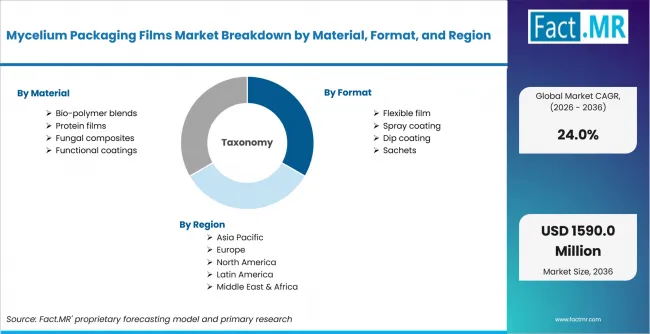
Mycelium Packaging Films Market Breakdown By Material, Format, And Region | Source: Fact.MR
| Attribute | Details |
|---|---|
| Quantitative Units | USD million |
| Market Definition | Bio-based film, coating and thin protective packaging materials made with mycelium, fungal composites or mycelium-linked bio-polymer blends for food and protective packaging use. |
| Material | Bio-polymer blends; Protein films; Fungal composites; Functional coatings |
| Format | Flexible film; Spray coating; Dip coating; Sachets |
| Barrier Function | Moisture; Oxygen; Oil and grease; Aroma |
| Application | Produce; Snacks; Dairy and proteins; Foodservice |
| Regions Covered | North America; Latin America; Western Europe; Eastern Europe; East Asia; South Asia & Pacific; Middle East & Africa |
| Countries Covered | United States; United Kingdom; Germany; Japan; South Korea |
| Key Companies Profiled | Ecovative; Dharaksha Ecosolutions; PermaFungi; Biohm |
| Forecast Period | 2026 to 2036 |
| Approach | Hybrid top-down and bottom-up approach using packaging replacement indicators; food-retail activity; produce supply; barrier-function needs; country adoption; and provider portfolio review. |
Source: Fact.MR analysis. Updated Aug 26, 2026
How is the market segmented?
-
By Material:
- Bio-polymer blends
- Protein films
- Fungal composites
- Functional coatings
-
By Format:
- Flexible film
- Spray coating
- Dip coating
- Sachets
-
By Barrier Function:
- Moisture
- Oxygen
- Oil and grease
- Aroma
-
By Application:
- Produce
- Snacks
- Dairy and proteins
- Foodservice
-
By Region:
- North America
- Latin America
- Western Europe
- Eastern Europe
- East Asia
- South Asia & Pacific
- Middle East & Africa
Frequently Asked Questions
How big is the mycelium packaging films market in 2026?
What is the CAGR of the mycelium packaging films market from 2026 to 2036?
Which material leads the mycelium packaging films market?
Which format leads the mycelium packaging films market?
Who are the leading companies in the mycelium packaging films market?
Who worked on this report


Preview the report firsthand - request a free sample
Free SampleGet the brochure for pricing and purchase details
Download PDF