Ultra-Low Volatization Urea Market

Ultra-Low Volatization Urea Market Size and Share Forecast Outlook 2026 to 2036

Ultra-low volatization urea market is projected to grow from USD 0.4 billion in 2026 to USD 1.1 billion by 2036, at a CAGR of 11.2%. Corn/Maize will dominate with a 46.8% market share, while polymer will lead the coating type segment with a 45.5% share.

Ultra-Low Volatilization Urea Coating System Market Forecast and Outlook 2026 to 2036

Projected to grow from USD 0.38 billion in 2026 to USD 1.09 billion by 2036, the ultra-low volatilization urea coating system market is set to advance at a significant CAGR of 11.2%. This accelerated growth reflects a critical evolution in nitrogen management, targeting one of the most significant sources of fertilizer inefficiency and environmental pollution ammonia loss to the atmosphere. These advanced coating technologies are engineered to control the release and conversion of urea, dramatically reducing gaseous emissions and maximizing nitrogen availability for crop uptake.

Key Takeaways from the Ultra-Low Volatilization Urea Coating System Market

  • Market Value for 2026: USD 0.38 Billion
  • Market Value for 2036: USD 1.09 Billion
  • Forecast CAGR (2026 to2036): 11.2%
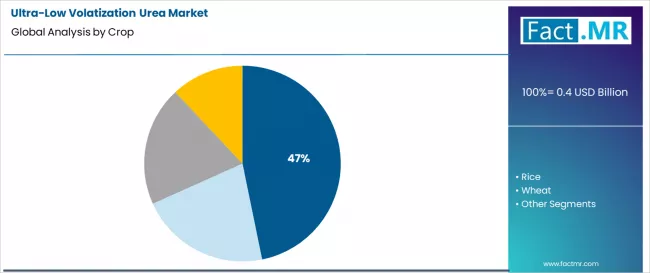
  • Leading Crop Share (2026): Corn/Maize (47%)
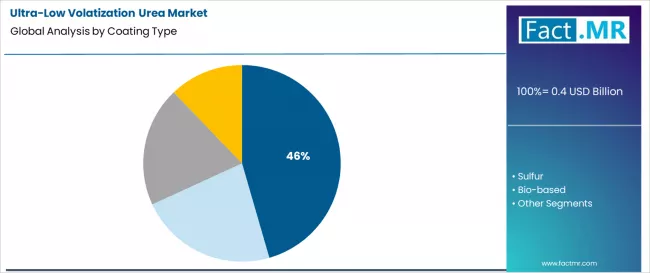
  • Leading Coating Type Share (2026): Polymer (46%)
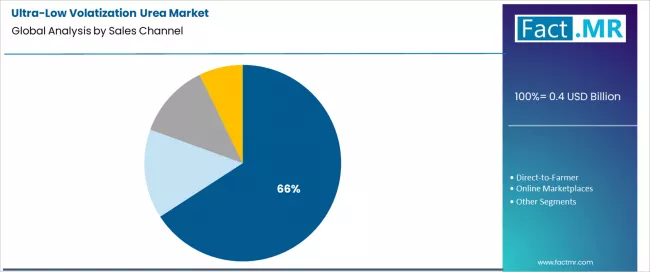
  • Leading Sales Channel Share (2026): Ag-Retailers (66%)
  • Key Players in the Market: Koch Agronomic Services, BASF, Nutrien, Yara International, CF Industries, EuroChem
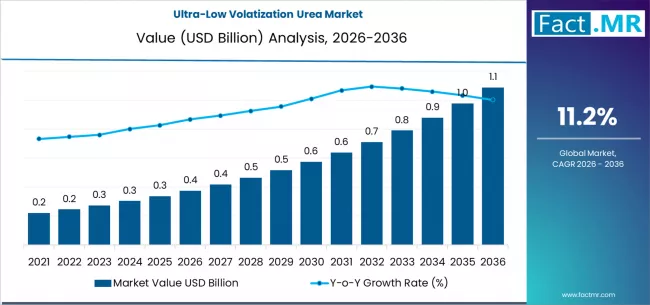
Ultra Low Volatization Urea Market Market Value Analysis

Corn/maize cultivation is the dominant crop segment, accounting for 47% of demand, driven by its high nitrogen requirement and vast cultivated area where even minor efficiency gains translate into substantial economic and environmental benefits. Polymer-based coatings represent the leading technology, with a 46% share, due to their precise and tunable barrier properties. The established network of Ag-Retailers remains the crucial sales channel, controlling 66% of the market, as they provide the essential technical guidance and blending services required for these specialized products.

Market expansion is fueled by the global imperative to improve nitrogen use efficiency in agriculture. Volatilization losses from conventional urea can exceed 30%, representing a major economic waste for farmers and a source of atmospheric pollution contributing to particulate matter and reactive nitrogen deposition. Ultra-low volatilization coatings directly address this by slowing hydrolysis, minimizing pH spikes at the granule surface, and ensuring nitrogen remains in the root zone. This technology is becoming a cornerstone for meeting both productivity goals and increasingly stringent environmental regulations on ammonia emissions.

Metric

Metric Value
Market Value (2026) USD 0.38 Billion
Market Forecast Value (2036) USD 1.09 Billion
Forecast CAGR (2026 to 2036) 11.2%

Category

Category Segments
Crop Corn/Maize, Rice, Wheat, Sugarcane
Coating Type Polymer, Sulfur, Bio-based, Inhibitor-Infused
Sales Channel Ag-Retailers, Direct-to-Farmer, Online Marketplaces, Cooperatives
Region North America, Latin America, Western Europe, Eastern Europe, East Asia, South Asia & Pacific, MEA

Segmental Analysis

By Crop, Which Segment Drives Large-Scale Adoption?
Ultra Low Volatization Urea Market Analysis By Crop

Corn/maize is the leading crop segment, commanding a 47% share. The high nitrogen demand of corn, coupled with its extensive monoculture planting patterns, creates the single largest addressable market for enhanced efficiency fertilizers.

The economic scale of corn production allows farmers to more readily invest in premium-coated urea, as the potential yield protection and reduced need for top-dressing applications offer a clear return on investment. This crop's sensitivity to nitrogen timing makes controlled-release and volatilization-reducing technologies particularly valuable.

By Coating Type, Which Technology Offers Precision Control?
Ultra Low Volatization Urea Market Analysis By Coating Type

Polymer coatings lead the technology segment with a 46% share. These coatings create a physical barrier around the urea granule, with release characteristics engineered based on polymer thickness and composition, often triggered by soil temperature and moisture.

This provides the most predictable and extended release profile, effectively synchronizing nitrogen availability with crop demand stages. Advanced polymer systems can be layered or combined with inhibitors to manage both volatilization and nitrification, offering a comprehensive solution for nitrogen stewardship.

By Sales Channel, How is This Technical Product Distributed?
Ultra Low Volatization Urea Market Analysis By Sales Channel

Ag-retailers are the predominant sales channel, controlling 66% of the market. The complexity of choosing the right coating type and application rate for specific soil conditions and crops necessitates expert advice.

Ag-retailers fulfill this role, providing agronomic consulting, soil testing, and often operating blending towers to create customized fertilizer mixes that incorporate coated urea. Their local presence and trusted relationships with growers are indispensable for educating the market and driving the adoption of this performance-driven input.

What are the Drivers, Restraints, and Key Trends of the Market?

The primary market driver is the increasing regulatory pressure on ammonia emissions from agriculture, particularly in Europe and North America, where national emission ceilings are being enforced. The rising cost of urea manufacturing, linked to natural gas prices, makes minimizing waste through volatilization an economic imperative. Growing farmer awareness of nitrogen stewardship and the tangible yield benefits from improved NUE under variable weather conditions are powerful adoption drivers from the ground level.

A key restraint is the additional cost per unit of nutrient compared to uncoated urea. While the ROI can be positive, the upfront cost can deter adoption, especially among price-sensitive smallholder farmers or in seasons with narrow crop margins. Performance can also be variable depending on soil moisture and temperature, which affect coating breakdown rates. Furthermore, the existence of multiple coating technologies (polymer, sulfur, bio-based) can create confusion in the market without clear, localized agronomic data to guide product selection.

Significant trends include the development of multifunctional smart coatings that combine volatilization control with micronutrients or biostimulants. There is a notable shift toward bio-based and biodegradable polymer coatings derived from plant oils or starches to improve the environmental profile of the coating itself. The integration of digital tools is also emerging, with some products linked to decision-support platforms that recommend optimal coating types and application rates based on satellite data and soil sensors.

Analysis of the Ultra-Low Volatilization Urea Coating System Market by Key Countries
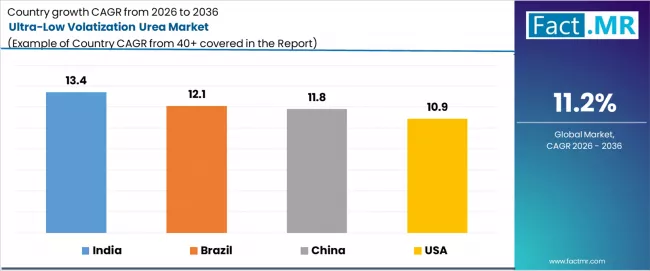
Ultra Low Volatization Urea Market Cagr Analysis By Country

Country CAGR (2026 to 2036)
India 13.4%
Brazil 12.1%
China 11.8%
USA 10.9%

What Factors underpin India's Exceptional Growth Rate?

India's leading CAGR of 13.4% is driven by the government's intense focus on improving fertilizer subsidy efficiency and reducing environmental impact. Policy initiatives promote the use of coated and fortified urea to reduce the country's massive urea consumption while maintaining yields.

The widespread cultivation of rice and wheat, which are highly susceptible to volatilization losses under warm, flooded or irrigated conditions, creates a vast and immediate need for this technology.

How does Brazil's Agricultural Model Influence Demand?

Brazil's 12.1% growth is fueled by its large-scale, technology-intensive production of corn and sugarcane. The tropical climate and often acidic soils can exacerbate nitrogen losses. Brazilian farmers, focused on sustainability credentials for export markets, are rapid adopters of practices that enhance efficiency. The scalability of farming operations allows for the cost-effective adoption of coated urea, viewed as an investment in yield stability and soil health in the Cerrado and other key regions.

Why is China's Market Expansion Linked to Policy Directives?

China's 11.8% CAGR is closely tied to its national Zero-Growth in Fertilizer Use action plan and growing concerns over air pollution from agricultural ammonia. Government support for the production and use of controlled-release and stabilized fertilizers is a major market driver.

The vast rice and wheat growing regions, where urea is the dominant nitrogen source, present a tremendous opportunity for coating technologies to deliver on national goals for both food security and environmental improvement.

What drives the Ultra-Low Volatization Urea Market in USA?
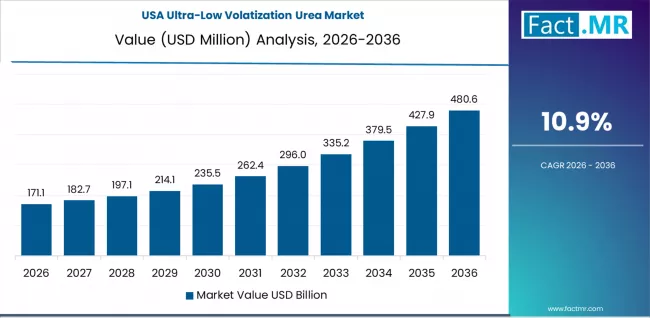
Ultra Low Volatization Urea Market Country Value Analysis

The USA's 10.9% growth stems from a mature precision agriculture sector, strong environmental regulation of nutrient runoff in watersheds like the Chesapeake Bay and Mississippi Basin, and the economic calculus of large-scale corn belt farmers.

The well-established system of ag-retailers and crop advisors effectively communicates the agronomic and regulatory benefits of these products. Adoption is further supported by the potential for coated urea to fit into integrated nutrient management plans that enhance sustainability branding for grain.

Competitive Landscape of the Ultra-Low Volatilization Urea Coating System Market
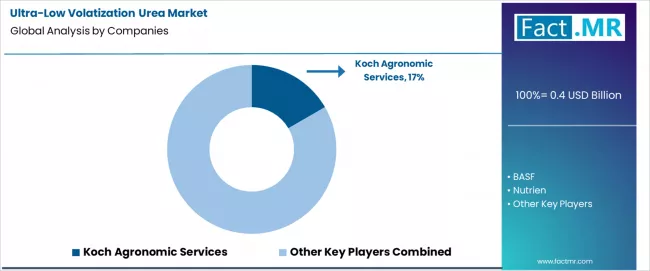
Ultra Low Volatization Urea Market Analysis By Company

Global nitrogen fertilizer producers and specialty chemical companies competing on coating technology IP, agronomic research, and supply chain integration characterize the competitive landscape.

Competition centers on proving superior field efficacy through extensive on-farm trial networks, developing cost-advantaged coating processes, and forming strategic partnerships with blenders and distributors. The ability to offer a portfolio of solutions, from simple inhibitor-infused coatings to advanced multi-layer polymers, for different crops and price points is a key differentiator.

Key Players in the Ultra-Low Volatilization Urea Coating System Market

  • Koch Agronomic Services
  • BASF SE
  • Nutrien
  • Yara International
  • CF Industries
  • EuroChem

Scope of Report

Items Values
Quantitative Units USD Billion
Crop Corn/Maize, Rice, Wheat, Sugarcane
Coating Type Polymer, Sulfur, Bio-based, Inhibitor-Infused
Sales Channel Ag-Retailers, Direct-to-Farmer, Online Marketplaces, Cooperatives
Key Countries India, Brazil, China, USA
Key Companies Koch Agronomic Services, BASF, Nutrien, Yara International, CF Industries, EuroChem
Additional Analysis Chemical mechanisms of urea hydrolysis and volatilization; comparative analysis of coating release kinetics; environmental impact assessment of reduced ammonia emissions; economic modeling of ROI for coated urea across different crop systems; regulatory frameworks for ammonia abatement in agriculture.

Market by Segments

Crop :

  • Corn/Maize
  • Rice
  • Wheat
  • Sugarcane

Coating Type :

  • Polymer
  • Sulfur
  • Bio-based
  • Inhibitor-Infused

Sales Channel :

  • Ag-Retailers
  • Direct-to-Farmer
  • Online Marketplaces
  • Cooperatives

Region :

  • North America
    • USA
    • Canada
  • Latin America
    • Brazil
    • Mexico
    • Argentina
    • Rest of Latin America
  • Western Europe
    • Germany
    • UK
    • France
    • Spain
    • Italy
    • BENELUX
    • Rest of Western Europe
  • Eastern Europe
    • Russia
    • Poland
    • Czech Republic
    • Rest of Eastern Europe
  • East Asia
    • China
    • Japan
    • South Korea
    • Rest of East Asia
  • South Asia & Pacific
    • India
    • ASEAN
    • Australia
    • Rest of South Asia & Pacific
  • MEA
    • Saudi Arabia
    • UAE
    • Turkiye
    • Rest of MEA

Table of Content

  1. Executive Summary
    • Global Market Outlook
    • Demand to side Trends
    • Supply to side Trends
    • Technology Roadmap Analysis
    • Analysis and Recommendations
  2. Market Overview
    • Market Coverage / Taxonomy
    • Market Definition / Scope / Limitations
  3. Market Background
    • Market Dynamics
      • Drivers
      • Restraints
      • Opportunity
      • Trends
    • Scenario Forecast
      • Demand in Optimistic Scenario
      • Demand in Likely Scenario
      • Demand in Conservative Scenario
    • Opportunity Map Analysis
    • Product Life Cycle Analysis
    • Supply Chain Analysis
    • Investment Feasibility Matrix
    • Value Chain Analysis
    • PESTLE and Porter’s Analysis
    • Regulatory Landscape
    • Regional Parent Market Outlook
    • Production and Consumption Statistics
    • Import and Export Statistics
  4. Global Market Analysis 2021 to 2025 and Forecast, 2026 to 2036
    • Historical Market Size Value (USD Million) Analysis, 2021 to 2025
    • Current and Future Market Size Value (USD Million) Projections, 2026 to 2036
      • Y to o to Y Growth Trend Analysis
      • Absolute $ Opportunity Analysis
  5. Global Market Pricing Analysis 2021 to 2025 and Forecast 2026 to 2036
  6. Global Market Analysis 2021 to 2025 and Forecast 2026 to 2036, By Crop
    • Introduction / Key Findings
    • Historical Market Size Value (USD Million) Analysis By Crop, 2021 to 2025
    • Current and Future Market Size Value (USD Million) Analysis and Forecast By Crop, 2026 to 2036
      • Corn/Maize
      • Rice
      • Wheat
      • Sugarcane
    • Y to o to Y Growth Trend Analysis By Crop, 2021 to 2025
    • Absolute $ Opportunity Analysis By Crop, 2026 to 2036
  7. Global Market Analysis 2021 to 2025 and Forecast 2026 to 2036, By Coating Type
    • Introduction / Key Findings
    • Historical Market Size Value (USD Million) Analysis By Coating Type, 2021 to 2025
    • Current and Future Market Size Value (USD Million) Analysis and Forecast By Coating Type, 2026 to 2036
      • Polymer
      • Sulfur
      • Bio-based
      • Inhibitor-Infused
    • Y to o to Y Growth Trend Analysis By Coating Type, 2021 to 2025
    • Absolute $ Opportunity Analysis By Coating Type, 2026 to 2036
  8. Global Market Analysis 2021 to 2025 and Forecast 2026 to 2036, By Sales Channel
    • Introduction / Key Findings
    • Historical Market Size Value (USD Million) Analysis By Sales Channel, 2021 to 2025
    • Current and Future Market Size Value (USD Million) Analysis and Forecast By Sales Channel, 2026 to 2036
      • Ag-Retailers
      • Direct-to-Farmer
      • Online Marketplaces
      • Cooperatives
    • Y to o to Y Growth Trend Analysis By Sales Channel, 2021 to 2025
    • Absolute $ Opportunity Analysis By Sales Channel, 2026 to 2036
  9. Global Market Analysis 2021 to 2025 and Forecast 2026 to 2036, By Region
    • Introduction
    • Historical Market Size Value (USD Million) Analysis By Region, 2021 to 2025
    • Current Market Size Value (USD Million) Analysis and Forecast By Region, 2026 to 2036
      • North America
      • Latin America
      • Western Europe
      • Eastern Europe
      • East Asia
      • South Asia and Pacific
      • Middle East & Africa
    • Market Attractiveness Analysis By Region
  10. North America Market Analysis 2021 to 2025 and Forecast 2026 to 2036, By Country
    • Historical Market Size Value (USD Million) Trend Analysis By Market Taxonomy, 2021 to 2025
    • Market Size Value (USD Million) Forecast By Market Taxonomy, 2026 to 2036
      • By Country
        • USA
        • Canada
        • Mexico
      • By Crop
      • By Coating Type
      • By Sales Channel
    • Market Attractiveness Analysis
      • By Country
      • By Crop
      • By Coating Type
      • By Sales Channel
    • Key Takeaways
  11. Latin America Market Analysis 2021 to 2025 and Forecast 2026 to 2036, By Country
    • Historical Market Size Value (USD Million) Trend Analysis By Market Taxonomy, 2021 to 2025
    • Market Size Value (USD Million) Forecast By Market Taxonomy, 2026 to 2036
      • By Country
        • Brazil
        • Chile
        • Rest of Latin America
      • By Crop
      • By Coating Type
      • By Sales Channel
    • Market Attractiveness Analysis
      • By Country
      • By Crop
      • By Coating Type
      • By Sales Channel
    • Key Takeaways
  12. Western Europe Market Analysis 2021 to 2025 and Forecast 2026 to 2036, By Country
    • Historical Market Size Value (USD Million) Trend Analysis By Market Taxonomy, 2021 to 2025
    • Market Size Value (USD Million) Forecast By Market Taxonomy, 2026 to 2036
      • By Country
        • Germany
        • UK
        • Italy
        • Spain
        • France
        • Nordic
        • BENELUX
        • Rest of Western Europe
      • By Crop
      • By Coating Type
      • By Sales Channel
    • Market Attractiveness Analysis
      • By Country
      • By Crop
      • By Coating Type
      • By Sales Channel
    • Key Takeaways
  13. Eastern Europe Market Analysis 2021 to 2025 and Forecast 2026 to 2036, By Country
    • Historical Market Size Value (USD Million) Trend Analysis By Market Taxonomy, 2021 to 2025
    • Market Size Value (USD Million) Forecast By Market Taxonomy, 2026 to 2036
      • By Country
        • Russia
        • Poland
        • Hungary
        • Balkan & Baltic
        • Rest of Eastern Europe
      • By Crop
      • By Coating Type
      • By Sales Channel
    • Market Attractiveness Analysis
      • By Country
      • By Crop
      • By Coating Type
      • By Sales Channel
    • Key Takeaways
  14. East Asia Market Analysis 2021 to 2025 and Forecast 2026 to 2036, By Country
    • Historical Market Size Value (USD Million) Trend Analysis By Market Taxonomy, 2021 to 2025
    • Market Size Value (USD Million) Forecast By Market Taxonomy, 2026 to 2036
      • By Country
        • China
        • Japan
        • South Korea
      • By Crop
      • By Coating Type
      • By Sales Channel
    • Market Attractiveness Analysis
      • By Country
      • By Crop
      • By Coating Type
      • By Sales Channel
    • Key Takeaways
  15. South Asia and Pacific Market Analysis 2021 to 2025 and Forecast 2026 to 2036, By Country
    • Historical Market Size Value (USD Million) Trend Analysis By Market Taxonomy, 2021 to 2025
    • Market Size Value (USD Million) Forecast By Market Taxonomy, 2026 to 2036
      • By Country
        • India
        • ASEAN
        • Australia & New Zealand
        • Rest of South Asia and Pacific
      • By Crop
      • By Coating Type
      • By Sales Channel
    • Market Attractiveness Analysis
      • By Country
      • By Crop
      • By Coating Type
      • By Sales Channel
    • Key Takeaways
  16. Middle East & Africa Market Analysis 2021 to 2025 and Forecast 2026 to 2036, By Country
    • Historical Market Size Value (USD Million) Trend Analysis By Market Taxonomy, 2021 to 2025
    • Market Size Value (USD Million) Forecast By Market Taxonomy, 2026 to 2036
      • By Country
        • Kingdom of Saudi Arabia
        • Other GCC Countries
        • Turkiye
        • South Africa
        • Other African Union
        • Rest of Middle East & Africa
      • By Crop
      • By Coating Type
      • By Sales Channel
    • Market Attractiveness Analysis
      • By Country
      • By Crop
      • By Coating Type
      • By Sales Channel
    • Key Takeaways
  17. Key Countries Market Analysis
    • USA
      • Pricing Analysis
      • Market Share Analysis, 2025
        • By Crop
        • By Coating Type
        • By Sales Channel
    • Canada
      • Pricing Analysis
      • Market Share Analysis, 2025
        • By Crop
        • By Coating Type
        • By Sales Channel
    • Mexico
      • Pricing Analysis
      • Market Share Analysis, 2025
        • By Crop
        • By Coating Type
        • By Sales Channel
    • Brazil
      • Pricing Analysis
      • Market Share Analysis, 2025
        • By Crop
        • By Coating Type
        • By Sales Channel
    • Chile
      • Pricing Analysis
      • Market Share Analysis, 2025
        • By Crop
        • By Coating Type
        • By Sales Channel
    • Germany
      • Pricing Analysis
      • Market Share Analysis, 2025
        • By Crop
        • By Coating Type
        • By Sales Channel
    • UK
      • Pricing Analysis
      • Market Share Analysis, 2025
        • By Crop
        • By Coating Type
        • By Sales Channel
    • Italy
      • Pricing Analysis
      • Market Share Analysis, 2025
        • By Crop
        • By Coating Type
        • By Sales Channel
    • Spain
      • Pricing Analysis
      • Market Share Analysis, 2025
        • By Crop
        • By Coating Type
        • By Sales Channel
    • France
      • Pricing Analysis
      • Market Share Analysis, 2025
        • By Crop
        • By Coating Type
        • By Sales Channel
    • India
      • Pricing Analysis
      • Market Share Analysis, 2025
        • By Crop
        • By Coating Type
        • By Sales Channel
    • ASEAN
      • Pricing Analysis
      • Market Share Analysis, 2025
        • By Crop
        • By Coating Type
        • By Sales Channel
    • Australia & New Zealand
      • Pricing Analysis
      • Market Share Analysis, 2025
        • By Crop
        • By Coating Type
        • By Sales Channel
    • China
      • Pricing Analysis
      • Market Share Analysis, 2025
        • By Crop
        • By Coating Type
        • By Sales Channel
    • Japan
      • Pricing Analysis
      • Market Share Analysis, 2025
        • By Crop
        • By Coating Type
        • By Sales Channel
    • South Korea
      • Pricing Analysis
      • Market Share Analysis, 2025
        • By Crop
        • By Coating Type
        • By Sales Channel
    • Russia
      • Pricing Analysis
      • Market Share Analysis, 2025
        • By Crop
        • By Coating Type
        • By Sales Channel
    • Poland
      • Pricing Analysis
      • Market Share Analysis, 2025
        • By Crop
        • By Coating Type
        • By Sales Channel
    • Hungary
      • Pricing Analysis
      • Market Share Analysis, 2025
        • By Crop
        • By Coating Type
        • By Sales Channel
    • Kingdom of Saudi Arabia
      • Pricing Analysis
      • Market Share Analysis, 2025
        • By Crop
        • By Coating Type
        • By Sales Channel
    • Turkiye
      • Pricing Analysis
      • Market Share Analysis, 2025
        • By Crop
        • By Coating Type
        • By Sales Channel
    • South Africa
      • Pricing Analysis
      • Market Share Analysis, 2025
        • By Crop
        • By Coating Type
        • By Sales Channel
  18. Market Structure Analysis
    • Competition Dashboard
    • Competition Benchmarking
    • Market Share Analysis of Top Players
      • By Regional
      • By Crop
      • By Coating Type
      • By Sales Channel
  19. Competition Analysis
    • Competition Deep Dive
      • Koch Agronomic Services
        • Overview
        • Product Portfolio
        • Profitability by Market Segments (Product/Age /Sales Channel/Region)
        • Sales Footprint
        • Strategy Overview
          • Marketing Strategy
          • Product Strategy
          • Channel Strategy
      • BASF
      • Nutrien
      • Yara International
      • CF Industries
      • EuroChem
  20. Assumptions & Acronyms Used
  21. Research Methodology

List Of Table

  • Table 1: Global Market Value (USD Million) Forecast by Region, 2021 to 2036
  • Table 2: Global Market Value (USD Million) Forecast by Crop, 2021 to 2036
  • Table 3: Global Market Value (USD Million) Forecast by Coating Type, 2021 to 2036
  • Table 4: Global Market Value (USD Million) Forecast by Sales Channel, 2021 to 2036
  • Table 5: North America Market Value (USD Million) Forecast by Country, 2021 to 2036
  • Table 6: North America Market Value (USD Million) Forecast by Crop, 2021 to 2036
  • Table 7: North America Market Value (USD Million) Forecast by Coating Type, 2021 to 2036
  • Table 8: North America Market Value (USD Million) Forecast by Sales Channel, 2021 to 2036
  • Table 9: Latin America Market Value (USD Million) Forecast by Country, 2021 to 2036
  • Table 10: Latin America Market Value (USD Million) Forecast by Crop, 2021 to 2036
  • Table 11: Latin America Market Value (USD Million) Forecast by Coating Type, 2021 to 2036
  • Table 12: Latin America Market Value (USD Million) Forecast by Sales Channel, 2021 to 2036
  • Table 13: Western Europe Market Value (USD Million) Forecast by Country, 2021 to 2036
  • Table 14: Western Europe Market Value (USD Million) Forecast by Crop, 2021 to 2036
  • Table 15: Western Europe Market Value (USD Million) Forecast by Coating Type, 2021 to 2036
  • Table 16: Western Europe Market Value (USD Million) Forecast by Sales Channel, 2021 to 2036
  • Table 17: Eastern Europe Market Value (USD Million) Forecast by Country, 2021 to 2036
  • Table 18: Eastern Europe Market Value (USD Million) Forecast by Crop, 2021 to 2036
  • Table 19: Eastern Europe Market Value (USD Million) Forecast by Coating Type, 2021 to 2036
  • Table 20: Eastern Europe Market Value (USD Million) Forecast by Sales Channel, 2021 to 2036
  • Table 21: East Asia Market Value (USD Million) Forecast by Country, 2021 to 2036
  • Table 22: East Asia Market Value (USD Million) Forecast by Crop, 2021 to 2036
  • Table 23: East Asia Market Value (USD Million) Forecast by Coating Type, 2021 to 2036
  • Table 24: East Asia Market Value (USD Million) Forecast by Sales Channel, 2021 to 2036
  • Table 25: South Asia and Pacific Market Value (USD Million) Forecast by Country, 2021 to 2036
  • Table 26: South Asia and Pacific Market Value (USD Million) Forecast by Crop, 2021 to 2036
  • Table 27: South Asia and Pacific Market Value (USD Million) Forecast by Coating Type, 2021 to 2036
  • Table 28: South Asia and Pacific Market Value (USD Million) Forecast by Sales Channel, 2021 to 2036
  • Table 29: Middle East & Africa Market Value (USD Million) Forecast by Country, 2021 to 2036
  • Table 30: Middle East & Africa Market Value (USD Million) Forecast by Crop, 2021 to 2036
  • Table 31: Middle East & Africa Market Value (USD Million) Forecast by Coating Type, 2021 to 2036
  • Table 32: Middle East & Africa Market Value (USD Million) Forecast by Sales Channel, 2021 to 2036

List Of Figures

  • Figure 1: Global Market Pricing Analysis
  • Figure 2: Global Market Value (USD Million) Forecast 2021-2036
  • Figure 3: Global Market Value Share and BPS Analysis by Crop, 2026 and 2036
  • Figure 4: Global Market Y to o to Y Growth Comparison by Crop, 2026-2036
  • Figure 5: Global Market Attractiveness Analysis by Crop
  • Figure 6: Global Market Value Share and BPS Analysis by Coating Type, 2026 and 2036
  • Figure 7: Global Market Y to o to Y Growth Comparison by Coating Type, 2026-2036
  • Figure 8: Global Market Attractiveness Analysis by Coating Type
  • Figure 9: Global Market Value Share and BPS Analysis by Sales Channel, 2026 and 2036
  • Figure 10: Global Market Y to o to Y Growth Comparison by Sales Channel, 2026-2036
  • Figure 11: Global Market Attractiveness Analysis by Sales Channel
  • Figure 12: Global Market Value (USD Million) Share and BPS Analysis by Region, 2026 and 2036
  • Figure 13: Global Market Y to o to Y Growth Comparison by Region, 2026-2036
  • Figure 14: Global Market Attractiveness Analysis by Region
  • Figure 15: North America Market Incremental Dollar Opportunity, 2026-2036
  • Figure 16: Latin America Market Incremental Dollar Opportunity, 2026-2036
  • Figure 17: Western Europe Market Incremental Dollar Opportunity, 2026-2036
  • Figure 18: Eastern Europe Market Incremental Dollar Opportunity, 2026-2036
  • Figure 19: East Asia Market Incremental Dollar Opportunity, 2026-2036
  • Figure 20: South Asia and Pacific Market Incremental Dollar Opportunity, 2026-2036
  • Figure 21: Middle East & Africa Market Incremental Dollar Opportunity, 2026-2036
  • Figure 22: North America Market Value Share and BPS Analysis by Country, 2026 and 2036
  • Figure 23: North America Market Value Share and BPS Analysis by Crop, 2026 and 2036
  • Figure 24: North America Market Y to o to Y Growth Comparison by Crop, 2026-2036
  • Figure 25: North America Market Attractiveness Analysis by Crop
  • Figure 26: North America Market Value Share and BPS Analysis by Coating Type, 2026 and 2036
  • Figure 27: North America Market Y to o to Y Growth Comparison by Coating Type, 2026-2036
  • Figure 28: North America Market Attractiveness Analysis by Coating Type
  • Figure 29: North America Market Value Share and BPS Analysis by Sales Channel, 2026 and 2036
  • Figure 30: North America Market Y to o to Y Growth Comparison by Sales Channel, 2026-2036
  • Figure 31: North America Market Attractiveness Analysis by Sales Channel
  • Figure 32: Latin America Market Value Share and BPS Analysis by Country, 2026 and 2036
  • Figure 33: Latin America Market Value Share and BPS Analysis by Crop, 2026 and 2036
  • Figure 34: Latin America Market Y to o to Y Growth Comparison by Crop, 2026-2036
  • Figure 35: Latin America Market Attractiveness Analysis by Crop
  • Figure 36: Latin America Market Value Share and BPS Analysis by Coating Type, 2026 and 2036
  • Figure 37: Latin America Market Y to o to Y Growth Comparison by Coating Type, 2026-2036
  • Figure 38: Latin America Market Attractiveness Analysis by Coating Type
  • Figure 39: Latin America Market Value Share and BPS Analysis by Sales Channel, 2026 and 2036
  • Figure 40: Latin America Market Y to o to Y Growth Comparison by Sales Channel, 2026-2036
  • Figure 41: Latin America Market Attractiveness Analysis by Sales Channel
  • Figure 42: Western Europe Market Value Share and BPS Analysis by Country, 2026 and 2036
  • Figure 43: Western Europe Market Value Share and BPS Analysis by Crop, 2026 and 2036
  • Figure 44: Western Europe Market Y to o to Y Growth Comparison by Crop, 2026-2036
  • Figure 45: Western Europe Market Attractiveness Analysis by Crop
  • Figure 46: Western Europe Market Value Share and BPS Analysis by Coating Type, 2026 and 2036
  • Figure 47: Western Europe Market Y to o to Y Growth Comparison by Coating Type, 2026-2036
  • Figure 48: Western Europe Market Attractiveness Analysis by Coating Type
  • Figure 49: Western Europe Market Value Share and BPS Analysis by Sales Channel, 2026 and 2036
  • Figure 50: Western Europe Market Y to o to Y Growth Comparison by Sales Channel, 2026-2036
  • Figure 51: Western Europe Market Attractiveness Analysis by Sales Channel
  • Figure 52: Eastern Europe Market Value Share and BPS Analysis by Country, 2026 and 2036
  • Figure 53: Eastern Europe Market Value Share and BPS Analysis by Crop, 2026 and 2036
  • Figure 54: Eastern Europe Market Y to o to Y Growth Comparison by Crop, 2026-2036
  • Figure 55: Eastern Europe Market Attractiveness Analysis by Crop
  • Figure 56: Eastern Europe Market Value Share and BPS Analysis by Coating Type, 2026 and 2036
  • Figure 57: Eastern Europe Market Y to o to Y Growth Comparison by Coating Type, 2026-2036
  • Figure 58: Eastern Europe Market Attractiveness Analysis by Coating Type
  • Figure 59: Eastern Europe Market Value Share and BPS Analysis by Sales Channel, 2026 and 2036
  • Figure 60: Eastern Europe Market Y to o to Y Growth Comparison by Sales Channel, 2026-2036
  • Figure 61: Eastern Europe Market Attractiveness Analysis by Sales Channel
  • Figure 62: East Asia Market Value Share and BPS Analysis by Country, 2026 and 2036
  • Figure 63: East Asia Market Value Share and BPS Analysis by Crop, 2026 and 2036
  • Figure 64: East Asia Market Y to o to Y Growth Comparison by Crop, 2026-2036
  • Figure 65: East Asia Market Attractiveness Analysis by Crop
  • Figure 66: East Asia Market Value Share and BPS Analysis by Coating Type, 2026 and 2036
  • Figure 67: East Asia Market Y to o to Y Growth Comparison by Coating Type, 2026-2036
  • Figure 68: East Asia Market Attractiveness Analysis by Coating Type
  • Figure 69: East Asia Market Value Share and BPS Analysis by Sales Channel, 2026 and 2036
  • Figure 70: East Asia Market Y to o to Y Growth Comparison by Sales Channel, 2026-2036
  • Figure 71: East Asia Market Attractiveness Analysis by Sales Channel
  • Figure 72: South Asia and Pacific Market Value Share and BPS Analysis by Country, 2026 and 2036
  • Figure 73: South Asia and Pacific Market Value Share and BPS Analysis by Crop, 2026 and 2036
  • Figure 74: South Asia and Pacific Market Y to o to Y Growth Comparison by Crop, 2026-2036
  • Figure 75: South Asia and Pacific Market Attractiveness Analysis by Crop
  • Figure 76: South Asia and Pacific Market Value Share and BPS Analysis by Coating Type, 2026 and 2036
  • Figure 77: South Asia and Pacific Market Y to o to Y Growth Comparison by Coating Type, 2026-2036
  • Figure 78: South Asia and Pacific Market Attractiveness Analysis by Coating Type
  • Figure 79: South Asia and Pacific Market Value Share and BPS Analysis by Sales Channel, 2026 and 2036
  • Figure 80: South Asia and Pacific Market Y to o to Y Growth Comparison by Sales Channel, 2026-2036
  • Figure 81: South Asia and Pacific Market Attractiveness Analysis by Sales Channel
  • Figure 82: Middle East & Africa Market Value Share and BPS Analysis by Country, 2026 and 2036
  • Figure 83: Middle East & Africa Market Value Share and BPS Analysis by Crop, 2026 and 2036
  • Figure 84: Middle East & Africa Market Y to o to Y Growth Comparison by Crop, 2026-2036
  • Figure 85: Middle East & Africa Market Attractiveness Analysis by Crop
  • Figure 86: Middle East & Africa Market Value Share and BPS Analysis by Coating Type, 2026 and 2036
  • Figure 87: Middle East & Africa Market Y to o to Y Growth Comparison by Coating Type, 2026-2036
  • Figure 88: Middle East & Africa Market Attractiveness Analysis by Coating Type
  • Figure 89: Middle East & Africa Market Value Share and BPS Analysis by Sales Channel, 2026 and 2036
  • Figure 90: Middle East & Africa Market Y to o to Y Growth Comparison by Sales Channel, 2026-2036
  • Figure 91: Middle East & Africa Market Attractiveness Analysis by Sales Channel
  • Figure 92: Global Market - Tier Structure Analysis
  • Figure 93: Global Market - Company Share Analysis

- FAQs -

How big is the ultra-low volatization urea market in 2026?

The global ultra-low volatization urea market is estimated to be valued at USD 0.4 billion in 2026.

What will be the size of ultra-low volatization urea market in 2036?

The market size for the ultra-low volatization urea market is projected to reach USD 1.1 billion by 2036.

How much will be the ultra-low volatization urea market growth between 2026 and 2036?

The ultra-low volatization urea market is expected to grow at a 11.2% CAGR between 2026 and 2036.

What are the key product types in the ultra-low volatization urea market?

The key product types in ultra-low volatization urea market are corn/maize, rice, wheat and sugarcane.

Which coating type segment to contribute significant share in the ultra-low volatization urea market in 2026?

In terms of coating type, polymer segment to command 45.5% share in the ultra-low volatization urea market in 2026.

Ultra-Low Volatization Urea Market