- Market Value (2025): USD 315.8 Mn
- Estimated Value (2026): USD 360.0 Mn
- Forecast Value (2036): USD 1335.0 Mn
- CAGR (2026-2036): 14.0%
What is the Organic Low-Methoxyl Pectins Market forecast to be worth by 2036?
USD 360.0 million in 2026 to USD 1,335.0 million by 2036, at 14.0% CAGR.
- The Organic Low-Methoxyl Pectins Market crossed a valuation of USD 315.8 million in 2025.
- Demand is projected to increase from USD 360.0 million in 2026 to USD 1,335.0 million by 2036.
- The market is forecast to record 14.0% CAGR from 2026 to 2036 as dairy-alternative brands and confectionery formulators use organic low-methoxyl pectin for low-sugar texture.
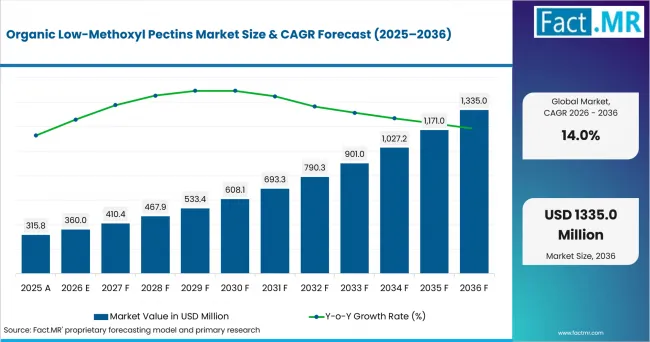
Organic Low Methoxyl Pectins Market Value Analysis | Source: Fact.MR
What are the defining numbers behind Organic Low-Methoxyl Pectins Market growth?
USD 975.0 million absolute opportunity by 2036, led by low-methoxyl pectin, gelling, dairy alternatives, and food grade.
- Demand Drivers in the Market
- Organic dairy-alternative brands need calcium-reactive gels that create spoonable texture in products where sugar and dairy solids are reduced.
- Demand for differentiated fruit preparations is supported by the expanding organic food market. USDA ERS, citing Organic Trade Association data, reports that U.S. organic food sales reached USD 70.1 billion in 2025.
- Confectionery developers need plant-derived gelling systems for organic gummies and fruit candies where gelatin replacement must preserve bite.
- Sauce and dressing manufacturers need organic stabilizers that control water release during chilled storage and retail distribution.
- Key Segments Analyzed
- By Product: Low-methoxyl pectin is expected to hold 39.0% share in 2026 because calcium-set gel formation fits low-sugar and organic fruit systems.
- By Function: Gelling is projected to account for 37.0% share in 2026 as organic desserts and jams require predictable set strength.
- By Application: Dairy alternatives are anticipated to capture 34.0% share in 2026 due to the need for plant-based texture and fruit-prep stability.
- By Grade: Food grade is estimated to represent 44.0% share in 2026 owing to direct use in finished foods and beverage formulations.
- Analyst Opinion at Fact.MR
- Shambhu Nath Jha, Principal Consultant at Fact.MR, states, "Organic low-methoxyl pectin is drawing attention because it solves a texture problem that organic brands cannot cover with high sugar or dairy solids. Demand is expected to widen as brands move from trials to repeat launches in fruit preparations, gummies, dairy alternatives, and sauces. Better-positioned producers should combine consistent calcium reactivity, clear organic documents, and application support for low-sugar processing."
- Strategic Implications
- Pectin producers should document degree of methoxylation and calcium reactivity so formulators can match texture to each recipe.
- U.S. food businesses handling foods covered by the Food Traceability Rule should align their traceability records and plans with FDA requirements. FDA proposed extending the rule’s compliance date to July 20, 2028.
- Confectionery teams should validate gelling temperature and bite before scaling organic gummies or fruit candies.
- Distributors should separate conventional pectin and organic-compliant grades to reduce certification delays during customer audits.
The USA is projected to record 15.4% CAGR through 2036, supported by organic retail spending and low-sugar product reformulation. Germany is expected to advance at 14.7% as organic farmland and pectin application know-how support premium food uses. Japan is anticipated to post 13.7% where shelf-stable food formats require controlled viscosity. France is forecast to record 13.2% through organic food recovery and dairy-alternative trials. Brazil is estimated to hold 12.6% as food processing scale and organic registration systems broaden local entry routes.
How does the Organic Low-Methoxyl Pectins Market break down by segment?
Low-methoxyl pectin leads Product at 39.0%; food grade leads Grade at 44.0%.
Which Product leads?
Low-methoxyl pectin holds 39.0% share in 2026.
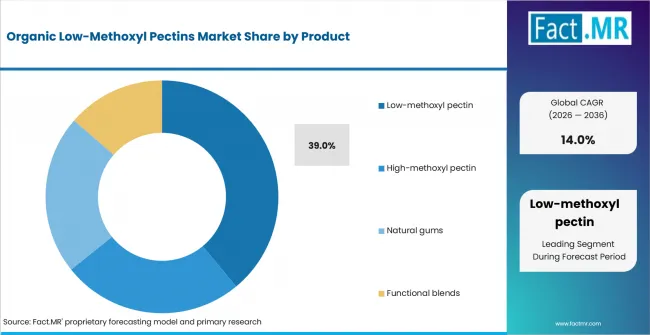
Organic Low Methoxyl Pectins Market Analysis By Product | Source: Fact.MR
Low-methoxyl pectin leads Product because it forms gels in the presence of calcium and uses less sugar than high-methoxyl systems. Cargill notes that low-methoxyl pectins have a degree of esterification below 50% and are suitable for fruit spreads, lower-sugar jams and fruit preparations for dairy. Cargill also lists conventional low-methoxyl pectin for bake-stable fruit fillings, fruit spreads, organic and lower-sugar jams, and fruit preparations for dairy.
What leads the Function segment?
Gelling accounts for 37.0% share in 2026.
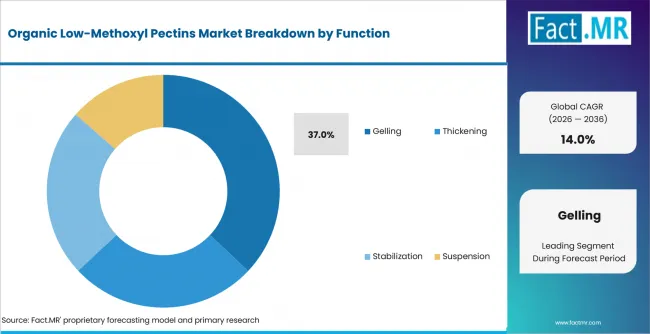
Organic Low Methoxyl Pectins Market Analysis By Function | Source: Fact.MR
Gelling leads Function because product developers need a stable set in organic jams, gummies, fruit bases, and spoonable desserts. The function is valuable when sugar reduction or plant-based positioning removes ingredients that once delivered firmness. Consistent calcium response becomes the technical checkpoint before a formulation moves into scale-up. Formulators compare gel speed and final bite before moving from pilot kettles to retail batches.
How does Application shape demand?
Dairy alternatives capture 34.0% share in 2026.
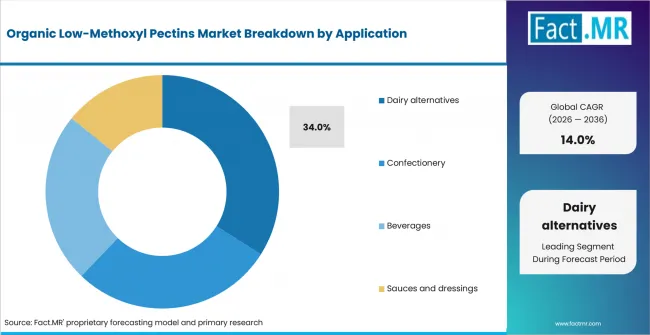
Organic Low Methoxyl Pectins Market Analysis By Application | Source: Fact.MR
Dairy alternatives lead Application because plant bases often need added body, fruit distribution, and smooth spoon texture. Organic low-methoxyl pectin supports fruit preparations used in yogurt alternatives and desserts. It also helps formulators manage syneresis when proteins, sugars, and acids interact during filling and storage. These tests carry weight when brands want fruit pieces to stay suspended during transport.
What supports Food grade within Grade?
Food grade represents 44.0% share in 2026.
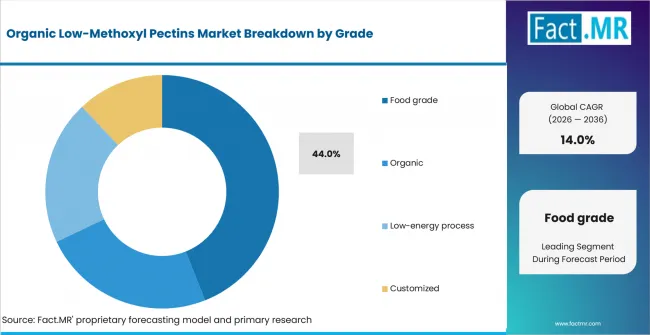
Organic Low Methoxyl Pectins Market Analysis By Grade | Source: Fact.MR
Food grade leads Grade because most demand comes from directly consumed products that require food-additive compliance, batch traceability, and sensory consistency. The grade supports private-label and branded launches where organic claims require documents at the ingredient and finished-product level. Food-grade pectin also gives application teams a familiar starting point for heat-treated sauces and fruit systems.
What is accelerating Organic Low-Methoxyl Pectins Market adoption, and what is holding it back?
Demand rises through low-sugar texture needs, organic label systems, calcium-set gels, and dairy-alternative formulation. Growth is limited by raw-material variability, certification cost, and application testing.
Drivers Impact Analysis
| DRIVER | (~) % IMPACT ON CAGR | GEOGRAPHIC RELEVANCE | IMPACT TIMELINE |
|---|---|---|---|
| Low-sugar gel formulation in jams and gummies | +1.8% | North America, Western Europe | Short term (<= 2 years) |
| Organic dairy-alternative texture systems | +1.5% | North America, Europe, Japan | Medium term (2-4 years) |
| Calcium-set functionality for fruit preparations | +1.2% | Global | Medium term (2-4 years) |
| Organic documentation and retailer label standards | +0.9% | USA, Germany, France | Long term (>= 4 years) |
Source: Fact.MR analysis. Updated Aug 31, 2026
- Low-sugar gel formulation: Brands use low-methoxyl pectin when sugar reduction weakens set and changes mouthfeel in fruit systems.
- Organic dairy-alternative texture: Plant-based bases need stabilizers that deliver smooth texture while fitting organic positioning.
- Calcium-set functionality: Low-methoxyl pectin gives formulators a way to control gel strength by adjusting calcium and solids.
- Organic documentation: Retailers and certifiers ask for clear ingredient records, which favors suppliers with organized compliance files.
Opportunity Impact Analysis
| OPPORTUNITY | (~) % IMPACT ON CAGR | GEOGRAPHIC RELEVANCE | IMPACT TIMELINE |
|---|---|---|---|
| Sugar-reduced confectionery with plant-based gelling | +1.1% | USA, Germany, France | Short term (<= 2 years) |
| Fruit preparations for yogurt alternatives | +0.9% | North America, Europe, Japan | Medium term (2-4 years) |
| Customized organic pectin blends for sauces | +0.7% | Global | Long term (>= 4 years) |
Source: Fact.MR analysis. Updated Aug 31, 2026
- Sugar-reduced confectionery: Organic pectin can support vegan gummies and fruit candies where sugar is reduced but bite remains essential.
- Fruit preparations: Dairy-alternative manufacturers can use pectin systems to keep fruit suspended and texture consistent.
- Customized blends: Pectin producers can combine grades with gums where sauces need both suspension and controlled pour.
Restraints Impact Analysis
| RESTRAINT | (~) % IMPACT ON CAGR | GEOGRAPHIC RELEVANCE | IMPACT TIMELINE |
|---|---|---|---|
| Organic raw-material variability | -0.6% | Global | Short term (<= 2 years) |
| Certification and audit cost | -0.5% | North America, Europe | Medium term (2-4 years) |
| Application-specific validation needs | -0.4% | Global | Long term (>= 4 years) |
Source: Fact.MR analysis. Updated Aug 31, 2026
- Organic raw-material variability: Citrus peel and apple pomace quality changes by crop, which can affect yield and pectin performance.
- Certification and audit cost: Organic ingredient qualification adds document work and supplier checks that smaller brands may delay.
- Application-specific validation: A grade that works in jam may perform differently in plant yogurt or acidic drinks.
Which countries are scaling the Organic Low-Methoxyl Pectins Market through 2036?
- The country comparison spans 2.8 percentage points and forms three practical growth bands across the forecast period.
- The USA remains 0.7 percentage point above Germany as organic retail scale and reformulation capacity support premium pectin systems.
- Germany remains 1.0 percentage point above Japan as organic farmland and European application labs support low-sugar texture work.
- Japan remains 0.5 percentage point above France through packaged food production and health-oriented formulation needs.
- France remains 0.6 percentage point above Brazil as organic consumption recovery and dairy-alternative trials support pectin use.
- Brazil closes the displayed range as food processing scale improves entry for certified and customized pectin systems.
Comparable CAGRs can create different entry conditions due to organic certification rules, fruit-pectin sourcing, food additive approval, dairy-alternative development and local processor scale. Full report coverage includes North America, Latin America, Western Europe, Eastern Europe, East Asia, South Asia & Pacific, Middle East & Africa.
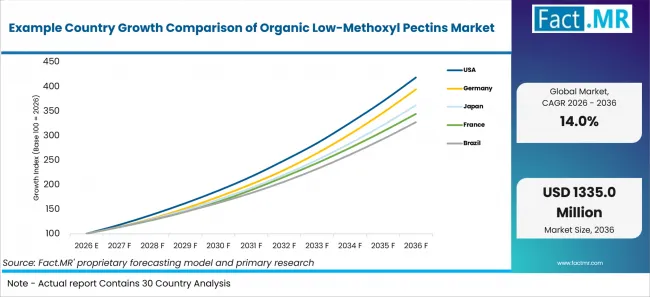
Example Country Growth Comparison Of Organic Low Methoxyl Pectins Market | Source: Fact.MR
| Country | CAGR (2026-2036) |
|---|---|
| USA | 15.4% |
| Germany | 14.7% |
| Japan | 13.7% |
| France | 13.2% |
| Brazil | 12.6% |
Source: Fact.MR analysis. Updated Aug 31, 2026
What supports USA adoption?
15.4% CAGR, supported by organic retail scale and low-sugar texture reformulation.
U.S. retail scale gives organic stabilizer suppliers a broad route into packaged food reformulation. The U.S. Census Bureau reported in August 2026 that July 2026 retail and food services sales reached USD 763.6 billion. Organic low-methoxyl pectin benefits when dairy-alternative and confectionery brands need calcium-set texture across national retail programs.
How is Germany scaling demand?
14.7% CAGR, driven by organic farmland and European texture-system know-how.
Germany combines organic certification depth with a food industry that tests hydrocolloids across fruit preparations and bakery fillings. Destatis reported in February 2026 that 11.1% of Germany agricultural area was organic in 2024. That farm base supports ingredient documentation and gives formulators a clearer route for organic low-sugar recipes.
How does Japan perform?
13.7% CAGR, led by packaged food reformulation and health-oriented texture demand.
Japan demand is shaped by shelf-stable desserts, beverages, and health-oriented packaged foods that require careful texture control. USDA FAS reported in April 2026 that Japan food processing output was USD 174.0 billion in 2025. Organic low-methoxyl pectin is expected to gain where imported specialty ingredients can meet local additive documentation needs.
What supports France adoption?
13.2% CAGR, driven by organic consumption recovery and dairy-alternative formulation.
France offers a mature organic food base for fruit preparations and plant-based desserts. The French Ministry of Agriculture reported in July 2025 that the organic market reached EUR 12.2 billion in 2024. Low-methoxyl pectin fits brands that need low-sugar gel strength and smooth fruit distribution in premium recipes.
How is Brazil developing demand?
12.6% CAGR, backed by food processing scale and organic registration infrastructure.
Brazil gives pectin suppliers a large processed-food base and a fruit-oriented formulation culture. USDA FAS reported, citing ABIA, that Brazil’s food-processing sector generated R$1.388 trillion (USD 248 billion) in 2025. Certified low-methoxyl pectin is expected to find use in fruit fillings, sauces, and dairy applications where exporters need organized ingredient records.
Who leads the Organic Low-Methoxyl Pectins Market?
Tate & Lyle participates through the pectin and specialty-gum capabilities integrated from CP Kelco, a Tate & Lyle business following its November 2024 acquisition. Herbstreith & Fox brings specialist pectin expertise for fruit processing and confectionery. Cargill competes through UniPECTINE® pectin and application support for dairy, fruit, beverage and confectionery products.
dsm-firmenich strengthened its pectin position in April 2025 by increasing its shareholding in Dsm-firmenich Pectin (Andre Pectin) to 90.5%. Suppliers differentiate through consistent gel performance, application expertise, organic-compatible pectin options and support for low-sugar formulations.
Which companies are the key providers?
Key companies include CP Kelco, a Tate & Lyle business; Herbstreith & Fox; Cargill; JRS Silvateam Ingredients; and Dsm-firmenich Pectin (Andre Pectin).
- CP Kelco, a Tate & Lyle business
- Herbstreith & Fox
- Cargill
- JRS Silvateam Ingredients
- Dsm-firmenich Pectin (Andre Pectin)
Bibliography
- Cargill. (2025, March 4). Cargill showcases full range of innovative food solutions at AAHAR 2025.
- Tate & Lyle. (2024, November 15). Completion of combination of Tate & Lyle and CP Kelco to create a leading global speciality food and beverage solutions business.
- Federal Statistical Office (Destatis). (2026, February 17). Organic farming in the EU 2024.
- dsm-firmenich. (2025, April 3). dsm-firmenich completes shareholding increase in Andre Pectin to 90.5%.
- Ministère de l’Agriculture, de l’Agro-alimentaire et de la Souveraineté alimentaire. (2025, July 1). Agriculture biologique : des signes encourageants en 2024.
- U.S. Census Bureau. (2026, August 14). Advance monthly sales for retail and food services.
- U.S. Department of Agriculture, Economic Research Service. (2026, August 13). Organic agriculture.
- U.S. Department of Agriculture, Foreign Agricultural Service. (2026, March 31). Food processing ingredients annual (Report No. BR2026-0011).
- U.S. Department of Agriculture, Foreign Agricultural Service. (2026, April 1). Food processing ingredients annual (Report No. JA2026-0012).
This Report Answers
- The report explains where organic low-methoxyl pectins are used across product, function, application, and grade.
- Segment analysis identifies the leading subsegments and the formulation reasons food brands prioritize them.
- Country analysis reviews the listed markets and the organic-food or processing mechanisms supporting adoption.
- Competitive analysis covers current providers across pectin, organic texture systems, and application support.
- Application analysis assesses how gelling strength, calcium reactivity, and documentation affect purchasing decisions.
What does the Organic Low-Methoxyl Pectins Market cover?
The organic food ingredients link frames the market around food-grade inputs used by certified brands. Organic low-methoxyl pectins cover citrus or apple-derived pectin grades used in low-sugar gels, dairy-alternative fruit preparations, beverages, confectionery, sauces, and dressings.
The assessment also relates to plant hydrocolloids and food stabilizers where texture, viscosity, and suspension guide formulation decisions. Demand is assessed across the supplied product, function, application, grade, and region dimensions.
What is included in the scope?
The scope includes commercial organic low-methoxyl pectin grades, functional blends that use pectin, and application-tested systems for dairy stabilizer systems. It includes formulation support for fruit preparations, low-sugar jams, organic gummies, and dressings.
It includes adjacent comparisons with alternative hydrocolloids, natural gelling agents, citrus pectin ingredients, and fruit pomace pectin when they affect ingredient selection.
What is excluded from the scope?
The scope excludes synthetic gums sold outside an organic formulation use case, ordinary bulk fruit acids, finished jams, and retail desserts. It also excludes organic foods beverages as finished product categories.
The scope excludes confectionery finished products when pectin is separate from the functional ingredient decision. General sweeteners, colors, and flavors fall outside the market unless bundled into a pectin-led texture blend.
How Was the Analysis Built?
The analysis draws on 120+ sources, 35+ company portfolios, 25+ countries, and more than 20 industry interviews.
- Primary Research: Primary research includes discussions with ingredient producers, distributors, food brands, contract manufacturers, application teams, purchasing teams, and subject-matter experts. These conversations examine buying priorities, approval requirements, technical barriers, and the factors that influence wider market acceptance.
- Desk Research: Desk research covers government statistics, regulatory publications, company releases, technical material, organic certification references, food-additive rules, and credible associations. Every source used in the analysis is documented in the bibliography.
- Market Sizing and Forecasting: Market estimates combine historical performance, demand indicators, segment shares, country-level growth, application adoption, supplier participation, certification requirements, and barriers to market expansion.
- Data Validation and Update Cycle: Findings are validated by comparing primary interviews with public data, company activity, regulatory changes, organic-market indicators, purchasing trends, and shifts in commercial adoption.
Segmentation
What is the report's scope and coverage?
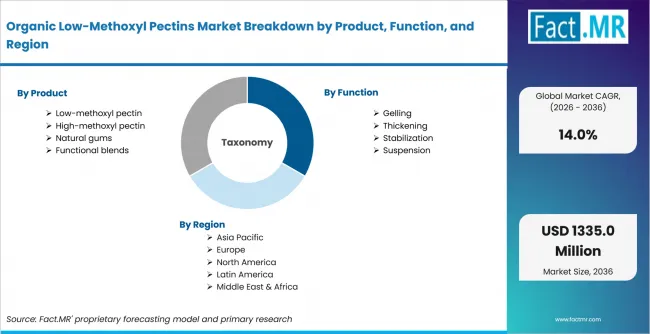
Organic Low Methoxyl Pectins Market Breakdown By Product, Function, And Region | Source: Fact.MR
| Attribute | Details |
|---|---|
| Quantitative Units | USD million |
| Market Definition | Organic pectin systems in which low-methoxyl pectin is used for gelling, thickening, stabilization, and suspension in food and beverage formulations. |
| Product | Low-methoxyl pectin; High-methoxyl pectin; Natural gums; Functional blends |
| Function | Gelling; Thickening; Stabilization; Suspension |
| Application | Dairy alternatives; Confectionery; Beverages; Sauces and dressings |
| Grade | Food grade; Organic; Low-energy process; Customized |
| Regions Covered | North America; Latin America; Western Europe; Eastern Europe; East Asia; South Asia & Pacific; Middle East & Africa |
| Countries Covered | USA; Germany; Japan; France; Brazil |
| Key Companies Profiled | CP Kelco, a Tate & Lyle business; Herbstreith & Fox; Cargill; JRS Silvateam Ingredients; Dsm-firmenich Pectin (Andre Pectin) |
| Forecast Period | 2026 to 2036 |
| Approach | Hybrid top-down and bottom-up approach using organic food demand, pectin applications, country adoption, segment shares, and provider portfolio review. |
Source: Fact.MR analysis. Updated Aug 31, 2026
How is the market segmented?
-
By Product:
- Low-methoxyl pectin
- High-methoxyl pectin
- Natural gums
- Functional blends
-
By Function:
- Gelling
- Thickening
- Stabilization
- Suspension
-
By Application:
- Dairy alternatives
- Confectionery
- Beverages
- Sauces and dressings
-
By Grade:
- Food grade
- Organic
- Low-energy process
- Customized
-
By Region:
- North America
- Latin America
- Western Europe
- Eastern Europe
- East Asia
- South Asia & Pacific
- Middle East & Africa
Frequently Asked Questions
How big is the organic low-methoxyl pectins market in 2026?
What is the CAGR of the organic low-methoxyl pectins market from 2026 to 2036?
Which product leads the organic low-methoxyl pectins market?
Which function leads the organic low-methoxyl pectins market?
Who are the leading companies in the organic low-methoxyl pectins market?
Who worked on this report


Preview the report firsthand - request a free sample
Free SampleGet the brochure for pricing and purchase details
Download PDF