- Forecast Value (2036): 16.00 Bn
- CAGR (2036): 21.7%
What is the padel club operations market forecast to be worth by 2036?
USD 2.25 billion in 2026 to USD 16.00 billion by 2036, at 21.7% CAGR.
- The padel club operations market crossed a valuation of USD 1.85 billion in 2025.
- Demand is expected to increase from USD 2.25 billion in 2026 to USD 16.00 billion by 2036.
- The market is forecast to record 21.7% CAGR during 2026 to 2036 as clubs expand memberships, coaching, booking systems, and venue-management services.
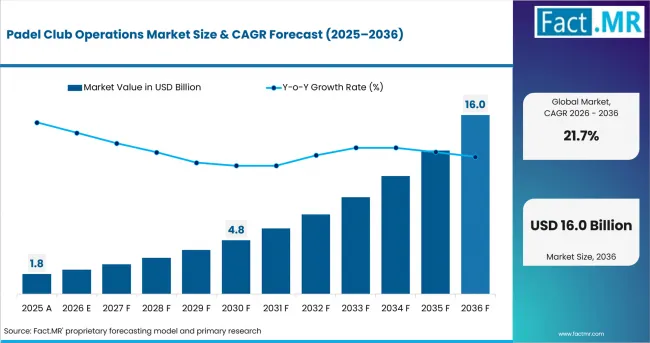
Padel Club Operations Market Value Analysis | Source: Fact.MR
What are the defining numbers behind padel club operations growth?
USD 13.75 billion absolute opportunity by 2036. United States, United Kingdom and France lead the country view.
- Demand Drivers in the Market
- Commercial clubs use memberships and coaching packages to reduce dependence on weekend court rentals.
- App booking makes casual play easier because players can reserve courts and join open matches without a club desk.
- Corporate events are projected to add weekday revenue where urban venues face rent and staffing pressure.
- Tennis clubs add padel courts to keep existing members active through a faster social racket format.
- Key Segments Analyzed
- By Venue Model: Commercial Clubs are expected to account for 46.0% of market share in 2026 because dedicated venues control booking, coaching and hospitality in one place.
- By Customer Type: Adult Members are projected to capture 42.0% of the market in 2026 as after-work play and weekend groups remain the core paid customer base.
- By Delivery Model: App-Enabled Clubs are estimated to hold 41.0% share in 2026. The share reflects live booking and payment control during peak court hours.
- By Facility Type: Indoor Venues are likely to represent 40.0% of the market in 2026 since weather protection helps clubs sell recurring time slots.
- By Revenue Stream: Court Rentals are forecast to secure 39.0% share in 2026 as first-time players usually begin with hourly sessions before buying programs.
- By Service Type: Membership Programs are anticipated to contribute 35.0% of total revenue in 2026 because recurring packages give operators a steadier base for staffing and maintenance.
- By Booking Channel: Mobile Apps are expected to account for 34.0% share in 2026 as players compare prices, reserve courts and find partners through app-led channels.
- By Geography: United States is projected to register a 30.2% CAGR through 2036, supported by a low base and dedicated padel-chain expansion in major cities.
- Analyst Opinion
- Shambhu Nath Jha, Senior Analyst at Fact.MR says "I see padel clubs becoming a real operating business, not a spare-court add-on. The winning operator is not the one with the newest court. It is the one that fills Monday mornings, keeps coaches booked and turns first-time players into repeat members. The next test is simple. Can a club run with high utilization without making the experience feel crowded? Buyers should watch staffing quality, booking control and local league activity. That operating evidence tells me more about a club chain than its launch photos.
- Strategic Implications
- Club chains should design membership tiers before adding new venues because rent risk rises when utilization depends only on weekend bookings.
- Tennis clubs need padel-specific coaching and app booking to reach casual players who do not enter through tennis programs.
- Booking platforms should offer revenue dashboards and league tools, not only court calendars.
- Investors can use court density and coaching supply as early filters when comparing city expansion plans.
Operations become billable when clubs move beyond hourly court rental. A venue with coaching, memberships and events captures more revenue from the same court base. The International Padel Federation reported more than 24.6 thousand clubs and 77.3 thousand courts in 2025.
How does the padel club operations market break down by segment?
Commercial Clubs lead at 46.0%. Adult Members follow with 42.0% share in 2026.
Which venue model leads?
Commercial Clubs hold 46.0% share in 2026.
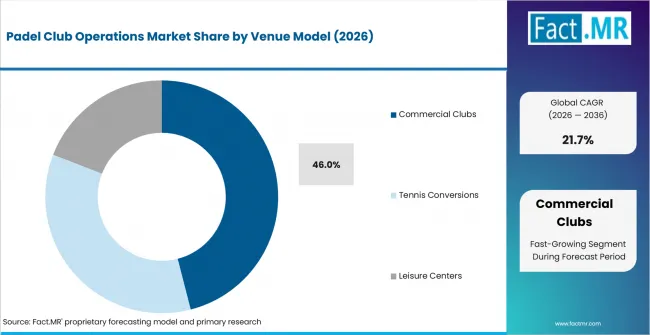
Padel Club Operations Market Analysis By Venue Model | Source: Fact.MR
Commercial Clubs are expected to hold 46.0% share in 2026 because dedicated venues manage the full customer journey. Booking rules, coaching schedules and food service sit under one operator. Tennis Club Conversions are likely to gain share where existing members want padel access without changing clubs.
Which customer type contributes the largest revenue?
Adult Members hold 42.0% share in 2026.
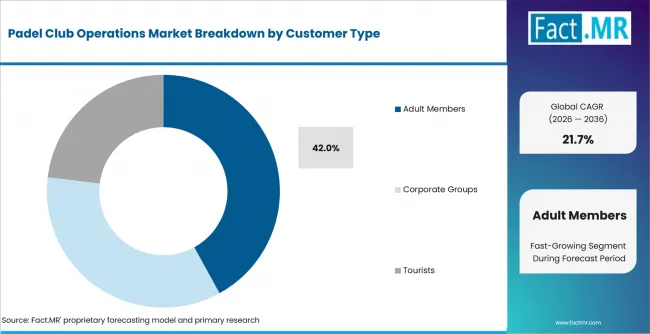
Padel Club Operations Market Analysis By Customer Type | Source: Fact.MR
Adult Members are projected to hold 42.0% share in 2026 as padel fits after-work play and weekend social groups. Corporate groups add weekday volume when clubs sell employer events. Junior players are expected to matter more once federations connect training paths with club courts.
Which delivery model is used most?
App-Enabled Clubs hold 41.0% share in 2026.
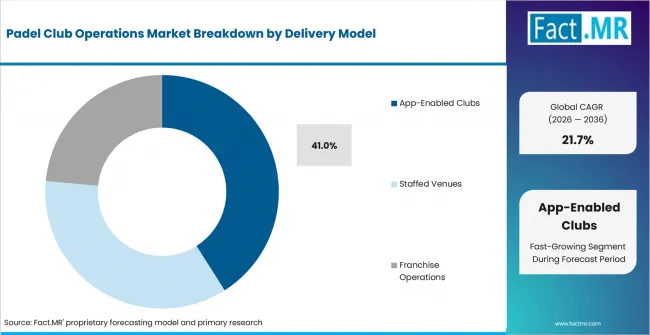
Padel Club Operations Market Analysis By Delivery Model | Source: Fact.MR
App-Enabled Clubs are forecast to account for 41.0% share in 2026 because players expect to book courts and join matches from phones. Gate access can lower front-desk dependence during off-peak hours. Staffed venues remain important when coaching and events define the club experience.
Which facility type supports recurring play?
Indoor Venues hold 40.0% share in 2026.
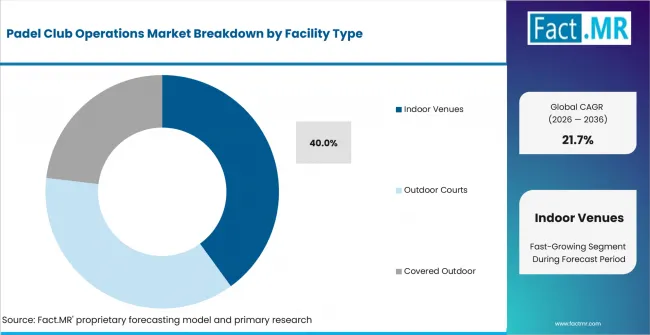
Padel Club Operations Market Analysis By Facility Type | Source: Fact.MR
Indoor Venues are anticipated to hold 40.0% share in 2026 because weather reliability protects recurring bookings. Covered outdoor courts matter where planning rules make full indoor builds difficult. Pure outdoor clubs are practical in Spain and warm U.S. states.
Which revenue stream leads club income?
Court Rentals hold 39.0% share in 2026.
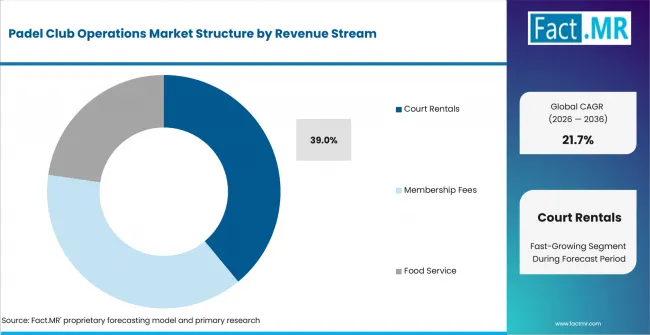
Padel Club Operations Market Analysis By Revenue Stream | Source: Fact.MR
Court Rentals are expected to capture 39.0% share in 2026 as new players usually start with pay-and-play sessions. Membership fees increase after usage becomes habitual. Coaching income adds margin when clubs can keep qualified coaches active at peak evening times.
Which service type anchors operations?
Membership Programs hold 35.0% share in 2026.
Membership Programs are projected to account for 35.0% share in 2026 because clubs need predictable cash flow. Court access remains the entry point. Events create local network effects when players return for leagues and social formats.
Which booking channel is used most?
Mobile Apps hold 34.0% share in 2026.
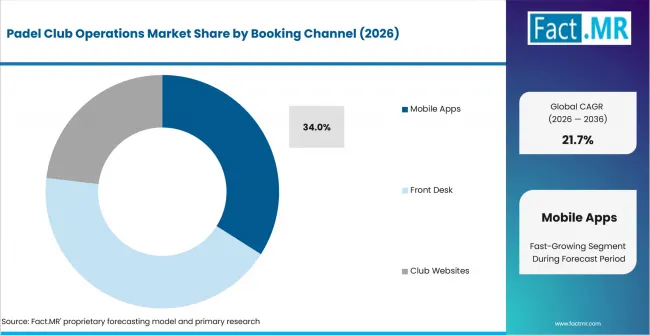
Padel Club Operations Market Analysis By Booking Channel | Source: Fact.MR
Mobile Apps are likely to hold 34.0% share in 2026 since players want price visibility and open-match discovery. Club websites still support first-time visitors and local information. Corporate booking grows where operators package group events and branded tournaments.
What is accelerating padel club operations demand, and what is holding it back?
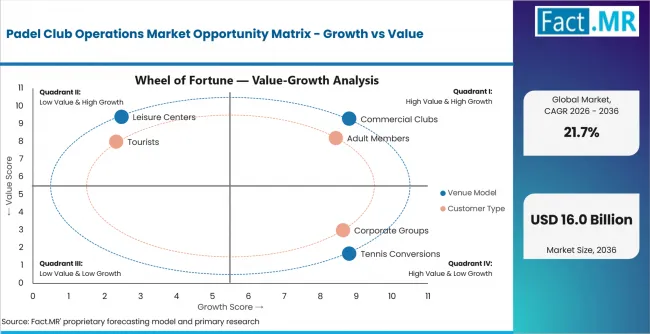
Padel Club Operations Market Opportunity Matrix Growth Vs Value | Source: Fact.MR
Court supply has reached a scale where operations now define revenue quality. The International Padel Federation’s 2025 club base shows why staffing, coaching, and booking control now matter more than court awareness alone. That makes staffing, coaching and booking control a larger issue than court awareness alone.
Players often enter padel through the same racket-sport channel that supports tennis equipment purchasing. Once the player becomes regular, the club captures more value through lessons and leagues. This shifts the buyer from a one-time court user into a repeat customer.
Expansion is constrained by planning rules and neighborhood noise concerns. Club operators also compete with health and fitness club services for urban leisure spend. The restraint is not player interest alone, but whether operators can secure sites that work all week.
Where do the biggest padel club operations opportunities sit?
Urban memberships, corporate events and app-managed venues.
- Urban Memberships: Operators can sell priority booking and member events where court supply stays tight during evening hours.
- Corporate Events: City clubs can use sports analytics style participation records to price leagues and track retention for employer groups.
- App-Managed Venues: Gate access and app booking can keep smaller venues open for longer hours without adding a full front-desk team.
Which countries are scaling padel club operations fastest?
United States 30.2% and United Kingdom 27.8% lead the country view. France 25.9%, Germany 24.7% and Netherlands 22.8% follow. Italy 20.9% and Spain 16.8% complete the top seven.
Based on regional analysis, the padel club operations market covers North America, Europe, East Asia, South Asia and Pacific, Latin America, and the Middle East and Africa.
.webp "Top Country Growth Comparison Padel Club Operations Market Cagr (2026 2036)")
Top Country Growth Comparison Padel Club Operations Market Cagr (2026 2036) | Source: Fact.MR
| Country | CAGR |
|---|---|
| United States | 30.2% |
| United Kingdom | 27.8% |
| France | 25.9% |
| Germany | 24.7% |
| Netherlands | 22.8% |
| Italy | 20.9% |
| Spain | 16.8% |
Source: Fact.MR analysis. Updated Jun 23, 2026
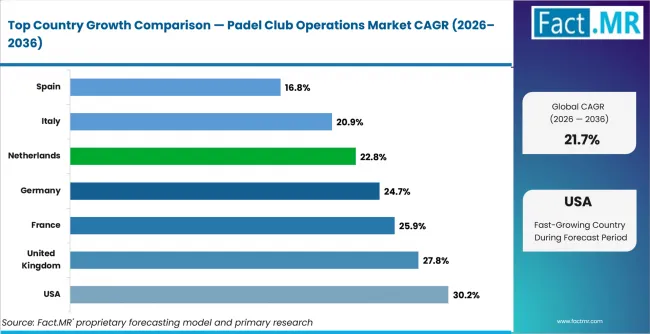
Padel Club Operations Market Cagr Analysis By Country | Source: Fact.MR
What supports the United States outlook?
United States 30.2% CAGR, led by a small base and dedicated club-chain expansion.
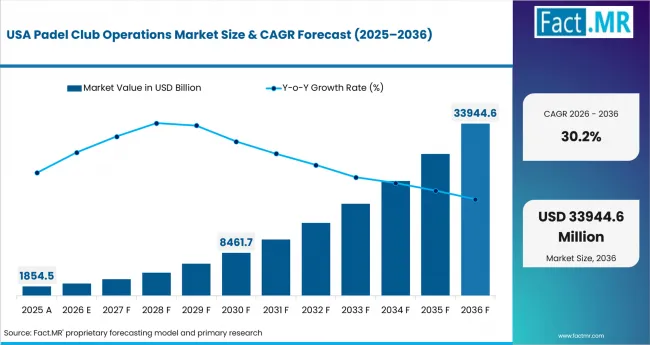
Padel Club Operations Market Country Value Analysis | Source: Fact.MR
The United States is moving from private-club padel toward dedicated venues in large cities. United States Padel Association reporting counted 1.073 million Americans who played padel in 2025. That base gives operators room to sell lessons, leagues and multi-site memberships before court density reaches European levels.
Why does the United Kingdom matter?
United Kingdom 27.8% CAGR, supported by club funding and fast venue growth.
The United Kingdom is building padel through tennis clubs, standalone venues, and funded club chains. The Lawn Tennis Association counted 1,553 courts across 559 venues at the end of 2025. Operators can use that venue base to sell memberships, coaching and covered-court packages across a weather-sensitive market.
How is France scaling club operations?
France 25.9% CAGR, supported by federation programs and a larger licensed base.
France has shifted from scattered padel access to federation-linked expansion. The French Tennis Federation reported 4.0 thousand padel courts and 1.03 thousand clubs in 2025. Boost Padel adds a financing route for affiliated clubs, so operators can connect new courts with coaching and local competition calendars.
What makes Germany a relevant commercial market?
Germany 24.7% CAGR, supported by a new national padel platform and event visibility.
Germany is still earlier than Spain or Italy, but its club operations base is becoming more organized. The Deutscher Tennis Bund launched MyPadel in September 2025 as a central portal for club and player services. That gives suppliers a clearer route for fitness apps style booking and participation tools inside padel venues.
Why is the Netherlands important?
Netherlands 22.8% CAGR, supported by dense court supply and club booking behavior.
The Netherlands shows how padel can become a mainstream club product in a compact country. Royal Dutch Lawn Tennis Association reporting counted 876,000 padel players in 2025. That usage base supports paid booking and online fitness style scheduling behavior across commercial centers and associations.
How does Italy support the operations base?
Italy 20.9% CAGR, led by court density and club-linked social play.
Italy is one of the world’s largest padel countries by facilities. The International Padel Federation reported that Italy reached 10,017 courts in June 2025. This creates a large base for coaching schedules and sports officiating technologies use in organized competition.
Why does Spain remain the anchor market?
Spain 16.8% CAGR, supported by a deep installed base and slower replacement-led expansion.
Spain remains the benchmark for padel club operations because the sport is already woven into daily leisure. The International Padel Federation reported nearly 4.5 thousand clubs and 17.0 thousand courts in Spain for 2024. That scale keeps growth below early-stage countries while shifting the operating focus toward service quality and related home fitness behavior.
Who leads the padel club operations landscape?
LeDap, Game4Padel and Playtomic lead through club networks and booking infrastructure. Local premium club operators add another route.
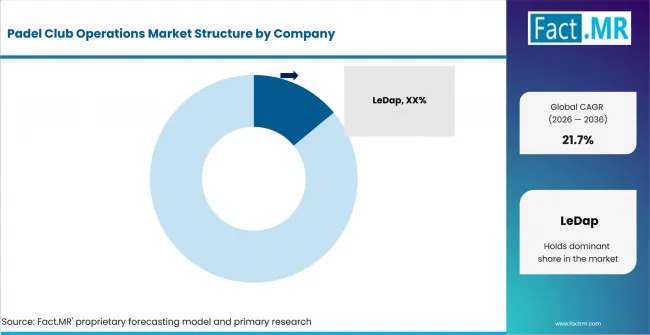
Padel Club Operations Market Analysis By Company | Source: Fact.MR
Competition is split between multi-site operators and software-enabled booking platforms. LeDap operates clubs across Europe and the Middle East. Game4Padel has built a United Kingdom network, while Playtomic gives clubs app-based discovery and booking. Operators also compare with golf equipment venues where premium leisure customers expect coaching and hospitality around the core sport.
Padel Haus and Reserve Padel focus on premium U.S. urban venues. Rocket Padel and The Padel Club are building United Kingdom communities through high-specification venues. Bay Padel and Padel Park show how local operators can use city clusters or franchise models to build a player base.
Providers that understand court utilization and coach scheduling should be better placed through 2036. Larger clubs may build their own operating teams. Outside specialists can win where buyers need booking tools, staffing support and local event programming together.
Which companies are the key players?
LeDap, Game4Padel and Playtomic are key players. Padel Haus, Reserve Padel and Rocket Padel are also profiled. The Padel Club completes the company set.
- LeDap
- Game4Padel
- Playtomic
- Padel Haus
- Reserve Padel
- Rocket Padel
- The Padel Club
Bibliography
- International Padel Federation. (2025, December 2). Online the FIP World Padel Report 2025, a comprehensive analysis of a sport in constant growth.
- International Padel Federation. (2025, March 18). A gradual and steady growth, the Miami Premier, and the boom of professionals: This is how the U.S. says “yes” to padel.
- United States Padel Association. (2026, April 13). Padel surpasses one million players in the United States.
- United States Padel Association. (2026, January 21). USPA releases 2025 annual report: A record-breaking year for padel in America.
- LTA Padel. (2026, March 25). 860,000 players: LTA unveils latest figures on growth of padel in Britain.
- LTA Padel. (2025, December 19). British padel in 2025: New milestones, team successes & empowering communities to play.
- British Business Bank. (2024, August 16). The Padel Club.
- Fédération Française de Tennis. (2025, December 10). 2025, une saison record pour le padel en France.
- Fédération Française de Tennis. (2025, September 9). Boost Padel : un dispositif inédit pour accélérer l’essor du padel en France !
- KNLTB. (2026, April 1). KNLTB en EY presenteren tweede editie Padel in Cijfers.
- KNLTB. (2025, June 23). Padel blijft groeien: van hype naar volwassen sport.
- Deutscher Tennis Bund. (2025, December 18). CERTINA German Padel Tour 2025: Rekorde auf ganzer Linie.
- Deutscher Tennis Bund. (2025, September 16). MyPadel: DTB launcht neue Padelmarke und zugehörige digitale Plattform.
- Federación Española de Pádel. (2025, November 14). Nuevo récord de licencias federativas de pádel en España.
- International Padel Federation. (2025, February 27). Pádel en España, crecimiento de pistas y licencias de jugadores en 2024. Morcillo: “Estos resultados reflejan el trabajo duro de los últimos años”.
- International Padel Federation. (2025, June 11). The padel “boom” shows no signs of stopping: Italy surpasses 10,000 courts second only to Spain.
- Game4Padel. (2025, December 22). 2025 was a breakout year for padel and the year ahead looks set to be even bigger.
This Report Addresses
- Strategic intelligence on padel club operations across service type, venue model, customer type and revenue stream.
- Segment analysis covering Commercial Clubs, Adult Members, App-Enabled Clubs, Indoor Venues and Court Rentals.
- Regional outlook covering United States, United Kingdom, France, Germany, Netherlands, Italy and Spain.
- Competitive analysis of LeDap, Game4Padel and Playtomic. Padel Haus, Reserve Padel and Rocket Padel are also profiled.
- Service assessment covering memberships, court booking, coaching programs, events and venue operations.
- Funding assessment covering The Padel Club, Game4Padel and federation-led court programs in France and the United Kingdom.
- Source-led market sizing using club counts, court counts, booking behavior and official company disclosures.
What does the padel club operations market cover?
Membership, coaching and venue-management services for commercial padel clubs and club chains.
The padel club operations market covers paid services that help a venue run padel as a repeat-use business. It includes membership administration and court booking. Coaching programs, events and multi-site management tools are also included.
What is included in the scope?
Membership programs and coaching operations. Venue staffing, court scheduling and tournament support are also included.
The scope includes commercial padel clubs, tennis club conversions and leisure centers that sell padel access. It also covers club software subscriptions and managed operating contracts. Food service and retail are included only when they are bundled into the club operating model.
What is excluded from the scope?
Court construction, paddle sales and professional tour rights sold without club operations.
The scope excludes glass court manufacturing and turf installation revenue. Standalone rackets, balls and shoes are excluded. Professional media rights, team ownership and player prize money are outside scope unless they directly support paid club operations.
How was the analysis built?
120+ sources and 50+ company or federation pages. 30+ countries were checked with 25+ operator and supplier interviews.
- Primary Research:
- Interviews covered padel club founders and leisure-center operators. Court builders and booking-platform teams were also included.
- Desk Research:
- Desk research reviewed federation releases and sports-body pages. Company sites, funding case studies and venue pages were checked.
- Market-Sizing and Forecasting:
- Forecasting used club counts and court counts. Membership revenue, coaching fees and venue utilization assumptions supported the model.
- Data Validation and Update Cycle:
- Estimates were checked against International Padel Federation club growth and national federation data. Playtomic booking evidence and LTA venue data were also reviewed.
Segmentation
What is the report’s scope and coverage?
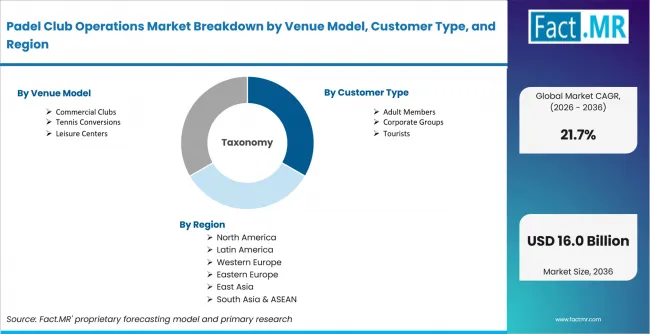
Padel Club Operations Market Breakdown By Venue Model, Customer Type, And Region | Source: Fact.MR
| Attribute | Details |
|---|---|
| Quantitative Units | USD Billion in 2026 to USD Billion by 2036 at CAGR |
| Market Definition | Membership, coaching and venue-management services for commercial padel clubs and chains |
| Service Type | Membership Programs, Court Booking, Coaching, Events, Venue Operations |
| Venue Model | Commercial Clubs, Tennis Conversions, Leisure Centers, Hotel Clubs, Mixed Hubs |
| Customer Type | Adult Members, Corporate Groups, Junior Players, Tourists, Students |
| Revenue Stream | Court Rentals, Membership Fees, Coaching Fees, Events, Food Service |
| Delivery Model | App-Enabled Clubs, Staffed Venues, Franchise Operations, Pop-Up Courts, Multi-Site Chains |
| Facility Type | Indoor Venues, Covered Outdoor, Outdoor Courts, Mixed Facilities |
| Booking Channel | Mobile Apps, Club Websites, Front Desk, Corporate Booking |
| Regions Covered | North America, Western Europe, Southern Europe, Northern Europe, East Asia, South Asia and Pacific |
| Countries Covered | United States, United Kingdom, France, Germany, Netherlands, Italy and Spain |
| Key Companies Profiled | LeDap, Game4Padel, Playtomic, Padel Haus, Reserve Padel, Rocket Padel and The Padel Club |
| Forecast Period | 2026 to 2036 |
| Approach | Hybrid top-down and bottom-up approach using club counts, court counts, booking behavior, operator funding and federation validation |
Source: Fact.MR analysis. Updated Jun 23, 2026
How is the market segmented?
-
By Service Type:
- Membership Programs
- Court Booking
- Coaching
- Events
- Venue Operations
-
By Venue Model:
- Commercial Clubs
- Tennis Conversions
- Leisure Centers
- Hotel Clubs
- Mixed Hubs
-
By Customer Type:
- Adult Members
- Corporate Groups
- Junior Players
- Tourists
- Students
-
By Revenue Stream:
- Court Rentals
- Membership Fees
- Coaching Fees
- Events
- Food Service
-
By Delivery Model:
- App-Enabled Clubs
- Staffed Venues
- Franchise Operations
- Pop-Up Courts
- Multi-Site Chains
-
By Facility Type:
- Indoor Venues
- Covered Outdoor
- Outdoor Courts
- Mixed Facilities
-
By Booking Channel:
- Mobile Apps
- Club Websites
- Front Desk
- Corporate Booking
-
By Region:
- North America
- United States
- Canada
- Mexico
- Latin America
- Brazil
- Argentina
- Rest of Latin America
- Europe
- Spain
- Italy
- France
- Germany
- United Kingdom
- Netherlands
- Rest of Europe
- East Asia
- China
- Japan
- South Korea
- South Asia and Pacific
- India
- ASEAN
- Australia and New Zealand
- Rest of South Asia and Pacific
- Middle East and Africa
- GCC Countries
- UAE
- South Africa
- Rest of Middle East and Africa
- North America
Frequently Asked Questions
What factors are driving the growth of the Padel Club Operations Market?
What is the future outlook for the Padel Club Operations Market?
What is the expected growth trajectory of the Padel Club Operations Market?
Which club format is expected to lead market adoption?
Which operational segment generates the highest revenue potential?
Which market is expected to demonstrate the strongest expansion potential?
What does the Padel Club Operations Market encompass?
What methodology is used to assess the market?
How are pricing structures typically organized at padel clubs?
How do dedicated padel clubs differ from converted tennis facilities?
Why are digital booking platforms important for padel clubs?
Who worked on this report


Preview the report firsthand - request a free sample
Free SampleGet the brochure for pricing and purchase details
Download PDF