- Base Value(2025): 1.2 Bn
- Forecast Value (2035): 1.2 Bn
- CAGR (2035): 9.1%
Perfume Mixer Market Outlook 2025 to 2035
The global perfume mixer market is expected to reach USD 1.2 Billion by 2035, up from USD 2.5 Billion in 2025. During the forecast period 2025 to 2035, the industry is projected to expand at a CAGR of 7.5%.
The perfume mixer market is booming because consumers have increased their demand of customized fragrances due to the increase in disposable income and need to have unique sensory experience. The market is driven through the development of AI-based scent development, eco-friendly packaging, and online markets.
An urbanized society and a younger generation that is tech-savvy increases acceptance in the retail, luxury and DIY market. The development of eco-friendly and low-cost mixing technologies is compatible with the trend of innovation, which makes AI-powered perfume mixers one of the key participants in the future of personalized beauty.
Quick Stats for Perfume Mixer Market
- Industry Value (2025): USD 1.2 Billion
- Projected Value (2035): USD 2.5 Billion
- Forecast CAGR (2025 to 2035): 7.5%
- Leading Segment (2025): Individual Consumers (58% Market Share)
- Fastest Growing Country (2025-2035): India (9.6% CAGR)
- Top Key Players: Maison 21G, L'Oréal S.A., Estée Lauder Companies Inc., Givaudan, Olfactory NYC, Mixologie, The Aroma Labs, and Ex Nihilo
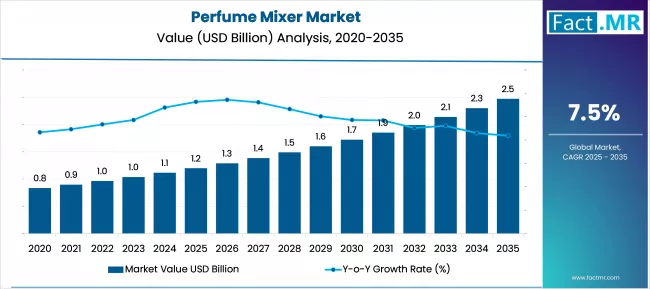
Perfume Mixer Market Market Value Analysis | Source: Fact.MR
What are the drivers of the Perfume Mixer Market?
The perfume mixer market is exploding because of the growing interest in customized, safe and sensory experiences of fragrance in both retail and luxury as well as DIY markets. With the support of advanced algorithms, AI-driven scent formulation is capable of improving personalization, and the development of e-commerce and social media channels such as Tik Tok increase their accessibility.
Sustainable products, including biodegradable components and refillable consumers, are in line with the eco-friendly movements. The adoption is caused by urbanization and tech-savvy consumers, which is facilitated by innovations in low-cost mixing technologies. Partnerships with technology and regulatory assistance to brother sustainable beauty drive the industry, making perfume mixers the key to bespoke, sustainable fragrance choices worldwide.
What are the regional trends of the Perfume Mixer Market?
The regional adoption of the perfume mixer market is dependent on the infrastructure, consumer preference and laws.
North America is the pioneer with developed AI and e-commerce, combining mixers in the retail and luxury industries.
Europe is concerned with sustainable mixing solutions fueled by eco-policies and smart cities.
Asia-Pacific, especially China and India is booming through e-commerce and tech savvy consumers who are adopting personalized fragrances.
Latin America embraces mixers in retail and DIY customization increasing the customer involvement.
Smart city initiatives and retail digitalization in the Middle East and Africa are used to enhance the use of perfume mixers in the luxury and residential environments with the increased urbanization.
What are the challenges and restraining factors of the Perfume Mixer Market?
The perfume mixer market is struggling with complicated operations, technological requirements and regulations. The cost of AI-based mixing machines and eco-friendly materials tends to be high, which restricts the scalability of AI-driven mixing devices, especially to small and medium enterprises.
An intermittent digital infrastructure and internet connectivity between regions hamper the adoption of e-commerce. Internet platforms are challenged by data privacy and cybersecurity issues. There is uncertainty on the laws regarding the safety of ingredients and packaging that is environmentally friendly, making it harder to comply.
In addition, the low digital literacy of emerging economies inhibits market penetration and the difference between consumer preferences in different regions complicates standardization to facilitate the extensive commercialization and adoption of individualized fragrance solutions.
Country-Wise Insights
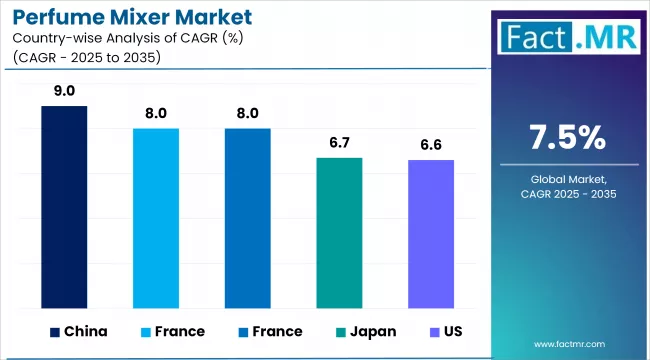
Perfume Mixer Market Cagr Analysis By Country | Source: Fact.MR
The U.S. leads personalized, tech-driven perfume mixer innovation
The U.S. perfume mixer market is based on the strong tech innovation and urban digitalization which leads to the necessity to use the personalized fragrance solutions. Big cities such as New York, California and Texas are using the benefits of tech-aware consumers and e-commerce platforms to incorporate AI-based mixers in the retail and luxury markets.
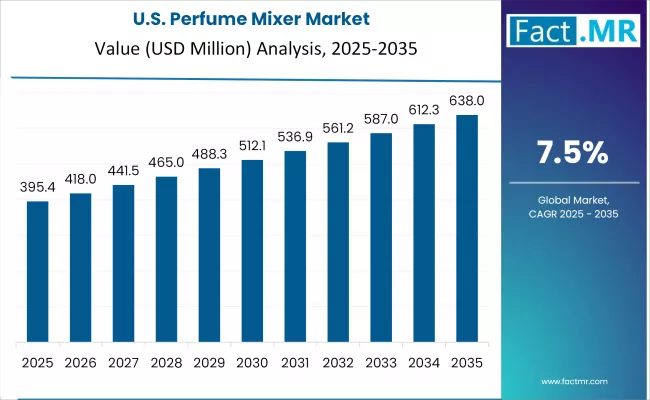
Perfume Mixer Market Country Value Analysis | Source: Fact.MR
Shortages in labor in service-oriented industries increase the use of automated mixing systems as a way to achieve efficiency. The recent tendency to focus on personalization at the national level standardizes real-time scent customization, supported by consumer interest in the latest devices and collaboration with tech giants, placing the U.S. in the role of the leader in scalable innovative fragrance experiences.
France excels in luxury, AI-driven custom perfume innovation
The perfume mixer market in France has been thriving because of its world leadership in fragrance and the value of luxury in the culture. The innovation is being innovated in cities such as Paris and Grasse with AI driven mixing systems in high-end retail and perfumeries. Sustainable, custom-made fragrance solutions are encouraged by environmentally-friendly policies and technologically inclined consumers.
The requirement of labor in the luxurious sectors drive the increase of automated mixers to customize experiences. The emphasis on craftsmanship and digital interfaces in France guarantees the ability to customize the scent smoothly, with the assistance of such prominent brands as Chanel and LVMH, and makes the country an excellent location to generate high-quality innovative perfume mixing technologies.
China drives AI-powered, e-commerce-based personalized perfume solutions
The perfume mixer market in china is in its boom and this is due to the rapid urbanization and adoption of digital in places such as Shanghai and Beijing. The increase in disposable incomes and the tech-driven millennial generation drive the necessity of AI-permitted, personalized fragrance solutions through the e-commerce platform.
The retail issues with labor drive automated mixers because of efficiency and cultural interest in customization leads to market expansion. Collaborations of tech companies and fragrance brands normalize real-time perfume creation, backed by well-developed digital infrastructure, making China a forward-moving leader within scalable, consumer-driven perfume mixing technologies.
Category-Wise Analysis
Automated devices enable easy, consistent, tech-driven perfume customization
Automated perfume mixing devices are another important innovation in the perfume mixer market whereby individuals can easily mix fragrances and have a personalized scent. These devices rely on a high level of technology like micro-dispensers, digital controller, and AI algorithms to mix fragrance ingredients precisely. They provide repeatable and stable scent formulations due to the evidence of the increase in consumer demand in convenience and customization.
The segment is growing fast because of new interest in smart home products and technology-based beauty products. The major players are combining these systems with mobile applications, which brings in remote control and data-driven scent suggestions and it is very attractive to the technologically advanced consumers.
Consumers increasingly prefer personalized perfumes for self-expression
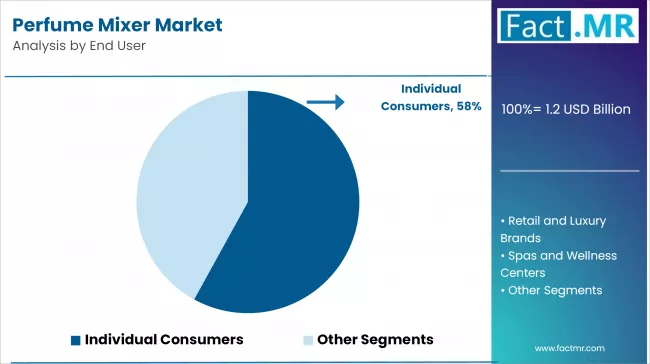
Perfume Mixer Market Analysis By End User | Source: Fact.MR
Individual consumers constitute the biggest and most rapidly expanding final-user market in the perfume mixer market. More and more consumers are demanding customized fragrance delivery solutions that embrace their individuality and not some of the mass-produced fragrances. The increasing disposable incomes, social media impact, and an increasing desire to express themselves are the drivers behind this trend.
Customers have the ability to make personalized perfumes using DIY kits, online fragrance making and workshop in-store options. The channels such as the e-commerce that are based on convenience are also contributing to increasing the segment and making it easy to obtain the personalized perfume products. New values such as environmental-friendly, animal-free and green are sought after by consumers.
Online retail drives accessible, scalable, and personalized perfume solutions
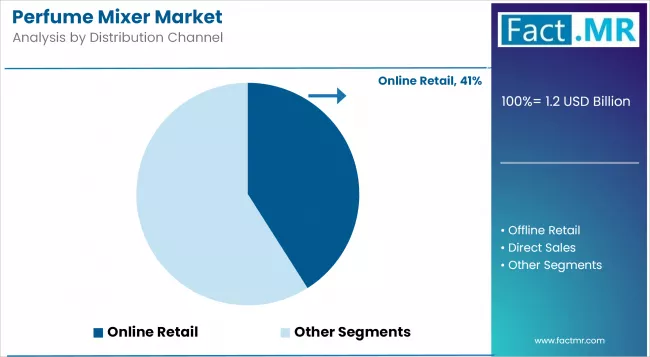
Perfume Mixer Market Analysis By Distribution Channel | Source: Fact.MR
The leading and the most rapidly expanding channel of distribution in Perfume Mixer Market is Online Retail. It facilitates geographical access to direct-to-consumer in order to make the custom perfume solutions very common. The channel takes advantage of high-tech digital platforms with easy-to-use interfaces, product suggestions, and scent-customization AI tools.
Online retail can help with the aspect of scalability; it provides customized kits and automated appliances without restrictions on brick-and-mortar stores. The consumer shopping behavior is transformed to speed up its growth due to convenience, product variety, and competitive pricing. Also on-line platforms, such as customer reviews, social proof, and targeted marketing strategies enable the brands to reach more diverse audience.
Competitive Analysis
The Key players in the perfume mixer market are Maison 21G, L'Oréal S.A., Estée Lauder Companies Inc., Givaudan, Olfactory NYC, Mixologie, The Aroma Labs and Ex Nihilo
The perfume mixer market is highly competitive among technology vendors, fragrance, and startups. The main players have invested in AI-based scent formulation, automated mixing, and eco-friendly packaging to enhance accuracy and experience. The collaborations of tech companies with luxury brands lead to the penetration of markets at retail, DIY, and luxury levels. Leading players are seeking to vertically integrate and provide full fragrance solution whereas regional players are proposing an app-based and localized solution. The main distinction between the products is sustainability and energy-saving devices, satisfying the demand of consumers with environmentally friendly and personalized solutions to fragrance in a fast-paced market.
Recent Development
- In August 2025, The Osmo tech startup presented an artificial intelligence-based platform allowing the creation of personal perfumes in 48 hours. The innovation is meant to democratize the production of scents by making it cheaper and more accessible and especially other small brands and independent creators. The technology of Osmo also guarantees the simplification of the production process, which would legally comply and shelf-stable formulas without the time-consuming delays that are characteristic of the perfume industry.
- In February 2025, Liquid Sound introduced a platform in which artificial intelligence is combined with synesthesia to produce smell based on sound. It will transform its perfume industry by giving it a new dimension of personalization so that consumers can have the experience of smell that touches their aural senses.
Fact.MR has provided detailed information about the price points of key manufacturers of Perfume Mixer Market positioned across regions, sales growth, production capacity, and speculative technological expansion, in the recently published report.
Methodology and Industry Tracking Approach
The report Global Perfume Mixer Market by Fact.MR (2025) polled 10, 500 stakeholders in 30 countries, of which at least 300 stakeholders were surveyed in each region. End-users and service providers (retail chains, luxury brands, DIY enthusiasts) represented about 60 percent of the total, whereas industry professionals (fragmenters, tech integrators, policymakers) constituted 40 percent of the total.
The information was gathered between July 2024 and June 2025 and included the adoption trends, technology investments, effects of regulations, market potential, and challenges. Regression analysis and scenario-based forecasting were applied to 250 or more secondary sources, such as patents, industry reports and regulatory documents in order to make accurate predictions about the market.
With Fact.MR monitoring consumer behavior, product efficacy, industry trends, and market opportunities since 2018, this report is becoming an authoritative source of information that stakeholders can rely on.
Segmentation
Segmentation of Perfume Mixer Market
-
By Product Type :
- Automated Perfume Mixing Devices
- Manual Perfume Mixing Kits
- Professional Perfume Mixing Systems
-
By Price Range :
- Mass Market
- Mid-Range
- Premium/Luxury
-
By Distribution Channel :
- Online Retail
- Offline Retail
- Direct Sales
-
By End-User :
- Individual Consumers
- Retail and Luxury Brands
- Spas and Wellness Centers
- Perfume Manufacturers
-
By Region :
- North America
- Latin America
- Western Europe
- Eastern Europe
- East Asia
- South Asia & Pacific
- Middle East & Africa
Frequently Asked Questions
What was the Global Perfume Mixer Market Size Reported by Fact.MR for 2025?
Who are the Major Players Operating in the Perfume Mixer Market?
What is the Estimated Valuation of the Perfume Mixer Market in 2035?
What Value CAGR did the Perfume Mixer Market Exhibit Over the Last Five Years?
Who worked on this report


Preview the report firsthand - request a free sample
Free SampleGet the brochure for pricing and purchase details
Download PDF