Phytase Enzyme for Animal-Free Brewing Applications Market (2026 - 2036)

The Phytase Enzyme for Animal-Free Brewing Applications Market is segmented by Product Type (3-Phytase, 6-Phytase, and Multi-Enzyme Blends), Source (Microbial and Plant-Derived), Form (Powder and Liquid), Application (Animal Feed, Food and Beverages, and Bioethanol and Industrial Fermentation), and Region. Forecast for 2026 to 2036.

FACT.MR analysis indicates a clear bifurcation in the phytase enzyme market for animal-free brewing applications. Conventional phytase used in animal feed continues to expand at a steady pace but remains largely commoditised. High-specificity microbial phytase designed for vegan brewing, clean fermentation, and phosphate reduction in beer and fermented beverages is gaining strong momentum. These food-grade enzymes are commanding premium pricing, driven by breweries transitioning toward Vegan Society and Barnivore-certified processes. This shift is creating a distinct demand segment beyond traditional feed applications, favouring suppliers with brewing-grade functionality and certification capabilities.

Phytase Enzyme for Animal-Free Brewing Applications Market Forecast and Outlook By Fact.MR)

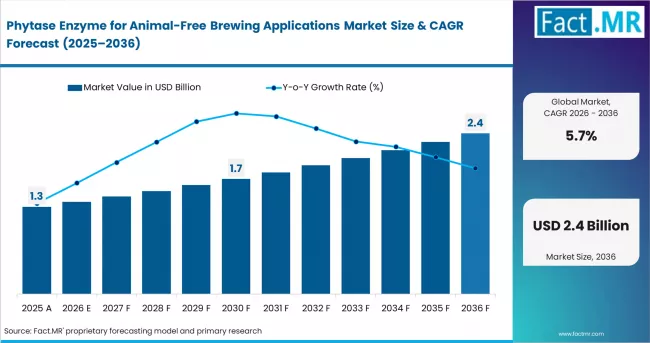
In 2025, the phytase enzyme for animal-free brewing applications market was valued at USD 1.2 billion. Based on Fact.MR analysis, demand for phytase enzyme in animal-free brewing applications is estimated to grow to USD 1.3 billion in 2026 and USD 2.3 billion by 2036. FACT.MR projects a CAGR of 5.7% during the forecast period.
Phytase Enzyme For Animal Free Brewing Applications Market Market Value Analysis

Metric Value
Estimated Value in 2026 USD 1.3 billion
Forecast Value in 2036 USD 2.3 billion
Forecast CAGR (2026 to 2036) 5.7%

Summary of Phytase Enzyme for Animal-Free Brewing Applications Market

  • Market Definition
    • The market covers food-grade and industrial phytase enzymes used in vegan-certified brewing, fermented beverage processing, and bioethanol fermentation for phosphate management and clean-label antinutrient reduction.
  • Demand Drivers
    • India's government bioethanol blending mandates are accelerating industrial phytase procurement at distillery and fermentation facility sites.
    • U.S. craft brewing vegan certification programmes are driving brewery adoption of food-grade phytase as an animal-free fining and phosphate management solution.
    • Brazil's sugarcane bioethanol expansion is generating structured industrial fermentation phytase procurement at large-scale ethanol production facilities.
  • Key Segments Analyzed
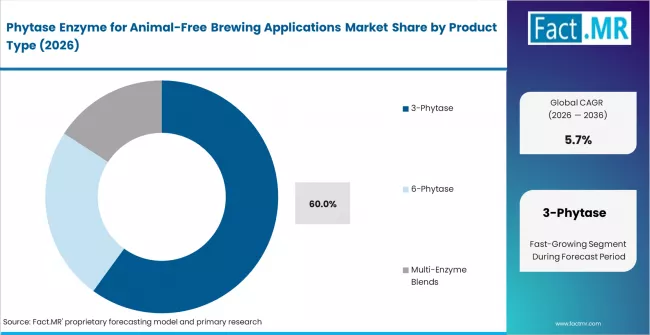
    • By Product Type: 3-Phytase leads with approximately 60% share in 2026, driven by superior phosphate release efficiency.
    • By Application: Animal Feed holds the largest base volume share.
    • By Geography: India leads at 8.0% CAGR through 2036, supported by government bioethanol blending mandates.
  • Analyst Opinion at FACT.MR
    • Shambhu Nath Jha Principal Consultant at Fact.MR states CXOs should prioritise food-grade phytase qualification for vegan brewing and bioethanol channels. Microbial 3-phytase offers near-term scalability, while multi-enzyme blends for clean fermentation will scale post-2030.
  • Strategic Implications
    • Secure food-grade brewing certification for phytase products early. Vegan Society and Barnivore certification enables premium craft brewery contract access.
    • Leverage India's bioethanol mandate and Brazil's ethanol expansion. Industrial fermentation phytase represents the largest near-term volume growth opportunity.
    • Expand into multi-enzyme blends for clean-label fermentation. These compound systems deliver higher value and switching-cost barriers versus single phytase supply.
  • Methodology
    • Market sizing based on enzyme production capacity and brewery procurement data, validated with producer revenues and disclosures from 2024 to 2025.
    • India MNRE, USDA, and EU enzyme regulation data support demand and regional analysis.
    • Forecasts include bioethanol programme volumes, vegan brewing adoption, fermentation capacity data, and expert inputs.

The market is projected to generate approximately USD 1.0 billion in incremental revenue over the forecast period, reflecting a phase of steady structural expansion. Growth is being underpinned by vegan certification mandates in craft brewing, clean-label fermentation ingredient demand from premium beverage brands, and bioethanol producer phosphate management requirements. Concurrently, declining microbial fermentation production costs are improving enzyme economics. However, the market continues to face constraints from high food-grade certification costs for non-feed phytase applications and extended brewery qualification cycles for new enzyme suppliers.

Demand is shifting from commodity feed-grade phytase toward high-purity food-grade and brewing-certified phytase products. Standard animal feed phytase volumes face stable but low-growth demand, while food and beverage and industrial fermentation applications command premium enzyme pricing and generate higher margin contracts, sustaining overall market revenue expansion even where volume growth remains incremental.

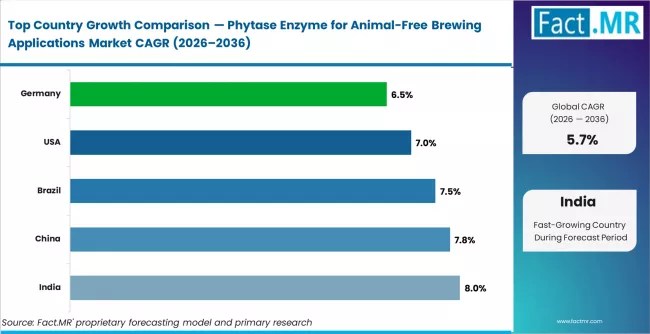
Country growth is shaped by vegan brewing adoption, fermentation industry scale, bioethanol programme investment, and enzyme production capability. India leads at 8.0% CAGR through rapid fermentation industry growth and government bioethanol mandate-driven industrial enzyme demand. Brazil follows at 7.5% through large-scale sugarcane bioethanol production and expanding fermentation enzyme procurement. China records 7.8% through the world's largest enzyme production base and rapidly expanding brewing and fermentation sector. The United States grows at 7.0% through strong craft brewing industry adoption of vegan certification and biotech enzyme innovation. Germany records 6.5% through advanced enzyme engineering heritage and premium craft beer vegan certification market development. Structural constraints across mature Western markets include high food-grade enzyme qualification costs and conservative brewery sourcing behaviour limiting faster supplier diversification.

Segmental Analysis

Phytase Enzyme for Animal-Free Brewing Applications Market Analysis by Product Type
Phytase Enzyme For Animal Free Brewing Applications Market Analysis By Product Type

3-Phytase holds 60% share in 2026, driven by its high phytate hydrolysis efficiency and wide compatibility across brewing, feed, and fermentation applications. It benefits from a strong research pipeline, scalable microbial production, and proven performance in phosphate reduction and vegan brewing certification, making it the most commercially accessible phytase type.

  • Novozymes Investment: Novozymes expanded its Ronozyme phytase production capacity in 2024 targeting food and beverage fermentation applications beyond animal feed, including craft brewery and bioethanol fermentation markets in North America and Europe. [1]
  • DSM-Firmenich Launch: DSM-Firmenich introduced a new high-temperature-stable phytase enzyme in 2025 specifically formulated for mash processing in craft brewery vegan certification applications, supporting phosphate reduction without animal-derived fining agents. [2]
  • Multi-Enzyme Blend Trend: Global brewery enzyme product launches incorporating phytase in multi-enzyme fermentation blends grew 19% in 2024, reflecting demand for integrated clean-fermentation enzyme systems targeting phosphate and antinutrient reduction simultaneously. [3]

Phytase Enzyme for Animal-Free Brewing Applications Market Analysis by Source
Phytase Enzyme For Animal Free Brewing Applications Market Analysis By Source

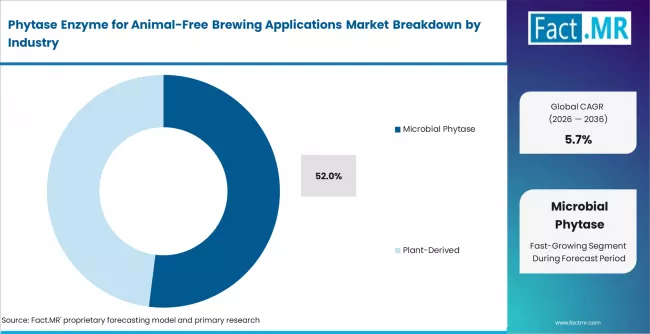
Microbial phytase holds 52% share in 2026, driven by scalable production through fungal and bacterial fermentation, consistent enzyme activity, and cost efficiency versus plant-based sources. Aspergillus niger-derived phytase remains the most widely used and qualified source for food-grade brewing and industrial fermentation globally.

  • BASF Partnership Investment: BASF SE expanded its enzyme fermentation partnership with a German biotech producer in 2024 targeting food-grade microbial phytase supply for European craft brewery and clean-label fermentation customers seeking vegan-certified enzyme sourcing. [4]
  • AB Vista Technology Launch: AB Vista launched Quantum Blue phytase in 2025 with improved thermostability and broader pH activity range, targeting brewery mash processing and bioethanol fermentation applications requiring consistent performance across variable process conditions. [5]
  • Plant-Derived Phytase Trend: Interest in plant-derived phytase from wheat bran and soybean sources grew among European organic and natural brewing brands in 2024, driven by demand for non-GMO, naturalorigin enzyme declarations in certified organic fermentation product labelling. [6]

Drivers, Restraints, and Opportunities
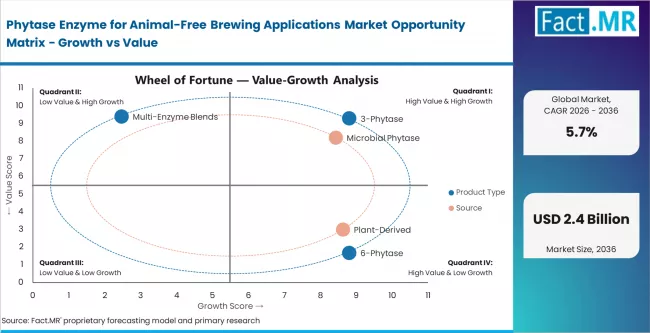
Phytase Enzyme For Animal Free Brewing Applications Market Opportunity Matrix Growth Vs Value

FACT.MR identifies rising demand from brewing, bioethanol, and food processing sectors. Vegan certification and clean-label requirements are accelerating adoption of food-grade phytase. Government bioethanol mandates and brewery vegan standards are expanding demand beyond feed applications, despite higher qualification costs.

Food-grade phytase use is increasing in craft brewing and bioethanol fermentation. These segments require strict enzyme specifications and certification. However, food-grade phytase remains 15–35% more expensive than feed-grade, slowing adoption in cost-sensitive markets.

  • India Bioethanol Mandate Expansion: India's Ministry of Petroleum and Natural Gas extended the E20 bioethanol blending mandate timeline in 2024, allocating INR 8,500 crore to distillery capacity expansion at IOCL and BPCL sites, directly expanding industrial fermentation phytase procurement for phosphate management in sugarcane and grain-based ethanol production programmes. [7]
  • U.S. Vegan Brewery Certification: The Vegan Society and Barnivore database recorded a 31% increase in U.S. vegan-certified beer registrations in 2024, compelling craft breweries including Brooklyn Brewery and New Belgium Brewing to qualify food-grade phytase as a primary phosphate management and animal-free fining alternative in their brewing processes. [8]
  • Brazil Sugarcane Ethanol Expansion: Brazil's RenovaBio programme, with updated 2024 decarbonisation credit targets for sugarcane ethanol producers, expanded fermentation enzyme procurement budgets at major producers including Raizen and Cosan, as phytase-based phosphate optimisation improves ethanol yield efficiency and reduces wastewater treatment costs. [9]

Regional Analysis

The phytase enzyme for animal-free brewing applications market is assessed across North America, Asia Pacific, Europe, Latin America, and Middle East and Africa, covering 40+ key countries with distinct demand profiles shaped by bioethanol programme investment, vegan brewing certification adoption, fermentation industry scale, food-grade enzyme regulation, and industrial enzyme production capability. The full report provides market attractiveness analysis by region and country.

Top Country Growth Comparison Phytase Enzyme For Animal Free Brewing Applications Market Cagr (2026 2036)

Country CAGR (2026 to 2036)
India 8.0%
Brazil 7.5%
China 7.8%
United States 7.0%
Germany 6.5%

Source: Fact.MR (FACT.MR) analysis, based on proprietary forecasting model and primary research
Phytase Enzyme For Animal Free Brewing Applications Market Cagr Analysis By Country

Asia Pacific Phytase Enzyme for Animal-Free Brewing Applications Market Analysis

Asia Pacific remains a high-growth region driven by strong fermentation expansion and enzyme production scale. China leads manufacturing capacity, while India drives demand through policy-led bioethanol expansion. Brewing and industrial fermentation are key demand centers. Major players include Novozymes Asia, domestic Chinese producers, and DSM-Firmenich.

  • India: Policy-backed expansion supports 8.0% CAGR through 2036. The E20 bioethanol mandate and INR 8,500 crore investment in IOCL and BPCL distilleries are accelerating enzyme demand. 2024 programme updates included phytase in fermentation specifications. Growth is driven by large-scale distillery capacity expansion and public sector procurement.
  • China: Scale-driven growth supports 7.8% CAGR through 2036. The 2024 National Enzyme Industry policy promotes high-activity phytase and blended enzymes. Companies such as Sunson and Challenge Group are expanding food-grade capacity. Demand is supported by brewing, food fermentation, and export markets.

FACT.MR covers India, China, Japan, South Korea, ASEAN, and ANZ. Includes fermentation capacity, bioethanol programmes, and enzyme adoption trends.

Latin America Phytase Enzyme for Animal-Free Brewing Applications Market Analysis

Latin America shows strong growth driven by large-scale ethanol production and fermentation demand. Brazil dominates regional consumption. Key suppliers include Novozymes, DSM-Firmenich, and BASF.

  • Brazil: Efficiency-led growth supports 7.5% CAGR through 2036. RenovaBio 2024 targets push ethanol producers such as Raizen and Cosan to optimise enzyme use. Phytase improves yield and reduces wastewater costs. ANP updated standards to recognise enzyme-assisted fermentation. Growth is driven by sustainability and production efficiency.

FACT.MR covers Brazil, Argentina, Mexico, Chile, and others. Includes ethanol output data, enzyme demand, and fermentation trends.

North America Phytase Enzyme for Animal-Free Brewing Applications Market Analysis
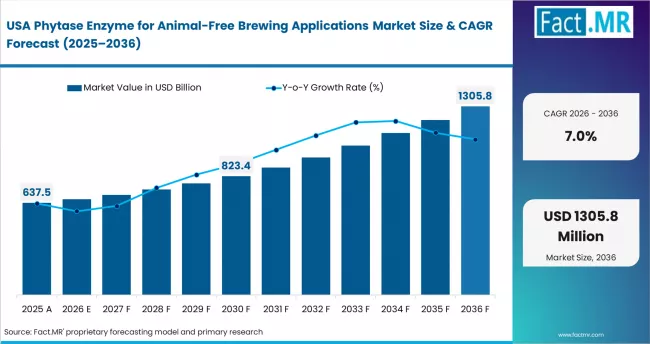
Phytase Enzyme For Animal Free Brewing Applications Market Country Value Analysis


North America is a premium market driven by vegan certification trends and advanced biotech capabilities. Demand is strongest in craft brewing and specialised fermentation. Key suppliers include Novozymes, DSM-Firmenich, and DuPont.

  • United States: Certification-driven growth supports 7.0% CAGR through 2036. Vegan beer registrations rose 31% in 2024, pushing breweries like New Belgium and Brooklyn Brewery to adopt food-grade phytase. USDA guidance supports enzyme use in grain fermentation. Growth is shaped by certification, innovation, and premium brewing demand.

FACT.MR covers the U.S., Canada, and Mexico. Includes regulatory data, certification trends, and enzyme adoption insights.

Europe Phytase Enzyme for Animal-Free Brewing Applications Market Analysis
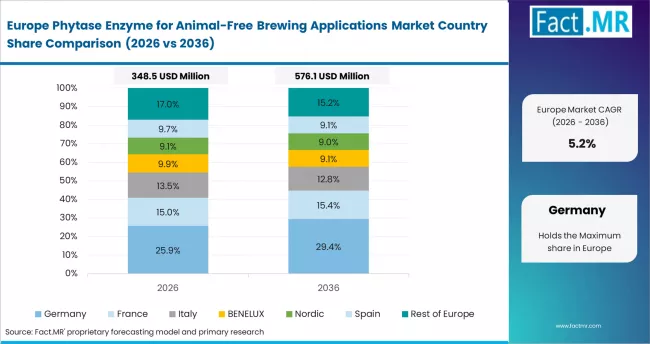
Phytase Enzyme For Animal Free Brewing Applications Market Europe Country Market Share Analysis, 2026 & 2036

Europe is a regulation-led premium market with strong focus on safety, certification, and enzyme innovation. EU regulations and vegan brewing standards define procurement. Leading players include DSM-Firmenich, BASF, and Novozymes.

  • Germany: Technology-driven growth supports 6.5% CAGR through 2036. The European Brewery Convention updated enzyme guidelines in 2024, formally including phytase. BASF expanded its Ludwigshafen facility to serve brewing and fermentation clients. Growth is driven by advanced R&D, compliance standards, and strong brewing industry demand.

FACT.MR covers Germany, France, UK, Belgium, Netherlands, and others. Includes EU regulation timelines, certification frameworks, and technology adoption trends.

Competitive Aligners for Market Players
Phytase Enzyme For Animal Free Brewing Applications Market Analysis By Company

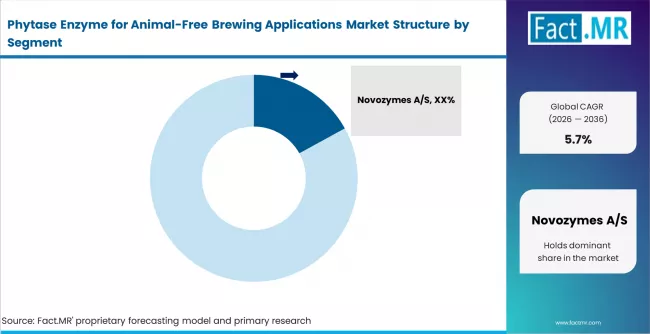
The phytase enzyme market for animal-free brewing applications shows moderate concentration, especially within the food-grade segment. Competitive success is driven by the ability to meet strict food-grade standards, align with vegan certification requirements, and provide strong technical support for fermentation processes. Companies that have developed thermostable microbial phytase with validated food-grade approval hold a clear edge. Leaders such as Novozymes, DSM-Firmenich, and AB Vista combine advanced enzyme engineering with deep brewing application expertise, allowing them to deliver integrated enzyme solutions rather than standalone products.

Large-scale enzyme manufacturers like BASF and Novozymes benefit from in-house microbial fermentation infrastructure and long-term contracts with breweries and bioethanol producers. This provides both cost efficiency and a qualification advantage, as food-grade enzyme approval processes are complex and time-consuming. Their established track record reduces risk for buyers and strengthens their position in procurement cycles. Specialised players such as Creative Enzymes complement the market by offering customised, high-activity phytase tailored for niche brewing and fermentation needs. These firms often focus on flexibility and innovation, addressing specific formulation or process challenges.

On the demand side, breweries and ethanol producers typically adopt a dual sourcing strategy. They depend on established, qualified suppliers for primary supply while evaluating smaller biotech firms as secondary options. Switching suppliers is difficult due to the need for revalidation and regulatory approval, which increases cost and time. This dynamic supports long-term partnerships and allows early-qualified suppliers to retain pricing power, while structured procurement systems in bioethanol programmes ensure consistent, multi-year demand.

Key Players

  • Novozymes A/S
  • DSM-Firmenich AG
  • BASF SE
  • DuPont (IFF Nutrition and Biosciences)
  • AB Vista
  • Kemin Industries Inc.
  • Adisseo
  • Novus International Inc.
  • Creative Enzymes

Bibliography

  • [1] Novozymes A/S. (2024). Production Capacity Expansion Announcement: Ronozyme Phytase Capacity Expansion Targeting Food and Beverage Fermentation Applications Including Craft Brewery and Bioethanol Markets in North America and Europe. Q3 2024. novozymes.com/investor-relations
  • [2] DSM-Firmenich AG. (2025). Product Launch: High-Temperature-Stable Phytase Enzyme for Mash Processing in Craft Brewery Vegan Certification Applications Supporting Phosphate Reduction Without Animal-Derived Fining Agents. January 2025. dsm-firmenich.com/newsroom
  • [3] Brewing Science Institute. (2024). Enzyme Application Survey 2024: 19% Growth in Multi-Enzyme Fermentation Blend Product Launches Incorporating Phytase for Integrated Phosphate and Antinutrient Reduction in Clean-Label Brewery Operations. December 2024. brewingscience.org
  • [4] BASF SE. (2024). Enzyme Fermentation Partnership Expansion: Food-Grade Microbial Phytase Supply Agreement for European Craft Brewery and Clean-Label Fermentation Customers Seeking Vegan-Certified Enzyme Sourcing. 2024. basf.com/global/en/media
  • [5] AB Vista. (2025). Product Launch: Quantum Blue Phytase with Improved Thermostability and Broader pH Activity Range Targeting Brewery Mash Processing and Bioethanol Fermentation Applications. January 2025. abvista.com/newsroom
  • [6] Organic Brewers Alliance. (2024). Natural Enzyme Sourcing Survey 2024: Growth in Plant-Derived Non-GMO Phytase Procurement Among European Organic Brewery and Natural Fermentation Brand Operators for Clean-Label Enzyme Declaration Compliance. November 2024. organicbrewers.org
  • [7] Ministry of Petroleum and Natural Gas, Government of India. (2024). E20 Bioethanol Blending Programme: INR 8,500 Crore Distillery Capacity Expansion Allocation at IOCL and BPCL Sites Including Fermentation Enzyme Procurement Specifications for Grain-Based Ethanol Production. 2024. petroleum.nic.in
  • [8] The Vegan Society. (2024). Vegan Trademark Annual Report 2024: 31% Increase in U.S. Vegan-Certified Beer Registrations Including Phytase Enzyme as Approved Animal-Free Processing Aid in Registered Brewery Operations. December 2024. vegansociety.com/trademark
  • [9] Agencia Nacional do Petroleo Gas Natural e Biocombustiveis. (2024). RenovaBio Programme Updated 2024 Decarbonisation Credit Targets: Bioethanol Producer Fermentation Process Optimisation Including Enzyme-Assisted Phosphate Management Recognition in Technical Production Standards. 2024. anp.gov.br/renovabio

This Report Addresses

  • Strategic insights on phytase enzyme demand across India bioethanol mandate-driven fermentation procurement, U.S. craft brewery vegan certification, Brazil RenovaBio ethanol expansion, China enzyme production scale-up, and Germany EU-qualified food-grade phytase development trends.
  • Market forecast from USD 1.3 billion in 2026 to USD 2.3 billion by 2036. CAGR of 5.7%.
  • Growth opportunities across food-grade phytase for vegan-certified brewing, multi-enzyme blends for clean fermentation, bioethanol phosphate optimisation, and high-thermostability phytase for industrial mash processing applications.
  • Segment analysis by product type (3-phytase, 6-phytase, multi-enzyme blends), source (microbial, plant-derived), form (powder, liquid), and application (animal feed, food and beverages, bioethanol and industrial fermentation).
  • Regional outlook covering Asia Pacific government mandate-led bioethanol enzyme demand, Latin America RenovaBio-programme-driven fermentation expansion, North America vegan certification-led brewery procurement, and European EU food enzyme regulation-driven qualification trends.
  • Competitive analysis of Novozymes, DSM-Firmenich, BASF, DuPont IFF, AB Vista, Kemin Industries, Adisseo, Novus International, and Creative Enzymes. Focus on food-grade qualification, brewery certification capability, and government programme positioning.
  • Regulatory impact analysis covering EU Regulation (EC) No 1332/2008 food enzyme safety assessment, India E20 bioethanol mandate enzyme procurement specifications, U.S. USDA fermentation enzyme efficacy guidance, Brazil RenovaBio technical standards, and European Brewery Convention vegan enzyme application guidelines.
  • Report available in PDF, Excel, and presentation formats. Supported by primary research, government programme records, brewery procurement data, and company investor disclosures.

Phytase Enzyme for Animal-Free Brewing Applications Market Definition

The phytase enzyme for animal-free brewing applications market includes food-grade and industrial-grade phytase enzymes used in brewing, fermentation, and bioethanol production to hydrolyse phytic acid, improving phosphate bioavailability, reducing antinutrient levels, and enabling vegan-certified processing without animal-derived fining agents.

Phytase Enzyme for Animal-Free Brewing Applications Market Inclusions

Includes forecasts from 2026 to 2036 by product type, source, form, and application. Covers 3-phytase, 6-phytase, and multi-enzyme blends in microbial and plant-derived forms used in animal feed, food and beverages, and industrial fermentation. Covers global and key country markets.

Phytase Enzyme for Animal-Free Brewing Applications Market Exclusions

Excludes phytase used exclusively in human dietary supplement capsules or pharmaceutical formulations without brewing function. Focus is only on phytase supplied as a processing enzyme to brewery, fermentation facility, and bioethanol plant operators. Omits non-phytase enzyme blends and protease or amylase products without phytase activity.

Phytase Enzyme for Animal-Free Brewing Applications Market Research Methodology

  • Primary Research: Interviews with enzyme producers, craft brewery procurement managers, bioethanol facility operators, and vegan certification body representatives.
  • Desk Research: Uses USDA, EU enzyme regulation data, India bioethanol programme records, and company reports from 2024 to 2025.
  • Market Sizing and Forecasting: Based on enzyme production capacity, output, and pricing by product type and application. Supported by brewery procurement and fermentation volume data.
  • Data Validation and Update Cycle: Validated using producer revenues, brewery contract data, and expert inputs. Regularly updated.

Scope of Report

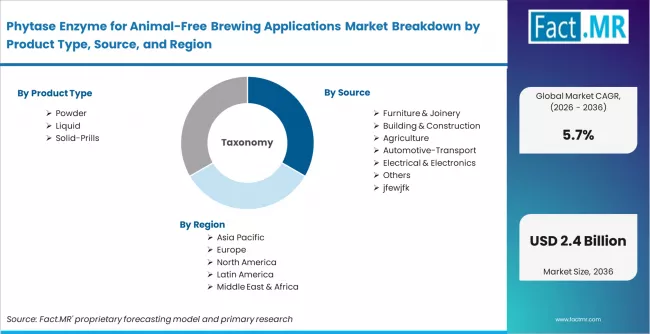
Phytase Enzyme For Animal Free Brewing Applications Market Breakdown By Product Type, Source, And Region

Attribute Details
Quantitative Units USD 1.3 billion (2026) to USD 2.3 billion (2036), at a CAGR of 5.7%
Market Definition Food-grade and industrial phytase enzymes supplied to brewery, fermentation facility, and bioethanol plant operators for phosphate management, antinutrient reduction, and vegan-certified brewing process applications globally.
Product Type Segmentation 3-Phytase, 6-Phytase, Multi-Enzyme Blends
Source Segmentation Microbial (Fungal and Bacterial), Plant-Derived
Form Segmentation Powder, Liquid
Application Segmentation Animal Feed, Food and Beverages (including Brewing and Fermentation), Bioethanol and Industrial Fermentation
Application Coverage Craft brewery vegan-certified phosphate management processing, commercial beer mash phytate hydrolysis, bioethanol fermentation phosphate optimisation, clean-label fermented beverage processing, and animal feed phosphate bioavailability improvement.
Regions Covered North America, Europe, Asia Pacific, Latin America, Middle East and Africa
Countries Covered USA, Canada, Mexico, UK, Germany, France, Italy, Spain, Nordic, BENELUX, China, Japan, South Korea, India, ASEAN, Australia and New Zealand, Brazil, Argentina, Chile, Saudi Arabia, GCC, Turkey, South Africa, Rest of MEA
Key Companies Profiled Novozymes A/S, DSM-Firmenich AG, BASF SE, DuPont IFF Nutrition and Biosciences, AB Vista, Kemin Industries, Adisseo, Novus International, Creative Enzymes
Forecast Period 2026 to 2036
Approach Hybrid top-down and bottom-up model using enzyme production capacity data by product type, brewery and fermentation procurement benchmarks, bioethanol programme records, vegan certification adoption data, and primary interviews with enzyme producers and brewery procurement managers.

Phytase Enzyme for Animal-Free Brewing Applications Market by Segments

  • By Product Type:

    • 3-Phytase
    • 6-Phytase
    • Multi-Enzyme Blends
  • By Source:

    • Microbial (Fungal and Bacterial)
    • Plant-Derived
  • By Form:

    • Powder
    • Liquid
  • By Application:

    • Animal Feed
    • Food and Beverages (including Brewing and Fermentation)
    • Bioethanol and Industrial Fermentation
  • By Region:

    • North America
      • United States
      • Canada
      • Mexico
    • Latin America
      • Brazil
      • Mexico
      • Argentina
      • Chile
      • Rest of Latin America
    • Western Europe
      • Germany
      • United Kingdom
      • France
      • Italy
      • Spain
      • Nordic Countries
      • BENELUX
      • Rest of Western Europe
    • Eastern Europe
      • Russia
      • Poland
      • Hungary
      • Balkan and Baltic
      • Rest of Eastern Europe
    • East Asia
      • China
      • Japan
      • South Korea
      • South Asia and Pacific
      • India
      • ASEAN
      • Australia and New Zealand
      • Rest of South Asia and Pacific
    • Middle East and Africa
      • Kingdom of Saudi Arabia
      • Other GCC Countries
      • Turkey
      • South Africa
      • Rest of Middle East and Africa

Table of Content

  1. Executive Summary
    • Global Market Outlook
    • Demand to side Trends
    • Supply to side Trends
    • Technology Roadmap Analysis
    • Analysis and Recommendations
  2. Market Overview
    • Market Coverage / Taxonomy
    • Market Definition / Scope / Limitations
  3. Research Methodology
    • Chapter Orientation
    • Analytical Lens and Working Hypotheses
      • Market Structure, Signals, and Trend Drivers
      • Benchmarking and Cross-market Comparability
      • Market Sizing, Forecasting, and Opportunity Mapping
    • Research Design and Evidence Framework
      • Desk Research Programme (Secondary Evidence)
        • Company Annual and Sustainability Reports
        • Peer-reviewed Journals and Academic Literature
        • Corporate Websites, Product Literature, and Technical Notes
        • Earnings Decks and Investor Briefings
        • Statutory Filings and Regulatory Disclosures
        • Technical White Papers and Standards Notes
        • Trade Journals, Industry Magazines, and Analyst Briefs
        • Conference Proceedings, Webinars, and Seminar Materials
        • Government Statistics Portals and Public Data Releases
        • Press Releases and Reputable Media Coverage
        • Specialist Newsletters and Curated Briefings
        • Sector Databases and Reference Repositories
        • Fact.MR Internal Proprietary Databases and Historical Market Datasets
        • Subscription Datasets and Paid Sources
        • Social Channels, Communities, and Digital Listening Inputs
        • Additional Desk Sources
      • Expert Input and Fieldwork (Primary Evidence)
        • Primary Modes
          • Qualitative Interviews and Expert Elicitation
          • Quantitative Surveys and Structured Data Capture
          • Blended Approach
        • Why Primary Evidence is Used
        • Field Techniques
          • Interviews
          • Surveys
          • Focus Groups
          • Observational and In-context Research
          • Social and Community Interactions
        • Stakeholder Universe Engaged
          • C-suite Leaders
          • Board Members
          • Presidents and Vice Presidents
          • R&D and Innovation Heads
          • Technical Specialists
          • Domain Subject-matter Experts
          • Scientists
          • Physicians and Other Healthcare Professionals
        • Governance, Ethics, and Data Stewardship
          • Research Ethics
          • Data Integrity and Handling
      • Tooling, Models, and Reference Databases
    • Data Engineering and Model Build
      • Data Acquisition and Ingestion
      • Cleaning, Normalisation, and Verification
      • Synthesis, Triangulation, and Analysis
    • Quality Assurance and Audit Trail
  4. Market Background
    • Market Dynamics
      • Drivers
      • Restraints
      • Opportunity
      • Trends
    • Scenario Forecast
      • Demand in Optimistic Scenario
      • Demand in Likely Scenario
      • Demand in Conservative Scenario
    • Opportunity Map Analysis
    • Product Life Cycle Analysis
    • Supply Chain Analysis
    • Investment Feasibility Matrix
    • Value Chain Analysis
    • PESTLE and Porter’s Analysis
    • Regulatory Landscape
    • Regional Parent Market Outlook
    • Production and Consumption Statistics
    • Import and Export Statistics
  5. Global Market Analysis 2021 to 2025 and Forecast, 2026 to 2036
    • Historical Market Size Value (USD Million) Analysis, 2021 to 2025
    • Current and Future Market Size Value (USD Million) Projections, 2026 to 2036
      • Y to o to Y Growth Trend Analysis
      • Absolute $ Opportunity Analysis
  6. Global Market Pricing Analysis 2021 to 2025 and Forecast 2026 to 2036
  7. Global Market Analysis 2021 to 2025 and Forecast 2026 to 2036, By Material Type
    • Introduction / Key Findings
    • Historical Market Size Value (USD Million) Analysis By Material Type , 2021 to 2025
    • Current and Future Market Size Value (USD Million) Analysis and Forecast By Material Type , 2026 to 2036
      • Metal Oxide
      • Mixed Metal Oxides
      • Others
    • Y to o to Y Growth Trend Analysis By Material Type , 2021 to 2025
    • Absolute $ Opportunity Analysis By Material Type , 2026 to 2036
  8. Global Market Analysis 2021 to 2025 and Forecast 2026 to 2036, By Application
    • Introduction / Key Findings
    • Historical Market Size Value (USD Million) Analysis By Application, 2021 to 2025
    • Current and Future Market Size Value (USD Million) Analysis and Forecast By Application, 2026 to 2036
      • Power Generation
      • Oil & Gas / Refining
      • Chemical Production
    • Y to o to Y Growth Trend Analysis By Application, 2021 to 2025
    • Absolute $ Opportunity Analysis By Application, 2026 to 2036
  9. Global Market Analysis 2021 to 2025 and Forecast 2026 to 2036, By Process Type
    • Introduction / Key Findings
    • Historical Market Size Value (USD Million) Analysis By Process Type, 2021 to 2025
    • Current and Future Market Size Value (USD Million) Analysis and Forecast By Process Type, 2026 to 2036
      • Chemical Looping Combustion (CLC)
      • Chemical Looping Reforming (CLR)
    • Y to o to Y Growth Trend Analysis By Process Type, 2021 to 2025
    • Absolute $ Opportunity Analysis By Process Type, 2026 to 2036
  10. Global Market Analysis 2021 to 2025 and Forecast 2026 to 2036, By Region
    • Introduction
    • Historical Market Size Value (USD Million) Analysis By Region, 2021 to 2025
    • Current Market Size Value (USD Million) Analysis and Forecast By Region, 2026 to 2036
      • North America
      • Latin America
      • Western Europe
      • Eastern Europe
      • East Asia
      • South Asia and Pacific
      • Middle East & Africa
    • Market Attractiveness Analysis By Region
  11. North America Market Analysis 2021 to 2025 and Forecast 2026 to 2036, By Country
    • Historical Market Size Value (USD Million) Trend Analysis By Market Taxonomy, 2021 to 2025
    • Market Size Value (USD Million) Forecast By Market Taxonomy, 2026 to 2036
      • By Country
        • USA
        • Canada
        • Mexico
      • By Material Type
      • By Application
      • By Process Type
    • Market Attractiveness Analysis
      • By Country
      • By Material Type
      • By Application
      • By Process Type
    • Key Takeaways
  12. Latin America Market Analysis 2021 to 2025 and Forecast 2026 to 2036, By Country
    • Historical Market Size Value (USD Million) Trend Analysis By Market Taxonomy, 2021 to 2025
    • Market Size Value (USD Million) Forecast By Market Taxonomy, 2026 to 2036
      • By Country
        • Brazil
        • Chile
        • Rest of Latin America
      • By Material Type
      • By Application
      • By Process Type
    • Market Attractiveness Analysis
      • By Country
      • By Material Type
      • By Application
      • By Process Type
    • Key Takeaways
  13. Western Europe Market Analysis 2021 to 2025 and Forecast 2026 to 2036, By Country
    • Historical Market Size Value (USD Million) Trend Analysis By Market Taxonomy, 2021 to 2025
    • Market Size Value (USD Million) Forecast By Market Taxonomy, 2026 to 2036
      • By Country
        • Germany
        • UK
        • Italy
        • Spain
        • France
        • Nordic
        • BENELUX
        • Rest of Western Europe
      • By Material Type
      • By Application
      • By Process Type
    • Market Attractiveness Analysis
      • By Country
      • By Material Type
      • By Application
      • By Process Type
    • Key Takeaways
  14. Eastern Europe Market Analysis 2021 to 2025 and Forecast 2026 to 2036, By Country
    • Historical Market Size Value (USD Million) Trend Analysis By Market Taxonomy, 2021 to 2025
    • Market Size Value (USD Million) Forecast By Market Taxonomy, 2026 to 2036
      • By Country
        • Russia
        • Poland
        • Hungary
        • Balkan & Baltic
        • Rest of Eastern Europe
      • By Material Type
      • By Application
      • By Process Type
    • Market Attractiveness Analysis
      • By Country
      • By Material Type
      • By Application
      • By Process Type
    • Key Takeaways
  15. East Asia Market Analysis 2021 to 2025 and Forecast 2026 to 2036, By Country
    • Historical Market Size Value (USD Million) Trend Analysis By Market Taxonomy, 2021 to 2025
    • Market Size Value (USD Million) Forecast By Market Taxonomy, 2026 to 2036
      • By Country
        • China
        • Japan
        • South Korea
      • By Material Type
      • By Application
      • By Process Type
    • Market Attractiveness Analysis
      • By Country
      • By Material Type
      • By Application
      • By Process Type
    • Key Takeaways
  16. South Asia and Pacific Market Analysis 2021 to 2025 and Forecast 2026 to 2036, By Country
    • Historical Market Size Value (USD Million) Trend Analysis By Market Taxonomy, 2021 to 2025
    • Market Size Value (USD Million) Forecast By Market Taxonomy, 2026 to 2036
      • By Country
        • India
        • ASEAN
        • Australia & New Zealand
        • Rest of South Asia and Pacific
      • By Material Type
      • By Application
      • By Process Type
    • Market Attractiveness Analysis
      • By Country
      • By Material Type
      • By Application
      • By Process Type
    • Key Takeaways
  17. Middle East & Africa Market Analysis 2021 to 2025 and Forecast 2026 to 2036, By Country
    • Historical Market Size Value (USD Million) Trend Analysis By Market Taxonomy, 2021 to 2025
    • Market Size Value (USD Million) Forecast By Market Taxonomy, 2026 to 2036
      • By Country
        • Kingdom of Saudi Arabia
        • Other GCC Countries
        • Turkiye
        • South Africa
        • Other African Union
        • Rest of Middle East & Africa
      • By Material Type
      • By Application
      • By Process Type
    • Market Attractiveness Analysis
      • By Country
      • By Material Type
      • By Application
      • By Process Type
    • Key Takeaways
  18. Key Countries Market Analysis
    • USA
      • Pricing Analysis
      • Market Share Analysis, 2025
        • By Material Type
        • By Application
        • By Process Type
    • Canada
      • Pricing Analysis
      • Market Share Analysis, 2025
        • By Material Type
        • By Application
        • By Process Type
    • Mexico
      • Pricing Analysis
      • Market Share Analysis, 2025
        • By Material Type
        • By Application
        • By Process Type
    • Brazil
      • Pricing Analysis
      • Market Share Analysis, 2025
        • By Material Type
        • By Application
        • By Process Type
    • Chile
      • Pricing Analysis
      • Market Share Analysis, 2025
        • By Material Type
        • By Application
        • By Process Type
    • Germany
      • Pricing Analysis
      • Market Share Analysis, 2025
        • By Material Type
        • By Application
        • By Process Type
    • UK
      • Pricing Analysis
      • Market Share Analysis, 2025
        • By Material Type
        • By Application
        • By Process Type
    • Italy
      • Pricing Analysis
      • Market Share Analysis, 2025
        • By Material Type
        • By Application
        • By Process Type
    • Spain
      • Pricing Analysis
      • Market Share Analysis, 2025
        • By Material Type
        • By Application
        • By Process Type
    • France
      • Pricing Analysis
      • Market Share Analysis, 2025
        • By Material Type
        • By Application
        • By Process Type
    • India
      • Pricing Analysis
      • Market Share Analysis, 2025
        • By Material Type
        • By Application
        • By Process Type
    • ASEAN
      • Pricing Analysis
      • Market Share Analysis, 2025
        • By Material Type
        • By Application
        • By Process Type
    • Australia & New Zealand
      • Pricing Analysis
      • Market Share Analysis, 2025
        • By Material Type
        • By Application
        • By Process Type
    • China
      • Pricing Analysis
      • Market Share Analysis, 2025
        • By Material Type
        • By Application
        • By Process Type
    • Japan
      • Pricing Analysis
      • Market Share Analysis, 2025
        • By Material Type
        • By Application
        • By Process Type
    • South Korea
      • Pricing Analysis
      • Market Share Analysis, 2025
        • By Material Type
        • By Application
        • By Process Type
    • Russia
      • Pricing Analysis
      • Market Share Analysis, 2025
        • By Material Type
        • By Application
        • By Process Type
    • Poland
      • Pricing Analysis
      • Market Share Analysis, 2025
        • By Material Type
        • By Application
        • By Process Type
    • Hungary
      • Pricing Analysis
      • Market Share Analysis, 2025
        • By Material Type
        • By Application
        • By Process Type
    • Kingdom of Saudi Arabia
      • Pricing Analysis
      • Market Share Analysis, 2025
        • By Material Type
        • By Application
        • By Process Type
    • Turkiye
      • Pricing Analysis
      • Market Share Analysis, 2025
        • By Material Type
        • By Application
        • By Process Type
    • South Africa
      • Pricing Analysis
      • Market Share Analysis, 2025
        • By Material Type
        • By Application
        • By Process Type
  19. Market Structure Analysis
    • Competition Dashboard
    • Competition Benchmarking
    • Market Share Analysis of Top Players
      • By Regional
      • By Material Type
      • By Application
      • By Process Type
  20. Competition Analysis
    • Competition Deep Dive
      • Alstom Power
        • Overview
        • Product Portfolio
        • Profitability by Market Segments (Product/Age /Sales Channel/Region)
        • Sales Footprint
        • Strategy Overview
          • Marketing Strategy
          • Product Strategy
          • Channel Strategy
      • Babcock & Wilcox Enterprises
      • General Electric Company
      • Siemens AG
      • Shell Global Solutions
      • Air Products and Chemicals, Inc.
      • IHI Corporation
  21. Assumptions & Acronyms Used

List Of Table

  • Table 1: Global Market Value (USD Million) Forecast by Region, 2021 to 2036
  • Table 2: Global Market Value (USD Million) Forecast by Material Type , 2021 to 2036
  • Table 3: Global Market Value (USD Million) Forecast by Application, 2021 to 2036
  • Table 4: Global Market Value (USD Million) Forecast by Process Type, 2021 to 2036
  • Table 5: North America Market Value (USD Million) Forecast by Country, 2021 to 2036
  • Table 6: North America Market Value (USD Million) Forecast by Material Type , 2021 to 2036
  • Table 7: North America Market Value (USD Million) Forecast by Application, 2021 to 2036
  • Table 8: North America Market Value (USD Million) Forecast by Process Type, 2021 to 2036
  • Table 9: Latin America Market Value (USD Million) Forecast by Country, 2021 to 2036
  • Table 10: Latin America Market Value (USD Million) Forecast by Material Type , 2021 to 2036
  • Table 11: Latin America Market Value (USD Million) Forecast by Application, 2021 to 2036
  • Table 12: Latin America Market Value (USD Million) Forecast by Process Type, 2021 to 2036
  • Table 13: Western Europe Market Value (USD Million) Forecast by Country, 2021 to 2036
  • Table 14: Western Europe Market Value (USD Million) Forecast by Material Type , 2021 to 2036
  • Table 15: Western Europe Market Value (USD Million) Forecast by Application, 2021 to 2036
  • Table 16: Western Europe Market Value (USD Million) Forecast by Process Type, 2021 to 2036
  • Table 17: Eastern Europe Market Value (USD Million) Forecast by Country, 2021 to 2036
  • Table 18: Eastern Europe Market Value (USD Million) Forecast by Material Type , 2021 to 2036
  • Table 19: Eastern Europe Market Value (USD Million) Forecast by Application, 2021 to 2036
  • Table 20: Eastern Europe Market Value (USD Million) Forecast by Process Type, 2021 to 2036
  • Table 21: East Asia Market Value (USD Million) Forecast by Country, 2021 to 2036
  • Table 22: East Asia Market Value (USD Million) Forecast by Material Type , 2021 to 2036
  • Table 23: East Asia Market Value (USD Million) Forecast by Application, 2021 to 2036
  • Table 24: East Asia Market Value (USD Million) Forecast by Process Type, 2021 to 2036
  • Table 25: South Asia and Pacific Market Value (USD Million) Forecast by Country, 2021 to 2036
  • Table 26: South Asia and Pacific Market Value (USD Million) Forecast by Material Type , 2021 to 2036
  • Table 27: South Asia and Pacific Market Value (USD Million) Forecast by Application, 2021 to 2036
  • Table 28: South Asia and Pacific Market Value (USD Million) Forecast by Process Type, 2021 to 2036
  • Table 29: Middle East & Africa Market Value (USD Million) Forecast by Country, 2021 to 2036
  • Table 30: Middle East & Africa Market Value (USD Million) Forecast by Material Type , 2021 to 2036
  • Table 31: Middle East & Africa Market Value (USD Million) Forecast by Application, 2021 to 2036
  • Table 32: Middle East & Africa Market Value (USD Million) Forecast by Process Type, 2021 to 2036

List Of Figures

  • Figure 1: Global Market Pricing Analysis
  • Figure 2: Global Market Value (USD Million) Forecast 2021-2036
  • Figure 3: Global Market Value Share and BPS Analysis by Material Type , 2026 and 2036
  • Figure 4: Global Market Y-o-Y Growth Comparison by Material Type , 2026 to 2036
  • Figure 5: Global Market Attractiveness Analysis by Material Type
  • Figure 6: Global Market Value Share and BPS Analysis by Application, 2026 and 2036
  • Figure 7: Global Market Y-o-Y Growth Comparison by Application, 2026 to 2036
  • Figure 8: Global Market Attractiveness Analysis by Application
  • Figure 9: Global Market Value Share and BPS Analysis by Process Type, 2026 and 2036
  • Figure 10: Global Market Y-o-Y Growth Comparison by Process Type, 2026 to 2036
  • Figure 11: Global Market Attractiveness Analysis by Process Type
  • Figure 12: Global Market Value (USD Million) Share and BPS Analysis by Region, 2026 and 2036
  • Figure 13: Global Market Y-o-Y Growth Comparison by Region, 2026 to 2036
  • Figure 14: Global Market Attractiveness Analysis by Region
  • Figure 15: North America Market Incremental Dollar Opportunity, 2026 to 2036
  • Figure 16: Latin America Market Incremental Dollar Opportunity, 2026 to 2036
  • Figure 17: Western Europe Market Incremental Dollar Opportunity, 2026 to 2036
  • Figure 18: Eastern Europe Market Incremental Dollar Opportunity, 2026 to 2036
  • Figure 19: East Asia Market Incremental Dollar Opportunity, 2026 to 2036
  • Figure 20: South Asia and Pacific Market Incremental Dollar Opportunity, 2026 to 2036
  • Figure 21: Middle East & Africa Market Incremental Dollar Opportunity, 2026 to 2036
  • Figure 22: North America Market Value Share and BPS Analysis by Country, 2026 and 2036
  • Figure 23: North America Market Value Share and BPS Analysis by Material Type , 2026 and 2036
  • Figure 24: North America Market Y-o-Y Growth Comparison by Material Type , 2026 to 2036
  • Figure 25: North America Market Attractiveness Analysis by Material Type
  • Figure 26: North America Market Value Share and BPS Analysis by Application, 2026 and 2036
  • Figure 27: North America Market Y-o-Y Growth Comparison by Application, 2026 to 2036
  • Figure 28: North America Market Attractiveness Analysis by Application
  • Figure 29: North America Market Value Share and BPS Analysis by Process Type, 2026 and 2036
  • Figure 30: North America Market Y-o-Y Growth Comparison by Process Type, 2026 to 2036
  • Figure 31: North America Market Attractiveness Analysis by Process Type
  • Figure 32: Latin America Market Value Share and BPS Analysis by Country, 2026 and 2036
  • Figure 33: Latin America Market Value Share and BPS Analysis by Material Type , 2026 and 2036
  • Figure 34: Latin America Market Y-o-Y Growth Comparison by Material Type , 2026 to 2036
  • Figure 35: Latin America Market Attractiveness Analysis by Material Type
  • Figure 36: Latin America Market Value Share and BPS Analysis by Application, 2026 and 2036
  • Figure 37: Latin America Market Y-o-Y Growth Comparison by Application, 2026 to 2036
  • Figure 38: Latin America Market Attractiveness Analysis by Application
  • Figure 39: Latin America Market Value Share and BPS Analysis by Process Type, 2026 and 2036
  • Figure 40: Latin America Market Y-o-Y Growth Comparison by Process Type, 2026 to 2036
  • Figure 41: Latin America Market Attractiveness Analysis by Process Type
  • Figure 42: Western Europe Market Value Share and BPS Analysis by Country, 2026 and 2036
  • Figure 43: Western Europe Market Value Share and BPS Analysis by Material Type , 2026 and 2036
  • Figure 44: Western Europe Market Y-o-Y Growth Comparison by Material Type , 2026 to 2036
  • Figure 45: Western Europe Market Attractiveness Analysis by Material Type
  • Figure 46: Western Europe Market Value Share and BPS Analysis by Application, 2026 and 2036
  • Figure 47: Western Europe Market Y-o-Y Growth Comparison by Application, 2026 to 2036
  • Figure 48: Western Europe Market Attractiveness Analysis by Application
  • Figure 49: Western Europe Market Value Share and BPS Analysis by Process Type, 2026 and 2036
  • Figure 50: Western Europe Market Y-o-Y Growth Comparison by Process Type, 2026 to 2036
  • Figure 51: Western Europe Market Attractiveness Analysis by Process Type
  • Figure 52: Eastern Europe Market Value Share and BPS Analysis by Country, 2026 and 2036
  • Figure 53: Eastern Europe Market Value Share and BPS Analysis by Material Type , 2026 and 2036
  • Figure 54: Eastern Europe Market Y-o-Y Growth Comparison by Material Type , 2026 to 2036
  • Figure 55: Eastern Europe Market Attractiveness Analysis by Material Type
  • Figure 56: Eastern Europe Market Value Share and BPS Analysis by Application, 2026 and 2036
  • Figure 57: Eastern Europe Market Y-o-Y Growth Comparison by Application, 2026 to 2036
  • Figure 58: Eastern Europe Market Attractiveness Analysis by Application
  • Figure 59: Eastern Europe Market Value Share and BPS Analysis by Process Type, 2026 and 2036
  • Figure 60: Eastern Europe Market Y-o-Y Growth Comparison by Process Type, 2026 to 2036
  • Figure 61: Eastern Europe Market Attractiveness Analysis by Process Type
  • Figure 62: East Asia Market Value Share and BPS Analysis by Country, 2026 and 2036
  • Figure 63: East Asia Market Value Share and BPS Analysis by Material Type , 2026 and 2036
  • Figure 64: East Asia Market Y-o-Y Growth Comparison by Material Type , 2026 to 2036
  • Figure 65: East Asia Market Attractiveness Analysis by Material Type
  • Figure 66: East Asia Market Value Share and BPS Analysis by Application, 2026 and 2036
  • Figure 67: East Asia Market Y-o-Y Growth Comparison by Application, 2026 to 2036
  • Figure 68: East Asia Market Attractiveness Analysis by Application
  • Figure 69: East Asia Market Value Share and BPS Analysis by Process Type, 2026 and 2036
  • Figure 70: East Asia Market Y-o-Y Growth Comparison by Process Type, 2026 to 2036
  • Figure 71: East Asia Market Attractiveness Analysis by Process Type
  • Figure 72: South Asia and Pacific Market Value Share and BPS Analysis by Country, 2026 and 2036
  • Figure 73: South Asia and Pacific Market Value Share and BPS Analysis by Material Type , 2026 and 2036
  • Figure 74: South Asia and Pacific Market Y-o-Y Growth Comparison by Material Type , 2026 to 2036
  • Figure 75: South Asia and Pacific Market Attractiveness Analysis by Material Type
  • Figure 76: South Asia and Pacific Market Value Share and BPS Analysis by Application, 2026 and 2036
  • Figure 77: South Asia and Pacific Market Y-o-Y Growth Comparison by Application, 2026 to 2036
  • Figure 78: South Asia and Pacific Market Attractiveness Analysis by Application
  • Figure 79: South Asia and Pacific Market Value Share and BPS Analysis by Process Type, 2026 and 2036
  • Figure 80: South Asia and Pacific Market Y-o-Y Growth Comparison by Process Type, 2026 to 2036
  • Figure 81: South Asia and Pacific Market Attractiveness Analysis by Process Type
  • Figure 82: Middle East & Africa Market Value Share and BPS Analysis by Country, 2026 and 2036
  • Figure 83: Middle East & Africa Market Value Share and BPS Analysis by Material Type , 2026 and 2036
  • Figure 84: Middle East & Africa Market Y-o-Y Growth Comparison by Material Type , 2026 to 2036
  • Figure 85: Middle East & Africa Market Attractiveness Analysis by Material Type
  • Figure 86: Middle East & Africa Market Value Share and BPS Analysis by Application, 2026 and 2036
  • Figure 87: Middle East & Africa Market Y-o-Y Growth Comparison by Application, 2026 to 2036
  • Figure 88: Middle East & Africa Market Attractiveness Analysis by Application
  • Figure 89: Middle East & Africa Market Value Share and BPS Analysis by Process Type, 2026 and 2036
  • Figure 90: Middle East & Africa Market Y-o-Y Growth Comparison by Process Type, 2026 to 2036
  • Figure 91: Middle East & Africa Market Attractiveness Analysis by Process Type
  • Figure 92: Global Market - Tier Structure Analysis
  • Figure 93: Global Market - Company Share Analysis

- Frequently Asked Questions -

How large is the phytase enzyme for animal-free brewing applications market in 2025?

The market was valued at USD 1.2 billion in 2025.

What will the market size be in 2026?

The market is estimated to reach USD 1.3 billion in 2026.

What is the projected market size by 2036?

The market is projected to reach USD 2.3 billion by 2036.

What is the expected CAGR of the phytase enzyme for animal-free brewing applications market?

The market is expected to grow at a CAGR of 5.7% from 2026 to 2036.

What is the absolute dollar opportunity in this market?

The market is expected to create an absolute dollar opportunity of USD 1.0 billion between 2026 and 2036.

Which product type segment leads the market?

3-Phytase leads with approximately 60% share in 2026.

Which source segment holds the largest share?

Microbial phytase leads with approximately 52% share in 2026 due to industrial scalability and consistent enzyme activity specifications.

Which country shows the fastest growth?

India leads with a CAGR of 8.0% through 2036, driven by E20 bioethanol mandate-led industrial fermentation enzyme procurement expansion.

What is phytase enzyme?

It is a phosphatase enzyme that hydrolyses phytic acid in grain substrates, improving phosphate bioavailability and reducing antinutrients in brewing and fermentation processes.

What is driving market growth?

Growth is driven by vegan brewing certification mandates, India and Brazil bioethanol programme expansion, and clean-label fermentation enzyme demand from premium beverage brands.

Why is food-grade phytase growing faster than feed-grade?

Food-grade phytase commands premium pricing through vegan certification requirements and food enzyme qualification standards, generating higher revenue per unit versus commodity feed-grade supply.

Which technology leads the market?

Microbial-derived 3-phytase currently leads due to higher substrate specificity, thermostability, and established industrial production scalability across brewing and fermentation applications.

Which application segment dominates?

Animal Feed holds the largest base volume, while Food and Beverages is the fastest-growing application generating premium pricing through vegan-certified brewery procurement.

Who are the key players?

Leading companies include Novozymes, DSM-Firmenich, BASF, DuPont IFF Nutrition and Biosciences, and AB Vista.

Why do integrated enzyme producers have an advantage?

They benefit from captive microbial fermentation infrastructure and established food-grade qualifications that independent distributors and toll processors cannot quickly replicate.

Phytase Enzyme for Animal-Free Brewing Applications Market