- Market Value (2025): USD 2.9 Bn
- Estimated Value (2026): USD 3.0 Bn
- Forecast Value (2036): USD 5.7 Bn
- CAGR (2026-2036): 6.5%
What is the Premium Recyclable Shrink Sleeves Market forecast to be worth by 2036?
USD 3.0 billion in 2026 to USD 5.7 billion by 2036 at a 6.5% CAGR.
- The Premium Recyclable Shrink Sleeves Market reached USD 2.9 billion in 2025.
- Demand is projected to increase from USD 3.0 billion in 2026 to USD 5.7 billion by 2036.
- The market is forecast to record a 6.5% CAGR from 2026 to 2036 as brands use premium sleeves that also fit PET and polyolefin recycling routes.
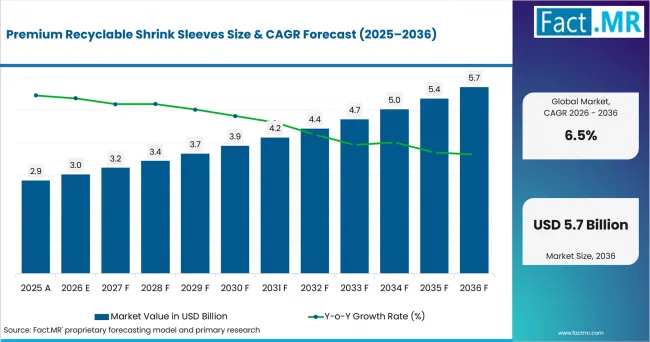
Premium Recyclable Shrink Sleeves Value Analysis | Source: Fact.MR
What are the defining numbers behind Premium Recyclable Shrink Sleeves Market growth?
USD 2.7 billion absolute opportunity between 2026 and 2036.
- Demand Drivers in the Market
- Beverage packaging teams need sleeve systems that protect clear PET recovery while keeping full-body graphics. EU rules require PET beverage bottles to contain at least 25% recycled plastic from 2025 and all covered plastic beverage bottles to contain at least 30% from 2030, calculated as an average for bottles placed on the market in each Member State.
- Dairy brands need strong light protection while keeping the main bottle easy to sort and recycle. Block-out sleeves can protect the product while allowing brands to use a clear primary bottle.
- Personal-care and household brands need 360-degree decoration on shaped containers. Film choice therefore depends on steady shrink behavior, print quality, and fit with the chosen recycling route.
- Recycling teams and packaging engineers need sleeves that float, wash off, or remain easy for sorting systems to detect. Clear material choices can help separate the sleeve from the bottle during sorting and washing.
- Key Segments Analyzed
- By Sleeve Material: Crystallizable PET is projected to hold 29.0% share in 2026 because it can support PET recycling while still providing controlled shrink performance.
- By Optical Function: Full block-out is anticipated to account for 36.0% share in 2026 as beverage and dairy brands seek strong light protection without changing the main bottle.
- By Container: Beverage PET is estimated to represent 31.0% share in 2026 because PET bottles combine high label volumes with established recycling routes.
- By Printing: Gravure is forecast to capture 37.0% share in 2026 because long production runs suit full-body graphics and steady print quality.
- Analyst Opinion at Fact.MR
- Shambhu Nath Jha, Principal Consultant at Fact.MR, states, “Recycling compatibility is becoming part of shrink-sleeve selection alongside print quality and product protection. Brands are evaluating film density, ink behavior, light blocking, and sorting response because the sleeve must support premium graphics without disrupting the intended bottle-recycling route. Suppliers that combine recyclable film design with reliable shrink performance and printing support are better positioned for wider beverage, dairy, and consumer-packaging programs.”
- Strategic Implications
- Film producers should document density, shrink behavior, and recycling fit for each packaging system. Clear data helps brand teams choose a sleeve that works with the bottle and its recovery route.
- Printers should use wash-off or non-bleeding ink systems where the recycling route requires them. Ink and film need to be tested together because both pass through washing and sorting.
- Brand owners should test light control and recycling performance on the same commercial pack. A strong block-out design must still allow the complete container to be sorted and recovered as planned.
- Sleeve converters should support gravure and flexographic work while also serving digital jobs where practical. Using one recycling strategy across short and long runs can reduce extra qualification work.
France is forecast at 7.3% CAGR through 2036 as recycling policy shapes bottle and sleeve design. China is expected to post 6.6% as beverage sales support label demand. The USA and Japan are each projected at 6.1%, while Germany is forecast at 5.9%.
How does the Premium Recyclable Shrink Sleeves Market break down by segment?
Crystallizable PET leads Sleeve Material at 29.0%; Gravure leads Printing at 37.0%.
Which Sleeve Material dominates?
Crystallizable PET is projected to hold 29.0% share in 2026.
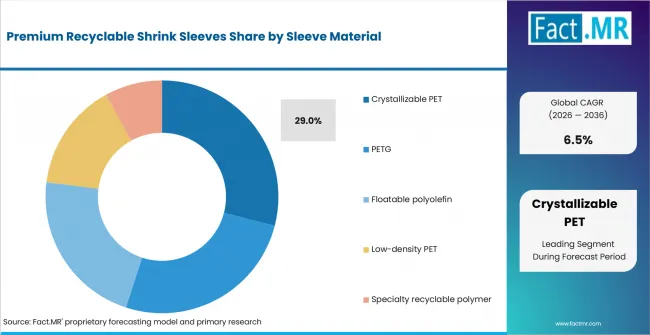
Premium Recyclable Shrink Sleeves Analysis By Sleeve Material | Source: Fact.MR
Crystallizable PET is projected to hold 29.0% share in 2026 because it can combine controlled shrink with PET-focused recycling. PETG remains useful for complex container shapes, while floatable polyolefin can support density-based separation. Low-density PET offers another route for PET bottles. Klöckner Pentaplast describes SmartCycle® as a family of recyclable heat-shrink sleeve label films, with options designed for PET and polyolefin recycling streams. SmartCycle® Pro contains certified 30% post-consumer mechanically recycled content.
What leads the Optical Function segment?
Full block-out is anticipated to account for 36.0% share in 2026.
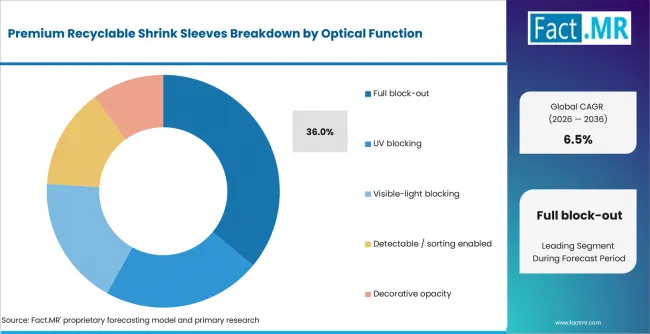
Premium Recyclable Shrink Sleeves Analysis By Optical Function | Source: Fact.MR
Full block-out is anticipated to account for 36.0% share in 2026 as some dairy and beverage products need strong light protection. UV-blocking designs target narrow bands of light, while visible-light blocking covers a wider range. Sorting-enabled variants help recovery systems identify the pack, and decorative opacity supports shelf appeal.
How does Container shape demand?
Beverage PET is estimated to represent 31.0% share in 2026.
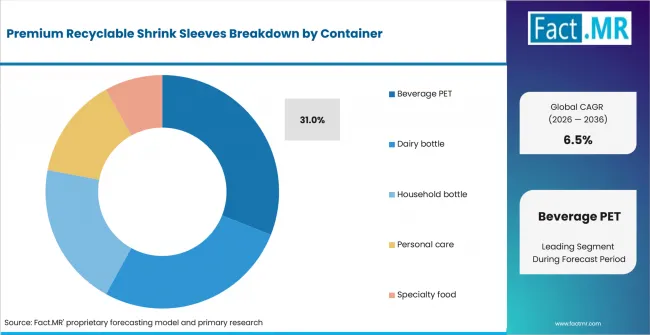
Premium Recyclable Shrink Sleeves Analysis By Container | Source: Fact.MR
Beverage PET is estimated to represent 31.0% share in 2026 because PET bottles combine large packaging volumes with established recovery routes. Dairy bottles add demand where sleeves provide decoration and light control. Household and personal-care packs use sleeves on shaped containers, while specialty food packs need films that can fit less standard shapes.
What supports Gravure within Printing?
Gravure is forecast to capture 37.0% share in 2026.
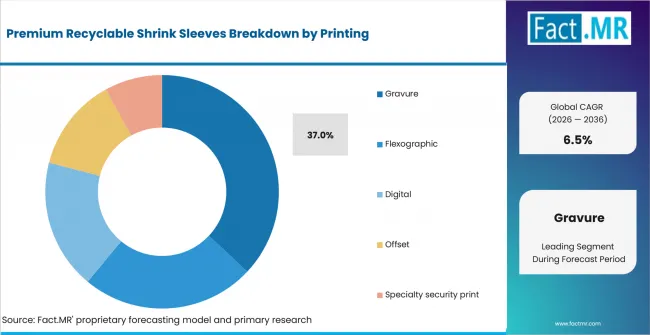
Premium Recyclable Shrink Sleeves Analysis By Printing | Source: Fact.MR
Gravure is forecast to capture 37.0% share in 2026 as premium sleeves often use continuous graphics across long runs. Flexographic printing serves a wider job mix, while digital printing supports shorter runs and frequent artwork changes. Offset fits selected jobs, and specialty printing can add security features.
What is accelerating Premium Recyclable Shrink Sleeves Market adoption, and what is holding it back?
Recycling-compatible decoration drives adoption; sorting and material-design constraints restrain it.
Drivers Impact Analysis
| DRIVER | (~) % IMPACT ON CAGR | GEOGRAPHIC RELEVANCE | IMPACT TIMELINE |
|---|---|---|---|
| PET bottle design-for-recycling requirements | +1.1% | North America, Europe, East Asia | Medium term (2-4 years) |
| Premium full-body decoration on shaped packs | +0.8% | Global | Short term (<= 2 years) |
| Light-protection needs in beverage and dairy | +0.6% | Europe, North America, East Asia | Medium term (2-4 years) |
| Sorting-compatible film and ink systems | +0.5% | Europe, North America | Long term (>= 4 years) |
Source: Fact.MR analysis. Updated Sep 24, 2026
Opportunity Impact Analysis
| OPPORTUNITY | (~) % IMPACT ON CAGR | GEOGRAPHIC RELEVANCE | IMPACT TIMELINE |
|---|---|---|---|
| Low-density PET sleeves for clear bottle loops | +0.7% | North America, Europe | Medium term (2-4 years) |
| Recyclable block-out sleeves | +0.5% | Europe, Japan | Short term (<= 2 years) |
| Digital short-run premium sleeves | +0.4% | Global | Medium term (2-4 years) |
Source: Fact.MR analysis. Updated Sep 24, 2026
Restraints Impact Analysis
| RESTRAINT | (~) % IMPACT ON CAGR | GEOGRAPHIC RELEVANCE | IMPACT TIMELINE |
|---|---|---|---|
| Sleeve-bottle incompatibility in recycling | -0.6% | Global | Short term (<= 2 years) |
| Higher qualification burden for barrier structures | -0.4% | Europe, North America | Medium term (2-4 years) |
| Ink and adhesive contamination risk | -0.3% | Global | Medium term (2-4 years) |
Source: Fact.MR analysis. Updated Sep 24, 2026
Which countries are scaling the Premium Recyclable Shrink Sleeves Market through 2036?
- The country comparison spans 1.4 percentage points from France at 7.3% to Germany at 5.9%.
- France remains 0.7 percentage point above China as plastic-packaging policy puts more focus on sleeve and bottle recycling.
- China remains 0.5 percentage point above the USA as beverage sales support a large base of labeled containers.
- The USA and Japan each record 6.1% CAGR, although their collection systems and package-design rules differ.
- Germany closes the displayed range at 5.9% as formal recycling checks become a routine part of package design.
The report covers North America, Latin America, Western Europe, Eastern Europe, East Asia, South Asia & Pacific, and Middle East & Africa.
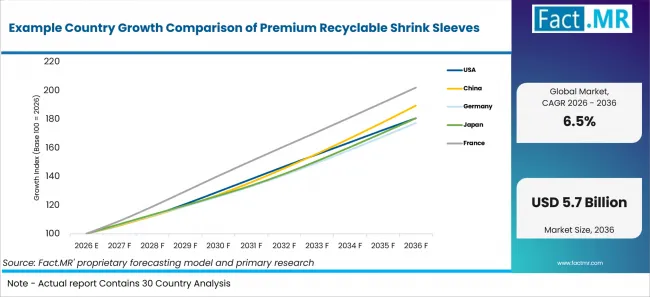
Example Country Growth Comparison Of Premium Recyclable Shrink Sleeves | Source: Fact.MR
| Country | CAGR (2026-2036) |
|---|---|
| France | 7.3% |
| China | 6.6% |
| United States | 6.1% |
| Japan | 6.1% |
| Germany | 5.9% |
Source: Fact.MR analysis. Updated Sep 24, 2026
What supports USA adoption?
6.1% CAGR, backed by PET recycling compatibility and varied collection systems.
The USA is expected to favor sleeve structures that preserve clear-bottle recovery across different recycling programs. In its August 2024 Recycling Needs Survey and Assessment, the U.S. Environmental Protection Agency reported that about 50% of states and territories measure an overall recycling rate, with an average recycling-rate estimate of roughly 30%. That variation increases the value of pack-level testing, especially when one sleeve design must work across several local systems.
How is China scaling demand?
6.6% CAGR, led by beverage consumption and large-scale packaged-goods activity.
China is expected to expand demand through beverage and consumer-goods packs that use full-body labels on PET and other rigid containers. In February 2026, the National Bureau of Statistics of China reported that beverage retail sales by enterprises above designated size rose 1.0% in 2025. That large consumption base supports recurring label demand while brands also work on recycling fit.
What supports Germany adoption?
5.9% CAGR, shaped by formal recyclability assessment and established packaging recovery.
Germany is forecast to maintain demand for sleeves that can be assessed as part of the complete packaging system. Destatis reported in February 2026 that 8.827934 million tonnes of packaging were collected or taken back in Germany during 2024. The scale of that system keeps attention on sleeve density, wash behavior, and fit with the bottle resin.
How does Japan perform?
6.1% CAGR, shaped by broad PET-bottle pickup planning and mature sleeve use.
Japan is expected to support recyclable sleeve demand through a mature PET-bottle collection network and long use of shrink decoration. The Ministry of the Environment reported in March 2026 that 1,730 municipalities planned separate PET-bottle collection for fiscal 2026, equal to 99.4% of municipalities. This broad coverage supports sleeves that separate cleanly or remain compatible with PET recovery.
What supports France adoption?
7.3% CAGR, supported by plastic-packaging recycling targets and bottle-collection pressure.
France is forecast to record the highest displayed CAGR as policy focuses on better plastic-packaging recovery. In June 2026, the Ministry for Ecological Transition reported that 26% of plastic packaging was recycled in France. This keeps sorting and material recovery important when brands select premium full-body sleeves for PET bottles.
Who leads the Premium Recyclable Shrink Sleeves Market?
Competitive differentiation is expected to depend on recycling compatibility, print performance, shrink behavior, light-protection requirements, and the ability of the complete bottle-and-label structure to move through its intended recycling stream. Material density, ink selection, shrink performance, and compatibility with application equipment can therefore influence sleeve qualification.
CCL Industries offers EcoFloat® shrink sleeves designed to support PET bottle-to-bottle recycling through density-based separation, while Fuji Seal International offers RecShrink™, a shrink-sleeve solution designed to be recycled together with PET bottles. Klöckner Pentaplast supplies SmartCycle® recyclable shrink-sleeve films for PET applications. Bonset America supplies heat-shrink films including Bonpet Renew™ C66, which is designed to be reclaimed with PET bottle flake, and MCC provides shrink-sleeve label solutions including PET-recycling-compatible options. Buyers can therefore evaluate suppliers based on recycling compatibility, print quality, shrink performance, application requirements, and the needs of the intended bottle-recycling route.
Which companies are the key providers?
Key companies include CCL Industries; Fuji Seal International; Klöckner Pentaplast; Bonset America; and Multi-Color Corporation (MCC).
- CCL Industries
- Fuji Seal International
- Klöckner Pentaplast
- Bonset America
- Multi-Color Corporation (MCC)
Bibliography
- European Parliament, & Council of the European Union. (2025, January 22). Regulation (EU) 2025/40 of the European Parliament and of the Council of 19 December 2024 on packaging and packaging waste, amending Regulation (EU) 2019/1020 and Directive (EU) 2019/904, and repealing Directive 94/62/EC.
- U.S. Environmental Protection Agency. (2026, July 31). U.S. recycling infrastructure assessment and state data collection reports.
- National Bureau of Statistics of China. (2026, February 28). Statistical communiqué of the People’s Republic of China on the 2025 national economic and social development.
- Statistisches Bundesamt (Destatis). (2026, February 23). Abfallentsorgung 2024: Art und Menge der im Berichtsjahr 2024 gesammelten/zurückgenommenen Verpackungen.
- Ministère de la Transition écologique. (2026, June 18). Plan plastique : 12 leviers pour réduire, réemployer et recycler les emballages plastiques.
- Klöckner Pentaplast. (2026, April 10). Designing labels for recyclability: Where material choice really matters.
- CCL Label. (2026, February 12). CCL Label expands operations in Tibi, Spain.
- Multi-Color Corporation. (2024, September 5). Reflections from our CEO: One year with MCC.
This Report Answers
- The report explains how brands select sleeve materials, optical functions, containers, and print methods.
- Segment analysis identifies the stated 2026 share leaders and explains how each one fits common packaging needs.
- Country analysis covers the USA, China, Germany, Japan, and France using the stated CAGRs and recent official evidence.
- Competitive analysis reviews companies that supply recyclable films, printed sleeves, or complete sleeve systems.
- Application analysis reviews recycling fit, light protection, sorting response, and line use when teams compare different sleeve options.
- Regulatory analysis reviews official rules and evidence that affect PET bottle and sleeve design.
- The report separates premium recyclable sleeves from standard shrink films used mainly for bundling or transport.
What does the Premium Recyclable Shrink Sleeves Market cover?
The Premium Recyclable Shrink Sleeves Market covers high-coverage labels that combine premium graphics with recycling-compatible behavior. It overlaps with the wider sleeve-label market, where shrink and stretch formats serve bottles and other rigid packs. The market also includes designs where ink, film density, or sleeve construction can affect material recovery.
The assessment includes sleeves used on beverage PET, dairy bottles, household packs, and personal-care containers. Bottle resin and sleeve film are reviewed together when label design can affect rigid-pack recovery. This is especially important for clear PET, where density and wash behavior can influence the quality of recovered resin.
What is included in the scope?
The scope includes crystallizable PET, PETG, floatable polyolefin, low-density PET, and other recyclable sleeve polymers. Material choice depends on shrink control, print response, and fit with the planned recovery route. Wider sustainable packaging trends provide context for design-for-recycling needs.
Optical functions include full block-out, UV blocking, visible-light blocking, sorting-enabled designs, and decorative opacity. Beverage and food uses need a balance between product protection and recycling fit. Ready-to-drink packs are relevant when the bottle and sleeve must deliver both shelf impact and material recovery.
What is excluded from the scope?
Conventional shrink films used only for bundling or transport protection fall outside the core market. BOPP packaging films also remain outside scope unless a related construction directly competes with a recyclable sleeve application.
Pressure-sensitive and wraparound labels remain outside the core boundary except when they are discussed as competing decoration formats. Standalone tamper-evident labels are also outside scope when the pack lacks a high-coverage shrink-sleeve function.
How Was the Analysis Built?
The analysis draws on 120+ sources, 35+ company portfolios, 25+ countries, and more than 20 industry interviews.
- Primary Research: Primary research includes discussions with manufacturers, service providers, technology developers, distributors, end users, and subject-matter experts. These conversations examine purchasing priorities, product adoption, operational challenges, approval requirements, competitive positioning, and the factors that influence wider market acceptance.
- Desk Research: Desk research covers government statistics, regulatory publications, company filings, trade data, technical studies, industry associations, standards, public policy, and other authoritative sources. Every source used in the analysis is documented in the bibliography.
- Market Sizing and Forecasting: Market estimates combine historical performance, demand indicators, pricing and volume trends, segment shares, company participation, country-level growth, adoption patterns, investment activity, and barriers to market expansion.
- Data Validation and Update Cycle: Findings are validated by comparing primary interviews with public data, company activity, regulatory changes, trade patterns, and industry developments. Regular updates review new product launches, capacity changes, partnerships, approvals, and shifts in commercial adoption.
Segmentation
What is the report’s scope and coverage?
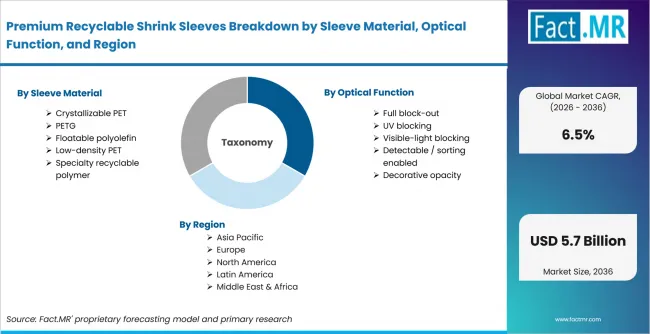
Premium Recyclable Shrink Sleeves Breakdown By Sleeve Material, Optical Function, And Region | Source: Fact.MR
| Attribute | Details |
|---|---|
| Quantitative Units | USD billion |
| Market Definition | Premium recyclable shrink sleeves are full-body or high-coverage sleeve labels engineered to provide premium decoration or functional protection while remaining compatible with an intended container-recycling route. |
| Sleeve Material | Crystallizable PET; PETG; Floatable polyolefin; Low-density PET; Specialty recyclable polymer |
| Optical Function | Full block-out; UV blocking; Visible-light blocking; Detectable / sorting enabled; Decorative opacity |
| Container | Beverage PET; Dairy bottle; Household bottle; Personal care; Specialty food |
| Printing | Gravure; Flexographic; Digital; Offset; Specialty security print |
| Regions Covered | North America; Latin America; Western Europe; Eastern Europe; East Asia; South Asia & Pacific; Middle East & Africa |
| Countries Covered | United States; China; Germany; Japan; France |
| Key Companies Profiled | CCL Industries; Fuji Seal International; Klöckner Pentaplast; Bonset America; Multi-Color Corporation (MCC) |
| Forecast Period | 2026 to 2036 |
| Approach | Hybrid top-down and bottom-up review using packaging applications, recycling rules, segment shares, country growth, company portfolios and first-hand public evidence. |
Source: Fact.MR analysis. Updated Sep 24, 2026
How is the market segmented?
-
By Sleeve Material:
- Crystallizable PET
- PETG
- Floatable polyolefin
- Low-density PET
- Specialty recyclable polymer
-
By Optical Function:
- Full block-out
- UV blocking
- Visible-light blocking
- Detectable / sorting enabled
- Decorative opacity
-
By Container:
- Beverage PET
- Dairy bottle
- Household bottle
- Personal care
- Specialty food
-
By Printing:
- Gravure
- Flexographic
- Digital
- Offset
- Specialty security print
-
By Region:
- North America
- Latin America
- Western Europe
- Eastern Europe
- East Asia
- South Asia & Pacific
- Middle East & Africa
Frequently Asked Questions
How big is the Premium Recyclable Shrink Sleeves Market in 2026?
What is the CAGR of the Premium Recyclable Shrink Sleeves Market from 2026 to 2036?
Which Optical Function leads the market?
Which Printing method leads the market?
Who are the profiled companies?
Who worked on this report


Preview the report firsthand - request a free sample
Free SampleGet the brochure for pricing and purchase details
Download PDF