- Market Value (2025): USD 1.4 Bn
- Estimated Value (2026): USD 1.5 Bn
- Forecast Value (2036): USD 3.5 Bn
- CAGR (2026-2036): 8.8%
What is the Recyclable Cartonboard Coatings Market forecast to be worth by 2036?
USD 1.5 billion in 2026 to USD 3.5 billion by 2036, recording a 8.8% CAGR.
- The recyclable cartonboard coatings market reached USD 1.4 billion in 2025 across coating formulation and board-converting applications.
- Recyclable cartonboard coatings market is forecast to climb from USD 1.5 billion in 2026 to USD 3.5 billion by 2036.
- The market is forecast to record an 8.8% CAGR from 2026 to 2036 as fiber packages replace selected plastic barrier structures.
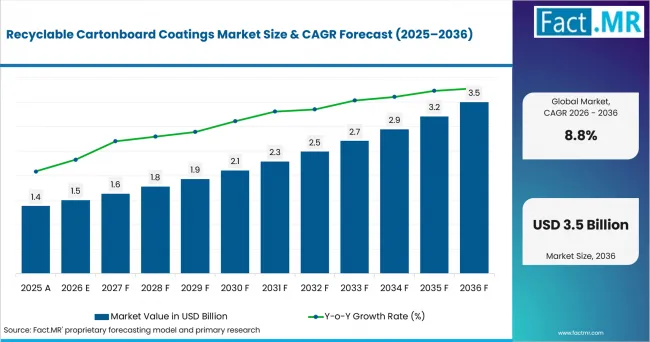
Recyclable Cartonboard Coatings Market Value Analysis | Source: Fact.MR
What are the defining numbers behind Recyclable Cartonboard Coatings Market growth?
USD 2.0 billion absolute opportunity by 2036, led by dispersion - water-based coatings and grease & oil resistance alongside food packaging.
- Demand Drivers in the Market
- Food packaging converters need coatings that replace selected barriers without weakening grease protection or commercial line speed.
- Paperboard mills require controlled coat weight and predictable drying across existing blade and rod coating equipment.
- Packaging brands require food-contact evidence and package-level recycling results during high-volume specification changes across product portfolios.
- Coating interactions with inks and adhesives require complete-package testing under commercial sorting and pulping conditions.
- Key Segments Analyzed
- By coating type: dispersion - water-based is expected to hold 46.0% share in 2026 supported by familiar mill workflows.
- By barrier property: grease & oil resistance is projected to account for 34.0% share in 2026 owing to visible carton failures.
- In 2026, blade - rod coating is anticipated to capture 38.0% share within application method due to controlled metering.
- Based on end use, food packaging is estimated to represent 48.0% share in 2026 attributable to repeat coating consumption.
- The substrate category is forecast to be led by folding boxboard at 40.0% share in 2026 due to efficient conversion.
- Analyst Opinion at Fact.MR
- Shambhu Nath Jha, Principal Consultant at Fact.MR and states: “Commercial acceptance depends on the complete coated carton instead of one favorable laboratory result during qualification programs. Formulators are expected to balance barrier protection with drying speed and fold durability across commercial lines.”
- Strategic Implications
- Coating formulators should test complete converted structures before presenting recycling or barrier claims to packaging brands.
- Paperboard mills should compare drying demand and coat-weight control before allocating capacity to unfamiliar coating chemistry.
- Converters should validate crease durability and glue performance because flat-sheet results cannot establish finished-package performance.
- Packaging brands require define the intended recycling route before approving formats that combine coatings and closures.
Multi-barrier coatings simplify qualification by combining sealing and product protection within one commercial carton layer. Michelman introduced two Nuvita Life systems in April 2026 for fiber-based food packaging, reducing coating routes across selected commercial formats.
The United Kingdom is anticipated to advance at 9.1% while Germany is estimated to expand at 8.5% CAGR. Brazil is forecast to register an 8.5% CAGR as fiber substitution supports food packaging programs.
How does the Recyclable Cartonboard Coatings Market break down by segment?
Dispersion - water-based 46.0%, grease & oil resistance 34.0%.
Which coating type dominates?
Dispersion - water-based is expected to hold 46.0% share in 2026.
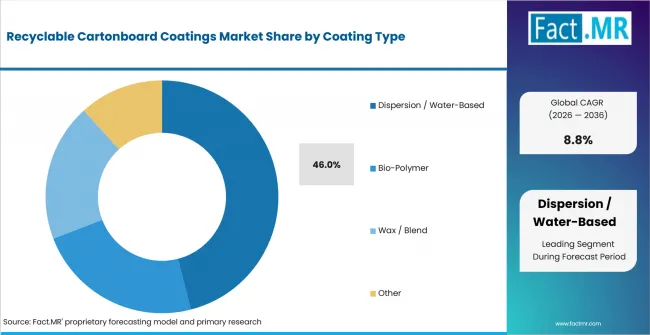
Recyclable Cartonboard Coatings Market Analysis By Coating Type | Source: Fact.MR
In 2026, dispersion - water-based is expected to lead coating type with 46.0% share because adjustable film formation suits mill workflows. Teams compare waterborne heat-seal coatings and paper barrier coatings under identical drying and recovery conditions. BASF and UPM began complete-structure testing in May 2026, connecting chemistry selection with finished-package performance.
What leads the barrier property segment?
Grease & oil resistance is projected to account for 34.0% share in 2026.
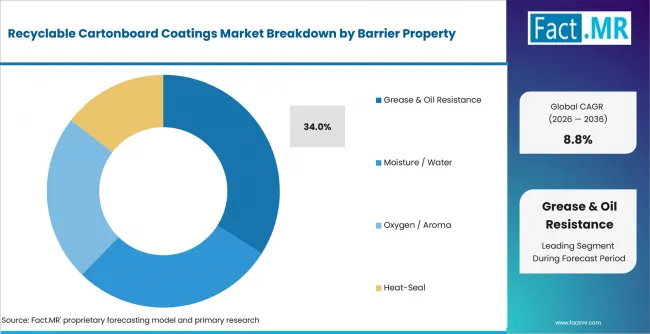
Recyclable Cartonboard Coatings Market Analysis By Barrier Property | Source: Fact.MR
By barrier property, grease & oil resistance is forecast to represent 34.0% share in 2026 driven by visible food-carton failures. Formulators compare fluorine-free barrier coatings with mineral oil barriers while checking fold durability and recovery compatibility. The FDA ended 35 PFAS food-contact notifications in January 2025, creating a direct reformulation requirement.
How does application method shape demand?
Blade - rod coating is anticipated to capture 38.0% share in 2026.
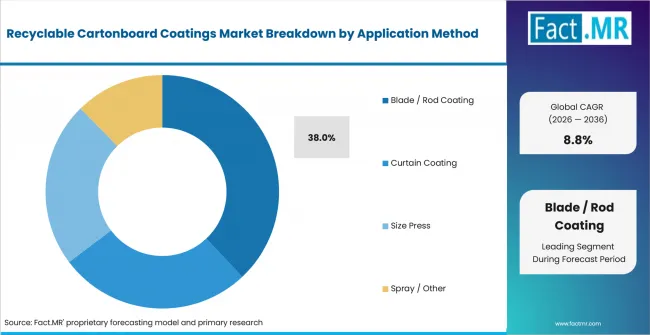
Recyclable Cartonboard Coatings Market Analysis By Application Method | Source: Fact.MR
Blade - rod coating is projected to hold 38.0% share in 2026 owing to precise metering on installed equipment. Converter economics require paper coating materials that dry consistently across paper packaging materials with varied porosity. Solenis reported standard-equipment flexographic barriers in August 2025, widening commercial trial access across regional converter programs.
What supports food packaging within end use?
Food packaging is estimated to represent 48.0% share in 2026.
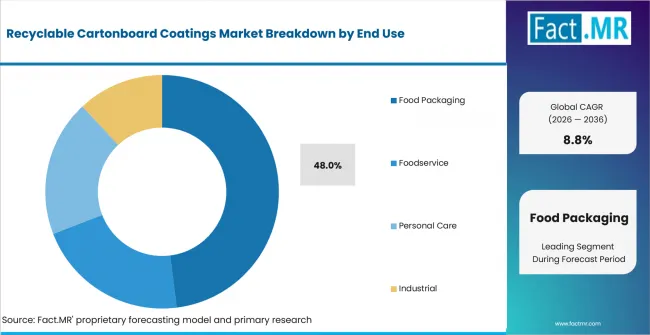
Recyclable Cartonboard Coatings Market Analysis By End Use | Source: Fact.MR
Based on end use, food packaging is projected to account for 48.0% share in 2026 due to repeat coating consumption. Fresh food packaging and on-the-go food packaging require barriers that survive filling and distribution conditions. Mondi expanded FunctionalBarrier Paper Ultimate in August 2025, adding protection for high-speed packaging lines globally.
Why does folding boxboard lead the substrate category?
Folding boxboard is forecast to hold 40.0% share in 2026.
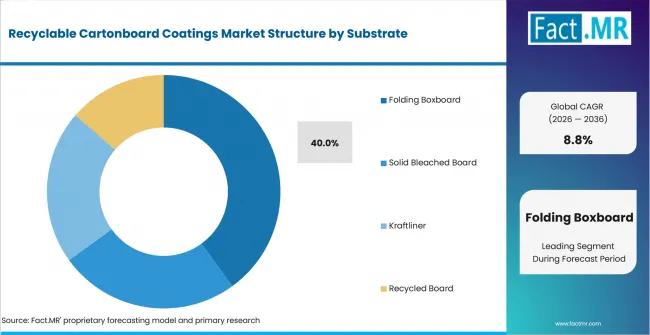
Recyclable Cartonboard Coatings Market Analysis By Substrate | Source: Fact.MR
The substrate category is forecast to be led by folding boxboard at 40.0% share in 2026 due to efficient conversion. Folding carton packaging exposes coatings to demanding scores and glue seams during commercial conversion programs. Stora Enso started its Oulu line in March 2025, expandingfiber-based packaging capacity for qualified structures.
What is accelerating Recyclable Cartonboard Coatings Market adoption, and what is holding it back?
Package redesign drives adoption, qualification restrains conversion.
Drivers Impact Analysis
| DRIVER | (~) % IMPACT ON CAGR | GEOGRAPHIC RELEVANCE | IMPACT TIMELINE |
|---|---|---|---|
| PFAS-free barrier redesign | +0.8% | North America, Europe | 0-2 years |
| PPWR recycling requirements | +0.7% | Europe | 2-4 years |
| Food-packaging paperboard substitution | +0.6% | Global | 2-4 years |
| Water-based coatings on existing assets | +0.4% | Asia Pacific, Europe | 2-4 years |
| Producer-responsibility reporting | +0.3% | Europe, selected systems | 4+ years |
Source: Fact.MR analysis. Updated Aug 1, 2026
- PFAS transition: Food-contact converters are replacing grease-proofing chemistry while protecting oil resistance and fold performance across active carton lines.
- European packaging rules: European recyclability rules now influence complete package design instead of isolated coating selection during early qualification. Regulation (EU) 2025-40 generally applies from August 2026 and advances coating reviews across packaging programs.
- Asset-compatible conversion: Water-based systems use familiar equipment, but expansion depends on maintaining line speed across cartonboard grades with different porosity.
- Fiber recovery infrastructure: Collection routes support coated cartonboard when finished structures preserve fiber yield and avoid excessive pulping reject.
- Producer-responsibility economics: Packaging fees bring recyclability evidence into material selection before artwork and machinery settings become fixed.
Opportunity Impact Analysis
| OPPORTUNITY | (~) % IMPACT ON CAGR | GEOGRAPHIC RELEVANCE | IMPACT TIMELINE |
|---|---|---|---|
| Multi-barrier water-based systems | +0.5% | Europe, North America | 2-4 years |
| Print-applied flexographic barriers | +0.4% | Global hubs | 0-2 years |
| Bio-polymer cartonboard coatings | +0.4% | Asia Pacific, Europe | 2-4 years |
| Low-coat-weight recovery systems | +0.3% | Global | 4+ years |
Source: Fact.MR analysis. Updated Aug 1, 2026
- Multi-barrier systems: Combined grease and moisture protection reduces carton layers when sealing performance remains stable through filling and folding.
- Print-applied barriers: Flexographic application uses established converter equipment and expands where uniform coat weight protects existing production schedules.
- Bio-polymer chemistry: Bio-polymer barriers need commercial routes that deliver oil protection and heat sealing across recyclable cartonboard formats. Kemira and Bluepha began an APAC commercialization partnership in June 2025 for PHA coatings across regional paper applications.
- Recycling pathway design: Packaging teams must select testing routes that match the finished structure and intended paper-mill recovery process.
Restraints Impact Analysis
| RESTRAINT | (~) % IMPACT ON CAGR | GEOGRAPHIC RELEVANCE | IMPACT TIMELINE |
|---|---|---|---|
| Package-level qualification | -0.5% | Global | 2-4 years |
| Application-specific compliance evidence | -0.4% | North America, Europe | 0-2 years |
| Drying and line-speed penalties | -0.3% | Asia Pacific, Latin America | 2-4 years |
| Uneven collection and service coverage | -0.2% | Emerging markets | 4+ years |
Source: Fact.MR analysis. Updated Aug 1, 2026
- Qualification burden: Every substrate and use condition adds printing and folding trials that extend approval across finished carton structures.
- Evidence by application: Food-contact and recycling results from one board grade cannot establish performance across different inks and filling conditions.
- Line efficiency risk: Limited drying capacity reduces output, so mills prioritize lower coat weight without sacrificing commercial barrier performance.
Which countries are scaling Recyclable Cartonboard Coatings Market fastest?
UK 9.1%, Germany and Brazil 8.5%.
Regional analysis covers North America and Europe alongside Asia Pacific, Latin America, and the Middle East & Africa.
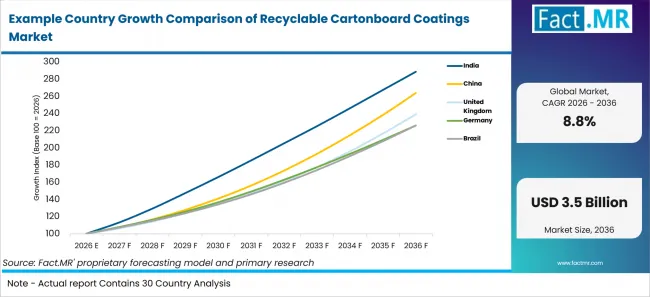
Example Country Growth Comparison Of Recyclable Cartonboard Coatings Market | Source: Fact.MR
| COUNTRY | CAGR |
|---|---|
| United Kingdom | 9.1% |
| Germany | 8.5% |
| Brazil | 8.5% |
Source: Fact.MR analysis. Updated Aug 1, 2026
What supports the United Kingdom outlook?
9.1% CAGR by 2036, shaped by recyclability reporting.
United Kingdom producers assess coatings against producer-responsibility reporting and expected recyclability fees during package design. Defra reported 74.3% recycling for paper and cardboard packaging waste under its 2024 methodology across national systems. Market is anticipated to advance at a 9.1% CAGR as documentation requirements change across packaging programs.
What underpins Germany’s growth?
8.5% CAGR through 2036, supported by recyclability measurement.
German brands assess complete packages because system fees increasingly reflect measurable recyclability outcomes during specification. The German Environment Agency linked its August 2025 minimum standard to fee differentiation under national law. Industry is estimated to expand at an 8.5% CAGR despite detailed evidence requirements during commercial qualification.
How is Brazil developing Recyclable Cartonboard Coatings demand?
8.5% CAGR through 2036, driven by fiber substitution.
Brazilian converters balance grease protection against humid distribution and price-sensitive food packaging across long routes. The October 2025 plastic-packaging decree set a 32% recovery target and excluded paperboard-containing mixed packages. Demand is forecast to record an 8.5% CAGR despite uneven collection and service coverage across regional programs.
Who leads the Recyclable Cartonboard Coatings Market?
BASF and Solenis anchor broad chemistry, Michelman and Archroma strengthen formulated coatings.
Competition spans specialty chemistry companies and integrated board producers instead of one uniform provider class. Formulators compete on chemistry breadth while board producers control substrate design and converter access during qualification. Wider entry requires food-contact documentation and repeatable converting performance across packaging programs and regional customer networks.
BASF and Solenis cover waterborne chemistry while Michelman and Archroma focus on grease and moisture protection. Kemira adds biopolymer routes while Stora Enso and Mondi connect barriers with fiber substrates across commercial applications. Competitive strength depends on line-speed proof and finished-package recycling results across qualified packaging programs globally.
Which companies are the key providers?
BASF, Solenis, Michelman, Archroma, Kemira, Stora Enso, and Mondi Group.
- BASF
- Solenis
- Michelman
- Archroma
- Kemira
- Stora Enso
- Mondi Group.
Bibliography
- BASF. (2026, May 4).
- Department for Environment, Food & Rural Affairs. (2025, July 23).
- European Parliament and Council of the European Union. (2024, December 19).
- German Environment Agency. (2025, August 29).
- Kemira. (2025, June 25).
- Michelman. (2026, April 30).
- Mondi Group. (2025, August 14).
- Press Information Bureau. (2025, August 4)
- Stora Enso. (2025, March 19).
- U.S. Food and Drug Administration. (2025, January 3).
This Report Addresses
- Analysis compares Coating type and barrier property choices across the recyclable cartonboard coatings market.
- Segment positions assess Application Method demand alongside End Use qualification needs.
- India, China, United Kingdom, Germany, and Brazil outlooks provide the regional comparison base.
- Provider reviews compare conversion capabilities with customer approval requirements in Recyclable Cartonboard Coatings.
- Commercial assessment links Substrate conditions to buyer purchasing behavior.
- Forecast inputs combine published indicators with interview-based checks for Recyclable Cartonboard Coatings.
What does the Recyclable Cartonboard Coatings Market cover?
Cartonboard coatings for grease, moisture, oxygen, aroma, sealing, and fiber recovery.
The market covers functional cartonboard layers providing grease protection and sealing before printing and package conversion. Commercial value counts the first coating sale while finished cartons and uncoated board remain outside the revenue boundary.
What is included in the scope?
Cartonboard coating systems for food, foodservice, personal care, and industrial formats.
Included systems cover water-based and bio-polymer chemistry alongside qualifying wax blends across defined cartonboard substrates.
What is excluded from the scope?
Uncoated board, plastic laminations, standalone inks, and non-barrier adhesives.
Finished cartons and packaged goods remain excluded because their revenue extends beyond the functional coating layer.
How Was the Analysis Built?
The analysis draws on 120+ sources, 35+ company portfolios, 25+ countries, and more than 20 industry interviews.
- Primary Research: Primary research includes discussions with manufacturers, service providers, technology developers, distributors, end users, procurement teams, and subject-matter experts. These conversations examine purchasing priorities, product adoption, operational challenges, approval requirements, competitive positioning, and the factors that influence wider market acceptance.
- Desk Research: Desk research covers government statistics, regulatory publications, company filings, trade data, technical studies, industry associations, standards, public policy, and other authoritative sources. Every source used in the analysis is documented in the bibliography.
- Market Sizing and Forecasting: Market estimates combine historical performance, demand indicators, pricing and volume trends, segment shares, company participation, country-level growth, adoption patterns, investment activity, and barriers to market expansion.
- Data Validation and Update Cycle: Findings are validated by comparing primary interviews with public data, company activity, regulatory changes, trade patterns, and industry developments. Regular updates review new product launches, capacity changes, partnerships, approvals, procurement trends, and shifts in commercial adoption.
Segmentation
What is the report’s scope and coverage?
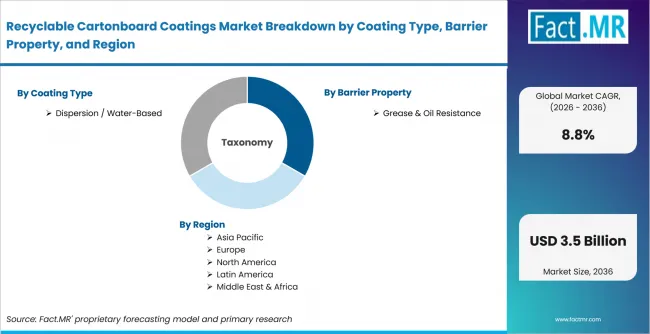
Recyclable Cartonboard Coatings Market Breakdown By Coating Type, Barrier Property, And Region | Source: Fact.MR
| Coverage field | Report scope |
|---|---|
| Quantitative Units | USD Billion |
| Market Definition | Revenue includes recyclable cartonboard coatings. Uncoated board and finished packages remain excluded. |
| Coating Type | Dispersion - Water-Based, Bio-Polymer, Wax - Blend, Other |
| Barrier Property | Grease & Oil Resistance, Moisture - Water, Oxygen - Aroma, Heat-Seal |
| Application Method | Blade - Rod Coating, Curtain Coating, Size Press, Spray - Other |
| End Use | Food Packaging, Foodservice, Personal Care, Industrial |
| Substrate | Folding Boxboard, Solid Bleached Board, Kraftliner, Recycled Board |
| Regions Covered | North America, Europe, Asia Pacific, Latin America, Middle East & Africa |
| Countries Covered | United Kingdom, Germany, Brazil, United States, Japan, and 25+ countries |
| Key Companies Profiled | BASF, Solenis, Michelman, Archroma, Kemira, Stora Enso, Mondi Group |
| Forecast Period | 2026 to 2036 |
| Approach | A hybrid model reconciles coating revenue, cartonboard output, coat weight, application penetration, and regional qualification cycles. |
Source: Fact.MR analysis. Updated Aug 1, 2026
How is the market segmented?
-
By Coating Type:
- Dispersion - Water-Based
- Bio-Polymer
- Wax - Blend
- Other
-
By Barrier Property:
- Grease & Oil Resistance
- Moisture - Water
- Oxygen - Aroma
- Heat-Seal
-
By Application Method:
- Blade - Rod Coating
- Curtain Coating
- Size Press
- Spray - Other
-
By End Use:
- Food Packaging
- Foodservice
- Personal Care
- Industrial
-
By Substrate:
- Folding Boxboard
- Solid Bleached Board
- Kraftliner
- Recycled Board
-
By Region:
- North America
- United States
- Canada
- Europe
- Germany
- United Kingdom
- France
- Italy
- Spain
- Benelux
- Nordics
- Poland
- Czech Republic
- Romania
- Hungary
- Asia Pacific
- India
- China
- Japan
- South Korea
- ASEAN
- Australia and New Zealand
- Latin America
- Brazil
- Argentina
- Mexico
- Chile
- Middle East & Africa
- GCC Countries
- South Africa
- Türkiye
- Israel
- North America
Frequently Asked Questions
What share is acrylic dispersion expected to capture?
How are moisture and water barriers positioned?
How quickly is India expected to expand?
What shapes the Brazil outlook?
What is the primary demand driver?
Which restraint slows commercial conversion?
Why does food packaging carry commercial weight?
What should converters assess before commercial approval?
Who worked on this report


Preview the report firsthand - request a free sample
Free SampleGet the brochure for pricing and purchase details
Download PDF