- Base Value(2025): 85.4 Bn
- Estimated Value(2026): 106.4 Bn
- Forecast Value (2036): 959.7 Bn
- CAGR (2026 - 2036): 24.6%
Programmatic Display Market Forecast By Fact.MR
In 2025, the programmatic display market was valued at USD 85.4 billion. Based on Fact MR analysis, demand for programmatic display advertising is estimated to grow to USD 106.4 billion in 2026 and USD 959.7 billion by 2036. FMR projects a CAGR of 24.6% during the forecast period.
The absolute dollar growth from 2026 to 2036 is USD 853.3 billion. This magnitude of expansion reflects a structural shift in digital advertising transactions rather than incremental increases in display ad spending. Programmatic systems automate the buying and selling of advertising inventory through real time bidding platforms and data driven audience targeting tools. Advertisers increasingly rely on automated platforms to optimize campaign delivery across websites, mobile applications, connected television environments, and social media channels. Growth remains influenced by digital privacy regulations, evolving cookie tracking restrictions, and increased competition across advertising technology platforms.
South Korea leads with a projected CAGR of 9.6%, supported by high mobile internet penetration and advanced digital advertising infrastructure. The United States follows with a CAGR of 9.5%, driven by large digital advertising ecosystems and strong adoption of automated ad buying platforms. Japan records a CAGR of 9.2%, reflecting steady adoption of programmatic systems across online publishing and mobile advertising channels. The United Kingdom shows the slowest growth at 9.1%, reflecting a mature digital advertising market where expansion increasingly reflects upgrades to existing programmatic platforms rather than new adoption.
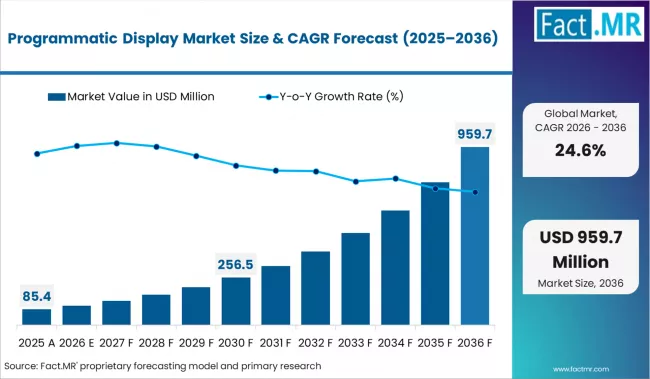
Programmatic Display Market Market Value Analysis | Source: Fact.MR
| Metric | Details |
|---|---|
| Industry Size (2026E) | USD 106.4 billion |
| Industry Value (2036F) | USD 959.7 billion |
| CAGR (2026 to 2036) | 24.6% |
Source: Fact.MR analysis. Updated Mar 24, 2026
Programmatic Display Market Definition
The Programmatic Display Market includes automated digital advertising systems that buy and place display advertisements through software platforms using data driven bidding processes. Programmatic display advertising uses algorithms and real time auctions to purchase advertising space on websites, mobile applications, and digital platforms. These systems enable advertisers to target specific audiences based on demographic data, browsing behavior, and location information. Programmatic display advertising is widely used by brands and marketing agencies to manage digital advertising campaigns across multiple online media channels. Its primary function is to automate the buying and placement of display ads for efficient digital marketing distribution.
Programmatic Display Market Inclusions
This report covers global and regional market sizes for programmatic display advertising with forecast analysis for the study period. The market is segmented by platform type including demand side platforms, supply side platforms, and ad exchanges used for automated ad transactions. Application segments include website advertising, mobile application advertising, and video display advertising. End users include advertising agencies, digital marketing firms, media publishers, and brand advertisers. The report also evaluates pricing models, advertising spending patterns, and selected trade flow analysis across major digital advertising markets.
Programmatic Display Market Exclusions
The report excludes traditional display advertising purchased through direct negotiations without automated bidding systems. Search engine advertising campaigns and keyword based search marketing are not included. The scope also excludes native advertising formats that blend with editorial content and social media advertising placements purchased outside programmatic platforms. Television, radio, and print advertising channels are outside the defined market scope, as the analysis focuses strictly on automated digital display advertising transactions.
Programmatic Display Market Research Methodology
- Primary Research: Interviews were conducted with advertising technology providers, digital marketing agencies, media publishers, and brand marketing managers.
- Desk Research: Public information was collected from digital advertising industry publications, company reports, regulatory filings, and online media statistics.
- Market-Sizing and Forecasting: A hybrid model combining bottom up advertising spending analysis with top down digital media demand assessment was applied.
- Data Validation and Update Cycle: Findings were cross verified through multiple industry data sources and expert inputs, with periodic updates conducted as new digital advertising data becomes available.
Summary of the Programmatic Display Market
- Market Definition
- The market comprises automated digital advertising systems that purchase and place display advertisements using software platforms and data driven bidding processes. Programmatic display platforms conduct real time auctions for advertising inventory across websites, mobile applications, and digital media channels. These systems enable advertisers to target audiences using behavioral data, demographic profiles, and location based information. Programmatic display technology is widely used by advertising agencies, digital marketing firms, and brand advertisers to manage online advertising campaigns across multiple digital media environments.
- Demand Drivers
- Increasing adoption of automated advertising platforms that enable real time bidding and data driven campaign management.
- Rising digital media consumption across websites, mobile applications, and connected devices supporting demand for display advertising placements.
- Growing use of audience targeting tools that analyze browsing behavior, demographic data, and location information.
- Expansion of digital marketing investments by brands and advertising agencies seeking efficient online campaign distribution.
- Key Segments Analyzed
- Sales Channel: Real time bidding represents about 50% share due to automated auction systems used for digital advertising transactions.
- Ad Format: Online display advertisements account for roughly 30% share supported by widespread use of banner and rich media advertising formats.
- Platform Usage: Programmatic systems operate across websites, mobile applications, and digital media platforms that distribute advertising inventory.
- Geography: South Korea records the fastest expansion supported by strong mobile internet penetration and advanced digital advertising infrastructure.
- Analyst Opinion at Fact MR
- Shambhu Nath Jha, Principal Consultant, Fact MR, opines, "In this updated edition of the Programmatic Display Market report, industry participants will observe that automated advertising platforms increasingly define digital marketing transactions across online media networks. Programmatic systems allow advertisers to purchase advertising inventory through real time auctions and data driven audience targeting tools. Companies operating scalable advertising technology platforms and integrated data management systems will maintain stronger positions within the digital advertising ecosystem."
- Strategic Implications or Executive Takeaways
- Expand development of programmatic advertising platforms capable of managing automated display ad transactions across digital media networks.
- Strengthen data analytics and audience targeting capabilities that support efficient digital advertising campaign delivery.
- Maintain compliance with evolving digital privacy regulations governing data collection and advertising targeting practices.
- Invest in scalable advertising technology infrastructure that supports real time bidding systems and large digital advertising exchanges.
- Methodology
- Primary interviews conducted with advertising technology providers, digital marketing agencies, media publishers, and brand marketing managers.
- Desk research based on digital advertising industry publications, company financial reports, regulatory filings, and online media statistics.
- Market sizing developed through a hybrid approach combining bottom up digital advertising expenditure analysis and top down digital media demand assessment.
- Findings validated through multiple industry data sources and expert consultations following Fact MR internal modeling standards.
Segmental Analysis
Programmatic Display Market Analysis by Sales Channel
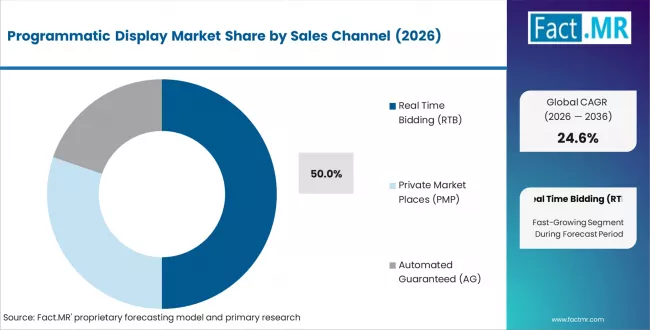
Programmatic Display Market Analysis By Sales Channel | Source: Fact.MR
- Market Overview: Real time bidding is projected to account for around 50% share of the programmatic display market by 2026. Real time bidding platforms allow advertisers to purchase digital advertising inventory through automated auctions conducted in milliseconds when users load webpages or applications. The system evaluates available ad impressions and enables advertisers to bid for placement based on targeting criteria such as user behavior, location, and browsing patterns. Advertisers benefit from real time bidding systems because campaigns can be optimized dynamically through data driven decision making. Digital publishers also rely on real time bidding platforms to maximize advertising revenue by selling inventory across multiple advertiser networks.
- Demand Drivers:
- Automated Advertising Transactions: Real time bidding systems enable automated buying and selling of advertising inventory through digital auctions.
- Audience Targeting Capabilities: Advertisers use data driven bidding strategies to target users based on browsing behavior, demographics, and location.
- Publisher Revenue Optimization: Digital publishers use real time bidding platforms to sell ad inventory efficiently across advertising networks.
Programmatic Display Market Analysis by Ad Format
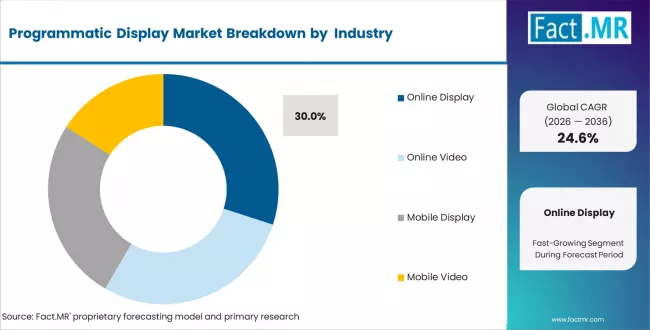
Programmatic Display Market Analysis By Ad Format | Source: Fact.MR
- Market Overview: Online display advertisements are expected to represent approximately 30% share of the programmatic display market in 2026. Online display advertising includes banner ads, rich media ads, and other visual advertising formats displayed across websites and mobile applications. Advertisers utilize programmatic platforms to distribute display advertisements across digital publishing networks in automated campaigns. Online display formats allow brands to present visual messaging and promotional content while reaching audiences across a wide range of digital platforms.
- Demand Drivers:
- Visual Advertising Formats: Online display advertisements allow brands to present graphical content including banners and interactive media across websites and mobile applications.
- Programmatic Campaign Distribution: Advertisers deploy display advertisements through automated programmatic platforms to reach targeted digital audiences.
- Digital Media Consumption: Increased online content consumption supports demand for visual advertising placements across digital publishing environments.
Programmatic Display Market Drivers, Restraints, and Opportunities
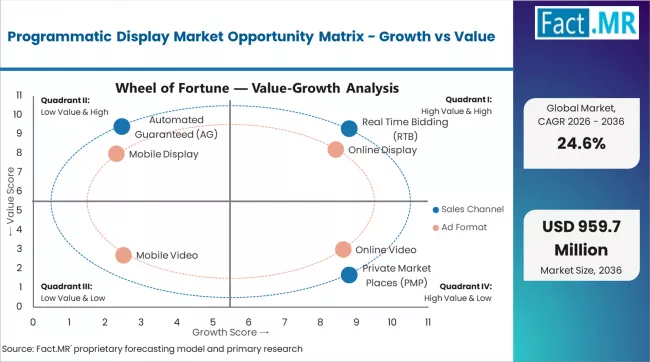
Programmatic Display Market Opportunity Matrix Growth Vs Value | Source: Fact.MR
Fact MR analysis indicates that the programmatic display market developed as digital advertising platforms adopted automated systems for buying and selling online advertising inventory. Early digital advertising transactions relied on manual negotiations between publishers and advertisers for banner placements across websites. The current market valuation reflects the widespread use of automated bidding platforms that allow advertisers to purchase display advertising space through real-time auctions across digital media networks. Demand persists because automated advertising platforms enable efficient allocation of marketing budgets while targeting specific audience segments based on behavioral and demographic data.
A structural shift is occurring as conventional manual display advertising transactions gradually decline within digital marketing ecosystems. Traditional direct advertising agreements remain present in premium media placements where publishers maintain direct relationships with advertisers. Programmatic platforms increasingly integrate data management tools, audience targeting algorithms, and real-time bidding systems that determine advertisement placement within milliseconds. These platforms require sophisticated data infrastructure and advertising technology systems, increasing operational costs for advertising networks. Higher spending on data-driven advertising platforms supports market value expansion even when overall digital display advertising volumes grow gradually.
- Real Time Bidding: Advertising technology platforms conduct automated auctions that allow advertisers to bid on digital display inventory in real time based on audience targeting parameters.
- Digital Advertising Regulation: Regulations such as the General Data Protection Regulation (GDPR) and the California Consumer Privacy Act (CCPA) influence data collection and user targeting practices within programmatic advertising systems.
- North America Ad Technology: The United States hosts major advertising technology companies and digital marketing platforms that operate large programmatic advertising exchanges.
Regional Analysis
The market analysis covers key global regions, including North America, Western Europe, and East Asia. It is segmented geographically, with specific market dynamics for each region. The full report provides a detailed market attractiveness analysis.
.webp "Top Country Growth Comparison Programmatic Display Market Cagr (2026 2036)")
Top Country Growth Comparison Programmatic Display Market Cagr (2026 2036) | Source: Fact.MR
| Country | CAGR (2026-2036) |
|---|---|
| USA | 9.5% |
| United Kingdom | 9.1% |
| Japan | 9.2% |
| South Korea | 9.6% |
Source: Fact.MR analysis. Updated Mar 24, 2026
Source: Fact MR (FMR) analysis, based on proprietary forecasting model and primary research
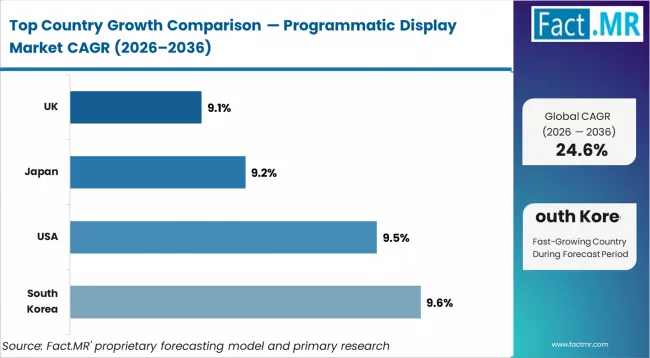
Programmatic Display Market Cagr Analysis By Country | Source: Fact.MR
North America
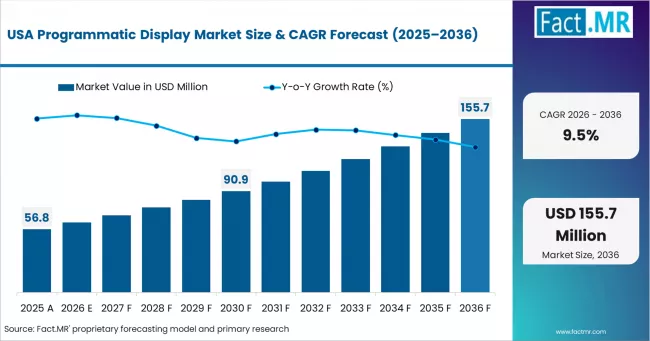
Programmatic Display Market Country Value Analysis | Source: Fact.MR
The USA represents a major market supported by digital advertising adoption, automated media buying platforms, and expansion of data driven marketing technologies. Key companies include Google, The Trade Desk, and Adobe.
- USA: Demand for programmatic display advertising solutions in the U.S. is projected to rise at 9.5% CAGR through 2036. Growth is supported by digital advertising transparency initiatives promoted by the Federal Trade Commission (04-2025) and expansion of automated advertising platforms by The Trade Desk (08-2025).
Western Europe
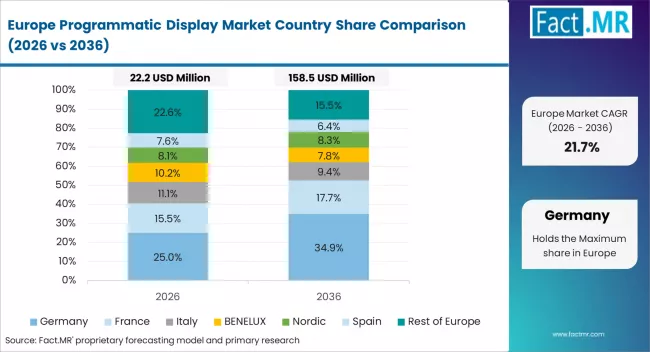
Programmatic Display Market Europe Country Market Share Analysis, 2026 & 2036 | Source: Fact.MR
The United Kingdom represents an important market supported by online media consumption, digital marketing platforms, and adoption of automated advertising technologies.
- United Kingdom: Demand for programmatic display advertising solutions in the UK is projected to rise at 9.1% CAGR through 2036. Growth is supported by digital advertising governance programs promoted by the Advertising Standards Authority (03-2025) and expansion of advertising technology platforms by Google (07-2025).
East Asia
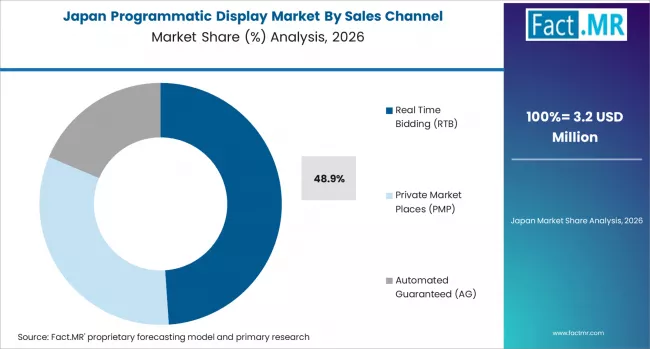
Programmatic Display Market Japan Market Share Analysis By Sales Channel | Source: Fact.MR
Japan and South Korea represent key markets supported by digital media platforms, mobile advertising ecosystems, and automated marketing technologies.
- Japan: Demand for programmatic display advertising solutions in Japan is projected to rise at 9.2% CAGR through 2036. Growth is supported by digital advertising innovation initiatives promoted by the Ministry of Economy, Trade and Industry (04-2025) and development of advertising technology platforms by CyberAgent (08-2025).
- South Korea: Demand for programmatic display advertising solutions in South Korea is projected to rise at 9.6% CAGR through 2036. Growth is supported by digital media innovation programs promoted by the Ministry of Science and ICT (02-2025) and expansion of advertising platforms by Naver Corporation (06-2025).
Fact MR's analysis of the programmatic display market in North America, Western Europe, and East Asia consists of country-wise assessments that include the USA, the United Kingdom, Japan, and South Korea. Readers can find detailed trends, regulatory updates, and company-specific investments shaping market growth in these countries.
Competitive Structure and Buyer Dynamics in the Programmatic Display Market
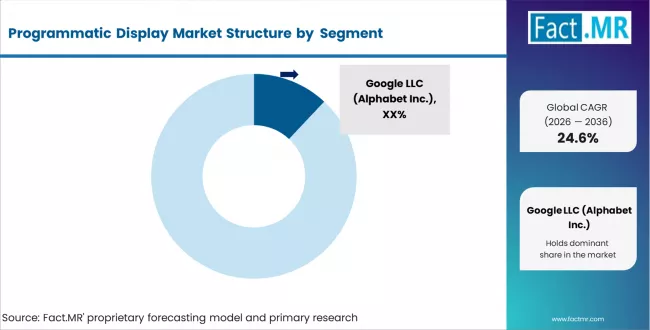
Programmatic Display Market Analysis By Company | Source: Fact.MR
The competitive structure of the Programmatic Display Market is moderately concentrated, with several digital advertising technology companies controlling a large share of automated ad buying platforms and data driven advertising infrastructure. Major firms including Google LLC (Alphabet Inc.), Amazon.com, Inc., Microsoft Corporation, and Adobe Inc. maintain strong market positions through integrated advertising ecosystems and extensive digital advertising networks. These companies provide demand side platforms, ad exchanges, and data management systems used by advertisers to purchase display advertising inventory across digital channels. Additional participants such as The Trade Desk, Inc., Magnite, Inc., PubMatic, Inc., Criteo S.A., MediaMath, Inc., and Yahoo Inc. contribute through specialized programmatic advertising platforms and supply side infrastructure for publishers. Competition in the market is primarily influenced by audience targeting accuracy, advertising inventory access, data analytics capability, and platform integration with digital media networks.
Several companies maintain structural advantages through large advertising networks and extensive consumer data resources. Firms such as Google LLC, Amazon.com, Inc., and Microsoft Corporation benefit from ownership of digital platforms that generate significant user data used for advertising targeting and campaign optimization. The Trade Desk, Inc., PubMatic, Inc., and Magnite, Inc. maintain specialized expertise in programmatic ad buying and supply side monetization technologies. Advertisers commonly adopt multi platform advertising strategies to avoid dependence on a single advertising network and to access diverse audience segments. Media agencies and advertisers evaluate vendors based on campaign performance metrics, transparency in ad placement, and data analytics capability. This purchasing behavior moderates supplier pricing leverage across the market. Platforms with extensive advertising inventory access and strong data targeting capabilities retain stronger negotiating influence.
Key Players of the Programmatic Display Market
- Google LLC (Alphabet Inc.)
- Amazon.com, Inc.
- The Trade Desk, Inc.
- Adobe Inc.
- Magnite, Inc.
- PubMatic, Inc.
- Criteo S.A.
- MediaMath, Inc.
- Microsoft Corporation
- Yahoo Inc.
Report Scope
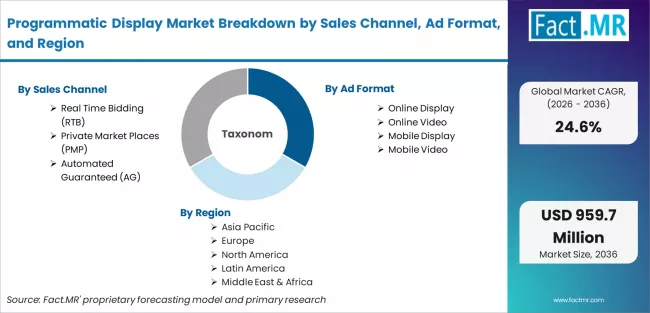
Programmatic Display Market Breakdown By Sales Channel, Ad Format, And Region | Source: Fact.MR
| Metric | Value |
|---|---|
| Quantitative Units | USD 106.4 billion (2026) to USD 959.7 billion (2036), at a CAGR of 24.6% |
| Market Definition | The programmatic display market includes automated digital advertising transactions where display and video advertising inventory is purchased and sold using software platforms, data driven bidding systems, and algorithmic decision tools that enable advertisers to target audiences across websites, mobile applications, and connected digital environments. |
| Ad Format Segmentation | Online Display, Online Video, Mobile Display, Mobile Video |
| Sales Channel Segmentation | Real Time Bidding (RTB), Private Marketplaces (PMP), Automated Guaranteed (AG) |
| Regions Covered | North America, Latin America, Europe, East Asia, South Asia, Oceania, Middle East and Africa |
| Countries Covered | United States, Canada, Mexico, Brazil, Germany, United Kingdom, France, Italy, Spain, China, India, Japan, South Korea, Australia, and 40+ countries |
| Key Companies Profiled | Google LLC (Alphabet Inc.), Amazon.com, Inc., The Trade Desk, Inc., Adobe Inc., Magnite, Inc., PubMatic, Inc., Criteo S.A., MediaMath, Inc., Microsoft Corporation, Yahoo Inc. |
| Forecast Period | 2026 to 2036 |
| Approach | Hybrid top-down and bottom-up market modeling supported by digital advertising expenditure analysis, programmatic ad exchange transaction data, platform revenue benchmarking, and validation through interviews with demand side platforms, supply side platforms, publishers, and digital advertising agencies. |
Source: Fact.MR analysis. Updated Mar 24, 2026
Bibliographies
- [1] Federal Trade Commission, USA. (2025). Digital advertising transparency initiatives.
- [2] Advertising Standards Authority, UK. (2025). Digital advertising governance programs.
- [3] Ministry of Economy, Trade and Industry, Japan. (2025). Digital advertising innovation initiatives.
- [4] Ministry of Science and ICT, South Korea. (2025). Digital media innovation programs.
- [5] The Trade Desk, Inc. (2025). Automated advertising platform expansion.
- [6] Google LLC. (2025). Advertising technology platform expansion.
- [7] CyberAgent, Inc. (2025). Advertising technology platform development.
- [8] Naver Corporation. (2025). Advertising platform expansion.
- [9] European Data Protection Board. (2023). GDPR for digital advertising.
This Report Addresses
- Market size estimation and revenue forecasts for the Programmatic Display Market from 2026 to 2036, supported by digital advertising expenditure benchmarks and automated advertising transaction indicators across global media platforms.
- Growth opportunity analysis across online display, online video, mobile display, and mobile video advertising formats used in automated digital marketing campaigns across websites and mobile applications.
- Segment and regional revenue forecasts covering real time bidding, private marketplaces, and automated guaranteed sales channels used by advertisers and media publishers for programmatic advertising transactions.
- Competitive strategy assessment including advertising technology platform capability, audience targeting algorithm performance, and programmatic advertising infrastructure benchmarking among digital advertising technology providers.
- Regulatory and compliance evaluation covering frameworks such as the General Data Protection Regulation and the California Consumer Privacy Act affecting data collection and user targeting in automated digital advertising systems.
- Market report delivery in PDF, Excel, PPT, and interactive dashboard formats designed for digital advertising investment planning, marketing technology evaluation, and media buying strategy analysis.
- Supply chain and operational risk analysis identifying third party cookie restrictions, data privacy compliance requirements, and dependence on digital advertising exchanges and audience data platforms affecting programmatic display advertising operations.
Segmentation
Programmatic Display Market Key Segments
-
Ad Format :
- Online Display
- Online Video
- Mobile Display
- Mobile Video
-
Sales Channel :
- Real Time Bidding (RTB)
- Private Market Places (PMP)
- Automated Guaranteed (AG)
-
Region :
- North America
- USA
- Canada
- Mexico
- Europe
- Germany
- UK
- France
- Italy
- Spain
- Nordic Countries
- BENELUX
- Rest of Europe
- Asia Pacific
- China
- Japan
- South Korea
- India
- Australia
- Rest of Asia Pacific
- Latin America
- Brazil
- Argentina
- Rest of Latin America
- Middle East and Africa
- Kingdom of Saudi Arabia
- United Arab Emirates
- South Africa
- Rest of Middle East and Africa
- Other Regions
- Oceania
- Central Asia
- Other Markets
- North America
Frequently Asked Questions
How large is the demand for Programmatic Display Advertising in the global market in 2026?
What will be the market size of Programmatic Display Advertising in the global market by 2036?
What is the expected demand growth for Programmatic Display Advertising in the global market between 2026 and 2036?
Which Sales Channel Segment is poised to lead global demand by 2026?
Which Company is Identified as a Leading Participant in the Programmatic Display Market?
What is Driving Programmatic Display Demand in the United States?
What is the United States Growth Outlook in this Report?
What Factors Support Programmatic Display Adoption in the United Kingdom?
What is the United Kingdom Growth Outlook in this Report?
Why is Japan an Important Market for Programmatic Display Advertising?
What is the Japan Growth Outlook in this Report?
Why is South Korea Considered a Key Market for Programmatic Display Advertising?
What is the South Korea Growth Outlook in this Report?
What is Programmatic Display Advertising and What is It Mainly Used For?
What does Programmatic Display Market Mean in this Report?
What is Included in the Scope of this Programmatic Display Market Report?
What is Excluded from the Scope of this Report?
What does Market Forecast Mean on this Page?
How is the Programmatic Display Market Forecast Developed in this Report?
Who worked on this report


Preview the report firsthand - request a free sample
Free SampleGet the brochure for pricing and purchase details
Download PDF