- Market Value (2025): USD 6.8 Bn
- Estimated Value (2026): USD 7.6 Bn
- Forecast Value (2036): USD 22.0 Bn
- CAGR (2026-2036): 11.2%
What is the Public Relations Tools Market forecast to be worth by 2036?
USD 7.6 billion in 2026 to USD 22.0 billion by 2036 at an 11.2% CAGR.
- The public relations tools market reached USD 6.8 billion in 2025 as teams moved more outreach and monitoring work into shared systems.
- Demand is projected to increase from USD 7.6 billion in 2026 to USD 22.0 billion by 2036.
- The market is forecast to record 11.2% CAGR from 2026 to 2036 owing to media fragmentation and reporting pressure.
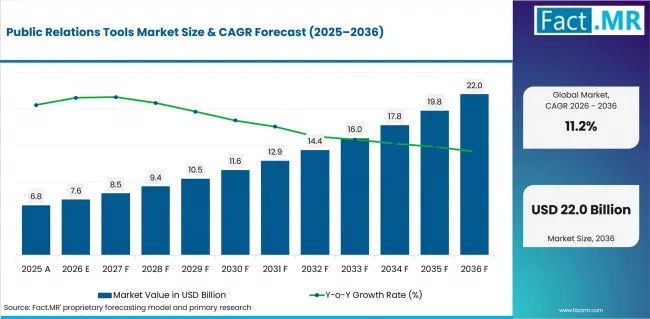
Public Relations Tools Market Value Analysis | Source: Fact.MR
What are the defining numbers behind Public Relations Tools Market growth?
USD 14.4 billion absolute opportunity by 2036.
- Demand Drivers in the Market
- Communications teams need one system to watch earned media and social posts. The same system should cover podcasts and AI-answer references.
- Large enterprises are expected to prefer shared dashboards because crisis response and executive communication depend on the same record.
- Agency teams need repeatable outreach records so media lists and campaign reports do not remain scattered across spreadsheets.
- Key Segments Analyzed
- By Deployment: Cloud-Based is projected to hold 73.0% share in 2026 because distributed teams need fast access without maintaining local software.
- By Component: Software is expected to account for 68.0% share in 2026 since monitoring and reporting become recurring platform work.
- By Enterprise Size: Large Enterprises are anticipated to hold 59.0% share in 2026 as they manage brands and approval layers across markets.
- By Application: Media Monitoring & Analytics is estimated to capture 29.0% share in 2026 because teams need early signals before response meetings.
- By End User Industry: Corporate Enterprises are forecast to represent 34.0% share in 2026 given their need to own reputation records internally.
- Analyst Opinion at Fact.MR
- Shambhu Nath Jha, Sr. Consultant at Fact.MR, opines: “PR teams need one record for earned-media coverage, journalist outreach, and response approval. The supplier test is whether coverage quality and permission controls still hold when several teams use the platform.”
- Strategic Implications
- Communication leaders should test source coverage before platform price. A tool loses value when it misses regional outlets or gives weak evidence for review.
- Vendors should show how AI assistance remains governed during drafting and journalist matching. This matters for AI-generated content because review control affects enterprise use.
- Investors should separate newswire distribution revenue from software subscription revenue. Each stream uses a different renewal trigger and cost base.
South Korea leads with a 12.3% CAGR as digital brands expand monitoring. The USA follows at 12.0% through enterprise platform spending. Canada reaches 11.7% due to bilingual coverage needs, while the UK records 11.4% through agency use. Germany posts 11.1%, Australia 10.8% and Japan 10.4% as governance, reputation programs and language validation shape adoption.
How does the Public Relations Tools Market break down by segment?
Cloud-Based is expected to lead Deployment at 73.0% share in 2026. Software is projected to lead Component at 68.0% share in 2026.
Why does Cloud-Based lead Deployment?
Cloud-Based is projected to account for 73.0% share in 2026.
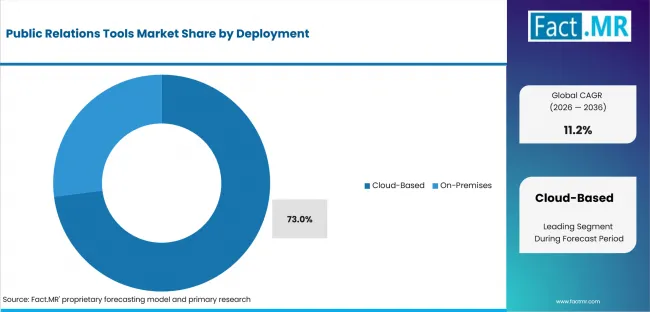
Public Relations Tools Market Analysis By Deployment | Source: Fact.MR
Cloud delivery fits public relations work because teams need access during launches and issue response. Customers are expected to favor systems that update media records without local maintenance.
Why does Software lead Component?
Software is expected to hold 68.0% share in 2026.
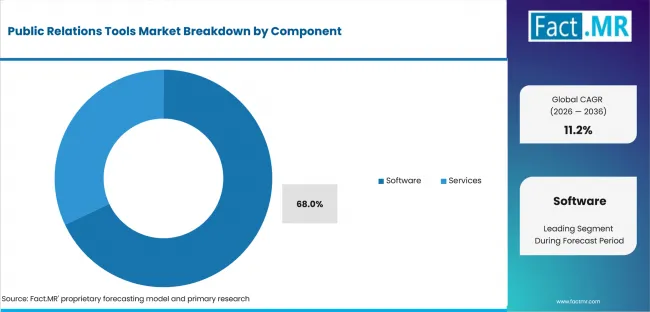
Public Relations Tools Market Analysis By Component | Source: Fact.MR
Software carries the recurring work inside public relations. Search queries and contact records gain value when one platform keeps prior activity.
What supports Large Enterprises within Enterprise Size?
Large Enterprises are anticipated to hold 59.0% share in 2026.
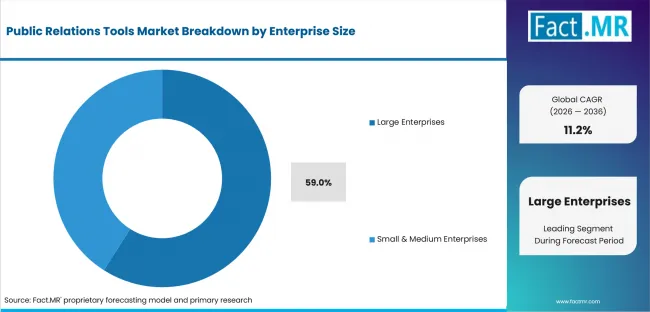
Public Relations Tools Market Analysis By Enterprise Size | Source: Fact.MR
Large enterprises manage several brands and public issues at the same time. Their teams need role permissions before executives trust a platform.
How does Media Monitoring & Analytics shape Application demand?
Media Monitoring & Analytics is estimated to represent 29.0% share in 2026.
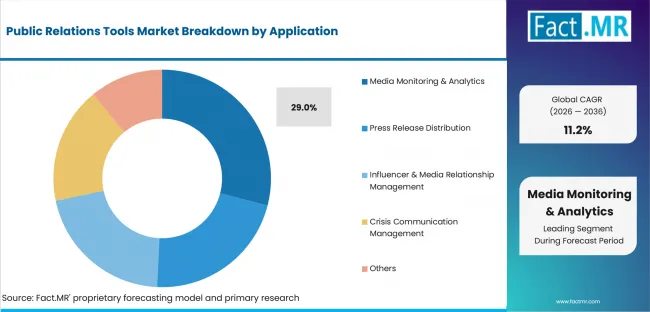
Public Relations Tools Market Analysis By Application | Source: Fact.MR
Reputation risk often appears before a campaign report is due. Teams need alerts before response meetings.
What supports Corporate Enterprises within End User Industry?
Corporate Enterprises are forecast to hold 34.0% share in 2026.
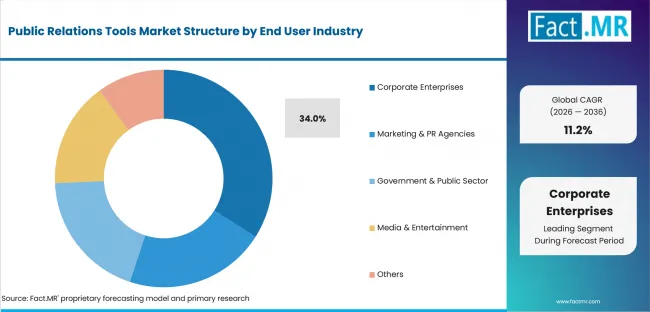
Public Relations Tools Market Analysis By End User Industry | Source: Fact.MR
Corporate enterprises buy public relations tools to support reputation management and executive visibility. Direct ownership of coverage history helps internal teams prepare approvals.
What is accelerating Public Relations Tools Market adoption, and what is holding it back?
Demand is expected to rise as communication teams track more media channels and measure campaign results. Growth may be limited by source licensing, AI review requirements, migration work and renewal pressure.
Drivers Impact Analysis
| DRIVER | RELATIVE IMPACT | GEOGRAPHIC RELEVANCE | IMPACT TIMELINE |
|---|---|---|---|
| Fragmented media monitoring workload | High | USA, UK, South Korea | Short term (<= 2 years) |
| Cloud workflow consolidation | High | USA, Canada, Australia | Short term (<= 2 years) |
| Journalist outreach record keeping | Moderate | Agency-led markets | Medium term (2-4 years) |
| AI-answer visibility checks | Moderate | USA, South Korea, Japan | Medium term (2-4 years) |
| Reporting and ROI proof | Moderate | Enterprise accounts | Long term (>= 4 years) |
Source: Fact.MR analysis. Updated Aug 3, 2026
- Fragmented media monitoring workload: Communications teams are expected to need one review flow for news coverage and social discussion. Podcasts and AI-answer references add more surfaces to monitor.
- Cloud workflow consolidation: Shared access is expected to reduce handoffs between corporate teams and agencies when issue response needs one record.
- Journalist outreach record keeping: Customer adoption is expected to rise where pitch history and contact notes guide future outreach decisions.
Opportunity Impact Analysis
| OPPORTUNITY | RELATIVE IMPACT | GEOGRAPHIC RELEVANCE | IMPACT TIMELINE |
|---|---|---|---|
| AI-search visibility modules | Moderate | USA and South Korea | Short term (<= 2 years) |
| Multilingual monitoring coverage | Moderate | Japan, Germany, Canada | Medium term (2-4 years) |
| Self-service agency workspaces | Moderate | UK and Australia | Medium term (2-4 years) |
| API and reporting integrations | Low | Large enterprise accounts | Long term (>= 4 years) |
Source: Fact.MR analysis. Updated Aug 3, 2026
- AI-search visibility modules: Vendors that show brand mentions inside AI answers are expected to create new budget lines for reputation teams.
- Multilingual monitoring coverage: Local language accuracy is expected to matter where sentiment review and journalist records need country-level precision.
- Self-service agency workspaces: Agencies are expected to favor tools that shorten client setup and keep coverage evidence easy to reuse.
Restraints Impact Analysis
| RESTRAINT | RELATIVE IMPACT | GEOGRAPHIC RELEVANCE | IMPACT TIMELINE |
|---|---|---|---|
| Data licensing and source coverage | High | Global | Short term (<= 2 years) |
| AI governance and approval risk | Moderate | USA, Germany, Japan | Short term (<= 2 years) |
| Integration and migration cost | Moderate | Large enterprises | Medium term (2-4 years) |
| ROI proof before renewal | Low | Agency and corporate accounts | Long term (>= 4 years) |
Source: Fact.MR analysis. Updated Aug 3, 2026
- Data licensing and source coverage: Selection is expected to slow when coverage rights for required outlets are unclear.
- AI governance and approval risk: Communications teams need permission controls and review trails before AI-assisted drafting moves into sensitive work.
- Integration and migration cost: Switching becomes slower when old media lists and release archives need cleanup before a new system works properly.
Which countries are scaling Public Relations Tools Market fastest?
- South Korea leads through digital brand activity and AI-answer monitoring. The USA and Canada follow as enterprises combine communication workflows, supported by broad platform use and bilingual coverage needs.
- The UK grows through agency adoption and cloud-based reporting, while Germany advances through data protection and governance reviews. Australia benefits from corporate reputation programs.
- Japan grows more steadily as buyers test language accuracy and service quality. Adoption depends on coverage proof, local support and reduced manual work.
The full report provides country-level CAGR analysis across North America; Latin America; Europe; East Asia; South Asia; Oceania; and the Middle East and Africa.
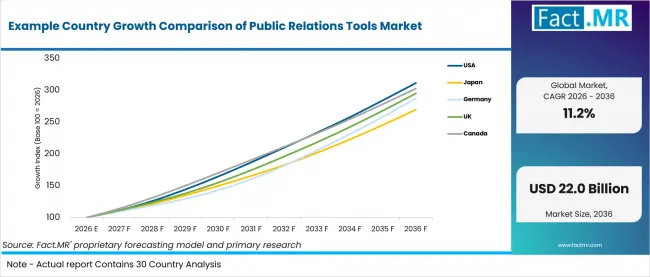
Example Country Growth Comparison Of Public Relations Tools Market | Source: Fact.MR
| Country | CAGR (2026-2036) |
|---|---|
| USA | 12.0% |
| Japan | 10.4% |
| Germany | 11.1% |
| UK | 11.4% |
| Canada | 11.7% |
| Australia | 10.8% |
| South Korea | 12.3% |
Source: Fact.MR analysis. Updated Aug 3, 2026
What supports USA adoption?
12.0% CAGR, supported by enterprise budgets and agency workflow consolidation.
The USA benefits from large communication teams that can spread platform costs across media monitoring, outreach and reporting. Before wider approval, buyers often review source coverage and integration quality.
How is Japan scaling demand?
10.4% CAGR, driven by local language accuracy and careful vendor review.
Japan’s growth depends heavily on the quality of Japanese-language monitoring. Buyers are expected to test sentiment accuracy, outlet coverage and service support before expanding use.
What is shaping Germany’s outlook through 2036?
11.1% CAGR, backed by governance-led enterprise adoption.
Germany advances through structured purchasing reviews where contact storage, monitoring controls and audit trails carry significant weight. Enterprise customers are likely to favor platforms that make permissions and data handling easy to verify.
How does the UK perform?
11.4% CAGR, led by agency use and fast cloud rollout.
The UK grows through agency-led adoption, particularly where teams manage several clients from one cloud platform. Quick setup and reusable reporting make these systems attractive for campaign work.
What supports Canada’s growth?
11.7% CAGR, supported by bilingual media needs and cross-border coverage.
Canada’s market is shaped by the need to monitor both English- and French-language media. Cross-border coverage adds further value because U.S. stories often influence national and provincial reputation work. Shared platforms help teams review these sources without separating monitoring across multiple systems.
How is Australia developing demand?
10.8% CAGR, driven by corporate reputation work and agency accounts.
Australia’s growth comes from national brands and agencies that need rapid coverage checks across trade, metropolitan and regional outlets. Buyers are expected to prefer simple dashboards, timely alerts and clear reporting.
What supports South Korea’s growth?
12.3% CAGR, backed by digital brand activity and AI-answer visibility checks.
South Korea leads as digital brands create more reputation touchpoints across online media and AI-generated answers. Vendors can gain attention by proving Korean-language accuracy and fast reporting.
Who leads the Public Relations Tools Market?
Cision and Meltwater show the clearest direct relevance, while Muck Rack strengthens the wider media-monitoring and AI-visibility landscape.
Cision supports public relations teams through media monitoring, journalist databases, release distribution and AI-search visibility tools. Meltwater contributes broad news, social and AI-answer monitoring for brand and reputation management. Muck Rack adds journalist relationship management and integrated social listening. Onclusive and Semrush Holdings, Inc., through Prowly extend the field through media intelligence, outreach and newsroom tools. Business Wire strengthens release distribution, while Agility PR Solutions, Notified and Prezly broaden coverage through monitoring, communications management and hosted newsroom capabilities.
Which companies are the key providers?
Key companies include Cision Ltd.; Meltwater; Onclusive; Semrush Holdings, Inc., through Prowly; Muck Rack; Business Wire; Agility PR Solutions; Notified; and Prezly.
- Cision Ltd.
- Meltwater
- Onclusive
- Semrush Holdings, Inc., through Prowly
- Muck Rack
- Business Wire
- Agility PR Solutions
- Notified
- Prezly
Bibliography
- Cision Ltd. (2026, July 14). Cision Adds AI Search Visibility to CisionOne, Helping PR Teams Track How Brands Appear in AI Answers.
- Meltwater. (2025, July 29). Meltwater Debuts Industry-First GenAI Lens, Unlocking Enhanced Brand Insights.
- Eurostat. (2025, December 11). 20% of EU enterprises use AI technologies.
- Agility PR Solutions. (2025, April 15). Agility PR Solutions ranks #1 across G2 Spring ’25 report.
This Report Answers
- The report provides strategic intelligence on Deployment and Component choices that shape platform selection.
- Segment analysis covers Cloud-Based delivery and Software leadership as the share leaders within the 2026 market.
- Country outlook evaluates South Korea and the USA alongside Canada and the UK. Germany and Australia complete the growth comparison alongside Japan.
- Competitive analysis profiles Cision and Meltwater alongside Onclusive and Semrush Holdings, Inc., through Prowly. Muck Rack completes the provider set with Business Wire; Agility PR Solutions; Notified; and Prezly.
- Application assessment covers Media Monitoring & Analytics, Press Release Distribution, Influencer & Media Relationship Management, Crisis Communication Management, and Others.
What does the Public Relations Tools Market cover?
Public relations tools manage outreach and release distribution. They support monitoring and reputation response.
The Public Relations Tools Market covers platforms used by corporate teams and agencies. Public organizations are included when they manage earned media work. Coverage extends to journalist databases and hosted newsrooms.
The market differs from general marketing automation because value comes from earned media workflow. Media buying and influencer payment remain outside the boundary. General social posting tools are excluded unless they support PR monitoring.
What is included in the scope?
Public relations tools are used across corporate and agency communication teams.
The scope includes Deployment and Component alongside Enterprise Size and Application. End User Industry and Region complete the structure. Coverage spans cloud systems and on-premises tools.
What is excluded from the scope?
Media buying and influencer compensation are excluded. Creative production and publisher revenue remain outside the scope.
The scope excludes paid media placement and general digital advertising tools. Broad agency retainers remain outside the scope unless revenue is clearly tied to platform use. Publisher subscription revenue is excluded.
How Was the Analysis Built?
The analysis combines primary interviews with public company materials, regulatory publications, trade data, and technical studies.
- Primary Research: Primary research includes discussions with software providers, communications agencies, corporate communications teams, procurement teams, and subject-matter experts. These conversations examine buying criteria, workflow requirements, approval controls, vendor positioning, and adoption barriers.
- Desk Research: Desk research covers government statistics, regulatory publications, company filings, trade data, technical studies, industry associations, standards, public policy, and other authoritative sources. Selected public references are listed in the bibliography.
- Market Sizing and Forecasting: Market estimates combine historical performance, demand indicators, pricing and volume trends, segment shares, company participation, country-level growth, adoption patterns, investment activity, and barriers to market expansion.
- Data Validation and Update Cycle: Findings are validated by comparing primary interviews with public data, company activity, regulatory changes, trade patterns, and industry developments. Regular updates review new product launches, capacity changes, partnerships, approvals, procurement trends, and shifts in commercial adoption.
Segmentation
What is the report's scope and coverage?
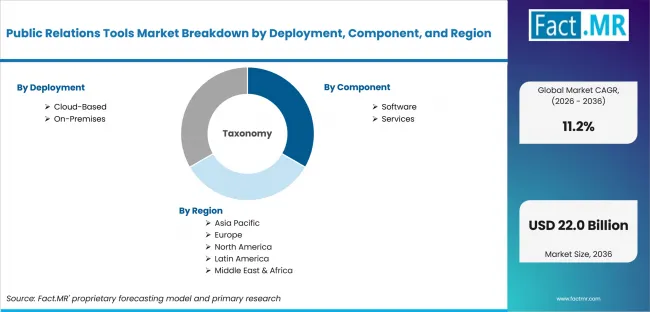
Public Relations Tools Market Breakdown By Deployment, Component, And Region | Source: Fact.MR
| Attribute | Details |
|---|---|
| Quantitative Units | USD 7.6 billion in 2026 to USD 22.0 billion by 2036 at 11.2% CAGR |
| Market Definition | Software and services used to plan outreach, manage media contacts, distribute releases, and monitor coverage |
| Deployment | Cloud-Based; On-Premises |
| Component | Software; Services |
| Enterprise Size | Large Enterprises; Small & Medium Enterprises |
| Application | Media Monitoring & Analytics; Press Release Distribution; Influencer & Media Relationship Management; Crisis Communication Management; Others |
| End User Industry | Corporate Enterprises; Marketing & PR Agencies; Government & Public Sector; Media & Entertainment; Others |
| Regions Covered | North America; Latin America; Europe; East Asia; South Asia and Pacific; Middle East & Africa |
| Key Countries Highlighted | USA; Japan; Germany; UK; Canada; Australia; South Korea |
| Key Companies Profiled | Cision Ltd.; Meltwater; Onclusive; Semrush Holdings, Inc., through Prowly; Muck Rack; Business Wire; Agility PR Solutions; Notified; Prezly |
| Forecast Period | 2026 to 2036 |
| Approach | Hybrid top-down and bottom-up approach using vendor portfolios; PR software workflows; media monitoring demand; release distribution use; and agency adoption |
Source: Fact.MR analysis. Updated Aug 3, 2026
How is the market segmented?
-
By Deployment:
- Cloud-Based
- On-Premises
-
By Component:
- Software
- Services
-
By Enterprise Size:
- Large Enterprises
- Small & Medium Enterprises
-
By Application:
- Media Monitoring & Analytics
- Press Release Distribution
- Influencer & Media Relationship Management
- Crisis Communication Management
- Others
-
By End User Industry:
- Corporate Enterprises
- Marketing & PR Agencies
- Government & Public Sector
- Media & Entertainment
- Others
-
By Region:
- North America
- Latin America
- Europe
- East Asia
- South Asia and Pacific
- Middle East and Africa
Frequently Asked Questions
Which Deployment leads the market?
Which Component leads the market?
Which Enterprise Size leads the market?
Which Application leads the market?
Which End User Industry leads the market?
Which country records the highest listed CAGR?
What is the primary driver in this market?
What is the main restraint?
Why does cloud-based deployment lead demand?
Who worked on this report


Preview the report firsthand - request a free sample
Free SampleGet the brochure for pricing and purchase details
Download PDF