- Base Value(2026): 150 Bn
- Forecast Value (2036): 239.7 Bn
- CAGR (2036): 4.8%
Radiance-Boosting Skin Care Market Forecast and Outlook 2026 to 2036
Radiance-boosting skin care market is likely to be valued at USD 150 billion in 2026 and is projected to reach USD 239.7 billion by 2036, reflecting a 4.8% CAGR, according to Fact.MR analysis.
Radiance-Boosting Skin Care Market Key Takeaways
- Radiance-Boosting Skin Care Market Value (2026): USD 150 billion
- Radiance-Boosting Skin Care Forecast Value (2036): USD 239.7 billion
- Radiance-Boosting Skin Care Forecast CAGR (2026-2036): 4.8%
- Radiance-Boosting Skin Care Leading Product Type: Radiance and Brightening Creams (34%)
- Radiance-Boosting Skin Care Key Growth Regions: China, India, Germany, Brazil, USA
- Radiance-Boosting Skin Care Top Players: L’Oréal, Estée Lauder, Shiseido, Procter & Gamble, Unilever, Beiersdorf, Johnson & Johnson, The Ordinary, Clinique, Garnier, Olay, Innisfree
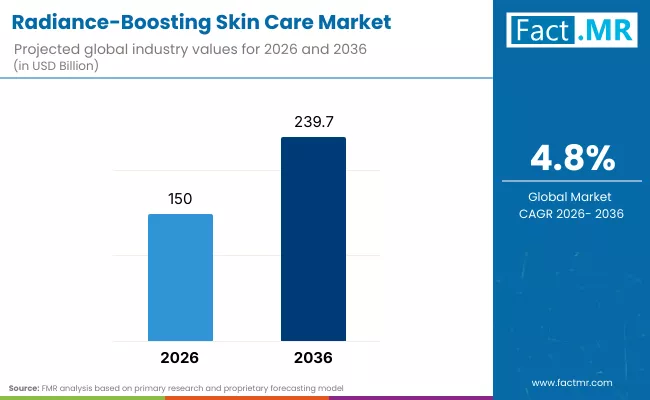
Radiance Boosting Skin Care Market By Industry | Source: Fact.MR
Growth is influenced by the rising prioritization of measurable skin appearance improvements within both professional and consumer channels, driving demand for standardized, high-performance formulations. Operational adoption emphasizes scalable manufacturing processes, consistent ingredient quality, and packaging designs that maintain product efficacy across global supply chains.
Regional variations and multi-channel distribution strategies shape market penetration, with prestige and mass segments adapting formulations for environmental conditions and consumer preferences. Evidence indicates that manufacturers focusing on reproducibility, logistics efficiency, and quality assurance gain accelerated adoption. Market expansion reflects strategic alignment between operational scalability, channel efficiency, and measurable performance outcomes, enabling companies to address evolving consumer expectations while maintaining predictable delivery, minimal handling variability, and reliable product performance across global radiance-focused skincare portfolios.
Radiance-Boosting Skin Care Market
| Metric | Value |
|---|---|
| Market Value (2026) | USD 150 billion |
| Forecast Value (2036) | USD 239.7 billion |
| Forecast CAGR (2026–2036) | 4.8% |
Source: Fact.MR analysis. Updated Feb 5, 2026
Category
| Category | Segments |
|---|---|
| Product Type | Radiance and brightening creams; Serums with radiance actives (e.g., Vitamin C); Exfoliating radiance masks; Radiance toners & essences; Radiance-boosting cleansers; Sunscreen with radiance enhancement |
| Ingredients | Vitamin C & derivatives; Niacinamide; Alpha Arbutin; Tranexamic acid; Peptides & antioxidants; Botanical extracts (e.g., Licorice, Turmeric) |
| Distribution Channel | E-commerce platforms; Specialty beauty retail; Department stores; Pharmacy & drugstores; Supermarkets and hypermarkets |
| End User | Women; Men; Unisex / All gender |
| Region | North America; Europe; Asia Pacific; Latin America; Middle East & Africa |
Source: Fact.MR analysis. Updated Feb 5, 2026
Segmental Analysis
By Product Type, Why Do Radiance and Brightening Creams Lead the Market?
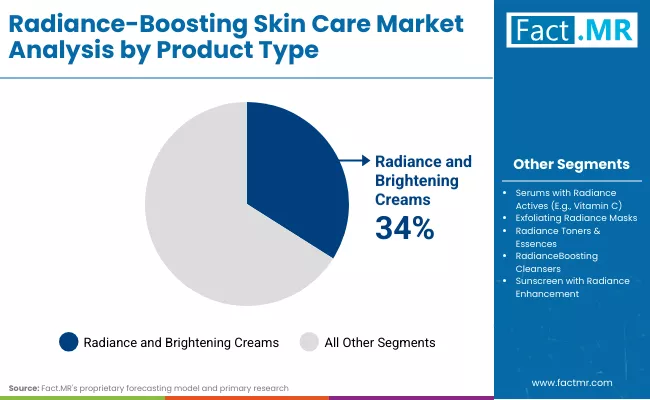
Radiance Boosting Skin Care Market By Product Type | Source: Fact.MR
Radiance and brightening creams lead the market with 34% share, reflecting high-frequency consumer replenishment across retail, e-commerce, and professional skincare channels. Market demand is driven by predictable purchasing cycles, multi-channel distribution, and scalable logistics that ensure operational efficiency for suppliers. High turnover, routine usage, and broad urban penetration reinforce recurring demand. Segment prominence is shaped by structural market drivers such as repeatable procurement, channel coverage, and inventory predictability rather than the specific formulation of individual creams. Market growth is anchored in consistent consumption patterns and repeatable supply chain workflows.
By Ingredients, Why Do Vitamin C and Derivatives Represent the Largest Segment?
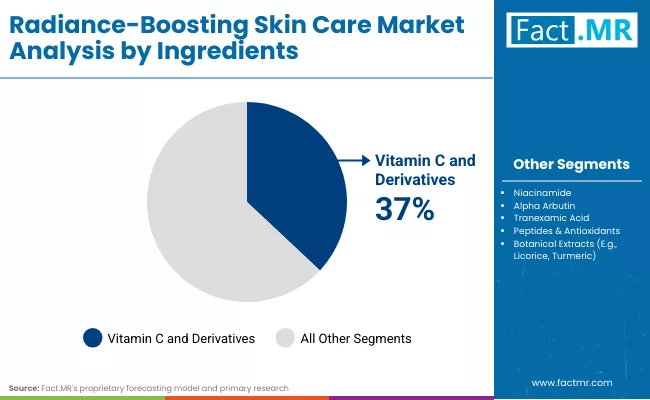
Radiance Boosting Skin Care Market By Ingredient | Source: Fact.MR
Vitamin C and derivatives account for 37% share, reflecting the market’s preference for widely adopted, repeatable ingredient solutions that support multi-channel distribution and scalable supply chains. Demand is concentrated in segments with frequent purchasing, predictable replenishment cycles, and operational efficiency in logistics and inventory management. Suppliers benefit from repeatable production runs and standardized material sourcing. Segment leadership arises from structural market characteristics including channel penetration, high-frequency turnover, and repeatable procurement rather than the functional effects of individual ingredients. Adoption is guided by consumption patterns, supply chain scalability, and operational repeatability.
Country/Region
| Country/Region | Driver | Restraint | Trend |
|---|---|---|---|
| USA | Rising consumer demand for luminous, brightening formulations → drives premium radiance-boosting skincare launches | FDA MoCRA 2026 cGMP and safety substantiation → increases compliance costs for small/mid-tier brands | Growth of dermatologist-tested, high-efficacy brightening products |
| India | Urbanization and e-commerce adoption → accelerates penetration of radiance-boosting skincare products | Supply chain and regulatory reporting challenges → slows rollout for smaller brands | Rapid expansion of online-ready luminous skincare for urban consumers |
| Brazil | Interest in natural-origin, locally sourced brightening actives → drives differentiated product launches | Import and ingredient restrictions → increase formulation costs | Growth of sustainable, locally sourced radiance-boosting skincare |
| China | Rising middle-class demand for luminous skin → fuels premium brightening skincare launches | GMP tightening → delays approvals for new formulations | Expansion of automated pigment and actives testing for radiance efficacy |
Source: Fact.MR analysis. Updated Feb 5, 2026
Analysis of the Radiance-Boosting Skin Care Market by Key Country
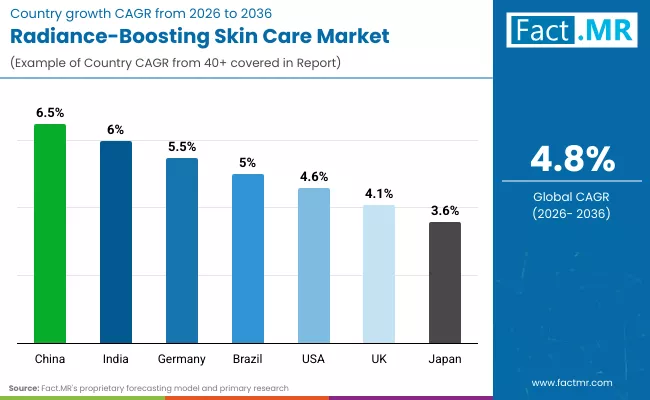
Radiance Boosting Skin Care Market By Country | Source: Fact.MR
| Country | CAGR (2026-2036) |
|---|---|
| China | 6.5% |
| India | 6.0% |
| Germany | 5.5% |
| Brazil | 5.0% |
| USA | 4.6% |
| UK | 4.1% |
| Japan | 3.6% |
Source: Fact.MR analysis. Updated Feb 5, 2026
The report covers an in-depth analysis of 40+ countries; top-performing countries are highlighted below.
How Is Demand for Radiance-Boosting Skin Care Products Growing in China?
Demand for radiance-boosting skin care products in China grows at 6.5% CAGR through 2036. Urban consumers increasingly prefer formulations that enhance skin glow while supporting barrier protection and hydration. E-commerce platforms accelerate trial and repeat purchases, while domestic and international brands invest in formulation efficacy, stability, and safety compliance. Operational improvements emphasize efficient inventory management, rapid replenishment, and regional distribution. Functional benefits combined with aesthetic appeal drive premium and mid-tier adoption. Consumer education and influencer marketing support awareness. Supply chain digitization ensures consistent availability. Market expansion reflects growing lifestyle focus on skin radiance and wellness.
What Is the Growth in Adoption of Radiance-Boosting Skin Care Products in India?
Growth in adoption of radiance-boosting skin care products in India is 6.0% CAGR through 2036. Rising disposable incomes, urbanization, and growing awareness of skincare benefits drive demand across metropolitan areas. Retail modernization and e-commerce penetration facilitate product accessibility and replenishment. Manufacturers tailor formulations to climate and skin type considerations, emphasizing stability and efficacy. Operational focus prioritizes supply chain efficiency and regional availability. Marketing campaigns highlight radiance enhancement and functional benefits. Premium and mid-tier segments show the strongest uptake. Market expansion is supported by educational initiatives, reliable product quality, and consistent availability.
How Is the Radiance-Boosting Skin Care Market Shaping in Germany?
Adoption of radiance-boosting skin care products in Germany grows at 5.5% CAGR through 2036. Consumers value functional formulations with transparent ingredient disclosures, safety, and visible performance. Retailers curate assortments across premium and mass-market channels. Operational improvements emphasize regulatory compliance, quality control, and sustainable packaging. Urban adoption drives premium segment growth, while regional distribution ensures coverage for mass-market products. Manufacturers integrate process standardization, ingredient validation, and operational efficiency. Consumer trust is reinforced by consistent product performance and adherence to safety standards. Market growth reflects stable adoption driven by functional aesthetics and verified results.
What Is the Outlook on Radiance-Boosting Skin Care Products in Brazil?
Outlook on radiance-boosting skin care products in Brazil grows at 5.0% CAGR through 2036. Climatic factors such as heat and humidity increase demand for products that maintain skin glow and hydration throughout the day. Urban retail chains and specialty stores provide curated assortments. Operational improvements focus on supply chain reliability, moisture-stable formulations, and regional distribution. Marketing initiatives educate consumers on product efficacy and visible results. Premium and mid-tier adoption increases steadily. Manufacturers prioritize consistent quality and performance. Market expansion is driven by rising awareness of functional skincare and urban lifestyle trends, ensuring sustained growth.
How Is the Radiance-Boosting Skin Care Market Growing in the United States?
Growth in the radiance-boosting skin care market in the United States is 4.6% CAGR through 2036. Consumers integrate brightening and glow-enhancing products into daily skincare routines, focusing on efficacy and safety. Retailers expand curated offerings across department stores, specialty stores, and online channels. Operational focus emphasizes formulation consistency, supply chain efficiency, and regulatory compliance. Urban and suburban adoption supports both mid-tier and premium segments. Brands that combine functional performance with aesthetic appeal strengthen market positioning. Market growth is driven by consumer demand for visible, reliable results in everyday skin health regimens.
What Are the Growth Patterns in the Radiance-Boosting Skin Care Market in the United Kingdom?
Growth patterns in the radiance-boosting skin care market in the United Kingdom reach 4.1% CAGR through 2036. Consumers prefer products that enhance skin radiance while maintaining skin health and safety. Retailers expand premium and mid-tier selections in specialist stores and online platforms. Operational improvements focus on quality assurance, supply chain reliability, and consistent formulation performance. Urban adoption drives premium uptake, while regional penetration ensures mass-market coverage. Marketing emphasizes functional benefits and visible results. Market expansion reflects steady, informed adoption, with consumer preference for efficacy, safety, and aesthetic performance as key growth drivers.
How Is the Radiance-Boosting Skin Care Market Developing in Japan?
Outlook on the radiance-boosting skin care market in Japan grows at 3.6% CAGR through 2036. Consumers favor subtle glow and radiance enhancements that complement daily skincare routines. Urban retail and specialty stores highlight functional and aesthetic benefits, while e-commerce channels provide convenient access. Operational improvements emphasize quality consistency, formulation reliability, and supply chain efficiency. Premium segments lead adoption, supported by informed consumer preferences for efficacy and safety. Market growth is steady, reflecting cautious yet consistent uptake. Brands integrating high-quality, safe, and effective products consolidate market share in the mature Japanese skincare market.
How Are Clinical Validation, Ingredient Transparency, and Multi Channel Integration Defining Competitive Moats in the Radiance Boosting Skin Care Market?
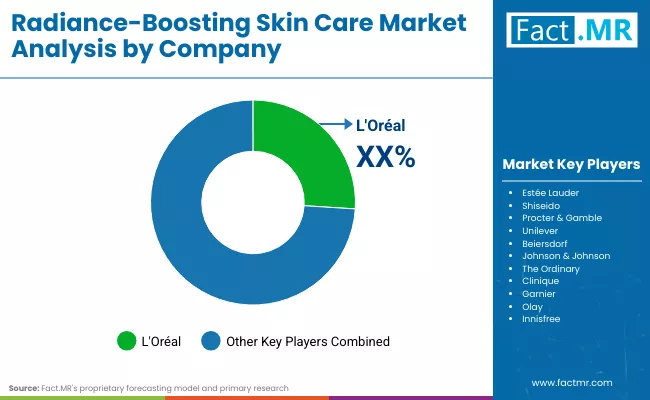
Radiance Boosting Skin Care Market By Company | Source: Fact.MR
As per Fact.MR analysis, the radiance‑boosting skin care market in 2026 is shaped by a shift from superficial glow claims to clinically substantiated outcomes, where ingredient transparency, regulatory compliance, and deep multi‑channel presence determine competitive advantage. L’Oréal, Estée Lauder, and Shiseido leverage advanced formulation science and laboratory‑verified efficacy data, which strengthens adoption among premium and professional channels. Procter & Gamble and Unilever scale validated radiance solutions across mass‑market portfolios, which expands reach into emerging regions and sustains volume growth. Beiersdorf and Johnson & Johnson integrate radiance actives within sensitive skin and barrier support systems, which enhances consumer trust and repeat purchase. The Ordinary emphasises clear, science‑driven ingredient disclosures, which increases appeal in informed consumer segments. Clinique and Olay combine dermatologist recommendations with actionable results, which deepens pharmacy and retail channel penetration. Garnier and Innisfree focus on naturally derived radiance boosters, which resonates in eco‑functional segments. Together, regulatory adherence, validated performance outcomes, and integrated supply chains provide defensible competitive moats that reduce reliance on aesthetics‑only claims.
Key Players in Radiance-Boosting Skin Care Market
- L'Oréal
- Estée Lauder
- Shiseido
- Procter & Gamble
- Unilever
- Beiersdorf
- Johnson & Johnson
- The Ordinary
- Clinique
- Garnier
- Olay
- Innisfree
References
- U.S. Food and Drug Administration. (2022, December 29; implementation updated through 2024-2025). Modernization of Cosmetics Regulation Act of 2022 (MoCRA). U.S. Department of Health and Human Services.
- European Commission. (2023, July 20). Commission Regulation (EU) 2023/1545 laying down common criteria for claims used in relation to cosmetic products. Official Journal of the European Union.
- Scientific Committee on Consumer Safety (SCCS). (2023, December 22). Notes of guidance for the testing of cosmetic ingredients and their safety evaluation (12th revision). European Commission.
- National Medical Products Administration. (2021; enforced and updated through 2024). Cosmetic Efficacy Claims Evaluation Norms. People’s Republic of China.
- Agência Nacional de Vigilância Sanitária. (2022, September 19; in force through 2024). Resolução da Diretoria Colegiada - RDC No. 752: Technical requirements for cosmetic products. Government of Brazil.
Segmentation
Scope of the Report
| Items | Values |
|---|---|
| Quantitative Units (2026) | USD billion |
| Product Type | Radiance and brightening creams, Serums with Vitamin C, Exfoliating radiance masks, Radiance toners & essences, Radiance cleansing, Sunscreen with radiance enhancement |
| Ingredients | Vitamin C & derivatives, Niacinamide, Alpha Arbutin, Tranexamic acid, Peptides & antioxidants, Botanical extracts (Licorice, Turmeric) |
| Distribution Channel | E-commerce, Specialty beauty retail, Department stores, Pharmacy & drugstores, Supermarkets & hypermarkets |
| End User | Women, Men, Unisex/All gender |
| Region | Asia Pacific, North America, Europe, Latin America, Middle East & Africa |
| Countries Covered | China, Japan, South Korea, India, Australia & New Zealand, ASEAN, Rest of Asia Pacific, Germany, UK, France, Italy, Spain, Nordic, BENELUX, Rest of Europe, USA, Canada, Mexico, Brazil, Chile, Rest of Latin America, KSA, Other GCC, Turkey, South Africa, Other African Union, Rest of MEA |
| Key Companies Profiled | L'Oréal, Estée Lauder, Shiseido, Procter & Gamble, Unilever, Beiersdorf, Johnson & Johnson, The Ordinary, Clinique, Garnier, Olay, Innisfree |
| Additional Attributes | Dollar by sales by product type and ingredient; validated radiance efficacy; supply chain efficiency; operational repeatability; multi-channel distribution; batch-to-batch consistency; climate-adapted formulations; professional and retail adoption; quality-controlled packaging; high-frequency consumer use; regulatory compliance; inventory predictability; measurable skin appearance improvements. |
Source: Fact.MR analysis. Updated Feb 5, 2026
Radiance-Boosting Skin Care Market Segmentation
-
Product Type :
- Radiance and Brightening Creams
- Serums with Radiance Actives (E.g., Vitamin C)
- Exfoliating Radiance Masks
- Radiance Toners & Essences
- Radiance‑Boosting Cleansers
- Sunscreen with Radiance Enhancement
-
Ingredients :
- Vitamin C & Derivatives
- Niacinamide
- Alpha Arbutin
- Tranexamic Acid
- Peptides & Antioxidants
- Botanical Extracts (E.g., Licorice, Turmeric)
-
Distribution Channel :
- E‑Commerce Platforms
- Specialty Beauty Retail
- Department Stores
- Pharmacy & Drugstores
- Supermarkets and Hypermarkets
-
End User :
- Women
- Men
- Unisex and All Gender
-
Region :
- Asia Pacific
- China
- Japan
- South Korea
- India
- Australia & New Zealand
- ASEAN
- Rest of Asia Pacific
- Europe
- Germany
- United Kingdom
- France
- Italy
- Spain
- Nordic
- BENELUX
- Rest of Europe
- North America
- United States
- Canada
- Mexico
- Latin America
- Brazil
- Chile
- Rest of Latin America
- Middle East & Africa
- Kingdom of Saudi Arabia
- Other GCC Countries
- Turkey
- South Africa
- Other African Union
- Rest of Middle East & Africa
- Asia Pacific
Frequently Asked Questions
How big is the global radiance-boosting skin care market in 2026?
What will be the size of the radiance-boosting skin care market in 2036?
How much will the demand for radiance-boosting skin care products grow between 2026 and 2036?
Which product type holds a significant share in the radiance-boosting skin care market in 2026?
Which ingredient segment leads the radiance-boosting skin care market in 2026?
Who worked on this report


Preview the report firsthand - request a free sample
Free SampleGet the brochure for pricing and purchase details
Download PDF