Recyclable Foam-In-Place Market Size, Share, Growth and Forecast (2026 - 2036)
The Recyclable Foam-In-Place Market is segmented by Chemistry, by Packaging System, by End Use, by Buyer Type and Region. Forecast for 2026 to 2036.
What is the recyclable foam-in-place market forecast to be worth by 2036?
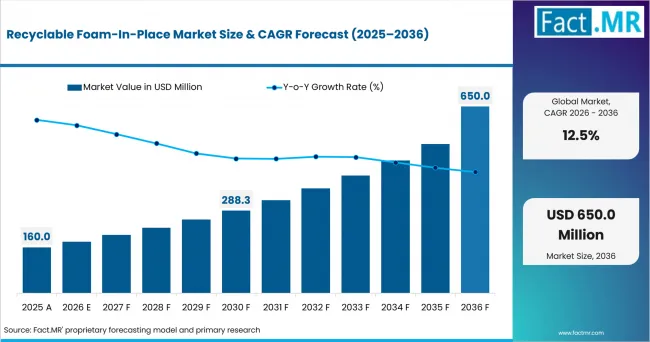
USD 200 million in 2026 to USD 650 million by 2036, at 12.5% CAGR.
- The Recyclable Foam-In-Place Market was valued at USD 160 million in 2025.
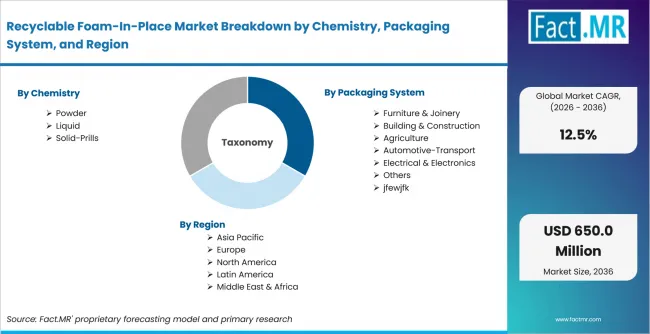
- The market is estimated at USD 200 million in 2026 and is projected to reach USD 650 million by 2036.
- The market is forecast to expand at 12.5% CAGR during the forecast period as sustainability goals, packaging regulations and demand for protective packaging continue accelerating adoption.
What are the defining numbers behind recyclable foam-in-place growth?
USD 450 million absolute opportunity by 2036 led by Germany, the United States and China.
- Demand Drivers in the Market
- Sustainability targets are increasing adoption of recyclable packaging materials.
- E-commerce growth continues driving demand for protective packaging solutions.
- Packaging regulations are encouraging recyclable material usage.
- Manufacturers seek lower packaging waste and improved circularity.
- Key Segments Analyzed
- By Chemistry: Recyclable PU Systems are expected to hold 34.0% share in 2026 due to strong cushioning performance and growing recyclability improvements.
- By Packaging System: On-Demand Dispensing Systems are projected to account for 37.0% share in 2026 because they reduce material waste and improve packaging efficiency.
- By End Use: Electronics are expected to hold 28.0% share in 2026 due to high demand for protective transit packaging.
- By Buyer Type: OEMs are projected to account for 33.0% share in 2026 because of large-scale packaging requirements.
- By Geography: Germany is projected to record 13.4% CAGR through 2036.
- Analyst Opinion at Fact.MR
- Shambhu Nath Jha, Senior Analyst at Fact.MR, states, “Recyclable foam-in-place systems are becoming an important part of sustainable packaging strategies. Companies increasingly prioritize packaging solutions that balance product protection with recyclability and waste reduction objectives.”
- Strategic Implications
- Focus on recyclable material innovation and circular packaging solutions.
- Expand partnerships with e-commerce and industrial packaging users.
- Invest in packaging systems that reduce material consumption.
- Strengthen recycling compatibility and sustainability certifications.
Recyclable foam-in-place systems create customized protective cushioning around products during packaging operations. These solutions improve product protection while helping companies reduce packaging waste and support recycling objectives.
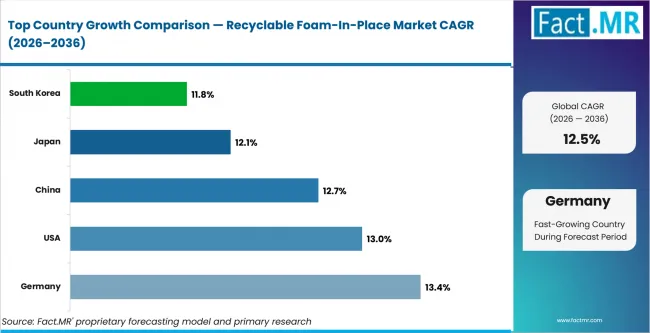
Germany is projected to record 13.4% CAGR through 2036, supported by strong circular economy initiatives and sustainable packaging investments. The United States is expected to expand at 13.0% CAGR due to growing e-commerce and industrial packaging demand. China is forecast to grow at 12.7% CAGR as packaging modernization accelerates. Japan is projected to advance at 12.1% CAGR through manufacturing and electronics packaging applications. South Korea is expected to register 11.8% CAGR through 2036 due to increasing adoption of sustainable packaging systems.
How does the recyclable foam-in-place market break down by segment?
Recyclable PU Systems lead at 34.0%; OEMs lead at 33.0%.
Which chemistry dominates?
Recyclable PU Systems hold 34.0% share in 2026.
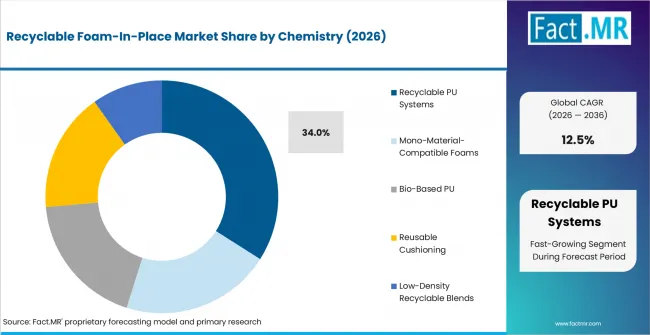
Recyclable PU systems lead because they provide strong cushioning performance and excellent shock absorption. These materials protect fragile products while supporting packaging sustainability goals. Manufacturers prefer these systems because they can fit into existing packaging operations with limited equipment changes. Dow and Gruppo Fiori announced a breakthrough process that recovers polyurethane foam from end-of-life vehicles without dismantling components, producing a waste stream suitable for depolymerization and chemical recycling. The innovation supports closed-loop polyurethane circularity and enables the creation of recycled-content polyols for new polyurethane applications. [1]
Which packaging system dominates?
On-Demand Dispensing Systems account for 37.0% share in 2026.
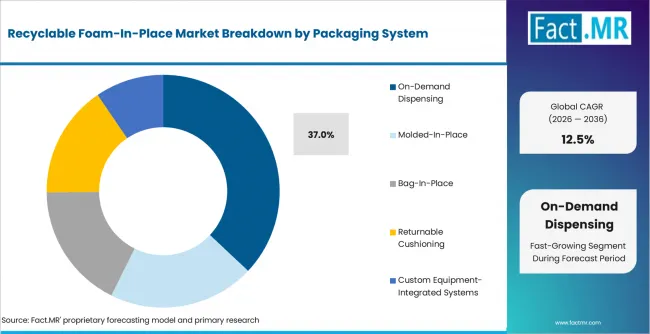
On-demand dispensing systems account for the largest share because they create custom cushioning only when required. This approach reduces packaging waste and improves material utilization. Sealed Air partnered with Best Buy to introduce packaging solutions containing higher recycled content, including BUBBLE WRAP® High Recycled Content Bubble Cushioning, recycled-content inflatable air pillows, and recyclable paper mailers. [2]
Which end-use industry dominates?
Electronics lead with 28.0% share in 2026.
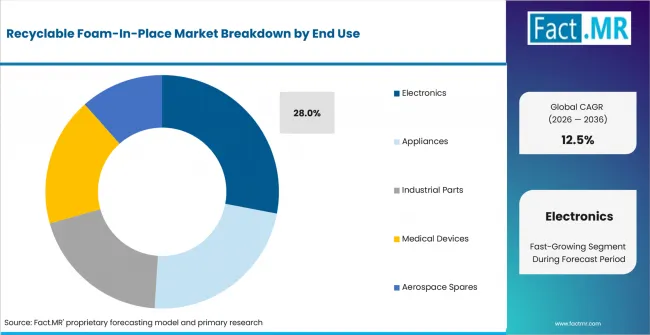
Electronics remain the largest end-use segment because sensitive devices require high levels of protection during transportation and storage. Foam-in-place packaging helps prevent movement and impact damage. Manufacturers increasingly seek recyclable alternatives to conventional protective packaging. Product value and damage prevention requirements continue supporting adoption.
Which buyer type dominates?
OEMs hold 33.0% share in 2026.
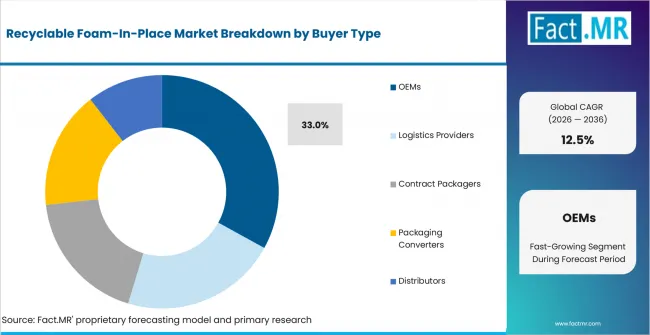
OEMs account for the largest share because they package high volumes of finished products for domestic and international distribution. Product protection remains a critical requirement throughout supply chains. Many OEMs are adopting recyclable packaging solutions to support sustainability commitments and reduce environmental impact. Borealis announced an investment of more than €100 million to build a new High Melt Strength polypropylene (HMS PP) production line at its Burghausen, Germany facility. The expansion will triple capacity for Daploy™ HMS PP, a fully recyclable foam material used in lightweight, high-performance foam applications, with start-up planned for the second half of 2026. [3]
What is accelerating recyclable foam-in-place demand and what is holding it back?
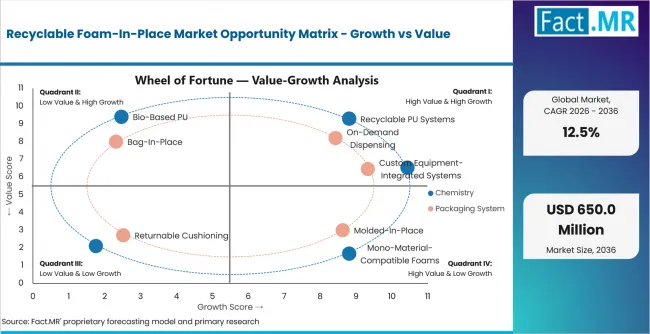
The primary growth driver is increasing demand for recyclable and circular packaging solutions. Companies are under pressure to reduce packaging waste and improve environmental performance. Regulations targeting packaging waste are encouraging adoption of recyclable materials. E-commerce growth is also increasing demand for protective packaging systems that can support sustainability objectives. SEE launched the CRYOVAC® compostable overwrap tray at IPPE 2024, introducing the first biobased industrially compostable protein-packaging tray designed to run on existing food-processing lines. The tray contains USDA-certified biobased resin derived from renewable wood cellulose and was developed as a sustainable alternative to conventional EPS foam packaging. [4]
Brand owners are increasingly seeking packaging solutions that align with corporate environmental targets. The primary restraint is higher cost compared with conventional protective packaging materials. Some recyclable formulations remain more expensive than traditional alternatives. Recycling infrastructure limitations in certain regions can also affect adoption rates. Compatibility with local recycling systems remains an important consideration. Storopack launched FOAMplus® 7008-BIO, a polyurethane packaging foam with more than 83% certified bio-based carbon content in its B-component. The foam works with all FOAMplus® Foam-in-Place systems and delivers the same protective performance while reducing dependence on fossil-based materials. [5]
Where do the biggest recyclable foam-in-place opportunities sit?
- Electronics Packaging:Electronics manufacturers continue increasing demand for protective packaging that supports recyclability objectives.
- E-Commerce Heavy Goods:Online retailers require protective solutions for large and fragile products shipped through complex logistics networks.
- Medical Devices:Medical equipment suppliers are adopting recyclable cushioning systems while maintaining strict product protection standards.
- Industrial Equipment:Industrial machinery and component manufacturers require customized protective packaging for high-value products.
Which countries are scaling recyclable foam-in-place adoption fastest?
Germany 13.4%, United States 13.0%, China 12.7%, Japan 12.1%, South Korea 11.8%.
Based on regional analysis, the recyclable foam-in-place market is segmented into North America, Western Europe, Asia Pacific, Latin America and Middle East & Africa.
.webp)
| Country | CAGR (2026-2036) |
|---|---|
| Germany | 13.4% |
| United States | 13.0% |
| China | 12.7% |
| Japan | 12.1% |
| South Korea | 11.8% |
Why is Germany leading the recyclable foam-in-place market?
13.4% CAGR, supported by circular economy policies and sustainable packaging investments
Germany is projected to record 13.4% CAGR through 2036 due to strong regulatory support for recyclable packaging and waste reduction initiatives. Manufacturers are increasingly replacing traditional protective packaging with recyclable alternatives. Industrial exporters and electronics producers continue investing in sustainable packaging systems. Demand is also supported by well-developed recycling infrastructure and circular economy targets.
What is driving growth in the United States?
13.0% CAGR, driven by e-commerce and industrial packaging demand
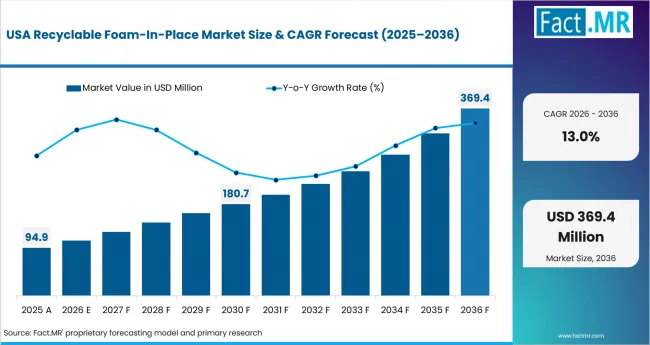
The United States is expected to post 13.0% CAGR as online retail activity and industrial shipments continue expanding. Companies are seeking packaging solutions that reduce waste while maintaining product protection. Large manufacturers and logistics providers are adopting recyclable foam systems to support sustainability commitments. Demand is especially strong across electronics and industrial equipment sectors. Packaging automation investments continue supporting market growth.
How is China expanding adoption?
12.7% CAGR, supported by manufacturing growth and packaging modernization
China is forecast to advance at 12.7% CAGR by 2036 due to rapid manufacturing activity and increasing adoption of modern packaging technologies. Export-oriented industries are seeking protective packaging solutions that align with sustainability goals. Electronics and appliance producers remain major users of foam-in-place packaging systems. Government initiatives aimed at reducing packaging waste are also supporting adoption.
What supports demand in Japan?
12.1% CAGR, driven by electronics and precision equipment packaging
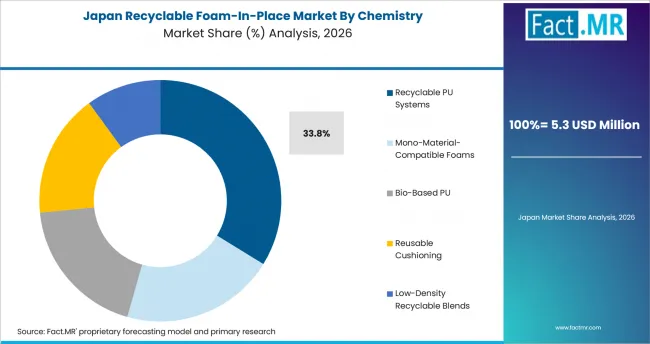
Japan is expected to register 12.1% CAGR by 2036 due to strong demand from electronics and precision manufacturing industries. Product protection remains a key requirement for high-value goods. Manufacturers are increasingly adopting recyclable materials to improve environmental performance. Packaging efficiency and waste reduction remain important purchasing factors.
Why is South Korea an important market?
11.8% CAGR, supported by technology manufacturing and export activity
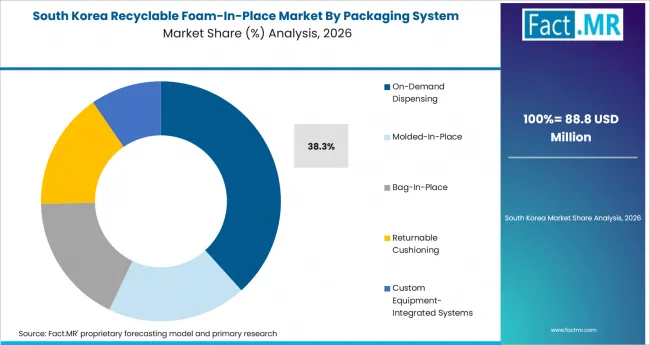
South Korea is projected to grow at 11.8% CAGR through 2036 as electronics and technology manufacturers expand adoption of sustainable packaging solutions. Export-oriented industries require reliable product protection during transportation. Recyclable foam-in-place systems help companies balance packaging performance and environmental objectives. Demand is also supported by increasing investment in packaging innovation.
Who leads the recyclable foam-in-place landscape?
Sealed Air, Pregis, Storopack, BASF and Dow lead through protective packaging expertise and material innovation.
The market is characterized by competition focused on recyclability and packaging efficiency. Suppliers continue developing foam systems that improve circularity while maintaining product protection. Electronics remains the largest opportunity for leading participants. Companies are also expanding into medical devices and e-commerce packaging applications where damage prevention remains critical.
Material compatibility with recycling systems is becoming a major purchasing factor. End users increasingly prefer packaging solutions that support sustainability targets without compromising protective performance. Sealed Air and Pregis maintain strong positions through extensive protective packaging portfolios and global distribution networks. Storopack continues expanding through customized foam packaging systems and Covestro supports innovation through recyclable material development.
Competition through 2036 will depend on recyclable material performance, packaging automation compatibility and circular economy capabilities. Suppliers that deliver strong protection with lower environmental impact are expected to strengthen their market position.
Which companies are the key players?
Sealed Air, Pregis, Storopack, Dow, Covestro
- Sealed Air
- Pregis
- Storopack
- Dow
- Covestro
Bibliography
- [1] Dow Inc. (2025). Dow and Gruppo Fiori develop breakthrough recycling process for post-consumer plastic waste. Dow Inc.
- [2] Sealed Air Corporation. (2024). Sealed Air provides packaging solutions for Best Buy to support product protection and packaging efficiency. Sealed Air Corporation.
- [3] Borealis AG. (2025). Borealis expands high melt strength polypropylene capacity in Germany to support advanced packaging applications. Borealis AG.
- [4] SEE. (2024). CRYOVAC compostable overwrap tray. SEE.
- [5] Storopack Hans Reichenecker GmbH. (2025). Storopack launches FOAMplus 7008-BIO packaging foam. Storopack.
This Report Addresses
- Strategic intelligence on recyclable foam-in-place packaging technologies.
- Segment analysis covering chemistry, packaging systems, end uses and buyer categories.
- Regional outlook covering Germany, United States, China, Japan and South Korea.
- Competitive assessment of Sealed Air, Pregis, Storopack and leading packaging suppliers.
- Analysis of sustainable packaging adoption and circular economy trends.
- Evaluation of recyclable cushioning technologies and protective packaging innovations.
- Assessment of e-commerce packaging requirements and industrial shipping needs.
- Primary interviews, supplier benchmarking and industry validation supporting forecast development.
- Analysis of packaging automation and material efficiency trends.
- Evaluation of opportunities linked to recyclable packaging regulations and sustainability initiatives.
What does the recyclable foam-in-place market cover?
Protective packaging systems that use recyclable foam materials for cushioning and product protection.
The market covers recyclable foam formulations, dispensing equipment and integrated packaging systems used to protect products during storage, handling and transportation.
What is included in the scope?
Recyclable foam packaging technologies and protective cushioning systems.
The scope includes recyclable PU systems, mono-material-compatible foams, bio-based PU foams, reusable cushioning solutions and low-density recyclable foam blends.
What is excluded from the scope?
Conventional non-recyclable protective packaging materials.
The scope excludes expanded polystyrene packaging, non-recyclable polyurethane foams and traditional void-fill packaging materials.
How was the analysis built?
100+ sources, 30+ packaging assessments, 25+ countries and industry interviews.
- Primary Research: Interviews with packaging manufacturers, logistics providers, converters and sustainability specialists.
- Desk Research: Analysis of packaging regulations, recycling initiatives, e-commerce activity and industrial packaging demand.
- Market Sizing and Forecasting: Estimates based on packaging consumption, protective packaging spending and foam system deployments.
- Data Validation and Update Cycle: Forecasts validated through supplier benchmarking, packaging project analysis and industry interviews.
What is the report's scope and coverage?
| Attribute | Details |
|---|---|
| Quantitative Units | USD Million in 2026 to USD Million by 2036 at CAGR |
| Market Definition | Covers recyclable protective foam systems used to create custom cushioning and product protection during shipping and storage |
| Chemistry Covered | Recyclable PU Systems, Mono-Material-Compatible Foams, Bio-Based PU, Reusable Cushioning, Low-Density Recyclable Blends |
| Packaging Systems Covered | On-Demand Dispensing, Molded-In-Place, Bag-In-Place, Returnable Cushioning, Custom Equipment-Integrated Systems |
| End Uses Covered | Electronics, Appliances, Industrial Parts, Medical Devices, Aerospace Spares, E-Commerce Heavy Goods |
| Buyer Types Covered | OEMs, Logistics Providers, Contract Packagers, Packaging Converters, Distributors |
| Regions Covered | North America, Western Europe, Asia Pacific, Latin America, Middle East & Africa |
| Key Countries Covered | Germany, United States, China, Japan, South Korea |
| Companies Covered | Sealed Air, Pregis, Storopack, BASF, Dow, Huntsman, Covestro, FoamPartner, JSP, Rogers Foam |
| Forecast Period | 2026 to 2036 |
| Research Approach | Hybrid top-down and bottom-up methodology using packaging demand, protective packaging spending, recyclable material adoption and packaging automation trends |
How is the market segmented?
-
By Chemistry
- Recyclable PU Systems
- Mono-Material-Compatible Foams
- Bio-Based PU
- Reusable Cushioning
- Low-Density Recyclable Blends
-
By Packaging System
- On-Demand Dispensing
- Molded-In-Place
- Bag-In-Place
- Returnable Cushioning
- Custom Equipment-Integrated Systems
-
By End Use
- Electronics
- Appliances
- Industrial Parts
- Medical Devices
- Aerospace Spares
- E-Commerce Heavy Goods
-
By Buyer Type
- OEMs
- Logistics Providers
- Contract Packagers
- Packaging Converters
- Distributors
-
By Region
- North America
- United States
- Canada
- Mexico
- Western Europe
- Germany
- United Kingdom
- France
- Italy
- Asia Pacific
- Australia
- China
- India
- Japan
- Latin America
- Chile
- Brazil
- Peru
- Middle East & Africa
- South Africa
- Saudi Arabia
- UAE
- North America
- Frequently Asked Questions -
Which chemistry leads the market?
Recyclable PU systems lead with 34.0% share in 2026 due to cushioning performance and improving recyclability.
Which packaging system accounts for the largest share?
On-demand dispensing systems hold 37.0% share in 2026 because they reduce waste and improve packaging flexibility.
What is driving demand for recyclable foam-in-place solutions?
Sustainability targets, packaging regulations and growing e-commerce activity are driving market demand.
Which country is growing the fastest?
Germany is projected to record the highest CAGR through 2036 due to strong circular economy initiatives.
What is the primary challenge facing the market?
Higher material costs and recycling infrastructure limitations remain the primary market challenges.
Which end use accounts for the largest share?
Electronics hold 28.0% share in 2026 because sensitive devices require strong protective packaging.
What opportunities exist for suppliers?
Electronics packaging, medical devices, industrial equipment and e-commerce heavy goods offer strong opportunities.
Why are OEMs adopting recyclable foam-in-place systems?
These systems help improve product protection while supporting sustainability and waste reduction objectives.
Table of Content
- Key Takeaways
- Market Size and CAGR
- Top Growth Driver
- Fastest Growing Segment
- Leading Region
- Key Companies
- Emerging Opportunities
- Executive Summary
- Global Market Outlook
- Demand-side Trends
- Supply-side Trends
- Technology Roadmap Analysis
- Analysis and Recommendations
- Analyst Perspective (What is happening? Why now? What should investors know?)
- Key Questions Answered
- How large is the market?
- What is the CAGR?
- What are key trends?
- Which region dominates?
- Who are the leaders?
- Market Overview
- Market Coverage / Taxonomy
- Market Definition / Scope / Limitations
- Research Methodology
- Chapter Orientation
- Analytical Lens and Working Hypotheses
- Market Structure, Signals, and Trend Drivers
- Benchmarking and Cross-market Comparability
- Market Sizing, Forecasting, and Opportunity Mapping
- Research Design and Evidence Framework
- Desk Research Programme (Secondary Evidence)
- Expert Input and Fieldwork (Primary Evidence)
- Tooling, Models, and Reference Databases
- Data Engineering and Model Build
- Quality Assurance and Audit Trail
- Market Background
- Market Dynamics (Drivers, Restraints, Opportunity, Trends)
- Scenario Forecast (Optimistic, Likely, Conservative)
- Impact Analysis
- AI Impact
- Sustainability Impact
- Regulatory Impact
- Technology Impact
- Consumer / Buyer Analysis
- Purchase Drivers
- Adoption Barriers
- Buyer Journey
- Opportunity Map Analysis
- Product Life Cycle Analysis
- Supply Chain Analysis
- Investment Feasibility Matrix
- Value Chain Analysis
- PESTLE and Porter's Analysis
- Regulatory Landscape
- Regional Parent Market Outlook
- Production and Consumption Statistics
- Import and Export Statistics
- Global Market Analysis and Forecast, 2021 to 2036
- Historical Market Size Value (USD Million) Analysis, 2021 to 2025
- Current and Future Market Size Value (USD Million) Projections, 2026 to 2036
- Y-o-Y Growth Trend Analysis
- Absolute $ Opportunity Analysis
- Global Market Pricing Analysis, 2021 to 2036
- Global Market Analysis and Forecast, By Chemistry, 2021 to 2036
- Introduction / Key Findings
- Historical Market Size Value (USD Million) Analysis By Chemistry, 2021 to 2025
- Current and Future Market Size Value (USD Million) Analysis and Forecast By Chemistry, 2026 to 2036
- Recyclable PU Systems
- Mono-Material-Compatible Foams
- Bio-Based PU
- Reusable Cushioning
- Low-Density Recyclable Blends
- Recyclable PU Systems
- Y-o-Y Growth Trend Analysis By Chemistry, 2021 to 2025
- Absolute $ Opportunity Analysis By Chemistry, 2026 to 2036
- Global Market Analysis and Forecast, By Packaging System, 2021 to 2036
- Introduction / Key Findings
- Historical Market Size Value (USD Million) Analysis By Packaging System, 2021 to 2025
- Current and Future Market Size Value (USD Million) Analysis and Forecast By Packaging System, 2026 to 2036
- On-Demand Dispensing
- Molded-In-Place
- Bag-In-Place
- Returnable Cushioning
- Custom Equipment-Integrated Systems
- On-Demand Dispensing
- Y-o-Y Growth Trend Analysis By Packaging System, 2021 to 2025
- Absolute $ Opportunity Analysis By Packaging System, 2026 to 2036
- Global Market Analysis and Forecast, By End Use, 2021 to 2036
- Introduction / Key Findings
- Historical Market Size Value (USD Million) Analysis By End Use, 2021 to 2025
- Current and Future Market Size Value (USD Million) Analysis and Forecast By End Use, 2026 to 2036
- Electronics
- Appliances
- Industrial Parts
- Medical Devices
- Aerospace Spares
- E-Commerce Heavy Goods
- Electronics
- Y-o-Y Growth Trend Analysis By End Use, 2021 to 2025
- Absolute $ Opportunity Analysis By End Use, 2026 to 2036
- Global Market Analysis and Forecast, By Buyer Type, 2021 to 2036
- Introduction / Key Findings
- Historical Market Size Value (USD Million) Analysis By Buyer Type, 2021 to 2025
- Current and Future Market Size Value (USD Million) Analysis and Forecast By Buyer Type, 2026 to 2036
- OEMs
- Logistics Providers
- Contract Packagers
- Packaging Converters
- Distributors
- OEMs
- Y-o-Y Growth Trend Analysis By Buyer Type, 2021 to 2025
- Absolute $ Opportunity Analysis By Buyer Type, 2026 to 2036
- Global Market Analysis and Forecast, By Region, 2021 to 2036
- Introduction
- Historical Market Size Value (USD Million) Analysis By Region, 2021 to 2025
- Current Market Size Value (USD Million) Analysis and Forecast By Region, 2026 to 2036
- North America
- Latin America
- Western Europe
- Eastern Europe
- East Asia
- South Asia and Pacific
- Middle East & Africa
- Market Attractiveness Analysis By Region
- North America Market Analysis and Forecast, By Country, 2021 to 2036
- Historical Market Size Value (USD Million) Trend Analysis By Market Taxonomy, 2021 to 2025
- Market Size Value (USD Million) Forecast By Market Taxonomy, 2026 to 2036
- By Country
- USA
- Canada
- Mexico
- By Chemistry
- By Packaging System
- By End Use
- By Buyer Type
- By Country
- Market Attractiveness Analysis
- By Country
- By Chemistry
- By Packaging System
- By End Use
- By Buyer Type
- Key Takeaways
- Latin America Market Analysis and Forecast, By Country
- Historical Market Size Value (USD Million) Trend Analysis By Market Taxonomy, 2021 to 2025
- Market Size Value (USD Million) Forecast By Market Taxonomy, 2026 to 2036
- By Country
- Brazil
- Chile
- Rest of Latin America
- By Chemistry
- By Packaging System
- By End Use
- By Buyer Type
- By Country
- Market Attractiveness Analysis
- By Country
- By Chemistry
- By Packaging System
- By End Use
- By Buyer Type
- Key Takeaways
- Western Europe Market Analysis and Forecast, By Country
- Historical Market Size Value (USD Million) Trend Analysis By Market Taxonomy, 2021 to 2025
- Market Size Value (USD Million) Forecast By Market Taxonomy, 2026 to 2036
- By Country
- Germany
- UK
- Italy
- Spain
- France
- Nordic
- BENELUX
- Rest of Western Europe
- By Chemistry
- By Packaging System
- By End Use
- By Buyer Type
- By Country
- Market Attractiveness Analysis
- By Country
- By Chemistry
- By Packaging System
- By End Use
- By Buyer Type
- Key Takeaways
- Eastern Europe Market Analysis and Forecast, By Country
- Historical Market Size Value (USD Million) Trend Analysis By Market Taxonomy, 2021 to 2025
- Market Size Value (USD Million) Forecast By Market Taxonomy, 2026 to 2036
- By Country
- Russia
- Poland
- Hungary
- Balkan & Baltic
- Rest of Eastern Europe
- By Chemistry
- By Packaging System
- By End Use
- By Buyer Type
- By Country
- Market Attractiveness Analysis
- By Country
- By Chemistry
- By Packaging System
- By End Use
- By Buyer Type
- Key Takeaways
- East Asia Market Analysis and Forecast, By Country
- Historical Market Size Value (USD Million) Trend Analysis By Market Taxonomy, 2021 to 2025
- Market Size Value (USD Million) Forecast By Market Taxonomy, 2026 to 2036
- By Country
- China
- Japan
- South Korea
- By Chemistry
- By Packaging System
- By End Use
- By Buyer Type
- By Country
- Market Attractiveness Analysis
- By Country
- By Chemistry
- By Packaging System
- By End Use
- By Buyer Type
- Key Takeaways
- South Asia and Pacific Market Analysis and Forecast, By Country
- Historical Market Size Value (USD Million) Trend Analysis By Market Taxonomy, 2021 to 2025
- Market Size Value (USD Million) Forecast By Market Taxonomy, 2026 to 2036
- By Country
- India
- ASEAN
- Australia & New Zealand
- Rest of South Asia and Pacific
- By Chemistry
- By Packaging System
- By End Use
- By Buyer Type
- By Country
- Market Attractiveness Analysis
- By Country
- By Chemistry
- By Packaging System
- By End Use
- By Buyer Type
- Key Takeaways
- Middle East & Africa Market Analysis and Forecast, By Country
- Historical Market Size Value (USD Million) Trend Analysis By Market Taxonomy, 2021 to 2025
- Market Size Value (USD Million) Forecast By Market Taxonomy, 2026 to 2036
- By Country
- Kingdom of Saudi Arabia
- Other GCC Countries
- Turkiye
- South Africa
- Other African Union
- Rest of Middle East & Africa
- By Chemistry
- By Packaging System
- By End Use
- By Buyer Type
- By Country
- Market Attractiveness Analysis
- By Country
- By Chemistry
- By Packaging System
- By End Use
- By Buyer Type
- Key Takeaways
- Key Countries Market Analysis
- USA
- Pricing Analysis
- Market Share Analysis, 2025
- By Chemistry
- By Packaging System
- By End Use
- By Buyer Type
- Canada
- Pricing Analysis
- Market Share Analysis, 2025
- By Chemistry
- By Packaging System
- By End Use
- By Buyer Type
- Mexico
- Pricing Analysis
- Market Share Analysis, 2025
- By Chemistry
- By Packaging System
- By End Use
- By Buyer Type
- Brazil
- Pricing Analysis
- Market Share Analysis, 2025
- By Chemistry
- By Packaging System
- By End Use
- By Buyer Type
- Chile
- Pricing Analysis
- Market Share Analysis, 2025
- By Chemistry
- By Packaging System
- By End Use
- By Buyer Type
- Germany
- Pricing Analysis
- Market Share Analysis, 2025
- By Chemistry
- By Packaging System
- By End Use
- By Buyer Type
- UK
- Pricing Analysis
- Market Share Analysis, 2025
- By Chemistry
- By Packaging System
- By End Use
- By Buyer Type
- Italy
- Pricing Analysis
- Market Share Analysis, 2025
- By Chemistry
- By Packaging System
- By End Use
- By Buyer Type
- Spain
- Pricing Analysis
- Market Share Analysis, 2025
- By Chemistry
- By Packaging System
- By End Use
- By Buyer Type
- France
- Pricing Analysis
- Market Share Analysis, 2025
- By Chemistry
- By Packaging System
- By End Use
- By Buyer Type
- India
- Pricing Analysis
- Market Share Analysis, 2025
- By Chemistry
- By Packaging System
- By End Use
- By Buyer Type
- ASEAN
- Pricing Analysis
- Market Share Analysis, 2025
- By Chemistry
- By Packaging System
- By End Use
- By Buyer Type
- Australia & New Zealand
- Pricing Analysis
- Market Share Analysis, 2025
- By Chemistry
- By Packaging System
- By End Use
- By Buyer Type
- China
- Pricing Analysis
- Market Share Analysis, 2025
- By Chemistry
- By Packaging System
- By End Use
- By Buyer Type
- Japan
- Pricing Analysis
- Market Share Analysis, 2025
- By Chemistry
- By Packaging System
- By End Use
- By Buyer Type
- South Korea
- Pricing Analysis
- Market Share Analysis, 2025
- By Chemistry
- By Packaging System
- By End Use
- By Buyer Type
- Russia
- Pricing Analysis
- Market Share Analysis, 2025
- By Chemistry
- By Packaging System
- By End Use
- By Buyer Type
- Poland
- Pricing Analysis
- Market Share Analysis, 2025
- By Chemistry
- By Packaging System
- By End Use
- By Buyer Type
- Hungary
- Pricing Analysis
- Market Share Analysis, 2025
- By Chemistry
- By Packaging System
- By End Use
- By Buyer Type
- Kingdom of Saudi Arabia
- Pricing Analysis
- Market Share Analysis, 2025
- By Chemistry
- By Packaging System
- By End Use
- By Buyer Type
- Turkiye
- Pricing Analysis
- Market Share Analysis, 2025
- By Chemistry
- By Packaging System
- By End Use
- By Buyer Type
- South Africa
- Pricing Analysis
- Market Share Analysis, 2025
- By Chemistry
- By Packaging System
- By End Use
- By Buyer Type
- USA
- Market Structure Analysis
- Competition Dashboard
- Competition Benchmarking
- Market Share Analysis of Top Players
- By Regional
- By Chemistry
- By Packaging System
- By End Use
- By Buyer Type
- Emerging Startups
- Innovation Benchmarking
- Competition Analysis
- Competition Deep Dive
- Sealed Air
- Overview
- Product Portfolio
- Profitability by Market Segments (Product/Age /Sales Channel/Region)
- Sales Footprint
- Strategy Overview
- Marketing Strategy
- Product Strategy
- Channel Strategy
- Pregis
- Storopack
- Dow
- Covestro
- Sealed Air
- Competition Deep Dive
- Case Studies
- Success Stories
- Recent Developments
- Assumptions & Acronyms Used
List Of Table
- Table 1: Global Market Value (USD Million) Forecast by Region, 2021 - 2036
- Table 2: Global Market Value (USD Million) Forecast by Chemistry, 2021 - 2036
- Table 3: Global Market Value (USD Million) Forecast by Packaging System, 2021 - 2036
- Table 4: Global Market Value (USD Million) Forecast by End Use, 2021 - 2036
- Table 5: Global Market Value (USD Million) Forecast by Buyer Type, 2021 - 2036
- Table 6: North America Market Value (USD Million) Forecast by Country, 2021 - 2036
- Table 7: North America Market Value (USD Million) Forecast by Chemistry, 2021 - 2036
- Table 8: North America Market Value (USD Million) Forecast by Packaging System, 2021 - 2036
- Table 9: North America Market Value (USD Million) Forecast by End Use, 2021 - 2036
- Table 10: North America Market Value (USD Million) Forecast by Buyer Type, 2021 - 2036
- Table 11: Latin America Market Value (USD Million) Forecast by Country, 2021 - 2036
- Table 12: Latin America Market Value (USD Million) Forecast by Chemistry, 2021 - 2036
- Table 13: Latin America Market Value (USD Million) Forecast by Packaging System, 2021 - 2036
- Table 14: Latin America Market Value (USD Million) Forecast by End Use, 2021 - 2036
- Table 15: Latin America Market Value (USD Million) Forecast by Buyer Type, 2021 - 2036
- Table 16: Western Europe Market Value (USD Million) Forecast by Country, 2021 - 2036
- Table 17: Western Europe Market Value (USD Million) Forecast by Chemistry, 2021 - 2036
- Table 18: Western Europe Market Value (USD Million) Forecast by Packaging System, 2021 - 2036
- Table 19: Western Europe Market Value (USD Million) Forecast by End Use, 2021 - 2036
- Table 20: Western Europe Market Value (USD Million) Forecast by Buyer Type, 2021 - 2036
- Table 21: Eastern Europe Market Value (USD Million) Forecast by Country, 2021 - 2036
- Table 22: Eastern Europe Market Value (USD Million) Forecast by Chemistry, 2021 - 2036
- Table 23: Eastern Europe Market Value (USD Million) Forecast by Packaging System, 2021 - 2036
- Table 24: Eastern Europe Market Value (USD Million) Forecast by End Use, 2021 - 2036
- Table 25: Eastern Europe Market Value (USD Million) Forecast by Buyer Type, 2021 - 2036
- Table 26: East Asia Market Value (USD Million) Forecast by Country, 2021 - 2036
- Table 27: East Asia Market Value (USD Million) Forecast by Chemistry, 2021 - 2036
- Table 28: East Asia Market Value (USD Million) Forecast by Packaging System, 2021 - 2036
- Table 29: East Asia Market Value (USD Million) Forecast by End Use, 2021 - 2036
- Table 30: East Asia Market Value (USD Million) Forecast by Buyer Type, 2021 - 2036
- Table 31: South Asia and Pacific Market Value (USD Million) Forecast by Country, 2021 - 2036
- Table 32: South Asia and Pacific Market Value (USD Million) Forecast by Chemistry, 2021 - 2036
- Table 33: South Asia and Pacific Market Value (USD Million) Forecast by Packaging System, 2021 - 2036
- Table 34: South Asia and Pacific Market Value (USD Million) Forecast by End Use, 2021 - 2036
- Table 35: South Asia and Pacific Market Value (USD Million) Forecast by Buyer Type, 2021 - 2036
- Table 36: Middle East & Africa Market Value (USD Million) Forecast by Country, 2021 - 2036
- Table 37: Middle East & Africa Market Value (USD Million) Forecast by Chemistry, 2021 - 2036
- Table 38: Middle East & Africa Market Value (USD Million) Forecast by Packaging System, 2021 - 2036
- Table 39: Middle East & Africa Market Value (USD Million) Forecast by End Use, 2021 - 2036
- Table 40: Middle East & Africa Market Value (USD Million) Forecast by Buyer Type, 2021 - 2036
List Of Figures
- Figure 1: Global Market Pricing Analysis
- Figure 2: Global Market Value (USD Million) Forecast 2021-2036
- Figure 3: Global Market Value Share and BPS Analysis by Chemistry, 2026 and 2036
- Figure 4: Global Market Y-o-Y Growth Comparison by Chemistry, 2026-2036
- Figure 5: Global Market Attractiveness Analysis by Chemistry
- Figure 6: Global Market Value Share and BPS Analysis by Packaging System, 2026 and 2036
- Figure 7: Global Market Y-o-Y Growth Comparison by Packaging System, 2026-2036
- Figure 8: Global Market Attractiveness Analysis by Packaging System
- Figure 9: Global Market Value Share and BPS Analysis by End Use, 2026 and 2036
- Figure 10: Global Market Y-o-Y Growth Comparison by End Use, 2026-2036
- Figure 11: Global Market Attractiveness Analysis by End Use
- Figure 12: Global Market Value Share and BPS Analysis by Buyer Type, 2026 and 2036
- Figure 13: Global Market Y-o-Y Growth Comparison by Buyer Type, 2026-2036
- Figure 14: Global Market Attractiveness Analysis by Buyer Type
- Figure 15: Global Market Value (USD Million) Share and BPS Analysis by Region, 2026 and 2036
- Figure 16: Global Market Y-o-Y Growth Comparison by Region, 2026-2036
- Figure 17: Global Market Attractiveness Analysis by Region
- Figure 18: North America Market Incremental Dollar Opportunity, 2026-2036
- Figure 19: Latin America Market Incremental Dollar Opportunity, 2026-2036
- Figure 20: Western Europe Market Incremental Dollar Opportunity, 2026-2036
- Figure 21: Eastern Europe Market Incremental Dollar Opportunity, 2026-2036
- Figure 22: East Asia Market Incremental Dollar Opportunity, 2026-2036
- Figure 23: South Asia and Pacific Market Incremental Dollar Opportunity, 2026-2036
- Figure 24: Middle East & Africa Market Incremental Dollar Opportunity, 2026-2036
- Figure 25: North America Market Value Share and BPS Analysis by Country, 2026 and 2036
- Figure 26: North America Market Value Share and BPS Analysis by Chemistry, 2026 and 2036
- Figure 27: North America Market Y-o-Y Growth Comparison by Chemistry, 2026-2036
- Figure 28: North America Market Attractiveness Analysis by Chemistry
- Figure 29: North America Market Value Share and BPS Analysis by Packaging System, 2026 and 2036
- Figure 30: North America Market Y-o-Y Growth Comparison by Packaging System, 2026-2036
- Figure 31: North America Market Attractiveness Analysis by Packaging System
- Figure 32: North America Market Value Share and BPS Analysis by End Use, 2026 and 2036
- Figure 33: North America Market Y-o-Y Growth Comparison by End Use, 2026-2036
- Figure 34: North America Market Attractiveness Analysis by End Use
- Figure 35: North America Market Value Share and BPS Analysis by Buyer Type, 2026 and 2036
- Figure 36: North America Market Y-o-Y Growth Comparison by Buyer Type, 2026-2036
- Figure 37: North America Market Attractiveness Analysis by Buyer Type
- Figure 38: Latin America Market Value Share and BPS Analysis by Country, 2026 and 2036
- Figure 39: Latin America Market Value Share and BPS Analysis by Chemistry, 2026 and 2036
- Figure 40: Latin America Market Y-o-Y Growth Comparison by Chemistry, 2026-2036
- Figure 41: Latin America Market Attractiveness Analysis by Chemistry
- Figure 42: Latin America Market Value Share and BPS Analysis by Packaging System, 2026 and 2036
- Figure 43: Latin America Market Y-o-Y Growth Comparison by Packaging System, 2026-2036
- Figure 44: Latin America Market Attractiveness Analysis by Packaging System
- Figure 45: Latin America Market Value Share and BPS Analysis by End Use, 2026 and 2036
- Figure 46: Latin America Market Y-o-Y Growth Comparison by End Use, 2026-2036
- Figure 47: Latin America Market Attractiveness Analysis by End Use
- Figure 48: Latin America Market Value Share and BPS Analysis by Buyer Type, 2026 and 2036
- Figure 49: Latin America Market Y-o-Y Growth Comparison by Buyer Type, 2026-2036
- Figure 50: Latin America Market Attractiveness Analysis by Buyer Type
- Figure 51: Western Europe Market Value Share and BPS Analysis by Country, 2026 and 2036
- Figure 52: Western Europe Market Value Share and BPS Analysis by Chemistry, 2026 and 2036
- Figure 53: Western Europe Market Y-o-Y Growth Comparison by Chemistry, 2026-2036
- Figure 54: Western Europe Market Attractiveness Analysis by Chemistry
- Figure 55: Western Europe Market Value Share and BPS Analysis by Packaging System, 2026 and 2036
- Figure 56: Western Europe Market Y-o-Y Growth Comparison by Packaging System, 2026-2036
- Figure 57: Western Europe Market Attractiveness Analysis by Packaging System
- Figure 58: Western Europe Market Value Share and BPS Analysis by End Use, 2026 and 2036
- Figure 59: Western Europe Market Y-o-Y Growth Comparison by End Use, 2026-2036
- Figure 60: Western Europe Market Attractiveness Analysis by End Use
- Figure 61: Western Europe Market Value Share and BPS Analysis by Buyer Type, 2026 and 2036
- Figure 62: Western Europe Market Y-o-Y Growth Comparison by Buyer Type, 2026-2036
- Figure 63: Western Europe Market Attractiveness Analysis by Buyer Type
- Figure 64: Eastern Europe Market Value Share and BPS Analysis by Country, 2026 and 2036
- Figure 65: Eastern Europe Market Value Share and BPS Analysis by Chemistry, 2026 and 2036
- Figure 66: Eastern Europe Market Y-o-Y Growth Comparison by Chemistry, 2026-2036
- Figure 67: Eastern Europe Market Attractiveness Analysis by Chemistry
- Figure 68: Eastern Europe Market Value Share and BPS Analysis by Packaging System, 2026 and 2036
- Figure 69: Eastern Europe Market Y-o-Y Growth Comparison by Packaging System, 2026-2036
- Figure 70: Eastern Europe Market Attractiveness Analysis by Packaging System
- Figure 71: Eastern Europe Market Value Share and BPS Analysis by End Use, 2026 and 2036
- Figure 72: Eastern Europe Market Y-o-Y Growth Comparison by End Use, 2026-2036
- Figure 73: Eastern Europe Market Attractiveness Analysis by End Use
- Figure 74: Eastern Europe Market Value Share and BPS Analysis by Buyer Type, 2026 and 2036
- Figure 75: Eastern Europe Market Y-o-Y Growth Comparison by Buyer Type, 2026-2036
- Figure 76: Eastern Europe Market Attractiveness Analysis by Buyer Type
- Figure 77: East Asia Market Value Share and BPS Analysis by Country, 2026 and 2036
- Figure 78: East Asia Market Value Share and BPS Analysis by Chemistry, 2026 and 2036
- Figure 79: East Asia Market Y-o-Y Growth Comparison by Chemistry, 2026-2036
- Figure 80: East Asia Market Attractiveness Analysis by Chemistry
- Figure 81: East Asia Market Value Share and BPS Analysis by Packaging System, 2026 and 2036
- Figure 82: East Asia Market Y-o-Y Growth Comparison by Packaging System, 2026-2036
- Figure 83: East Asia Market Attractiveness Analysis by Packaging System
- Figure 84: East Asia Market Value Share and BPS Analysis by End Use, 2026 and 2036
- Figure 85: East Asia Market Y-o-Y Growth Comparison by End Use, 2026-2036
- Figure 86: East Asia Market Attractiveness Analysis by End Use
- Figure 87: East Asia Market Value Share and BPS Analysis by Buyer Type, 2026 and 2036
- Figure 88: East Asia Market Y-o-Y Growth Comparison by Buyer Type, 2026-2036
- Figure 89: East Asia Market Attractiveness Analysis by Buyer Type
- Figure 90: South Asia and Pacific Market Value Share and BPS Analysis by Country, 2026 and 2036
- Figure 91: South Asia and Pacific Market Value Share and BPS Analysis by Chemistry, 2026 and 2036
- Figure 92: South Asia and Pacific Market Y-o-Y Growth Comparison by Chemistry, 2026-2036
- Figure 93: South Asia and Pacific Market Attractiveness Analysis by Chemistry
- Figure 94: South Asia and Pacific Market Value Share and BPS Analysis by Packaging System, 2026 and 2036
- Figure 95: South Asia and Pacific Market Y-o-Y Growth Comparison by Packaging System, 2026-2036
- Figure 96: South Asia and Pacific Market Attractiveness Analysis by Packaging System
- Figure 97: South Asia and Pacific Market Value Share and BPS Analysis by End Use, 2026 and 2036
- Figure 98: South Asia and Pacific Market Y-o-Y Growth Comparison by End Use, 2026-2036
- Figure 99: South Asia and Pacific Market Attractiveness Analysis by End Use
- Figure 100: South Asia and Pacific Market Value Share and BPS Analysis by Buyer Type, 2026 and 2036
- Figure 101: South Asia and Pacific Market Y-o-Y Growth Comparison by Buyer Type, 2026-2036
- Figure 102: South Asia and Pacific Market Attractiveness Analysis by Buyer Type
- Figure 103: Middle East & Africa Market Value Share and BPS Analysis by Country, 2026 and 2036
- Figure 104: Middle East & Africa Market Value Share and BPS Analysis by Chemistry, 2026 and 2036
- Figure 105: Middle East & Africa Market Y-o-Y Growth Comparison by Chemistry, 2026-2036
- Figure 106: Middle East & Africa Market Attractiveness Analysis by Chemistry
- Figure 107: Middle East & Africa Market Value Share and BPS Analysis by Packaging System, 2026 and 2036
- Figure 108: Middle East & Africa Market Y-o-Y Growth Comparison by Packaging System, 2026-2036
- Figure 109: Middle East & Africa Market Attractiveness Analysis by Packaging System
- Figure 110: Middle East & Africa Market Value Share and BPS Analysis by End Use, 2026 and 2036
- Figure 111: Middle East & Africa Market Y-o-Y Growth Comparison by End Use, 2026-2036
- Figure 112: Middle East & Africa Market Attractiveness Analysis by End Use
- Figure 113: Middle East & Africa Market Value Share and BPS Analysis by Buyer Type, 2026 and 2036
- Figure 114: Middle East & Africa Market Y-o-Y Growth Comparison by Buyer Type, 2026-2036
- Figure 115: Middle East & Africa Market Attractiveness Analysis by Buyer Type
- Figure 116: Global Market - Tier Structure Analysis
- Figure 117: Global Market - Company Share Analysis